I enjoy most of the archive poems from the Paris Review which arrive in the inbox. I save many of them in my folder ‘Inspiration’.
The poem Imaginary Paintings, by Lisel Mueller (Fall 1992, # 124) is in seven numbered sections. Seven is always a good number. The length of sections varies, from one line (Love) to 10 (Big Lie).
Lisel Mueller, 1924 – 2020
1 How I would Paint the Future
A strip of horizon and figure, seen from the back, forever approaching.
2 How I would Paint Happiness 3 How I would Paint Death 4 How I would Paint Love 5 How I would Paint the Leap of Faith 6 How I would Paint the Big Lie 7 How I would Paint Nostalgia
I liked the start of the Big Lie painting:
Smooth, and deceptively small so that it can be swallowed like something we take for a cold.
Here is my attempt at How I would Paint Patience:
A small mat, wool, handwoven. Mostly pale grey, with the odd black nubbly bits at the corners.
Credit: Prawny via Pixabay
Writing prompt: If you’re looking for a subject for your imaginary paintings, you could always take one of the seven cardinal sins (pride, greed, lust, envy, gluttony, wrath, sloth) or one of the capital virtues that overcome them (humility, generosity, chastity, brotherly love, temperance, meekness, diligence). There is also prudence, fortitude, justice. Or take anything abstract, such as stubbornness, peace.
It’s four years this month since the poet Tony Hoagland died. Turn Up the Ocean was published posthumously this year.
The blurb on the back says ‘Over the course of his celebrated career, Tony Hoagland ventured fearlessly into the unlit alleys of emotion and experience. The poems [ … ] examine with mordant wit the reality of living and dying in a time and culture that conspire to erase our inner lives.’
The mordant wit can be found in some of the titles:
Four Beginnings for an Apocalyptic Novel of Manners
Why I Like the Hospital
On Why I Must Decline To Receive The Prayers You Say You Are Constantly Sending
The last few lines of this poem are:
And could you stop burning so many candles, please?
My god, think how many hours and hours and hours – think of how hard those bees worked to make all that wax!
Hoagland’s poems often go just over the page and here are the last few lines of Gorgon:
Your job is to stay calm. Your job is to watch and take notes, to go on looking.
It’s an immense pleasure introducing this month’s guest poet Ramona Herdman. We met a few years ago on a residential workshop and are members of a group that meets weekly online.
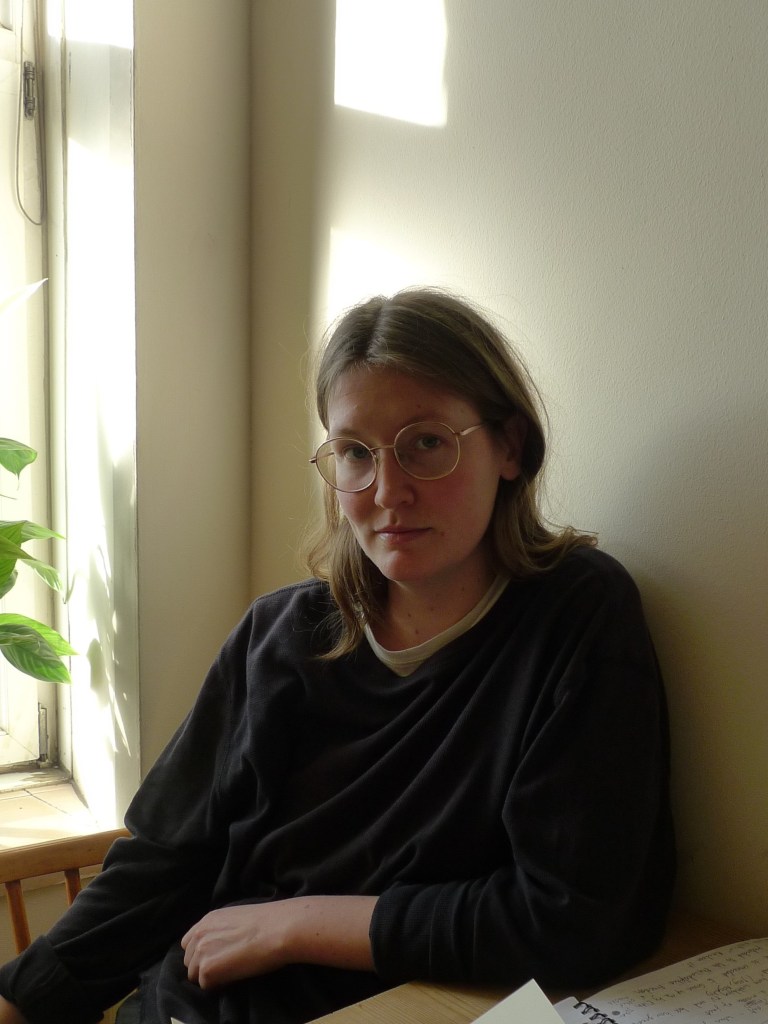
Ramona Herdman’s recent publications are Glut (Nine Arches Press), A warm and snouting thing (The Emma Press) and Bottle (HappenStance Press). Ramona lives in Norwich and is a committee member for Café Writers. She tweets @ramonaherdman
I have selected four poems from Glut, beautifully produced by Nine Arches Press, to give you a flavour of these darkly funny, bittersweet poems. I hope my choices also show their ‘quiet ferocity’ (Philip Gross). Below the poems you’ll find links to a blog about the cover (by Jacky Howson) and to a video with Ramona reading Blackberrying and Congratulations. Glorious is the word!
Blackberrying
Blooded young, we waded into the hooked shallows of hedges, caught up and cut in our toddler blundering, dirty with gritty juice and dotted-line scratches.
We without-ritual British, we atheists. Hippies’ children, grown up in the world they believe they changed – we have blackberrying as our sacrament.
At school, neater children wouldn’t eat the berries, said their mothers said no, said they had worms in that would eat our insides and poke out of our bumholes.
Now we go every year, like it’s Midnight Mass. We avoid the dog zone at the bottom of the bushes. Tell each other that by Michaelmas the Devil will have pissed them bitter.
We take offal-heavy carrier bags of berries to our parents, too old now for all that bother. We pick the children out of the tangled footings. We cook pies and crumbles in our own kitchens, competently. We placate the gods.
Cover design by Jacky Howson
Cuckoo and egg
It’s hard to soft-boil an egg in another woman’s kitchen – even the water is different.
It’s our first ‘family’ holiday together. She makes me a soft-boiled egg with a lot of fanfare and the whole breakfast-table gets involved in the hoo-hah.
And there’s a performance of trust in cracking it – the risk of a wet white, the opposite risk of a solid yolk. We’re on the edge
of an ovation when it turns out perfect. I eat it hot, like a heart.
It’s not me taking the minutes
It’s not me anymore escorting visitors from the front desk. I don’t fill the water jugs and make sure the glasses aren’t too dirty. I sometimes buy the biscuits, now there’s no budget. It’s not me too scared to ask a question or supply a fact, wondering if I’m allowed a view or am just a transcription machine.
A man once told me working with women had taught him not to interrupt. It’s a terrible world. I told him working with men had taught me to keep on talking, slightly louder. Try interrupting and you’ll get to see the flying-galleon belly of my argument as I lift off cathedral-high over you.
Don’t dare to talk over my people, including the young woman taking minutes, who is well on her way to wherever she wants, who could take your eye out with her wit. The meetings are my meetings now.
Two death in the afternoons, please
Dad, now you’re dead you scare me. Every time I think about stepping into traffic I think of you building your glass castle, cornershop-whisky-bottle by cornershop-whisky-bottle.
I had to do one of those questionnaires recently: How many times in the last month has your drinking stopped you doing things you needed or wanted to do? I put zero, Dad, proud nothing. They never ask
about the times the drink makes living possible. I think of your kitchen-drinking nights, how you told me you didn’t get hangovers anymore and I was too young to reply.
When I’m scared, Dad, I know a gluey-gold inch of brandy or one gin and tonic’s scouring effervescence will lift me to arm’s-length from caring, will calm me in a bubble of slight incapacity.
The old dread, Dad – I think now you carried it like a wolf in your stomach. The drink quiets it, but it doesn’t drown. I recently learned another cocktail by Hemingway –
‘Death in the afternoon’, champagne and absinthe. You’d find the name as funny as I do. He recommended three or five in slow succession. When I make them, I toast him. He’s family.
Dad, you’re nothing now. It’s only the thought of your life that scares me. But if there were an afterlife I’d meet you there, happy hour. It’d be dimlit and we’d sit low in a booth and they’d keep
bringing the drinks in fine heavy glasses and no one would interrupt to say this wasn’t actually heaven, this delicious blunting of feeling, this merciful cessation, and that there was something outside that was better –
like walking out on the seafront together, wind and water-roar and saying something risky and being understood.
Today I am with my brother and sister-on-law. It’s his birthday today, so I arrived yesterday to have the chance to catch up with them before friends and family arrive.
I’m the eldest, three years between us. I’ve been protective of him from the start.
For many years now, my brother has worn a metal brace on his leg. A few years ago he managed to get a second-hand ‘loopfiets’ – a walking bicycle. I’d never seen one before, but it’s small enough to go through a standard door so one can go into shops, and it’s light enough to put in a car.
Example of ‘walking’ bike
It was my father’s birthday on Sunday 2 September that year and my parents’ friends commented on how my brother limped, encouraged my mother to get it checked out. GP on Monday, neurologist on Tuesday. I can still see my parents’ car disappear round the corner on the Wednesday morning.
1962
Alexander Eduard (coppersmith in the bible and van Beinum, the famous conductor). Our Irish setter had been given the names of an unborn child.
A ward of six, our parents’ daily drive, forty minutes each way. Neurologist, paralysis, lumbar puncture, nausea.
Grandfather owned an electrical shop (double-fronted on the main street); gave my brother a beige-brown radio.
The specialist allowed our red Irish setter to visit my brother, celebrating his fourteenth birthday in the academic hospital in Leiden.
Three months later he arrived home, just in time for St. Nicolaas. My brother still limped and his crown was marked by two scars at right angles, the space between dipped and dented. A few days later grandfather came to take his radio back.
Sorting out boxes with books that moved with me from the UK, I found this small pamphlet. Manchester poets Steve Waling and Francesca Pridham edited poems by members of Manchester Poets. Copies were sold at the Didsbury Festival to raise funds.
Here Fran tells us about her connection with the Madagascar Development Funds and shares some wonderful proverbs – writing prompts for your poems, flash fiction, short stories.
Madagascar
“My first contact with Madagascar came in 2013, when my husband, interested primarily in the country’s unique wildlife, persuaded me to take part in a trekking holiday there. The scenery is awe inspiring. A melting pot situated between Asia, Africa and Australia, Madagascar is the mysterious land of the ancient baobab tree, a land where pachypodiums thrive, the cat-like fossa hunts and lemurs swing from tree to tree. The most revered lemur, the Indri’s strange call wails through the rainforests, echoing the ancient isolation of the island.
The people
Despite this beauty, what however most caught my heart were the people. There is little infrastructure in the country and most villages consist of a small collection of adobe houses made from the spectacular red mud that Madagascar is famous for. The people have nothing, just the land they live on and any livestock, such as chickens or the zebu cattle that represent their wealth. Their generosity and welcome though is infectious. I gave a biscuit to a small child, four others appeared instantly, and the biscuit was shared immediately.
Credit: Puabar via Pixabay
Water
Their water supplies are often limited to streams that trickle into small muddy ponds, polluted sometimes by cattle who too have to use the water. Standing by the side of a small dirt track nearing the end of my trekking holiday I drank thirstily from a litre bottle of water I’d brought with me. Staggering down the track was an old man with his grandson, pulling and pushing at a makeshift trolley, carrying four battered plastic water containers. They had walked five miles to the nearest water supplies and were coming back to the village.
Credit: via Pixabay
The Madagascar Development Fund
When I returned to England, I started raising money to develop water supplies and build wells in Madagascar. We are lucky enough to work with The Madagascar Development Fund, a small charity run by the ex British Ambassador to Madagascar and have provided enough money now for four wells. The charity specialises in small projects which because of the charity’s experience are achievable and can bypass the complicated political situation in the country.
We have been lucky enough to attend the opening of one of the wells where we were welcomed into the village by singing, dancing, and drumming. We were given a welcome feast and a poem, written specially for the event was read by a young man, resplendent in what looked like a doctor’s white coat!
Malagasy Proverbs
The Madagascan culture is infectious! Their proverbs or ohabolana capture the learning and wisdom of centuries, inspiring both thought and writing! Enjoy the poems they produce!”
Truth is like sugar cane: even if you chew it for a long time it is still sweet. Words are like eggs; when they are hatched they have wings. Like the chameleon keep one eye on the future and one eye on the past. Let your love be like the misty rains coming softly but flooding the river. Those who know how to swim are the ones who sink. Don’t be like a shadow: a constant companion, but not a comrade. An egg does not fight a rock. Only thin dogs become wild. A canoe does not know who is king: when it turns over everybody gets wet.
We’re staying with the Writing Poetry paperback that Matthew Sweeney and John Hartley Williams wrote together for the Teach Yourself series.
In Chapter 12 they’re looking at first lines of contemporary poems, and the need to hook the reader:
Someday I will go to Aarhus Hitler entered Paris the way The strangest thing I ever stole? A snowman. Brethren, I know that many of you have come here today We gotta make a film of this, Jack. After she left he bought another cactus.
All these lines are intriguing, but they work in different ways. The first is a vow, then we have the first half of a comparison that the reader needs to complete. The third is a question with its own answer, followed by a resolve in dialogue. Number 6 is a story that begins in the middle.
Here are first lines from some of the poems in my pamphlet A Stolen Hour (Grey Hen Press, 2020):
For just one minute of the day If we were strangers, His binoculars rest on the windowsill. The week before I’d given my pleated dress away. Bedrooms are for hiding white. One hour was stolen from the time I am the last stonemason. Date of refusal decision: 13 September 2017
What do you think? Which is the one that intrigues you most and why? Feel free to use them for your freewrite, your ink waster. If you get a poem or flash fiction from a line, I’d be pleased to know!
Earlier this week I looked at my website statistics. The blog post that has got the most views (after the Home page and the Archives) is Fishbones Dreaming from August 2019. Every other day someone views the post. Here is the link.
The children’s poem Fishbones Dreaming is by Matthew Sweeney. It is four years since he died on the 5th of August 2018, aged only 65. The poem uses a gradual flashback technique and a refrain.
Prompt
Here is a prompt that Matthew gave on the course he ran at the wonderful Almassera Vella, Spain in 2006.
We were just to sit quietly, clearing the head from clutter and then to slowly run through the letters of the alphabet until one letter gave some energy, sound or resistance.
I was sitting on the loggia, looking out over the terraced fields and the small white chapel in the distance. Once we got the letter, we were to run through some nouns until one noun spoke….potato, parsley, parchment. Pliers came from that prompt, and it was my first blog post.
Credit: Fabio Ribeiro on Pixabay
Pliers
A museum dedicated to pliers opened last month in the old part of town. Pliers, collected from the five continents, are displayed in rows on walls and glass cases. Most are made from metal, shiny or a rusty red. The curator, a small Belgian, Jan de Smets, exiled from the Congo thirty years before, found the earliest exhibits on expeditions to empty houses, garages, sheds and shacks. Pliers have also been donated by retired plumbers, old builders and master carpenters. Six toy pliers are on permanent loan. Where pliers are missing from a boxed set the white outline of their shape remains.
One of the poems in this week’s inbox came courtesy of The Paris Review: Identity Check by Hans Magnus Enzensberger. The title is intriguing enough, the first line is a bold claim and a denial:
This is not Dante
This immediately sets up tension and hooks the reader’s curiosity. If not Dante, who is it? We get an answer we know can’t be true: This is a photograph of Dante. Then: This is a film showing an actor who pretends to be Dante.
The poem continues like this. It reminded me of a poem of mine published in orbis magazine which uses similar techniques. If I feel really ‘stale’, then using two prompts of a different kind is guaranteed to work.
In 2017 I went to Tate Modern for the exhibition of Robert Rauschenberg – very stimulating. It included his telegram This is a painting of Iris Clert if I say so. A visit with a poet friend to Manchester Art Gallery then started the poem. The painting described is Portrait of Lucian Freud by Francis Bacon. Here is the link.
Franz Kafka
This is a portrait if I say so
A portrait of Kafka, in a long coat; dark grey, almost black. No, it’s not. It’s just paint on canvas. This is a portrait of the man who was a friend of the man who put the paint on the canvas. Paint is history. Painting is looking for something, then losing it again. This is a portrait of a man, based on a photo of Kafka. My friend Kathleen asked Was Kafka’s face that long? The man in the long coat in the portrait is striding out. No, he’s not. The note to the right of the portrait says the man who is not Kafka is leaning against the pillar, but the pillar isn’t straight. This is a portrait of a man who isn’t famous, based on a photo of Kafka, and Kafka became famous, and the man who put the paint on the canvas became famous. Kafka is dead. The painter is dead, but this portrait is living, dead paint is living. This is the living portrait of a man who had friends. The man in a coat the colour of death. All colours become history. A coat; a face; a pillar. A portrait is, he says so.
I was sad to learn of the recent death of the artist Paula Rego. Last century I saw her work at the Whitworth Museum in Manchester, UK. That’s when I bought Nursery Rhymes. In March this year I went to the first major retrospective exhibition of her work in The Netherlands – at the Kunstmuseum here in The Hague. The museum shop had copies of Power Games.
I admire her as a person and an artist. As she told it ‘art was a way to work through fear and trauma, to soothe and comfort, as well as to erase, attack, scratch out and destroy.’
Whitworth Museum, extension
After a major refurbishment the Whitworth reopened in 2015. I would have liked very much to meet Paula Rego and talk with her about life and art. This imaginary meeting is set in the new café. The poem was published in my pamphlet A Stolen Hour (Grey Hen Press, 2020).
Meeting Paula Rego at the Whitworth, Manchester
Shading her eyes with a small black fan she looks distressed and even out of place. Ash trees cast a greenish shadow on her face. To me she seems older now, frailer than in the short winter days of that other year when the quiet ghost of a drowned baby played with black hen, spiders, women who prayed for open roads, escape, a private den.
There was a boating lake once in the park. We wait for panini, service is slow. Café in the trees, I say, canopy. Her earrings sparkle, her eyes are still dark. It’s from the Greek; “konops” means mosquito. Paula’s face lights up; her imagination set free.
1 I discovered Pome only a couple of months ago and am enjoying the poems very much: an interesting range and they are short, even very short. As I understand it, Matthew (Matt) Ogle originally posted the poems some years ago and the project has restarted via Tiny Letter.
Here is an Issa haiku, translated by Robert Hass. Since I am a paid-up member of the Society for the Prevention of Cruelty to House Dust, it speaks to me …
Don’t worry, spiders, I keep house casually
2 Monostich – a poem or epigram of one single line. The title is important and may be long, longer even than the poem. My recent example from a course I’m doing:
While it rained, we went out and put the poster on trees and lamp posts in theneighbourhood
It needs heart and courage (lebh in Hebrew) to wear a pochet with conviction.
3 Here is a short poem by Carl Tomlinson from his Changing Places. It has a haiku-like quality. Carl is the May guest poet. I look forward to sharing more of his poems with you then.
August
All along the bridleway some kind of rain is trying to shake off the wind. The land feels thinned.