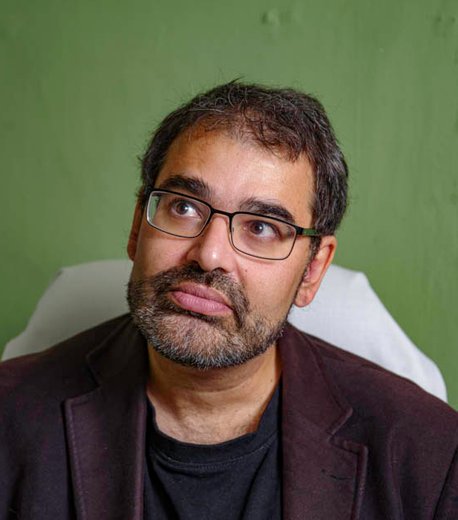
I’m very pleased to introduce this month’s guest poet Tom Sastry. His collection was published to its usual high standards by Nine Arches Press in 2025. The striking cover ‘Half Full’ is by Tom Denbigh, 2025. It’s a contemporary woodcut of the 1607 Bristol Channel Flood image.
Tom Sastry has published one pamphlet and three collections. Carol Ann Duffy said he “makes friendships and love affairs new and strange” and Hera Lindsay Bird call him “a magician of deadpan”. His poems have appeared in The Guardian and Poetry Review. His latest book is Life Expectancy Begins to Fall is described by Jonathan Edwards as “the most important – and certainly the most entertaining – book about the end of the world I’ve yet found”. Tom himself describes it as the perfect birthday present for someone with a sense of humour about their mortality.
The title poem – a sequence of six titled poems, each consisting of six couplets – is at the core of the book. It is linked to the Covid-19 pandemic and government decisions.
The collection is also a short master class on making titles work:
- How to tell the apocalypse is happening when you get all your news from Instagram
- Navigating the Peri-Apocalypse with Radical Self-Care
- The preserved body of a billionaire slowly defrosts in a devastated world
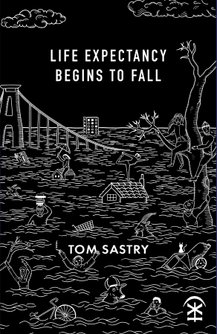
These are strong poems in a variety of form, length and layout. In among the titled poems are untitled poems of six lines in italics. They create a change of tone and voice. The white space gives the reader a chance to catch their breath. Here is an example:
Everyone loves the end of the world
We all hope to enjoy the apocalypse
from a distance. A good storm
spares the roof but rattles the glass.
Children know: destruction is funny, sometimes beautiful.
A distant inferno would enchant your night
if you saw it from the next coast.
So much torment is shut away, you might even be comforted
by a Hell with space for your friends.
We build great telescopes to watch stars die
send divers to explore drowned cities, give prizes
for pictures of flaming sinkholes
or bones bleaching by a dry lake.
An old man reads of a decade he won’t see
lethal heat, scarcity of food.
It aches softly, like a sunset.
A new desert at the edge of town, some murders on the news.
If the world is broken, let it be final:
a vengeful or careless god
snapping continents like biscuits.
What I fear is a Next Day.
The sweeping up and the reckoning.
The sobriety. The resumption.
As I was preparing this post, Tom wrote to me: ‘You can be pessimistic about the drift of world-historical events and still hopeful about human nature and human connection. You can be hopeful about what might happen next week or about the reception of your friend’s new book. There’s no link between optimism and virtue or between pessimism and cynicism. So that’s really the moral centre of the book – the belief that an age of pessimism doesn’t condemn us to live mean lives. We can live well as pessimists.’
Three more poems from this collection described as ‘part-elegy and part-satire’.
Nothing to do but play cards
If it’s too late to start cathedrals
or trust in a forty-year pension plan
too soon
to snatch the thing to hand
in the name of survival
if we’re too honest
for self-sufficiency
or heroism
and our giddy hours don’t come
if the deed
in our small reach
has no resounding name
let’s call it with our silence
let’s shuffle it again.
Hope buys an absurdly expensive woodland burial plot
She is excited to be rendered
by fungi into tree-food. I feel a sharp
sadness when she says it. I check
it was not an urgent purchase
then ask questions. I learn
the particulars of the site and the price
smile at her joyous cycle of life
and secretly, inwardly
devour it with my scorn.
Life is a guzzling machine
forever eating itself.
Hope – your people need you.
Don’t give up on us.
An increasing incidence of extreme weather events
We watched the charts all week
as the old hurricane’s great lash
curled back across the ocean, not weakening
until we saw Bristol in its path.
The police told us to leave
for the nowhere we had to go
in the nothing we had to get there.
They would take the gloves off for looters.
Abandoned people are always crazy
like a fool who squares up to a storm.
Crazy like us, on the roofs of Easton
waving at the news helicopter
as the studio repeats the warnings
we were apparently ignoring
when we walked onto the M32
in a world already shaking and tearing
for a woman desperate to pass her child
into the mystery of a stranger’s car
which was crammed to the corners
with the old necessities of home.