If you repeat the word ‘wind’ often enough it will start blowing. (Theo Jansen)
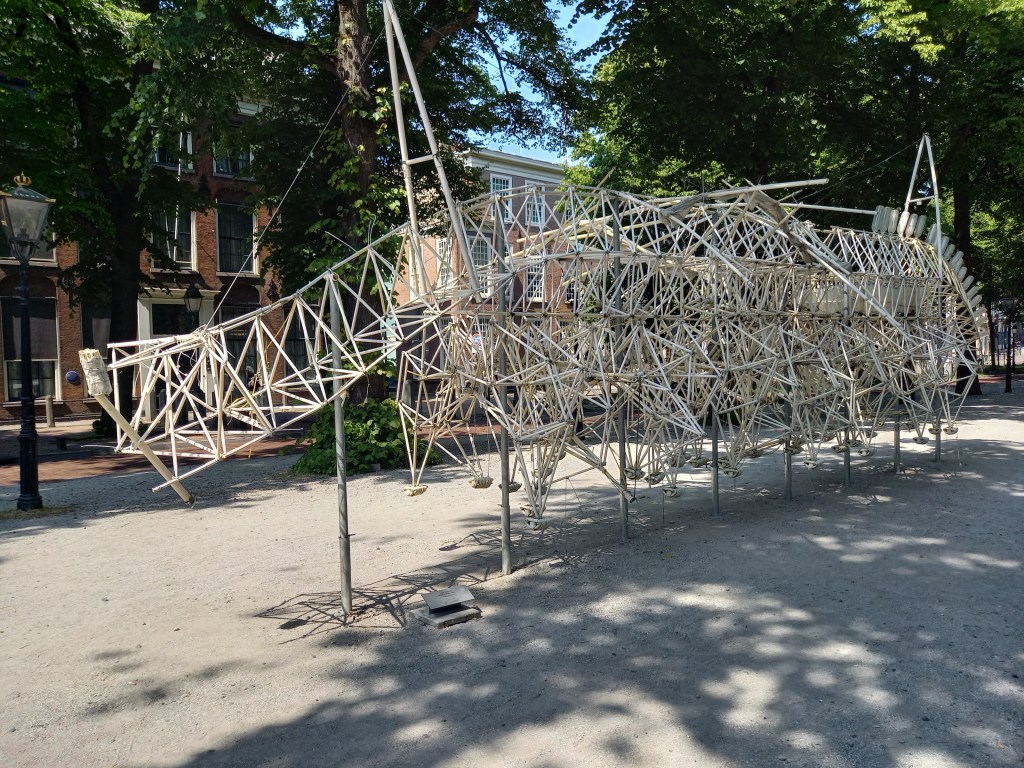
I took this photo three years ago when one of the Strandbeesten was on display at Lange Voorhout, one of the oldest streets in the Hague. You can see the linden trees (Tilia) which were planted in the early 16th century.
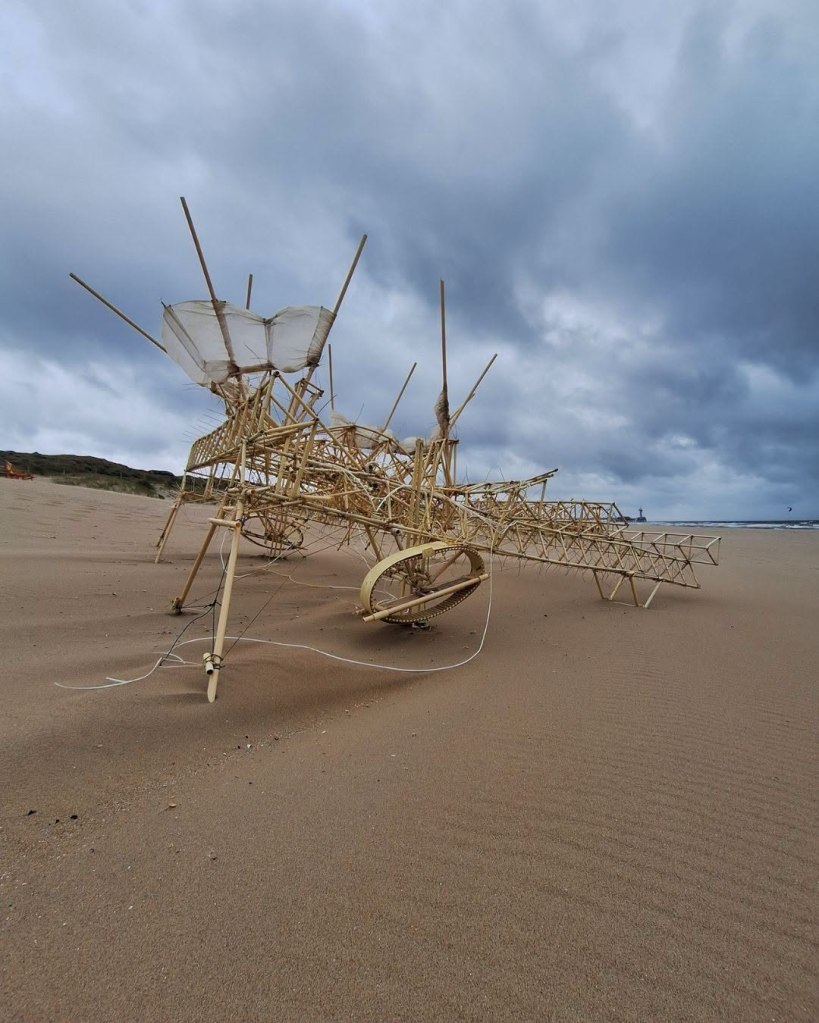
On his website, Theo Jansen explains how the Strandbeesten came to be. In short videos he describes the development of the neural system, leg system and waterfeeler system – essential for survival on the beach.
The main component is cheap yellow PVC tubing (around 2,000 to 3,000 metres per animal) with tie clips and empty PET bottles. An animal weighs around 180 kg. Jansen would prefer to use bamboo (more ecological) but this would not survive on the beach.
A diagram shows the evolution and family tree since the ‘Pregluton’ phase of 1989. In the winter Jansen works on developing the next generation which is tested on the beach the following summer. That species of Strandbeest is then declared extinct.
Source: This is The Hague 2026
People pay to be on Scheveningen beach (north of the pier) when Jansen tests the new animal, and the 2026 sessions filled quickly. Here are some videos instead:
The New York Times has just recommended The Hague as a ‘cool’ destination. A contrast with Barcelona and Paris where it’s 40 Celsius. The article praises the ‘cobbled streets’ and ‘picturesque canals’. You can view Girl with a Pearl Earring in the morning, and sip sangria on Scheveningen Beach in the afternoon.
Well, it won’t be cool here: temperatures up to 36 degree Celsius are forecast from today. The Hague is a great travel destination: several outstanding museums of which the Mauritshuis is one. That girl is, however, leaving this Friday. She’s destined for Japan where she’ll be on display in the Nakanoshima Museum in Osaka (21 August – 27 September).
As it may be hot on the beach, let’s head to Voorlinden Museum instead.
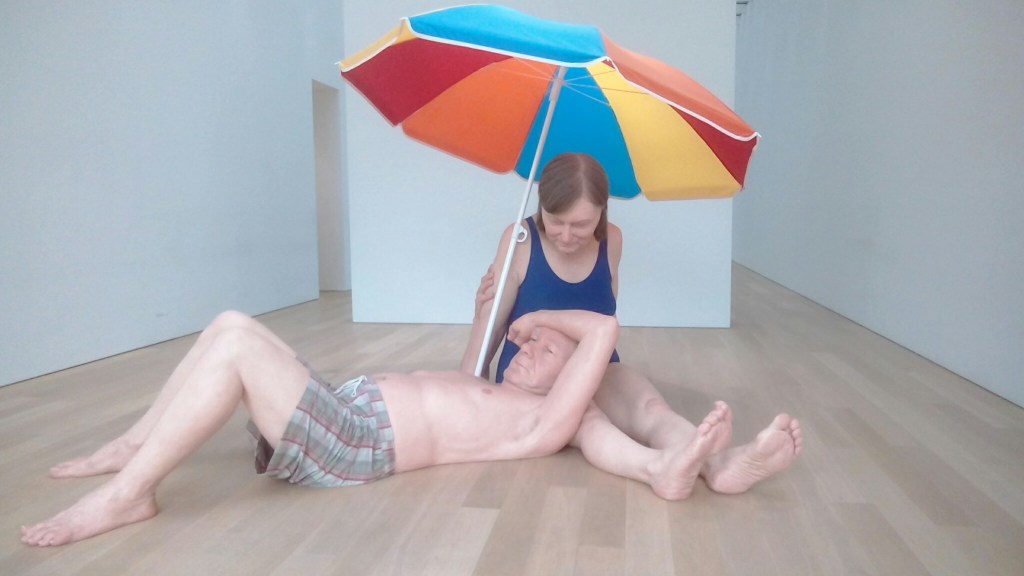
Couple under an Umbrella, own photo
Ron Mueck made the work of fibreglass and silicone in 2013. It’s hyper realistic – the veins and hairs are there. The work is exactly twice human dimension. Mueck has also made smaller works. The couple do not represent specific individuals, but they are universal and recognisable.
They don’t have to walk far to take a splash: the famous Swimming Pool installation by Leandro Erlich is just metres away. Originally made for the Venice Biennale of 1999, the installation was then moved to the 21st Century Museum of Contemporary Art, Kanazawa, Japan.
Voorlinden opened 10 years ago and the installation there has the same swimming pool blue, lights and steps. The shimmering water is an illusion. There is 10 cm of water above transparent glass. Visitors can enter the installation by going down steps.
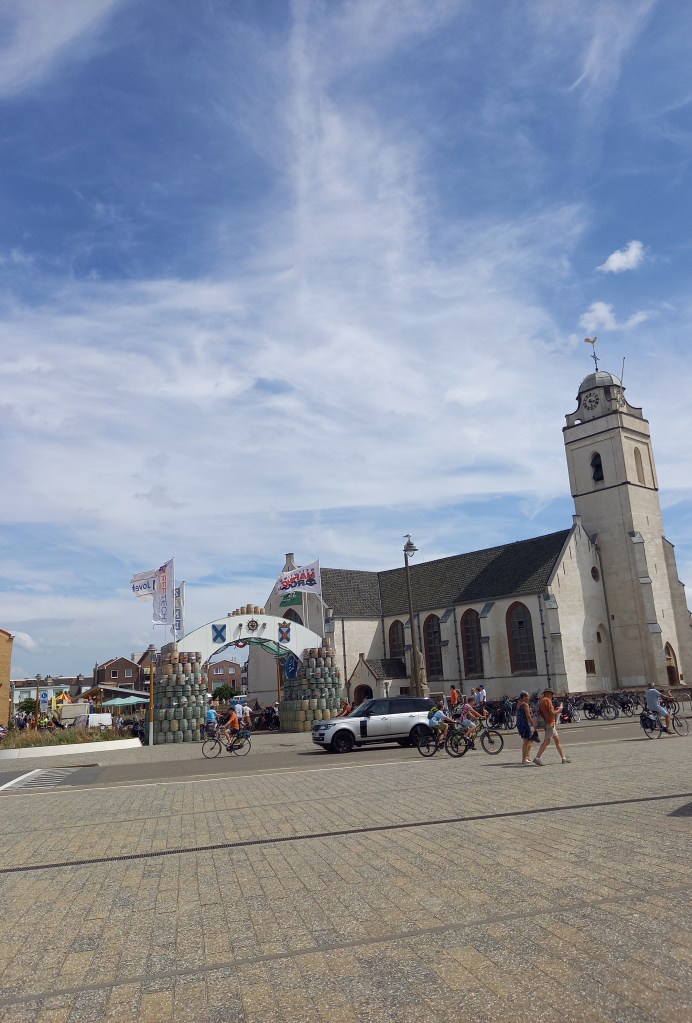
Only half an hour’s drive away is Katwijk aan Zee, a traditional town with a small fishing port. During the summer vacation, the weekly Tuesday market is extended: crafts people showing and selling their goods, music, or a display of vintage cars.
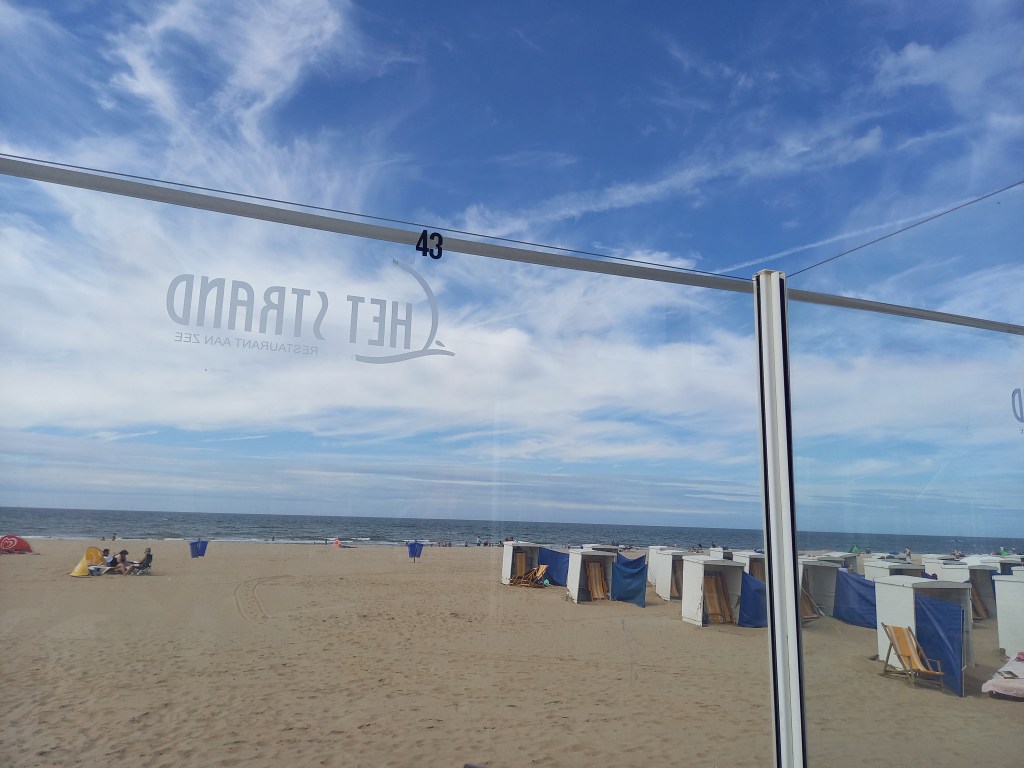
The council spent money on a large car park hidden below the dunes. Coffee, a walk round the market, lunch on the beach. This year my friend and I chose the Trio of the Sea – smoked salmon, Dutch shrimps and a delicious taco with tuna and wasabi. We favour Het Strand, with glass panels between tables for privacy.
Today, the heat is back. So, I’m posting a cooling prompt from earlier this year. Write on from Everything was frozen…
Everything is frozen
The welcomes clatter to the ground. Those sandwiches, salmon and cucumber; the cheese scones; even the tiered metal tray on the once-wooden table. Mary, the absentee landlady, gasps. Two small vowels fall on the carpet. Everything so white, so silvery, so creaking on the change.
Tom strokes his beard, that has been soft as a lamb, cuts his finger and now the miracle of the red blood turning to icy droplets. If there had been a cat, it would have chased them around the room. This is always a sadness – a poem or story without a cat.
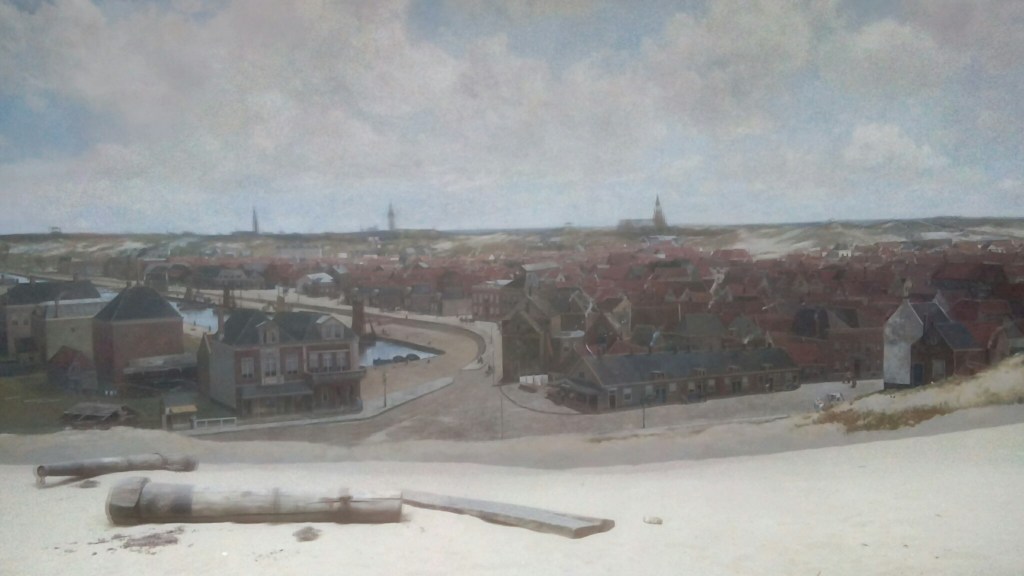
Panorama Mesdag, Scheveningen village with The Hague in background. Credit: T Duijndam.
Recently two friends were over from the UK – a Seville reunion. They stayed at Scheveningen, minutes from the beach and boulevard. It was mostly sunny. I pointed out some sights: the red lighthouse, the building with the green shutters, and Seinpostduin – the high dune on which the painter Hendrik Mesdag sat in 1880 to make the preliminary sketches for the commission he’d received for a 360-degree painting.
At one time there were many panoramas. They were expensive to maintain and once photography and film were available, people’s interest declined and most were demolished.
Panorama Mesdag, The Hague (1881) is the world’s oldest surviving panorama in its original location. The painting is over 14m high, has a diameter of 40m and the circumference is 120m2. That makes it the largest painting in the Netherlands.
Scheveningen was then an independent fishing village with its own clothing and dialect. There were about 500 houses and people lived from herring fishing.
When he got the commission, Mesdag was already well-known for his seascapes. Several of these are shown at the Panorama. He wanted the sky to look as though it was the weather on one single day. He made many sketches, also of the houses which were transferred to canvas using a grid. The original glass cylinder in which he sat is shown at Panorama Mesdag.
The Panorama commission was a massive job and Mesdag was fortunate to be able to put a team together: his wife Sientje Mesdag-van Houten who was an established painter in her own right, Théophile de Bock who painted the sky and dunes with broad brush strokes, Bernard Blommers, and George Hendrik Breitner who specialised in painting horses. Mesdag himself focused on the sea and the flat-bottomed boats on the beach.
It took them four months to complete the work. Instead of a signature, Mesdag painted Sientje. She sits on the beach painting under a white parasol. Panorama Mesdag opened on 1 August 1881.
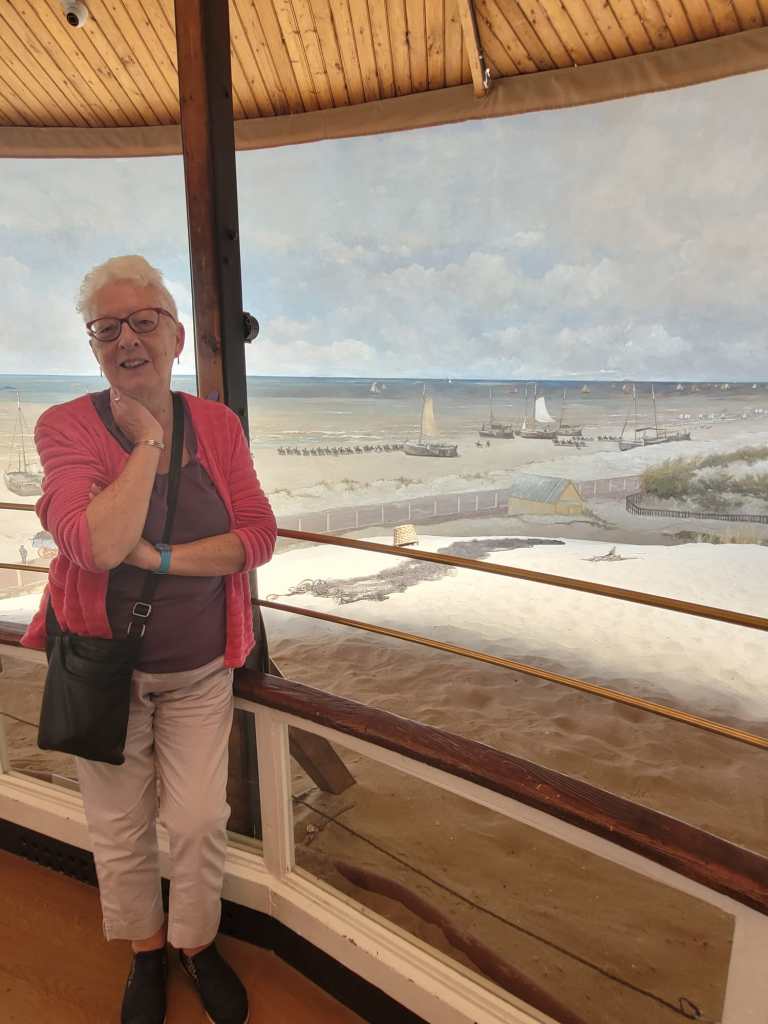
It’s an astonishing experience – come up the wooden staircase and suddenly you stand on the viewing platform: scenery all around you. There is so much rich detail: dozens of boats, horses pulling in the boats, cavalry horses, the sky, the women out with their washing, bathers, the steam train on its way from The Hague, birds.
Because of the glass roof, the weather changes as you are there, and the illusion is complete because the platform is surrounded by real sand with objects on it. You are standing on Seinpostduin, more than 140 years ago.
My thanks to David Cooke, Editor of The High Window, where this poem first appeared.
Panorama Mesdag
Invisible skylights let through the light. Just as I arrive upstairs, the sun comes out across the busy beach I know so well.
All those horses. In two neat columns, the cavalry on exercise, heading south. Other horses pull the flat-bottomed boats onto the sand. Fish is being sold straight from the boats. Women are repairing nets.
Mesdag’s wife has been included. I know where to look for Sientje, painting in a folding chair, striped sunshade.
Am I hallucinating the sound of gulls? I see the seams in the canvas, and I don’t care. As I go round the wooden platform, here is the washing laid out on the grass, a plume of smoke, the empty clog.
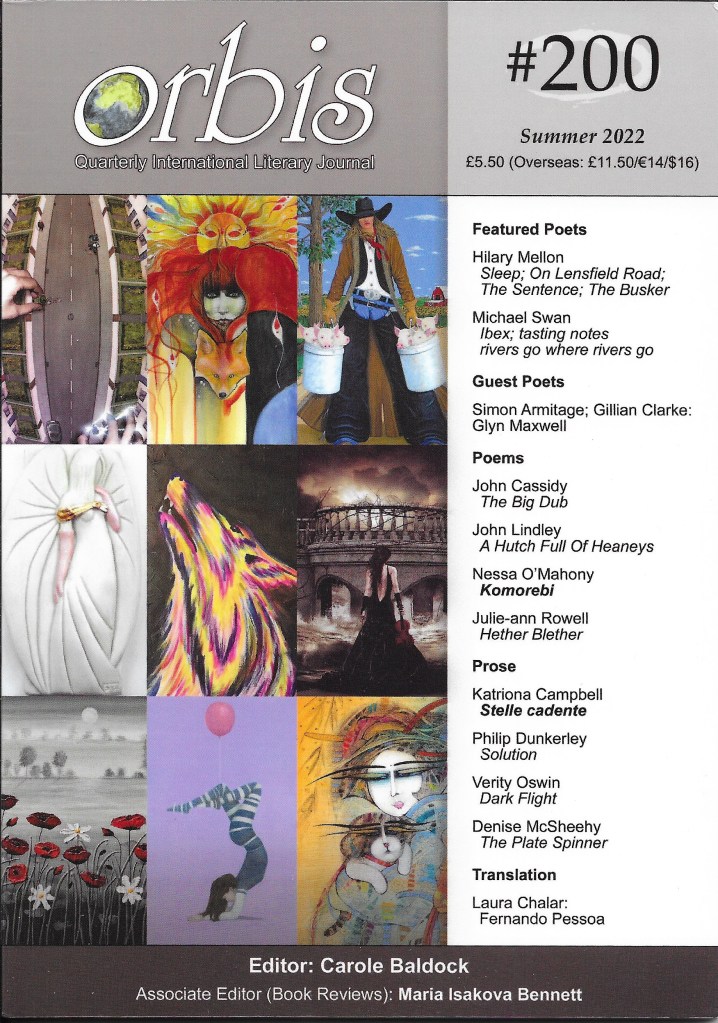
Congratulations to Orbis Quarterly International Literary Journal and Editor Carole Baldock. The 200th issue has just arrived. It is a bumper bundle and I look forward to getting stuck in.
Orbis is not just a poetry magazine, it is an international community of poets: each issue carries Lines on lines – brief communications from readers and I particularly like the Readers’ Award. Each issue readers can nominate up to four contributors whose work most appeals. A sum of money goes to the poem(s) that get the most votes and a similar amount is split between the runners-up. I find that I read each poem or prose piece with more attention – to have a rationale for my choices and votes.
I appreciate that my work has been featured in orbis three times. Below are two poems which featured most recently.
Credit: Steven Hill via Pixabay
The fire in Sydney
We’ve been out in the harbour to get our Lifeboat Certificate. The only woman, too feeble to row, I had to steer the lifeboat alongside SS Oronsay. First time I didn’t manage to line it up. Passengers lean over the railings, watch us circle for a second attempt.
A fire on board has cut the electricity. Our lifeboat cannot be winched back up. The small, wizened Australian examiner stares straight ahead. A passing ferry hoots. From the galley portholes drifts the smell of freshly baked bread. The ferry hoots again. We dare not wave. We don’t know yet if we’ve passed.
The last dogs
are running along the flood line. Visitors are leaving for home, vacating the boarding houses; hotels. A few people sit outside their huts: Parnassia, Shangri-La, Paradise; grand names for a row of painted wooden boxes which will be taken apart, then taken away at the end of the season. The last dogs of the day are running along the flood line. Gulls are scattering. It’s still warm. Somebody is singing a Beatles song.
Credit Skitterphoto on Pixabay – Scheveningen Pier
Greetings on World Poetry Day! At the 30th General Conference of UNESCO in Paris, 1999, it was decided to mark 21 March as an annual celebration. Poetry has “the unique ability to capture the creative spirit of the human mind”.
I’ve chosen a poem with international connections, a lot of people, fruit – a festive gathering on a Dutch beach. It’s from my collection Nothing serious, nothing dangerous.
On the beach after My boat by Raymond Carver
Bill’s last words were always Have fun, so I will. He was a very good father, Bill, though he wasn’t my father. Liz will be there too. And Mary and Brian, the Como couple. Seville will be there, all the places I ever fell in love with. We’ll be on a beach, a wide sandy beach with small white shells, large white gulls and far off, in the distance, the red container ships, nothing dangerous, nothing serious.
At the flood line broken razor clams crackle under our feet. There is Dick, almost 80, and Miep, their cycles parked up against the metal wire by the marram grass dotted on the dunes. Esther, Peter, Theo, Ancilla on their e-bikes, they love this beach. Skewered fruit, Water Melon Men and the three Irish men I loved, and the others, the artist with one eye has come back from Hungary. Boats will be there, beached. We’re all beached. My UK friends have come by ship, a ship with starched officers, a ship from Southwold that I specially chartered.
I invited J S Bach, Schubert and anyone else whose names I am forgetting. I have been given dispensation – hey, that sounds medical, nothing dangerous, nothing serious, the friends who are no longer friends, what’s rejection, abandonment among true friends. Apples, oranges, enough grapes to count in the new year, fresh figs, plums, peaches, kiwi fruit for sleep, passion fruit. With all that fruit we are fit to count our blessings, our nine lives. Have fun. The tide’s out, and it is a long time before it’s coming back in.
Earlier this week I celebrated my birthday. Up to 10 visitors are now allowed onto the camp site for parties and birthdays. However, I decided to celebrate over a 10-day period: some days the weather has been autumnal – cold, wet and windy. Inside the caravan I wouldn’t have been able to guarantee the 1m social distance. Besides, after months of social isolation, lockdown, shielding, I was desperate for proper contact and conversation with family and close friends. It was a marvellous extended week!
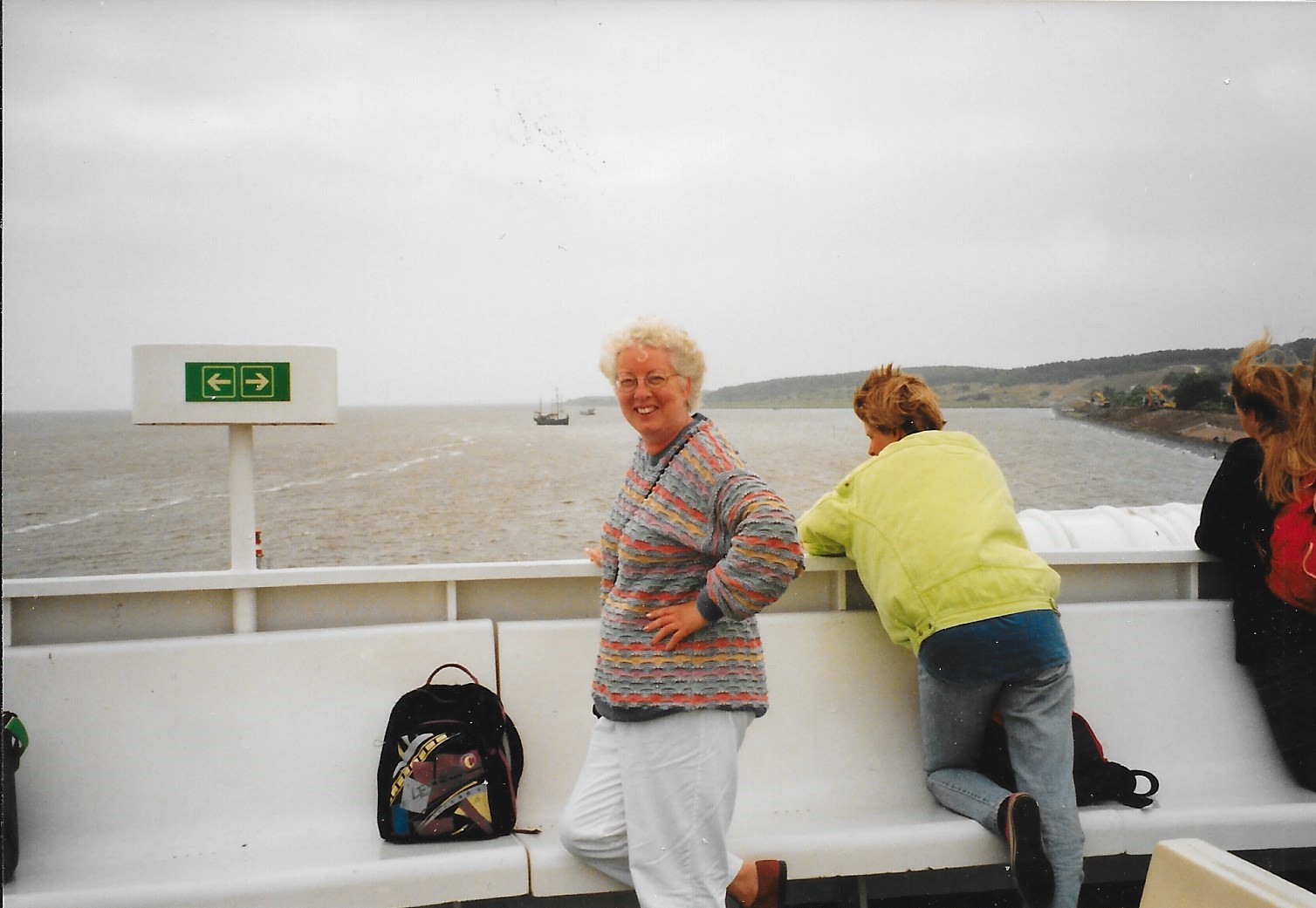
I vividly remember another birthday. With a close friend I had an overnight stay on Vlieland, one of the Frisian Islands in the Wadden Sea. We travelled by ferry from Harlingen (a peaceful 90-minute journey), stayed overnight in Hotel De Wadden that once was the island’s marine college, rented bikes, ate fish and chips, bought cranberries which grow there. We were blessed with the weather: sunny and a breeze.
A major storm in 1296 separated Vlieland from the mainland. It’s hard to imagine how important the island once was: in the 17th century hundreds of trading and whaling ships would have been afloat nearby. The tides and winds have shifted and changed the shape of the island. Now, it is only about 12 kms long and 2 kms wide at best and, mostly dependent on tourism. Visitors are not allowed to bring a car across – bring your own bike or rent one!
Vlieland
Empty days
cycling on white paths
crushed shells
bless the lighthouse
on this island
Full nights
dreams of fishes
frogs, berries, seals
the white ferry
resting
Birthday
blessed July
sky, salt breeze
You look younger
on this island