Tag Archives: painting

Panorama Mesdag – favourite museum

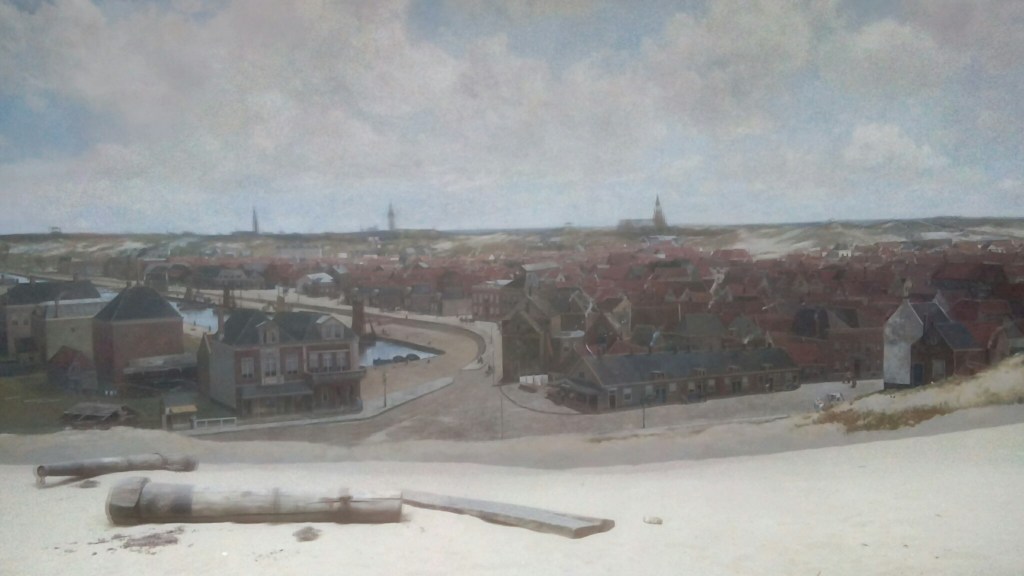
Panorama Mesdag, Scheveningen village with The Hague in background. Credit: T Duijndam.

Recently two friends were over from the UK – a Seville reunion. They stayed at Scheveningen, minutes from the beach and boulevard. It was mostly sunny. I pointed out some sights: the red lighthouse, the building with the green shutters, and Seinpostduin – the high dune on which the painter Hendrik Mesdag sat in 1880 to make the preliminary sketches for the commission he’d received for a 360-degree painting.

At one time there were many panoramas. They were expensive to maintain and once photography and film were available, people’s interest declined and most were demolished.

Panorama Mesdag, The Hague (1881) is the world’s oldest surviving panorama in its original location. The painting is over 14m high, has a diameter of 40m and the circumference is 120m2. That makes it the largest painting in the Netherlands.

Scheveningen was then an independent fishing village with its own clothing and dialect. There were about 500 houses and people lived from herring fishing.

When he got the commission, Mesdag was already well-known for his seascapes. Several of these are shown at the Panorama. He wanted the sky to look as though it was the weather on one single day. He made many sketches, also of the houses which were transferred to canvas using a grid. The original glass cylinder in which he sat is shown at Panorama Mesdag.

The Panorama commission was a massive job and Mesdag was fortunate to be able to put a team together: his wife Sientje Mesdag-van Houten who was an established painter in her own right, Théophile de Bock who painted the sky and dunes with broad brush strokes, Bernard Blommers, and George Hendrik Breitner who specialised in painting horses. Mesdag himself focused on the sea and the flat-bottomed boats on the beach.

It took them four months to complete the work. Instead of a signature, Mesdag painted Sientje. She sits on the beach painting under a white parasol. Panorama Mesdag opened on 1 August 1881.

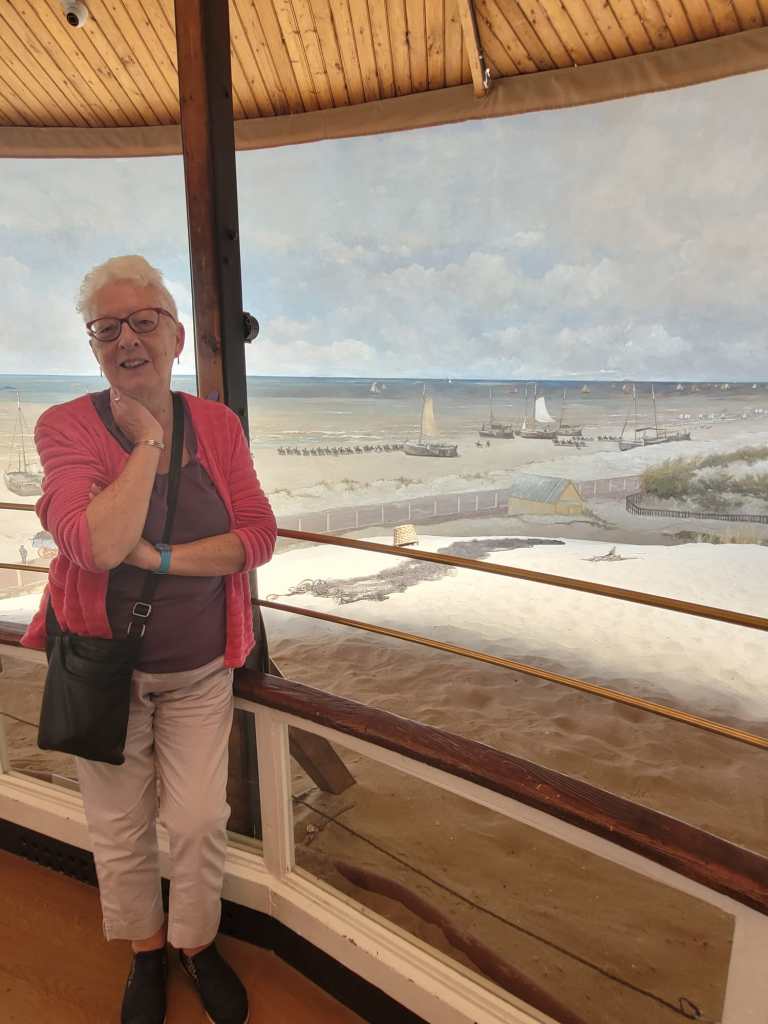
It’s an astonishing experience – come up the wooden staircase and suddenly you stand on the viewing platform: scenery all around you. There is so much rich detail: dozens of boats, horses pulling in the boats, cavalry horses, the sky, the women out with their washing, bathers, the steam train on its way from The Hague, birds.

Because of the glass roof, the weather changes as you are there, and the illusion is complete because the platform is surrounded by real sand with objects on it. You are standing on Seinpostduin, more than 140 years ago.
My thanks to David Cooke, Editor of The High Window, where this poem first appeared.

Panorama Mesdag

Invisible skylights let through the light.
Just as I arrive upstairs, the sun comes out
across the busy beach I know so well.

All those horses. In two neat columns,
the cavalry on exercise, heading south.
Other horses pull the flat-bottomed boats
onto the sand. Fish is being sold straight
from the boats. Women are repairing nets.

Mesdag’s wife has been included.
I know where to look for Sientje, painting
in a folding chair, striped sunshade.

Am I hallucinating the sound of gulls?
I see the seams in the canvas, and I don’t care.
As I go round the wooden platform, here
is the washing laid out on the grass,
a plume of smoke, the empty clog.
Interior with a Table – competition success

My poem Interior with a Table has been awarded equal Fourth Prize in the 2026 Kent & Sussex 2026 Open Poetry Competition. I was delighted, especially as the competition was judged by Mimi Khalvati. She describes the poem as a ‘sensitive example of ekphrastic poetry’. You can read her Judge’s Report here.


The poem was inspired by the 2021 painting of the same title by Vanessa Bell. The date put me in mind of WWI which enters the frame.

You can read the poem here.


Congratulations to the other winners. Most of their poems are already on the website. Jonathan Edwards was awarded the First Prize. His lovely poem My Father Sits his Driving Test’ will appear shortly.

The Departure – on its way?

International Anthony Burgess Foundation, 3 March 2020

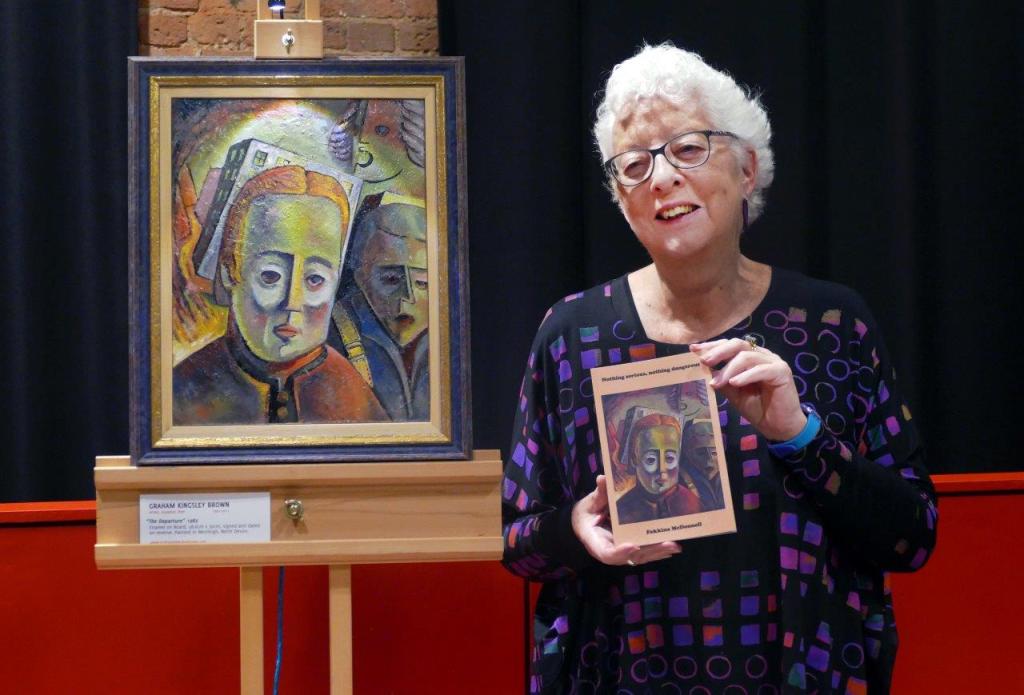
Friday 16 September is an exciting day: the catalogue of David Duggleby, Valuers & Auctioneers, includes 24 works by the artist Graham Kingsley Brown. He was the father of my friend Sophie Brown. She is my webmaster, designed the original website for my psychotherapy practice and, in 2016, this website.

Sophie is herself a Fine Arts graduate and practising artist. That is how I got talking to her about a suitable design for the cover of my second collection Nothing serious, nothing dangerous. It was wonderful to have the actual painting at the launch. Strange to think that a fortnight later I had my own departure – fled just before the UK lockdown to my bolthole in Holland.


The Departure is Lot 203, the estimate £400 – £600, and the approx. sale time is 13:54 – 14:14 UK time. The auction is at the venue in in Scarborough and live online, so – if you are drawn to any of the works, register and make a bid!

Details of all the works can be found here in the catalogue:

On her blog Sophie has previously written about her interpretation of The Departure – it may be inspired, partly, by his childhood experience of being evacuated during WW2.

This is not Dante – writing prompt

Dante, by Botticelli

One of the poems in this week’s inbox came courtesy of The Paris Review: Identity Check by Hans Magnus Enzensberger. The title is intriguing enough, the first line is a bold claim and a denial:


This is not Dante


This immediately sets up tension and hooks the reader’s curiosity. If not Dante, who is it? We get an answer we know can’t be true: This is a photograph of Dante. Then: This is a film showing an actor who pretends to be Dante.


The poem continues like this. It reminded me of a poem of mine published in orbis magazine which uses similar techniques. If I feel really ‘stale’, then using two prompts of a different kind is guaranteed to work.


In 2017 I went to Tate Modern for the exhibition of Robert Rauschenberg – very stimulating. It included his telegram This is a painting of Iris Clert if I say so. A visit with a poet friend to Manchester Art Gallery then started the poem. The painting described is Portrait of Lucian Freud by Francis Bacon. Here is the link.

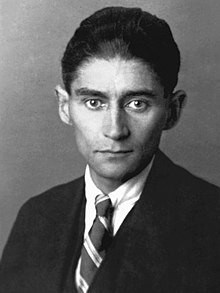
Franz Kafka

This is a portrait if I say so


A portrait of Kafka, in a long coat; dark grey, almost black. No, it’s not. It’s just paint on canvas. This is a portrait of the man who was a friend of the man who put the paint on the canvas. Paint is history. Painting is looking for something, then losing it again. This is a portrait of a man, based on a photo of Kafka. My friend Kathleen asked Was Kafka’s face that long? The man in the long coat in the portrait is striding out. No, he’s not. The note to the right of the portrait says the man who is not Kafka is leaning against the pillar, but the pillar isn’t straight. This is a portrait of a man who isn’t famous, based on a photo of Kafka, and Kafka became famous, and the man who put the paint on the canvas became famous. Kafka is dead. The painter is dead, but this portrait is living, dead paint is living. This is the living portrait of a man who had friends. The man in a coat the colour of death. All colours become history. A coat; a face; a pillar. A portrait is, he says so.

Blossoming and Abundance – poetry, writing prompt

Credit: Watercolour by Prawny on PIxabay

The 10th edition of Poëzieweek (Poetry Week) has just ended. Over 120 activities happened in The Netherlands and Vlaanderen (the Northern, Dutch-speaking part of Belgium). Some of these will continue during the year.


The theme this time was Nature. During any year there are a several ‘book’ weeks in The Netherlands and readers can claim a free book when they purchase up to a given amount. As poetry books are expensive here, the sum of Euro 12,50 was easily reached!

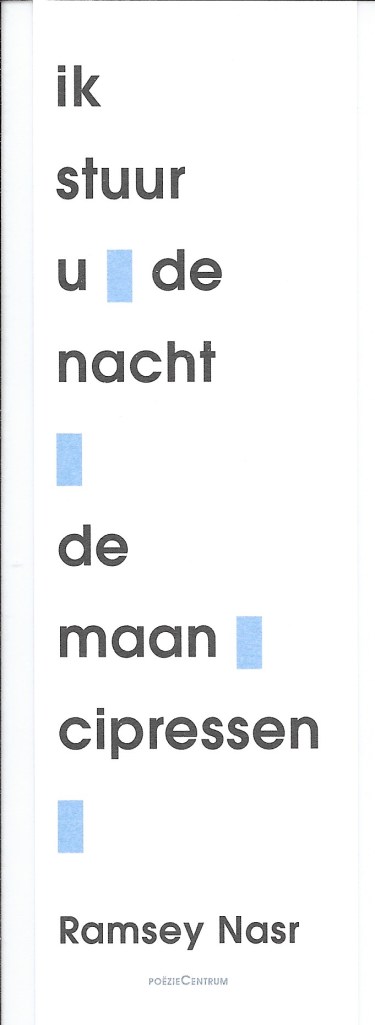
The Dutch-Palestinian author and actor Ramsey Nasr was commissioned to write the poetry gift this year. He is well-known, as he was the Dichter des Vaderlands (the unofficial title for poet laureate) during 2009 – 2012.


The pamphlet with 10 poems is well produced on quality paper. It’s based on the hundreds of letters Van Gogh wrote from his youth until his death in 1890. Under the motto Blossoming and Abundance, the poet has selected and re-arranged Van Gogh’s words. The two blue horizontal lines on the cover indicate caesuras. These return in the text as thin blue vertical lines, showing where Nasr has deleted a word or several phrases from the original text.


I love how Ramsey Nasr has distilled the essence of Van Gogh. It is a very interesting way of using found material. Here are my translations of a few parts of some of his poems.


(3)
let us | find a task
that forces us to quietly | sit
busy with work that is simpler
than | tasks that | are useful

(4)

i am no better than another |
am not like a street pump | from stone | or iron |

(6)

i send you | the night |
the moon | cypresses |

(5)

it cannot | remain like it is now |
burn rather than choke |
a door must be open or closed
something in-between i do not understand

(10)

the mediterranean has a colour like | mackerel |
you don’t know | if it is green or purple
you don’t know | if it is blue for a second later
the constantly changing reflection has
taken on a pink or grey tinge |

A cylinder full of the rushing sea …


Mesdag 4

Panorama Mesdag is a cylindrical painting, more than 14 metres high and 120 metres in circumference. It’s a view of the sea, the dunes and Scheveningen village as it was in 1881. It’s the oldest 19th century panorama in the world in its original site.

Ever since getting my caravan in Holland, I’ve been visiting several times a year. When I am standing on the circular viewing platform in the centre, I know I’m just 14 metres away from the canvas. I know it’s all an illusion, but I can hear sea gulls, I get the salty tang, I see clouds pass by and the sun break through.

Mesdag 3

Painting the enormous canvas was a team effort: Hendrik Willem Mesdag with his wife Sientje and various able painters from the Hague. Other panoramas portray violent scenes (the battle at Waterloo, the Crucifixion of Christ). Here it’s visible silence, still as the hourglass (Dante Gabriel Rossetti), the tranquility of everyday life. A few fishermen are messing about with their nets, the boats are beached, the cavalry are walking their horses on the sand, women are chatting in a doorway, a dog lies down quietly.

Before the camping closes and I lock up my caravan, I will go and stand on that viewing platform again and say my goodbyes to Panorama Mesdag. The poem is by my friend Keith Lander.


Mesdag trieneke

The Mesdag Panorama
after a panoramic painting by Mesdag in The Hague

I’m on a school trip to The Hague
transfixed by the Mesdag Panorama,
especially the seascape stretching away
from the viewpoint on the man-made sandhill,
with fishing boats moored on the vast beach,
a troop of cavalry men in training,
and, joy of joys, a donkey ride.

When no one is looking I climb
over the railings onto the sandhill
and, without looking back, skip away
laughing and tumbling down the slope
towards the beach, the north sea breeze
in my hair, to run behind the military
and have endless rides on the donkeys.

Forty years later, a bored business man
with time to spare before an appointment,
I visit the Panorama and remember
I’ve been there before as a schoolboy.
As I stare at the seascape again I see
the boats on the beach, the military men
and a lost boy waving from the donkey ride.