It’s an enormous pleasure introducing this month’s guest poet. We met a while ago when I attended one of Alexandra’s online courses. She’s an inspiring tutor.
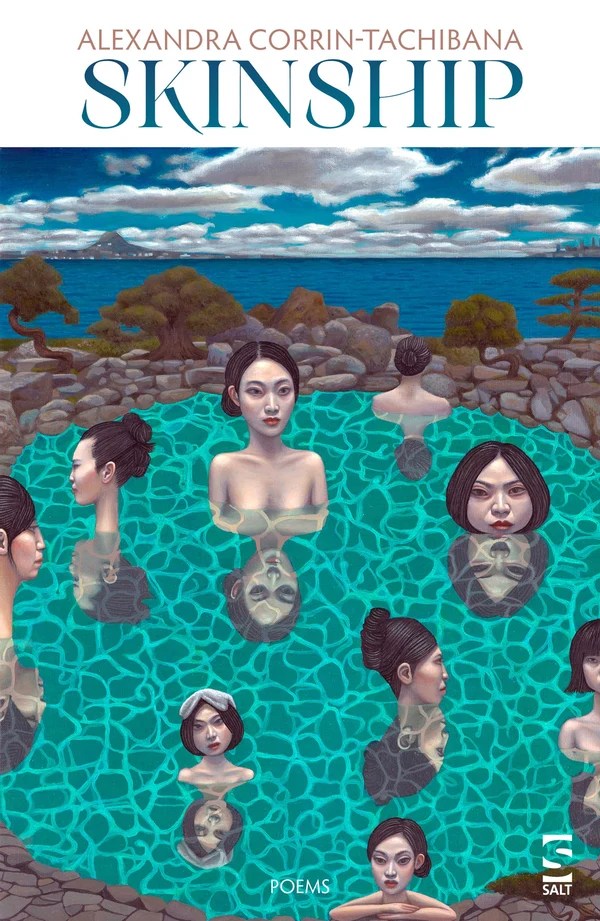
You’ll find her biography at the end of this post, with links to two more poems. This week Alexandra’s second collection with Salt is published. Skinship is a full collection: formally innovative in using and adapting traditional Japanese forms (haiku, tanka, senryu, haibun, and zuihitsu). I was particularly struck by the ‘burning haibun’.
The poems are ‘rooted in Alexandra’s lived experience of Japan’ and rich, poignant and memorable. There is a well-judged balance of humour and sadness. It’s not surprising that many of the poems have already been published and successful in competitions.
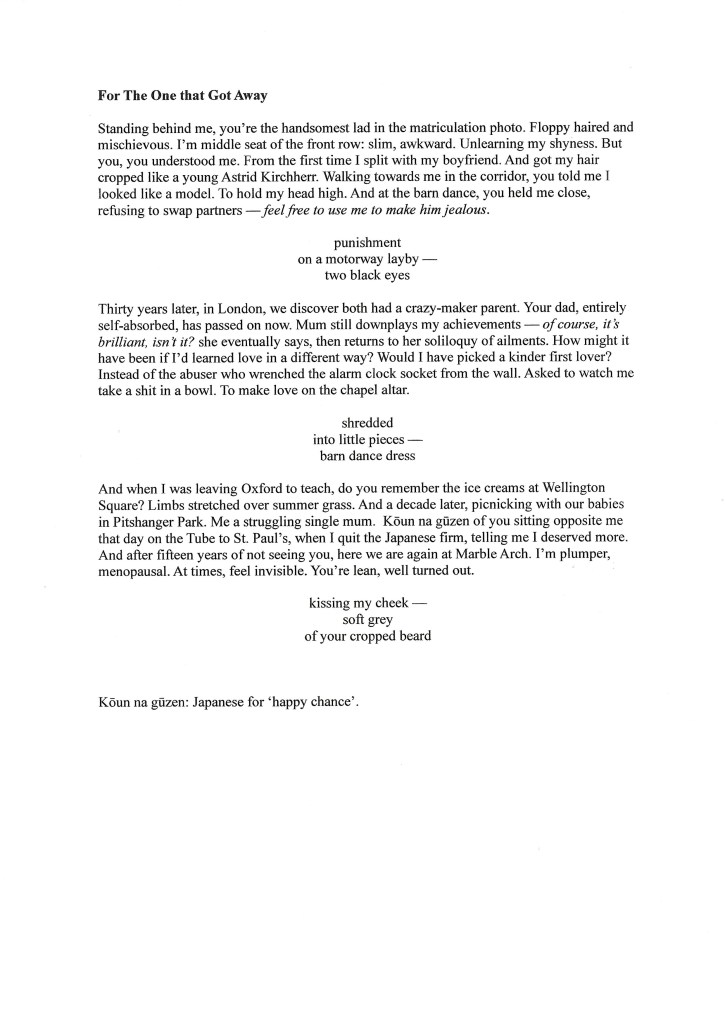
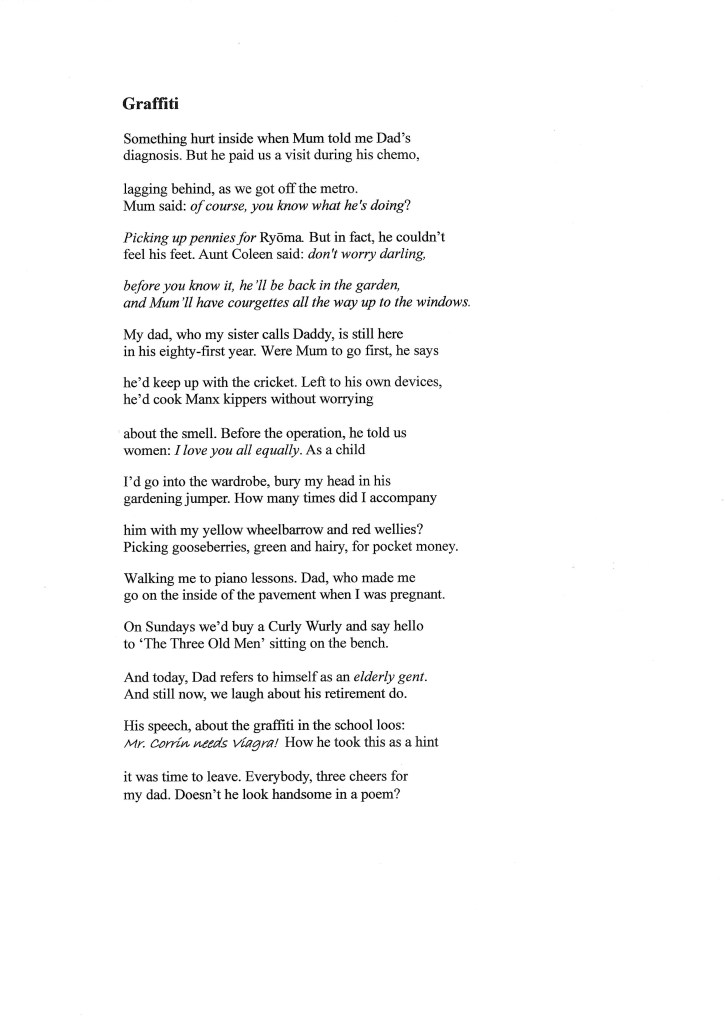
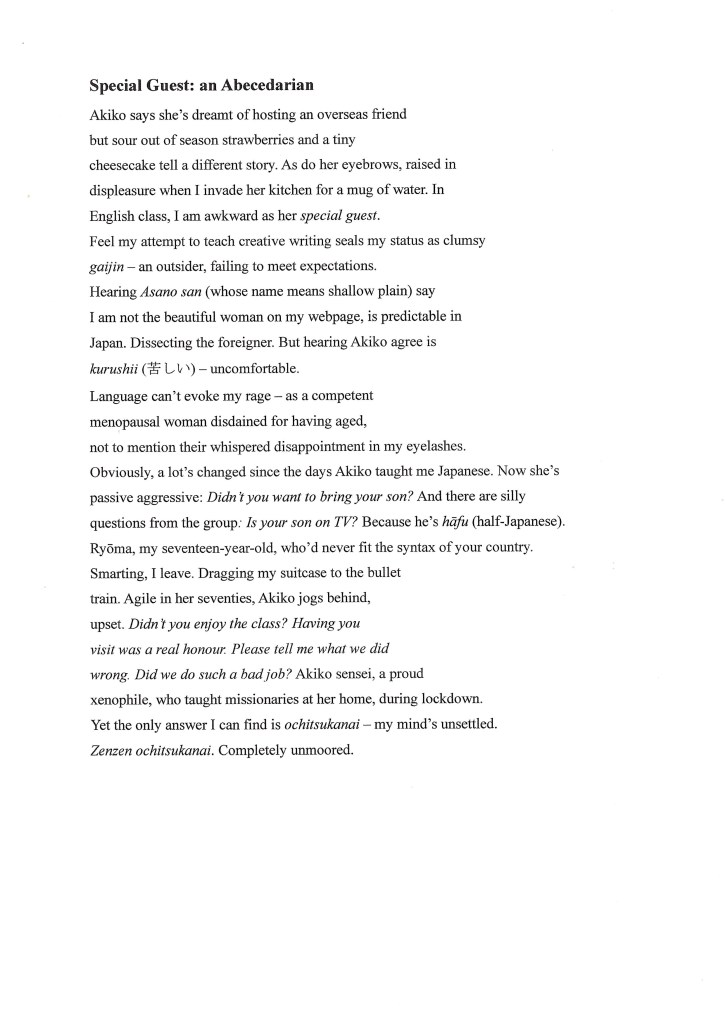
Here are the three poems which I chose from my long shortlist. To preserve the original features, the poems are presented as images.
Biography
Alexandra Corrin-Tachibana is the author of two poetry collections: Sing Me Down from the Dark and Skinship, both published by Salt publishing.
This year, she won the Frome Festival Crysse Morrison Poetry Prize, as well as Verve’s February Poem of the Month competition, was placed third, by Mimi Khalvati, in the Kent and Sussex competition, and shortlisted for the Wolves Lit Festival competition. She is shortlisted for the 2026 Forwards Prize for Best Single Written Poem, for her poem, Madam Gout, originally published by Magma.
Alexandra lived in Japan for 10 years and has Masters’ degrees in Japanese Language and Culture and in Writing Poetry. She is based in Newcastle-upon-Tyne and teaches for The Poetry School and The Poetry Business. Her most recent work is published or forthcoming in Pennine Platform, The North, Vervacious anthology (Verve Poetry Press), The Alchemy Spoon, and online in And Other Poems.
It’s a great pleasure to introduce this month’s guest poet Julie Mellor.
Julie holds a PhD in creative writing from Sheffield Hallam University and has published two poetry chapbooks with Smith/Doorstop: Breathing Through Our Bones (2012) and Out of the Weather (2017). In 2019 she became interested in haiku, and since then her haiku and haibun have appeared in Blithe Spirit, Frogpond, Modern Haiku, Presence, The Heron’s Nest and Tinywords, as well as two Red Moon anthologies. She recently retired from a career in education, and enjoys walking her dog, attending art classes and playing the banjo.
Here are recent haiku and a haibun with their publication details. You can find more of Julie’s writing on her site here.
Modern Haiku 54.3 (Autumn 2023)
toe-hold weeds things that were said years ago
Blithe Spirit 35:2 (May 2025)
long night joining the dots between stars
The Heron’s Nest Summer 2025
wetting the ink a ghost orchid blooms from its painted stem
Presence issue 82 (Summer 2025)
morning moon beside the fretless banjo pistachio shells
BHS Hope anthology 2025 (ed Neil Sommerville)
butterfly summer I write a letter to my future self
Presence 73 – Summer 2022 – and included in Contemporary Haibun 18 (Red Moon Press, 2023)
The Coffin Path
Grass, waist high this morning, and wet with last night’s rain. Brushing past it, my jeans wick the droplets from seeding cock’s-foot and brome. No one else walks this way. Behind the hawthorn hedge is the cemetery. People tend to use the other path, the one that the council mows. Or else they drive – ‘to save their legs’ my mother says. Some days she says she wants to be buried. Other days, she thinks she’d prefer to be cremated and have her ashes scattered next to a memorial bench. No rush to decide, I tell her, trying to make light of things.
elderflowers pressed in her prayer book a recipe for wine
Solstice: a clear day here in the Netherlands with the sun breaking through as I type this.
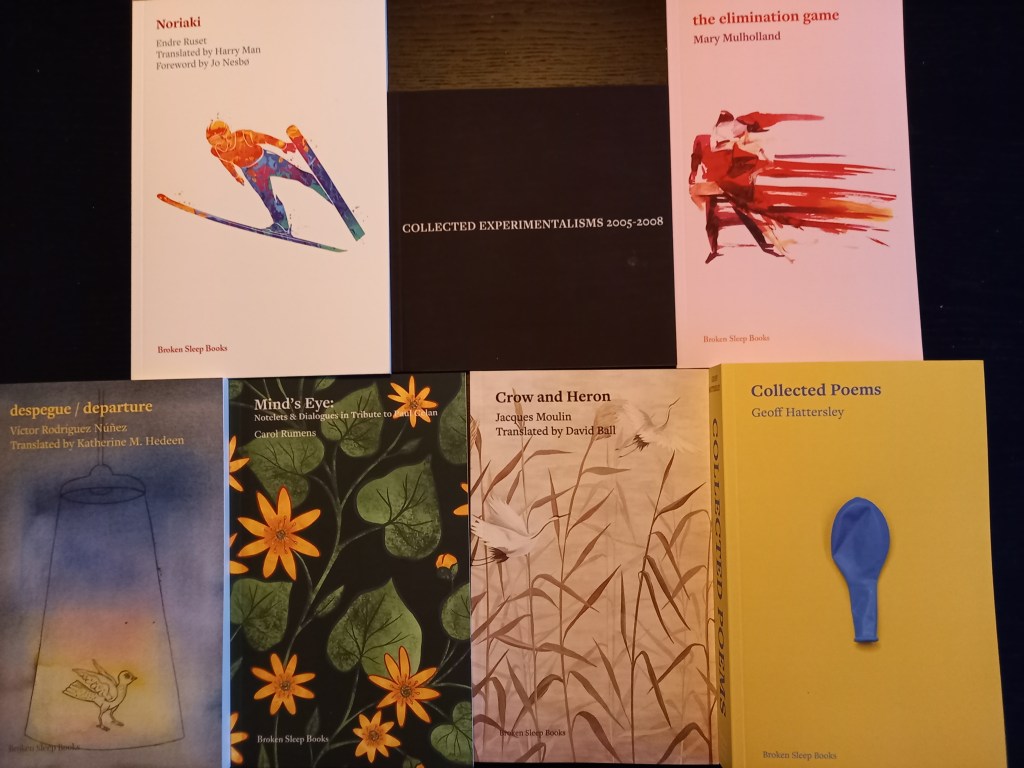
My holiday reading is sorted. The seven books include translations from French, Spanish and Norwegian. The latter an interesting set of haiku and haiku-like poems about the Japanese ski-jumper Noriaki Kasai.
Broken Sleep Books use the world’s largest on-demand publishers. The parcel came from France: no import duties, no VAT, no waiting while parcels linger in the customs depot. A bonus!
This is my last post for 2025. Season’s Greetings and many thanks to you all.
Here is the link to James Schuyler’s poem Linen. A poem about gratitude, starting with a question, and almost a sestude.
It is a great pleasure to introduce this month’s guest poet David Bingham. We first met many years ago through the British Haiku Society. David was President of the Society from 2020-2022, and in 2020 he was the winner of the British Haiku Society International Haibun Prize. His poetry appears regularly in a wide variety of magazines. See below for further details.
The haiku have all been previously published: in Presence, Blithe Spirit, or Time Haiku. The tanka first appeared in Blithe Spirit and the BHS Tanka Anthology 2022, while the haibun was the winner of the British Haiku Society International Ken and Noragh Jones Haibun Award, 2017. I hope you enjoy the selection.
Haiku
a lifetime overcoming gravity – still it gets me down
Private Keep Out molehills on both sides of the fence
clear night sky – lights from both the living and the dead
away in the wind … the word-filled air
is there a word for it? the sound swans make when they fly
late spring meadow… within the yellow the blue of summer
storming the old hill fort – bluebells and celandine
inland sea the wash from our boat moves the border
stream through sunlight through stream
closing over trails in algae where the ducks have been
I turn to call the dog … then remember
Euston Station – my skin ripples in the hand drier
an apology… the predictive text writes it for me
Tanka
sun shine and motorway spray – I drive through rainbows to be with you
silently together after all that talk watching swallows hawk for flies over the meadow
on waking I turn my dreams inside out letting the seams show for the rest of the day
doors left wide open revealing an unlit space nothing here to steal but the darkness
Haibun
Sleight of Mind
Some people need to know how he pulls the shining light bulbs from his mouth, levitates above the stage or escapes from a straightjacket.
Me, I like the mystery of it; the explanations are always so mundane. True magic lies in the imagination. Switching off the rational mind. Letting yourself go and trusting the conjuror.
I do it with words. Like how I brought you here. Even if you asked me, I couldn’t tell you how it’s done.
snowdrops … mistaking ‘what is’ for ‘what isn’t’
Biography
David Bingham’s debut poetry collection The Chatter of Crows was published by Offa’s Press in October 2014 and in 2020 he was the winner of the British Haiku Society International Haibun Prize.
His poetry appears regularly in a wide variety of magazines, including Blithe Spirit, TimeHaiku and Presence and in anthologies, including: the Wenlock Poetry Festival anthologies for 2012, 2014, 2015 and 2016; Beyond Words, 2018 and where silence becomes song, 2019, the International Haiku Conference Anthology, published by the British Haiku Society; In the Sticks, 2021 and Away with the Birds, published by Offa’s Press; In Snow and Rain, 2022, an anthology of tanka published by the British Haiku Society; and Festival in a Book, published by the Wenlock Poetry Festival, 2023.
At different times, he was editor of both Borderlines and Blithe Spirit magazines and joint editor of the haiku and related genres anthologies Ripening Cherries, published by Offa’s Press, 2019 and Shining Wind published by the British Haiku Society, 2024.
He has read his work in arts centres, pubs, theatres, on local radio and poetry and literature festivals. He has read at City Voices in Wolverhampton, Country Voices in Shropshire and as a member of Green Wood Haiku at the BHS International Haiku Conference in St Albans in June 2019.
As part of the humorous poetry double act, Bingham and Woodall, he has performed at the Wolverhampton Lit Fest and Comedy Festivals in 2017 and 2018, and at the Ironbridge Festival in 2019.
This month’s guest slot is for poems from To Live Here, an anthology of haiku published by The Wee Sparrow Press. The Press was founded by Claire Thom. 100% of the proceeds of their anthologies are given to charity.
The anthology is edited by Giorgia Di Pancrazio & Katherine E Winnick. The lovely cover and illustrations are by Scottish artist Colin Thom.
To Live Here is “A collection of haiku on the theme of home, which explores the many facets of human experience, from the mundane to the sublime. Featuring the work of talented poets from around the world, this anthology invites readers to reflect on the beauty and complexity of the world we inhabit.”
Salford Loaves and Fishes, a charity supporting the homeless, has already received over £600. The anthology is available through Amazon – ISBN 9788409528165. I’m grateful to Francis Attard and Julie Mellor for permission to share their haiku.
sandy beach turtles lay clutches of eggs off-shore breeze
Francis Attard, Malta
three cornered field the generations who farmed here
Here is the second selection of poems by Judy Kendall, our June guest poet. She lived and worked in Japan for almost seven years. Cinnamon Press published four collections of her haiku and ‘mainstream’ poems. You can find her biography below her writing.
Poems:
The First Fountain Ever Placed In A Japanese Garden for my mother
more than half is the sound of it as it splashes on the stone rim
this is the part the thousands of photographs will never reach
their takers stop to make a frieze and then move on
no chance of hearing the other half clapping its moving shadow in the trees
the shudder when the leaves follow the foam
which drops, unmoved as if thrown by a boy to fall through air
diluting dissolving into parts
Note: The first fountain in a Japanese garden was built in Kenroku en, Kanazawa, in 1861
Driving To Noto
Men are better says Toshi I know no they are not says I (I also know) and so we argue to the tip of Noto
To Suzu where the wood huts slump in shock plopped suddenly in frocks of snow and the sea is whipped to icicles of frenzy
Over a nabe pot of fish and cabbage (Toshi warns me not to call it cabbage for it is the vastly superior hakusai) our host asks me my age
Taken aback (I`m older than he thought more single), he inquires don’t you like men?
So I assure him only frequent country-moving has prevented me from choosing one of them
The returning road is white, wide as a field the ditches spread themselves with frosting and the windscreen blanks out like a blizzard
Toshi scrapes at the iced-up wipers singing to himself, waving me in
Midwinter hangs in the boughs
The pine trees are bent nearly in two laden with second helpings
(earlier version published in Ambit)
Short poem, haiku and tanka fromThe Drier The Brighter (Cinnamon Press, 2007):
Poem:
5 am
these cold skies cheating the dawn,
these bits of tree, blocks of houses too close to houses, shrouded people, shrinking in the weather.
Haiku:
too much autumn the reds are almost scorching now a mouth brimming with leaves
tanka:
leaving.
not one stick of furniture in the room. in the heart,
no tears.
(previously published in Presence)
Biography:
Judy Kendall worked as an English lecturer at Kanazawa University in Japan for nearly seven years. When she first went to Japan she was a practicing playwright but she soon began to focus on poetry and haiku, kickstarted by an invitation to to participate in a collaborative translation of Miyaiki Eiko’s haiku. This became the bilingual publication Suiko /The Water Jar. Since then she has been writing haiku and haibun along with other poetic and prose forms. The haiku mode has informed her four Cinnamon Press poetry collections, particularly Joy Change – composed while she was in Japan. She has won several poetry awards, recently receiving a 2019 Genjuan International Haibun An Cottage prize, and is the essays and bilingual translations editor for Presence haiku journal. She has also run the Yorkshire/Lancashire haiku group.
She is Reader in English and Creative Writing at Salford University, and aside from haiku and haibun, works as a poet, poetry translator and visual text exponent. She has published several articles and books on the translation and creative process, including ‘Jo Ha Kyu and Fu Bi Xing; Reading|Viewing Haiku’ in Juxtapositions, 1 (2). She is currently putting the finishing touches to a monograph for Edinburgh University Press on Where Language Thickens (focusing on the threshold between articulation and inarticulation in language – a threshold in which haiku itself is surely situated).
The day before my birthday storm Poly (Beaufort 11) raged at speeds of 140 kms an hour: overhead lines and trees came down. The day after my birthday the Dutch government fell.
On my birthday I treated family to lunch. It was a joyous occasion. My uncle (born 17 years after my mother) turned 85 in June. He has only recently given up playing volleyball: too much for his shoulders. He’s taken up Jeu de Boules instead.
Here are two verses from an extended sequence titled Briefly a small brown eye.
Primary school demolished, protestant church a community centre. Our old house extended. Forty years on no reason to visit this town other than the old uncle.
Lunchtime, my aunt brings out the special table cloth. She has embroidered signatures, some in Arabic, some in Cyrillic. I’m looking for mine.
It’s a great pleasure to introduce this month’s guest poet Judy Kendall. We met many years ago through our membership of the Yorkshire/Lancashire Haiku group. Judy lived and worked in Japan for nearly seven years. Cinnamon Press published four collections – containing haiku and ‘mainstream’ poems. You can read Judy’s full biography further down. I’ll post a second selection of Judy’s writing next month.
Haiku published in Presence
shades of blue distance in the fells
afternoon off red grouse in flight almost grazing the heather
moorland air just after a curlew’s call liquid fresh—
travelling light I will my neighbor to turn the page
(published in Presence and selected for Red Moon Best English Language anthology)
Short poems or ‘vegetable’ haiku published in insatiable carrot (Cinnamon Press, 2015)
[Many of these have featured on Incredible Edible Todmorden’s Edible Poetry site and on or around the town]
tall green mild and meek not quite the full onion the gentle leek
hairy bitter cress going wild among the cabbages
snug by the wall the one the pennine wind forgot Todmorden’s first apricot
taken apart, the cabbage becomes all heart and leaves
chunky, nobbly-eyed the potato says ‘hi, will you be my friend?’
Haiku and poems from Joy Change (Cinnamon Press, 2010) Haiku:
wooden geta the water quivers with carp a horizon of lilies
sickle moon, yellow and black, on my way back to the heart
(still international haiku competition)
watching the breath come and go, who am I but a broken bit of star?
(still international haiku competition)
drifting mountains shoulder the sky blotches of pine
(Asahi Shimbun)
Biography
Judy Kendall worked as an English lecturer at Kanazawa University in Japan for nearly seven years. When she first went to Japan she was a practicing playwright but she soon began to focus on poetry and haiku, kickstarted by an invitation to to participate in a collaborative translation of Miyaiki Eiko’s haiku. This became the bilingual publication Suiko /The Water Jar. Since then she has been writing haiku and haibun along with other poetic and prose forms. The haiku mode has informed her four Cinnamon Press poetry collections, particularly Joy Change – composed while she was in Japan. She has won several poetry awards, recently receiving a 2019 Genjuan International Haibun An Cottage prize, and is the essays and bilingual translations editor for Presence haiku journal.
She is Reader in English and Creative Writing at Salford University, and aside from haiku and haibun, works as a poet, poetry translator and visual text exponent. She has published several articles and books on the translation and creative process, including ‘Jo Ha Kyu? and Fu Bi Xing; Reading|Viewing Haiku’ in Juxtapositions, 1 (2). She is currently putting the finishing touches to a monograph for Edinburgh University Press on Where Language Thickens (focusing on the threshold between articulation and inarticulation in language – a threshold in which haiku itself is surely situated).
World Book Day is on the 23rd of April. In the UK it takes place on the 2nd of March to avoid clashes with spring school holidays and St. Georges’ Day.
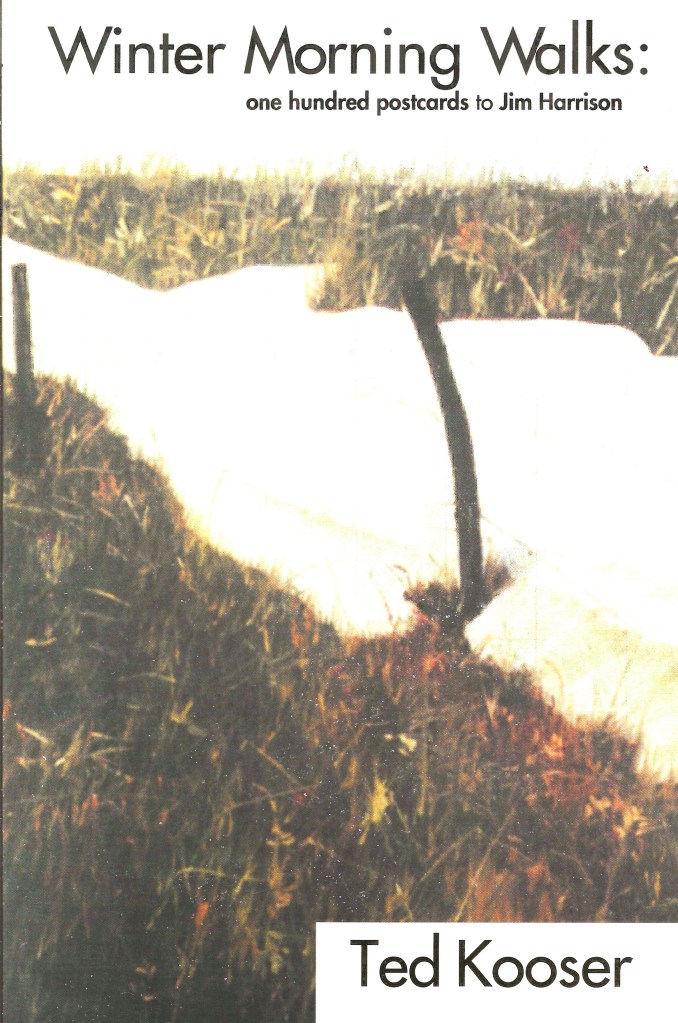
A fellow poet introduced me to the American poet Ted Kooser, now in his early 80s. His style is accomplished, yet extremely simple. My current bedtime reading is his poetry collection Winter Morning Walks: one hundred postcards to Jim Harrison (Carnegie Mellon University Press, 2001).
In the late 90s Kooser developed cancer. He gave up his insurance job and writing. When he began to write again, it was to paste daily poems on postcards he sent to his friend and fellow writer Jim Harrison. In the preface, Kooser tells us ‘I began to take a two-mile walk each morning. I’d been told by my radiation oncologist to stay out of the sun for a year because of skin sensitivity, so I exercised before dawn, hiking the isolated country roads near where I live.’ These country roads are in Nebraska.
The poems cover a period from 9 November until 20 March. In the poems Kooser doesn’t directly talk about the illness. He does so through metaphor. All the poems include a brief description of the weather. The clear and precise observation gives them a haiku quality.
Here is his postcard for march 5:
Very windy and cold.
A flock of robins bobs in the top of a wind-tossed tree, with every robin facing north and the sky flying into their faces. But this is not straightforwardness, nor is it courage, nor an example of purpose and direction against insurmountable odds. They perch like this to keep their feathers smooth.
I am very glad to introduce this month’s guest poet Sheila Butterworth. We met many years ago, in that Yorks/Lancs Branch of the BHS. I let Sheila introduce herself and her haiku.
“Winning the Leeds Waterstones Haiku Competition in 2000, organised by the Yorks/Lancs Branch of the British Haiku Society, introduced me to the world of haiku poets, workshops, journals and a network of local poets with whom to chew the haiku fat. I have since had poems published in Blithe Spirit, Presence, The Snapshot Press Haiku Calendar, Wales Haiku Journal and The Red Moon Anthology.
Most of my haiku come out of the everyday experiences of life within a mile of my edge of village doorstep where I have lived for 40 years. This is where I notice those things that have most meaning to make haiku. The familiar environment highlights the nuances of change in place, in time and in me and this is when haiku happen.”
coming light the bubble and trill of robin and wren
high street dawn the smell of sweet dough folds into the fog
morning mizzle molehills spatter the spring pasture
planting potatoes startled sparrows scatter in the quickthorn
summer rain the shining bole of a sapling ash
evening sun the shadow of the wood fills the field