Tag Archives: family

Forgetfulness – guest poet Ian Seed

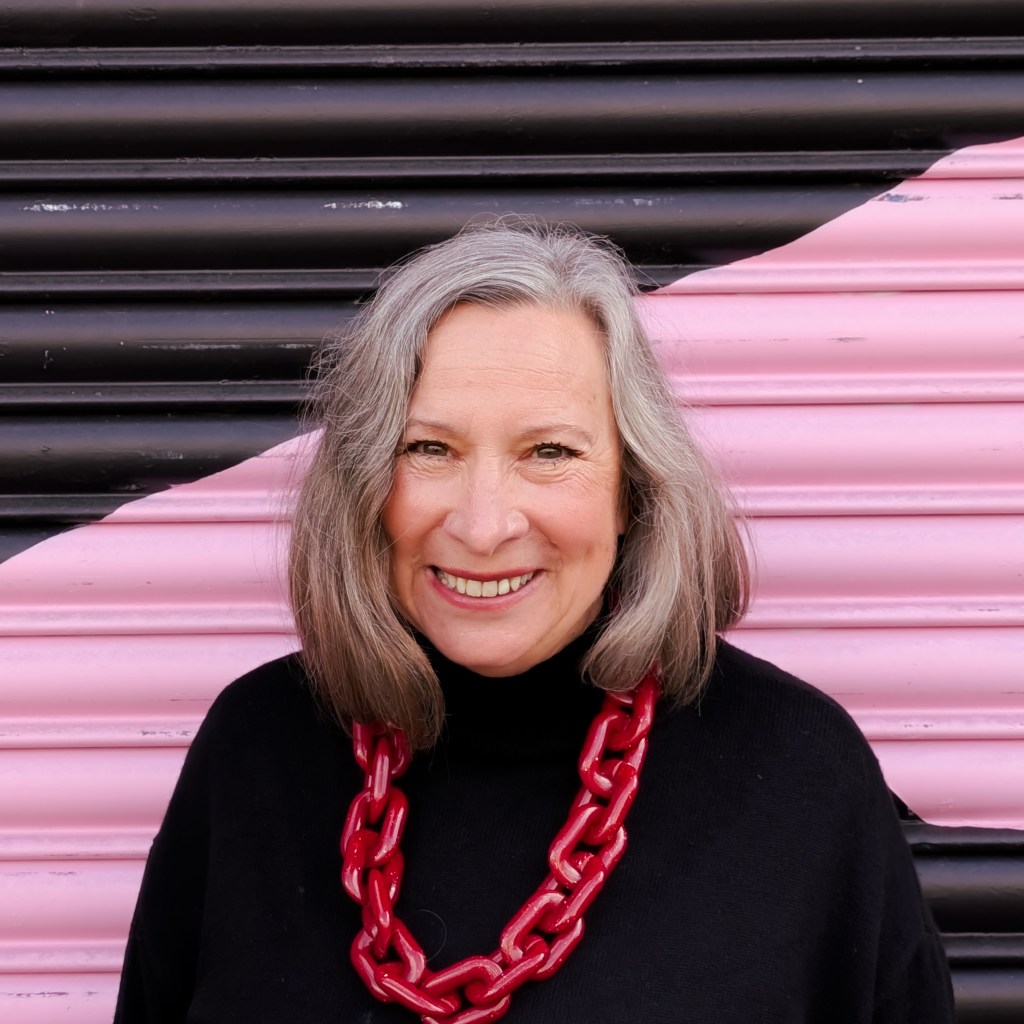
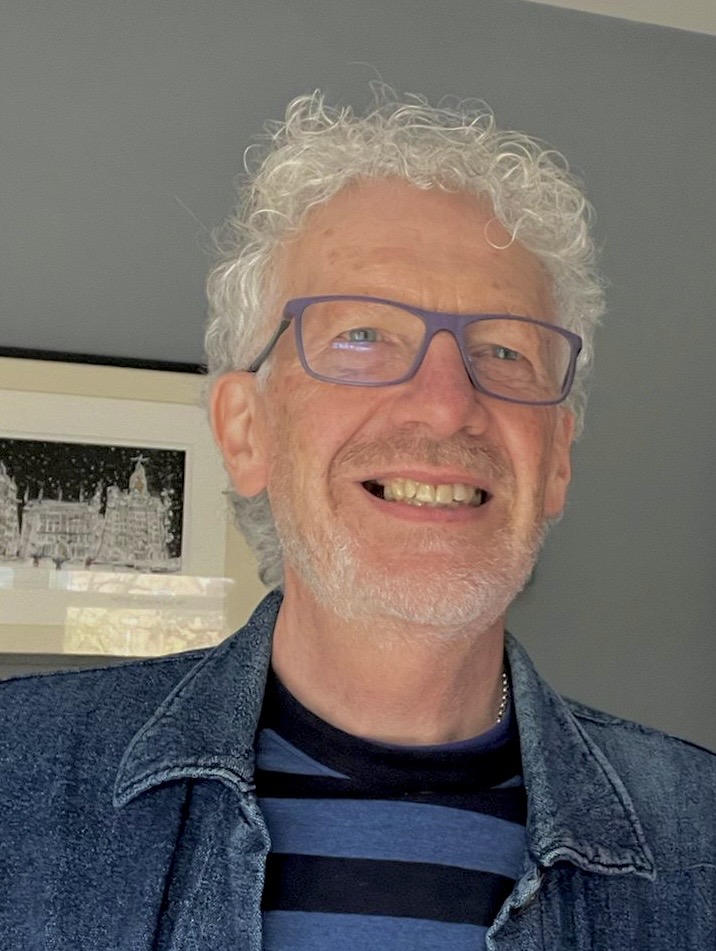
Photo credit: Jonathan Bean, Lancaster Litfest


I am delighted to introduce our June guest poet Ian Seed. We met on a writing course where Ian was the guest reader on the 9th of December 2019. I know the exact date because I bought a copy of his translation of The Thief of Talant by Pierre Reverdy and Ian wrote a dedication for me ‘sometimes it’s nice to be a stranger’.


You’ll find Ian’s biography below the four poems. These are from his recent collection Forgetfulness, ‘tragicomic navigation of different forms of loss’. It is beautifully produced by Shearsman Books. Caroline Bird writes: “Ian Seed allows us to ‘stay inside the asking’’, inside a dream half-dreamt, a loss mid-grieved. His elegies expand like half-lit corridors, leading to new selves – or old selves we have forgotten, their ‘cigarettes glowing in the oncoming evening’.”


The collection is in four sections. Section 1 opens with Scattering my Mother’s Ashes – a sequence of nine prose poems. This is followed by the title poem Forgetfulness. Section 2 includes the numbered sequence Jugglers and poems laid out in stanzas, like Unscripted. Section 3 has 20 prose poems of varying length. I found it very hard to choose, but here are Pastoral and Relations.

Forgetfulness

Walking up the mountain, I see my mother sitting on the café terrace of her new care home. She’s looking remarkably young – her hair’s been dyed its old dark colour and someone must have applied a lotion to make her skin all smooth again. Yet she still has that look in her eyes of not knowing where she is anymore. I doubt she will recognise me, but she greets me by name. I tell her I’m on my way to meet a friend at the top of the mountain – I can’t stop for long. She nods, though I’m not sure she’s understood. Deep down we both know she’s no longer alive, but neither of us can bring ourselves to say so.

Unscripted

A heavy snow. The film eyes
of a stranger. This street is absent
from the story of the city

which I cannot recognise, though
my body’s memory can read
its twists and turns, its lines

broken through movement. The shape
of this snowflake resists
the tyranny of completion. I

is the space of the abandoned
intersection, the recorder motionless
for the first time.

Pastoral
after Max Jacob

The three soldiers in their red uniforms were sitting on the river bank, their long rifles laid to rest on the grass. ‘Soldiers are not handsome in themselves, except they can make themselves look as if they are,’ I declared from my perch on a fallen tree trunk nearby. ‘People may say that beard is ugly, but that’s only because it happens not to be in fashion at a particular time.’ I looked at one of the young soldiers – slim, dark hair, blue eyes, whose name I gathered from their conversation I’d listened to earlier was Tom – and went on: ‘But there are some soldiers who are extraordinarily handsome whatever they wear, whatever the fashion.’ I looked at the other two soldiers. ‘And you too can make yourselves handsome with just a few changes. As for me, I’m out of the game now.’

Relations

My grandfather, who had committed suicide, was in an old-fashioned train compartment with me, lying in my arms. I remembered the softness of his woollen suit from my teenage years. He was just as lost as he had been back then after my grandmother died. He was comforted by my holding him, but not sure who either of us was.

Biography

Ian Seed’s recent publications include Forgetfulness (Shearsman, 2026), My Outsize Hank Williams Cowboy Hat, with artwork by Lupo Sol (Sacred Parasite, 2025), The Dice Cup, from the French of Max Jacob (Wakefield, 2023), The River Which Sleep Has Told Me, from the Italian of Ivano Fermini (Fortnightly Review Odd Volumes, 2022), and New York Hotel (Shearsman, 2018), a TLS Book of the Year. To find out more, go to www.ianseed.co.uk

Birthday Party – poem

Today is the birthday of my friend Kathleen Kummer. After several falls, she is now very frail and housebound.

Kathleen and I met on a writing week with the poet Lawrence Sail at the beginning of the century. She had lived and worked in the Netherlands. We became friends. I visited her in Dorchester and in Devon where she moved, aged 79, to be nearer her two daughters.

Kathleen had a body of work when she moved to Devon, and sent a manuscript to Alwyn Marriage at Oversteps Books. They published her debut collection Living below sea level (2012).

I am deeply grateful to Kathleen for our friendship and our poetry connection. Today I’m posting her poem Birthday Party, showing her empathy and eye for telling detail.

Birthday Party

It’s his fortieth birthday. He’s sitting alone. He seems
neither man, not child, nor anything in between.
When he opens his presents, he’s all of these at once,
and happy. (‘What shall I give him?’ ‘Anything’, they’d said.)

Somehow, he’d made it plain he wanted a fish
on his cake. So on top, a flatfish. It looks like a fossil,
all its bones impressed on the green marzipan. A frieze
of stiff, blue icing ripples round the base.

A family group over there on the leather settee
talks about children at college and moving house.
He gazes through and beyond them, remote as those heads
on Easter Island, but jumps up to blow out his candles.

He’s given a card which reads Happy 30th! (‘He won’t know,
don’t worry.’) His hair is receding – he’s beginning to look like
his father, who tomorrow will take him back to the Home
where he has his bedroom and bathroom en suite. (‘Very smart!’).

For Easter, try egg blowing – guest poet

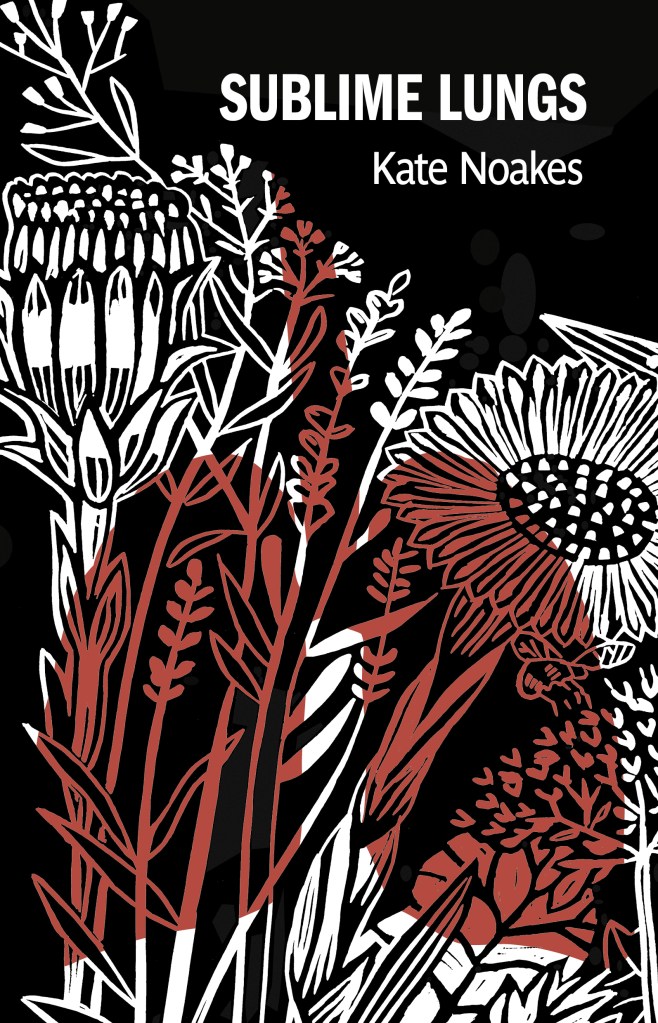
Here is a sample poem by our April guest poet Kate Noakes. The poem is from her new collection Sublime Lungs, which will be published by Two Rivers Press on 21 April. This is her ninth full collection. More poems after Easter.

Kate will read at the Cheltenham Poetry Festival on 14 April. There is an online launch on 24 April. You can find the schedule of online and live launches on Kate’s website

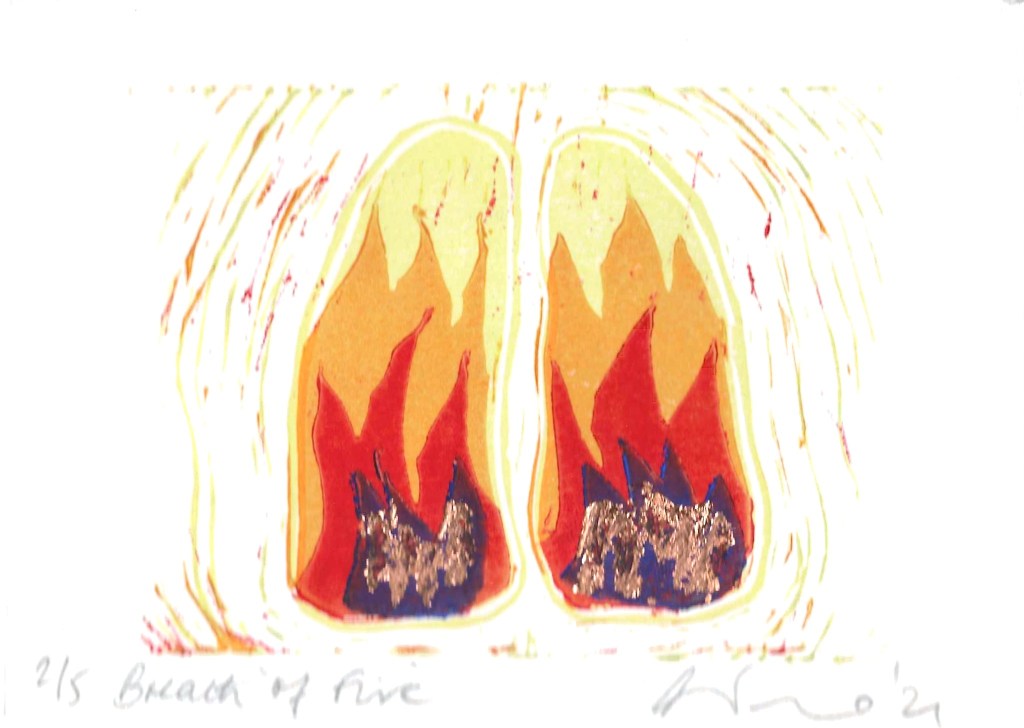
Kate Noakes Breath of Fire

For Easter, try egg blowing

David Attenborough stood on an ostrich egg
to demonstrate its strength once.
‘The toughest egg in the world,’ he said.
He may even have jumped on it for emphasis.

Of course, no-one had drilled it and sapped its yolk
with mega-breaths and an extra-thick straw,
which is how it withstood his weight, unlike
the three souvenirs we bought in Oudtshorn,
their weakness apparent under failing coving.

They smithereened the carpet and needed
hand picking, the hoover’s inhalations proved weak.
We’d have been better off buying feather dusters
from the hawker pitched outside the super-market.
They’d have been easier to carry home.

Canada is as far away as bibles are – poetry

I was very pleased to see my poem Canada is as far away as bibles are on After. Many thanks to Editor Mark Antony Owen. You can read the poem here.


After publishes ekphrastic poems and my poem was inspired by The Avid Reader, 1949. Rodney Graham (1949 – 2022) was a visual artist, painter, and musician. He made the lightbox in 2011.


We see the middle-aged man / carrying a hat, smoking a pipe, / because Graham inhabits him.’


The Avid Reader, 1949 was one of the works on display at Voorlinden Museum, Wassenaar, the Netherlands in the major exhibition of Graham’s work titled That’s Not Me. An ironic title as Graham appears in all the works – as a builder having a smoke, a lighthouse keeper, historical figure.

Voorlinden is a fabulous museum – more about it some other time.


I was struck by the attention to detail and the scale of the works. The woman is ‘his wife, swing coat, high heels, walks past on the right.’

Having the last word – guest poet

credit: Monika1607 via Piaxabay


Cliff Yates was our guest poet last November. You can read the poems here. As I was going through his New & Selected Poems (The Poetry Business, 2023) to select a set, I came across the poem below.


It’s even sweeter on Valentine’s Day…

from Another Last Word

EXPENSIVE CHOCOLATE

There are eight pieces. She has two
and gives me one. ‘Confiscate this,’
she says, handing over the rest.
‘Hide it, or I’ll be tempted when you’re out.’
When I get back, the drawer’s open,
there’s one piece left, and a note
on a scrap of paper: NOT VERY WELL HIDDEN.

CLEARING UP

She’s cooking Sunday lunch and I’m clearing up.
‘It’s ridiculous,’ I said, ‘you spend time
getting things out of cupboards
and I spend time putting them back in.’
‘Not enough time in my opinion.’

BIRTHDAY

‘You’re being nice,’ she says, ‘you’ll be running
out of steam soon. You’ve been nice
since 7 o’clock, that’s 3 hours, 10 minutes.’

DANCE

‘It’s great the way we dance around each other,’
I said, ‘when we’re getting the meal on.’
‘We only do that because you get in the way.’

SATSUMA

‘I can’t be bothered with this satsuma.’
‘Give it here,’ she says. ‘Can’t peel a satsuma,
can’t peel an egg. We’ve been married how many years,
and I’ve made no progress with you whatsoever.’

WRITING

‘I had to work on that one,’ I said, ‘because
you didn’t actually say that. I am in fact
writing these poems.’ ‘That’s what you think.’

ENTERTAINING

‘Some of these make me sound terrible,’
she says. ‘It’s because you find me so entertaining.
It makes me worse when you start laughing.’

LUNCH

‘Apart from the salad and potatoes,’
I said, ‘what did we have for lunch?’
‘If you can’t remember what we had for lunch
I feel sorry for you.’

GETTING IT RIGHT

‘I’ll get it right one day.’ ‘I doubt it,’ she says.
I laugh. ‘It’s not funny really, is it?’
‘No,’ she says, ‘but at least you’re hopeful.’

PHILOSOPHY

‘You’re too hard on yourself,’ she says,
‘when I wake up I just want a cup of tea
and then I want to be entertained by life.’

FISH

‘What we need is a special pan for fish
and a fish spatula.’ ‘No,’ she says,
‘what we need is for you to eat fish.’

COLOURING PENCILS

She’s at the kitchen table, going at it
with her new colouring pencils.
‘I had some when I was little,’ she says,
‘but I was never let loose. It was always
What’s THAT supposed to be? or Where’s the SKY?

Photo credit: Andrew Taylor

Biography

Cliff Yates was born in Birmingham and has been publishing poetry since the 1980s. His New & Selected Poems (Smith/Doorstop, 2023) brings together work from various collections including Henry’s Clock  (Fenton Aldeburgh First Collection Prize; Poetry Business Book & Pamphlet Competition), Frank Freeman’s Dancing School (Arts Council England Writers Award) and Jam (ACE Grant for the Arts). He taught English at Maharishi School in Skelmersdale and wrote Jumpstart Poetry in the Secondary School during his time as Poetry Society poet-in-residence, following the success of his students in poetry competitions. He has led courses for, among others, the Arvon Foundation and the British Council. Read more on his site here

wetting the ink…guest poet

It’s a great pleasure to introduce this month’s guest poet Julie Mellor.

Julie holds a PhD in creative writing from Sheffield Hallam University and has published two poetry chapbooks with Smith/Doorstop: Breathing Through Our Bones (2012) and Out of the Weather (2017). In 2019 she became interested in haiku, and since then her haiku and haibun have appeared in Blithe Spirit, Frogpond, Modern Haiku, Presence, The Heron’s Nest and Tinywords, as well as two Red Moon anthologies. She recently retired from a career in education, and enjoys walking her dog, attending art classes and playing the banjo.

Here are recent haiku and a haibun with their publication details. You can find more of Julie’s writing on her site here.

Modern Haiku 54.3 (Autumn 2023)

toe-hold weeds
things that were said
years ago

Blithe Spirit 35:2 (May 2025)

long night joining the dots between stars

The Heron’s Nest Summer 2025

wetting the ink
a ghost orchid blooms
from its painted stem

Presence issue 82 (Summer 2025)

morning moon
beside the fretless banjo
pistachio shells

BHS Hope anthology 2025 (ed Neil Sommerville)

butterfly summer
I write a letter
to my future self

Presence 73 – Summer 2022 – and included in Contemporary Haibun 18 (Red Moon Press, 2023)

The Coffin Path

Grass, waist high this morning, and wet with last night’s rain. Brushing past it, my jeans wick the droplets from seeding cock’s-foot and brome. No one else walks this way. Behind the hawthorn hedge is the cemetery. People tend to use the other path, the one that the council mows. Or else they drive – ‘to save their legs’ my mother says. Some days she says she wants to be buried. Other days, she thinks she’d prefer to be cremated and have her ashes scattered next to a memorial bench. No rush to decide, I tell her, trying to make light of things.

elderflowers
pressed in her prayer book
a recipe for wine

Solstice and poetry – books

Solstice: a clear day here in the Netherlands with the sun breaking through as I type this.


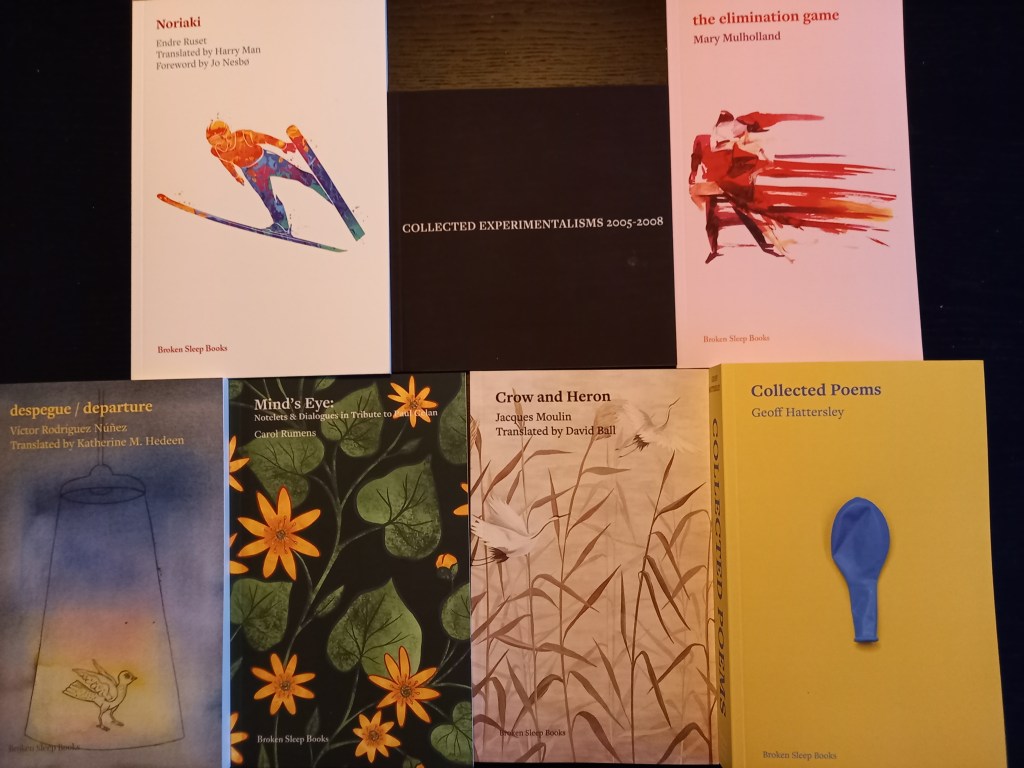
My holiday reading is sorted. The seven books include translations from French, Spanish and Norwegian. The latter an interesting set of haiku and haiku-like poems about the Japanese ski-jumper Noriaki Kasai.


Broken Sleep Books use the world’s largest on-demand publishers. The parcel came from France: no import duties, no VAT, no waiting while parcels linger in the customs depot. A bonus!


This is my last post for 2025. Season’s Greetings and many thanks to you all.


Here is the link to James Schuyler’s poem Linen. A poem about gratitude, starting with a question, and almost a sestude.

Poetry Worth Hearing – poetry

Many thanks to Kathleen Mcphilemy for including three of my poems in episode 37 of Poetry Worth Hearing or you can listen on Youtube, Audible and Spotify.

One of the poems is his ashes on a corner.


The theme was hiding and/or seeking. The episode is 60 minutes. The first half hour or so is an interesting interview with poet Nancy Campbell who talks about her residency on Greenland among other things. The interview and Nancy’s poems bookend poems by Guy Jones, Zelda Cahill-Patten, Lesley Saunders, Pat Winslow, Richard Lister, Dinah Livingstone, and Sarah Mnatzaganian.


The theme for the next episode is all things ‘eco’. Send up to four minutes of unpublished poems (text and sound file) plus a short biography to poetryworthhearing@gmail.com by 18 January 2026. Find more information on poetryworthhearing.biz.

his ashes on a corner

of the dining table
by the small square
votive container
the discreet
undertaker’s logo

she greets him
will have a glass
at six his ashes
waiting with us
for borders to open

Day Breaks as a Petrol Station – guest poet

photo credit: Andrew Taylor

It’s a great pleasure to introduce this month’s guest poet Cliff Yates. I met him on an excellent online workshop he ran for the Poetry Business. They published his New & Selected Poems, which brings together poems from five earlier publications – over thirty years of ‘inimitable’ work. Poignancy, economy, humour, a touch of the surreal…

You can find Cliff’s biography and the link to his website below the poems.

Day Breaks as a Petrol Station

Day breaks deliberate as a petrol station
newspapers and expensive flowers
but you’re tired of vacuum-packed sandwiches
and sordid headlines.

On the 15.07 out of Deansgate
she’s reading The Holy Sinner.
The dog opposite smiles
through its muzzle.
Coffee, or maybe something’s on fire
we do appear to be speeding
unless we’re stationary and the landscape’s
rattling past. ‘It’s been a good day,’
she says, ‘it makes up for yesterday.’
‘Why, what happened yesterday?’

Days without rain and suddenly it rains.
Another country, your body’s not your own.
You want to go for a walk. In this?

He threw a stick for the dog in Habberley Valley
the tattoo flew from his arms
landed in the bracken like leaves.

Dog

So many places closed: the off-licence,
the butcher, the corner shop, even
the telephone box screwed shut.
Dog had come a long way, and now what?

The cherry blossom, he noted,
looking up for once from the pavement,
was particularly stunning this year,
maybe it was the same every year

but noticing it, his heart was lifted
and he decided not to be disappointed.
The journey had been arduous, the future
was uncertain, but there is more to life,

he reflected, cocking his leg against the letter box,
than a bowl of fruit on a table.

The Lesson

The nun points out the ones to watch:
the boy in the corner, the girl at the back.
In this class it’s the boy in the middle
who thinks he’s a cat.

Outside, workmen are felling trees.
A bird’s nest tumbles in through the window,
lands on a desk. Inside the nest, a baby bird.
It’s okay it’s okay, the children say,
Brian will know what to do.

The boy who thinks he’s a cat
gathers the bird and, holding it
at arm’s length in the cup of his hands,
heads for the door, the nun behind him
between the silent rows of children
and the bird, as if on cue, lifts up its beak and sings.

Lighthouse

The lighthouse flickers at the end of the pier.
We watch it in our red pyjamas.
Actually, neither of us are wearing red pyjamas.
You’re wearing my blue shirt.

The lighthouse flickers at the end of the pier.
It’s the only thing we can be sure of.
Everything’s uncertain
since you set alight my record collection.

I’m trying to work out an appropriate reaction,
rearranging things in my head to eliminate
all memory of the record collection.
The lighthouse flickers on and off.

Actually it doesn’t, you point out, it just appears to.
You look amazing in my blue shirt.
I haven’t words to describe how good you look
in the light from the lighthouse. Now you’re here

now you’re not. Maybe I should burn
something of yours, you suggest.
Your voice leaves me in the dark.
It doesn’t sound like you when I can’t see you.

Cliff Yates was born in Birmingham and has been publishing poetry since the 1980s. His New & Selected Poems (Smith/Doorstop, 2023) brings together work from various collections including Henry’s Clock  (Fenton Aldeburgh First Collection Prize; Poetry Business Book & Pamphlet Competition), Frank Freeman’s Dancing School (Arts Council England Writers Award) and Jam (ACE Grant for the Arts). He taught English at Maharishi School in Skelmersdale and wrote Jumpstart Poetry in the Secondary School during his time as Poetry Society poet-in-residence, following the success of his students in poetry competitions. He has led courses for, among others, the Arvon Foundation and the British Council.

Cliff’s site: https://cliffyates.wordpress.com/

Black Nore Review – poetry

Very pleased to have my first acceptance from Black Nore Review. Thanks to editor Ben Banyard.

Speaking with the palaeontologist

was nearly impossible:
he was half-hidden,
curled up and surrounded
by layered samples,
a palisade of aged earth.

I appointed myself
as his research assistant,
proofread grant applications,
sprinkled adjectives,
added a thousand here and there.

He was as moody as most men,
his weathervane creaked.
His interest in football, horseracing
reduced to a fixation
with mud and grass.

The rare times he sampled me
he tut-tutted about saliva,
breathing rates, confidence
intervals; swore as the expensive
equipment disappeared down my throat.

After Lizzie Hawkins