Tag Archives: war

Life expectancy begins to fall – guest poet


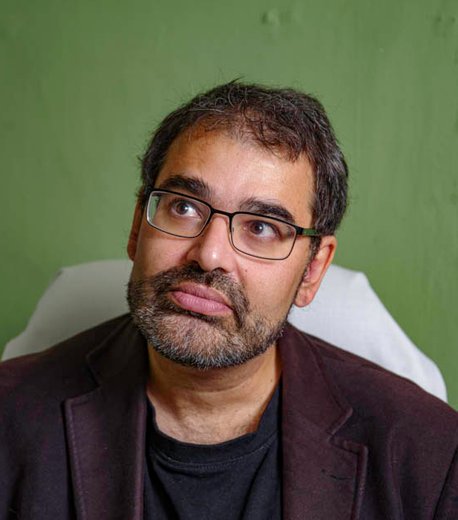
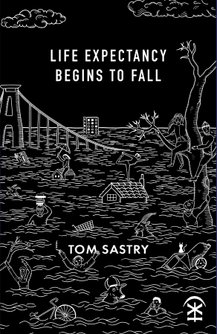
I’m very pleased to introduce this month’s guest poet Tom Sastry. His collection was published to its usual high standards by Nine Arches Press in 2025. The striking cover ‘Half Full’ is by Tom Denbigh, 2025. It’s a contemporary woodcut of the 1607 Bristol Channel Flood image.


Tom Sastry has published one pamphlet and three collections. Carol Ann Duffy said he “makes friendships and love affairs new and strange” and Hera Lindsay Bird call him “a magician of deadpan”. His poems have appeared in The Guardian and Poetry Review. His latest book is Life Expectancy Begins to Fall is described by Jonathan Edwards as “the most important – and certainly the most entertaining – book about the end of the world I’ve yet found”. Tom himself describes it as the perfect birthday present for someone with a sense of humour about their mortality.


The title poem – a sequence of six titled poems, each consisting of six couplets – is at the core of the book. It is linked to the Covid-19 pandemic and government decisions.


The collection is also a short master class on making titles work:

  • How to tell the apocalypse is happening when you get all your news from Instagram
  • Navigating the Peri-Apocalypse with Radical Self-Care
  • The preserved body of a billionaire slowly defrosts in a devastated world


These are strong poems in a variety of form, length and layout. In among the titled poems are untitled poems of six lines in italics. They create a change of tone and voice. The white space gives the reader a chance to catch their breath. Here is an example:

Everyone loves the end of the world
 
We all hope to enjoy the apocalypse 
from a distance. A good storm 
spares the roof but rattles the glass.  
Children know: destruction is funny, sometimes beautiful.

A distant inferno would enchant your night 
if you saw it from the next coast. 
So much torment is shut away, you might even be comforted 
by a Hell with space for your friends. 

We build great telescopes to watch stars die 
send divers to explore drowned cities, give prizes
for pictures of flaming sinkholes 
or bones bleaching by a dry lake. 

An old man reads of a decade he won’t see 
lethal heat, scarcity of food. 
It aches softly, like a sunset.
A new desert at the edge of town, some murders on the news. 

If the world is broken, let it be final:
a vengeful or careless god
snapping continents like biscuits.

What I fear is a Next Day.
The sweeping up and the reckoning.
The sobriety. The resumption.

As I was preparing this post, Tom wrote to me: ‘You can be pessimistic about the drift of world-historical events and still hopeful about human nature and human connection. You can be hopeful about what might happen next week or about the reception of your friend’s new book.  There’s no link between optimism and virtue or between pessimism and cynicism. So that’s really the moral centre of the book – the belief that an age of pessimism doesn’t condemn us to live mean lives. We can live well as pessimists.’

Three more poems from this collection described as ‘part-elegy and part-satire’.

Nothing to do but play cards

If it’s too late to start cathedrals
or trust in a forty-year pension plan

too soon
to snatch the thing to hand
in the name of survival

if we’re too honest
for self-sufficiency
or heroism

and our giddy hours don’t come

if the deed
in our small reach
has no resounding name

let’s call it with our silence
let’s shuffle it again.

Hope buys an absurdly expensive woodland burial plot

She is excited to be rendered
by fungi into tree-food. I feel a sharp
sadness when she says it. I check
it was not an urgent purchase
then ask questions. I learn
the particulars of the site and the price
smile at her joyous cycle of life
and secretly, inwardly
devour it with my scorn.
Life is a guzzling machine
forever eating itself.
Hope – your people need you.
Don’t give up on us.

An increasing incidence of extreme weather events

We watched the charts all week
as the old hurricane’s great lash
curled back across the ocean, not weakening
until we saw Bristol in its path.

The police told us to leave
for the nowhere we had to go
in the nothing we had to get there.
They would take the gloves off for looters.

Abandoned people are always crazy
like a fool who squares up to a storm.
Crazy like us, on the roofs of Easton
waving at the news helicopter

as the studio repeats the warnings
we were apparently ignoring
when we walked onto the M32
in a world already shaking and tearing

for a woman desperate to pass her child
into the mystery of a stranger’s car
which was crammed to the corners
with the old necessities of home.

Filling the well – art

A war memorial

Health issues have kept me housebound, but I was determined to go and see this artwork at Museum Beelden aan Zee, Scheveningen before it goes back to Marseille. A sunny, breezy autumn day, a salty tang, quiet beach.

Khaled Dawwa (Maysaf, 1985) worked on it during 2018 – 2022. He was invited to show it at Beelden aan Zee in 2025 – when here in The Netherlands we celebrate 80 years of freedom.

Voici mon coeur!

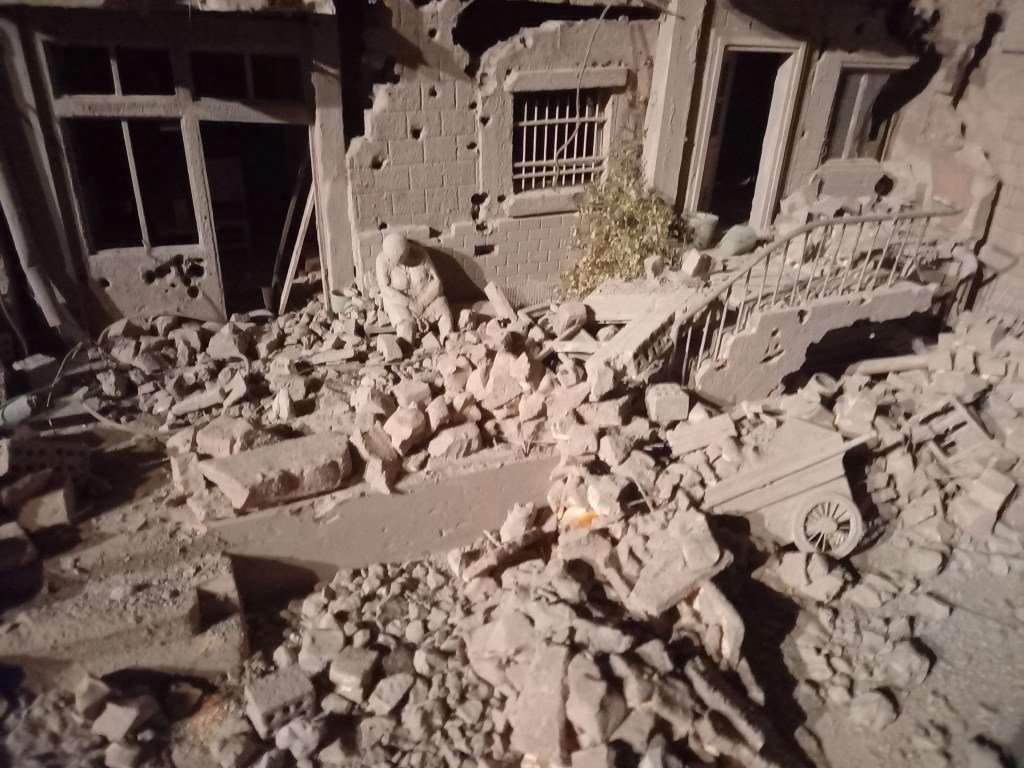
The work (tr. Here is my heart!) is a 6 m long model. It’s made of vulnerable, unbaked clay. It represents a fictional street in Damascus. Outside, there are the remains of a car, benches, a swing seat. We see material damage. The setting is nighttime.

It was a disorienting experience walking into the small side gallery as it was almost dark. A volunteer gives visitors a small torch, so we can walk around and shine into the rooms: beds, tables, chairs, a poster on the wall, a book left on the table.

Dawwa and his family fled Syria shortly after the start of the civil war. After a year in Lebanon, they travelled to France where they now live in exile. Khaled now works in a studio just outside Paris.

Before leaving he took photos of the works he had made, then destroyed them – for security reasons, or because they were too large to travel.

Voici mon coeur!, a contemporary war memorial, is a personal and emotional representation, in contrast with the collective memory expressed by traditional war memorials. A powerful and timely reminder. I found it deeply moving.

Links: https://www.beeldenaanzee.nl/tentoonstellingen/khaled-dawwa

https://www.facebook.com/share/15fJ6dg7Eq/ On this page you can find details of other works by Khaled Dawwa.

Archive – guest poet – art

Aus Herzen und Hirnen spriessen die Halme der Nacht, 2019-2020. Oil, acrylic, emulsion, shellac, straw, gold leaf, wood and metal on canvas. Dims: 471 x 841,5 x 36 cm. Collection Voorlinden.

Our guest poet this month is Patrick Wright. As I was reading his collection Exit Strategy (Broken Sleep Books, 2024) I came upon the poem Archive and discovered that Patrick and I are both very interested in Kiefer’s work.

For me one of the highlights last year was visiting Bilderstreit, a major exhibition of Kiefer’s work at Voorlinden Museum, The Netherlands. A few weeks earlier I had watched the documentary that Wim Wenders made about Anselm Kiefer. I was blown away too by the film: it’s in black-and-white and one can watch it through 3D glasses.

Kiefer was born during the bombing raids in the final months of WWII. For him, everything exists somewhere in the cycle of death and rebirth. Whenever he creates a new work, he knows that one day he will destroy it: attacking it with a flamethrower, axe, bolt cutter, or red-hot liquid lead.

ARCHIVE
After Anselm Kiefer

Before his landscapes scorched by war and history, paintings of straw
and glue, your golden hair, Margarethe, before ‘Death Fugue’, I was back at
school, deep winter. In the yard blew a few stray crisp packets; seagulls
pecked at crumbs. The annex and fence had the look of an abandoned
camp, in Polish hinterlands. Through a cloakroom window I peered,
looking for a ghost of myself, then at a ghost of myself, as the sun
poked out from a cloud and the contours of bulimia gazed back, in
sepia tones. I saw the bullies too, with razored eyebrows, piercings,
fists in my gut, spit on my shoulder, the stench of Lynx, using queer
as an insult. With my SLR, I clicked more in hope than expectation.
I fumbled with fixative, the stop bath, the gelatin swell. My negatives
solarised. I kept re-visiting as a witness. Those days, I bit the inside
of my lip, stubbed cigarettes out on my arm. When the dysmorphic
class photos were framed, still as that winter, your golden hair, said the
Kiefer print, your golden hair, Margarethe.

Flying a kite – guest poet

My friend Kathleen Kummer recently had her 95th birthday. We have had a weekly telephone call since the start of the first lockdown in March 2020. Kathleen’s poems from her collection Living below sea level have featured here before.


Flying a kite refers to the ‘90s, as the grandson is now in his thirties. He lives abroad, but regularly visits. A variation on the villanelle form, the poem successfully blends the personal and the universal.

Flying a kite

My grandson and I are flying his kite.
Though we stand on the earth’s green rim in spring,
there’ll be talk of wars on the news tonight.

We have climbed the steep meadow, have not taken fright
at the notice, Beware of the Bull. Larks sing
as my grandson and I are flying his kite.

We have coaxed it upwards, where wind and light
give life to what was a limp, gaudy thing.
Time enough for reports of the fighting tonight.

Its streamers rippling, the wind just right,
it rides the skies, a jocular king.
My grandson and I are flying his kite.

These skies are empty, but for the flight
of buzzards and invisible larks on the wing.
The skies they will show on the news tonight

will be apocalyptic, eerily bright
with the clever ways of destroying and killing
to which the whole world claims the right.
I am watching my grandson wind in his kite.

FEET – guest poet


One of the most enjoyable things I did recently was read the manuscript of FEET. Elsa Fischer had asked if I would write a ‘blurb’ for her collection coming out a few weeks from now. Elsa’s poems from her two pamphlets (Palmistry in Karachi, Hourglass) have featured here in May 2020.


erbacce press in Liverpool run an annual poetry competition. In 2012 I was a runner-up and had 12 poems in the quarterly magazine, along with an interview. There were around 6,000 other entries. This year over 15,000 poets worldwide sent a selection of their work. Elsa’s submission was one of three to achieve publication.


Elsa was a young child in The Netherlands during WW2 and her collection includes some poems about that experience. Here is Hunger Winter about the winter 1944/45, followed by the poem Remembrance Sunday.

Veteranendag, Den Haag


Since 2005, the last Saturday in June has become ‘Veteranendag’, a day to honour the more than 100,000 Dutch veterans. There is a flypast and a parade of over 3,500 serving soldiers, several forces’ orchestras, old and new equipment. On the Malieveld, the large green area near The Hague central station, are marquees and vehicles. A good PR opportunity: the army, navy and air force all need recruits …

Hunger winter


To blunt the pangs of hunger
my mother would copy recipes.
In her wartime diary, between salmon
mousse and boeuf bourguignon I find
the birthdays of uncles and aunts,
lists of friends, their ‘phone numbers
in four digits. Crossed out the names
of those who perished. Lines of French
poetry: how dawn had chased the night
the poet would have wanted to last longer.
A list of socks, hats, underwear and who
she knitted for. A monthly record of her
bleeding. Exclamation marks around my
name on a page in September.

Remembrance Sunday


One hundred years old.
And two months, he adds
and in my regiment
the last man standing.
Holding a globe
he points at El Alamein.
That was a good one, he says.
Grins.

Lemonade in the Armenian Quarter – guest poet

This month’s guest poet is Sarah Mnatzaganian. We first met on a Poetry Business residential workshop a few years ago. Sarah is an Anglo Armenian poet based in Ely, UK. She grew up in rural Wiltshire and in her late teens spent each summer with her father’s family in the Armenian Quarter of Jerusalem.

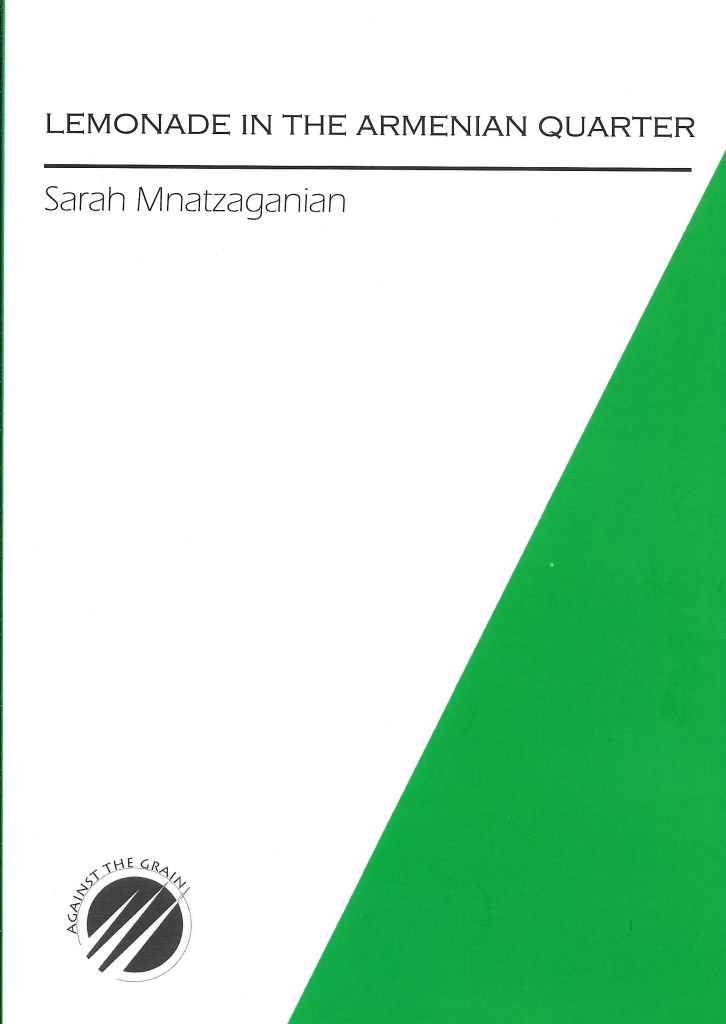
Her debut pamphlet, Lemonade in the Armenian Quarter, is published by Against the Grain Press. Sarah’s work has appeared in The North, The Rialto, Poetry News, Poetry Wales, Poetry Salzburg Review, Magma, Pennine Platform, London Grip, Atrium, and many anthologies. She was a winner in the Poetry Society’s winter 2020 members’ competition on the theme of ‘Youth’ and won the inaugural Spelt nature poetry competition in 2021.

In the 2022 Saboteur Awards Sarah’s debut with its ‘wonderfully moving poems’ gained the award for Best Poetry Pamphlet.

Lemonade in the Armenian Quarter

Uncle Hagop planted lemon trees outside his house
where small passionate tortoises collide each spring
with the hollow pock of a distant tennis match.

At night his ripest lemons dropped into a crackle
of leaves. He grunted through the cardamom-coffee kitchen
into the courtyard to fill his hands with fruit.

Auntie soothed the juice with syrup and iced water.
Uncle drank, clacked his tongue and sang, My Heart
Will Go On, his head thrown back like a songbird.

The lemons lay thick last February. My sister filled a bag
for Uncle. She put a smooth yellow oval into his hand
and helped him lift it to his face to smell the zest.

Dad asked the nurse for sugar and a knife. He cut,
squeezed, stirred. See, Hagop, I’m making lemonade
from your trees. Watched his brother smile, sip, sleep.

Egg Time

To my mother, Madeleine

Give me an egg, round as childhood.
I’ll tap its innocent shell; push sideways
through its Humpty Dumpty head to find
a core of molten gold or the dry pollen
of a hardened heart. May this teaspoon
teach my tongue the taste of lunch hour
on a school day when I’m six, hugging
the bump under mum’s dungarees.
How did the morning go? Watching her
butter home-made bread. Reading aloud
while the baby kicks. Back down the lane
for the lonely end of playtime, her love
like albumen around my ears and in
my eyes. Voices water-slow. Whistle
blown from the other side of the world.

Juice

To my father, Apraham

Every time I set spade against turf,
you’re there, cutting grass-topped cliffs
into our borders, neat as the Normandy coast.

You snatch sweat from your face
and ask for Lemon, half a lemon,
squeezed, with water please, darling,
it quenches the thirst.

I silently sing each syllable to myself
in your voice, like no other voice,
licking the ‘l’ in half almost as long as in lemon,
expressing the juice of each word with your verve,
crushing the fruit’s face into ridged glass
and clouding cold water with the sharpness you crave.
Each sucked finger stings.

Now I want to watch your dark throat dance
while you drink.

At the end of my suffering / there was a door

Have you ever hated anyone enough
to ask an iris leaf to turn into a sword
sharp as the new moon, cold as a snowdrop,
irresistible as spring grass growing disorderly,
before it’s mown to match the wishes of one
demanding pair of eyes? Don’t lose focus.

Take one, narrow, curved iris leaf and hold it up.
If the heart you want to penetrate is hard enough
to steal a country and the lives from its people;
if that heart won’t learn the wisdom of the iris,
the snowdrop and the moon – that life is mutable –
then that heart will feel the leaf turn to steel
and, to grant your wish, will stop beating.

The iris will flower blue and yellow, as it should,
for the people returning to their country,
as they should, and there will be no blood
on your hands.

The title is a quotation from The Wild Iris by Louise Glück.

Sirens

Credit: AdAdriaans via Pixabay


Tomorrow is the first Monday of the month when the 4,000+ alarms through the Netherlands are tested. This alarm-and-warning system was set up after the Second World War. The monthly test stopped after the fall of the Berlin Wall in 1989, and for a period the sirens were only tested once a year. The government wanted to introduce a warning system by mobile telephone, but this did not prove effective. So, from September 2003 the monthly sounds can be heard for exactly 1 minute and 26 seconds.

The alarms aren’t rung if the first Monday falls on a religious or national public holiday, or on the national Remembrance Day of 4 May. This month, the Dutch people will be reminded beforehand that the sound is just a test.


On Monday I am sending the final manuscript of my collection Remembering / Disease to Aaron Kent at Broken Sleep Books. I have chosen a poem from the new book that includes a siren and want to thank Isabelle Kenyon of Fly on the Wall Press for first selecting it.

Credit: TBIT via Pixabay

Voice

I’m scared of the voice that tells me to let go of the wheel
it’s an old man’s harsh gritty cold pushing me
that time Monday sunny A487 heading for Porthmadog

black figures carry bags home whatever home might mean

silence only sirens calling the dog-end of the year

falling is kind of doing something
you can fall sideways head-first backwards
I have worked all these years to stay upright
running like a rabbit on a metal track

Stonemason – writing prompt

Credit: Ray Miller via PIxabay

Here in Scheveningen, the seaside district of The Hague, it’s a wet Sunday. Tomorrow it’ll be World Animal Day. Here is a short poem with wet animals, inspired by seeing the peregrine falcons at Norwich Cathedral. It’s from my pamphlet A Stolen Hour, published by Grey Hen Press.

Prompt: What animal(s) did inspire you? Where did you first see it? What day was it?

Stonemason

I am the last stonemason.
Green water spouts from
the gargoyle to my left.
I am hidden up here
with the two peregrines,
sodden on their cathedral nest.

My apprentice didn’t come today.
Black sky, lightning and
the distant rumbling of armies
advancing, retreating.
I count hours on my arthritic fingers.

In the fields near Arnhem – poem

During this year I’ve been posting poems by my friend Kathleen Kummer. This is the last one. Kathleen lived and worked in the Netherlands after she married a Dutchman and taught German and French at an international school.

The battle of Arnhem took place during 17 – 26 September 1944. Operation Market Garden failed when the allied forces could not take the bridge over the Rhine.

In the fields near Arnhem

It falls like a petal from the last rose of summer:
a bus ticket, Arnhem Municipal Transport, flutters
from the faded pages of L’Art D’Etre Aimée.

Learning how to love and be loved, which was harder,
was what I had no idea I was doing that summer
of trains, boats and buses, all bound for Cythera.

It sounded so playful in French: Ecoutez-le,
(listen to him), passionnément. Ils adorent les cheveux,
so, wear your hair loose. But this was no game, we were serious.

Not so much so that we thought how, six years earlier,
they had floated down from the sky, white flowers
in their thousands in the fields near Arnhem.

Horses of a different colour – prize-winning poem

Anthology, publ. Dempsey & Windle

It was a lovely surprise to get this anthology ahead of schedule, so I could read it before leaving for the Netherlands. Dempsey & Windle organise an annual competition, with options to enter single poems as well as a batch of 10 to win publication of a pamphlet. The anthology has poems by the winners of both categories, as well as the highly commended and longlisted poems. I was glad to have my tribute to a poet friend included. On Thursday 10 June in the evening there will be a reading on Zoom with a number of poets reading. Contact Dempsey & Windle for the link.


This poem by fellow poet Rod Whitworth has it first publication in the same anthology. Rod and I met several years ago on writing workshops. I admire its economy and delicacy. It’s not surprising it gained a 2nd prize.

Demobbed

Go on. Hold his hand. You’ll be all right.
I looked at the man in the new suit
they’d told me was my dad and I walked
at his side, hands in my pockets.

We stepped into the street, his right hand
steering Megan’s pram with ease and command
past Cropper’s with the pigeons, and I walked
at his side, hands in my pockets.

Down Platting Brew, round the curve
over the culverted brook and a hard shove
to the road to Daisy Nook, me walking
at his side, hands in my pockets.

Past the milk farm – Whitehead’s –
and the field with the pond and reeds,
the greying April snow. I walked,
my right hand warm in his left hand.

The day we switched off the machine,
I told him they’d arrested Pinochet,
though he was past cheering, and he lay,
his right hand cold in my left hand.