The New York Times has just recommended The Hague as a ‘cool’ destination. A contrast with Barcelona and Paris where it’s 40 Celsius. The article praises the ‘cobbled streets’ and ‘picturesque canals’. You can view Girl with a Pearl Earring in the morning, and sip sangria on Scheveningen Beach in the afternoon.
Well, it won’t be cool here: temperatures up to 36 degree Celsius are forecast from today. The Hague is a great travel destination: several outstanding museums of which the Mauritshuis is one. That girl is, however, leaving this Friday. She’s destined for Japan where she’ll be on display in the Nakanoshima Museum in Osaka (21 August – 27 September).
As it may be hot on the beach, let’s head to Voorlinden Museum instead.
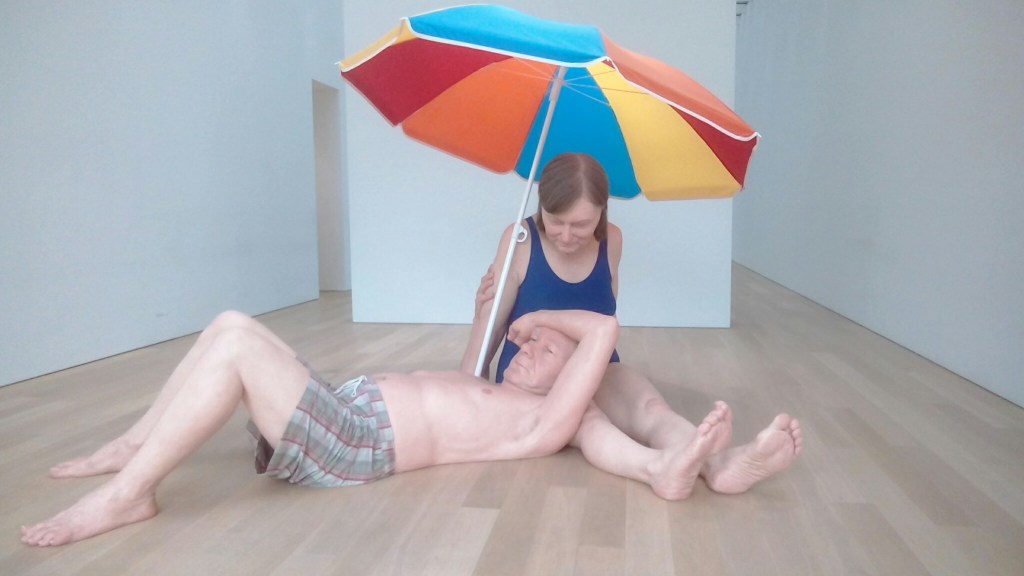
Couple under an Umbrella, own photo
Ron Mueck made the work of fibreglass and silicone in 2013. It’s hyper realistic – the veins and hairs are there. The work is exactly twice human dimension. Mueck has also made smaller works. The couple do not represent specific individuals, but they are universal and recognisable.
They don’t have to walk far to take a splash: the famous Swimming Pool installation by Leandro Erlich is just metres away. Originally made for the Venice Biennale of 1999, the installation was then moved to the 21st Century Museum of Contemporary Art, Kanazawa, Japan.
Voorlinden opened 10 years ago and the installation there has the same swimming pool blue, lights and steps. The shimmering water is an illusion. There is 10 cm of water above transparent glass. Visitors can enter the installation by going down steps.
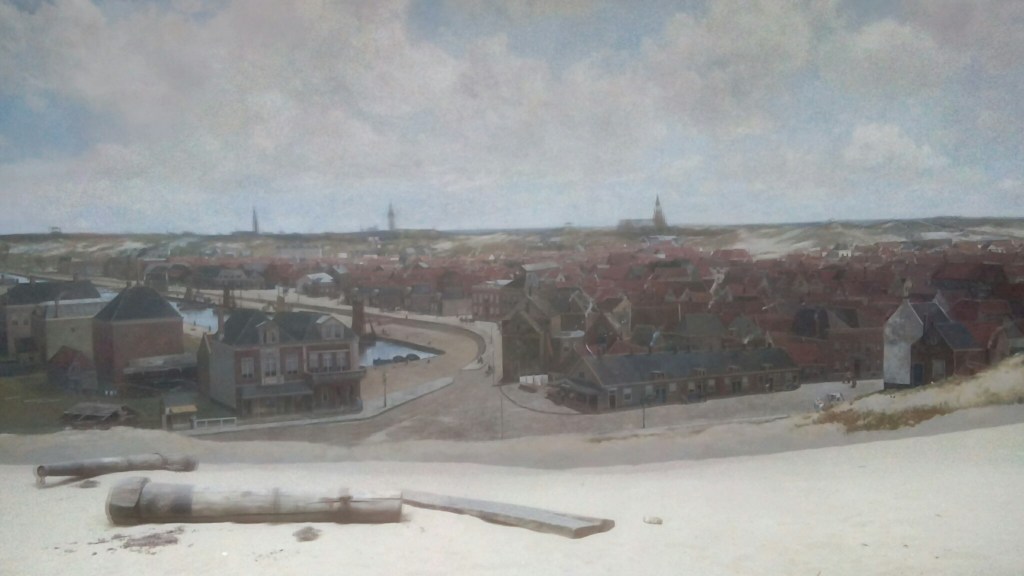
Panorama Mesdag, Scheveningen village with The Hague in background. Credit: T Duijndam.
Recently two friends were over from the UK – a Seville reunion. They stayed at Scheveningen, minutes from the beach and boulevard. It was mostly sunny. I pointed out some sights: the red lighthouse, the building with the green shutters, and Seinpostduin – the high dune on which the painter Hendrik Mesdag sat in 1880 to make the preliminary sketches for the commission he’d received for a 360-degree painting.
At one time there were many panoramas. They were expensive to maintain and once photography and film were available, people’s interest declined and most were demolished.
Panorama Mesdag, The Hague (1881) is the world’s oldest surviving panorama in its original location. The painting is over 14m high, has a diameter of 40m and the circumference is 120m2. That makes it the largest painting in the Netherlands.
Scheveningen was then an independent fishing village with its own clothing and dialect. There were about 500 houses and people lived from herring fishing.
When he got the commission, Mesdag was already well-known for his seascapes. Several of these are shown at the Panorama. He wanted the sky to look as though it was the weather on one single day. He made many sketches, also of the houses which were transferred to canvas using a grid. The original glass cylinder in which he sat is shown at Panorama Mesdag.
The Panorama commission was a massive job and Mesdag was fortunate to be able to put a team together: his wife Sientje Mesdag-van Houten who was an established painter in her own right, Théophile de Bock who painted the sky and dunes with broad brush strokes, Bernard Blommers, and George Hendrik Breitner who specialised in painting horses. Mesdag himself focused on the sea and the flat-bottomed boats on the beach.
It took them four months to complete the work. Instead of a signature, Mesdag painted Sientje. She sits on the beach painting under a white parasol. Panorama Mesdag opened on 1 August 1881.
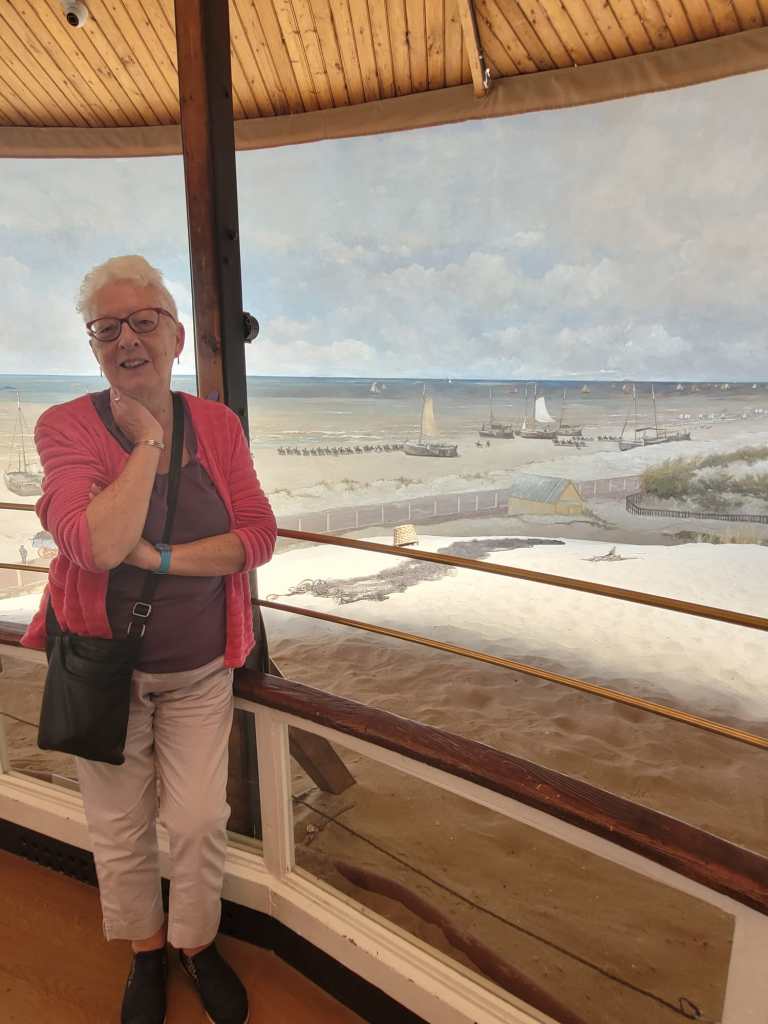
It’s an astonishing experience – come up the wooden staircase and suddenly you stand on the viewing platform: scenery all around you. There is so much rich detail: dozens of boats, horses pulling in the boats, cavalry horses, the sky, the women out with their washing, bathers, the steam train on its way from The Hague, birds.
Because of the glass roof, the weather changes as you are there, and the illusion is complete because the platform is surrounded by real sand with objects on it. You are standing on Seinpostduin, more than 140 years ago.
My thanks to David Cooke, Editor of The High Window, where this poem first appeared.
Panorama Mesdag
Invisible skylights let through the light. Just as I arrive upstairs, the sun comes out across the busy beach I know so well.
All those horses. In two neat columns, the cavalry on exercise, heading south. Other horses pull the flat-bottomed boats onto the sand. Fish is being sold straight from the boats. Women are repairing nets.
Mesdag’s wife has been included. I know where to look for Sientje, painting in a folding chair, striped sunshade.
Am I hallucinating the sound of gulls? I see the seams in the canvas, and I don’t care. As I go round the wooden platform, here is the washing laid out on the grass, a plume of smoke, the empty clog.
Today I am voting twice: first for a political party, then for a tree.
In a busy city, there is little room for trees to become old. On average, a city tree lives for 50 years.
The Hague doesn’t have many old trees: during WWII a lot were cut down, their wood used for cooking and heating. Of the 120,000 city trees, only around 1300 have the ‘monumental’ tree status.
Such trees are over 50 years old and meet at least one of these criteria: it is irreplaceable, of rare type, shape, or size. It may have historical value, or provide a home for rare plants or animals.
Photo credit: Joost Gieskes
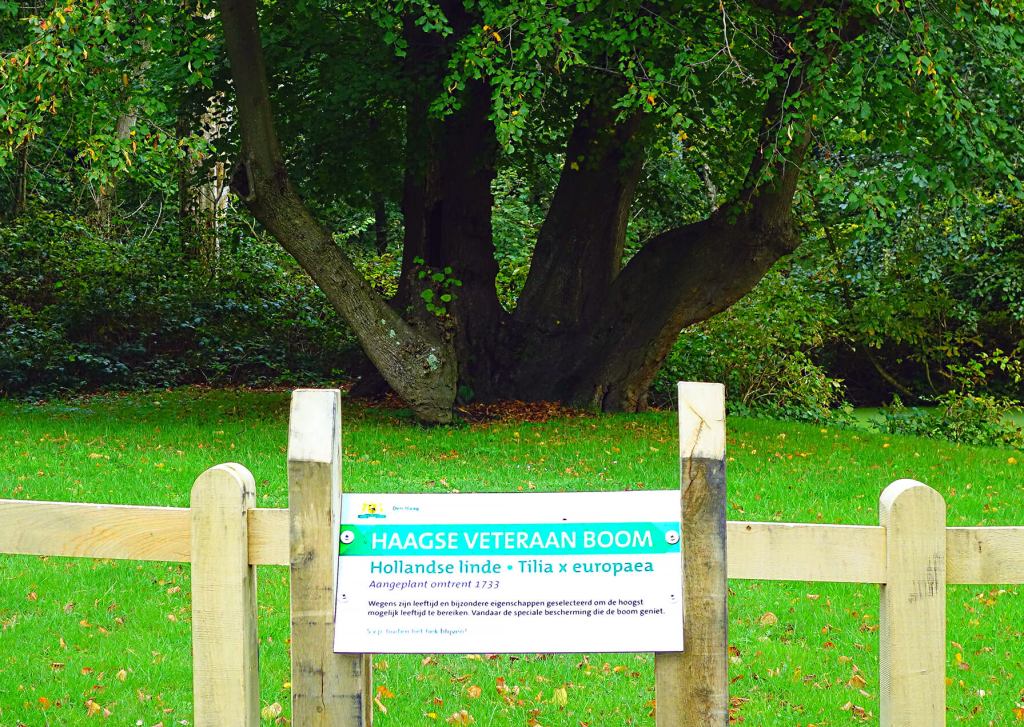
The veteran tree initiative comes from the UK. The first official veteran tree of The Hague – even of The Netherlands – is a lime or linden tree (Tilia x europea) on the Clingendael Estate. This was planted around 1733.
I came across it on my walks during the first 2020 lockdown: Clingendael is close to the camping where I had my caravan. I was intrigued to find a tree in a corner of a field with a fence round it.
A veteran tree is protected and allowed to remain in place forever. A ‘monumental’ tree may be cut down when it becomes dangerous or diseased.
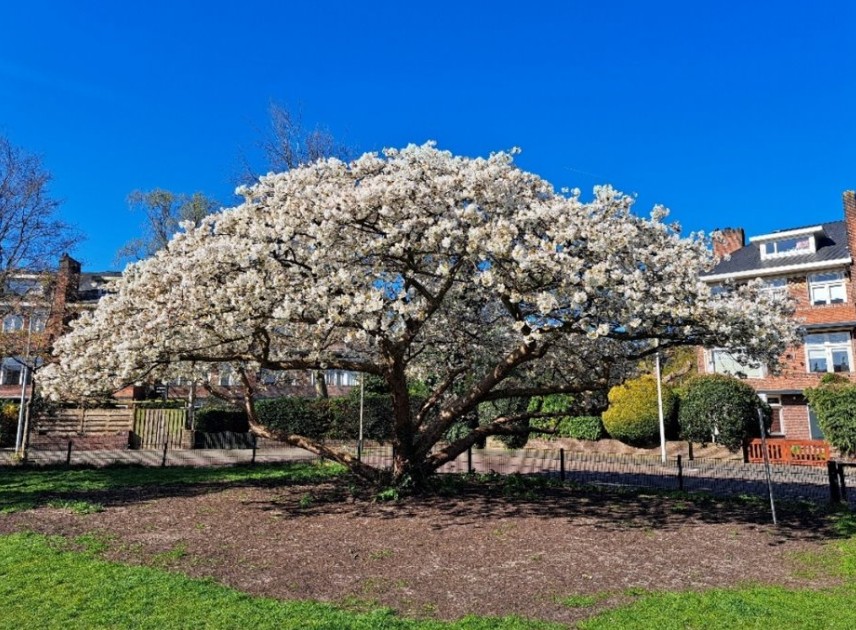
Japanese flowering cherry, tree. 92, 13 m wide.
The Hague local authority has nominated 10 trees and invites people to vote for five of these to become a veteran tree. The five trees that don’t get veteran status will become monumental trees. All the nominated trees are between 70 and 220 years old.
This is much harder than choosing a political party!
Will I choose that Japanese cherry, or the ’12 Broers’, tree no. 73, a 220-year-old oak that had a tough life (cut down often) and now has 12 trunks (the brothers), or choose the 145-year-old Mourning beech that houses falcons. I will let you know.
Storks are said to bring happiness. The bird has been the official emblem of The Hague for centuries. Until the beginning of the last century, storks with clipped wings walked the many fish markets in the city, keeping the streets clean.
I hope this new year will bring health and happiness to you and those you hold dear. The poem is from my new collection Remembering / Disease published last October by Broken Sleep Books. It first appeared in the online magazine Dust, edited by Tara Wheeler.
Storks also feature in my poem High wind. It was selected as one of 20 poems by a jury for the Poetry Archive’s Poetry Archive Now! Wordview 2022. You can see and hear me read it here.
Waiting
The water meadows are waiting for the storks to return
always invisible the other side of her face
in this book there is snow on every page
even an old potato can be turned into a Christmas stamp
the naming of colours is not a science. I vote for bird’s nest grey
The warm, sunny weather this week has helped me to stay more in the present. I’ve been for walks in the nearby estate of Clingendael.
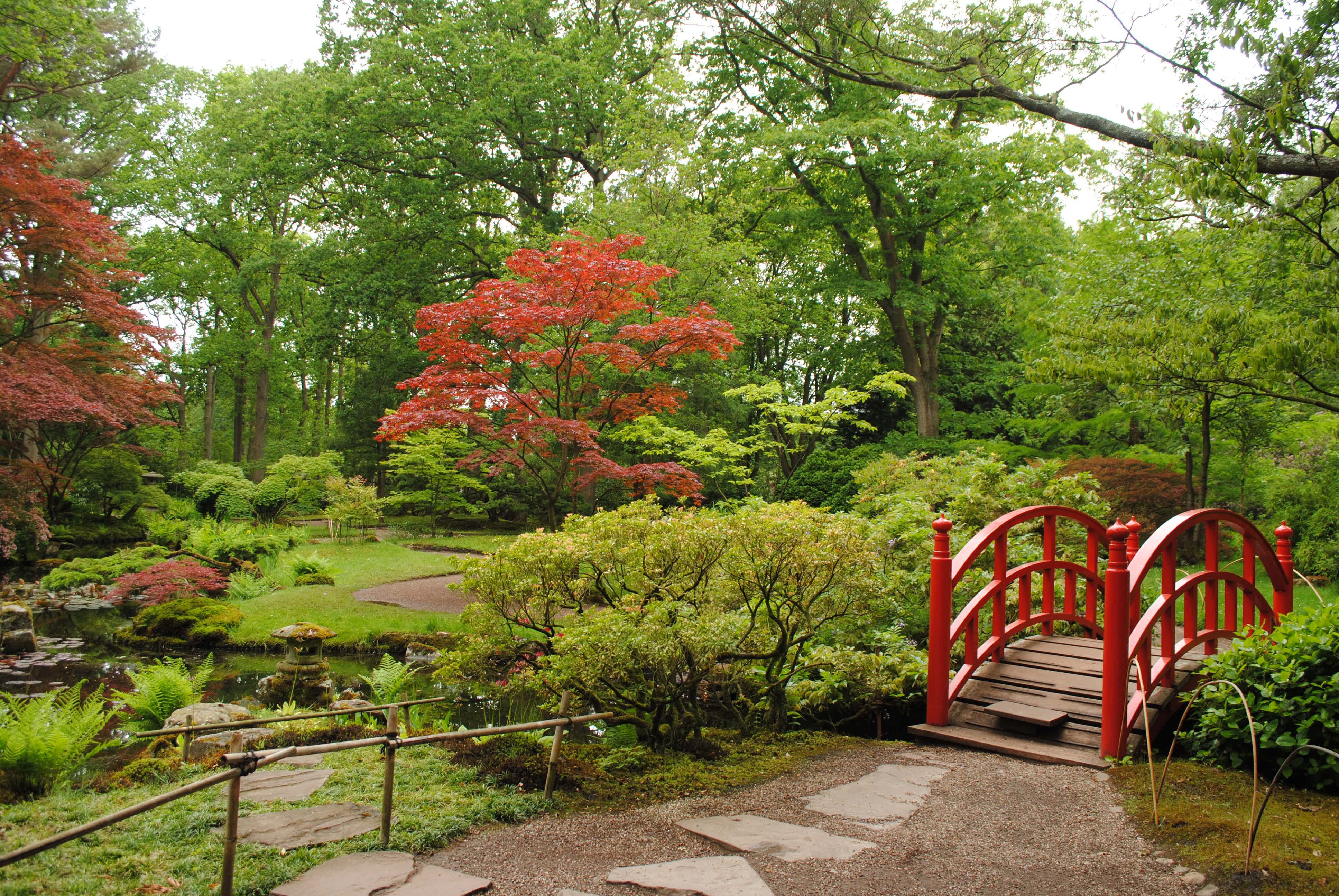
Clingendael estate has a 17th Century manor house which is home to the Dutch Institute for International Relations. Since the 16th Century the gardens have been remodelled, from the original French design, to the popular English landscape style. Now you can find a rose garden, splendid azaleas and rhododendrons, and a walled fruit garden. There are some marked walks, cycling paths, and canoeists and rowers can travel through by water.
However, Clingendael is most famous for its Japanese garden. It is the only Japanese garden from around 1910 and is, therefore, of great historical importance and a state monument. Marguerite M, Baroness van Brienen made several trips to Japan by ship to purchase the lanterns, statues, bridges and the wooden pavilion. Because of its fragility, the Japanese garden is only open eight weeks of the year, from mid-May to early July. Because of the Corona-crisis, it is closed. Here you can view a short video clip that The Hague city council put on their website.
Photo credit: Ted Koehler
My poem Moment from my second collection Nothing serious, nothing dangerous was inspired by a poem with the title This Moment by the Irish poet Eavan Boland who died recently, aged 75, after a stroke. Her poem, with its short, choppy lines starts Aneighbourhood/At dusk and is an excellent example of how a short poem can give us a snapshot of time, the night and temporality. You can read the original poem here. It is deceptively simple, but Boland uses several poetic techniques to achieve the effect, such as alliteration and repetition.
Moment
A suburb at dawn
People are turning back
from dreams
into their own lives
Frost and spiders,
shrubs cradle themselves.
One side of the road is black.
One row of houses a yellow pink.
A cat wakes up
to the footsteps above,
secure in his oval basket.
Frost fades,
spiders stretch,
ferns unfold in the sun.
Panorama Mesdag is a cylindrical painting, more than 14 metres high and 120 metres in circumference. It’s a view of the sea, the dunes and Scheveningen village as it was in 1881. It’s the oldest 19th century panorama in the world in its original site.
Ever since getting my caravan in Holland, I’ve been visiting several times a year. When I am standing on the circular viewing platform in the centre, I know I’m just 14 metres away from the canvas. I know it’s all an illusion, but I can hear sea gulls, I get the salty tang, I see clouds pass by and the sun break through.
Painting the enormous canvas was a team effort: Hendrik Willem Mesdag with his wife Sientje and various able painters from the Hague. Other panoramas portray violent scenes (the battle at Waterloo, the Crucifixion of Christ). Here it’s visible silence, still asthe hourglass (Dante Gabriel Rossetti), the tranquility of everyday life. A few fishermen are messing about with their nets, the boats are beached, the cavalry are walking their horses on the sand, women are chatting in a doorway, a dog lies down quietly.
Before the camping closes and I lock up my caravan, I will go and stand on that viewing platform again and say my goodbyes to Panorama Mesdag. The poem is by my friend Keith Lander.
The Mesdag Panorama
—after a panoramic painting by Mesdag in The Hague
I’m on a school trip to The Hague
transfixed by the Mesdag Panorama,
especially the seascape stretching away
from the viewpoint on the man-made sandhill,
with fishing boats moored on the vast beach,
a troop of cavalry men in training,
and, joy of joys, a donkey ride.
When no one is looking I climb
over the railings onto the sandhill
and, without looking back, skip away
laughing and tumbling down the slope
towards the beach, the north sea breeze
in my hair, to run behind the military
and have endless rides on the donkeys.
Forty years later, a bored business man
with time to spare before an appointment,
I visit the Panorama and remember
I’ve been there before as a schoolboy.
As I stare at the seascape again I see
the boats on the beach, the military men
and a lost boy waving from the donkey ride.