It’s an enormous pleasure introducing this month’s guest poet. We met a while ago when I attended one of Alexandra’s online courses. She’s an inspiring tutor.
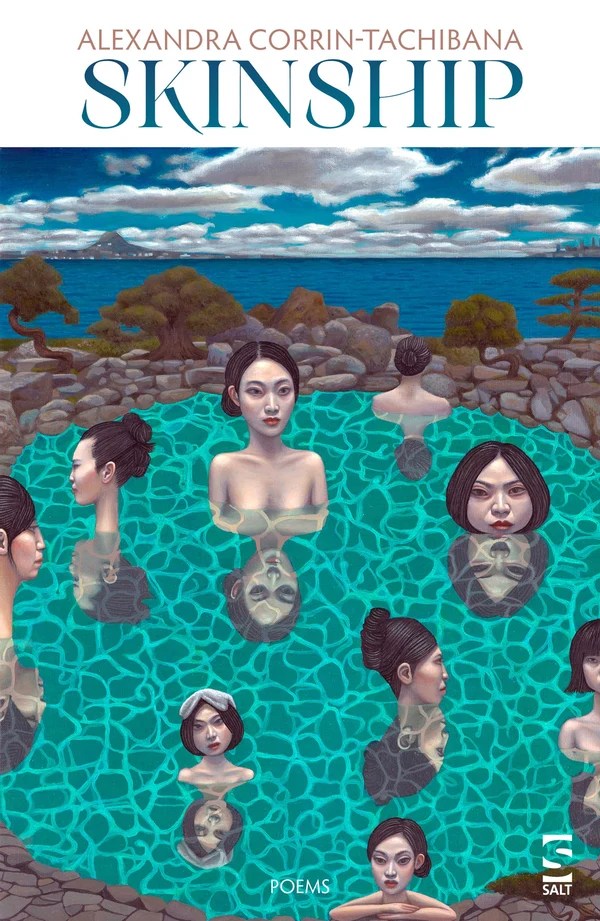
You’ll find her biography at the end of this post, with links to two more poems. This week Alexandra’s second collection with Salt is published. Skinship is a full collection: formally innovative in using and adapting traditional Japanese forms (haiku, tanka, senryu, haibun, and zuihitsu). I was particularly struck by the ‘burning haibun’.
The poems are ‘rooted in Alexandra’s lived experience of Japan’ and rich, poignant and memorable. There is a well-judged balance of humour and sadness. It’s not surprising that many of the poems have already been published and successful in competitions.
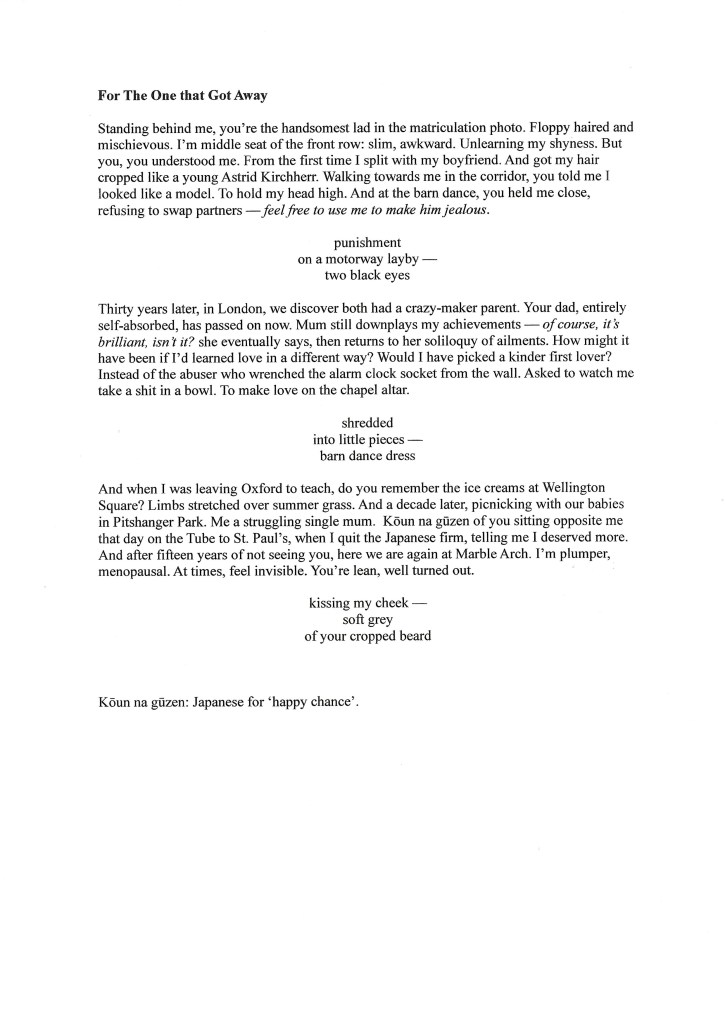
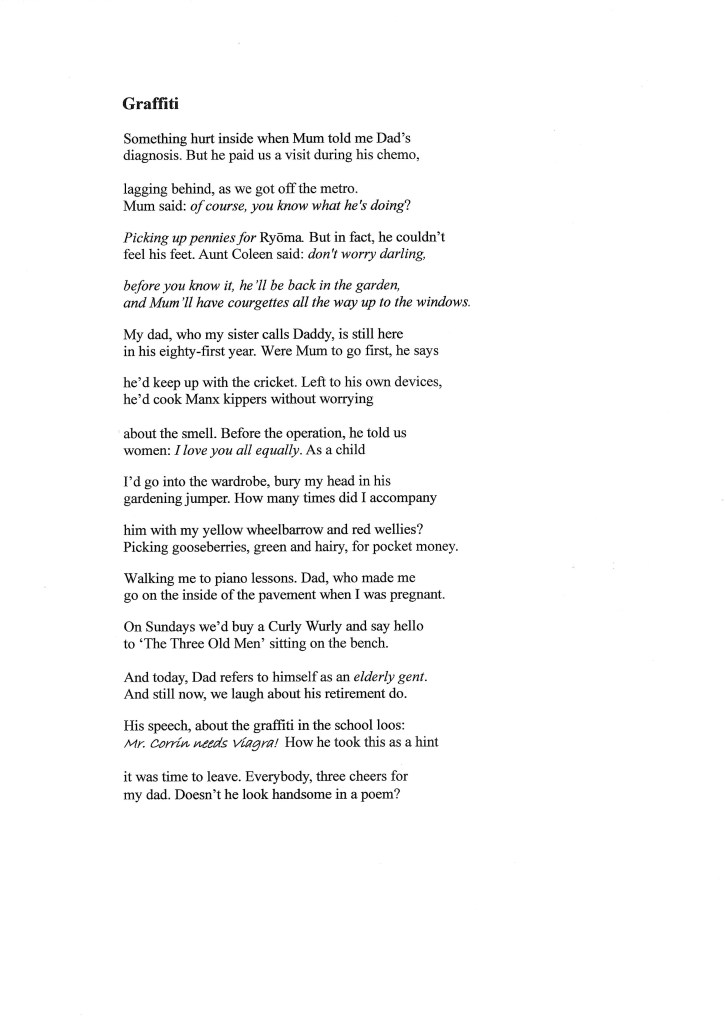
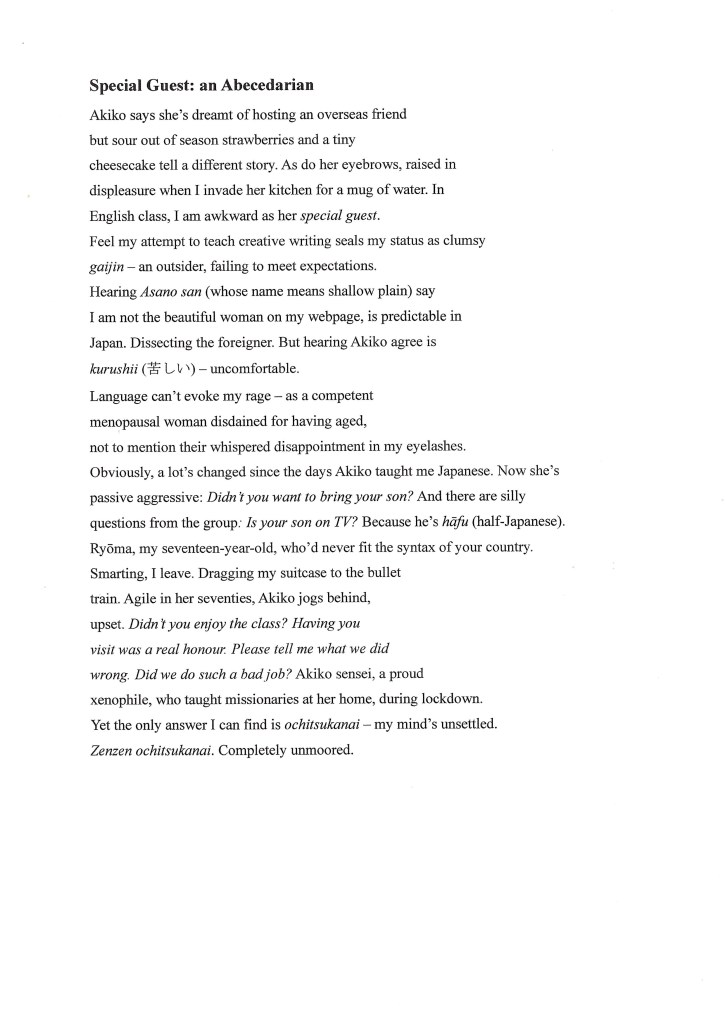
Here are the three poems which I chose from my long shortlist. To preserve the original features, the poems are presented as images.
Biography
Alexandra Corrin-Tachibana is the author of two poetry collections: Sing Me Down from the Dark and Skinship, both published by Salt publishing.
This year, she won the Frome Festival Crysse Morrison Poetry Prize, as well as Verve’s February Poem of the Month competition, was placed third, by Mimi Khalvati, in the Kent and Sussex competition, and shortlisted for the Wolves Lit Festival competition. She is shortlisted for the 2026 Forwards Prize for Best Single Written Poem, for her poem, Madam Gout, originally published by Magma.
Alexandra lived in Japan for 10 years and has Masters’ degrees in Japanese Language and Culture and in Writing Poetry. She is based in Newcastle-upon-Tyne and teaches for The Poetry School and The Poetry Business. Her most recent work is published or forthcoming in Pennine Platform, The North, Vervacious anthology (Verve Poetry Press), The Alchemy Spoon, and online in And Other Poems.
It is a great pleasure to introduce this month’s guest poet David Bingham. We first met many years ago through the British Haiku Society. David was President of the Society from 2020-2022, and in 2020 he was the winner of the British Haiku Society International Haibun Prize. His poetry appears regularly in a wide variety of magazines. See below for further details.
The haiku have all been previously published: in Presence, Blithe Spirit, or Time Haiku. The tanka first appeared in Blithe Spirit and the BHS Tanka Anthology 2022, while the haibun was the winner of the British Haiku Society International Ken and Noragh Jones Haibun Award, 2017. I hope you enjoy the selection.
Haiku
a lifetime overcoming gravity – still it gets me down
Private Keep Out molehills on both sides of the fence
clear night sky – lights from both the living and the dead
away in the wind … the word-filled air
is there a word for it? the sound swans make when they fly
late spring meadow… within the yellow the blue of summer
storming the old hill fort – bluebells and celandine
inland sea the wash from our boat moves the border
stream through sunlight through stream
closing over trails in algae where the ducks have been
I turn to call the dog … then remember
Euston Station – my skin ripples in the hand drier
an apology… the predictive text writes it for me
Tanka
sun shine and motorway spray – I drive through rainbows to be with you
silently together after all that talk watching swallows hawk for flies over the meadow
on waking I turn my dreams inside out letting the seams show for the rest of the day
doors left wide open revealing an unlit space nothing here to steal but the darkness
Haibun
Sleight of Mind
Some people need to know how he pulls the shining light bulbs from his mouth, levitates above the stage or escapes from a straightjacket.
Me, I like the mystery of it; the explanations are always so mundane. True magic lies in the imagination. Switching off the rational mind. Letting yourself go and trusting the conjuror.
I do it with words. Like how I brought you here. Even if you asked me, I couldn’t tell you how it’s done.
snowdrops … mistaking ‘what is’ for ‘what isn’t’
Biography
David Bingham’s debut poetry collection The Chatter of Crows was published by Offa’s Press in October 2014 and in 2020 he was the winner of the British Haiku Society International Haibun Prize.
His poetry appears regularly in a wide variety of magazines, including Blithe Spirit, TimeHaiku and Presence and in anthologies, including: the Wenlock Poetry Festival anthologies for 2012, 2014, 2015 and 2016; Beyond Words, 2018 and where silence becomes song, 2019, the International Haiku Conference Anthology, published by the British Haiku Society; In the Sticks, 2021 and Away with the Birds, published by Offa’s Press; In Snow and Rain, 2022, an anthology of tanka published by the British Haiku Society; and Festival in a Book, published by the Wenlock Poetry Festival, 2023.
At different times, he was editor of both Borderlines and Blithe Spirit magazines and joint editor of the haiku and related genres anthologies Ripening Cherries, published by Offa’s Press, 2019 and Shining Wind published by the British Haiku Society, 2024.
He has read his work in arts centres, pubs, theatres, on local radio and poetry and literature festivals. He has read at City Voices in Wolverhampton, Country Voices in Shropshire and as a member of Green Wood Haiku at the BHS International Haiku Conference in St Albans in June 2019.
As part of the humorous poetry double act, Bingham and Woodall, he has performed at the Wolverhampton Lit Fest and Comedy Festivals in 2017 and 2018, and at the Ironbridge Festival in 2019.
Here is the second selection of poems by Judy Kendall, our June guest poet. She lived and worked in Japan for almost seven years. Cinnamon Press published four collections of her haiku and ‘mainstream’ poems. You can find her biography below her writing.
Poems:
The First Fountain Ever Placed In A Japanese Garden for my mother
more than half is the sound of it as it splashes on the stone rim
this is the part the thousands of photographs will never reach
their takers stop to make a frieze and then move on
no chance of hearing the other half clapping its moving shadow in the trees
the shudder when the leaves follow the foam
which drops, unmoved as if thrown by a boy to fall through air
diluting dissolving into parts
Note: The first fountain in a Japanese garden was built in Kenroku en, Kanazawa, in 1861
Driving To Noto
Men are better says Toshi I know no they are not says I (I also know) and so we argue to the tip of Noto
To Suzu where the wood huts slump in shock plopped suddenly in frocks of snow and the sea is whipped to icicles of frenzy
Over a nabe pot of fish and cabbage (Toshi warns me not to call it cabbage for it is the vastly superior hakusai) our host asks me my age
Taken aback (I`m older than he thought more single), he inquires don’t you like men?
So I assure him only frequent country-moving has prevented me from choosing one of them
The returning road is white, wide as a field the ditches spread themselves with frosting and the windscreen blanks out like a blizzard
Toshi scrapes at the iced-up wipers singing to himself, waving me in
Midwinter hangs in the boughs
The pine trees are bent nearly in two laden with second helpings
(earlier version published in Ambit)
Short poem, haiku and tanka fromThe Drier The Brighter (Cinnamon Press, 2007):
Poem:
5 am
these cold skies cheating the dawn,
these bits of tree, blocks of houses too close to houses, shrouded people, shrinking in the weather.
Haiku:
too much autumn the reds are almost scorching now a mouth brimming with leaves
tanka:
leaving.
not one stick of furniture in the room. in the heart,
no tears.
(previously published in Presence)
Biography:
Judy Kendall worked as an English lecturer at Kanazawa University in Japan for nearly seven years. When she first went to Japan she was a practicing playwright but she soon began to focus on poetry and haiku, kickstarted by an invitation to to participate in a collaborative translation of Miyaiki Eiko’s haiku. This became the bilingual publication Suiko /The Water Jar. Since then she has been writing haiku and haibun along with other poetic and prose forms. The haiku mode has informed her four Cinnamon Press poetry collections, particularly Joy Change – composed while she was in Japan. She has won several poetry awards, recently receiving a 2019 Genjuan International Haibun An Cottage prize, and is the essays and bilingual translations editor for Presence haiku journal. She has also run the Yorkshire/Lancashire haiku group.
She is Reader in English and Creative Writing at Salford University, and aside from haiku and haibun, works as a poet, poetry translator and visual text exponent. She has published several articles and books on the translation and creative process, including ‘Jo Ha Kyu and Fu Bi Xing; Reading|Viewing Haiku’ in Juxtapositions, 1 (2). She is currently putting the finishing touches to a monograph for Edinburgh University Press on Where Language Thickens (focusing on the threshold between articulation and inarticulation in language – a threshold in which haiku itself is surely situated).
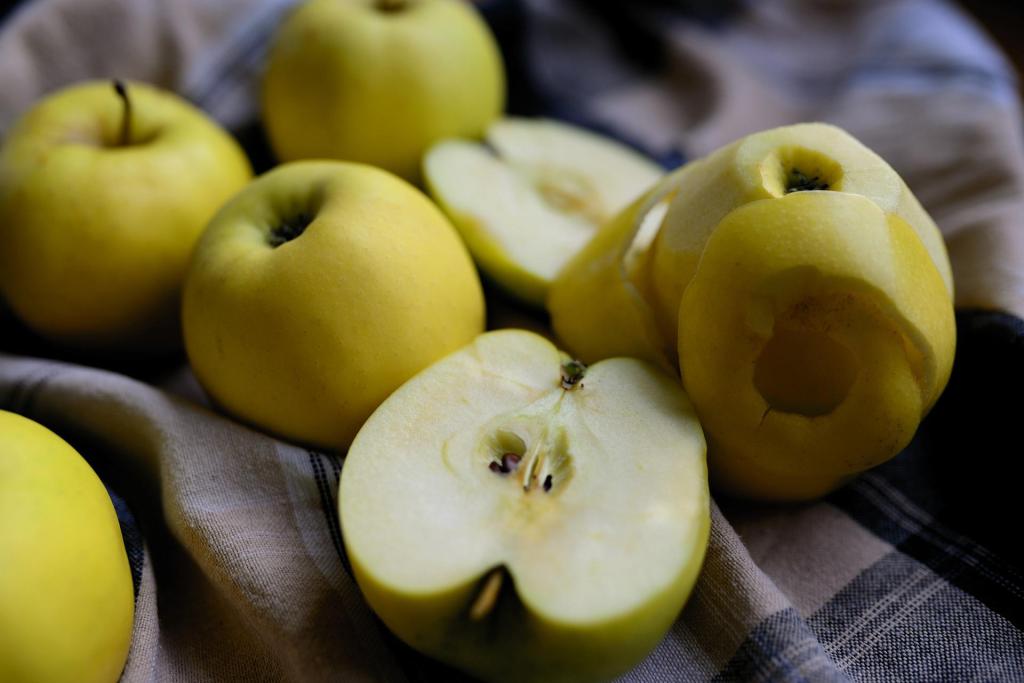
National Apple Day falls on the 21st of October. It was created in the UK by the charity Common Ground in Covent Garden, London on 21 October 1990 to raise awareness about the importance of diversity in different communities. Apparently, there are about 7,500 varieties of apple grown globally. In my local Hoogvliet supermarket I can find six: Kanzi, Pink Lady, Golden Delicious, Granny Smith, Royal Gala and Jazz.
Celebrations take place in the UK throughout October, so go to a fair, take part in an apple peeling contest, bake or eat an apple pie. Here in the Netherlands, traditional Appeltaart always has a good dose of warm spices – cinnamon, ginger, nutmeg. They are baked in a spring form and have a lattice crust. I will have mine with a good dollop of sweet whipped cream, thank you.
My poem is somewhat melancholy. It has the feel of a tanka – the first three lines giving a description, with emotion and reflection in the last two lines.
carefully quartering soft red apples into a compostable bag – I still wait for the letter that will never come
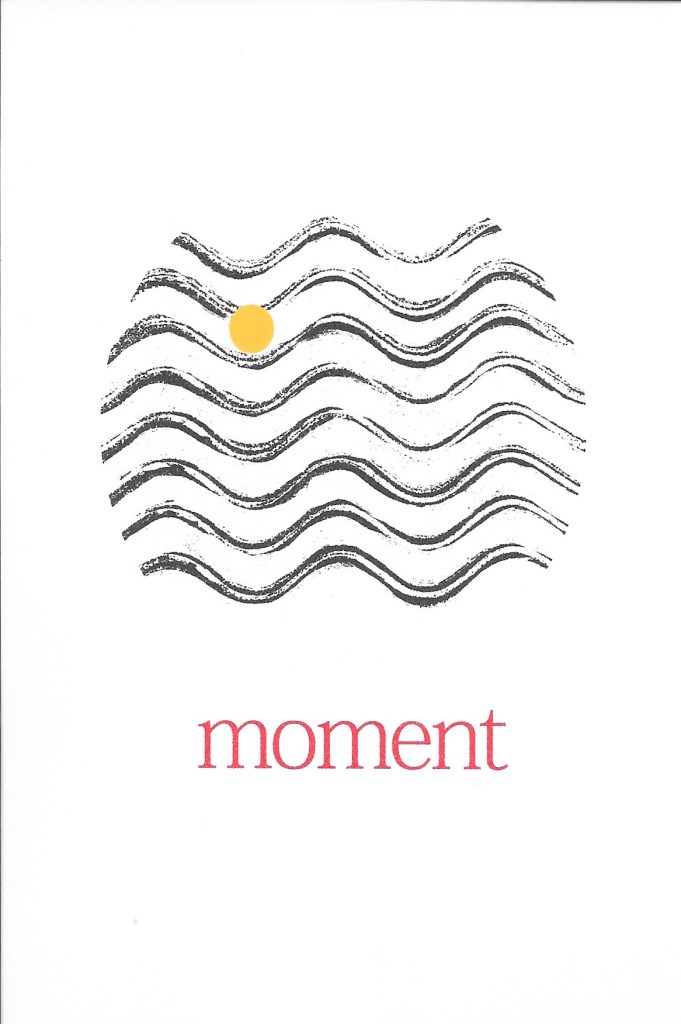
Moment arrived at the beginning of the year. A wonderful surprise. It’s a pocket-book size anthology of haiku, senryu and tanka by Ian Turner. Ian, this month’s poet, was for many years a member of our regional haiku group which used to meet monthly. After his 30-year career as an Fine Art Lecturer, he relocated with his partner to France where he is now a practising fine artist.
Beautifully produced on thick cream paper, Moment includes well over 300 haiku. Ian has organised these in small sets on a number of themes which recur through the book: the seasons, various places and locations, both in nature and urban, animal behaviour, human activities. So, there is variety and consistency. The poems cover the period 1997 – 2020 and most have been previously published in quality haiku magazines: Blithe Spirit, Presence, Snapshot Press, Shamrock Haiku Journal.
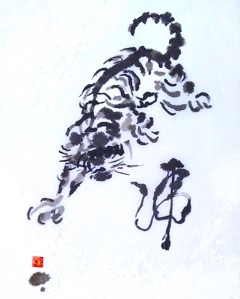
Ian tells me he is photophobic, so instead here is the image of indigotyger, Ian’s taoist spirit persona. I hope you enjoy my selection from his anthology.
that’s me in the far thistle field stalking a tethered pit pony hooves and heart skip a beat
early thaw a snail emerges from the meter box
hospital maze I become number seven on a pink plastic chair
the cool silence of a prayer room last flight call
swishing shingle the putter of a fishing boat in a smudge of light
throngs of tour coaches a gypsy woman’s empty paper cup
phantom moon red deer at the turnpike in their own time
yet more protests riot police greet each other on both cheeks
stood in a rippling white cloud the black calf
safe storage facility a life free of stuff so insecure
wild sage deep in the maquis a clank of goats
after a squall the ink stained letter in an unknown hand
It is an enormous pleasure to introduce the talented John Barlow: poet, editor, publisher and designer. I can’t remember exactly when and where we first met. It may well have been at one of the annual conferences organised by the British Haiku Society.
John Barlow is the editor of The Haiku Calendar, which has appeared annually since the 2000 edition, and co-editor (with Martin Lucas) of The New Haiku (2002). His other books include Waiting for the Seventh Wave and Wing Beats: British Birds in Haiku (with Matthew Paul).
John grew up surrounded by fields and woodlands. A keen amateur naturalist, his haiku appear in Where the River Goes: The Nature Tradition in English-Language Haiku, and he has given talks and workshops on haiku for organisations such as New Networks for Nature, Haiku North America, and the RSPB.
His haiku and tanka have received more than 150 awards, including the Modern Haiku Award, The Heron’s Nest Award, the Haiku Presence Award (in 2007, 2010, and 2011), and British Haiku Society Awards (in 2015, 2016, and 2018), while works he has edited have been honoured by the Haiku Society of America and the Poetry Society of America.
In 1997 he founded Snapshot Press, described in Haiku in English: The First Hundred Years as “the most important English-language haiku publishing house outside the United States.” From his published work John has made this selection. Starting with the inventive vertical haiku, it forms a seasonal progression.
down
the
leafless
beech
the
voice
of
a
nuthatch
under leaden skies the low-slung belly of a river
through her skin
the baby’s heartbeat
fieldfares in alders
each one on sunlight the yellowhammer’s phrases
summer morning
the riverbed stones warm
beneath my feet
sparroweight the groundsel bends to ground
a nestful of feathers
and tiny skulls . . .
clouds without rain
leaf-cast shade
a hoverfly moves around
a spot of sunshine
crab buckets along the quay the gait of trawlermen
train delays
for the fifth day now
the dead fieldmouse
our shadows holding hands the width of the stubble field
inside the clown’s smile the clown’s smile
calls of marsh tits
in the autumn woods
leaves release their rain
wind-rippled tarn
a raven’s croak
echoes through stone
for all the wind-borne spores lungfuls of the wood
a stoat arcs into undergrowth thin winter moon
the faint pulse
of out-of-tune strings—
winter light
This month I’m featuring one of my fellow haiku poets: Ian Storr. He is a history graduate and trained social worker whose last job before he retired was with Voice forthe Child in Care, managing their advocacy service in the north of England. Ian has been writing haiku and tanka since the mid-1970s and he has had over 200 published in British and oversees journals.
His poems have won prizes in Britain, Canada and Ireland and they have been included in British and international anthologies. Ian is the production and poetry editor of Presence magazine, described by the Founder and Chairperson of The Haiku Foundation as “the most important haiku journal in English outside the United States.”
I first met Ian more than 25 years ago and I’m delighted to share a selection of his writing with you. His tanka, in particular, I find deeply moving and masterful examples.
Haiku
Brightening
the house in winter
orange roses from the wreath
Cleft of the brook
wood sorrel bright
on a fallen birch
wind strengthening a skylark holds his place of song
The rhythm of
this baby’s sleep upon me
. . . days of rain
Valley head
white with cotton grass
the silence before the raven
Sweeping rain
deer on the ridge
climb into cloud
Gusts from the street
the store greeter’s
unreturned hellos
Darkening marsh
the swirl of golden plovers
settles again
Tanka
Night mist . . .
back where I was born
I walk this lane again
down to the flooded pit shaft
where tinkers used to camp
Snow falls tonight
as I drive slowly home
against the windscreen
a drift of stars
melting into water
Our son of seven weeks
struggles from sleep in my arms
tight in his hand
from the night’s feed
a long strand of your hair
Our balcony
over the settled sea . . .
you bring on two white plates
grapes the green of jade
the seeds within like shadows
More an ache than sorrow
this second anniversary . . .
falling on shrouded hills
and reservoir
the wet november snow
I put on my father’s boots
for a path I’ve never walked . . .
through reeds and cotton grass
comes the autumn wind
sounding like the sea
Year ending
frost covers the boards
of the empty pier
above a beach
strewn with razor shells
A stretcher-bearer
wounded twice and twice
returned to the front
Grandpa back on duckboards
over the sucking mud