Category Archives: Writing Prompt

When Sunday is not a day of rest

Photo Anton van Daal

A poem that has two fathers in it, with a photo of the actual building.

When Sunday is not a day of rest

Two narrow wooden benches form the arena.
Both gladiators enter through the main left door.
The one with the brown perm has an entourage:
three boys (one with red hair), a girl with braces,
and the eldest son with glasses, the creepy smile
inherited from his father, a businessman with butter
in his mouth who happens to be our uncle.
As church elder, he’ll collect in the interval,
holds out a long wooden pole with black velvet bag.
Both gladiators buy at Stoutebeek,
the town’s upmarket department store.

Our gladiator has better legs, better posture,
a striking hat, which makes up for just three of us.
She is a semi-professional singer.
Our gladiator chose to marry the controller
of church proceedings – the organist.
Outside, afterwards, the light ammunition
of smiles, air kisses and compliments.

Writing prompt

‘Sundays could feel very threadbare’ (Claire Keegan, Small things like these).

What is Sunday for you? A day you look forward to; a day you wish would pass quickly?

Is there another day that has special meaning to you – positive or negative?

The best years of our lives – guest poet

To celebrate my friend Kathleen Kummer’s 94th birthday, here is a poem from her debut collection Living below sea level. Poems from the book have featured on the blog before. The cover image is by Shirley Smith, Society of Wood Engravers.

Kathleen’s father was a coal miner. She went to Cambridge to study Modern Languages. She met and married a Dutchman. For several years Kathleen taught French and German at an International School in The Netherlands.

Happy Birthday, Kathleen: Van harte gefeliciteerd met je verjaardag.

The best years of our lives

Passing under the neo-Gothic
redbrick arch, the original bluestockings?
Not quite, but close enough to be given
the run of the Fellows’ drawing room
to sip our pre-prandial sherry, held
in hands we remembered curled for warmth
round mugs of cocoa. The cold tiles loud
with echoes, we followed the murky passage
to Hall, the swimming-pool’s proximity
still worrying, potent with the imagined
smell of bleach. The dinner was,
as expected, reassuringly bad;
the rooms were bleak, the unfamiliar
duvets thin, cot-sized; resilience
was needed for the nocturnal trek to the bathroom.
But none of this detracted one jot
from the utter, heartfelt certainty
that those had been the best years of our lives.

Exhibitions

I’ve just renewed my annual Museum pass. With a typical entry fee of 15 Euros, it’s well worth it: over 400 Dutch museums take part. There is usually a top-up fee for major exhibitions. I wrote the prose poem on a recent workshop.

Exhibitions

You can’t just wake up and decide to visit an exhibition. Not a major show. You must book a ticket online beforehand and choose a time slot. I managed to get one, Saturday lunchtime, for the Manhattan Masters. Rembrandt, aged 52, poster boy.

I was way too early (I’d gone with Astrid to collect her prize from the Xmas competition and have our photo taken) so I ended up buying books in all three bookshops near the Mauritshuis. Manhattan Masters, ten paintings over from New York while the Frick is being refurbished. The Fricks went to Europe to buy, do the grand tour. They were booked to travel back on the Titanic. She sprained her ankle and they postponed.

I won’t even tell you about the Vermeer at the Rijksmuseum, the coloured lines on the floor, everyone taking photos, the horse-tooth woman who needed to be in the photo with the painting. I gave up after 30 minutes. I think it’s well-known that the exhibitions of prehistoric art take place in replica caves with fake bones and spotlights on those red hand prints and bison on the walls. I’ll give it a miss. I’ll order the catalogue and a pack of six postcards from the museum shop online.

Britain, once more … guest poet

Nuri Rosegg had seen publicity about my online reading for Writers in the Bath, Sheffield. This led them to my website. Nuri loves the UK and, pre-Brexit, used to visit often. Nuri’s website can be found below her poem. There are also three poems on the Visual Verse website.

Below is Nuri’s poem, inspired by my poem Britain, from the Anthology Welcome to Britain.

BRITAIN  
 
Britain is a fedora hat, opera- 
And theatre-tried. In this modern era 
Dramas turn into comedies. 
 
This country is a glass of ginger wine: 
Tangy wetness without a spine. 
Alas, the love for self-harm is mega-big. 
 
Britain is a decaying cherry tree 
Turning its back on the sea. 
The City, such a cold-hearted cherry pit. 

http://aroundthewritingworld.weebly.com/about-me.htm

https://visualverse.org/writers/nuri-rosegg/


Before 11am I am not human

Credit: Son Ngyen Dinh via Pixabay

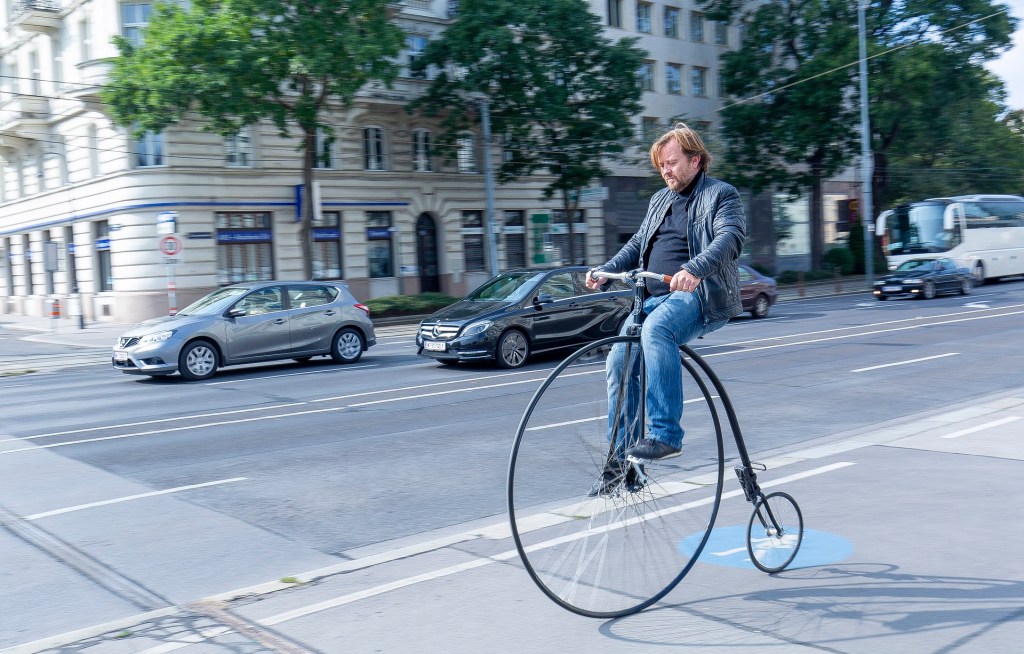
Not only that, it’s Sunday: my least favourite day of the week. I’ve been rescued by being on an online writing weekend with fellow poets most of whom I know. So here is a short warm-up for you. You can use it as a prompt. What mode of transport were you afraid of? What presents have you given that were returned in some way?

My father died in 1990, my mother in 2008. That penny farthing now stands on top of a bookcase here in my flat.

Before 11am I am not human

I’m blue like old potato sky. I was afraid of penny-farthings and of men with tall cylinder hats. My own hands are on a photo, making a gift of a miniature penny-farthing to my parents, an anniversary party.

Too Much Mirch – guest poet

It’s an enormous pleasure to introduce our guest poet. Safia and I met on a Poetry Business workshop a few years ago.

Safia Khan is a newly qualified doctor and poet. Her debut pamphlet (Too Much Mirch, Smith | Doorstop) won the 2021 New Poet’s Prize. Safia’s full biography can be found below her stunning poems.

Dave

Let’s discharge him today.
We’re wasting a bed keeping him here,
I know a lost cause when I see one.

No need to biopsy, it’s clearly end-stage.
Sadly, not much we can do at this point,
best to discharge him today.

He’s asked, but don’t bother with a referral
to Addiction Services – he won’t engage.
Trust me, I know a lost cause when I see one.

Before you book his cab, tell him he needs
to break the cycle. Record it, otherwise
we can’t discharge him today.

His notes say no fixed abode. He mentioned
a daughter. I doubt she’ll take him in this state,
that’s a lost cause if I’ve ever seen one.

Social services have called twice now.
The daughter asked why she wasn’t contacted.
I said they told me to discharge him,
they knew a lost cause when they saw one.

On Placement

I donned mask, visor, and apron,
washed my hands the right way,

correctly identified an osteophyte
at the acromioclavicular joint,

imagined the right diagnosis,
asserted the wrong ones,

was humbled like pines after avalanche,
inspected behind the curtain,

tried not to register relief
when hers looked like mine,

translated incorrectly, blamed my parents
for speaking English in the house.

I donned mask, visor, and apron,
washed my hands the right way,


noted an antibiotic prescription
for a young wife’s sudden death,

and a son’s hanging decades later,
ate fish and chips during a discussion


on seven-year old M, presenting with
pain down there (by his cousin),

taken into care after being removed
for witnessing Mum’s self-immolation.

After, I wiped
the mushy peas from my mouth.

I donned mask, visor, and apron,
washed my hands the right way,

vaccinated death in a red dressing gown,
touched its eggshell, auscultated its yolk.

I have heard ghosts blooming like spring mist
through my stethoscope.

River
(After Selima Hill
)

Other people’s mothers
shout at them in public,
I cry in the car on the way
back from dinner.
Other people’s mothers
don’t cremate their
daughters with a look.
My mother opens
like the seed of a tree.

I am sorry, she says.
You are right. But
other people’s mothers
had the chance
to be daughters.
Other people’s mothers
were softened by rivers.
I had to be bedrock
all my life.

I am sorry
you can feel silt
in my love,
but know you are
water to me.
Wherever you run
I’ll run under you,
holding the current
like no one else can.

But where are you really from?

Clay. A shapeshifting clot of blood. A kernel inside the first shell-
breath of God. Primordial soup, reduced to its atoms after being
brought to boil. The same place as the stars and birds, where
everything that ever existed was wrapped in tin foil and microwaved
into being. An iron ballerina, pirouetting round the Sun and sweating
out the Oceans. Mountains formed in an ice tray mould. A patch of
grass that drifted from elsewhere. A patch of grass still drifting. Like a
refugee with amnesia, I cannot recall home, though once in a while, I
catch its fragrance on the wind.


Biography:

Safia Khan is a newly qualified doctor and poet. Her debut pamphlet (Too Much Mirch, Smith | Doorstop) won the 2021 New Poet’s Prize. Her work has been published in various journals and anthologies including The North, BATH MAGG, Poetry Wales, Introduction X: The Poetry Business Book of New Poets (New Poets List), We’re All in It Together: Poems for a disUnited Kingdom (Grist), Dear Life (Hive), Surfing the Twilight (Hive).

She has been commissioned to write poetry for the University of Huddersfield and The British Library. Safia has performed her work widely, including as a headliner for Off The Shelf Festival. She has delivered poetry workshops for The Poetry Business, and seminars for the University of Oxford on the role of poetry as patient advocacy. Safia has been invited to deliver a creative writing teaching series with Nottingham Trent University’s WRAP Program, as their featured writer for 2023. 


refugee with amnesia, I cannot recall home, though once in a while, I
catch its fragrance on the wind.

Welcome to Britain

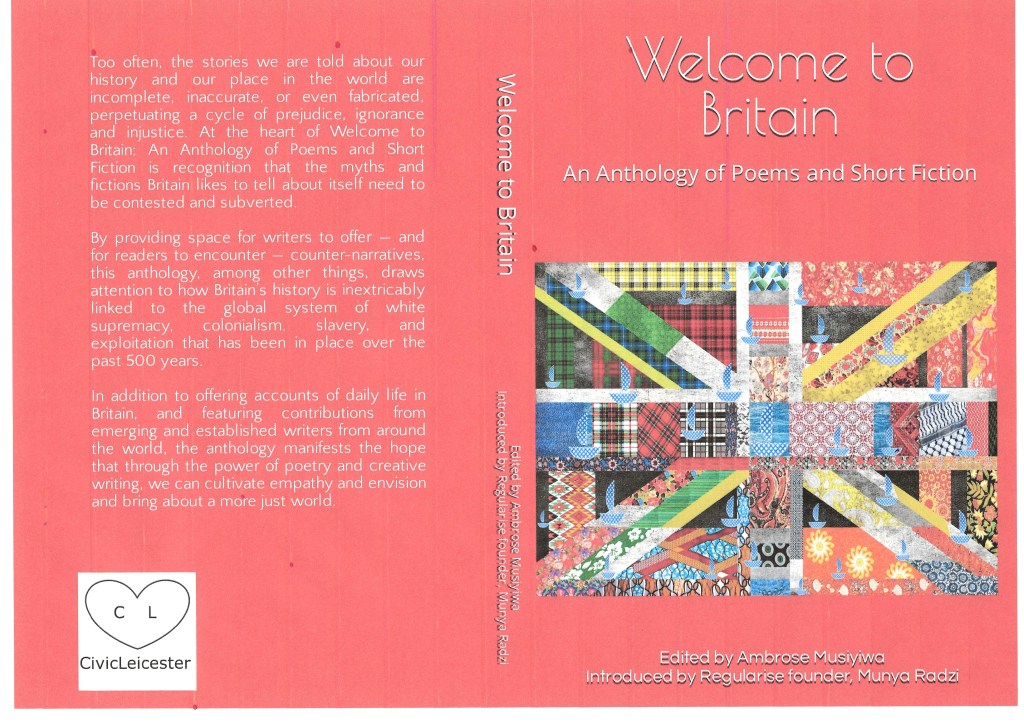
The striking cover of Welcome to Britain: An Anthology of Poems and Short Fiction is Gil Mualem-Doron’s New Union Flag which re-imagines the Union Jack. The anthology manifests the hope that through the power of poetry and creative writing, we can cultivate empathy and envision and bring about a more just world.


Congratulations to the other contributors: emerging and established writers from around the world. Huge thanks to Editor Ambrose Musiyiwa of CivicLeicester. Three of my poems were chosen: Going bananas, an Abecedarian poem about Brexit, In Blighty, a Golden Shovel poem, and Britain which appears below.

Britain

Britain is a homburg hat
that will produce a rabbit
if you ask nicely.

This country is a parking ticket
on a rainy day: bright yellow
with small, smudged writing.

Britain is an apple, stolen
or fallen from an unkempt tree:
not enough to make a wholesome pie.

Easter Monday

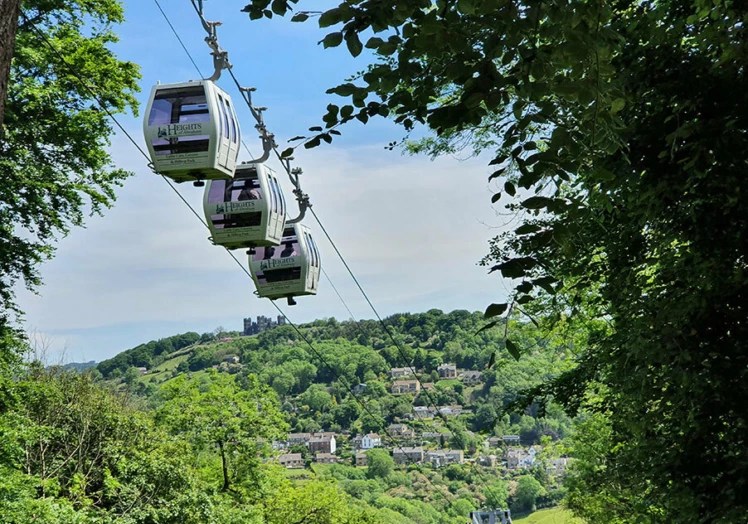
I’ve been sorting and clearing old photos and old poems. It reminded me of trips out into Derbyshire with friends: taking the cable car up to the Heights of Abraham, walking through the historic centre of Buxton. The Buxton Baths date back to Roman times. In the Georgian and Victorian period these were developed. Buxton is the highest market town in England. Easter can be early or late – walking through snow or sitting out in sunshine. Enjoy your Easter, wherever you are.

Buxton Centre

Buxton, 2pm

Here is Buxton Spa, Easter, green hills.
Not a credit card between us.

Good intentions: it’s the year of the Pig.

We’ve been to China, lugged back
soldiers from Xian, wrapped in towels.

Now they’re resting under the Red Cross.

For our next birthdays, we say,
we just want Prosecco, book tokens, no bric-a-brac,

but our hands are restless,
our fingers flick through a tray of rings.

Wassenaar via Lalibela

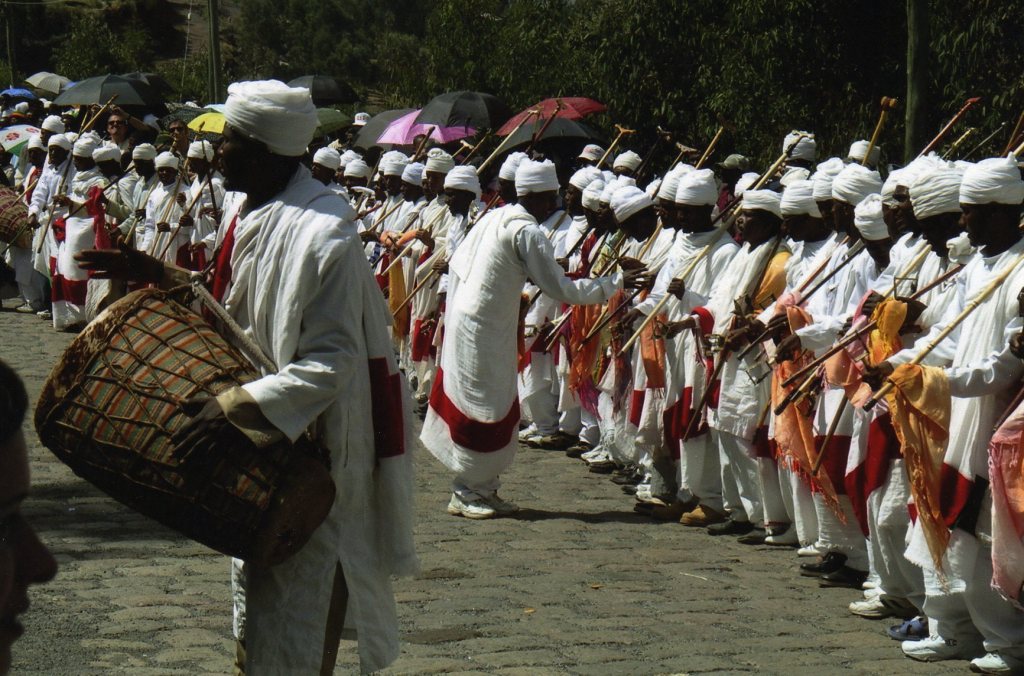
Priests at the Timket celebration, Lalibela

Yesterday, the camping where I have my static caravan opened for the season. This post explains how I ended up in the Netherlands via Ethiopia.

Marianne Carolan and I met through being students at the Open University. She had come across a young boy while on a study tour of Ethiopia. She started to sponsor him. Her friends, colleagues and neighbours followed suit. As the young people finished secondary education, the cost became too much for individuals. Therefore, Marianne set up the Lalibela Educational Trust (LET) in 2006 to raise funds which paid the fees for University and Nursing College.

With Marianne and several other sponsors I travelled to Ethiopia in January 2007, during Timket, the Ethiopian Orthodox Tewahedo Church celebration of Epiphany. I met my ‘son’ and his widowed mother. With its rock churches, Lalibela is a UNESCO World Heritage site.

Early this century Marianne had bought a second-hand static caravan in Wassenaar, the small town near The Hague which was her birthplace. At the time of her death in July 2008, the charity was sponsoring 26 young people. They are now doctors, engineers, nurses, IT professionals and entrepreneurs. She left her old caravan to me and I bought a new one a few years later.

Marianne Carolan (centre)

Night Flight, January 2007

Addis Ababa to Heathrow.
Us two, stretched out
across three seats
at the back of the plane.

Lalibela and the rock churches.
We wear the Shamma
they gave us for Timket:
The boys we sponsor.

Abolition

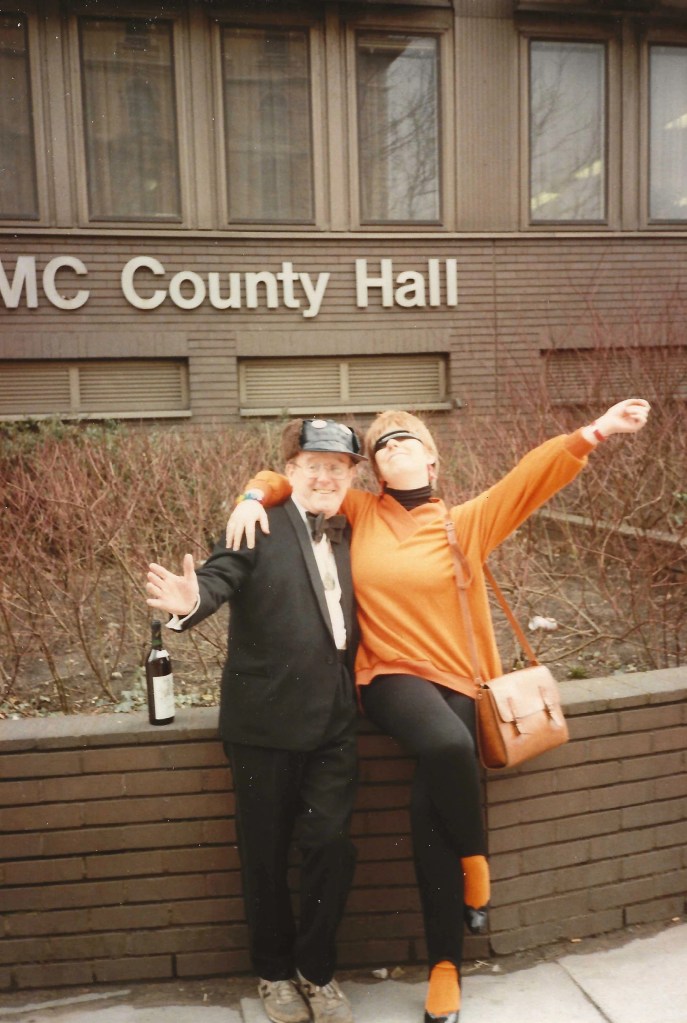
Lat month I was in Manchester, walking down Portland Street on my way to Piccadilly Station. It reminded me of my brief time (seven months) when I worked for the Greater Manchester Council (GMC). With my boss I ran workshops helping to prepare staff for job applications, CVs, interview techniques and salary negotiation. The GMC was the top tier local government administrative body. Its 106 members came from 10 district councils with which it shared power from 1/4/1974 until 30/3/86. Most of those district councils were Labour: not to the liking of Margaret Thatcher. Her Conservative Government abolished the GMC as well as the GLC (Greater London Council). Hence all that preparation for new jobs.

Abolition Greater Manchester Council, March 1986

That was the time I went as a dominatrix.
I wore my jodhpurs, riding boots,
carried a whip. I had my Cleopatra eyes,
and black bra under a side-less top.

Rebecca, my boss, had dyed her bob orange.
Tony, always modest, in dinner jacket,
bow tie, trainers, and baseball cap.
Black lace gloves for the HR woman in the wheelchair.

The young clerks were versions of cowboys and Indians.
We conga-ed across the zebra crossing onto Piccadilly Gardens.
Later we carried on drinking in the empty offices,
stroked and kissed the bricks of County Hall.