Tag Archives: Writing Prompt

wetting the ink…

It’s a great pleasure to introduce this month’s guest poet Julie Mellor.

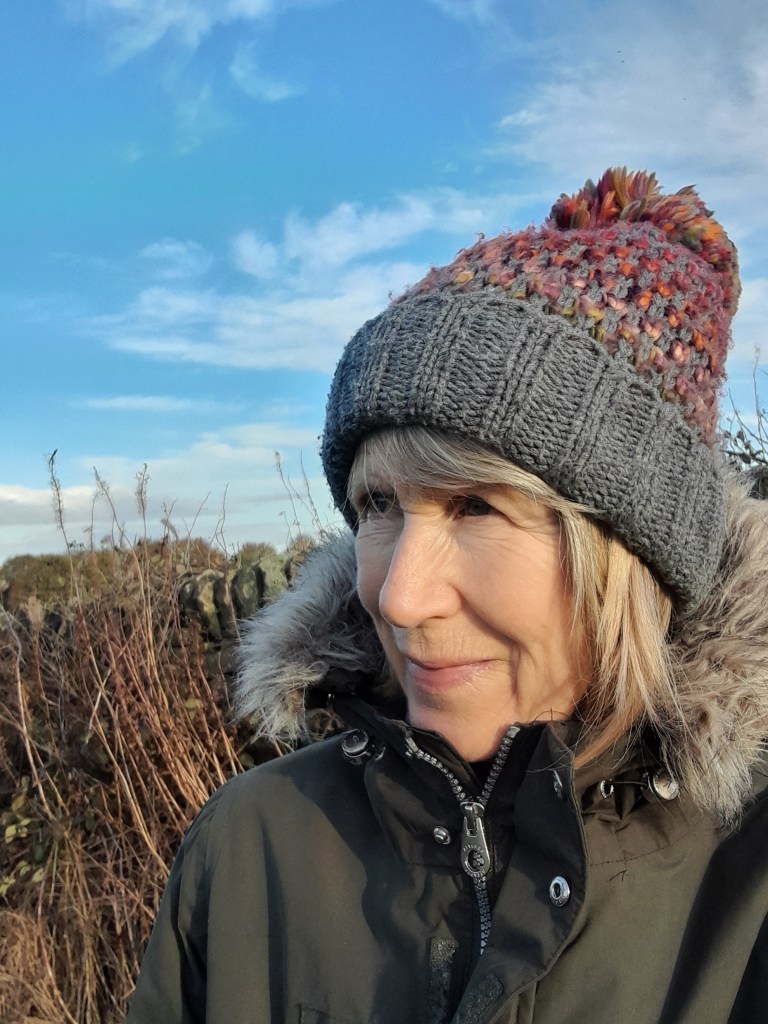
Julie holds a PhD in creative writing from Sheffield Hallam University and has published two poetry chapbooks with Smith/Doorstop: Breathing Through Our Bones (2012) and Out of the Weather (2017). In 2019 she became interested in haiku, and since then her haiku and haibun have appeared in Blithe Spirit, Frogpond, Modern Haiku, Presence, The Heron’s Nest and Tinywords, as well as two Red Moon anthologies. She recently retired from a career in education, and enjoys walking her dog, attending art classes and playing the banjo.

Here are recent haiku and a haibun with their publication details. You can find more of Julie’s writing on her site here.

Modern Haiku 54.3 (Autumn 2023)

toe-hold weeds
things that were said
years ago

Blithe Spirit 35:2 (May 2025)

long night joining the dots between stars

The Heron’s Nest Summer 2025

wetting the ink
a ghost orchid blooms
from its painted stem

Presence issue 82 (Summer 2025)

morning moon
beside the fretless banjo
pistachio shells

BHS Hope anthology 2025 (ed Neil Sommerville)

butterfly summer
I write a letter
to my future self

Presence 73 – Summer 2022 – and included in Contemporary Haibun 18 (Red Moon Press, 2023)

The Coffin Path

Grass, waist high this morning, and wet with last night’s rain. Brushing past it, my jeans wick the droplets from seeding cock’s-foot and brome. No one else walks this way. Behind the hawthorn hedge is the cemetery. People tend to use the other path, the one that the council mows. Or else they drive – ‘to save their legs’ my mother says. Some days she says she wants to be buried. Other days, she thinks she’d prefer to be cremated and have her ashes scattered next to a memorial bench. No rush to decide, I tell her, trying to make light of things.

elderflowers
pressed in her prayer book
a recipe for wine

If there were no wind, cobwebs…

Photo credit: Der Tobi via Pixabay


Thanks to poet Jonathan Davidson for introducing me (and the other poets on the course) to the Sestude. This form (a poem of 62 words) was invented by John Simmons, co-founder of the ‘26’ writing group in 2003. The English alphabet has 26 letters and 62 is its opposite.


It started with a project ‘26 treasures’ in the Victoria & Albert Museum’s British Galleries. The creative community 26.org.uk is a not-for-profit organisation which still undertakes a range of creative projects.


I enjoyed playing around with the form and, going through my folders, came across a short prose poem that only needed to lose a few words:

If there were no wind, cobwebs would cover the sky.

If there were no wind, cobwebs would cover the sky. Soon enough, the clouds would get angry, address the spiders Have you no manners? Your offspring is just sitting around. The angrier the clouds got, the greyer they looked. It was a battle of grey against grey. Battles and wars always end in tears. The people below were relieved: Rain at last.

Note: Serbian proverb quoted by Vasko Popa, The Golden Apple, 2010.

The Golden Apple collection is a round of stories, songs, spells, proverbs & riddles that Popa himself selected from various anthologies of Serbo-Croatian folk literature.

Writing Prompt


A few more proverbs and riddles. I will share answers next month!

Proverbs

  1. Get your moustaches together, you’re going on a journey.
  2. If you put him on a wound, it would heal.
  3. When did fog ever uproot a tree-trunk?

Riddles

  1. In one room both bone and flesh grow.
  2. I stretched a gold thread through the wide world and wound it up into a walnut shell.
  3. I shake a tree here, but the fruit falls half an hour away.

Dimmet


It is a pleasure to introduce our February guest poet Rob Miles. I do not know Rob personally: we have been Facebook friends for some time. I bought a copy of his recent collection Dimmet which was published by Broken Sleep Books. See below the poems for Rob’s biography.

The glorious cover image of a murmuration was designed by Aaron Kent. Dimmet is a West Country word for dusk, twilight. Katherine Towers notes of the collection: ‘These are poems of great precision and delicacy’. I’ve chosen four poems which demonstrate these qualities.

Dimmet

His hands still bronzed, still
baling-raw. His voice
no longer snared, whisper-low
as decades ago, in this same field, he guided me

to not disturb that horse; circling
quietly, its half-scattered straw
an ingot melting, and my thin flames no match
for such a sunset anyway.

*

On this, another near-to-night, it’s clear
that he has no more kept his mind
from wayward sparks than I
have closed my eyes

before any fading fire, ever since recalled
a slow white shadow
steady on its dial
in the always almost dark.

Café Poem

Just when I think there is nothing
so boring

as someone else’s childhood
a toddler

in dungarees is guided
around our table

by his puppeteer parent, arms
up, in a vertical sky-dive, or

like a drunk, when walking
is more about not falling

every step forward
rewarded with a double high five.

I whispered to the dog

that she’d been a winner
a Crufts champion
 
at least twice. Once
she saw off a Dobermann, burglars, a werewolf
 
even the odd Sasquatch.
I reminded her

as her old eyes darkened     
that she had saved lives.

Making Way

A keeper, you said of the house, but I’d sensed everything
trying to make its way: those errant velvet fingers
from your orchid pots; the oak
putting on its chain mail of ivy and moss
and losing; the birds we fed still pinned
to their shadows; crisp wasps
electrocuted by views
through grubby double glazing, and you
just weeks before, showing your wrists
as if uncuffed, asking for my thoughts on a fragrance.

Biography

Rob Miles is from South Devon, and he lives in Leeds where he is Fellow in Film Studies in the Centre for World Cinemas and Digital Cultures at The University of Leeds. His poetry has appeared widely in magazines and anthologies, recently in Stand, New Welsh Review, The Scores, Spelt, 14 Magazine, Ink Sweat and Tears, One Hand Clapping, Poetry Wales, and four Candlestick Press pamphlets. He has won various awards including the Philip Larkin Prize, judged by Don Paterson, the Resurgence International Ecopoetry Prize, judged by Jo Shapcott and Imtiaz Dharker, and the Poets & Players Prize, judged by Sinéad Morrissey.

Lucy Newlyn describes Dimmet as ‘the best collection of contemporary poetry I have read in a long while’, and John Glenday writes: ‘When it’s done as well as this, there’s nowhere on earth poetry can’t go.’

Sleight of Mind

Image via Pixabay, courtesy Gregory Delaunay

It is a great pleasure to introduce this month’s guest poet David Bingham. We first met many years ago through the British Haiku Society. David was President of the Society from 2020-2022, and in 2020 he was the winner of the British Haiku Society International Haibun Prize. His poetry appears regularly in a wide variety of magazines. See below for further details.

The haiku have all been previously published: in Presence, Blithe Spirit, or Time Haiku. The tanka first appeared in Blithe Spirit and the BHS Tanka Anthology 2022, while the haibun was the winner of the British Haiku Society International Ken and Noragh Jones Haibun Award, 2017. I hope you enjoy the selection.

Haiku

a lifetime
overcoming gravity –
still it gets me down

Private Keep Out
molehills on both sides
of the fence

clear night sky –
lights from both the living
and the dead

away
in the wind …
the word-filled air

is there a word for it?
the sound swans make
when they fly

late spring meadow…
within the yellow
the blue of summer

storming
the old hill fort – bluebells  
and celandine

inland sea
the wash from our boat
moves the border

stream through sunlight through stream

closing over
trails in algae where
the ducks have been

I turn
to call the dog …
then remember

Euston Station –
my skin ripples
in the hand drier

an apology…
the predictive text writes
it for me

Tanka

sun shine
and motorway spray –
I drive through
rainbows
to be with you

silently together
after all that talk
watching swallows
hawk for flies over
the meadow

on waking
I turn my dreams
inside out
letting the seams show
for the rest of the day

doors left
wide open revealing
an unlit space
nothing here to steal
but the darkness

Haibun

Sleight of Mind 
 
Some people need to know how he pulls the shining light bulbs from his mouth, levitates above the stage or escapes from a straightjacket.
 
Me, I like the mystery of it; the explanations are always so mundane. True magic lies in the imagination. Switching off the rational mind. Letting yourself go and trusting the conjuror.
 
I do it with words. Like how I brought you here. Even if you asked me, I couldn’t tell you how it’s done.
 
snowdrops …
mistaking ‘what is’
for ‘what isn’t’


Biography

David Bingham’s debut poetry collection The Chatter of Crows was published by Offa’s Press in October 2014 and in 2020 he was the winner of the British Haiku Society International Haibun Prize.

His poetry appears regularly in a wide variety of magazines, including Blithe SpiritTime Haiku and Presence and in anthologies, including: the Wenlock Poetry Festival anthologies for 2012, 2014, 2015 and 2016; Beyond Words, 2018 and where silence becomes song, 2019, the International Haiku Conference Anthology, published by the British Haiku Society; In the Sticks, 2021 and Away with the Birds, published by Offa’s Press; In Snow and Rain, 2022, an anthology of tanka published by the British Haiku Society; and Festival in a Book, published by the Wenlock Poetry Festival, 2023.

At different times, he was editor of both Borderlines and Blithe Spirit magazines and joint editor of the haiku and related genres anthologies Ripening Cherries, published by Offa’s Press, 2019 and Shining Wind published by the British Haiku Society, 2024.

He has read his work in arts centres, pubs, theatres, on local radio and poetry and literature festivals. He has read at City Voices in Wolverhampton, Country Voices in Shropshire and as a member of Green Wood Haiku at the BHS International Haiku Conference in St Albans in June 2019.
 
As part of the humorous poetry double act, Bingham and Woodall, he has performed at the Wolverhampton Lit Fest and Comedy Festivals in 2017 and 2018, and at the Ironbridge Festival in 2019.


Flying a kite

My friend Kathleen Kummer recently had her 95th birthday. We have had a weekly telephone call since the start of the first lockdown in March 2020. Kathleen’s poems from her collection Living below sea level have featured here before.


Flying a kite refers to the ‘90s, as the grandson is now in his thirties. He lives abroad, but regularly visits. A variation on the villanelle form, the poem successfully blends the personal and the universal.

Flying a kite

My grandson and I are flying his kite.
Though we stand on the earth’s green rim in spring,
there’ll be talk of wars on the news tonight.

We have climbed the steep meadow, have not taken fright
at the notice, Beware of the Bull. Larks sing
as my grandson and I are flying his kite.

We have coaxed it upwards, where wind and light
give life to what was a limp, gaudy thing.
Time enough for reports of the fighting tonight.

Its streamers rippling, the wind just right,
it rides the skies, a jocular king.
My grandson and I are flying his kite.

These skies are empty, but for the flight
of buzzards and invisible larks on the wing.
The skies they will show on the news tonight

will be apocalyptic, eerily bright
with the clever ways of destroying and killing
to which the whole world claims the right.
I am watching my grandson wind in his kite.

Boxes

It’s good to get an acceptance and even better when it’s prompt! Thanks to Paul Brookes for accepting this poem and two others for his online poetry journal The Starbeck Orion. You’ll find it here: the 880.substack.com. Issue 4 is themed. Current contributions are open themed.


You will be asked what your favourite constellation is. I bought the domain name acaciapublications in the early 90s, so you won’t be surprised that Camelopardalis is mine. It is a large but faint constellation of the northern sky representing a giraffe.


The poem was written from a prompt on the Boxes workshop with Graham Mort. WordPress wanted to make it a list, which messed up the numbers the lines had. We like a non-sequitur…

Boxes

I declined it. The man in black nodded, walked back to the horse.

Boy, am I glad I can feel my legs.

There must always be doors for the pleasure of opening them. Cats know this.

Boardroom brown, expensive pens, hand-rolled cigars, promises on parchment.

On display in the glass case: the motorbike, black-and-white photos, three bullets.

Groundswell – so little land, so much water.

Was I not meant to see the deep scarlet lining?

Cromer, June

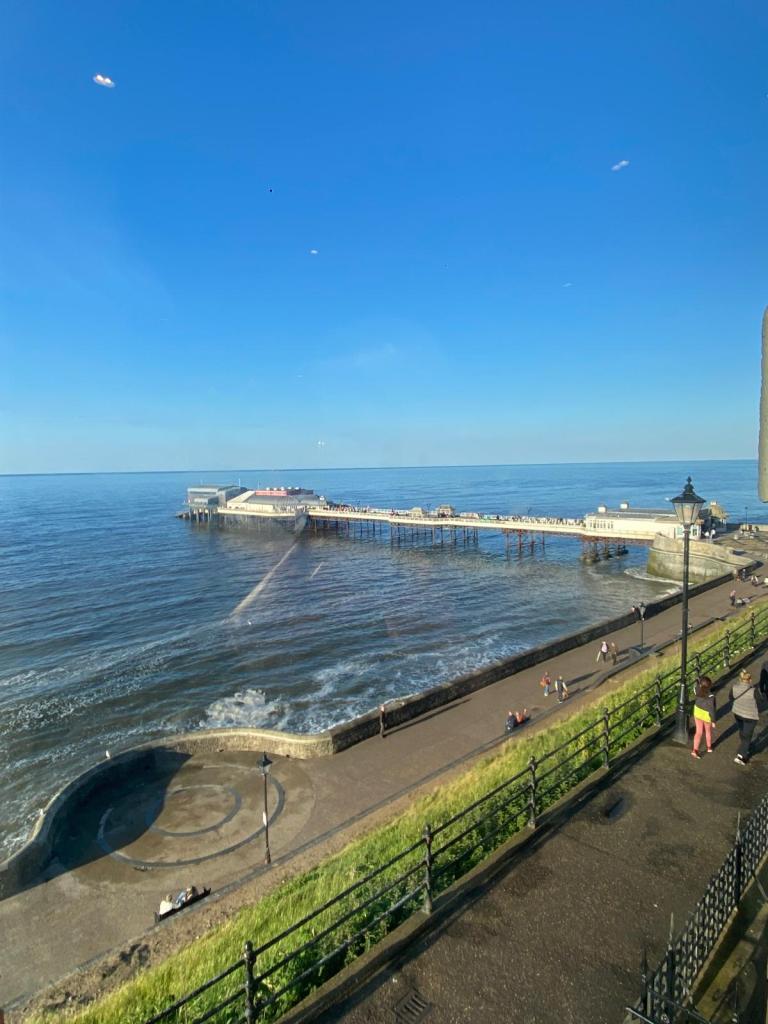
Cromer Pier and Esplanade

As the church bells began ringing, we were off – like thoroughbreds out of the starting boxes. We’d arrived on Saturday, inspected the spacious and comfortable rental property. Then enjoyed a delicious fish dinner at No. 1 Cromer Upstairs.

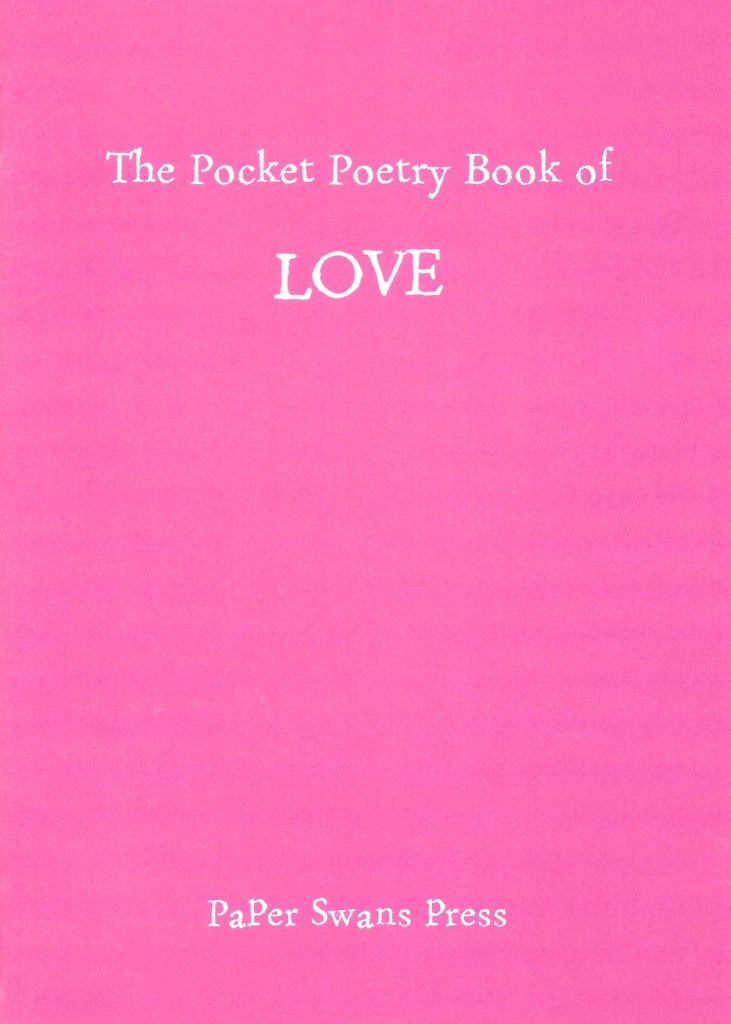
My morning flight from Schiphol landed at Norwich. The views of the coast and the Broads reminded me of other times. The poem was first published in The Pocket Poetry Book of LOVE (Paper Swans Press, 2018).

With love to my five talented poet friends…

Cromer, August

Curved around Cromer Pier a twitching mass of legs,
sturdy calves, socks, sandals. Fathers scoop up bait,
wind black thread onto pink plastic spools.
An old couple, in matching anoraks,
watch a thin man, wheelchair-bound.
He shakily lifts his thermos flask.

I thought of you then and the creaking stair lift,
the plastic roll-up seat, raising her in and out of the bath.
The small wooden cart you made
so she can travel through the orchard
inspecting the new fruit with her crooked hands.

I’m for the art of last war’s raincoats


Another quote from Claes Oldenburg’s famous Ode to Possibilities ‘I’m for …’ from 1961. It reads like a long list poem. Oldenburg said it was a statement, not a manifesto.

Risham Syed, The Tent of Darius

My poem Wearable Narratives, from my second collection, Nothing serious, nothing dangerous, published by Indigo Dreams in 2019, is in two parts. The poem was inspired by art in the Manchester Art Gallery. Last week I posted part i (Scarf).


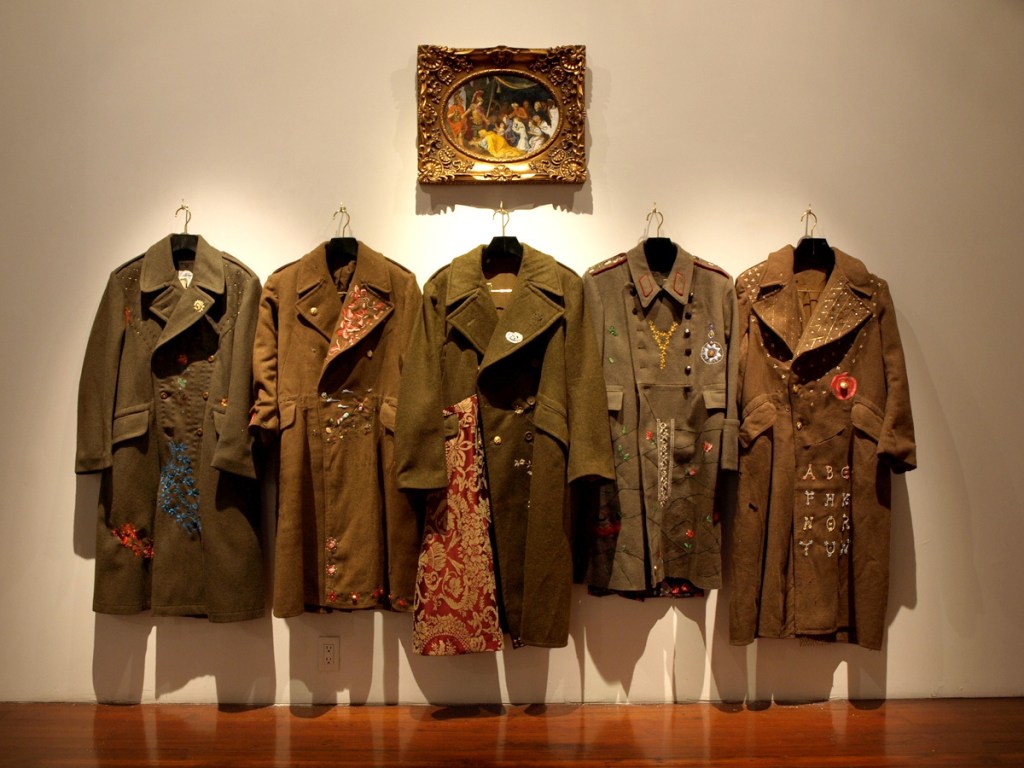
The Tent of Darius, an installation from 2009, is a complex work by the Lahore-based Risham Syed. It consists of five embroidered vintage European Army Coats with a small painting. This is a copy, painted by her, of the Charles Le Brun work of the same name.
Syed describes her inspiration for it:


“I imagined these five coats to have travelled all over the world, with women having contributed to them by adding a piece of embroidery. They are like these tired, old worn-out soldiers who have dreamt of coming back home. On the one hand, they symbolize the imperial power, but on the other hand, there is another aspect to this work; how soldiers from the colonies were made to fight for the Imperial powers. It’s true for any army including the Pakistan army, where most soldiers are from Jehlum, Potowar region, from poor, lower middle-class families and end up with the army because of their physique/tradition, in the hope of making a romantic/glamorous career. This work, compares the romance/glamor to the actual reality of war, the aim of it and the beneficiaries of it. I juxtapose the embroidered coats with an ‘Oriental’ painting called The Tent of Darius, a seventeenth-century painting by Charles Le Brun that provides the title for the installation. In it, the Queen of Persia bows to Alexander the Great who has conquered the land. It serves as a metaphor for the West making incisions in the East.”

I was very moved by the sight of these five coats and the details of the embroideries which inspired the last stanza.

The tent of Darius

The ornate faux-Chinese frame holds
a cropped copy on acrylic:
The Queen of Persia
draped at the feet of Alexander.

Below, an array of five overcoats,
donated by European soldiers,
appliquéd and embroidered
by women’s hands.

Under the lapel, a stilled windmill,
peach-coloured vanes.
A green tree above a button hole.
Death comes like blue geese.

I am for an art that helps old ladies across the street

Oldenburg in 1970 with Giant Toothpaste (1964)

So said Claes Oldenburg and he said a lot more like it, such as ‘I’m for art that flaps like a flag, or helps blow noses like a handkerchief’. Oldenburg said that his famous 1961 Ode to Possibilities, ‘I am for …’ was a statement, not a manifesto. It’s a fantastic read, a long list poem that works well as a writing prompt. Here is the link.


Swedish-born Oldenburg, one of the founding fathers of Pop Art died July this year at the age of 93. He was famous for his monumental sculptures where mundane objects (matches, clothes peg, apple core) suddenly became larger than life.

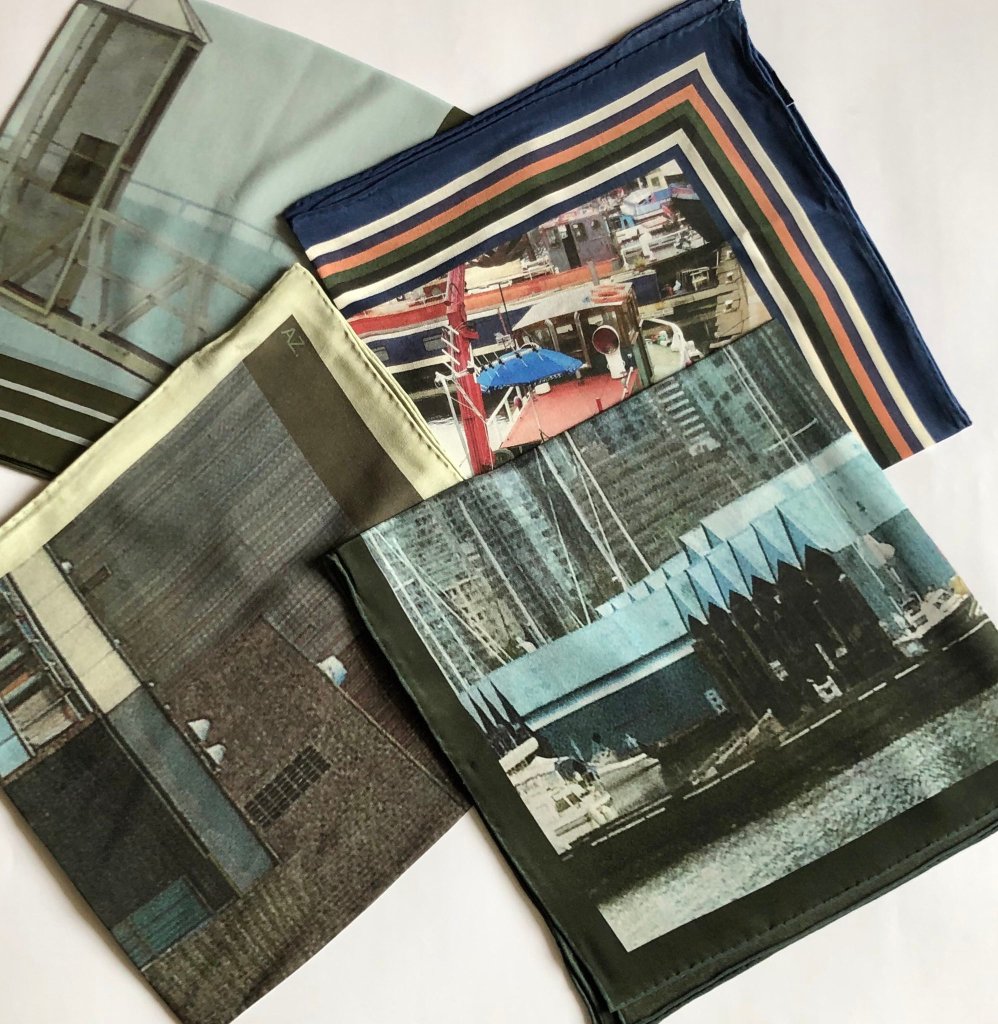
My poem Wearable Narratives (from the collection Nothing serious, nothing dangerous) is in two parts. Here is part i. It was inspired by a pure silk scarf, made by Andrea Zapp, that was on display in the shop of Manchester Art Gallery. At that time, I didn’t have a smartphone. So, here is a picture of other scarves, made by Andrea Zapp. See the note below for more information about her amazing work.

Scarf

A turquoise ribbon runs under khaki stepping stones.
Tomatoes are the red carpet. Slanting shadows
pull the empty staircase under water. Its fine metal
tracery anchors a washing line with checked tea towel.

Cold marble columns, bleached shutters closed.
Almost out of sight wooden farming implements,
a clock stopped at ten to eleven, a car hubcap.

Everything here is at an angle now.
What survives are the chalk drawings:
a cheerful elephant, the ibis and another bird,
its round black eye like a spinning top.

Note:

Andrea Zapp, born in Germany, living in Manchester, pioneered in coalescing her digital media art background with the fashion industry. Andrea has created the luxury fashion brand AZ.andreazapp. This sells high quality silk dresses and scarves printed with her own photography of urban views, rural panoramas, miniature scenarios and objects of culture and curiosity, creating a collection of stunning authentic hand-made garments.

Turn Up the Ocean – poems

It’s four years this month since the poet Tony Hoagland died. Turn Up the Ocean was published posthumously this year.

The blurb on the back says ‘Over the course of his celebrated career, Tony Hoagland ventured fearlessly into the unlit alleys of emotion and experience. The poems [ … ] examine with mordant wit the reality of living and dying in a time and culture that conspire to erase our inner lives.’


The mordant wit can be found in some of the titles:

  • Four Beginnings for an Apocalyptic Novel of Manners
  • Why I Like the Hospital
  • On Why I Must Decline To Receive The Prayers You Say You Are Constantly Sending


The last few lines of this poem are:


And could you stop burning so many candles, please?


My god, think how many hours and hours and hours –
think of how hard those bees worked
to make all that wax!

Hoagland’s poems often go just over the page and here are the last few lines of Gorgon:

Your job is to stay calm.
Your job is to watch and take notes,
to go on looking.

Your job is to not be turned into stone.