Tag Archives: Poetry

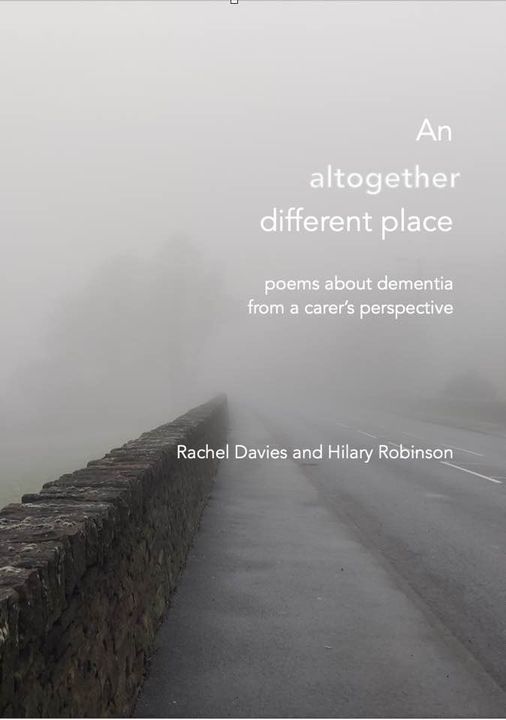
An altogether different place

Cover photo by Ben Robinson


Rachel Davies and Hilary Robinson have been friends for over 20 years. Friends call them the ‘poetry twins’. They are both accomplished poets and you can find their biography below.


An altogether different place
, published by Beautiful Dragons Squared, is a joint project. In 2022 Hilary’s husband was diagnosed with vascular dementia; in 2023 Rachel’s partner with dementia and Lewy bodies. In the introduction they write ‘dementia is a catalogue of cruel diseases’. Living with and caring for someone with dementia ‘you come to know grief by slow degrees’. Through poetry Hilary and Rachel ‘found a joint space to laugh, cry, find context and write out their experiences’.


The collection is sold to raise essential research funds for dementia charities in the UK. It is a privilege to share a selection of the poems here: Brainworm and Seven ways of looking at a husband are by Hilary. Rachel wrote Degrees of Challenge and This is not a poem about dementia which was awarded 2nd place in the Hippocrates Prize 2024.

Brainworm


There are many crap poems online for those who care for loved ones with dementia. Dementia has a symbolic flower – the unimaginative forget-me-not. I’ll have none of that shit. I want the gristle of it, the offal, brain-spatter, white matter of it. Show me the MRI with extensive vascular changes, let me count the dead parts of the brain so I can explain, daily, what ails my love. I watch Dirty Great Machines, find Big Bertha in Seattle, tunnelling machine on steroids moving at thirty five feet a day. Something has wormed its way into the tiny vessels inside his head over years and now whole sections of his once-sharp brain have died. It’s our Golden Wedding Anniversary this year. I don’t know who I’ll be celebrating with.

Seven ways of looking at a husband

1
Straight on. Taking in his 2-day grey beard,
his nostril hair and ear fuzz. His smile.

2
Side profile. Noticing his cute nose,
the same shape as our daughter’s.

3
From the bedroom door. Noting
the cocoon he’s made of the duvet.

4
Across the kitchen. See, he’s forgotten
how to toast his fruit tea cake, make coffee.

5
From the driver’s seat. Clocking his wince
as you pull out safely onto the busy main road.

6
Across the care home corridor. Seeing his smile grow,
then his arm around you, his whiskery kiss.

7
On the care home terrace. Look, he can’t turn
his head to where you point. Misses the squirrel.

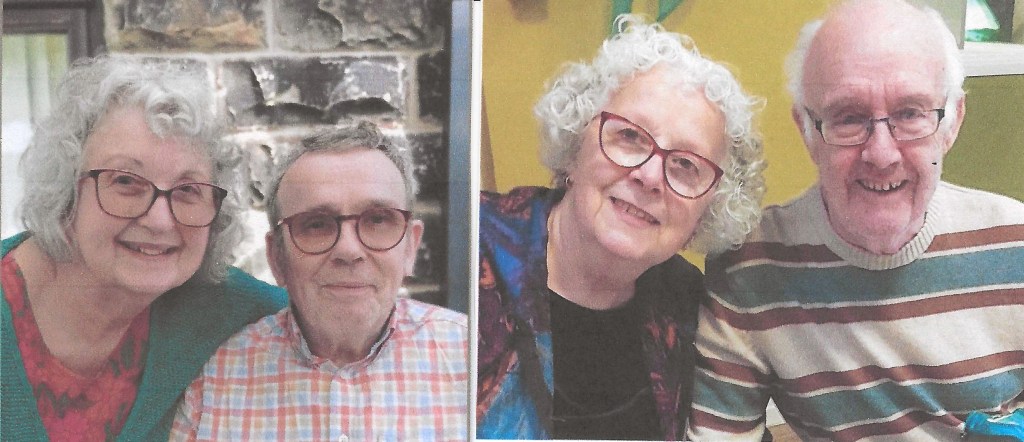
(L) Hilary with David (R) Rachel with Bill

Degrees of Challenge

I’m watching you struggle to break the seal
on an ice cream wrapper and I think of the time
you redesigned the roof of Piccadilly Station,
worked in millimetres to ensure each pane of glass

fitted exactly into the space you’d drawn for it.
I remember the night you clipped on a safety harness,
climbed onto the roof to inspect each perfect joint,
came home buzzing but satisfied at day break.

Tomorrow you’ll shuffle out to the Age UK minibus,
the driver watching you don’t slip on the wet steps;
but tonight you’re making a major task

of breaking into a Mini Magnum. I know better
than to offer help; eventually you’ll pass it to me,
say I’m sorry, I can’t seem to

This is not a poem about dementia

I am opening the windows and doors
letting in fresh air to blow dementia
down the lane like giant tumble weed

I am clearing out drawers and wardrobes
filling black bags with hallucinations
donating them all to the Age UK shop

I am having the Lewy bodies serviced
unblocking its pipes flushing confusion
down the drain with the incontinent waste

I am partying like there’s no dementia
raising a cake with bicarb of dementia
licking up the fluffy dementia crumbs

I am sleeping peacefully in the quiet night
dreaming a poem that has absolutely
nothing to do with dementia

Biographies


Rachel Davies is a mother, grandmother and great-grandmother and a retired primary school headteacher. Her poetry is widely published in journals and anthologies and has been a prize-winner in several poetry competitions, most recently, the Hippocrates Prize 2024. A selection of her work was published in Some Mothers Do… (Dragon Spawn Press 2018). Her debut pamphlet, Every Day I Promise Myself, was published by 4Word Press in December 2020. Since retiring she has achieved an MA in Creative Writing and a PhD in contemporary poetry, both from Manchester Metropolitan University.


Hilary Robinson has lived in Saddleworth for most of her life. She met her husband, David, at secondary school. She gained a BA (Distinction) and a PGCE and became a primary school teacher. After a successful career, Hilary retired and started a Creative Writing (Poetry) MA at Manchester Metropolitan University and gained a distinction. Her poetry is published in print and online journals, and in several anthologies. Her poetry has also been set to music by RNCM students of composition. In 2018 some of her problems were published by Dragons Spawn as Some Mothers Do… and this was followed in June 2021 by her first solo pamphlet, Revelation, published by 4Word Press.

After the Rites and Sandwiches

It is a privilege and a great pleasure to share three poems by Kathy Pimlott from her third pamphlet with The Emma Press, published this month. It is ‘an honest, lyrical and nuanced journey through the complexity of bereavement’. The poem What I do with you now you’re dead was longlisted for the National Poetry Competition 2023. Further down you’ll find Kathy’s biography and links to her website.

Death Admin I

Your demise constitutes a third off council tax;
the removal of a vote you seldom cast and then
only to be contrary; write-off of a modest overdraft;
the bill for an overpaid pension. Tell Us Once promises
it will be a doddle. It is not. I repeat time and again
in spoken and in written words to the indifferent
or distracted, He has died. What do I need to do?

What I do with you now you’re dead

The Queen is dead too and on her way to a proper tomb.
Everything’s shut and there’s nothing on tv, but the sun
comes out so I go to the mimosa tree where, months ago,
I dumped, in a laughing panic, dumped, about a quarter
of your ashes and ran away, the illicit thrill exactly what
you would have wanted. Today, with a flask, shortbread,

I’ve come because, while I don’t love the Queen, it seems
like a fitting thing to do. This royal park is empty, quiet,
allowing me to cry all through its splendid long borders
with their harmonious purple and blue planting until,
on a near-enough bench, I sit. By my feet, Lamb’s Ears
offer silky comfort, as does the pile of pistachio shells,

little coracles, showing someone sat here eating a bagful.
You kept your shells in the pockets of your gardening coat
which I emptied out before taking it to the charity shop
with your best shoes. The mimosa’s not out of course
but its ferny leaves show promise of the glory to come.
A robin perches closer than he should, inspects me,

then accepts a crumb or two. Your ashes have disappeared,
no longer so alarmingly burnt-bone visible, so very there.
They say the old Queen’s coffin is oak, lined with lead.
Three-quarters of you is still in the back of the wardrobe.
A crow chases off my robin. So much peril. It’s enough
to be sitting thumbing Lamb’s Ears, thinking about you.

The Passing Visit

A friend came by from Brussels and we talked of our dead
or rather about what they leave behind, the stuff in storage,

the binding strands. I told him more than I’d told most,
of how (and I said, then rejected, the word tumultuous),

how textured our long, long marriage had been and by textured
I meant bumpy, dropped stitches, amateur darning. I told him

how often you fell in and out of love and how I left and returned
more than once. Perhaps because I didn’t care enough, I said.

And perhaps I didn’t. There was something he wasn’t telling me
but the sun was out and we walked the courtyards and backways

of the neighbourhood, crossed the bridge, watching the sky whiten
and the coloured lamps in the trees come on. We spoke of cities,

their pleasures. The comfort I find in the river. How Brussels’ Senne
is covered over, subterranean. Of moving along and clearing out.

Biography

Kathy Pimlott has two previous pamphlets with The Emma Press: Goose Fair Night (2016) and Elastic Glue (2019). Her debut full collection, the small manoeuvres, was published by Verve Poetry Press (2022). Her work is widely published in magazines and anthologies, and she has been longlisted, placed and has won several poetry prizes.

Kathy’s website

The Friday Poem

Breakfast

Here in The Netherlands Kookboekenweek (Cookery Books Week) has just ended. A recent annual event, it’s designed to promote cookery books. Bookshops and libraries organise workshops, lectures, and tasting events. Of course, it’s all to encourage people to buy books as presents for December: St Nicolaas and Kerstmis.


Professionals shortlisted six books (Vietnamese, Japanese, Indian, Italian (2), and baking skills). They’ve chosen Bloem Suiker Boter, by Nicola Lamb, translated into Dutch. I’m going with Breakfast, a poem celebrating poetry and friendship.

Breakfast

Bridie would be in the kitchen,
barking with Finn and Tara
in a metal cage under the table.
I’m in your backroom, sheepskin
on the seat of the wooden chair,
just gone 9 o’clock this Tuesday.

You’ve made the scrambled eggs
exactly as I like them, with enough
mustard and fresh chives.
Now you’re coming in with yours,
followed by your small dogs
who settle on the settee, by the fire.

We catch up over this monthly meal.
Soon we’ll sit silently behind our laptops,
typing up poems from old notebooks.
Now eating toast with ginger preserve,
I look out of the window; the smiling
Buddha is lit up by the sun.

Slow Movement

It is an immense pleasure to present this month’s guest poet Sarah Mnatzaganian. Poems from her award-winning pamphlet Lemonade in the Armenian Quarter were featured here before. Today’s poems were chosen from the dozen that were included in Slow Movement, an exquisite small journal designed, created and stitched by poet Maria Isakova Bennett. The photo of the cover doesn’t quite do it justice.

The sequence was one of four winners in the 2022/2023 Coast to Coast to Coast poetry prize. Maria wrote ‘Slow Movement is a sensuous sequence of love poems expressed through the colours, sounds, materials, and obsessions of cello making and sailing.’ The sequence is dedicated to Robin, the cello maker; poems were previously published (Poetry Wales, Magma, Poetry Salzburg).

Bogle

Two wedges of maple are ready for the vice.
The cello maker scans the silken surfaces for flaws
but the wood looks clean as buttermilk.

He leans and pushes translucent ribbons,
tissue paper thin, through the plane’s grey mouth.
Stops. A failed twig-hole, a dark finger of incipient rot

points from the joint accusingly. He groans,
grabs a back-arch template, offers it to the knot.
Smiles. He’ll outwit the bogle this time.

He heats hide-glue in the pot and rubs the joint
until it gels and bites, the halves aligned and left to dry.
Next week, he’ll flip the plate like a stranded tortoise

and hunt the blemish with his keenest gouge
until he holds a hollow brindled shell,
bogle-ridden wood chips snapping at his feet.

Laying up

Salt-bitten snap shackles slump down the forestay
and surrender to the pull of his thumbs.
He drags an impossibility of canvas over the guard rail
while I hug the rest free of the wire.

The sail crumples like a giant wedding dress,
crocodile-toothed with zigzag thread. It’s time
to climb down to the queasy buoyancy of the old
polystyrene pontoon, to stand fifteen feet from him

and guess where in this pale tangle of cloth to grip
with my left hand; how far to reach with my right.
We’ll tighten the white distances between us
and fold each crease over into a taut edge

until we make a concertina of the sail. He’ll nod
and fold his end towards me, two foot at a time.
I’ll do the same for him until our halves meet
and lie without stretch or slack,

my luff to his leech, head to his foot,
clew to his tack, throat to his peak.

Bridge

He’s in the kitchen, leaning over the hob,
dropping a bridge blank into the frying pan.

I start to speak but know he can’t reply.
He’s counting down the seconds till it’s time to flip

the steaming bridge, to press and count again.
Twenty, twenty, ten, ten, five, five. Done.

He stands the bridge to cool. Takes the next.
I’ll kiss him then, to pass annealing time.

Twenty to please my tongue and lips. Twenty
more to tighten breasts and scalp. Ten, ten

to spice my skin. His free fingers stroke a slow
five, five around my willing ear.

Flying a kite

My friend Kathleen Kummer recently had her 95th birthday. We have had a weekly telephone call since the start of the first lockdown in March 2020. Kathleen’s poems from her collection Living below sea level have featured here before.


Flying a kite refers to the ‘90s, as the grandson is now in his thirties. He lives abroad, but regularly visits. A variation on the villanelle form, the poem successfully blends the personal and the universal.

Flying a kite

My grandson and I are flying his kite.
Though we stand on the earth’s green rim in spring,
there’ll be talk of wars on the news tonight.

We have climbed the steep meadow, have not taken fright
at the notice, Beware of the Bull. Larks sing
as my grandson and I are flying his kite.

We have coaxed it upwards, where wind and light
give life to what was a limp, gaudy thing.
Time enough for reports of the fighting tonight.

Its streamers rippling, the wind just right,
it rides the skies, a jocular king.
My grandson and I are flying his kite.

These skies are empty, but for the flight
of buzzards and invisible larks on the wing.
The skies they will show on the news tonight

will be apocalyptic, eerily bright
with the clever ways of destroying and killing
to which the whole world claims the right.
I am watching my grandson wind in his kite.

Boxes

It’s good to get an acceptance and even better when it’s prompt! Thanks to Paul Brookes for accepting this poem and two others for his online poetry journal The Starbeck Orion. You’ll find it here: the 880.substack.com. Issue 4 is themed. Current contributions are open themed.


You will be asked what your favourite constellation is. I bought the domain name acaciapublications in the early 90s, so you won’t be surprised that Camelopardalis is mine. It is a large but faint constellation of the northern sky representing a giraffe.


The poem was written from a prompt on the Boxes workshop with Graham Mort. WordPress wanted to make it a list, which messed up the numbers the lines had. We like a non-sequitur…

Boxes

I declined it. The man in black nodded, walked back to the horse.

Boy, am I glad I can feel my legs.

There must always be doors for the pleasure of opening them. Cats know this.

Boardroom brown, expensive pens, hand-rolled cigars, promises on parchment.

On display in the glass case: the motorbike, black-and-white photos, three bullets.

Groundswell – so little land, so much water.

Was I not meant to see the deep scarlet lining?

A tribute

This post is a tribute to my brother Theo who died early on Tuesday morning in hospital. On the evening of Friday 28 June, he went out with his wife Ancilla to celebrate their 52nd wedding anniversary. After a lovely meal he had a fall in which he sustained serious brain damage. I spent time with him on the Saturday. Ancilla and my nephew were with him when he died.


It was only last autumn, when a MRI scan was taken for other purposes, that my brother learned that he had the rare condition of multiple cavernomas. This explains the paralysis and subsequent sudden hearing loss. The poem 1962 was published in my debut collection Another life.


My brother had a rich and full life. The photo was taken in 2019 when he and Ancilla both received honours (Member of the Order of Oranje-Nassau) in recognition of decades of charity and community service.

1962

Alexander Eduard (coppersmith
in the bible and van Beinum,
the famous conductor).
Our Irish setter had been given
the names of an unborn child.

A ward of six, our parent’s daily
drive, almost an hour each way.
Neurologist, paralysis,
lumbar puncture, nausea
.

Grandfather owned an electrical shop
(double-fronted on the main street),
gave my brother a beige-brown radio.

The specialist allowed our red
Irish setter to visit my brother,
celebrating his fourteenth birthday
in the academic hospital in Leiden.

Three months later he arrived home,
just in time for Sint Nikolaas.
My brother still limped and his crown
was marked by two scars at right angles,
the space between dipped and dented.
A few days later grandfather came
to take his radio back.

Cromer, June

Cromer Pier and Esplanade

As the church bells began ringing, we were off – like thoroughbreds out of the starting boxes. We’d arrived on Saturday, inspected the spacious and comfortable rental property. Then enjoyed a delicious fish dinner at No. 1 Cromer Upstairs.

My morning flight from Schiphol landed at Norwich. The views of the coast and the Broads reminded me of other times. The poem was first published in The Pocket Poetry Book of LOVE (Paper Swans Press, 2018).

With love to my five talented poet friends…

Cromer, August

Curved around Cromer Pier a twitching mass of legs,
sturdy calves, socks, sandals. Fathers scoop up bait,
wind black thread onto pink plastic spools.
An old couple, in matching anoraks,
watch a thin man, wheelchair-bound.
He shakily lifts his thermos flask.

I thought of you then and the creaking stair lift,
the plastic roll-up seat, raising her in and out of the bath.
The small wooden cart you made
so she can travel through the orchard
inspecting the new fruit with her crooked hands.

Past Tense Future Imperfect

It’s a pleasure to introduce this month’s guest poet Jon Miller. We met some years ago on a poetry workshop. His biography is at the end of the post.

Jon was winner of The Poetry Business International Book and Pamphlet Award 2022 and his latest pamphlet Past Tense Future Imperfect (2023) is published by Smith|Doorstop from which these three poems are taken.

They Made A Crime Series Here

We are miles off Hringvegur, American satnav garbling
‘Fjardarheidi’: a high pass, a blizzard shreds the windscreen,

then down to Seydisfjordur, where the road stubs itself out
against the fjord; like us, it has given up fighting the inevitable.

Past the fish factory, its yellow flag cracking the wind.
Corrugated sheds, oil tanks. Houses stare into themselves.

This town has let out all its breath, waits to take another
next century. For the lonely, binoculars stand on windowsills.

A thought bubble: Stay low. The world is not your lobster.
Tie everything down. Run for port. A beard hides a lot of guilt.

Picnic benches crouch like crabs at car parks and supermarkets;
husbands keep engines running in case wives make a break for it.

A camper van – rented – drifts by, turns down the wrong road,
bikes shrouded in grey, a child’s face at the window.

Beside the filling station three farmers lean into a trailer,
debate the efficacy of bladed implements. One looks up.

Nothing connects until everything does. We have tickets,
drive into the ferry, its belly, its deep machine hum, extras no longer.

Lost Child

Not the brazen trumpeters
or the flittering sailboats
or in the minds of mariners
with their white-washed eyes
is there a button of hope.

Neither in the small boys roaming
the fogged avenues
called home for tea
returning with birds’ nests
and the ruins of puberty.

You become a twitch
in the fingertips of newscasters
or out here where it happened
the midnight click of the latch
the song in the five-barred gate.

This Way to the Observation Lounge

Out through the placid archipelagos they go
at ease in their daylit aquarium
moving over water at the pace of a slow car.

The sea is flat on its back. The flag barely mutters
at the mast. All are hypnotised by empty sea and sky,
by the line where nothing meets.

They have left the world to turn without them.
and sit with hands clasped in laps
as if listening to a sermon on vacancy.

Asleep, they twitch to escape their clothes.
They know themselves the way the blind
feel what they cannot see.

I could tuck in chins, settle a head on its neck,
retrieve dropped novels, while their eyes read dreams
the way an unborn child pushes against its mother’s belly.

They are at rest. Someone is on the bridge.
Over the horizon is harbour. Weather is busy somewhere else.
Who they are has fallen away like rain over islands.

Biography

Jon Miller lives near Ullapool in the Scottish Highlands and has had poetry published in a wide range of literary magazines as well as being a contributor of book and exhibition reviews and literary journalism. He formerly editor of Northwords Now, a magazine featuring writing from the north of Scotland. He was short-listed for the Wigtown Poetry Prize in 2021 and awarded joint First Place in the Neil Gunn Poetry Competition 2022.

A Coalition of Cheetahs

It’s a great pleasure to introduce our April guest poet Doreen Gurrey. We met on a writing workshop some years ago and belong to a group that meets regularly online. You can find Doreen’s biography at the end of the post. I have chosen three poems from her new pamphlet A Coalition of Cheetahs, just out with smith/doorstop. It was a winner of the 2023 Poetry Business International Book & Pamphlet Prize.

Zoo

From the lit hall, I slide back the hardboard panel
to find you under the stairs, crouched like an Indian street seller
in front of the toy animals you’ve fumbled into a ring.

Hands and knees on chipped linoleum, I crawl in,
smell the turps and boot polish, the must of apples
separated until next year.

You’re listening to the slow clicks of the electric meter,
your heart monitor, sharing the sound with the broom
which shoulders the corner like your guardian angel.

I haul you out, pick up the polar bear, giraffe,
the big elephant and the little elephant, then soothe
the smouldering print, reddening on your thigh.

Yarn

I was learning to knit when you left me,
decoding the language; stocking stitch, moss,
knit2tog., twist; the wool a filigree

snaking through my fingers across
the floor. The note was cold: In Italy
don’t write or ring. Needles knit up my loss,

a pink anaconda down to my knees.
I learned to pick up stitches I’d dropped,
then all my friends said pink suited me,

asked would I carry on or had I stopped?
I said I’d started another in green,
that casting off was easier than casting on.

Guest

You came with all you needed,
your car a metal suitcase,

the boot full of booze
the back seat housing a portable grill.

Temporary you said, but I forgot
how little you need to live.

You kept mostly to the garage,
the beer stacked next to the tool box,

the radio tuned in to the French news;
you smoked your roll ups and grilled

your côtes de porc.
My washing took on a Gallic smell.

Now you’re gone, I’ve got the garage back,
but sometimes mistake

the growl of the tumble drier
for your phlegmy cough,

the washing machine’s whine
for your whistling.

Biography

Doreen Gurrey trained as an English and drama teacher and for several years ran her own Youth Theatre Company. She went on to become an Adult Literacy Tutor writing and delivering Family Learning courses for the local council. Latterly she has worked as a Creative Writing tutor at York University. Her work has appeared in Poetry Salzburg Review, The North and The Yorkshire Anthology. She has won prizes in The McClellan, Bridport and Troubadour poetry competitions. Doreen lives in York and has five grown up children.