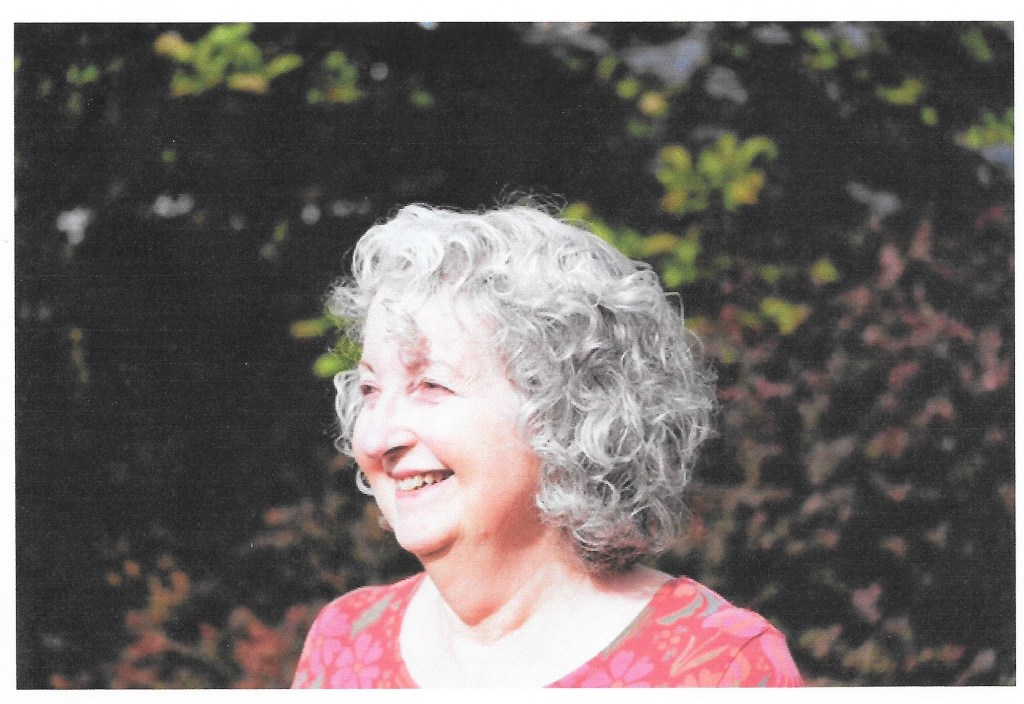
It’s an enormous pleasure introducing this month’s guest poet. We met a while ago when I attended one of Alexandra’s online courses. She’s an inspiring tutor.
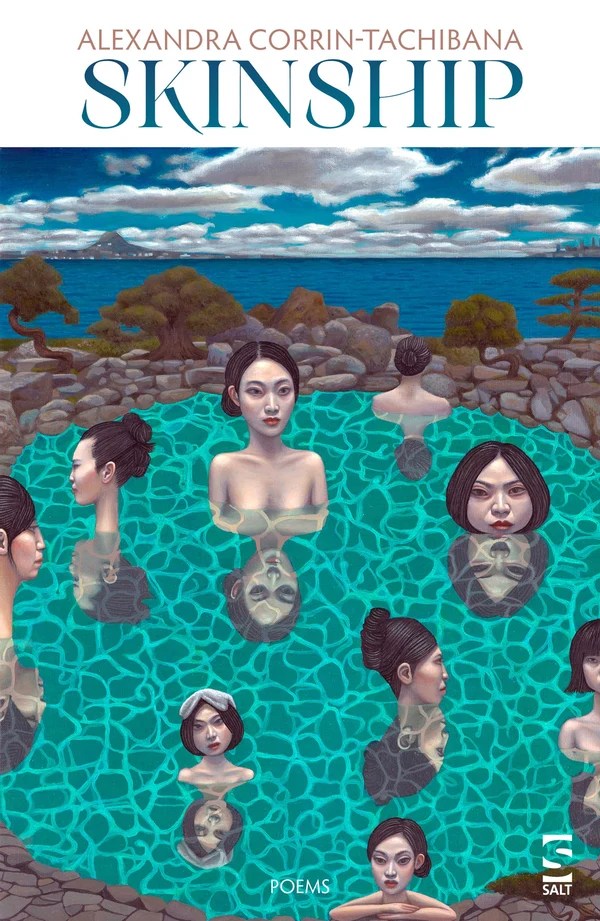
You’ll find her biography at the end of this post, with links to two more poems. This week Alexandra’s second collection with Salt is published. Skinship is a full collection: formally innovative in using and adapting traditional Japanese forms (haiku, tanka, senryu, haibun, and zuihitsu). I was particularly struck by the ‘burning haibun’.
The poems are ‘rooted in Alexandra’s lived experience of Japan’ and rich, poignant and memorable. There is a well-judged balance of humour and sadness. It’s not surprising that many of the poems have already been published and successful in competitions.
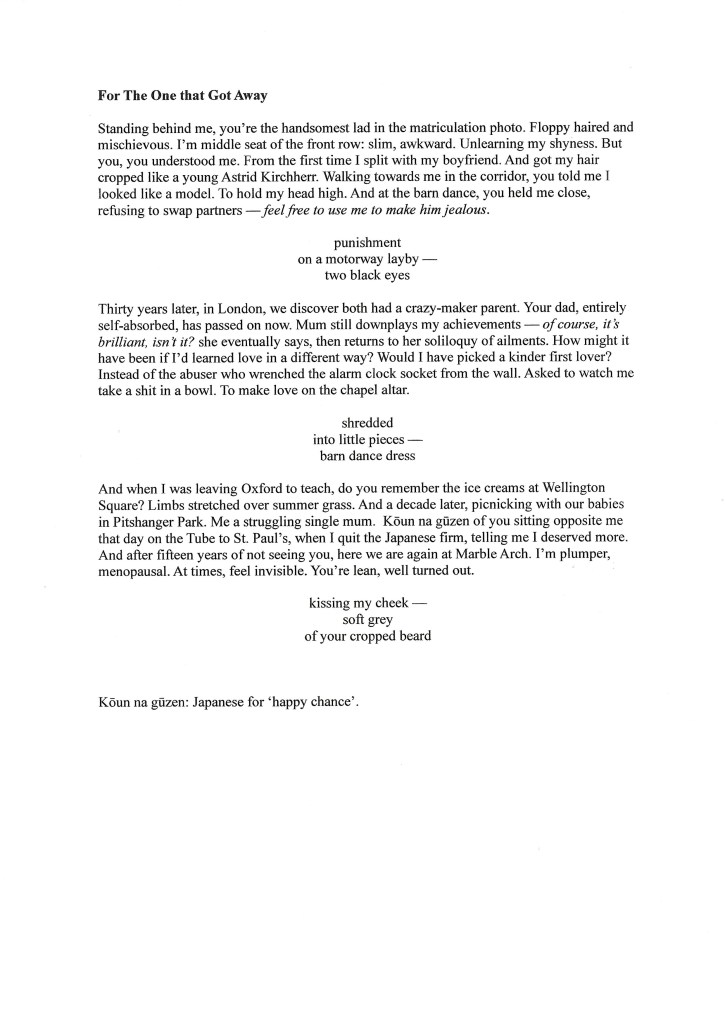
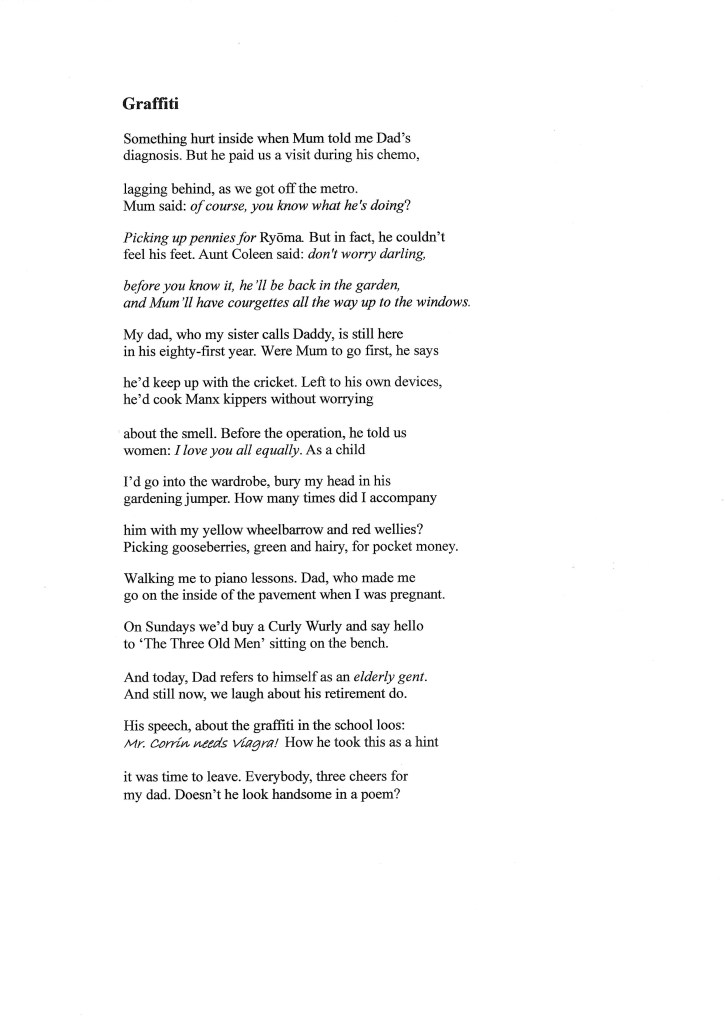
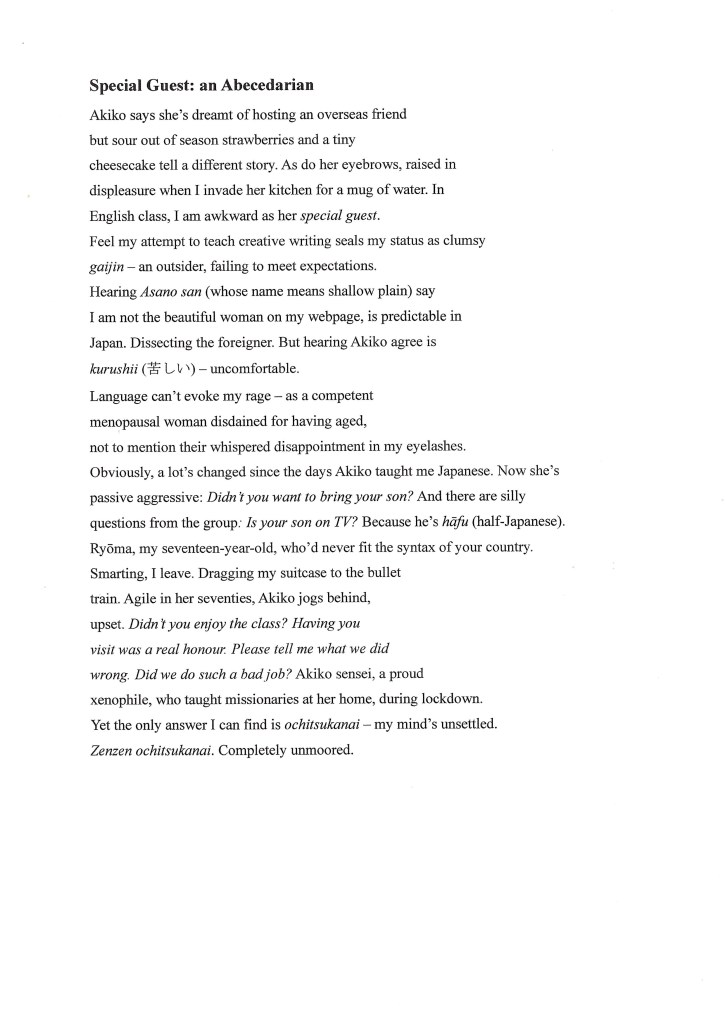
Here are the three poems which I chose from my long shortlist. To preserve the original features, the poems are presented as images.
Biography
Alexandra Corrin-Tachibana is the author of two poetry collections: Sing Me Down from the Dark and Skinship, both published by Salt publishing.
This year, she won the Frome Festival Crysse Morrison Poetry Prize, as well as Verve’s February Poem of the Month competition, was placed third, by Mimi Khalvati, in the Kent and Sussex competition, and shortlisted for the Wolves Lit Festival competition. She is shortlisted for the 2026 Forwards Prize for Best Single Written Poem, for her poem, Madam Gout, originally published by Magma.
Alexandra lived in Japan for 10 years and has Masters’ degrees in Japanese Language and Culture and in Writing Poetry. She is based in Newcastle-upon-Tyne and teaches for The Poetry School and The Poetry Business. Her most recent work is published or forthcoming in Pennine Platform, The North, Vervacious anthology (Verve Poetry Press), The Alchemy Spoon, and online in And Other Poems.
It is a privilege and a great pleasure to share three poems by Kathy Pimlott from her third pamphlet with The Emma Press, published this month. It is ‘an honest, lyrical and nuanced journey through the complexity of bereavement’. The poem What I do with you now you’re dead was longlisted for the National Poetry Competition 2023. Further down you’ll find Kathy’s biography and links to her website.
Death Admin I
Your demise constitutes a third off council tax; the removal of a vote you seldom cast and then only to be contrary; write-off of a modest overdraft; the bill for an overpaid pension. Tell Us Once promises it will be a doddle. It is not. I repeat time and again in spoken and in written words to the indifferent or distracted, He has died. What do I need to do?
What I do with you now you’re dead
The Queen is dead too and on her way to a proper tomb. Everything’s shut and there’s nothing on tv, but the sun comes out so I go to the mimosa tree where, months ago, I dumped, in a laughing panic, dumped, about a quarter of your ashes and ran away, the illicit thrill exactly what you would have wanted. Today, with a flask, shortbread,
I’ve come because, while I don’t love the Queen, it seems like a fitting thing to do. This royal park is empty, quiet, allowing me to cry all through its splendid long borders with their harmonious purple and blue planting until, on a near-enough bench, I sit. By my feet, Lamb’s Ears offer silky comfort, as does the pile of pistachio shells,
little coracles, showing someone sat here eating a bagful. You kept your shells in the pockets of your gardening coat which I emptied out before taking it to the charity shop with your best shoes. The mimosa’s not out of course but its ferny leaves show promise of the glory to come. A robin perches closer than he should, inspects me,
then accepts a crumb or two. Your ashes have disappeared, no longer so alarmingly burnt-bone visible, so very there. They say the old Queen’s coffin is oak, lined with lead. Three-quarters of you is still in the back of the wardrobe. A crow chases off my robin. So much peril. It’s enough to be sitting thumbing Lamb’s Ears, thinking about you.
The Passing Visit
A friend came by from Brussels and we talked of our dead or rather about what they leave behind, the stuff in storage,
the binding strands. I told him more than I’d told most, of how (and I said, then rejected, the word tumultuous),
how textured our long, long marriage had been and by textured I meant bumpy, dropped stitches, amateur darning. I told him
how often you fell in and out of love and how I left and returned more than once. Perhaps because I didn’t care enough, I said.
And perhaps I didn’t. There was something he wasn’t telling me but the sun was out and we walked the courtyards and backways
of the neighbourhood, crossed the bridge, watching the sky whiten and the coloured lamps in the trees come on. We spoke of cities,
their pleasures. The comfort I find in the river. How Brussels’ Senne is covered over, subterranean. Of moving along and clearing out.
Biography
Kathy Pimlott has two previous pamphlets with The Emma Press: Goose Fair Night (2016) and Elastic Glue (2019). Her debut full collection, the small manoeuvres, was published by Verve Poetry Press (2022). Her work is widely published in magazines and anthologies, and she has been longlisted, placed and has won several poetry prizes.
It is an enormous pleasure to introduce this month’s guest poet Hilary Robinson. We met many years ago on writing workshops in Manchester.
Hilary Robinson
Hilary Robinson has lived in Saddleworth for over 40 years. Publications include The Interpreter’s House, Obsessed with Pipework, Strix, The Morning Star, Riggwelter, Atrium and Poetry Birmingham and several anthologies including Please Hear What I’m Not Saying (Fly on the Wall Poetry 2018), A New Manchester Alphabet (Manchester Writing School 2015), Noble Dissent (Beautiful Dragons Press 2017), Bloody Amazing! (Yaffle/Beautiful Dragons Press 2020) and The Cotton Grass Appreciation Society. In 2018 twelve of her poems were published in the first joint DragonSpawn book, Some Mothers Do . . . alongside Dr Rachel Davies and the late Tonia Bevins. Her poem, ‘Second Childhood’ was shortlisted in the 2016 Yorkmix Poetry Competition.
Hilary has collaborated with composition students from the Royal Northern College of Music as part of the Rosamond Prize and was involved in the 2016 Leeds Lieder Festival. She is currently collaborating with composer, Joseph Shaw, on an opera to be performed at the Royal Northern College of Music.
In June 2021, Hilary’s debut pamphlet, Revelation, was published by 4Word Press. Hilary has an MA in Creative Writing from Manchester Metropolitan University. The central section of Revelation is a series of poems which explore the aftermath of betrayal in a marriage. From this section I have selected four poems. Nikolai Duffy says that these poems ‘sing with a lyrical precision that is as authentic as it is unflinching.’
Revelation
And I beheld the last seven years open up before me and they gave up their secrets.
And I beheld my beloved’s face concealed by a fine beard and his feet that were turned to sand.
And I beheld seven office chairs, unoccupied except for two, on which sat my beloved and his shame.
And surrounding my beloved and his shame were all the places they had been while I had slept on in our bed.
And all the places they had been were also all the places he had taken me. And I wept that this was true.
And I beheld his eyes turn to streams as his remorse descended from him. And lo — his arms reached out for mine.
And I tightened my golden belt around my waist, knelt down by his side and said that I forgave him.
That September
Every time he went to the window he saw them. Gangs hired to find us, gangs armed with torches burning even though it was early September and still light. Gangs getting closer.
He’d let everyone down, his partners, clients, staff, his family. Most of all he’d let me down in ways I’d never imagined. Now they were at the end of our drive. Now he’d found a way to stop the fire he’d caused.
It took four of us to prize his fingers from the Swiss Army Knife’s twin blades. I never knew what happened to that knife. I wiped blood from his hand, found the doctor’s home number.
The rest is a history of ashes, scorched earth of a marriage that somehow bore new life after hospital, after ECT, after many hours of therapy. This house still stands.
Brittle
In the kingdom of glass everything is transparent, and there is no place to hide a dark heart. Vera Nazarian, The Perpetual Calendar of Inspiration
To become glass, learn to make yourself fluid as egg-timer sand.
Hone yourself to brittleness with just a little give to accommodate rough winds.
Research your ancestry — try to enter the mindset of silica.
Practise the occasional sharp look, the cutting remark — hide in the shadows.
To become glass, give in — become transparent; melt into the view from this bedroom.
Trying to Take my Husband to the Antica Carbonera
There is no chance I’ll find the Calle Bembo with its kinks, its turns, its lamps hanging above shops of antique Murano beads, its shiny cobbles and those buskers trotting out Vivaldi through the season. No chance I’ll find what translates
where Cath and I ate wild mushrooms cooked four ways and spent so much they brought us Limoncello on the house.
Yet here we are. This is the first Venetian street our feet touch on the way to the Al Codega. The food is perfectly seasoned. Tonight we’re on the roof. I have another angle on this street.