Many thanks to Kathleen Mcphilemy for including three of my poems in episode 37 of Poetry Worth Hearingor you can listen on Youtube, Audible and Spotify.
One of the poems is his ashes on a corner.
The theme was hiding and/or seeking. The episode is 60 minutes. The first half hour or so is an interesting interview with poet Nancy Campbell who talks about her residency on Greenland among other things. The interview and Nancy’s poems bookend poems by Guy Jones, Zelda Cahill-Patten, Lesley Saunders, Pat Winslow, Richard Lister, Dinah Livingstone, and Sarah Mnatzaganian.
The theme for the next episode is all things ‘eco’. Send up to four minutes of unpublished poems (text and sound file) plus a short biography to poetryworthhearing@gmail.com by 18 January 2026. Find more information on poetryworthhearing.biz.
his ashes on a corner
of the dining table by the small square votive container the discreet undertaker’s logo
she greets him will have a glass at six his ashes waiting with us for borders to open
It is a pleasure to introduce our February guest poet Rob Miles. I do not know Rob personally: we have been Facebook friends for some time. I bought a copy of his recent collection Dimmet which was published by Broken Sleep Books. See below the poems for Rob’s biography.
The glorious cover image of a murmuration was designed by Aaron Kent. Dimmet is a West Country word for dusk, twilight. Katherine Towers notes of the collection: ‘These are poems of great precision and delicacy’. I’ve chosen four poems which demonstrate these qualities.
Dimmet
His hands still bronzed, still baling-raw. His voice no longer snared, whisper-low as decades ago, in this same field, he guided me
to not disturb that horse; circling quietly, its half-scattered straw an ingot melting, and my thin flames no match for such a sunset anyway.
*
On this, another near-to-night, it’s clear that he has no more kept his mind from wayward sparks than I have closed my eyes
before any fading fire, ever since recalled a slow white shadow steady on its dial in the always almost dark.
Café Poem
Just when I think there is nothing so boring
as someone else’s childhood a toddler
in dungarees is guided around our table
by his puppeteer parent, arms up, in a vertical sky-dive, or
like a drunk, when walking is more about not falling
every step forward rewarded with a double high five.
I whispered to the dog
that she’d been a winner a Crufts champion
at least twice. Once she saw off a Dobermann, burglars, a werewolf
even the odd Sasquatch. I reminded her
as her old eyes darkened that she had saved lives.
Making Way
A keeper, you said of the house, but I’d sensed everything trying to make its way: those errant velvet fingers from your orchid pots; the oak putting on its chain mail of ivy and moss and losing; the birds we fed still pinned to their shadows; crisp wasps electrocuted by views through grubby double glazing, and you just weeks before, showing your wrists as if uncuffed, asking for my thoughts on a fragrance.
Biography
Rob Miles is from South Devon, and he lives in Leeds where he is Fellow in Film Studies in the Centre for World Cinemas and Digital Cultures at The University of Leeds. His poetry has appeared widely in magazines and anthologies, recently in Stand, New Welsh Review, The Scores, Spelt, 14 Magazine, Ink Sweat and Tears, One Hand Clapping, Poetry Wales, and four Candlestick Press pamphlets. He has won various awards including the Philip Larkin Prize, judged by Don Paterson, the Resurgence International Ecopoetry Prize, judged by Jo Shapcott and Imtiaz Dharker, and the Poets & Players Prize, judged by Sinéad Morrissey.
Lucy Newlyn describes Dimmet as ‘the best collection of contemporary poetry I have read in a long while’, and John Glenday writes: ‘When it’s done as well as this, there’s nowhere on earth poetry can’t go.’
It is a great pleasure to introduce this month’s guest poet David Bingham. We first met many years ago through the British Haiku Society. David was President of the Society from 2020-2022, and in 2020 he was the winner of the British Haiku Society International Haibun Prize. His poetry appears regularly in a wide variety of magazines. See below for further details.
The haiku have all been previously published: in Presence, Blithe Spirit, or Time Haiku. The tanka first appeared in Blithe Spirit and the BHS Tanka Anthology 2022, while the haibun was the winner of the British Haiku Society International Ken and Noragh Jones Haibun Award, 2017. I hope you enjoy the selection.
Haiku
a lifetime overcoming gravity – still it gets me down
Private Keep Out molehills on both sides of the fence
clear night sky – lights from both the living and the dead
away in the wind … the word-filled air
is there a word for it? the sound swans make when they fly
late spring meadow… within the yellow the blue of summer
storming the old hill fort – bluebells and celandine
inland sea the wash from our boat moves the border
stream through sunlight through stream
closing over trails in algae where the ducks have been
I turn to call the dog … then remember
Euston Station – my skin ripples in the hand drier
an apology… the predictive text writes it for me
Tanka
sun shine and motorway spray – I drive through rainbows to be with you
silently together after all that talk watching swallows hawk for flies over the meadow
on waking I turn my dreams inside out letting the seams show for the rest of the day
doors left wide open revealing an unlit space nothing here to steal but the darkness
Haibun
Sleight of Mind
Some people need to know how he pulls the shining light bulbs from his mouth, levitates above the stage or escapes from a straightjacket.
Me, I like the mystery of it; the explanations are always so mundane. True magic lies in the imagination. Switching off the rational mind. Letting yourself go and trusting the conjuror.
I do it with words. Like how I brought you here. Even if you asked me, I couldn’t tell you how it’s done.
snowdrops … mistaking ‘what is’ for ‘what isn’t’
Biography
David Bingham’s debut poetry collection The Chatter of Crows was published by Offa’s Press in October 2014 and in 2020 he was the winner of the British Haiku Society International Haibun Prize.
His poetry appears regularly in a wide variety of magazines, including Blithe Spirit, TimeHaiku and Presence and in anthologies, including: the Wenlock Poetry Festival anthologies for 2012, 2014, 2015 and 2016; Beyond Words, 2018 and where silence becomes song, 2019, the International Haiku Conference Anthology, published by the British Haiku Society; In the Sticks, 2021 and Away with the Birds, published by Offa’s Press; In Snow and Rain, 2022, an anthology of tanka published by the British Haiku Society; and Festival in a Book, published by the Wenlock Poetry Festival, 2023.
At different times, he was editor of both Borderlines and Blithe Spirit magazines and joint editor of the haiku and related genres anthologies Ripening Cherries, published by Offa’s Press, 2019 and Shining Wind published by the British Haiku Society, 2024.
He has read his work in arts centres, pubs, theatres, on local radio and poetry and literature festivals. He has read at City Voices in Wolverhampton, Country Voices in Shropshire and as a member of Green Wood Haiku at the BHS International Haiku Conference in St Albans in June 2019.
As part of the humorous poetry double act, Bingham and Woodall, he has performed at the Wolverhampton Lit Fest and Comedy Festivals in 2017 and 2018, and at the Ironbridge Festival in 2019.
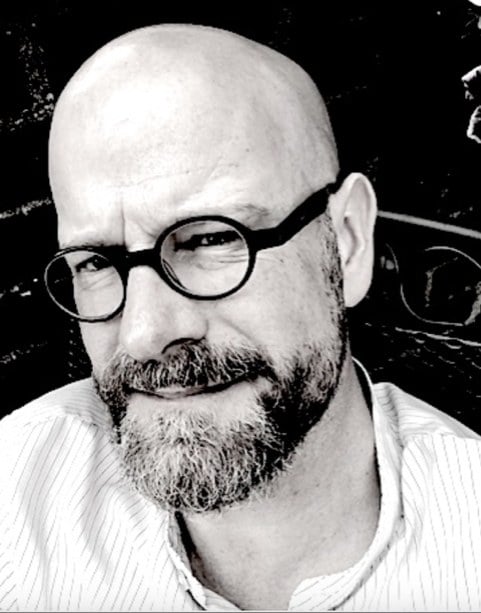
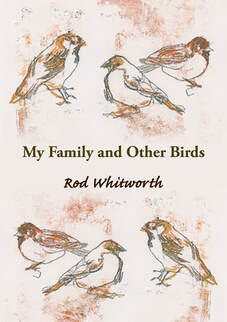
It’s a great pleasure introducing this month’s guest poet: Rod Whitworth. We first met, probably, a good decade or so ago. His poems have been widely published and successful in competitions. One of these, the poignant Demobbed was featured here on 30 May, 2021. Rod recently launched his first full collection My family and otherbirds. I’ve chosen a selection of poems on the themes of family and birds and, of course, jazz.
Tandem in Holland
On that day, your smile hung like a sunrise over the polders.
And on that day, your voice greeted me like blackbirds singing to claim and to yield.
And on that day, your touch thrilled like a breeze from the pine trees.
And that day brought the knowledge of itself and knew that it was this day.
Portrait of my grandfather, accompanied
The daft smile, wide as a spiv, tells us Sunday afternoon, after a slow left-arm morning and Chester’s Best in the Cotton Tree. You’re sitting in the sun on the donkey-stoned front step of Number 51 in undone waistcoat, collarless shirt, felt slippers, a Capstan Full Strength drooped from a trailing hand. This is happiness: transported from your brother Llewelyn who never left the Somme, from crying all the way home after delivering jam and marmalade to shops in Coventry the day after it was blitzed.
On your right knee: me, plump as a queen’s cushion, wide-eyed, in Auntie-Louie-knitted rompers, not knowing any of this.
Names you know, names
It was Rod, the other one, the one who listened to American radio on his Communist dad’s short wave, who, one bright April morning between the 53 bus stop and school, said You’ve got to listen to this bloke, a pianist, Thelonious Monk. He’s something else. Another world. I told him no-one could be called Thelonious Monk. It took me two years to find out he was right, on both counts. What he didn’t know though was that Monk’s middle name was Sphere. By the time I knew that, the car Rod was travelling in had crashed into the lamp post.
One for…
He was walking away when I noticed the wings.
Furled they were, but still visible against the dark blue
hoodie. I don’t believe in angels but it does make you think.
I called him back, asked him to intercede. You’re asking a lot from a magpie
he croaked, then flew off. Made me feel sorrowful.
I wished he’d had a friend.
Biography
Rod Whitworth was born in Ashton-under-Lyne in 1943, and has done a number of jobs, including teaching maths (for 33 years) and working in traffic censuses (the job that kept him on the streets). He currently works as a medical rôle-player. Rod has been writing poetry for a few years and has had work published in a number of journals and anthologies. His first collection, My family and other birds, was published by Vole Books in 2024. He now lives in Oldham and is still tyrannised by commas.
This month’s guest slot is for poems from To Live Here, an anthology of haiku published by The Wee Sparrow Press. The Press was founded by Claire Thom. 100% of the proceeds of their anthologies are given to charity.
The anthology is edited by Giorgia Di Pancrazio & Katherine E Winnick. The lovely cover and illustrations are by Scottish artist Colin Thom.
To Live Here is “A collection of haiku on the theme of home, which explores the many facets of human experience, from the mundane to the sublime. Featuring the work of talented poets from around the world, this anthology invites readers to reflect on the beauty and complexity of the world we inhabit.”
Salford Loaves and Fishes, a charity supporting the homeless, has already received over £600. The anthology is available through Amazon – ISBN 9788409528165. I’m grateful to Francis Attard and Julie Mellor for permission to share their haiku.
sandy beach turtles lay clutches of eggs off-shore breeze
Francis Attard, Malta
three cornered field the generations who farmed here
A lively and intriguing title for a poem sequence by our guest poet Lydia Harris. Her work has featured here before (March 2019). This sequence is from her new collection Objects for Private Devotion, beautifully produced by Pindrop Press, published last year. Lydia lives in the Orkney island of Westray. Many of the poem sequences in her new book focus on local culture, people, nature, objects – such as the prayer nut which provides the cover image.
The sequence about the fieldfare is inspired by the great Serbian poet Vasco Popa. The Blackbird’s Field is also a sequence, from Popa’s Collected Poems, close on 400 pages – drawing on folk tale, surrealist fable, personal anecdote, and tribal myth.
Fieldfare, blown off course, early spring
After Vasco Popa
My Fieldfare
He’s made of bone pins. He’s a book inside a box with a beak-shaped lid. A snapped-shut lock.
He Makes Landfall
at Hagock where the Scollays ploughed in patches, wore tracks with their boots, gulped spring water, built their house.
Body
His muscles hurtle from rump to neb.
First Song
The sky is my eye, earth my egg. From Noup to the Ness in the turn of my head.
How I know him
His underwing flashes, he wheels before settling on plough or pasture.
His Manners
When the tide is asleep he swallows it. His wings are granite with a hundred eyes.
Second Song
Bone grinds skin, stone splits grain.
His Passion
Flames again. He thinks he is clay. The sea wrought him like a mace head, speckled, banded, half-way done. Bird before he was bird.
Third Song
Snapped flint, water-worn sea pebble.
His Dress Code
He squints through an eye mask, lifts his mottled back through west winds, across north winds.
A Flagstone in the Wall Speaks to Him
Grapple with my grain. My night surfaces. Tap the lichen from my face. Draw silver from my base.
Lament
I’ve lost my folk, my night ships, my dear blood, thick then thin, night bird, stray bird.
Tongue
A whip of liver-coloured flesh sheathed in the coffin of his beak.
His Heart
Its flicker forms ice, his own padlocked air. His map of the wind stiff with frost in the skirts of an old storm.
He Takes His Leave
Fooled by the moon. He’s lost his bearings, like the night boat. We need to talk on the edge of sight.
Biography: Lydia Harris lives in the Orkney island of Westray. Her first pamphlet Glad not to be the corpse was published by Smiths Knoll in 2012. In 2017 she held a Scottish Book Trust New Writers’ Award. Her pamphlet A Small Space was placed first in the Paper Swans competition 2020.
It’s a great pleasure to introduce this month’s guest poet Judy Kendall. We met many years ago through our membership of the Yorkshire/Lancashire Haiku group. Judy lived and worked in Japan for nearly seven years. Cinnamon Press published four collections – containing haiku and ‘mainstream’ poems. You can read Judy’s full biography further down. I’ll post a second selection of Judy’s writing next month.
Haiku published in Presence
shades of blue distance in the fells
afternoon off red grouse in flight almost grazing the heather
moorland air just after a curlew’s call liquid fresh—
travelling light I will my neighbor to turn the page
(published in Presence and selected for Red Moon Best English Language anthology)
Short poems or ‘vegetable’ haiku published in insatiable carrot (Cinnamon Press, 2015)
[Many of these have featured on Incredible Edible Todmorden’s Edible Poetry site and on or around the town]
tall green mild and meek not quite the full onion the gentle leek
hairy bitter cress going wild among the cabbages
snug by the wall the one the pennine wind forgot Todmorden’s first apricot
taken apart, the cabbage becomes all heart and leaves
chunky, nobbly-eyed the potato says ‘hi, will you be my friend?’
Haiku and poems from Joy Change (Cinnamon Press, 2010) Haiku:
wooden geta the water quivers with carp a horizon of lilies
sickle moon, yellow and black, on my way back to the heart
(still international haiku competition)
watching the breath come and go, who am I but a broken bit of star?
(still international haiku competition)
drifting mountains shoulder the sky blotches of pine
(Asahi Shimbun)
Biography
Judy Kendall worked as an English lecturer at Kanazawa University in Japan for nearly seven years. When she first went to Japan she was a practicing playwright but she soon began to focus on poetry and haiku, kickstarted by an invitation to to participate in a collaborative translation of Miyaiki Eiko’s haiku. This became the bilingual publication Suiko /The Water Jar. Since then she has been writing haiku and haibun along with other poetic and prose forms. The haiku mode has informed her four Cinnamon Press poetry collections, particularly Joy Change – composed while she was in Japan. She has won several poetry awards, recently receiving a 2019 Genjuan International Haibun An Cottage prize, and is the essays and bilingual translations editor for Presence haiku journal.
She is Reader in English and Creative Writing at Salford University, and aside from haiku and haibun, works as a poet, poetry translator and visual text exponent. She has published several articles and books on the translation and creative process, including ‘Jo Ha Kyu? and Fu Bi Xing; Reading|Viewing Haiku’ in Juxtapositions, 1 (2). She is currently putting the finishing touches to a monograph for Edinburgh University Press on Where Language Thickens (focusing on the threshold between articulation and inarticulation in language – a threshold in which haiku itself is surely situated).
Contrapasso is the title of the debut collection of Alexandra Fössinger. She is of Italian origin and currently lives in Northern Germany. She writes mostly in English. Many of the poems included have been previously published in the UK and elsewhere, in magazines such as Tears in the Fence, The High Window, The Journal. The cover design – a black bird against a stark white background – is by Daniel Lambert, Art Director of Cephalopress, established in 2018, providing ‘a voice for the marginalised and the voiceless’.
I do not know the author, though I attended her online reading with Q&A. There she explained the background to the poems: her attempt at survival ‘after the imprisonment in the UK of someone dear to me’. This sudden loss may, in part, have coincided with the pandemic and its lockdowns: creating an incarceration for the poet too.
In Dante’s Divine Comedy, contrapasso is the punishment of souls by a process either resembling or contrasting with the sin itself. The collection is in two parts, both preceded by a quotation from Dante’s Inferno. Part 1 covers the period of imprisonment, while poems in Part 2 were written after the person’s release.
Birds for someone who cannot hear is the title of the opening poem and birds appear throughout the collection, as messengers, omens, and symbols: the blackbird frozen in shock, the thrushes in hiding, along with magpies, sparrows, sky larks, great tit, kingfishers, herons, seabirds. The second poem is titled Cell, giving us just the bare numbers: 1, 5, 3, 4, 7, 1, and ending: bad luck has brought and kept you here, and whether you’ll walk out or be carried in a coffin is also entirely a matter of chance.
The poems are the author’s response to the sudden loss, despair, darkness, pain. Wehave no life apart from life apart (Sentence); How can I find dreams of oarweed and eelgrass, / bring currents to glide on, as I must, when half / of my body is entangled / on thewrong side of the sea, / how will I know when time says to dive? (Velut luna).
Fössinger has said that she ‘is mostly interested in the spaces between things, the tiny shifts in time, the overlooked, the unsaid.’ Throughout the collection, we find astute observations and statements: la vita assurda: the middle-aged couple / pushing their dog in a pram. (July); that emptiness is best hidden / by a display of tame beauty. (Ambulant).
The strongest poems are those which describe a specific situation, or which have objects as ‘animate scaffold’. The poem Ambulant is in two parts: I The house with the Christmas decoration, and the magnolia tree in bloom, and the blackbird frozen in shock, and an ambulance parked in the front garden, all stand completely still. People walk by, averting their gaze, a stoop hammered into their skin – How many lives will they have lost before, without ever noticing. The orange light is beating on the windows like rain.
Here is Fössinger’s close attention to the overlooked, effective personification, interesting use of language. Not all the poems are so securely grounded, sometimes abstraction obscures their meaning. Other poems would have benefited from being tighter, shorter. The book is a short collection of 31 poems with quite a few blank pages. Some readers might want ‘more poems’ for their ‘pounds’.
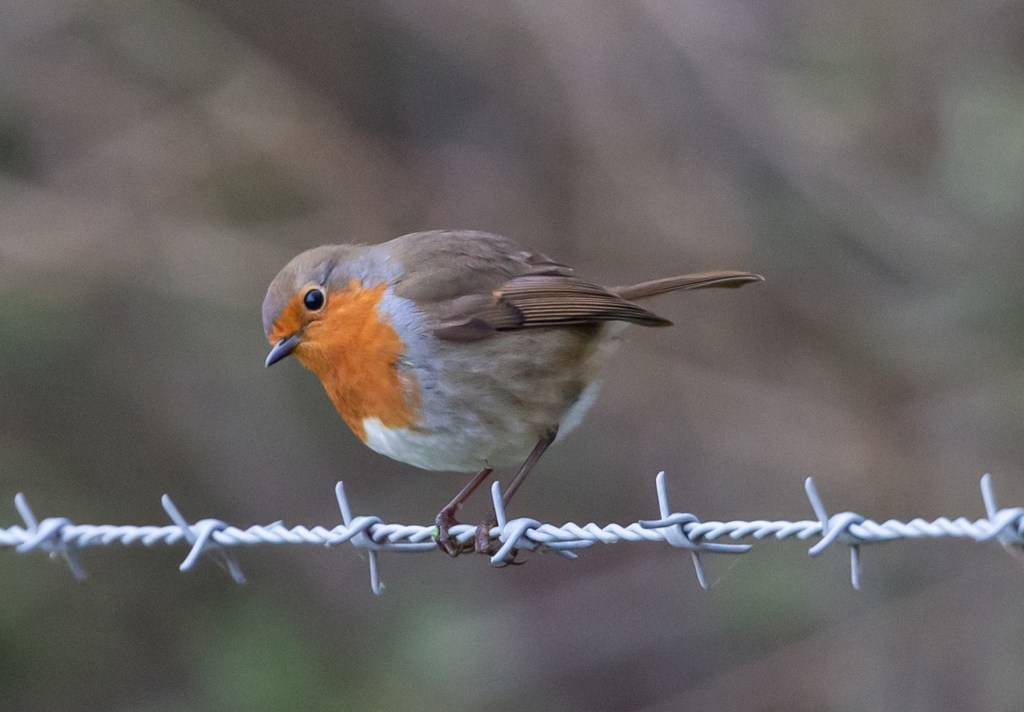
While the poems reflect the poet’s emotional and psychological response to loss and separation, she manages to maintain a careful balance: hope is not abandoned. The recurrent bird theme also provides a framework, an underlying structure. This theme returns in the short closing poem, The robin redbreast. The loved one appears in a dream, as tiny as a bird, and:
Then you grew a beak with which to pick and sing and transport worms and roses.
Contrapasso is a confident and authentic debut by a perceptive, astute poet. Her personal tale finds echoes in the reader’s universal story. However long and painful the journey, there can be closure and transformation.
World Book Day is on the 23rd of April. In the UK it takes place on the 2nd of March to avoid clashes with spring school holidays and St. Georges’ Day.
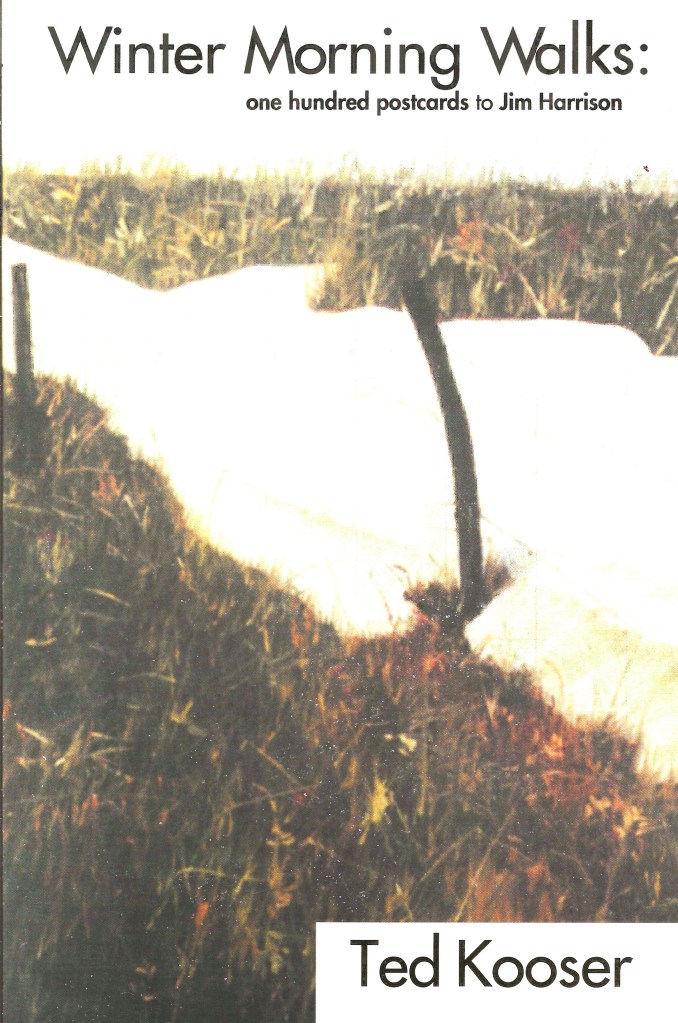
A fellow poet introduced me to the American poet Ted Kooser, now in his early 80s. His style is accomplished, yet extremely simple. My current bedtime reading is his poetry collection Winter Morning Walks: one hundred postcards to Jim Harrison (Carnegie Mellon University Press, 2001).
In the late 90s Kooser developed cancer. He gave up his insurance job and writing. When he began to write again, it was to paste daily poems on postcards he sent to his friend and fellow writer Jim Harrison. In the preface, Kooser tells us ‘I began to take a two-mile walk each morning. I’d been told by my radiation oncologist to stay out of the sun for a year because of skin sensitivity, so I exercised before dawn, hiking the isolated country roads near where I live.’ These country roads are in Nebraska.
The poems cover a period from 9 November until 20 March. In the poems Kooser doesn’t directly talk about the illness. He does so through metaphor. All the poems include a brief description of the weather. The clear and precise observation gives them a haiku quality.
Here is his postcard for march 5:
Very windy and cold.
A flock of robins bobs in the top of a wind-tossed tree, with every robin facing north and the sky flying into their faces. But this is not straightforwardness, nor is it courage, nor an example of purpose and direction against insurmountable odds. They perch like this to keep their feathers smooth.
Storks are said to bring happiness. The bird has been the official emblem of The Hague for centuries. Until the beginning of the last century, storks with clipped wings walked the many fish markets in the city, keeping the streets clean.
I hope this new year will bring health and happiness to you and those you hold dear. The poem is from my new collection Remembering / Disease published last October by Broken Sleep Books. It first appeared in the online magazine Dust, edited by Tara Wheeler.
Storks also feature in my poem High wind. It was selected as one of 20 poems by a jury for the Poetry Archive’s Poetry Archive Now! Wordview 2022. You can see and hear me read it here.
Waiting
The water meadows are waiting for the storks to return
always invisible the other side of her face
in this book there is snow on every page
even an old potato can be turned into a Christmas stamp
the naming of colours is not a science. I vote for bird’s nest grey








 Acacia Publications