Today I am with my brother and sister-on-law. It’s his birthday today, so I arrived yesterday to have the chance to catch up with them before friends and family arrive.
I’m the eldest, three years between us. I’ve been protective of him from the start.
For many years now, my brother has worn a metal brace on his leg. A few years ago he managed to get a second-hand ‘loopfiets’ – a walking bicycle. I’d never seen one before, but it’s small enough to go through a standard door so one can go into shops, and it’s light enough to put in a car.
Example of ‘walking’ bike
It was my father’s birthday on Sunday 2 September that year and my parents’ friends commented on how my brother limped, encouraged my mother to get it checked out. GP on Monday, neurologist on Tuesday. I can still see my parents’ car disappear round the corner on the Wednesday morning.
1962
Alexander Eduard (coppersmith in the bible and van Beinum, the famous conductor). Our Irish setter had been given the names of an unborn child.
A ward of six, our parents’ daily drive, forty minutes each way. Neurologist, paralysis, lumbar puncture, nausea.
Grandfather owned an electrical shop (double-fronted on the main street); gave my brother a beige-brown radio.
The specialist allowed our red Irish setter to visit my brother, celebrating his fourteenth birthday in the academic hospital in Leiden.
Three months later he arrived home, just in time for St. Nicolaas. My brother still limped and his crown was marked by two scars at right angles, the space between dipped and dented. A few days later grandfather came to take his radio back.
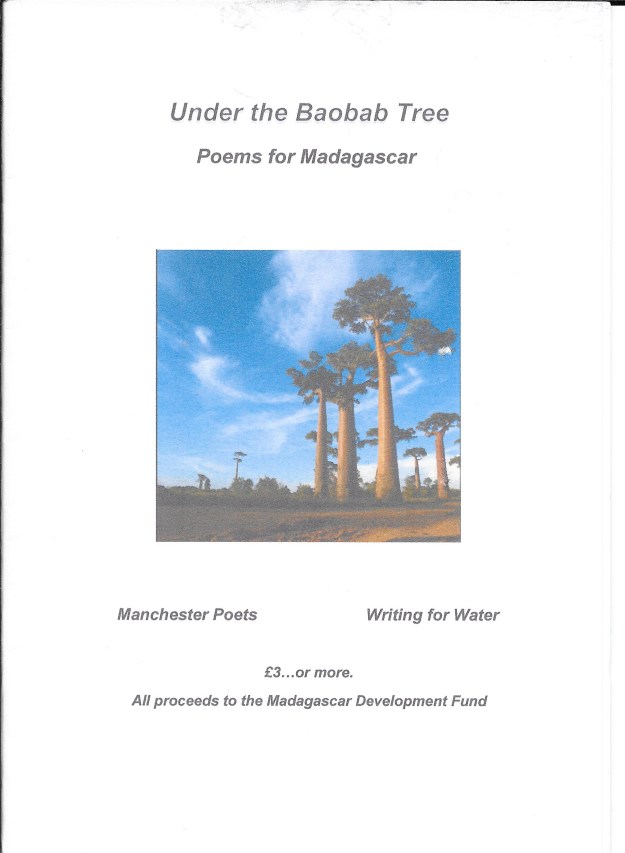
Sorting out boxes with books that moved with me from the UK, I found this small pamphlet. Manchester poets Steve Waling and Francesca Pridham edited poems by members of Manchester Poets. Copies were sold at the Didsbury Festival to raise funds.
Here Fran tells us about her connection with the Madagascar Development Funds and shares some wonderful proverbs – writing prompts for your poems, flash fiction, short stories.
Madagascar
“My first contact with Madagascar came in 2013, when my husband, interested primarily in the country’s unique wildlife, persuaded me to take part in a trekking holiday there. The scenery is awe inspiring. A melting pot situated between Asia, Africa and Australia, Madagascar is the mysterious land of the ancient baobab tree, a land where pachypodiums thrive, the cat-like fossa hunts and lemurs swing from tree to tree. The most revered lemur, the Indri’s strange call wails through the rainforests, echoing the ancient isolation of the island.
The people
Despite this beauty, what however most caught my heart were the people. There is little infrastructure in the country and most villages consist of a small collection of adobe houses made from the spectacular red mud that Madagascar is famous for. The people have nothing, just the land they live on and any livestock, such as chickens or the zebu cattle that represent their wealth. Their generosity and welcome though is infectious. I gave a biscuit to a small child, four others appeared instantly, and the biscuit was shared immediately.
Credit: Puabar via Pixabay
Water
Their water supplies are often limited to streams that trickle into small muddy ponds, polluted sometimes by cattle who too have to use the water. Standing by the side of a small dirt track nearing the end of my trekking holiday I drank thirstily from a litre bottle of water I’d brought with me. Staggering down the track was an old man with his grandson, pulling and pushing at a makeshift trolley, carrying four battered plastic water containers. They had walked five miles to the nearest water supplies and were coming back to the village.
Credit: via Pixabay
The Madagascar Development Fund
When I returned to England, I started raising money to develop water supplies and build wells in Madagascar. We are lucky enough to work with The Madagascar Development Fund, a small charity run by the ex British Ambassador to Madagascar and have provided enough money now for four wells. The charity specialises in small projects which because of the charity’s experience are achievable and can bypass the complicated political situation in the country.
We have been lucky enough to attend the opening of one of the wells where we were welcomed into the village by singing, dancing, and drumming. We were given a welcome feast and a poem, written specially for the event was read by a young man, resplendent in what looked like a doctor’s white coat!
Malagasy Proverbs
The Madagascan culture is infectious! Their proverbs or ohabolana capture the learning and wisdom of centuries, inspiring both thought and writing! Enjoy the poems they produce!”
Truth is like sugar cane: even if you chew it for a long time it is still sweet. Words are like eggs; when they are hatched they have wings. Like the chameleon keep one eye on the future and one eye on the past. Let your love be like the misty rains coming softly but flooding the river. Those who know how to swim are the ones who sink. Don’t be like a shadow: a constant companion, but not a comrade. An egg does not fight a rock. Only thin dogs become wild. A canoe does not know who is king: when it turns over everybody gets wet.
We’re staying with the Writing Poetry paperback that Matthew Sweeney and John Hartley Williams wrote together for the Teach Yourself series.
In Chapter 12 they’re looking at first lines of contemporary poems, and the need to hook the reader:
Someday I will go to Aarhus Hitler entered Paris the way The strangest thing I ever stole? A snowman. Brethren, I know that many of you have come here today We gotta make a film of this, Jack. After she left he bought another cactus.
All these lines are intriguing, but they work in different ways. The first is a vow, then we have the first half of a comparison that the reader needs to complete. The third is a question with its own answer, followed by a resolve in dialogue. Number 6 is a story that begins in the middle.
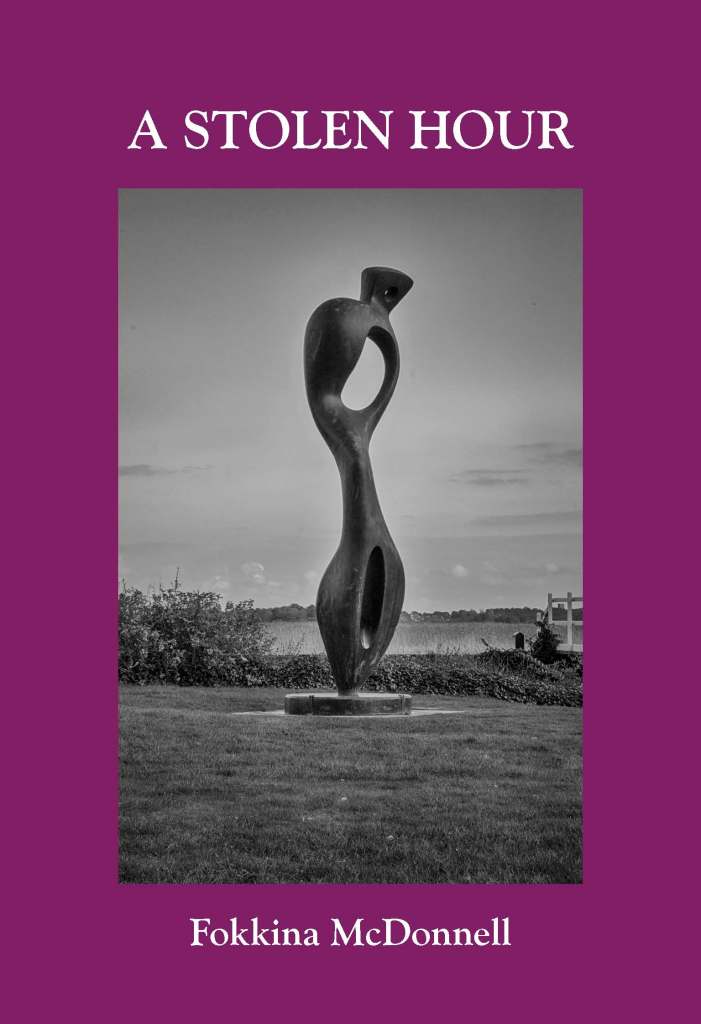
Here are first lines from some of the poems in my pamphlet A Stolen Hour (Grey Hen Press, 2020):
For just one minute of the day If we were strangers, His binoculars rest on the windowsill. The week before I’d given my pleated dress away. Bedrooms are for hiding white. One hour was stolen from the time I am the last stonemason. Date of refusal decision: 13 September 2017
What do you think? Which is the one that intrigues you most and why? Feel free to use them for your freewrite, your ink waster. If you get a poem or flash fiction from a line, I’d be pleased to know!
Earlier this week I looked at my website statistics. The blog post that has got the most views (after the Home page and the Archives) is Fishbones Dreaming from August 2019. Every other day someone views the post. Here is the link.
The children’s poem Fishbones Dreaming is by Matthew Sweeney. It is four years since he died on the 5th of August 2018, aged only 65. The poem uses a gradual flashback technique and a refrain.
Prompt
Here is a prompt that Matthew gave on the course he ran at the wonderful Almassera Vella, Spain in 2006.
We were just to sit quietly, clearing the head from clutter and then to slowly run through the letters of the alphabet until one letter gave some energy, sound or resistance.
I was sitting on the loggia, looking out over the terraced fields and the small white chapel in the distance. Once we got the letter, we were to run through some nouns until one noun spoke….potato, parsley, parchment. Pliers came from that prompt, and it was my first blog post.
Credit: Fabio Ribeiro on Pixabay
Pliers
A museum dedicated to pliers opened last month in the old part of town. Pliers, collected from the five continents, are displayed in rows on walls and glass cases. Most are made from metal, shiny or a rusty red. The curator, a small Belgian, Jan de Smets, exiled from the Congo thirty years before, found the earliest exhibits on expeditions to empty houses, garages, sheds and shacks. Pliers have also been donated by retired plumbers, old builders and master carpenters. Six toy pliers are on permanent loan. Where pliers are missing from a boxed set the white outline of their shape remains.
One of the poems in this week’s inbox came courtesy of The Paris Review: Identity Check by Hans Magnus Enzensberger. The title is intriguing enough, the first line is a bold claim and a denial:
This is not Dante
This immediately sets up tension and hooks the reader’s curiosity. If not Dante, who is it? We get an answer we know can’t be true: This is a photograph of Dante. Then: This is a film showing an actor who pretends to be Dante.
The poem continues like this. It reminded me of a poem of mine published in orbis magazine which uses similar techniques. If I feel really ‘stale’, then using two prompts of a different kind is guaranteed to work.
In 2017 I went to Tate Modern for the exhibition of Robert Rauschenberg – very stimulating. It included his telegram This is a painting of Iris Clert if I say so. A visit with a poet friend to Manchester Art Gallery then started the poem. The painting described is Portrait of Lucian Freud by Francis Bacon. Here is the link.
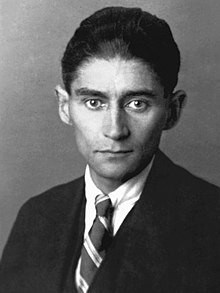
Franz Kafka
This is a portrait if I say so
A portrait of Kafka, in a long coat; dark grey, almost black. No, it’s not. It’s just paint on canvas. This is a portrait of the man who was a friend of the man who put the paint on the canvas. Paint is history. Painting is looking for something, then losing it again. This is a portrait of a man, based on a photo of Kafka. My friend Kathleen asked Was Kafka’s face that long? The man in the long coat in the portrait is striding out. No, he’s not. The note to the right of the portrait says the man who is not Kafka is leaning against the pillar, but the pillar isn’t straight. This is a portrait of a man who isn’t famous, based on a photo of Kafka, and Kafka became famous, and the man who put the paint on the canvas became famous. Kafka is dead. The painter is dead, but this portrait is living, dead paint is living. This is the living portrait of a man who had friends. The man in a coat the colour of death. All colours become history. A coat; a face; a pillar. A portrait is, he says so.
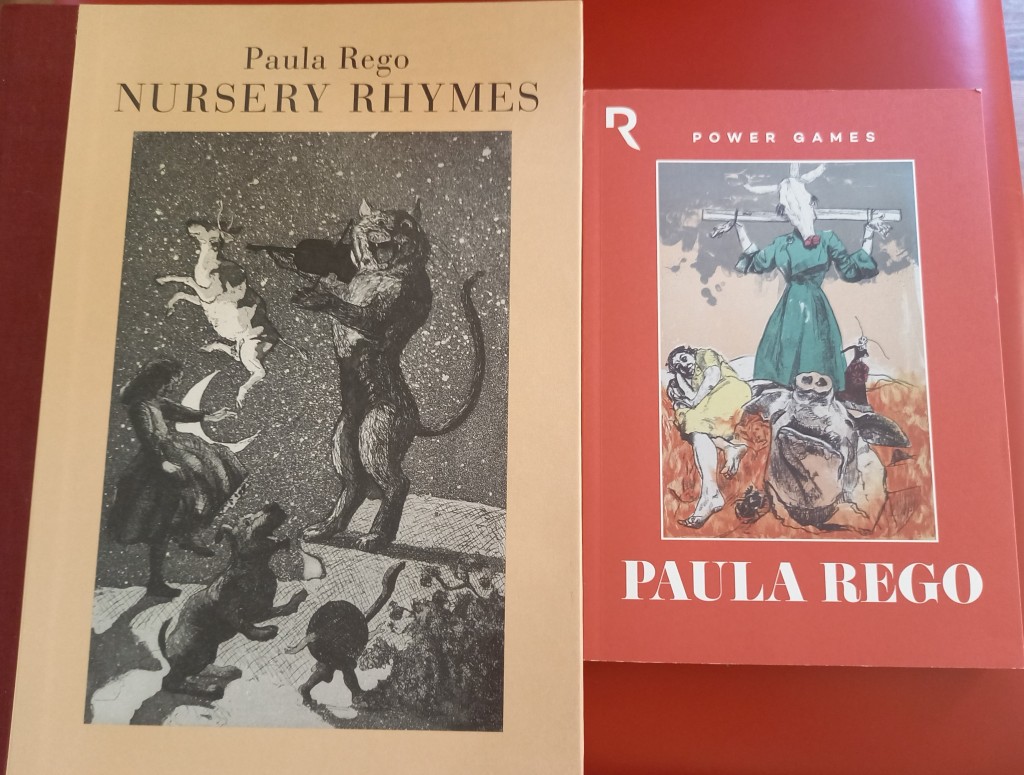
I was sad to learn of the recent death of the artist Paula Rego. Last century I saw her work at the Whitworth Museum in Manchester, UK. That’s when I bought Nursery Rhymes. In March this year I went to the first major retrospective exhibition of her work in The Netherlands – at the Kunstmuseum here in The Hague. The museum shop had copies of Power Games.
I admire her as a person and an artist. As she told it ‘art was a way to work through fear and trauma, to soothe and comfort, as well as to erase, attack, scratch out and destroy.’
Whitworth Museum, extension
After a major refurbishment the Whitworth reopened in 2015. I would have liked very much to meet Paula Rego and talk with her about life and art. This imaginary meeting is set in the new café. The poem was published in my pamphlet A Stolen Hour (Grey Hen Press, 2020).
Meeting Paula Rego at the Whitworth, Manchester
Shading her eyes with a small black fan she looks distressed and even out of place. Ash trees cast a greenish shadow on her face. To me she seems older now, frailer than in the short winter days of that other year when the quiet ghost of a drowned baby played with black hen, spiders, women who prayed for open roads, escape, a private den.
There was a boating lake once in the park. We wait for panini, service is slow. Café in the trees, I say, canopy. Her earrings sparkle, her eyes are still dark. It’s from the Greek; “konops” means mosquito. Paula’s face lights up; her imagination set free.
1 I discovered Pome only a couple of months ago and am enjoying the poems very much: an interesting range and they are short, even very short. As I understand it, Matthew (Matt) Ogle originally posted the poems some years ago and the project has restarted via Tiny Letter.
Here is an Issa haiku, translated by Robert Hass. Since I am a paid-up member of the Society for the Prevention of Cruelty to House Dust, it speaks to me …
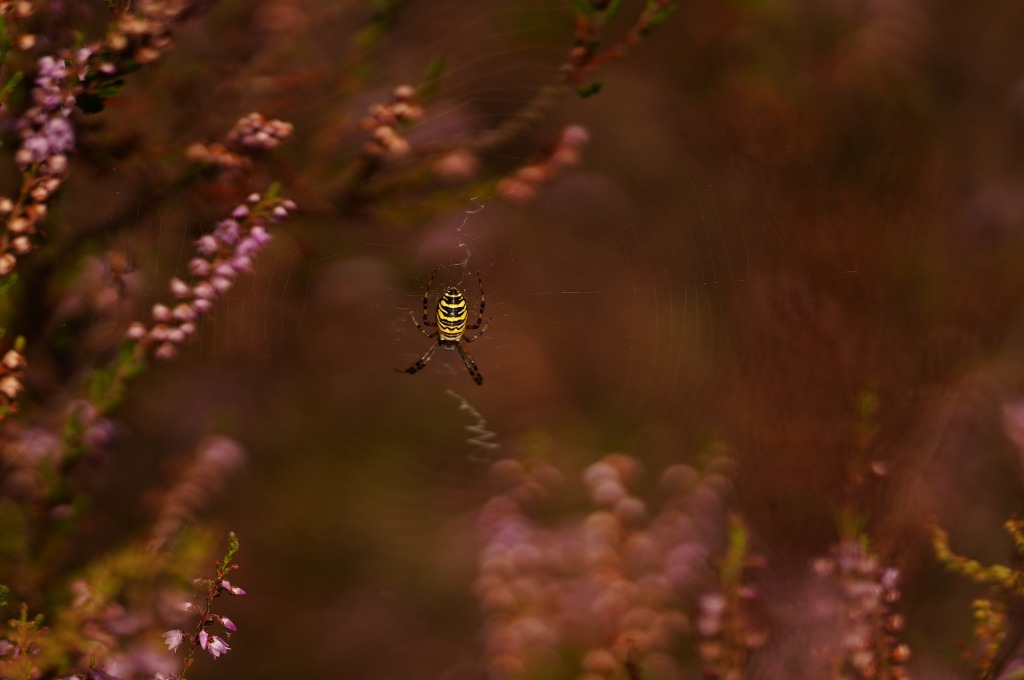
Don’t worry, spiders, I keep house casually
2 Monostich – a poem or epigram of one single line. The title is important and may be long, longer even than the poem. My recent example from a course I’m doing:
While it rained, we went out and put the poster on trees and lamp posts in theneighbourhood
It needs heart and courage (lebh in Hebrew) to wear a pochet with conviction.
3 Here is a short poem by Carl Tomlinson from his Changing Places. It has a haiku-like quality. Carl is the May guest poet. I look forward to sharing more of his poems with you then.
August
All along the bridleway some kind of rain is trying to shake off the wind. The land feels thinned.
A great many thanks to my fellow poets who responded splendidly on Facebook to the George Perec ‘e’ challenge. It’s a feast. I hope you enjoy the selection. I send them and you warm Easter greetings.
Steve Smythe: Send me every gem she ever kept. Steve Smythe: Beef, beer, weed: perfect. Helen Kay: Helen expects eleven eggs every week. Sarah L Dixon: Every beret fells seven men even when they tend seeds, mend fences, then recede. End. Steve Smythe: Best strengthen the steel sheep pen Hannah Mackay: Chew seven spelt seeds. Renew every few weeks. Steve Smythe: Feel the breeze; expect red cheeks. Hilary Robinson: Send me the new bed, fresh sheet-bedecked. Janet Sutherland: She expects her energy ends here. Barry Fentiman-Hall: When Ben went there Jen went red. Sarah J Bryson: He knew every beech tree grew free, the breeze renewed, endlessly. Katy Evans-Bush: She’d never pre-empt these seven, then exempt. Angi Holden: Envy the clever shepherd – the twelve speckled sheep he secretly keeps chew where the endless greenery stretches between cherry tree edged beech crescents. Sue Kindon: The Beer Fest swells the seventh tent; breezy revellers emerge, three sheets teetered. Oz Hardwick: The elect erected dressy needles, yet clerks scythe empty chests. Pam Thompson: We’re held, spent – thresh sleep/speech event, feel stress. Rachel Davies: When we’re elderly trekkers the knees need rest Sarah Mnatzaganian: Eyes drench every element when they weep. Stephen Payne: He prefers terser sentences. Vanessa Lampert: Yes the egg never left me, yes the elf then wept, even better, he grew mettle greener, severed the tree then tweeted the red hedge news. Sally Evans: she emerges even when she expects endless reverses.
Credit: Peggy Marco via Pixabay
By way of bonus, here is poet Rod Whitworth’s contribution – using only ‘i’ and ‘y’.
I
I mind (with liking) this child imbibing milk. Lit with infinity, it insists it is big. Bit by bit — spiting my might, my right — it fights my will.
I find sticks in bins igniting nightly, kindling my illicit still. Timing it by twilight I skip by drinking whisky, singing in high winds, rhyming, rhythmic. By limp light I’m writing mythic signs my child might find inspiring. I sigh.
I discovered a book programme on Dutch TV. It’s called Brommeropzee (mopedonsea) after a Dutch short story. There are two presenters. Based on my brief observation, I would say: she is E for Empathy, he is E for Ego.
One item was an interview with Guido van de Wiel. He has previously translated Perec’s 1969 novel La Disparation (A Void) into Dutch – see the cover. Like the original, the text does not include a single vowel ‘e’.
In 1972 Perec published a companion piece Les Revenentes (The Exeter Text). In the interview Guido showed long lists of words containing only the vowel ‘e’. He has worked on this translation on-and-off for 12 years. The translation follows the original in form (lipogram) and content.
Brommeropzee issued a challenge to viewers: compose a coherent sentence of at least 10 and at most 30 words, using any consonant, but only the vowel ‘e’. Here is my sentence: De beleefde kreeft heeft even geleden en elders negeert de kwelder de heen-en-weer regen.
Translated: The polite lobster has suffered briefly and elsewhere the salt marsh ignores the to-and-fro rain. There are no rhyming sounds as in my Dutch original, but you get the flavour.
If you like a challenge, compose a (decent) sentence of words using only the vowel ‘e’ and send them to me via the Contact page. I’ll publish a selection in a few weeks.
Yesterday I talked with friends about Cambridge. That brought back memories of a one-week workshop at Madingley Hall with the poet Lawrence Sail. Madingley Hall is a 16th Century building just a few miles from Cambridge. It is set in seven acres of splendid gardens and grounds, designed by the famous Capability Brown in the 18th Century.The weather was good the week I was there and we would all find a quiet corner outside and get writing.
Credit: Pasja1000 via Pixabay
Writing prompt
One of the exercises was about personification. We mentally went through the alphabet and stopped at a letter that resonated with us. What kind of life does that letter have? What do they want and what is difficult for them?
The poem Trying was published in my debut Another life (Oversteps Books Ltd, 2016).
Trying
Trying not to be like one who has gone before. Allocated a slot at the back of the queue: a circle dancer with a club foot.
Striving to become the symbol of perfection. Dragging a tail, leaving tiny furrows on the rough terrain.
Trying then to hide in foreign places. Archaic words spoken with a twang: Qua, quorum, quota, quasi.












 Acacia Publications