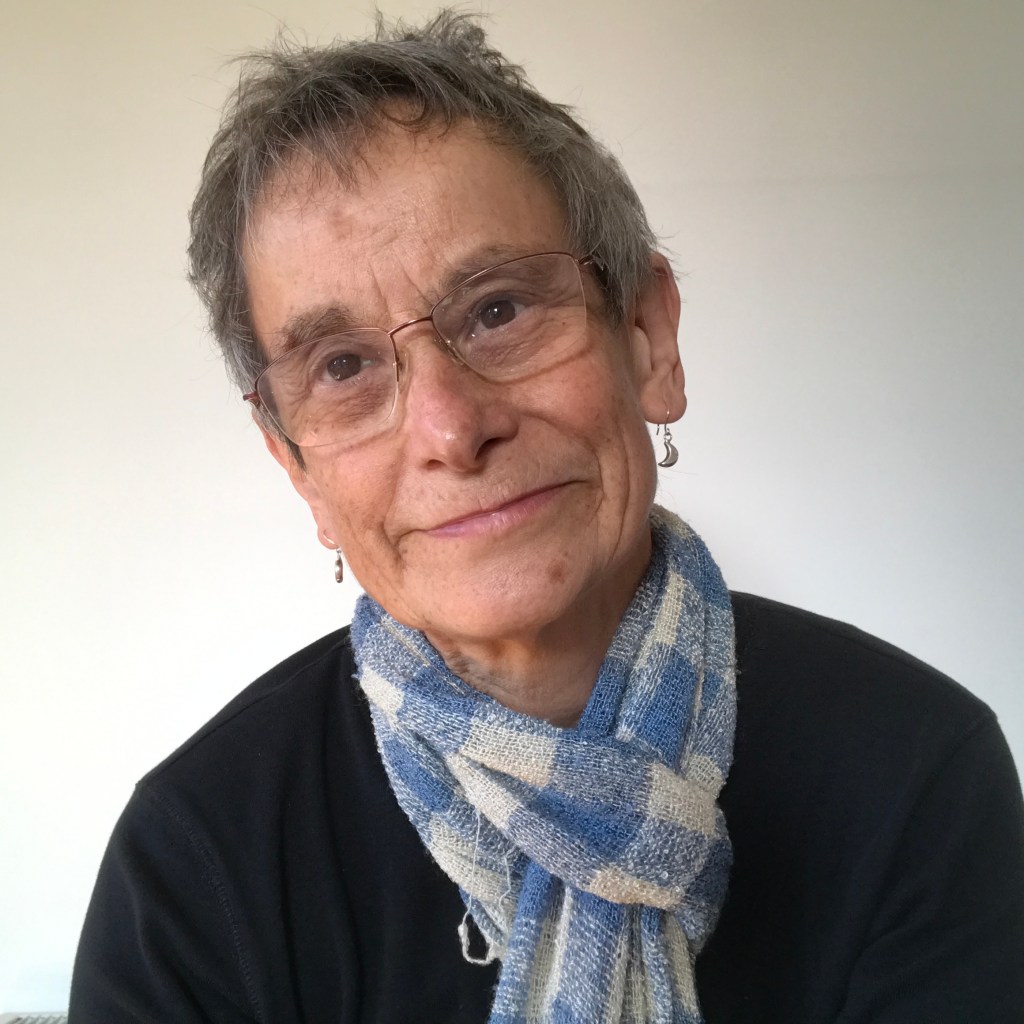
I am very glad to introduce this month’s guest poet Sheila Butterworth. We met many years ago, in that Yorks/Lancs Branch of the BHS. I let Sheila introduce herself and her haiku.
“Winning the Leeds Waterstones Haiku Competition in 2000, organised by the Yorks/Lancs Branch of the British Haiku Society, introduced me to the world of haiku poets, workshops, journals and a network of local poets with whom to chew the haiku fat. I have since had poems published in Blithe Spirit, Presence, The Snapshot Press Haiku Calendar, Wales Haiku Journal and The Red Moon Anthology.
Most of my haiku come out of the everyday experiences of life within a mile of my edge of village doorstep where I have lived for 40 years. This is where I notice those things that have most meaning to make haiku. The familiar environment highlights the nuances of change in place, in time and in me and this is when haiku happen.”
coming light the bubble and trill of robin and wren
high street dawn the smell of sweet dough folds into the fog
morning mizzle molehills spatter the spring pasture
planting potatoes startled sparrows scatter in the quickthorn
summer rain the shining bole of a sapling ash
evening sun the shadow of the wood fills the field
Yesterday’s journey: comfortable Eurostar from Rotterdam Centraal, a sit-down at Soho & Co, Liverpool Street Station for food. The unexpected ‘red signal’ at Colchester turned out to be ‘waiting for British Transport Police’. They escorted a couple off the train. Missed connection at Ipswich gives an unexpected hour to mull and ponder. The friendly taxi driver from A2B and warm welcome at The White Lion where the bar is still open.
Today is the publication day of my third collection. This evening, starting at 19:30 UK time, there will be a Zoom launch, organised by the publisher, Broken Sleep Books. There is a link on their website to Eventbrite.
Four other poets will also be reading, to launch their pamphlet or collection: Caleb Parkin, Chrissy Williams, Taylor Strickland, and Chris Laoutaris.
The manuscript was awarded a Northern Writers’ Award from New Writing North in June 2020. That raised my spirits during the lockdown. It was a unanimous decision by the Board of Broken Sleep Books to accept the collection for publication. The delicate cover design by Aaron Kent is a great match for the minimalist content.
My poems and I have found at Broken Sleep Books, and I am looking forward very much to the reading this evening.
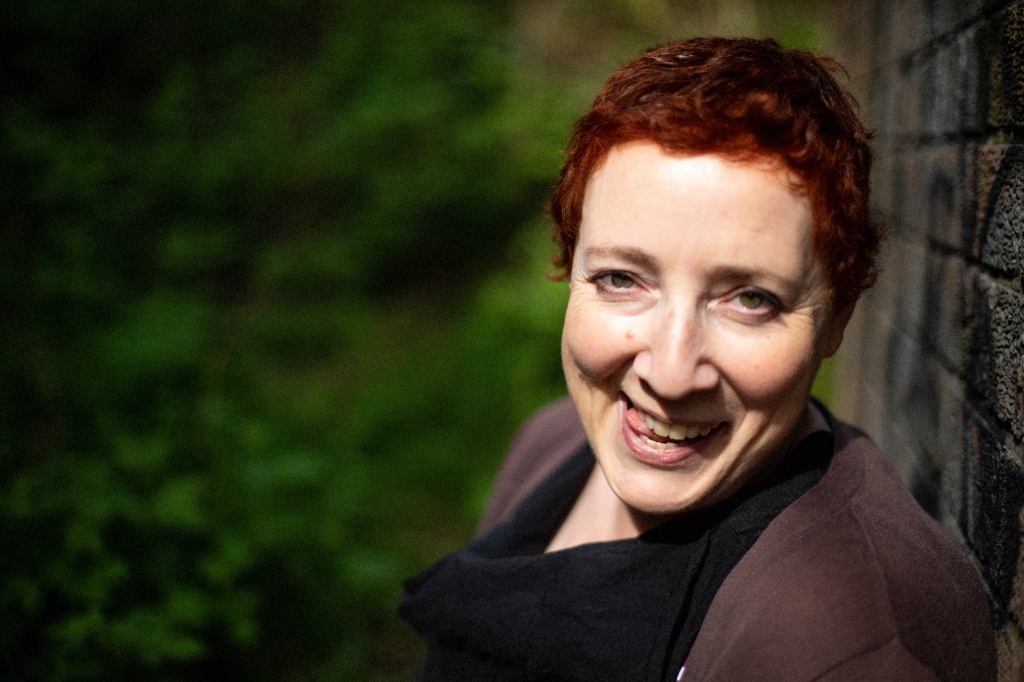
It is a great pleasure to introduce this month’s guest poet Tania Hershman. I met Tania a few years ago when I attended a series of workshops she gave on flash fiction. She is a generous, inspiring tutor. I have chosen four different poems from her new collection.
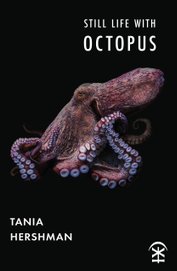
Tania Hershman’s second poetry collection, Still Life with Octopus, was published by Nine Arches Press in July 2022, and her debut novel, Go On, a hybrid “fictional-memoir-in-collage” will be published by Broken Sleep Books on 17 November 2022. Her poetry pamphlet,How High Did She Fly, was joint winner of Live Canon’s 2019 Poetry Pamphlet Competition and her hybrid particle-physics-inspired book ‘and what if we were all allowed to disappear’ was published by Guillemot Press in March 2020.
Tania is also the author of a poetry collection, a poetry chapbook and three short story collections, and co-author of Writing Short Stories: A Writers’ & Artists’ Companion (Bloomsbury, 2014). She is co-creator of the @OnThisDayShe Twitter account, co-author of the On This Day She book (John Blake, 2021), and has a PhD in creative writing inspired by particle physics. As writer-in-residence for Arvon for Autumn 22-Winter 23, Tania has curated a programme of readings, workshops and talks, both online and in person. Find out more at http://www.taniahershman.com
Still Life With Octopus (II)
I only asked her once to climb inside a jar for me. (Before we met, I’d watched all the videos of those experiments.) She sighed but did it, said I could screw the lid, released herself easily. You could become any shape you want, I said. She said nothing. One arm sent itself out to switch the kettle on. While she made us tea, I put the jar back in the cupboard, feeling that slight ache from too much sitting in my hip bones, my lower back, where fixed part meets fixed part of me.
Standardized Patient*
Today I am your lower back pain. Listen, I have all the details, will not veer
from the script. Tomorrow I will be your cancer of the kidneys. Next week,
I may be your one-legged skier (I know, I know). Whose pain is this?
*Standardized patient simulation lets medical students practice on people trained to play patients.
And then God
sends someone else’s Jewish grandmother to stop me
with a question about birds I can’t answer. She says – as if this is her river – I’ve never
seen you here before, then presses for my exact address. Instead
of the usual, Such a nice girl, no husband?, she asks, No dog? I don’t know why
I tell her then that I’m a poet, but the gleam in her eyes
warns me this is the point to leave, the unasked
dancing on the path between us: Will you make a poem out of me?
Middle of the Night
Night asks me to wake up. What? I say. Night whispers darkly, something about cats coming in and out, a baby five doors down. You want company? I ask. Night nods. I get up
and we make tea. Too early, the cat mutters as we pass. Night and I get back into bed. I’m fine now, Night says.
Cover design: Ben Rothery
Note: Peter Godfrey-Smith, Other Minds: The Octopus and the Evolution of Intelligent Life (William Collins, 2017).
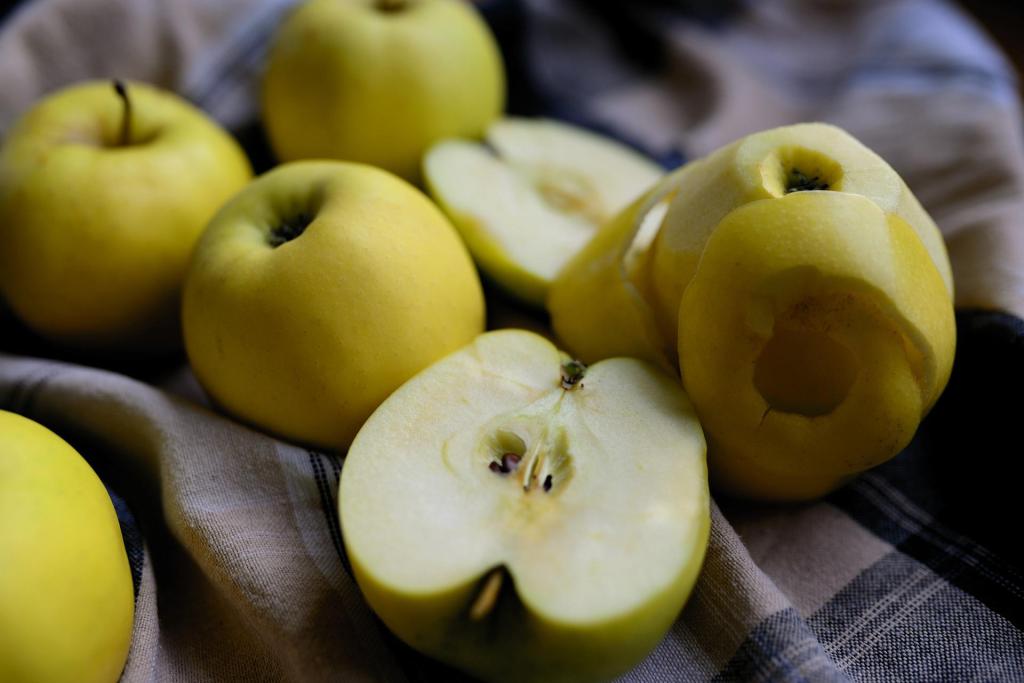
National Apple Day falls on the 21st of October. It was created in the UK by the charity Common Ground in Covent Garden, London on 21 October 1990 to raise awareness about the importance of diversity in different communities. Apparently, there are about 7,500 varieties of apple grown globally. In my local Hoogvliet supermarket I can find six: Kanzi, Pink Lady, Golden Delicious, Granny Smith, Royal Gala and Jazz.
Celebrations take place in the UK throughout October, so go to a fair, take part in an apple peeling contest, bake or eat an apple pie. Here in the Netherlands, traditional Appeltaart always has a good dose of warm spices – cinnamon, ginger, nutmeg. They are baked in a spring form and have a lattice crust. I will have mine with a good dollop of sweet whipped cream, thank you.
My poem is somewhat melancholy. It has the feel of a tanka – the first three lines giving a description, with emotion and reflection in the last two lines.
carefully quartering soft red apples into a compostable bag – I still wait for the letter that will never come
I enjoy most of the archive poems from the Paris Review which arrive in the inbox. I save many of them in my folder ‘Inspiration’.
The poem Imaginary Paintings, by Lisel Mueller (Fall 1992, # 124) is in seven numbered sections. Seven is always a good number. The length of sections varies, from one line (Love) to 10 (Big Lie).
Lisel Mueller, 1924 – 2020
1 How I would Paint the Future
A strip of horizon and figure, seen from the back, forever approaching.
2 How I would Paint Happiness 3 How I would Paint Death 4 How I would Paint Love 5 How I would Paint the Leap of Faith 6 How I would Paint the Big Lie 7 How I would Paint Nostalgia
I liked the start of the Big Lie painting:
Smooth, and deceptively small so that it can be swallowed like something we take for a cold.
Here is my attempt at How I would Paint Patience:
A small mat, wool, handwoven. Mostly pale grey, with the odd black nubbly bits at the corners.
Credit: Prawny via Pixabay
Writing prompt: If you’re looking for a subject for your imaginary paintings, you could always take one of the seven cardinal sins (pride, greed, lust, envy, gluttony, wrath, sloth) or one of the capital virtues that overcome them (humility, generosity, chastity, brotherly love, temperance, meekness, diligence). There is also prudence, fortitude, justice. Or take anything abstract, such as stubbornness, peace.
It’s four years this month since the poet Tony Hoagland died. Turn Up the Ocean was published posthumously this year.
The blurb on the back says ‘Over the course of his celebrated career, Tony Hoagland ventured fearlessly into the unlit alleys of emotion and experience. The poems [ … ] examine with mordant wit the reality of living and dying in a time and culture that conspire to erase our inner lives.’
The mordant wit can be found in some of the titles:
Four Beginnings for an Apocalyptic Novel of Manners
Why I Like the Hospital
On Why I Must Decline To Receive The Prayers You Say You Are Constantly Sending
The last few lines of this poem are:
And could you stop burning so many candles, please?
My god, think how many hours and hours and hours – think of how hard those bees worked to make all that wax!
Hoagland’s poems often go just over the page and here are the last few lines of Gorgon:
Your job is to stay calm. Your job is to watch and take notes, to go on looking.
It’s an immense pleasure introducing this month’s guest poet Ramona Herdman. We met a few years ago on a residential workshop and are members of a group that meets weekly online.
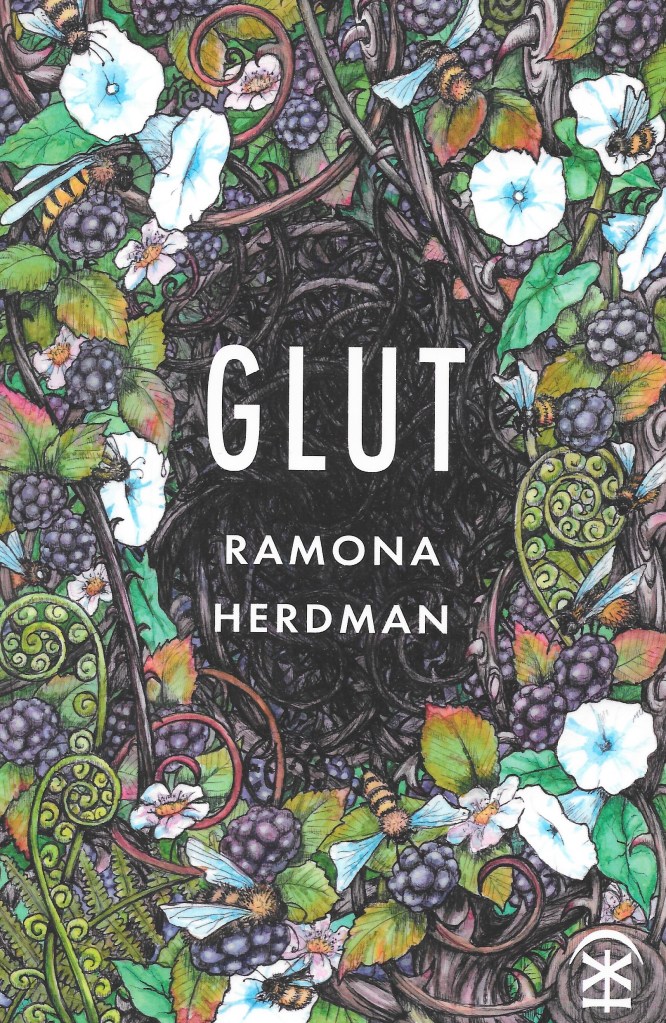
Ramona Herdman’s recent publications are Glut (Nine Arches Press), A warm and snouting thing (The Emma Press) and Bottle (HappenStance Press). Ramona lives in Norwich and is a committee member for Café Writers. She tweets @ramonaherdman
I have selected four poems from Glut, beautifully produced by Nine Arches Press, to give you a flavour of these darkly funny, bittersweet poems. I hope my choices also show their ‘quiet ferocity’ (Philip Gross). Below the poems you’ll find links to a blog about the cover (by Jacky Howson) and to a video with Ramona reading Blackberrying and Congratulations. Glorious is the word!
Blackberrying
Blooded young, we waded into the hooked shallows of hedges, caught up and cut in our toddler blundering, dirty with gritty juice and dotted-line scratches.
We without-ritual British, we atheists. Hippies’ children, grown up in the world they believe they changed – we have blackberrying as our sacrament.
At school, neater children wouldn’t eat the berries, said their mothers said no, said they had worms in that would eat our insides and poke out of our bumholes.
Now we go every year, like it’s Midnight Mass. We avoid the dog zone at the bottom of the bushes. Tell each other that by Michaelmas the Devil will have pissed them bitter.
We take offal-heavy carrier bags of berries to our parents, too old now for all that bother. We pick the children out of the tangled footings. We cook pies and crumbles in our own kitchens, competently. We placate the gods.
Cover design by Jacky Howson
Cuckoo and egg
It’s hard to soft-boil an egg in another woman’s kitchen – even the water is different.
It’s our first ‘family’ holiday together. She makes me a soft-boiled egg with a lot of fanfare and the whole breakfast-table gets involved in the hoo-hah.
And there’s a performance of trust in cracking it – the risk of a wet white, the opposite risk of a solid yolk. We’re on the edge
of an ovation when it turns out perfect. I eat it hot, like a heart.
It’s not me taking the minutes
It’s not me anymore escorting visitors from the front desk. I don’t fill the water jugs and make sure the glasses aren’t too dirty. I sometimes buy the biscuits, now there’s no budget. It’s not me too scared to ask a question or supply a fact, wondering if I’m allowed a view or am just a transcription machine.
A man once told me working with women had taught him not to interrupt. It’s a terrible world. I told him working with men had taught me to keep on talking, slightly louder. Try interrupting and you’ll get to see the flying-galleon belly of my argument as I lift off cathedral-high over you.
Don’t dare to talk over my people, including the young woman taking minutes, who is well on her way to wherever she wants, who could take your eye out with her wit. The meetings are my meetings now.
Two death in the afternoons, please
Dad, now you’re dead you scare me. Every time I think about stepping into traffic I think of you building your glass castle, cornershop-whisky-bottle by cornershop-whisky-bottle.
I had to do one of those questionnaires recently: How many times in the last month has your drinking stopped you doing things you needed or wanted to do? I put zero, Dad, proud nothing. They never ask
about the times the drink makes living possible. I think of your kitchen-drinking nights, how you told me you didn’t get hangovers anymore and I was too young to reply.
When I’m scared, Dad, I know a gluey-gold inch of brandy or one gin and tonic’s scouring effervescence will lift me to arm’s-length from caring, will calm me in a bubble of slight incapacity.
The old dread, Dad – I think now you carried it like a wolf in your stomach. The drink quiets it, but it doesn’t drown. I recently learned another cocktail by Hemingway –
‘Death in the afternoon’, champagne and absinthe. You’d find the name as funny as I do. He recommended three or five in slow succession. When I make them, I toast him. He’s family.
Dad, you’re nothing now. It’s only the thought of your life that scares me. But if there were an afterlife I’d meet you there, happy hour. It’d be dimlit and we’d sit low in a booth and they’d keep
bringing the drinks in fine heavy glasses and no one would interrupt to say this wasn’t actually heaven, this delicious blunting of feeling, this merciful cessation, and that there was something outside that was better –
like walking out on the seafront together, wind and water-roar and saying something risky and being understood.
Today I am with my brother and sister-on-law. It’s his birthday today, so I arrived yesterday to have the chance to catch up with them before friends and family arrive.
I’m the eldest, three years between us. I’ve been protective of him from the start.
For many years now, my brother has worn a metal brace on his leg. A few years ago he managed to get a second-hand ‘loopfiets’ – a walking bicycle. I’d never seen one before, but it’s small enough to go through a standard door so one can go into shops, and it’s light enough to put in a car.
Example of ‘walking’ bike
It was my father’s birthday on Sunday 2 September that year and my parents’ friends commented on how my brother limped, encouraged my mother to get it checked out. GP on Monday, neurologist on Tuesday. I can still see my parents’ car disappear round the corner on the Wednesday morning.
1962
Alexander Eduard (coppersmith in the bible and van Beinum, the famous conductor). Our Irish setter had been given the names of an unborn child.
A ward of six, our parents’ daily drive, forty minutes each way. Neurologist, paralysis, lumbar puncture, nausea.
Grandfather owned an electrical shop (double-fronted on the main street); gave my brother a beige-brown radio.
The specialist allowed our red Irish setter to visit my brother, celebrating his fourteenth birthday in the academic hospital in Leiden.
Three months later he arrived home, just in time for St. Nicolaas. My brother still limped and his crown was marked by two scars at right angles, the space between dipped and dented. A few days later grandfather came to take his radio back.
International Anthony Burgess Foundation, 3 March 2020
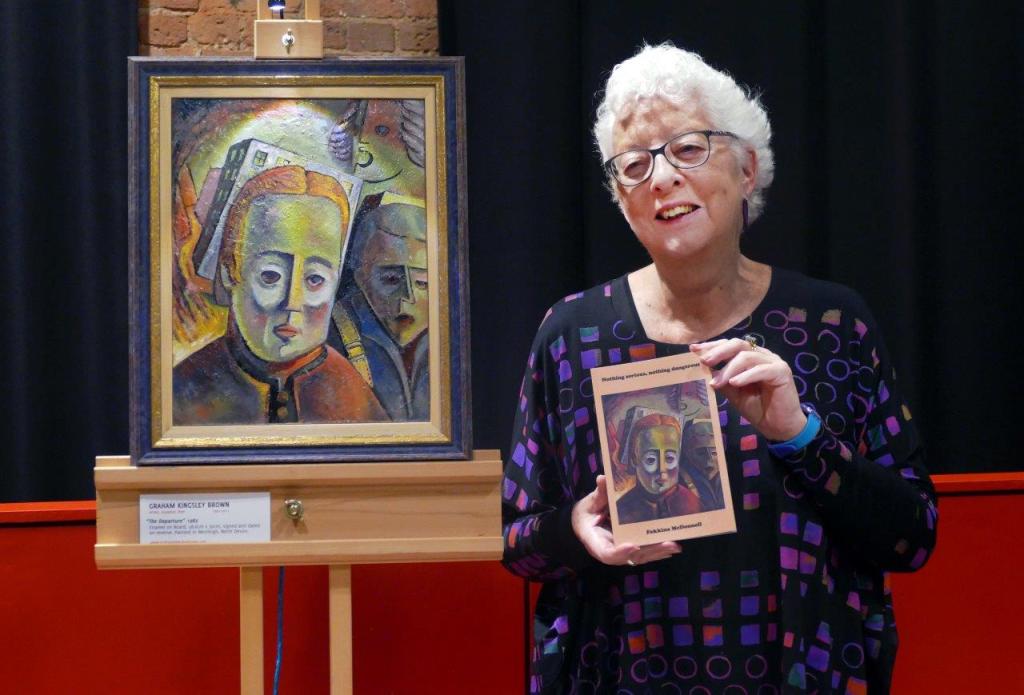
Friday 16 September is an exciting day: the catalogue of David Duggleby, Valuers & Auctioneers, includes 24 works by the artist Graham Kingsley Brown. He was the father of my friend Sophie Brown. She is my webmaster, designed the original website for my psychotherapy practice and, in 2016, this website.
Sophie is herself a Fine Arts graduate and practising artist. That is how I got talking to her about a suitable design for the cover of my second collection Nothing serious, nothing dangerous. It was wonderful to have the actual painting at the launch. Strange to think that a fortnight later I had my own departure – fled just before the UK lockdown to my bolthole in Holland.
The Departure is Lot 203, the estimate £400 – £600, and the approx. sale time is 13:54 – 14:14 UK time. The auction is at the venue in in Scarborough and live online, so – if you are drawn to any of the works, register and make a bid!
Details of all the works can be found here in the catalogue:
On her blog Sophie has previously written about her interpretation of The Departure – it may be inspired, partly, by his childhood experience of being evacuated during WW2.







 Acacia Publications