During this year I’ve been posting poems by my friend Kathleen Kummer. This is the last one. Kathleen lived and worked in the Netherlands after she married a Dutchman and taught German and French at an international school.
The battle of Arnhem took place during 17 – 26 September 1944. Operation Market Garden failed when the allied forces could not take the bridge over the Rhine.
In the fields near Arnhem
It falls like a petal from the last rose of summer: a bus ticket, Arnhem Municipal Transport, flutters from the faded pages of L’Art D’Etre Aimée.
Learning how to love and be loved, which was harder, was what I had no idea I was doing that summer of trains, boats and buses, all bound for Cythera.
It sounded so playful in French: Ecoutez-le, (listen to him), passionnément. Ils adorent les cheveux, so, wear your hair loose. But this was no game, we were serious.
Not so much so that we thought how, six years earlier, they had floated down from the sky, white flowers in their thousands in the fields near Arnhem.
I am very pleased to have a poem in this pamphlet which, along with its companion Counting Down the Days, has just been published by Grey Hen Press. Joy Howard, the editor, has done a great job of producing these two anthologies: allowing older women poets to show their support for the younger generation.
All proceeds from the sales of the two books will go to supporting the work of the UK Youth Climate Coalition. Below is my poem to give you a taster.
Paternoster
Some survivors live on the edge in cars, dented, rusted ridges, blown tyres, a towel drying on the steering wheel. Much of life now is waiting and standing in line, but Paternoster tells us it was often so in the Old Life.
Strong men searched among the rubble, found saucepans, leather boots, shoulder bags. Once a black wooden box called Schimmel which Paternoster says means white horse. Papaver grows inside that piano now.
Horses stand by the narrow river, kick sand. One brown mare is with foal. Our Friesian cows give us white gold most days. We are waiting for rain, for a sign. Men play a game of stone, paper, scissors.
I stroke the flute I made from bone. I must be careful not to dream. We trained the rats to smell landmines. Paternoster remembers grapefruit, a bitter yellow ball, the colour of sun.
Cruise liners were parked at sea last year. I could see them from the beach at Scheveningen. And a travel company did send me an offer I could refuse…
It was a different story on 3rd of July 2012, when P&O celebrated its 175-year anniversary: for the first time ever its seven passenger ships were in port together. An ex-P&O friend of mine was there taking pictures. Here is the flotilla leaving Southampton.
The offer of a £150 reduction comes on heavy white paper
SS Zeus floats downstream on the Danube. Elderly passengers, each with their own balcony. A decade on, scale models the colour of gold are on display in suburban charity shops where other old hands fumble, hand over coins with the monarch’s head.
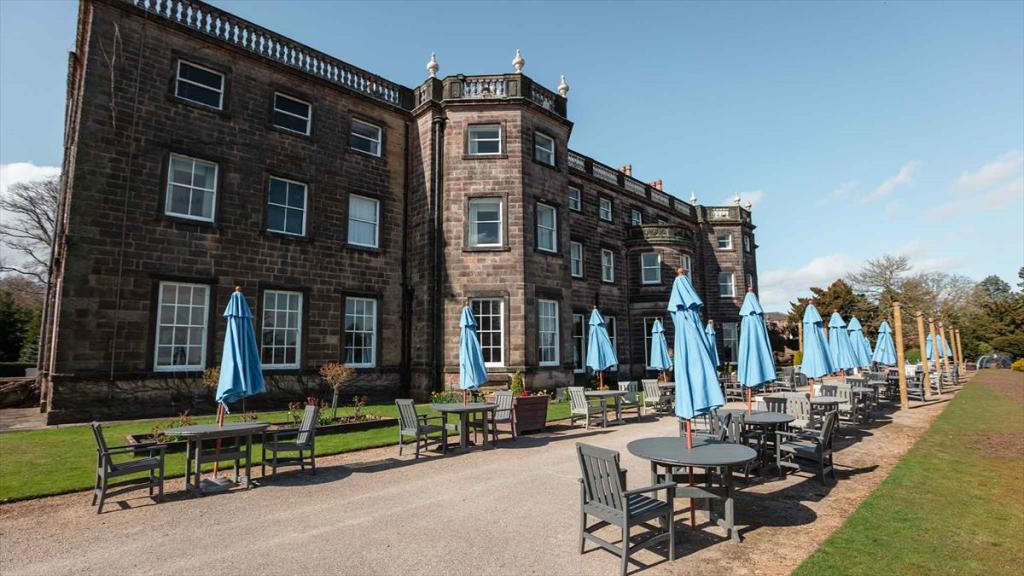
I’m away this weekend on a reunion, staying at Nidd Hall Hotel, near Harrogate. Nidd Hall is a Grade II listed building with large gardens and a fishing lake. Many years ago, I went on a daytrip to the fabulous Turkish Baths in Harrogate. Dating back to 1897, it is full working order and historically complete: islamic arches, tiled brickwork, terrazzo flooring.
That outing was organised by Spice UK where Spice stands for ‘Special Programme of Interest, Challenge and Excitement’. Spice was started in the ‘80s on a part-time basis by Dave Smith, a police officer who held a sky-diving qualification. It grew into a national franchise organisation and still exists.
New to Manchester, I met lots of people at the social events, made friends and tried things I wouldn’t have done otherwise: abseiling, rock climbing, motorcycling, Formula Ford at Aintree. Here is a poem about one of those events. It’s from my first collection Another life. I hope you’re having a good weekend yourself!
Nicolae Baltatescu, via Pixabay
From Grassington, June for Dave Smith
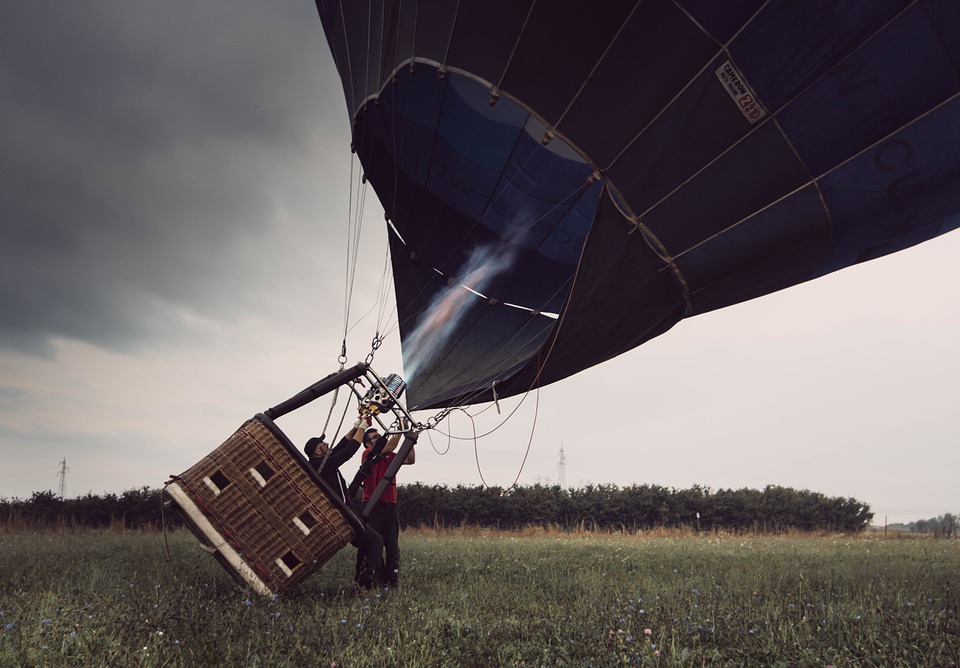
We had been following the Roman road: Rita who was almost 80, her bearded son, clutching champagne, the pale daughter-in-law, and me still gripping the metal frame.
Our shadow floated ahead of us, scaring sheep and deer into running towards the orange early evening. The only sound creaking wicker and the hissing of gas
We ducked as we rushed over telephone lines, fences, tree tops. The Land Rover – still keeping up – with the bottle of whisky to placate the farmer on whose field we hoped to land.
It’s only days since I returned to Manchester and I’m slowly getting back into the English language. It has been a great pleasure to feature poems here this year by my friend Kathleen Kummer. I hope you enjoy this one.
A walk in summer in Holland
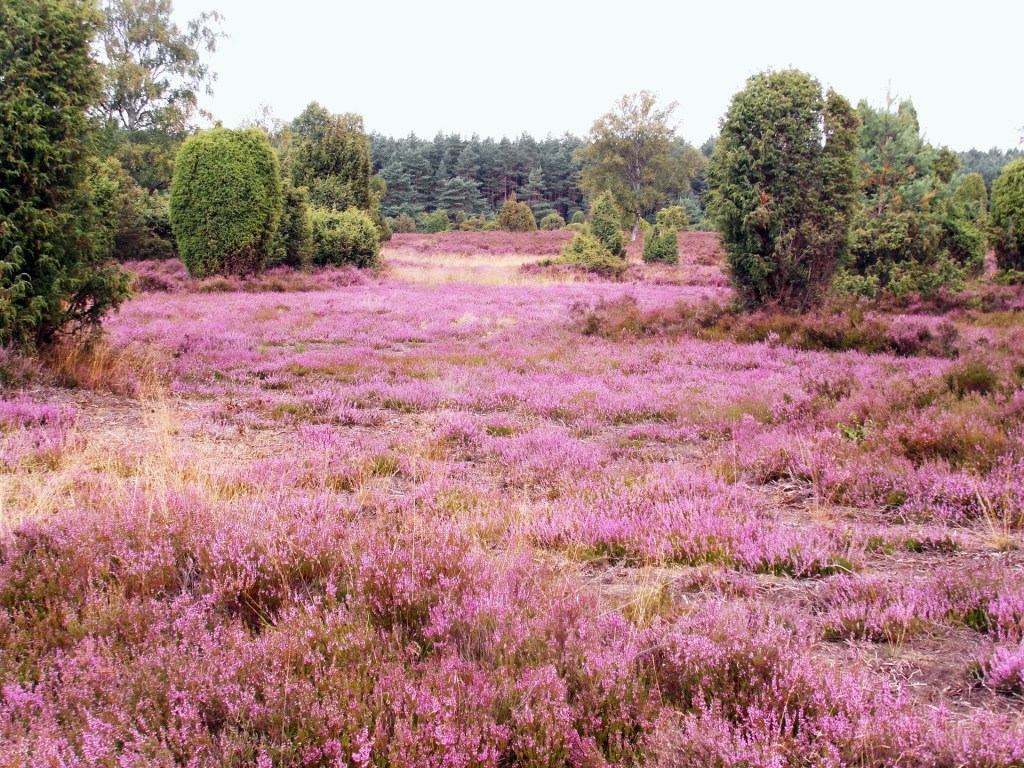
No ditch, no canal, no river here, no heron to remind me, as always, of Gandhi, hunched up, as it studies the text of the water. This landscape, the heat at Blaricum, its sandy paths moist from yesterday’s rain, never seem to be still. It moves with a gentle, rocking rhythm. The mass of heather, shrubs and trees, the tipsy ladders of vapour the jets leave behind like litter, the cirrus snagged on the sky, the flock of sheep, horned flecked with brown, expertly nibbling between each dainty, filigree sprig – all of these frolic round us: moving pictures on a frieze like those in a child’s bedroom.
An illusion? Call van Gogh as a witness. His olive groves writhe, his crops are waves, cypresses rock on an ocean of fields or boil with the stars in a fiery furnace. But here, there is no such fever. Under the huge Dutch sky, we are cradled, rocked on a warm bed of purple heather.
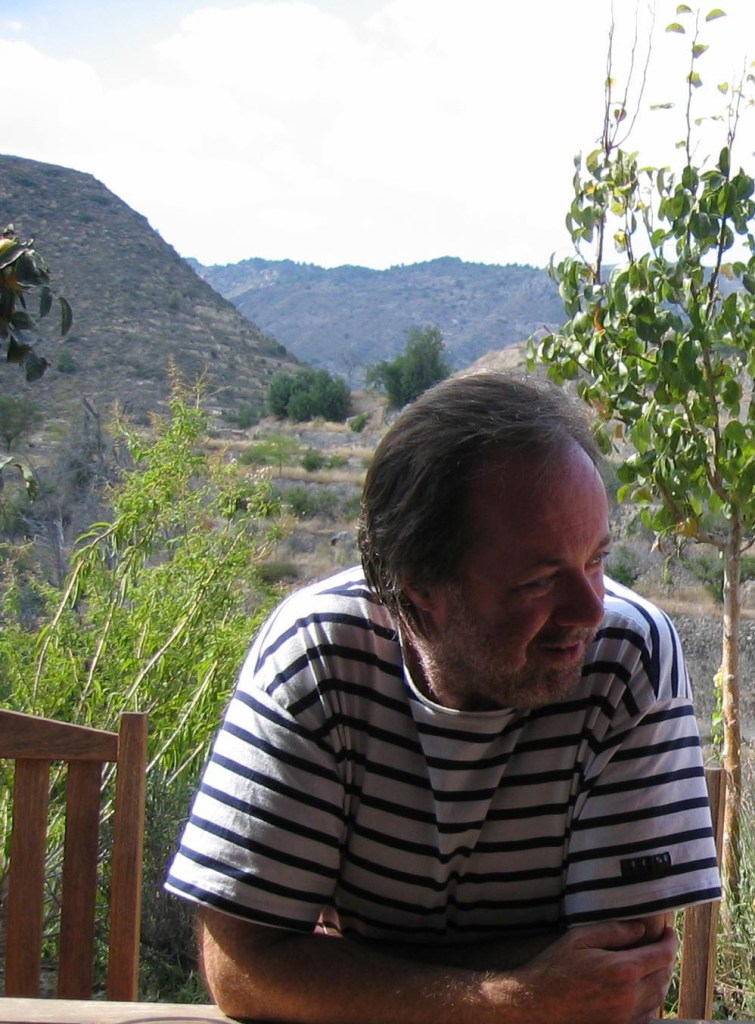
It is three years since the poet Matthew Sweeney died. I was fortunate of having a whole week with him at the wonderful Almassera Vella, Spain in 2006. I learned a great deal. The photo was taken in the garden by the infinity pool.
One of my favourite books about writing is Teach Yourself Writing Poetry. It was written by Matthew and his friend and poet John Hartley Williams. It is packed with exercises, and I love the book because in between the exercises there is dialogue, chat, discussion. I can hear their voices as they talk (I’m sure over a glass of wine). Wit and poignancy.
Prompt:
The Hermit was written on a workshop. We were given Sweeney’s poem The Shoplifter and asked to think about someone with an unusual occupation and what life would be like for them when they retired. Both the shoplifter and hermit now live by the sea. Sweeney’s shoplifter has ‘fronds of marijuana’ outside, has ‘learned the use of coins’ and has a use for all those books:
His books come in useful now as each time he has shinned
with an aerial up the chimney Viking wind has ripped it down.
The Hermit
The hermit had to be retired for health and safety reasons.
He was flown out of the desert, given a dictionary and glasses.
He is renting an old longhouse, leaves doors and windows open
so he can smell the cool air, but still he cannot sleep.
The postman was his first visitor. Mail lies piled up by the gate.
The grains of sand on the beach make him feel homesick even now.
By the light of a candle he may be able to look in the mirror, but not yet.
(first published in Another life, Oversteps Books, 2016)
Matthew Paul is one of a small number of poets who write both haiku and longer poems. A selection of the latter was featured here on 5 July 2020.
On Lammas Day here is his selection from The Lammas Lands, beautifully produced by Snapshot Press, followed by his thoughts on writing both haiku and longer poems. I relate to the bugbear he mentions!
The Lammas Lands
first in the office my whistling echoes up the stairwell
onto my fingers the rust of the farmyard gate
school’s out the riverbank flush with tansy florets
the last sun across the lammas lands perennial asters
cobweb morning the merest outline of ship funnels
two years old she grasps with both hands the autumn wind
through an angler’s pipe-smoke rising jays
touch of sleet— making space for the guide dog
white skies a hare skedaddles over Wealden clay
*
I discovered haiku at the age of 15 or 16, firstly through an English teacher at school and then by reading The Dharma Bums, Desolation Angels and The Penguin Book of Japanese Verse. I tried writing them shortly afterwards, at pretty much the same time I started writing longer poems. I’ve written both fairly regularly since then, though I went through a long period – from 1990, when the British Haiku Society was founded, until 2010 – in which I concentrated more on haiku. In the last 10 years, my focus, as a writer – as opposed to editor or reviewer – has been much more on longer poems.
For me, the engagement needed for one is rather different to the other. Being able to write effective and affective haiku stems from being in the moment, using all your senses to pick up on what you’re experiencing and finding a charge between two different objects/elements which you are perceiving at the same time. ‘Desk’ haiku are almost always obvious and lacking the spark born from real sensory experience.
Longer poems can, of course, also have content born of, or responding to, ‘the moment’ and can therefore be haiku-esque in how they treat their subject-matter – Imagism was often like that, and haiku itself was born from longer forms. But longer poems for me have much more space and freedom to move back and forth through time and, if necessary, tell a story, whereas haiku can’t do that in any meaningful way because of their intrinsic brevity.
My longer poems are probably more likely to be mini-stories than those of most poets precisely because of the freedom they afford which isn’t available within the form of the haiku. (I should add that achieving any consensus among English-language haiku poets about the essential qualities of haiku has repeatedly been proven to be impossible!)
One of my bugbears is that longer-form poets often use what they think of as haiku as a means simply to sharpen their powers of perception, as if it’s child’s play. Whilst that may well work for some people, I feel that approach rather misses the point of haiku. Like any art form, it takes a long time to become adept at it, albeit that an ‘apprentice’ haiku poet can have a freshness of perception which is often labelled “beginner’s mind”.
On the whole, though, I find it annoying when poets put their first, usually clunky attempts at haiku out on social media or, worse still, into print. Haiku in English do not have to be – though they can – be written as three lines of five-seven-five syllables. It’s common sense, isn’t it, that the essence and power of haiku aren’t derived from syllable-counting, but from direct, lived experience. Like many haiku poets, I have reservations about even calling my haiku ‘haiku’, because the original Japanese art-form is so freighted with Japanese culture and history – and translators from the Japanese into English invariably repeat the mistakes of previous translators!
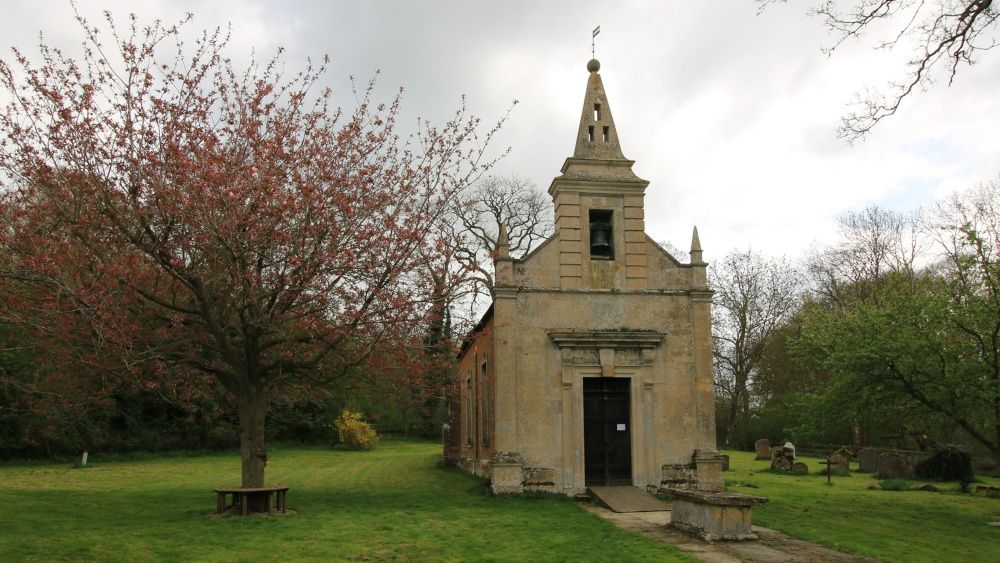
It is 20 years since I visited Little Gidding, as the mid-week trip on a one-week course at Madingley, part of Cambridge University. Our tutor that week was the poet Lawrence Sail. Last Sunday I featured four poems from his collection Guises. That week I also met Kathleen Kummer who has become a good friend. Her poems have featured here over the last few months.
Little Gidding is famous for being the fourth and final poem of T S Eliot’s Four Quartets. Eliot had visited Little Gidding in 1936. The title refers to a small Anglican community in Huntingdonshire, established by Nicholas Farrar in the 17th Century.
I wrote the short sequence of haiku during my visit. It was published in Presence magazine.
Almost hidden by grass
following her across the field a white butterfly
almost hidden by grass three wooden crosses
the church bell covered in pigeon droppings
pink geranium petals a droning plane
on the terrace calling us old, advanced – the toothless guide
This month’s poet is Lawrence Sail. We met 20 years ago when he tutored a week-long course at Madingley Hall, part of Cambridge University. We have kept in touch and I was delighted with his endorsement of my second collection Nothing serious nothing dangerous.
Lawrence Sail has written thirteen books of poems; Waking Dreams: New & Selected Poems (Bloodaxe Books, 2010) was a Poetry Book Society Special Commendation. His publications include the anthology First and Always: Poems for Great Ormond Street Children’s Hospital (Faber, 1988), and two books of essays, Cross-Currents (Enitharmon, 2005) and The Key to Clover (Shoestring Press, 2013). He has written two memoirs, both published by Impress Books: Sift (2010) and Accidentals, the latter illustrated by his daughter, Erica Sail, and published in December 2020.
He was chairman of the Arvon Foundation from 1991 to 1994, has directed the Cheltenham Festival of Literature and was on the management committee of the Society of Authors from 2007 to 2011. He was awarded a Hawthornden Fellowship in 1992, and an Arts Council Writer’s Bursary the following year. In 2004 he received a Cholmondeley Award for his poetry. He is a Fellow of the Royal Society of Literature.
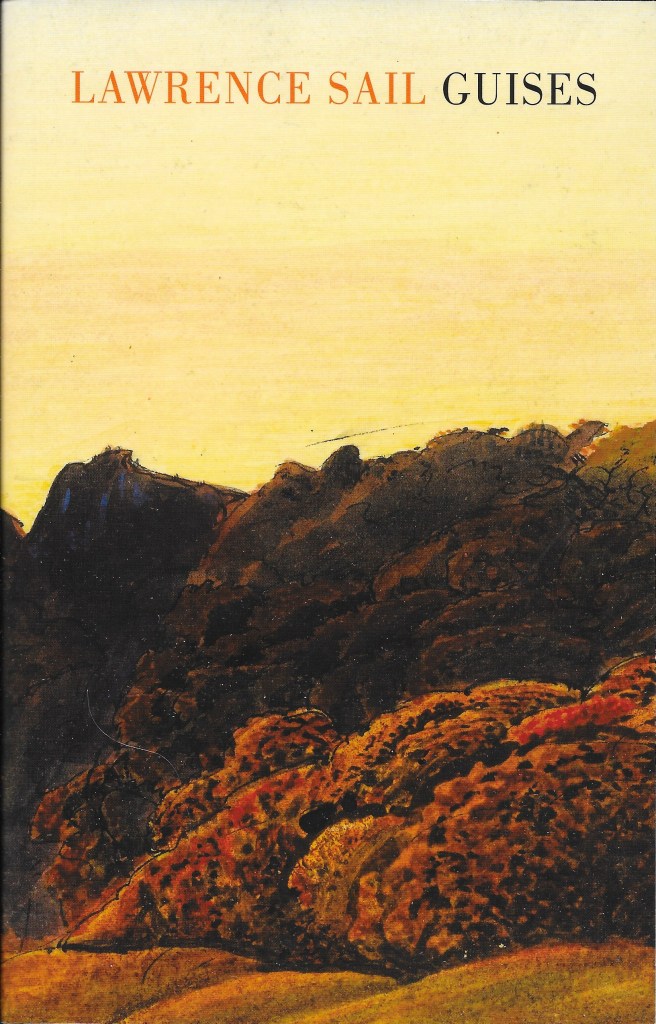
I’ve selected four poems from Guises, Lawrence’s most recent collection, published by Bloodaxe Books in early 2020. They show his close observation skills, precision of imagery, interest in art and in life – what is and what was lost. Understatement is used to great effect in Journey.
Cover painting: detail of Yellow Twilight by Samuel Palmer
Radishes ‘What do I know of man’s destiny? I could tell you more about radishes.’ Samuel Beckett
Bunched tightly – no sign of the flowers with their four petals
At one end, weak and tatty leaves that soon wilt, ill with yellow
At the other a wisp of root, vestigial tail thinly curling
Their cylinders, white and carmine, harbour a residue of soil’s sourness
Their gifts? Crispness and surprise – from their pure white core they bite back: like destiny
Olympic Cyclists
Start at the nape with the helmet that tapers so finely and looks designed for a new occipital shape – it must come straight out of a dream played on an oval board, under lights
Everything comes second to aero-dynamics, kinetics – it is not always easy to tell where the cycle ends and the rider begins. They become one curve among many, parts of one thought
– which bends their spines, stares from the rounds of the goggles, pumps the pedals, blurs the black wheels’ outlines; which has them swoop flightily down the banked track sudden as a hawk stooping
Such oneness, wholly integrated – as in the fado singer’s tremble of husky melancholy, or the grounded delight of lovers before they reel out of the charmed circle
Giacometti’s Cat
Its head to body to tail is one long, mean horizontal hoisted on the spindly twin trestles of its best feet forward
A nerve-bundle fused in bronze it lives apart, locked in a trance of stealth as it probes the air ahead taking nothing for granted
Journey
I am travelling to meet you again – through morning air burnt to a clarity you would admire
And of course my mind has stored a certain amount of baggage accrued in the course of time
It includes a small rucksack you once wore, and the sweep of your arm, stressing a point
As well as the passion with which you embark on serious discussion with, sometimes, an emphatic blink
Yet almost as vivid is the thought of the platform as it will look after the train has gone
The shine of the rails snaking away, a soft breeze, the atmosphere intent but free of intention
On the far side of you waits an absence charged and changed that I do not want to re-settle
With my birthday coming up, I am posting a poem that celebrates key experiences in my life. These include visiting Lalibela in Ethiopia in 2007, travelling with the friend who set up the Lalibela Educational Trust, to meet the boy I sponsored and his widowed mother. My parents – a church organist father and semi-professional singing mother – did pass on the creative gene, for sure.
Thank you for liking these posts and for following my blog!
St Mark’s Venice – Hermann via Pixabay
Taking other routes
My parents never taught me to swim; didn’t take me skating on those Christmas-card frozen canals. I have never been famous, but I have sung in Burgos and Florence, Vespers in St Mark’s. My singing has made grown men cry.
I have not travelled on ferries, floating from one Greek island to another, forgetting the name of the day. I have never stroked a giraffe, nor given birth to a baby boy. But I have picked redcurrants from the back garden, sharing rich crops for over twenty years with small black birds.
In Ethiopia I have a son and I sat with him in his Physics class. And for a few years I was a sailor, snatching a few hours in Sydney, shopping in Hong Kong. I danced in a grass skirt and flew across Alaskan glaciers with the man I loved.