Tag Archives: Devon

Birthday Party – poem

Today is the birthday of my friend Kathleen Kummer. After several falls, she is now very frail and housebound.

Kathleen and I met on a writing week with the poet Lawrence Sail at the beginning of the century. She had lived and worked in the Netherlands. We became friends. I visited her in Dorchester and in Devon where she moved, aged 79, to be nearer her two daughters.

Kathleen had a body of work when she moved to Devon, and sent a manuscript to Alwyn Marriage at Oversteps Books. They published her debut collection Living below sea level (2012).

I am deeply grateful to Kathleen for our friendship and our poetry connection. Today I’m posting her poem Birthday Party, showing her empathy and eye for telling detail.

Birthday Party

It’s his fortieth birthday. He’s sitting alone. He seems
neither man, not child, nor anything in between.
When he opens his presents, he’s all of these at once,
and happy. (‘What shall I give him?’ ‘Anything’, they’d said.)

Somehow, he’d made it plain he wanted a fish
on his cake. So on top, a flatfish. It looks like a fossil,
all its bones impressed on the green marzipan. A frieze
of stiff, blue icing ripples round the base.

A family group over there on the leather settee
talks about children at college and moving house.
He gazes through and beyond them, remote as those heads
on Easter Island, but jumps up to blow out his candles.

He’s given a card which reads Happy 30th! (‘He won’t know,
don’t worry.’) His hair is receding – he’s beginning to look like
his father, who tomorrow will take him back to the Home
where he has his bedroom and bathroom en suite. (‘Very smart!’).

That summer day – a poem

Dartington Hall, Devon

My friend and poet Kathleen Kummer will have her birthday soon. We have visited the Dartington Estate in Devon several times: to hear the then Poet Laureate Sir Andrew Motion read, to listen to music during the Music Summer School & Festival which was established in 1947. Alwyn Marriage of Oversteps Books invited me to read during the Ways with Words Literary Festival. It was wonderful seeing people out on the lawn, resting in deckchairs, or queuing up to get their book signed by famous authors.

Dartington Hall is a spectacular Grade I listed building. The gardens are grade II listed: a sculpture by Henry Moore, a yew tree that is 1500 years old and a row of sweet chestnut trees believed to be about 400 years old. The gardens are a delight in every season. Here is Kathleen’s poem about the gardens.

The Tiltyard, Dartington Hall Gardens

That summer day

That summer day at Dartington,
everything familiar, beautiful:
the corrugation of the bark
of ancient trees, the sun behind
the scarlet maple leaves, the swathes
of wildflowers in the glades, warm
to the touch the might buttocks
of Henry Moore’s reclining figure,
the bench, its oak smooth, silver,
following the stone wall’s curve,
on which we sat. Unexpected,
the robin landing next to us,
a fledgling, plump, who stayed ten, fifteen
minutes until his mother called him.
And, in the little wave of sadness
which washed over us, because
he looked so young, indivisible
as water is, this swell of happiness.

Item – poem and writing prompt

Photo credit Stux via Pixabay

This week I am featuring another one of Kathleen Kummer’s poem. It’s short and the neutral title belies the heart-breaking content. The poem is addressed to her adult son.

Item

You left behind: your silver spoon –
there are days when I stir my coffee with it;
the drawing of yourself with the Mona Lisa eyes;
I sometimes wonder how you got the chestnut avenue
from that angle, and I’m suddenly happy, as though
you’d just sauntered in from school and were upstairs
moving your table, shouting down you were hungry;
all the photographs of you – if I flicked the pages
fast enough, would those in the top right-hand corner,
at least, spring jerkily into life?

Item: a bank account – didn’t you need
the money? Your sisters; me. People hope
I don’t mind them asking about you. As if
in a language I’m learning, I say, no, I don’t mind.

Prompt: What item do you still need to write about, even if a part of you doesn’t want to? To whom are you writing?

Eating a Croissant in a Graveyard – writing prompt

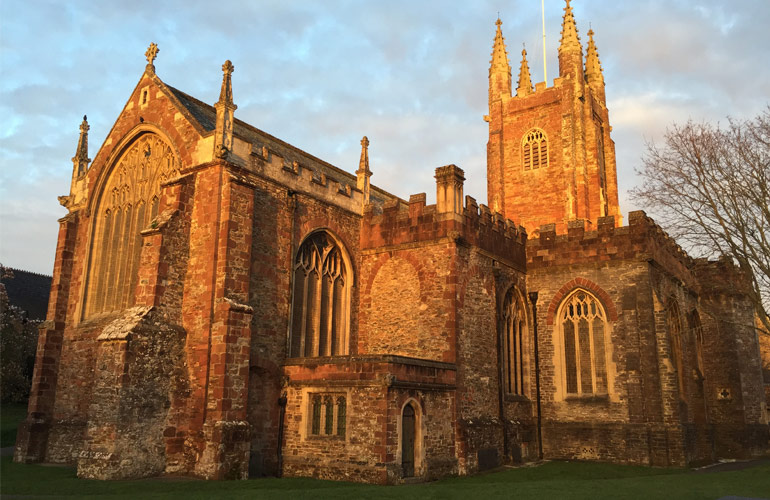
St Mary’s, Totnes in Devon

For Easter Sunday I have chosen this poem by my friend Kathleen Kummer. The title is intriguing, the details are precise: we sense they are based on the poet’s own experience. Then there is the reference to that well-known Stanley Spencer painting of the Resurrection. You can see it here. Does it work for you as a prompt?

I asked Kathleen about the graveyard. It’s part of St. Mary’s Church, a Grade I listed building in the centre of Totnes, Devon. Perhaps, I could have worked it out for myself: the poem mentions the iconic ‘steep hill’ in Totnes. Kathleen and I have walked up and down it many times, and hope we can do so again soon. Easter Greetings to you all!

Eating a Croissant in a Graveyard

I’m eating a croissant in a graveyard, grassed over.
People come here to rest, eat a sandwich.
(I wish I’d bought something less flighty, like
a scone or an Eccles cake.) The graves
are few and not recent. There’s a table-top tomb,
ideal for a picnic, but respect is shown:
low voices, no chirrup from a mobile phone;
people sit on the wall or the grass. I’m expecting
that Labrador to cock his leg, but he doesn’t.

Across the street, the bustle of the market
just reaches us, and I think of the dead
around me, of how this town was theirs,
that they walked up the steep hill, stopping
to speak to their friends about their simple,
complicated lives. When I close my eyes,
I see them clambering out of their graves,
as in that Resurrection painting
by Stanley Spencer, looking dazed,
but as if their discomfiture won’t last long,
with the green hills they knew around them,
the sky blue and summery. And surely
the warm-hearted townsfolk will welcome the dead.

It’s as if I’ve banished them by opening my eyes.
The place is empty, but for two men
in wheelchairs, parked with their backs to the view.

High Street, Totnes in Devon