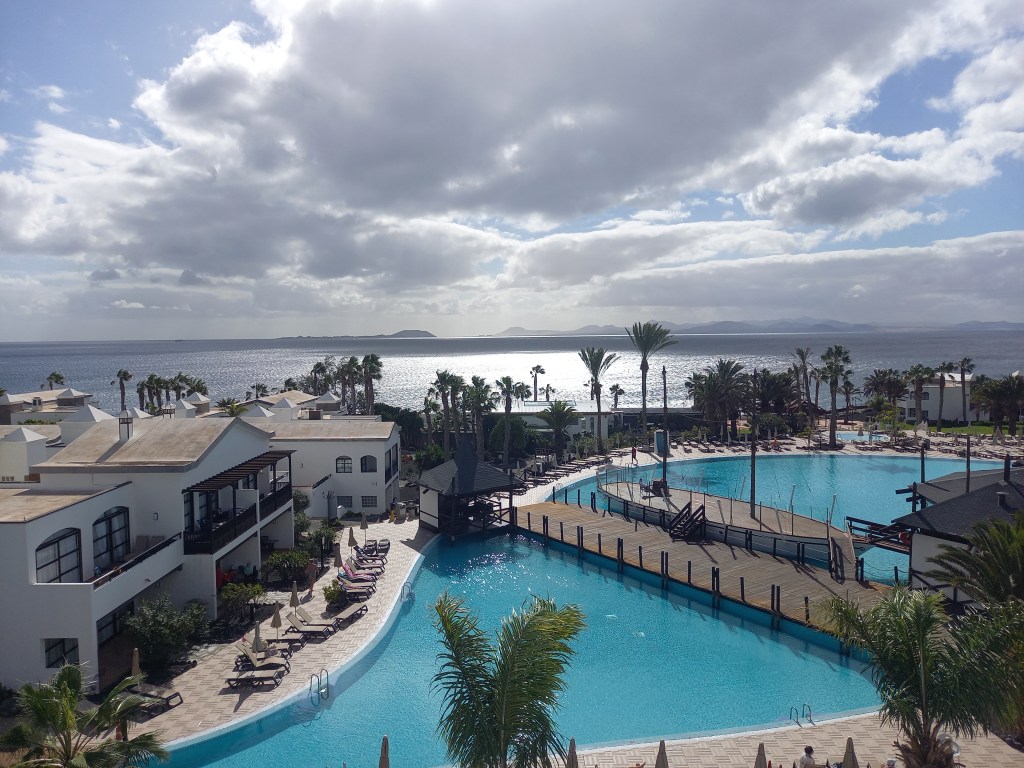
Most of January I was on Lanzarote. I was unwell, so I spent much of my time reading in the Piano Bar of the hotel. Here is a view from the balcony. In the distance is Fuerteventura.
I also forgot about posting the answers to Vasko Popa’s riddles which I posted in December. The riddles are from his collection The Golden Apple, 2010. It’s a round of stories, songs, spells, proverbs & riddles that Popa himself selected from various anthologies of Serbo-Croatian folk literature. Here are the riddles and their answers, followed by another riddle.
Riddles
In one room both bone and flesh grow.
I stretched a gold thread through the wide world and wound it up into a walnut shell.
I shake a tree here, but the fruit falls half an hour away
Answers
1 Egg 2 Eyesight 3 The sound of a bell
Photo
Photo credit: stevepb via Pixabay
Riddle
With an iron key I open a green fortress And drive out the black cattle
I was very pleased to see my poem Canada is as far away as bibles are on After. Many thanks to Editor Mark Antony Owen. You can read the poem here.
After publishes ekphrastic poems and my poem was inspired by The Avid Reader, 1949. Rodney Graham (1949 – 2022) was a visual artist, painter, and musician. He made the lightbox in 2011.
‘We see the middle-aged man / carrying a hat, smoking a pipe, / because Graham inhabits him.’
The Avid Reader, 1949 was one of the works on display at Voorlinden Museum, Wassenaar, the Netherlands in the major exhibition of Graham’s work titled That’s Not Me. An ironic title as Graham appears in all the works – as a builder having a smoke, a lighthouse keeper, historical figure.
Voorlinden is a fabulous museum – more about it some other time.
I was struck by the attention to detail and the scale of the works. The woman is ‘his wife, swing coat, high heels, walks past on the right.’
Cliff Yates was our guest poet last November. You can read the poems here. As I was going through his New & Selected Poems (The Poetry Business, 2023) to select a set, I came across the poem below.
It’s even sweeter on Valentine’s Day…
from Another Last Word
EXPENSIVE CHOCOLATE
There are eight pieces. She has two and gives me one. ‘Confiscate this,’ she says, handing over the rest. ‘Hide it, or I’ll be tempted when you’re out.’ When I get back, the drawer’s open, there’s one piece left, and a note on a scrap of paper: NOT VERY WELL HIDDEN.
CLEARING UP
She’s cooking Sunday lunch and I’m clearing up. ‘It’s ridiculous,’ I said, ‘you spend time getting things out of cupboards and I spend time putting them back in.’ ‘Not enough time in my opinion.’
BIRTHDAY
‘You’re being nice,’ she says, ‘you’ll be running out of steam soon. You’ve been nice since 7 o’clock, that’s 3 hours, 10 minutes.’
DANCE
‘It’s great the way we dance around each other,’ I said, ‘when we’re getting the meal on.’ ‘We only do that because you get in the way.’
SATSUMA
‘I can’t be bothered with this satsuma.’ ‘Give it here,’ she says. ‘Can’t peel a satsuma, can’t peel an egg. We’ve been married how many years, and I’ve made no progress with you whatsoever.’
WRITING
‘I had to work on that one,’ I said, ‘because you didn’t actually say that. I am in fact writing these poems.’ ‘That’s what you think.’
ENTERTAINING
‘Some of these make me sound terrible,’ she says. ‘It’s because you find me so entertaining. It makes me worse when you start laughing.’
LUNCH
‘Apart from the salad and potatoes,’ I said, ‘what did we have for lunch?’ ‘If you can’t remember what we had for lunch I feel sorry for you.’
GETTING IT RIGHT
‘I’ll get it right one day.’ ‘I doubt it,’ she says. I laugh. ‘It’s not funny really, is it?’ ‘No,’ she says, ‘but at least you’re hopeful.’
PHILOSOPHY
‘You’re too hard on yourself,’ she says, ‘when I wake up I just want a cup of tea and then I want to be entertained by life.’
FISH
‘What we need is a special pan for fish and a fish spatula.’ ‘No,’ she says, ‘what we need is for you to eat fish.’
COLOURING PENCILS
She’s at the kitchen table, going at it with her new colouring pencils. ‘I had some when I was little,’ she says, ‘but I was never let loose. It was always What’s THAT supposed to be? or Where’s the SKY?’
Photo credit: Andrew Taylor
Biography
Cliff Yates was born in Birmingham and has been publishing poetry since the 1980s. His New & Selected Poems (Smith/Doorstop, 2023) brings together work from various collections including Henry’s Clock (Fenton Aldeburgh First Collection Prize; Poetry Business Book & Pamphlet Competition), Frank Freeman’s Dancing School (Arts Council England Writers Award) and Jam (ACE Grant for the Arts). He taught English at Maharishi School in Skelmersdale and wrote Jumpstart Poetry in the Secondary School during his time as Poetry Society poet-in-residence, following the success of his students in poetry competitions. He has led courses for, among others, the Arvon Foundation and the British Council. Read more on his site here
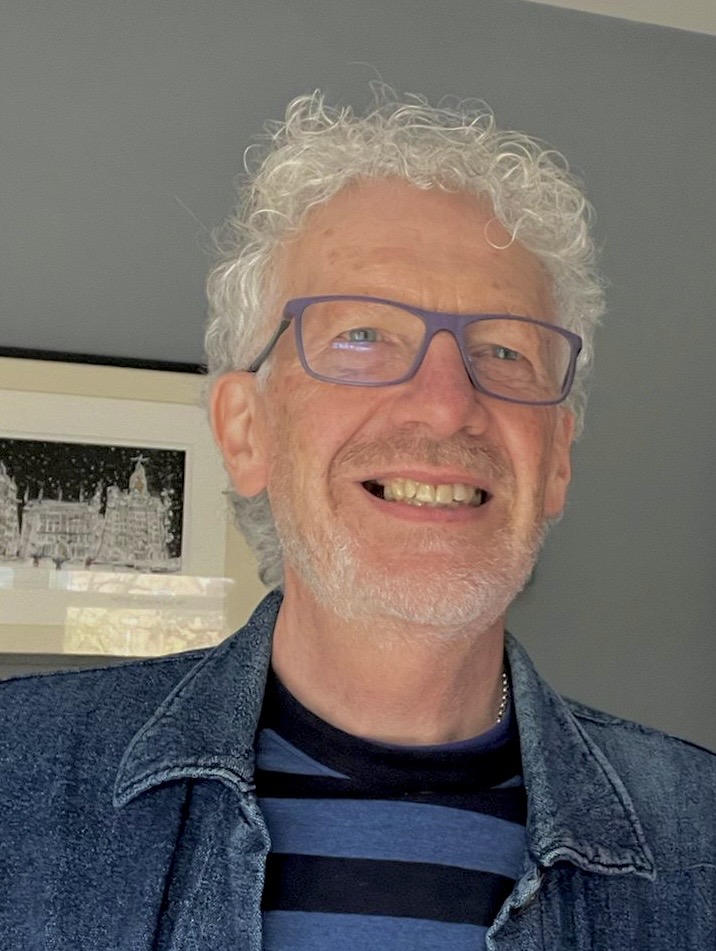
It’s a great pleasure to introduce this month’s guest poet Julie Mellor.
Julie holds a PhD in creative writing from Sheffield Hallam University and has published two poetry chapbooks with Smith/Doorstop: Breathing Through Our Bones (2012) and Out of the Weather (2017). In 2019 she became interested in haiku, and since then her haiku and haibun have appeared in Blithe Spirit, Frogpond, Modern Haiku, Presence, The Heron’s Nest and Tinywords, as well as two Red Moon anthologies. She recently retired from a career in education, and enjoys walking her dog, attending art classes and playing the banjo.
Here are recent haiku and a haibun with their publication details. You can find more of Julie’s writing on her site here.
Modern Haiku 54.3 (Autumn 2023)
toe-hold weeds things that were said years ago
Blithe Spirit 35:2 (May 2025)
long night joining the dots between stars
The Heron’s Nest Summer 2025
wetting the ink a ghost orchid blooms from its painted stem
Presence issue 82 (Summer 2025)
morning moon beside the fretless banjo pistachio shells
BHS Hope anthology 2025 (ed Neil Sommerville)
butterfly summer I write a letter to my future self
Presence 73 – Summer 2022 – and included in Contemporary Haibun 18 (Red Moon Press, 2023)
The Coffin Path
Grass, waist high this morning, and wet with last night’s rain. Brushing past it, my jeans wick the droplets from seeding cock’s-foot and brome. No one else walks this way. Behind the hawthorn hedge is the cemetery. People tend to use the other path, the one that the council mows. Or else they drive – ‘to save their legs’ my mother says. Some days she says she wants to be buried. Other days, she thinks she’d prefer to be cremated and have her ashes scattered next to a memorial bench. No rush to decide, I tell her, trying to make light of things.
elderflowers pressed in her prayer book a recipe for wine
Solstice: a clear day here in the Netherlands with the sun breaking through as I type this.
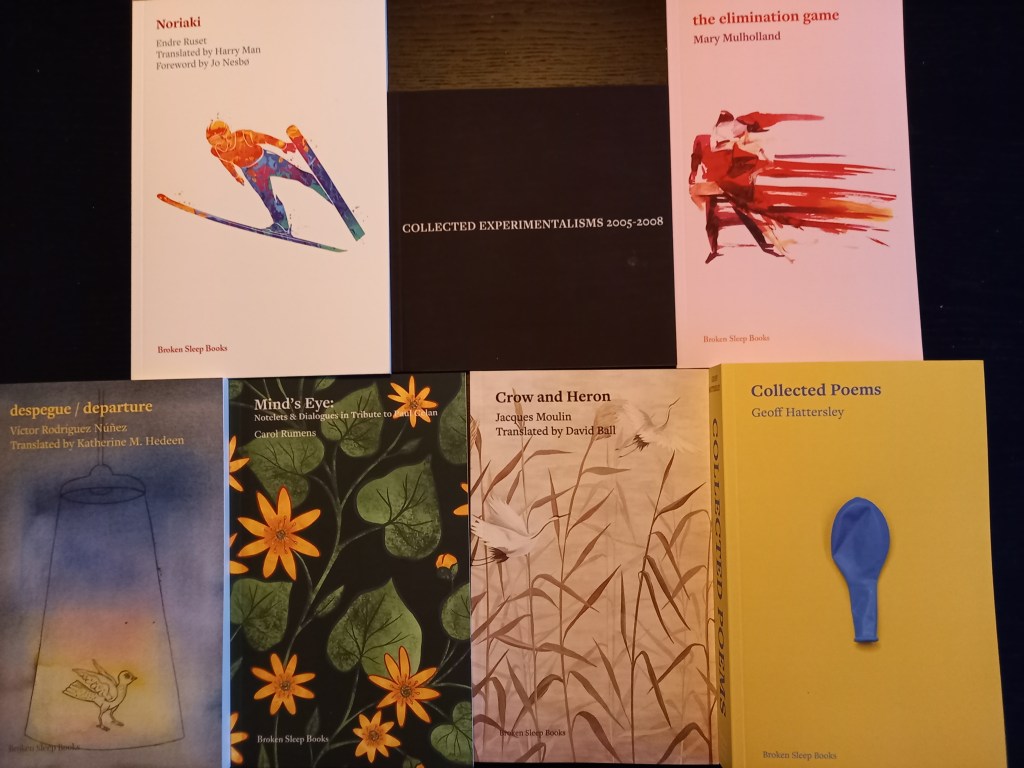
My holiday reading is sorted. The seven books include translations from French, Spanish and Norwegian. The latter an interesting set of haiku and haiku-like poems about the Japanese ski-jumper Noriaki Kasai.
Broken Sleep Books use the world’s largest on-demand publishers. The parcel came from France: no import duties, no VAT, no waiting while parcels linger in the customs depot. A bonus!
This is my last post for 2025. Season’s Greetings and many thanks to you all.
Here is the link to James Schuyler’s poem Linen. A poem about gratitude, starting with a question, and almost a sestude.
Thanks to poet Jonathan Davidson for introducing me (and the other poets on the course) to the Sestude. This form (a poem of 62 words) was invented by John Simmons, co-founder of the ‘26’ writing group in 2003. The English alphabet has 26 letters and 62 is its opposite.
It started with a project ‘26 treasures’ in the Victoria & Albert Museum’s British Galleries. The creative community 26.org.uk is a not-for-profit organisation which still undertakes a range of creative projects.
I enjoyed playing around with the form and, going through my folders, came across a short prose poem that only needed to lose a few words:
If there were no wind, cobwebs would cover the sky.
If there were no wind, cobwebs would cover the sky. Soon enough, the clouds would get angry, address the spiders Have you no manners? Your offspring is just sitting around. The angrier the clouds got, the greyer they looked. It was a battle of grey against grey. Battles and wars always end in tears. The people below were relieved: Rain at last.
Note: Serbian proverb quoted by Vasko Popa, The Golden Apple, 2010.
The Golden Apple collection is a round of stories, songs, spells, proverbs & riddles that Popa himself selected from various anthologies of Serbo-Croatian folk literature.
Writing Prompt
A few more proverbs and riddles. I will share answers next month!
Proverbs
Get your moustaches together, you’re going on a journey.
If you put him on a wound, it would heal.
When did fog ever uproot a tree-trunk?
Riddles
In one room both bone and flesh grow.
I stretched a gold thread through the wide world and wound it up into a walnut shell.
I shake a tree here, but the fruit falls half an hour away.
Many thanks to Kathleen Mcphilemy for including three of my poems in episode 37 of Poetry Worth Hearingor you can listen on Youtube, Audible and Spotify.
One of the poems is his ashes on a corner.
The theme was hiding and/or seeking. The episode is 60 minutes. The first half hour or so is an interesting interview with poet Nancy Campbell who talks about her residency on Greenland among other things. The interview and Nancy’s poems bookend poems by Guy Jones, Zelda Cahill-Patten, Lesley Saunders, Pat Winslow, Richard Lister, Dinah Livingstone, and Sarah Mnatzaganian.
The theme for the next episode is all things ‘eco’. Send up to four minutes of unpublished poems (text and sound file) plus a short biography to poetryworthhearing@gmail.com by 18 January 2026. Find more information on poetryworthhearing.biz.
his ashes on a corner
of the dining table by the small square votive container the discreet undertaker’s logo
she greets him will have a glass at six his ashes waiting with us for borders to open
It’s a great pleasure to introduce this month’s guest poet Cliff Yates. I met him on an excellent online workshop he ran for the Poetry Business. They published his New & Selected Poems, which brings together poems from five earlier publications – over thirty years of ‘inimitable’ work. Poignancy, economy, humour, a touch of the surreal…
You can find Cliff’s biography and the link to his website below the poems.
Day Breaks as a Petrol Station
Day breaks deliberate as a petrol station newspapers and expensive flowers but you’re tired of vacuum-packed sandwiches and sordid headlines.
On the 15.07 out of Deansgate she’s reading The Holy Sinner. The dog opposite smiles through its muzzle. Coffee, or maybe something’s on fire we do appear to be speeding unless we’re stationary and the landscape’s rattling past. ‘It’s been a good day,’ she says, ‘it makes up for yesterday.’ ‘Why, what happened yesterday?’
Days without rain and suddenly it rains. Another country, your body’s not your own. You want to go for a walk. In this?
He threw a stick for the dog in Habberley Valley the tattoo flew from his arms landed in the bracken like leaves.
Dog
So many places closed: the off-licence, the butcher, the corner shop, even the telephone box screwed shut. Dog had come a long way, and now what?
The cherry blossom, he noted, looking up for once from the pavement, was particularly stunning this year, maybe it was the same every year
but noticing it, his heart was lifted and he decided not to be disappointed. The journey had been arduous, the future was uncertain, but there is more to life,
he reflected, cocking his leg against the letter box, than a bowl of fruit on a table.
The Lesson
The nun points out the ones to watch: the boy in the corner, the girl at the back. In this class it’s the boy in the middle who thinks he’s a cat.
Outside, workmen are felling trees. A bird’s nest tumbles in through the window, lands on a desk. Inside the nest, a baby bird. It’s okay it’s okay, the children say, Brian will know what to do.
The boy who thinks he’s a cat gathers the bird and, holding it at arm’s length in the cup of his hands, heads for the door, the nun behind him between the silent rows of children and the bird, as if on cue, lifts up its beak and sings.
Lighthouse
The lighthouse flickers at the end of the pier. We watch it in our red pyjamas. Actually, neither of us are wearing red pyjamas. You’re wearing my blue shirt.
The lighthouse flickers at the end of the pier. It’s the only thing we can be sure of. Everything’s uncertain since you set alight my record collection.
I’m trying to work out an appropriate reaction, rearranging things in my head to eliminate all memory of the record collection. The lighthouse flickers on and off.
Actually it doesn’t, you point out, it just appears to. You look amazing in my blue shirt. I haven’t words to describe how good you look in the light from the lighthouse. Now you’re here
now you’re not. Maybe I should burn something of yours, you suggest. Your voice leaves me in the dark. It doesn’t sound like you when I can’t see you.
Cliff Yates was born in Birmingham and has been publishing poetry since the 1980s. His New & Selected Poems (Smith/Doorstop, 2023) brings together work from various collections including Henry’s Clock (Fenton Aldeburgh First Collection Prize; Poetry Business Book & Pamphlet Competition), Frank Freeman’s Dancing School (Arts Council England Writers Award) and Jam (ACE Grant for the Arts). He taught English at Maharishi School in Skelmersdale and wrote Jumpstart Poetry in the Secondary School during his time as Poetry Society poet-in-residence, following the success of his students in poetry competitions. He has led courses for, among others, the Arvon Foundation and the British Council.
Today I am voting twice: first for a political party, then for a tree.
In a busy city, there is little room for trees to become old. On average, a city tree lives for 50 years.
The Hague doesn’t have many old trees: during WWII a lot were cut down, their wood used for cooking and heating. Of the 120,000 city trees, only around 1300 have the ‘monumental’ tree status.
Such trees are over 50 years old and meet at least one of these criteria: it is irreplaceable, of rare type, shape, or size. It may have historical value, or provide a home for rare plants or animals.
Photo credit: Joost Gieskes
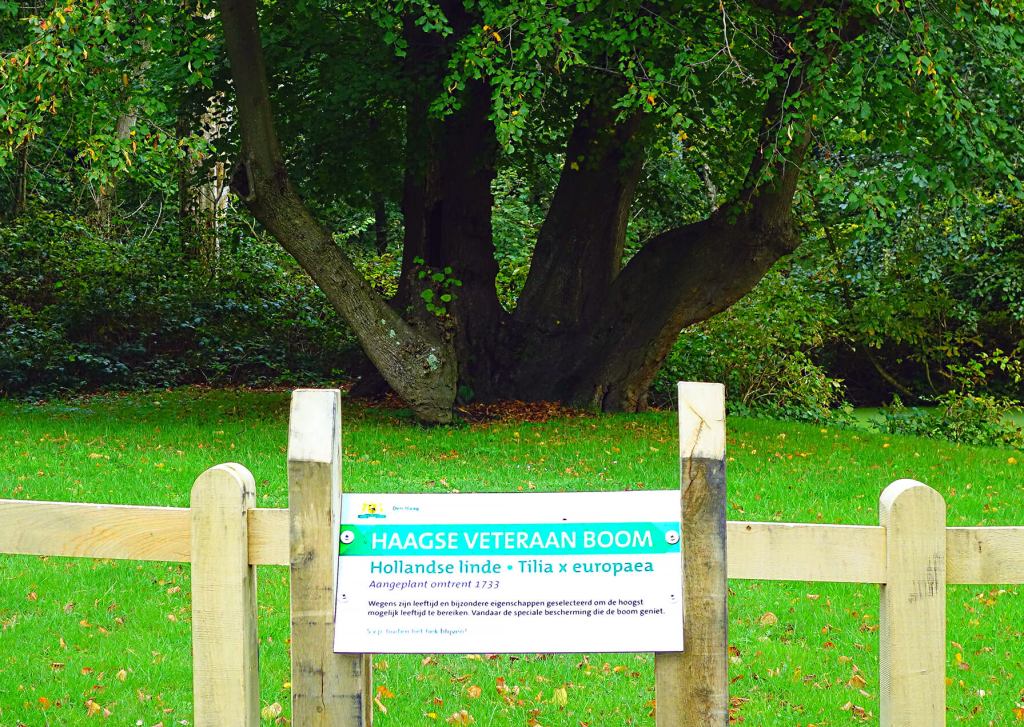
The veteran tree initiative comes from the UK. The first official veteran tree of The Hague – even of The Netherlands – is a lime or linden tree (Tilia x europea) on the Clingendael Estate. This was planted around 1733.
I came across it on my walks during the first 2020 lockdown: Clingendael is close to the camping where I had my caravan. I was intrigued to find a tree in a corner of a field with a fence round it.
A veteran tree is protected and allowed to remain in place forever. A ‘monumental’ tree may be cut down when it becomes dangerous or diseased.
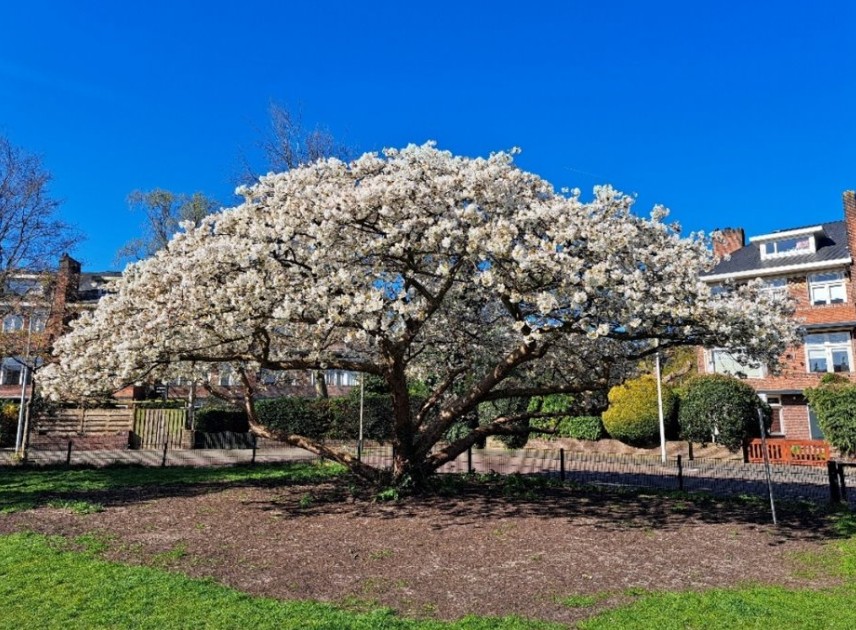
Japanese flowering cherry, tree. 92, 13 m wide.
The Hague local authority has nominated 10 trees and invites people to vote for five of these to become a veteran tree. The five trees that don’t get veteran status will become monumental trees. All the nominated trees are between 70 and 220 years old.
This is much harder than choosing a political party!
Will I choose that Japanese cherry, or the ’12 Broers’, tree no. 73, a 220-year-old oak that had a tough life (cut down often) and now has 12 trunks (the brothers), or choose the 145-year-old Mourning beech that houses falcons. I will let you know.








 Acacia Publications