It’s a great pleasure to introduce this month’s guest poet Julie Mellor.
Julie holds a PhD in creative writing from Sheffield Hallam University and has published two poetry chapbooks with Smith/Doorstop: Breathing Through Our Bones (2012) and Out of the Weather (2017). In 2019 she became interested in haiku, and since then her haiku and haibun have appeared in Blithe Spirit, Frogpond, Modern Haiku, Presence, The Heron’s Nest and Tinywords, as well as two Red Moon anthologies. She recently retired from a career in education, and enjoys walking her dog, attending art classes and playing the banjo.
Here are recent haiku and a haibun with their publication details. You can find more of Julie’s writing on her site here.
Modern Haiku 54.3 (Autumn 2023)
toe-hold weeds things that were said years ago
Blithe Spirit 35:2 (May 2025)
long night joining the dots between stars
The Heron’s Nest Summer 2025
wetting the ink a ghost orchid blooms from its painted stem
Presence issue 82 (Summer 2025)
morning moon beside the fretless banjo pistachio shells
BHS Hope anthology 2025 (ed Neil Sommerville)
butterfly summer I write a letter to my future self
Presence 73 – Summer 2022 – and included in Contemporary Haibun 18 (Red Moon Press, 2023)
The Coffin Path
Grass, waist high this morning, and wet with last night’s rain. Brushing past it, my jeans wick the droplets from seeding cock’s-foot and brome. No one else walks this way. Behind the hawthorn hedge is the cemetery. People tend to use the other path, the one that the council mows. Or else they drive – ‘to save their legs’ my mother says. Some days she says she wants to be buried. Other days, she thinks she’d prefer to be cremated and have her ashes scattered next to a memorial bench. No rush to decide, I tell her, trying to make light of things.
elderflowers pressed in her prayer book a recipe for wine
Solstice: a clear day here in the Netherlands with the sun breaking through as I type this.
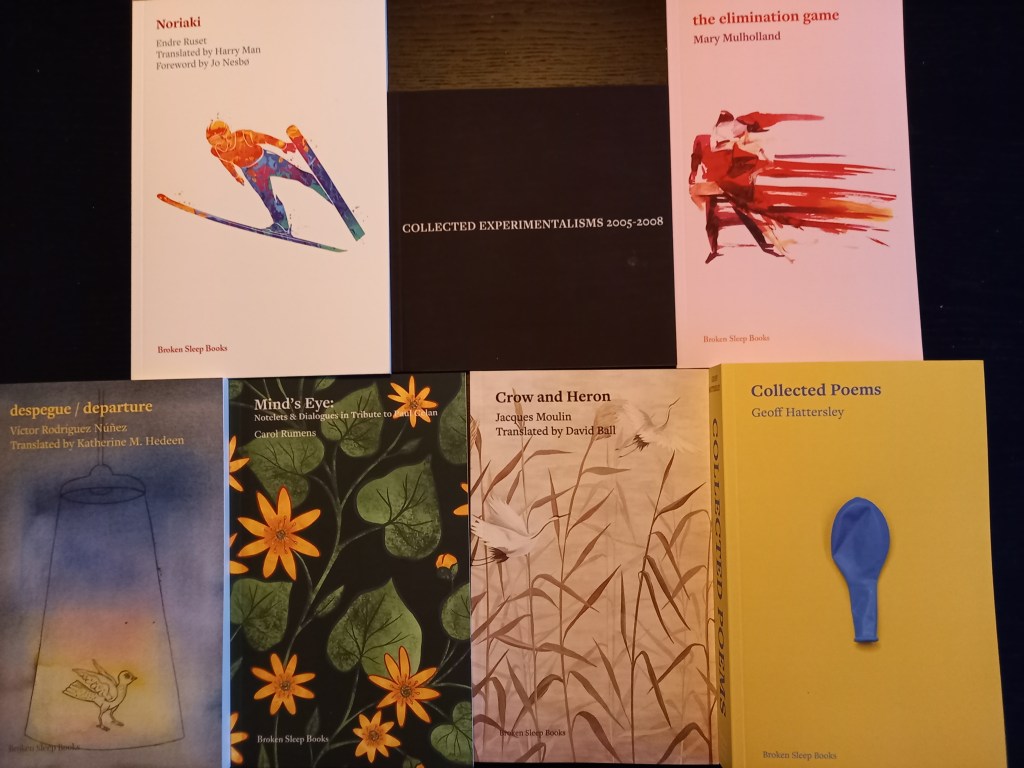
My holiday reading is sorted. The seven books include translations from French, Spanish and Norwegian. The latter an interesting set of haiku and haiku-like poems about the Japanese ski-jumper Noriaki Kasai.
Broken Sleep Books use the world’s largest on-demand publishers. The parcel came from France: no import duties, no VAT, no waiting while parcels linger in the customs depot. A bonus!
This is my last post for 2025. Season’s Greetings and many thanks to you all.
Here is the link to James Schuyler’s poem Linen. A poem about gratitude, starting with a question, and almost a sestude.
Thanks to poet Jonathan Davidson for introducing me (and the other poets on the course) to the Sestude. This form (a poem of 62 words) was invented by John Simmons, co-founder of the ‘26’ writing group in 2003. The English alphabet has 26 letters and 62 is its opposite.
It started with a project ‘26 treasures’ in the Victoria & Albert Museum’s British Galleries. The creative community 26.org.uk is a not-for-profit organisation which still undertakes a range of creative projects.
I enjoyed playing around with the form and, going through my folders, came across a short prose poem that only needed to lose a few words:
If there were no wind, cobwebs would cover the sky.
If there were no wind, cobwebs would cover the sky. Soon enough, the clouds would get angry, address the spiders Have you no manners? Your offspring is just sitting around. The angrier the clouds got, the greyer they looked. It was a battle of grey against grey. Battles and wars always end in tears. The people below were relieved: Rain at last.
Note: Serbian proverb quoted by Vasko Popa, The Golden Apple, 2010.
The Golden Apple collection is a round of stories, songs, spells, proverbs & riddles that Popa himself selected from various anthologies of Serbo-Croatian folk literature.
Writing Prompt
A few more proverbs and riddles. I will share answers next month!
Proverbs
Get your moustaches together, you’re going on a journey.
If you put him on a wound, it would heal.
When did fog ever uproot a tree-trunk?
Riddles
In one room both bone and flesh grow.
I stretched a gold thread through the wide world and wound it up into a walnut shell.
I shake a tree here, but the fruit falls half an hour away.
Many thanks to Kathleen Mcphilemy for including three of my poems in episode 37 of Poetry Worth Hearingor you can listen on Youtube, Audible and Spotify.
One of the poems is his ashes on a corner.
The theme was hiding and/or seeking. The episode is 60 minutes. The first half hour or so is an interesting interview with poet Nancy Campbell who talks about her residency on Greenland among other things. The interview and Nancy’s poems bookend poems by Guy Jones, Zelda Cahill-Patten, Lesley Saunders, Pat Winslow, Richard Lister, Dinah Livingstone, and Sarah Mnatzaganian.
The theme for the next episode is all things ‘eco’. Send up to four minutes of unpublished poems (text and sound file) plus a short biography to poetryworthhearing@gmail.com by 18 January 2026. Find more information on poetryworthhearing.biz.
his ashes on a corner
of the dining table by the small square votive container the discreet undertaker’s logo
she greets him will have a glass at six his ashes waiting with us for borders to open
It’s a great pleasure to introduce this month’s guest poet Cliff Yates. I met him on an excellent online workshop he ran for the Poetry Business. They published his New & Selected Poems, which brings together poems from five earlier publications – over thirty years of ‘inimitable’ work. Poignancy, economy, humour, a touch of the surreal…
You can find Cliff’s biography and the link to his website below the poems.
Day Breaks as a Petrol Station
Day breaks deliberate as a petrol station newspapers and expensive flowers but you’re tired of vacuum-packed sandwiches and sordid headlines.
On the 15.07 out of Deansgate she’s reading The Holy Sinner. The dog opposite smiles through its muzzle. Coffee, or maybe something’s on fire we do appear to be speeding unless we’re stationary and the landscape’s rattling past. ‘It’s been a good day,’ she says, ‘it makes up for yesterday.’ ‘Why, what happened yesterday?’
Days without rain and suddenly it rains. Another country, your body’s not your own. You want to go for a walk. In this?
He threw a stick for the dog in Habberley Valley the tattoo flew from his arms landed in the bracken like leaves.
Dog
So many places closed: the off-licence, the butcher, the corner shop, even the telephone box screwed shut. Dog had come a long way, and now what?
The cherry blossom, he noted, looking up for once from the pavement, was particularly stunning this year, maybe it was the same every year
but noticing it, his heart was lifted and he decided not to be disappointed. The journey had been arduous, the future was uncertain, but there is more to life,
he reflected, cocking his leg against the letter box, than a bowl of fruit on a table.
The Lesson
The nun points out the ones to watch: the boy in the corner, the girl at the back. In this class it’s the boy in the middle who thinks he’s a cat.
Outside, workmen are felling trees. A bird’s nest tumbles in through the window, lands on a desk. Inside the nest, a baby bird. It’s okay it’s okay, the children say, Brian will know what to do.
The boy who thinks he’s a cat gathers the bird and, holding it at arm’s length in the cup of his hands, heads for the door, the nun behind him between the silent rows of children and the bird, as if on cue, lifts up its beak and sings.
Lighthouse
The lighthouse flickers at the end of the pier. We watch it in our red pyjamas. Actually, neither of us are wearing red pyjamas. You’re wearing my blue shirt.
The lighthouse flickers at the end of the pier. It’s the only thing we can be sure of. Everything’s uncertain since you set alight my record collection.
I’m trying to work out an appropriate reaction, rearranging things in my head to eliminate all memory of the record collection. The lighthouse flickers on and off.
Actually it doesn’t, you point out, it just appears to. You look amazing in my blue shirt. I haven’t words to describe how good you look in the light from the lighthouse. Now you’re here
now you’re not. Maybe I should burn something of yours, you suggest. Your voice leaves me in the dark. It doesn’t sound like you when I can’t see you.
Cliff Yates was born in Birmingham and has been publishing poetry since the 1980s. His New & Selected Poems (Smith/Doorstop, 2023) brings together work from various collections including Henry’s Clock (Fenton Aldeburgh First Collection Prize; Poetry Business Book & Pamphlet Competition), Frank Freeman’s Dancing School (Arts Council England Writers Award) and Jam (ACE Grant for the Arts). He taught English at Maharishi School in Skelmersdale and wrote Jumpstart Poetry in the Secondary School during his time as Poetry Society poet-in-residence, following the success of his students in poetry competitions. He has led courses for, among others, the Arvon Foundation and the British Council.
Today I am voting twice: first for a political party, then for a tree.
In a busy city, there is little room for trees to become old. On average, a city tree lives for 50 years.
The Hague doesn’t have many old trees: during WWII a lot were cut down, their wood used for cooking and heating. Of the 120,000 city trees, only around 1300 have the ‘monumental’ tree status.
Such trees are over 50 years old and meet at least one of these criteria: it is irreplaceable, of rare type, shape, or size. It may have historical value, or provide a home for rare plants or animals.
Photo credit: Joost Gieskes
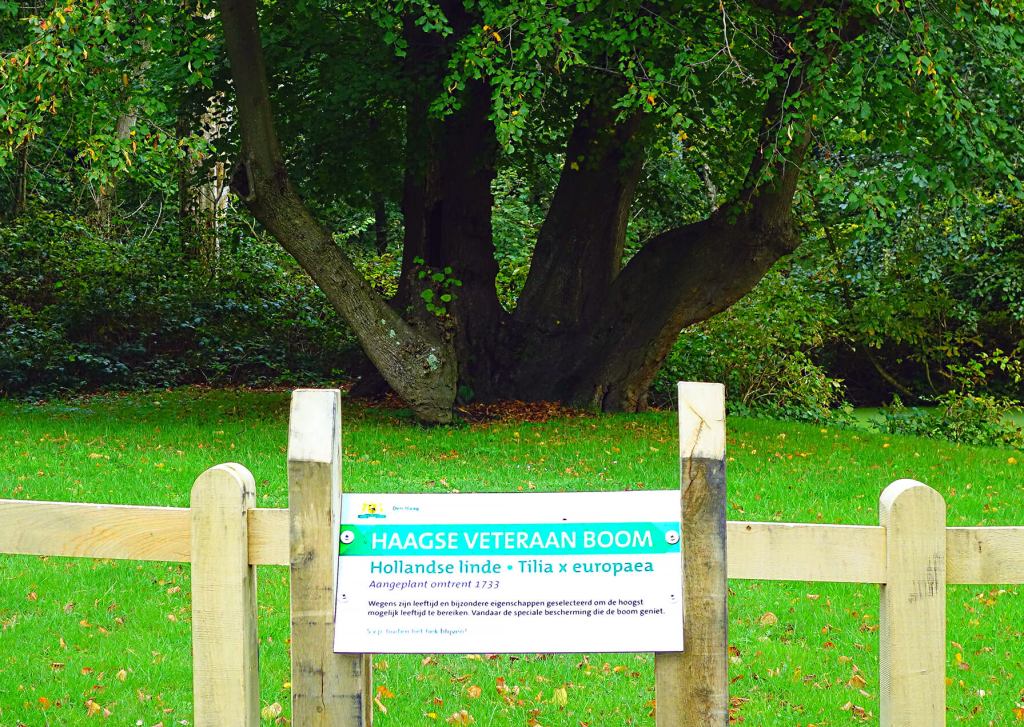
The veteran tree initiative comes from the UK. The first official veteran tree of The Hague – even of The Netherlands – is a lime or linden tree (Tilia x europea) on the Clingendael Estate. This was planted around 1733.
I came across it on my walks during the first 2020 lockdown: Clingendael is close to the camping where I had my caravan. I was intrigued to find a tree in a corner of a field with a fence round it.
A veteran tree is protected and allowed to remain in place forever. A ‘monumental’ tree may be cut down when it becomes dangerous or diseased.
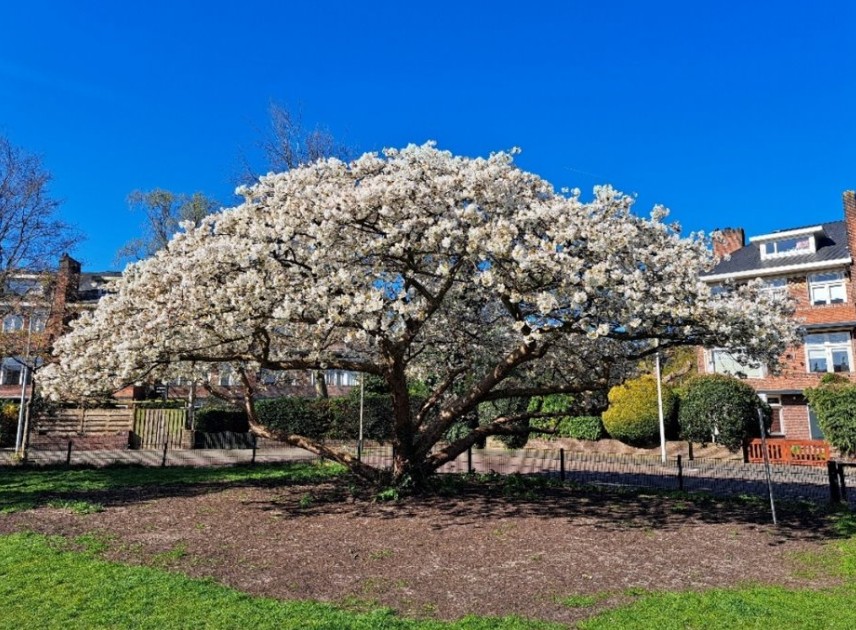
Japanese flowering cherry, tree. 92, 13 m wide.
The Hague local authority has nominated 10 trees and invites people to vote for five of these to become a veteran tree. The five trees that don’t get veteran status will become monumental trees. All the nominated trees are between 70 and 220 years old.
This is much harder than choosing a political party!
Will I choose that Japanese cherry, or the ’12 Broers’, tree no. 73, a 220-year-old oak that had a tough life (cut down often) and now has 12 trunks (the brothers), or choose the 145-year-old Mourning beech that houses falcons. I will let you know.
I’m delighted to share poems by Matthew Paul from his new collection with Crooked Spire Press. The poems demonstrate Matthew’s ‘unflinching clarity’, and his ‘fierce attention to detail’. His biography follows the poems and there you can also find a link to his own website.
Spent Matches
Mum lets only Granddad light up in our house. The second Thursday of every other month, she fetches Grandma and him over from Sutton. The chalkhill-blue elegance of the Wedgwood ashtray rhymes with unfiltered smoke rings pixilating like Ceefax in the living-room air.
Teatime doesn’t wait for Dad: Hovis, Primula, Shippam’s fish paste, allotment tomatoes, cress; mini rolls, Penguins, cremated fruitcake; pots of Brooke Bond PG Tips; Beryl Ware replaced by Royal Worcester, on Hay Wain place mats. Chit-chat wilts like Dad’s California poppies.
Mum fills space with monologues. My brothers’ progress; mine. WRVS activities. Her botched hysterectomy. We watch Grandma’s must-see, Crossroads, then ours: ‘Top of the Flops, I call it,’ says Granddad. The outfits, songs, presenters and Legs & Co. baffle him into silence; except
when Julio Iglesias butchers ‘Begin the Beguine’. ‘Artie Shaw!’ he cries; and his and Grandma’s memories spool back to bulletins on the wireless, to Chamberlain’s jubilant declaration of peace. Barely through the door, Dad re-buttons his coat to take them home. Granddad beams, ‘Abyssinia!’
Photo credit: Liam Wilkinson
A Common Hand
I don’t have to prove whether I did it or not; if they can’t see it, what kind of damned experts are they? [. . .] I’m not a crook; I’m just doing what people have always done in the history of the world: ever since art was invented, people have made imitations of it. Eric Hebborn, ‘Portrait of a Master Forger’, Omnibus, BBC TV, 1991
Eric pestles oak gall, gum Arabic, pinches of iron Sulphate and rain into ink with ‘a gorgeous patina’, To pen his line on slyly foxed paper, in the styles Of Pisanello, Poussin and sundry other old masters, Reshaping preparatory sketches to make pentimenti, Faking collectors’ monograms as cherries on top.
At junior school, Eric, aged eight, discovered that Burnt Swan and Vesta matchsticks’ charcoal tips Burnished imagination’s marks, incurring, firstly, Welts from a leathering for possessing matches, Then a three-year stretch in an Essex reformatory For wilfully setting cloakrooms on fire. A flair for Painting sees him into art schools, lastly the RA, Where, though he wins every prize, contemporaries Remember Eric only as ‘a silent creature’; ‘a joke’.
They would say that, since he’s brought their craft Into disrepute. ‘Dealers are not interested in art, but Money,’ he says. ‘The real criminal, if there is one, Is he who makes the false description; guiltier by far Than had he manipulated the nib himself. Ignore The fusspots. Enjoy art, without worrying whether Attributions are correct.’ Museums have everything To lose from uncovering Eric’s handiwork; queasily, They check their acquisitions back to the Sixties And issue, de haut en bas, highly selective denials.
‘No one is studying art with honesty,’ claims Eric, Upon the publication of The Art Forger’s Handbook In Italian. Out in Trastevere three icy nights later, He stumbles, soaked in Chianti Classico Riserva, Down a cobbled passage, to his blunt force demise.
In Which I Spend a Fortnight of my West Berlin Summer in 1987 Doing a Few Hours’ Cleaning Per Day in Some Multinational’s HQ
My Iraqi supervisor Zaynab and I enjoy, for our lingua franca, helpless amusement. Every day, precisely at knocking-off time, we point at the clock, chorus ‘Sechs!’, then cackle like siblings.
Dieter, fellow cleaner, never gets our jokes. Just like me, he’s twenty and nearing the end of a gap year; mandatory, before enrolment at Humboldt. Mine’s elective, for my mental health. He and I view the city’s halves from the roof: the Wall zigzags like the Western Front.
Afterwards, we take the U-Bahn —he buys a ticket; I don’t— to the agency’s office, at Nollendorfplatz. He translates the clerk: I won’t get paid until next week. ‘Scheisse,’ I say. Dieter deadpans: ‘She said, “Ah, so the English boy can speak German after all”’
Biography
Matthew Paul hails from South London and lives in South Yorkshire. His second collection, The Last Corinthians, was published by Crooked Spire Press in June 2025. He is also the author of two haiku collections – The Regulars (2006) and The Lammas Lands (2015) – and co-writer/editor (with John Barlow) of Wing Beats: British Birds in Haiku (2008), all published by Snapshot Press. His reviews regularly appear in The Friday Poem and elsewhere. He blogs here.
The original wind phone, photo credit Matthew Komatsu
It’s a year ago today that my brother died. If grief is love with nowhere to go, the wind phone can be a place for those feelings to land, even momentarily.
The initiative was started in Japan by garden designer Itaru Sasaki in Otsuchi Prefecture in 2010. Sasaki said: ‘Because my thoughts couldn’t be relayed over a regular phone line, I wanted them to be carried on the wind.’ Hence the name Kaze no denwa’ – phone of the wind. The disconnected old-style rotary telephone allowed him to deal with grief after his cousin’s death of cancer.
Sasaki: ‘When your heart is filled with grief or some kind of burden, you aren’t in tune with your senses. You’re closed off like curtains have been pulled around you. After you empty your heart a little bit, you might be able to hear some birds singing again.’
The following year close to 20,000 people were killed by the earthquake and tsunami. In Tokohu 10% of the population died. Sasaki allowed local people to use the wind phone. Over 30,000 people have made the journey to this telephone since, and wind phones have been set up in other countries. The wind phone also provided inspiration for films and novels.
Amy Dawson (USA) lost her daughter Emily to terminal illness in 2020. She learned about wind phones and now devotes much of her time to maintaining a listing of wind phones worldwide, providing advice and resources. The current total is just over 400. Not all calls are to a deceased. People make calls about other losses. Go to her website for more information. There is also an article on Colossal
The first wind phone in The Netherlands was placed in 2019. There are now eight, with a further eight being planned. The locations include Haarlem – the town where my brother and sister-in-law lived before moving to the nearby village of Spaarndam.
I imagine a wind phone, the black cord snipped, in the dunes of Wijk aan Zee – where I’ll celebrate my special birthday this weekend, and where my brother and I spent much time as children during the summer vacation.
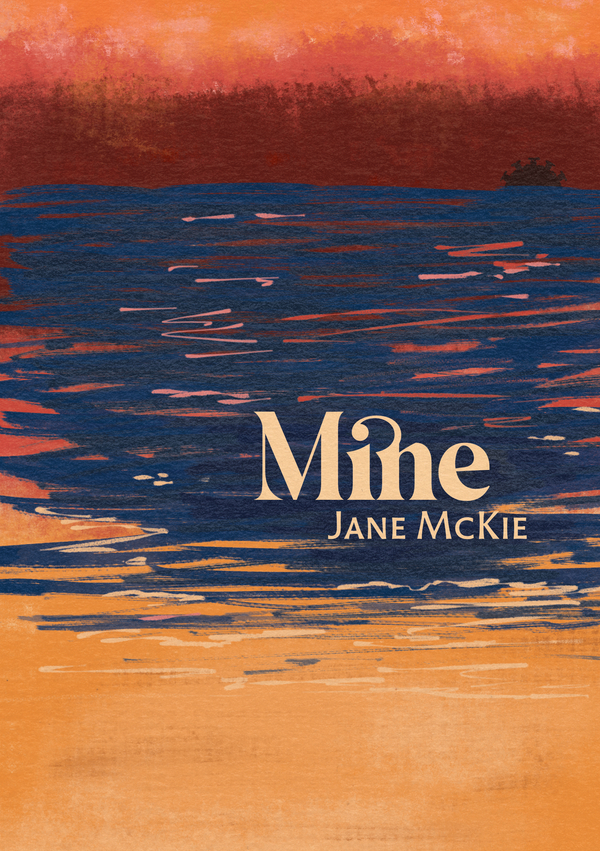
It’s my pleasure to introduce our May guest poet Jane McKie. We met many years ago on a writing workshop and are still part of an email group. You can find her biography at the end of this post. Cinnamon Press recently published her new poems and I’ve chosen some poems from Mine: vivid, clear embodied images with marvellous economy.
Mine
On nights when the wind drops, I hear it crooning softly, not like a real bomb. A toothless, barnacled silhouette, wittering to itself when the tide is low. My friends and I sometimes get close, daring each other to nudge its rust. But what happens when the music cuts out? Tonight, the mine’s a mute companion: whiff of brine, cryptic fist. As my eyelids close, that’s when it—
Kevlar
I am the tattoo of a spider’s web on a sixteen-year-old girl’s calf. Traced from a drawing of a photo, in time, I will thread up her thigh, over her whole torso, in a riot of silk that is stronger than Kevlar.
She will wear me like armour: my vest of ink, her toughest skin. Who wouldn’t fear a woman fluent in the language of spiders? Those twitches in cobwebs that throb like old wounds.
Dreaming in an age of austerity
Not a single one finished: all mark time until a rich developer completes the job. Here, stone knuckles. There, exposed metal rods stab at the sky like a mech-monster’s fingers.
Not vital or hungry, these resort Titans. But not quite dead either. Gulls like to roost in the pockets of them. Gulls dabble bills in puddles that form from the absence of roofs.
Even small children play in the undead bodies of imagined buildings, sneaking past tape to be mummies and daddies in beautiful houses that shelter insatiable, suckling doll-babies.
Polished malachite
on my desk, riven with almost-blue, a pool or algal cistern.
I touch it when I’m sad and its green eye blinks, rippling with souterrain light.
Biography
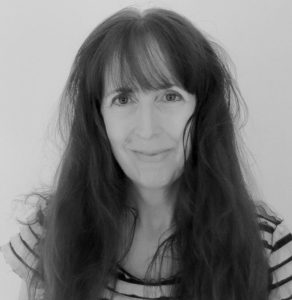
Jane McKie is a Senior Lecturer in Creative Writing at the University of Edinburgh. She has written several poetry collections, including Morocco Rococo (2007), Kitsune (2015), and Quiet Woman, Stay (2020) with Cinnamon. Her most recent full collection is Carnation Lily Lily Rose (Blue Diode, 2023). She lives in Scotland, but was originally from the Sussex coast, which inspired several poems in Mine.
It’s my pleasure to introduce this month’s guest poet Patrick Wright. Patrick and I met years ago at Manchester Poets. Earlier this month his poem Archive, inspired by Anselm Kiefer, featured on the blog. You’ll find Patrick’s biography at the end of the post.
Today I’m sharing more poems from his substantial collection Exit Strategy, a ‘vivid exploration of grief and loss’. Tamar Yoseloff said of the collection: ‘Patrick Wright is one of those rare poets who can translate the complex images of visual artists into precise and pitch-perfect language.’
Patrick has been inspired by artists past and present (Rousseau, Klee, Rachel Whitehead, J M W Turner), to mention some well-known names.
The collection uses a wide range of forms (couplets, tercets, stanza, sonnet, ghazal, prose poem) and makes excellent use of white space through columns and indents. WordPress can’t do justice to formatting. Therefore, I’ve chosen poems with a more traditional lay-out.
COLD DARK MATTER
After Cornelia Parker
Thanks to you I am learning to see again through a sparseness of particles—
like how I learned to listen to an eyelid twitch once yes and twice no through a coma.
Darkness I’ve come to realise is a privilege— known at 4am & sleepless
the sun rising like a scalpel & turning the room purple.
Somehow, we go on & somehow it never ends & we go on like a double pendulum.
Perhaps love is like this fixed explosion. Perhaps you’re nearer now than the word belief.
SHADOW OF A GIRL PLAYING WITH A HULA HOOP After Giorgio de Chirico
It used to scare me, what this girl is doing, or those around her, off in the blind field. Seemingly a girl playing with a hula hoop, or just a shadow, no source, just a shadow next to a wagon, its backdrop here a dusty plaza. Somewhere, I feel, from an upstairs room, an eye looks at me. Somewhere, off screen, a murder is taking place, this shade a clue. Even so, things are too belated now, this girl clearly a phantom and not a muse, like she’s in a toy shop or inside its puzzle, no girl playing so nonchalant with a hoop. The sun, at these times, is no longer a sun, more likely a lamp. My fingers are syllables. And this pine table where the postcard sits is full of knots, staring like gods from above.
ROBERT RAUSCHENBERG’S UNTITLED
& already I see alpines prise their way through the brutalist grey of Chernobyl floors. Through the sarcophagus they reach for sunlight. Maybe we only learn what the burn of graphite means once blind. I know you better after knowing disaster.
I’ve studied the colour theories of Goethe and Albers where the wheel & the wheel of life are a way to feel closer. I am the stalk through the fallout, one that insists on pushing its way & one that’s been patient. On the surface we share the mark of detonation.
They say a town like this is void though one pulse of a deer’s heart makes it a plenum. A full spectrum will reveal itself only when you’ve pledged to cease hurting. Through this I see what you saw when the sun set & made shades on a radiator. We are both on the side of art.
WINTER LANDSCAPE WITH SKATERS AND BIRD TRAP After Pieter Bruegel the Elder
I find no pleasure in the ice. Everything about me lies still—save for murmurations.
Peasants weave between trees: each crystalline like coral on a seabed.
I give you a winter landscape in place of a mirror. The bird trap is my heart.
Soon it will be still, a skull in a crypt, lit by candles. My hills are a wishbone. They undulate under great tension.
The skaters are insouciant, crows peck their shadows. My face startles—a chance alignment of stars.
Skaters are on slippery ground and if they should slip, they have nothing to cling onto.
Biography
Patrick Wright’s poems have appeared in Poetry Ireland, Poetry Wales, The North, Gutter, and The London Magazine. His debut collection, Full Sight of Her, was published in 2020 by Eyewear and nominated for the John Pollard Prize. His pamphlet, Nullaby (2017), was also published by Eyewear. His second collection, Exit Strategy (2025), was published by Broken Sleep Books. He teaches English and Creative Writing at the Open University.








 Acacia Publications