I was very pleased to see my poem Canada is as far away as bibles are on After. Many thanks to Editor Mark Antony Owen. You can read the poem here.
After publishes ekphrastic poems and my poem was inspired by The Avid Reader, 1949. Rodney Graham (1949 – 2022) was a visual artist, painter, and musician. He made the lightbox in 2011.
‘We see the middle-aged man / carrying a hat, smoking a pipe, / because Graham inhabits him.’
The Avid Reader, 1949 was one of the works on display at Voorlinden Museum, Wassenaar, the Netherlands in the major exhibition of Graham’s work titled That’s Not Me. An ironic title as Graham appears in all the works – as a builder having a smoke, a lighthouse keeper, historical figure.
Voorlinden is a fabulous museum – more about it some other time.
I was struck by the attention to detail and the scale of the works. The woman is ‘his wife, swing coat, high heels, walks past on the right.’
Health issues have kept me housebound, but I was determined to go and see this artwork at Museum Beelden aan Zee, Scheveningen before it goes back to Marseille. A sunny, breezy autumn day, a salty tang, quiet beach.
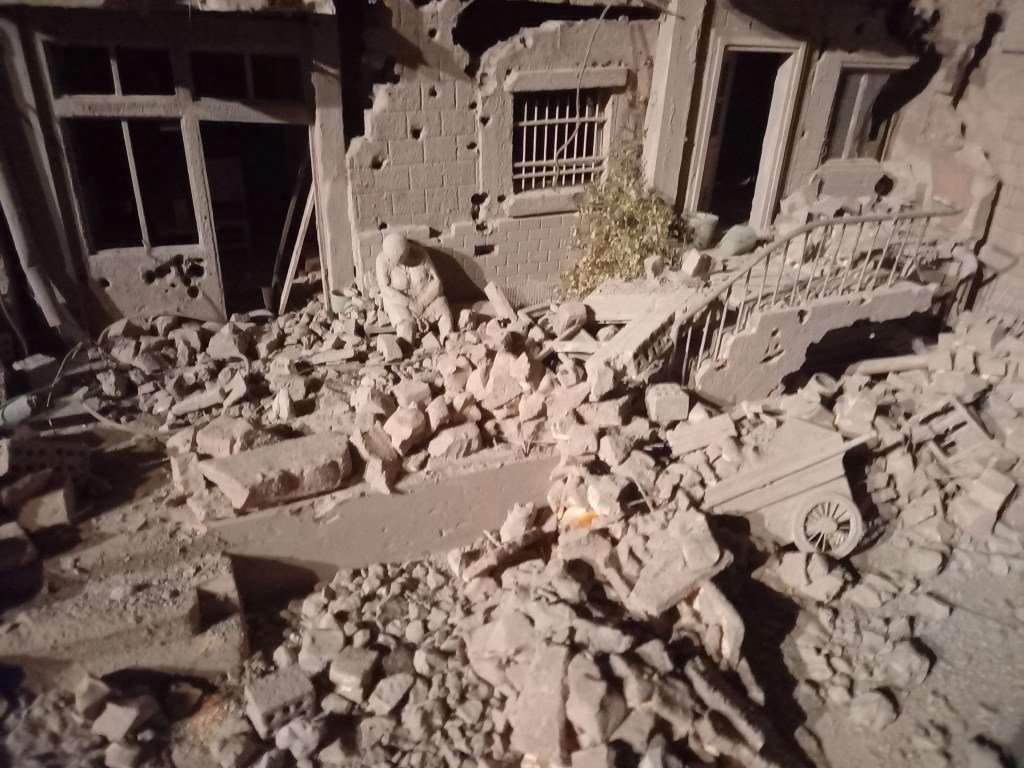
Khaled Dawwa (Maysaf, 1985) worked on it during 2018 – 2022. He was invited to show it at Beelden aan Zee in 2025 – when here in The Netherlands we celebrate 80 years of freedom.
Voici mon coeur!
The work (tr. Here is my heart!) is a 6 m long model. It’s made of vulnerable, unbaked clay. It represents a fictional street in Damascus. Outside, there are the remains of a car, benches, a swing seat. We see material damage. The setting is nighttime.
It was a disorienting experience walking into the small side gallery as it was almost dark. A volunteer gives visitors a small torch, so we can walk around and shine into the rooms: beds, tables, chairs, a poster on the wall, a book left on the table.
Dawwa and his family fled Syria shortly after the start of the civil war. After a year in Lebanon, they travelled to France where they now live in exile. Khaled now works in a studio just outside Paris.
Before leaving he took photos of the works he had made, then destroyed them – for security reasons, or because they were too large to travel.
Voici mon coeur!, a contemporary war memorial, is a personal and emotional representation, in contrast with the collective memory expressed by traditional war memorials. A powerful and timely reminder. I found it deeply moving.
I’m delighted to share three poems by Matthew Paul from his new collection with Crooked Spire Press. The poems demonstrate Matthew’s ‘unflinching clarity’, and his ‘fierce attention to detail’. His biography follows the poems and there you can also find a link to his own website.
Spent Matches
Mum lets only Granddad light up in our house. The second Thursday of every other month, she fetches Grandma and him over from Sutton. The chalkhill-blue elegance of the Wedgwood ashtray rhymes with unfiltered smoke rings pixilating like Ceefax in the living-room air.
Teatime doesn’t wait for Dad: Hovis, Primula, Shippam’s fish paste, allotment tomatoes, cress; mini rolls, Penguins, cremated fruitcake; pots of Brooke Bond PG Tips; Beryl Ware replaced by Royal Worcester, on Hay Wain place mats. Chit-chat wilts like Dad’s California poppies.
Mum fills space with monologues. My brothers’ progress; mine. WRVS activities. Her botched hysterectomy. We watch Grandma’s must-see, Crossroads, then ours: ‘Top of the Flops, I call it,’ says Granddad. The outfits, songs, presenters and Legs & Co. baffle him into silence; except
when Julio Iglesias butchers ‘Begin the Beguine’. ‘Artie Shaw!’ he cries; and his and Grandma’s memories spool back to bulletins on the wireless, to Chamberlain’s jubilant declaration of peace. Barely through the door, Dad re-buttons his coat to take them home. Granddad beams, ‘Abyssinia!’
Photo credit: Liam Wilkinson
A Common Hand
I don’t have to prove whether I did it or not; if they can’t see it, what kind of damned experts are they? [. . .] I’m not a crook; I’m just doing what people have always done in the history of the world: ever since art was invented, people have made imitations of it. Eric Hebborn, ‘Portrait of a Master Forger’, Omnibus, BBC TV, 1991
Eric pestles oak gall, gum Arabic, pinches of iron Sulphate and rain into ink with ‘a gorgeous patina’, To pen his line on slyly foxed paper, in the styles Of Pisanello, Poussin and sundry other old masters, Reshaping preparatory sketches to make pentimenti, Faking collectors’ monograms as cherries on top.
At junior school, Eric, aged eight, discovered that Burnt Swan and Vesta matchsticks’ charcoal tips Burnished imagination’s marks, incurring, firstly, Welts from a leathering for possessing matches, Then a three-year stretch in an Essex reformatory For wilfully setting cloakrooms on fire. A flair for Painting sees him into art schools, lastly the RA, Where, though he wins every prize, contemporaries Remember Eric only as ‘a silent creature’; ‘a joke’.
They would say that, since he’s brought their craft Into disrepute. ‘Dealers are not interested in art, but Money,’ he says. ‘The real criminal, if there is one, Is he who makes the false description; guiltier by far Than had he manipulated the nib himself. Ignore The fusspots. Enjoy art, without worrying whether Attributions are correct.’ Museums have everything To lose from uncovering Eric’s handiwork; queasily, They check their acquisitions back to the Sixties And issue, de haut en bas, highly selective denials.
‘No one is studying art with honesty,’ claims Eric, Upon the publication of The Art Forger’s Handbook In Italian. Out in Trastevere three icy nights later, He stumbles, soaked in Chianti Classico Riserva, Down a cobbled passage, to his blunt force demise.
In Which I Spend a Fortnight of my West Berlin Summer in 1987 Doing a Few Hours’ Cleaning Per Day in Some Multinational’s HQ
My Iraqi supervisor Zaynab and I enjoy, for our lingua franca, helpless amusement. Every day, precisely at knocking-off time, we point at the clock, chorus ‘Sechs!’, then cackle like siblings.
Dieter, fellow cleaner, never gets our jokes. Just like me, he’s twenty and nearing the end of a gap year; mandatory, before enrolment at Humboldt. Mine’s elective, for my mental health. He and I view the city’s halves from the roof: the Wall zigzags like the Western Front.
Afterwards, we take the U-Bahn —he buys a ticket; I don’t— to the agency’s office, at Nollendorfplatz. He translates the clerk: I won’t get paid until next week. ‘Scheisse,’ I say. Dieter deadpans: ‘She said, “Ah, so the English boy can speak German after all”’
Biography
Matthew Paul hails from South London and lives in South Yorkshire. His second collection, The Last Corinthians, was published by Crooked Spire Press in June 2025. He is also the author of two haiku collections – The Regulars (2006) and The Lammas Lands (2015) – and co-writer/editor (with John Barlow) of Wing Beats: British Birds in Haiku (2008), all published by Snapshot Press. His reviews regularly appear in The Friday Poem and elsewhere. He blogs here.
It’s an enormous pleasure to introduce this month’s guest poet Pam Thompson. Pam and I met 13 years ago on an extended writing course. You can find her biography below the poems. These are from Pam’s prize-winning pamphlet and show the range of her writing. The Paper Swans pamphlet competition was judged by John McCullough: ‘Sub/urban Legends gripped me because of the way it marries poignancy with a really bold imagination and stylistic flair’. The intriguing cover image is also by Pam.
Explorers, Antarctica, 1901
The leader sits on the sledge. He never does this. It’s against the rules of the expedition but now there are no rules.
Two huskies – the two remaining huskies, they ate the rest – sit either side like imperial lions.
The ship is stuck in frozen waves. The crew are starving or dead but this photo will be evidence that they reached their destination.
The photographer in the black hood. Stepping back. Pulling the cord. The flash.
Self Portrait as Fulang Chang
Freedom, chica, is all. I’ll wear the mandarin’s hat and silk waistcoat, eat all the honeyed grapes, to stay favoured, like a first-born.
I perch on her left shoulder, always on guard, never at ease. I bare my teeth and scream, at Diego and the village dogs.
I am the brush passer, ear for her secrets, but I am all chat, you know, teller of her tales though she isn’t one to keep schtum.
The bloody hearts we paint will drip onto the Blue House floor.
Fête Galante
Take the bus from outside the Water Margin Chinese restaurant—or from where it used to be in 1974—allow plenty of time. You’re at work in Lewis’s, folding up school shirts badly, cramming them back in their packaging; in a History of Art lecture looking at a slide of Fragonard’s ‘The Swing’. The bus will be full, people will be smoking on the top deck, so will you. This must be your stop. Is it everybody’s stop? You join the flow—you think of Tracy Emin’s tent with the names of all the people she ever slept with, or is it her messy bed you’re thinking of. All the beds you ever slept in. Lewis’s. All the shops you ever worked in. And the canteen in the factory where the men always patronised you. Here—you say to the tiny chef—you scrub the bloody burnt pans. All the patronising men you ever worked for—they all get off the bus. You watch them cross London Road. You haven’t moved very far. The Water Margin is the water’s margin and you wonder how this pond, this lake, this sea, arrived in the city. There are willows, and, over there, a fête galante, a woman on a swing, being pushed and pulled, higher and harder, by all the people she ever slept with.
Biography
Pam Thompson is a writer, educator and reviewer based in Leicester. She is a Hawthornden Fellow. Her works include The Japan Quiz (Redbeck Press, 2009) and Show Date and Time, (Smith|Doorstop, 2006). Her collection, Strange Fashion, was published by Pindrop Press in 2017. Pam was winner of the 2023 Paper Swans Pamphlet Competition and her winning pamphlet, Sub/urban Legends (Paper Swans Press) was published in March 2025.
It’s my pleasure to introduce this month’s guest poet Patrick Wright. Patrick and I met years ago at Manchester Poets. Earlier this month his poem Archive, inspired by Anselm Kiefer, featured on the blog. You’ll find Patrick’s biography at the end of the post.
Today I’m sharing more poems from his substantial collection Exit Strategy, a ‘vivid exploration of grief and loss’. Tamar Yoseloff said of the collection: ‘Patrick Wright is one of those rare poets who can translate the complex images of visual artists into precise and pitch-perfect language.’
Patrick has been inspired by artists past and present (Rousseau, Klee, Rachel Whitehead, J M W Turner), to mention some well-known names.
The collection uses a wide range of forms (couplets, tercets, stanza, sonnet, ghazal, prose poem) and makes excellent use of white space through columns and indents. WordPress can’t do justice to formatting. Therefore, I’ve chosen poems with a more traditional lay-out.
COLD DARK MATTER
After Cornelia Parker
Thanks to you I am learning to see again through a sparseness of particles—
like how I learned to listen to an eyelid twitch once yes and twice no through a coma.
Darkness I’ve come to realise is a privilege— known at 4am & sleepless
the sun rising like a scalpel & turning the room purple.
Somehow, we go on & somehow it never ends & we go on like a double pendulum.
Perhaps love is like this fixed explosion. Perhaps you’re nearer now than the word belief.
SHADOW OF A GIRL PLAYING WITH A HULA HOOP After Giorgio de Chirico
It used to scare me, what this girl is doing, or those around her, off in the blind field. Seemingly a girl playing with a hula hoop, or just a shadow, no source, just a shadow next to a wagon, its backdrop here a dusty plaza. Somewhere, I feel, from an upstairs room, an eye looks at me. Somewhere, off screen, a murder is taking place, this shade a clue. Even so, things are too belated now, this girl clearly a phantom and not a muse, like she’s in a toy shop or inside its puzzle, no girl playing so nonchalant with a hoop. The sun, at these times, is no longer a sun, more likely a lamp. My fingers are syllables. And this pine table where the postcard sits is full of knots, staring like gods from above.
ROBERT RAUSCHENBERG’S UNTITLED
& already I see alpines prise their way through the brutalist grey of Chernobyl floors. Through the sarcophagus they reach for sunlight. Maybe we only learn what the burn of graphite means once blind. I know you better after knowing disaster.
I’ve studied the colour theories of Goethe and Albers where the wheel & the wheel of life are a way to feel closer. I am the stalk through the fallout, one that insists on pushing its way & one that’s been patient. On the surface we share the mark of detonation.
They say a town like this is void though one pulse of a deer’s heart makes it a plenum. A full spectrum will reveal itself only when you’ve pledged to cease hurting. Through this I see what you saw when the sun set & made shades on a radiator. We are both on the side of art.
WINTER LANDSCAPE WITH SKATERS AND BIRD TRAP After Pieter Bruegel the Elder
I find no pleasure in the ice. Everything about me lies still—save for murmurations.
Peasants weave between trees: each crystalline like coral on a seabed.
I give you a winter landscape in place of a mirror. The bird trap is my heart.
Soon it will be still, a skull in a crypt, lit by candles. My hills are a wishbone. They undulate under great tension.
The skaters are insouciant, crows peck their shadows. My face startles—a chance alignment of stars.
Skaters are on slippery ground and if they should slip, they have nothing to cling onto.
Biography
Patrick Wright’s poems have appeared in Poetry Ireland, Poetry Wales, The North, Gutter, and The London Magazine. His debut collection, Full Sight of Her, was published in 2020 by Eyewear and nominated for the John Pollard Prize. His pamphlet, Nullaby (2017), was also published by Eyewear. His second collection, Exit Strategy (2025), was published by Broken Sleep Books. He teaches English and Creative Writing at the Open University.
Aus Herzen und Hirnen spriessen die Halme der Nacht, 2019-2020. Oil, acrylic, emulsion, shellac, straw, gold leaf, wood and metal on canvas. Dims: 471 x 841,5 x 36 cm. Collection Voorlinden.
Our guest poet this month is Patrick Wright. As I was reading his collection Exit Strategy (Broken Sleep Books, 2024) I came upon the poem Archive and discovered that Patrick and I are both very interested in Kiefer’s work.
For me one of the highlights last year was visiting Bilderstreit, a major exhibition of Kiefer’s work at Voorlinden Museum, The Netherlands. A few weeks earlier I had watched the documentary that Wim Wenders made about Anselm Kiefer. I was blown away too by the film: it’s in black-and-white and one can watch it through 3D glasses.
Kiefer was born during the bombing raids in the final months of WWII. For him, everything exists somewhere in the cycle of death and rebirth. Whenever he creates a new work, he knows that one day he will destroy it: attacking it with a flamethrower, axe, bolt cutter, or red-hot liquid lead.
ARCHIVE After Anselm Kiefer
Before his landscapes scorched by war and history, paintings of straw and glue, your golden hair, Margarethe, before ‘Death Fugue’, I was back at school, deep winter. In the yard blew a few stray crisp packets; seagulls pecked at crumbs. The annex and fence had the look of an abandoned camp, in Polish hinterlands. Through a cloakroom window I peered, looking for a ghost of myself, then at a ghost of myself, as the sun poked out from a cloud and the contours of bulimia gazed back, in sepia tones. I saw the bullies too, with razored eyebrows, piercings, fists in my gut, spit on my shoulder, the stench of Lynx, using queer as an insult. With my SLR, I clicked more in hope than expectation. I fumbled with fixative, the stop bath, the gelatin swell. My negatives solarised. I kept re-visiting as a witness. Those days, I bit the inside of my lip, stubbed cigarettes out on my arm. When the dysmorphic class photos were framed, still as that winter, your golden hair, said the Kiefer print, your golden hair, Margarethe.
It’s been a long time since I’ve been out to fill that well. I’ve had health issues and sat at home with the black dog. The exhibition of Joan Miró’s sculptures at Beelden aan Zee is almost closing. On a cold and sunny Tuesday, I got two trams to Scheveningen.
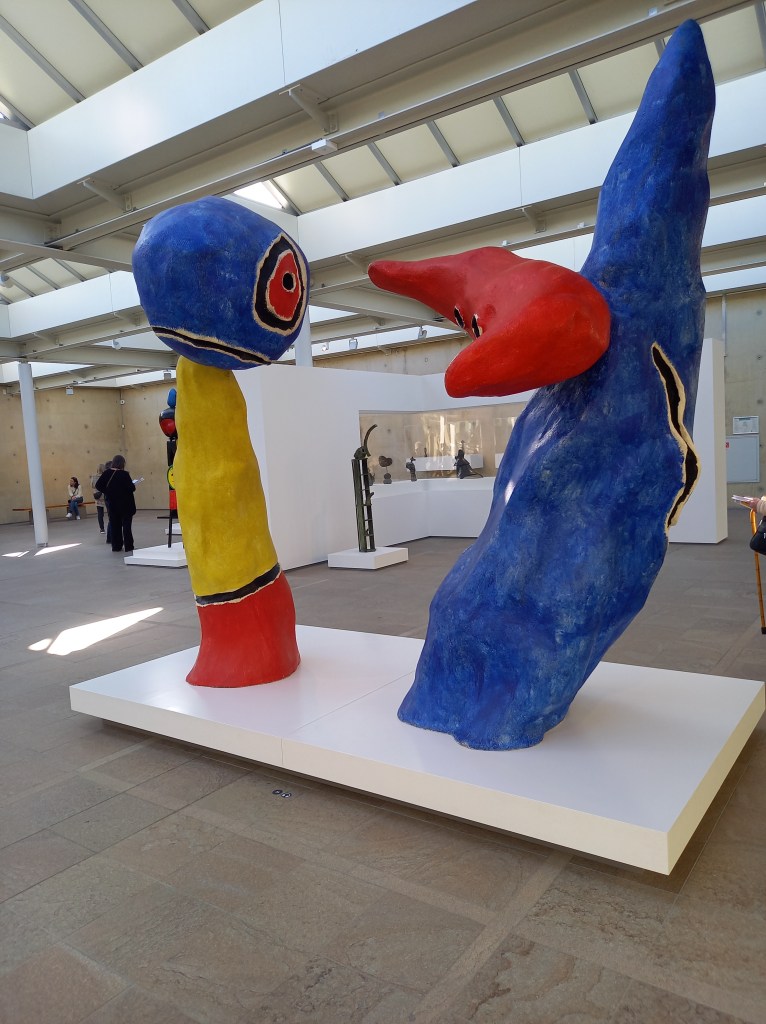
Pair of lovers playing with almond blossom
Beelden aan Zee is the only Dutch museum specialising in sculpture and it’s in a great setting. The authorities in The Hague insisted that the building should not be visible, so it’s hidden inside a dune, and it is mostly underground. From the terrace you can only see the sea, not the busy boulevard. All the materials have a sandy colour. Through plenty of glass in the roof there is a lot of light.
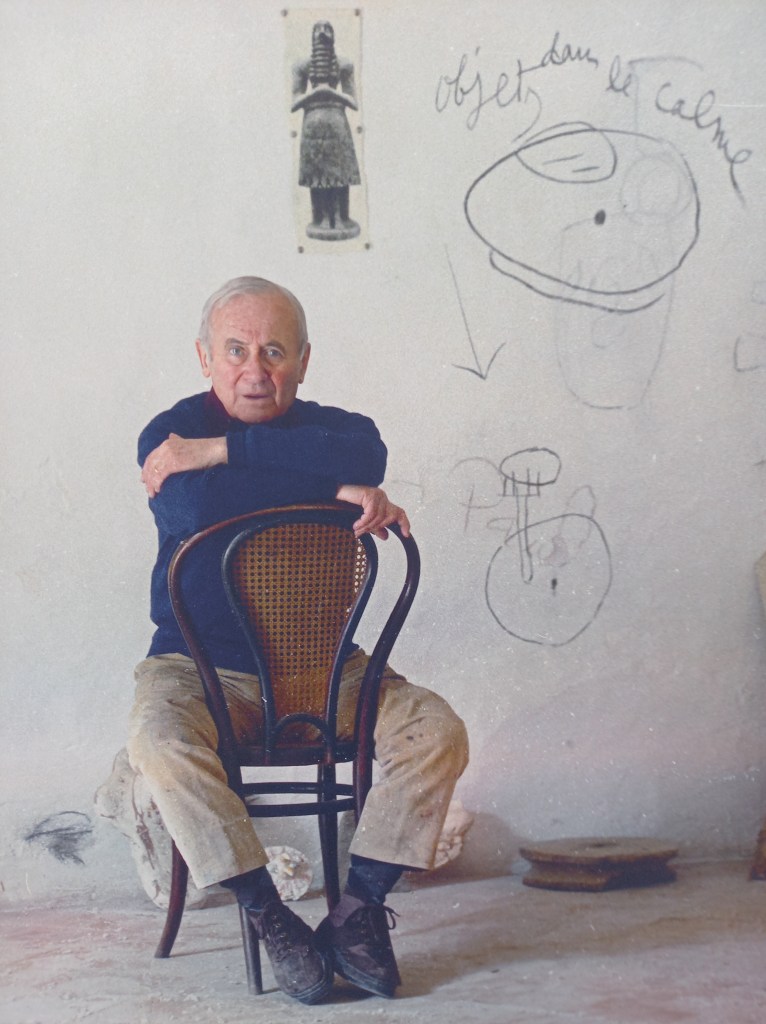
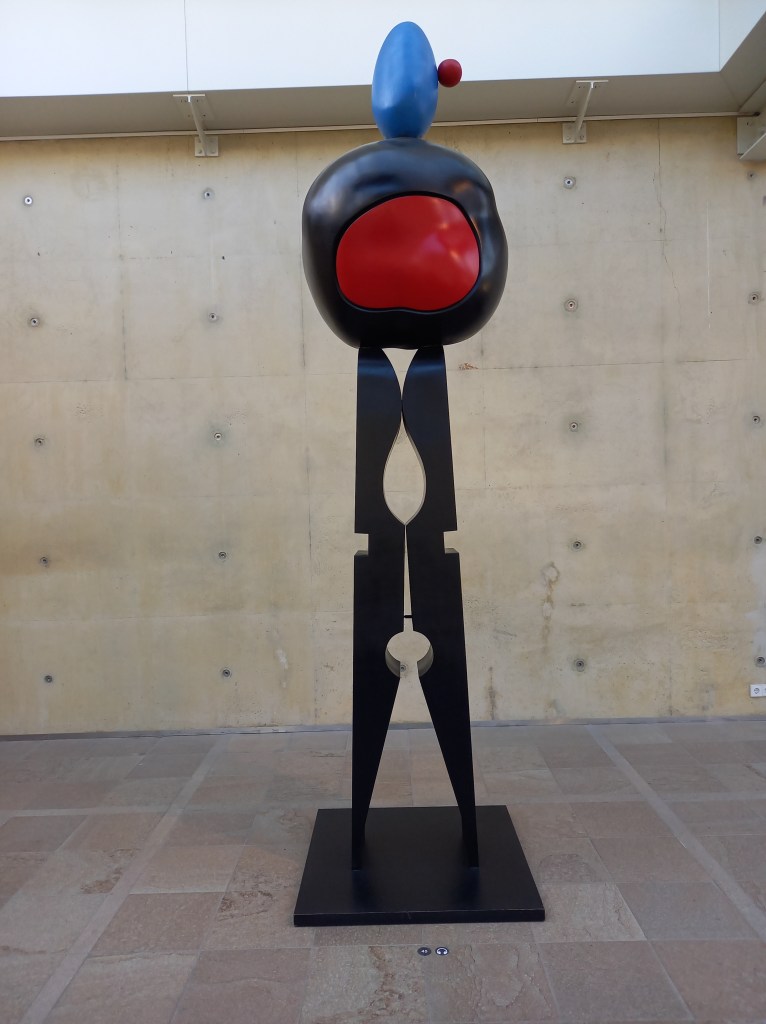
In his studios by the sea in Mont-roig del Camp and on Mallorca, Miró’s love for sculpture was given a huge boost. The (natural) objects he found on his walks were incorporated into sculptures and assemblages, along with everyday objects. The giant clothes peg (painted synthetic resin) was a design for a prestigious project in Central Park, New York. It would have been at least 14 metres high, though it was never realised.
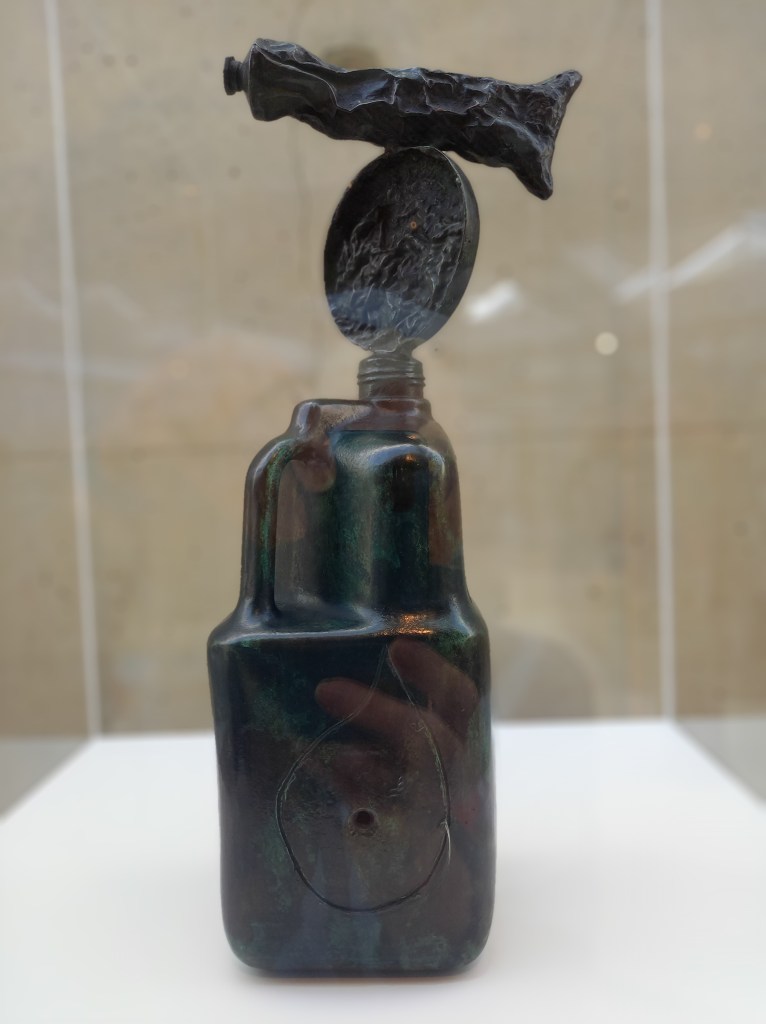
You can see the objects in this bronze sculpture: a paint tube, plastic bottle, spoon. Miró’s bronze sculptures were created using plastic models that he continued to shape until he found them good enough to cast.
The sculpture Monsieur et madame (Sir and Madam) is made of painted bronze. Two different objects form a couple. A square, red-painted stool stands for the man. On top of it is a rectangular white box with a face on it. The round, black stool represents the woman. It has a yellow egg on it. A playful, archetypical representation of masculinity and femininity.
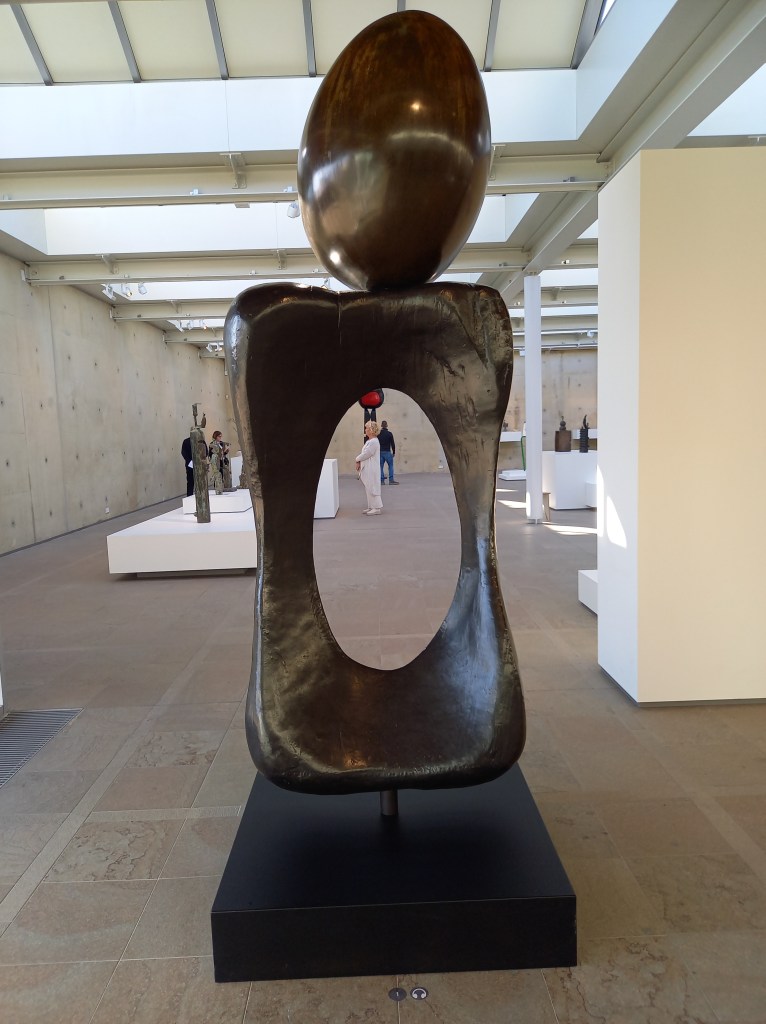
The Monument is the first sculpture as you enter the main hall. You can see some of the light coming through the roof.
It was hugely inspiring to see how Miró continued to innovate and be curious well into his 70s and 80s.
I’ve just renewed my annual Museum pass. With a typical entry fee of 15 Euros, it’s well worth it: over 400 Dutch museums take part. There is usually a top-up fee for major exhibitions. I wrote the prose poem on a recent workshop.
Exhibitions
You can’t just wake up and decide to visit an exhibition. Not a major show. You must book a ticket online beforehand and choose a time slot. I managed to get one, Saturday lunchtime, for the Manhattan Masters. Rembrandt, aged 52, poster boy.
I was way too early (I’d gone with Astrid to collect her prize from the Xmas competition and have our photo taken) so I ended up buying books in all three bookshops near the Mauritshuis. Manhattan Masters, ten paintings over from New York while the Frick is being refurbished. The Fricks went to Europe to buy, do the grand tour. They were booked to travel back on the Titanic. She sprained her ankle and they postponed.
I won’t even tell you about the Vermeer at the Rijksmuseum, the coloured lines on the floor, everyone taking photos, the horse-tooth woman who needed to be in the photo with the painting. I gave up after 30 minutes. I think it’s well-known that the exhibitions of prehistoric art take place in replica caves with fake bones and spotlights on those red hand prints and bison on the walls. I’ll give it a miss. I’ll order the catalogue and a pack of six postcards from the museum shop online.
So said Claes Oldenburg and he said a lot more like it, such as ‘I’m for art that flaps like a flag, or helps blow noses like a handkerchief’. Oldenburg said that his famous 1961 Ode to Possibilities, ‘I am for …’ was a statement, not a manifesto. It’s a fantastic read, a long list poem that works well as a writing prompt. Here is the link.
Swedish-born Oldenburg, one of the founding fathers of Pop Art died July this year at the age of 93. He was famous for his monumental sculptures where mundane objects (matches, clothes peg, apple core) suddenly became larger than life.
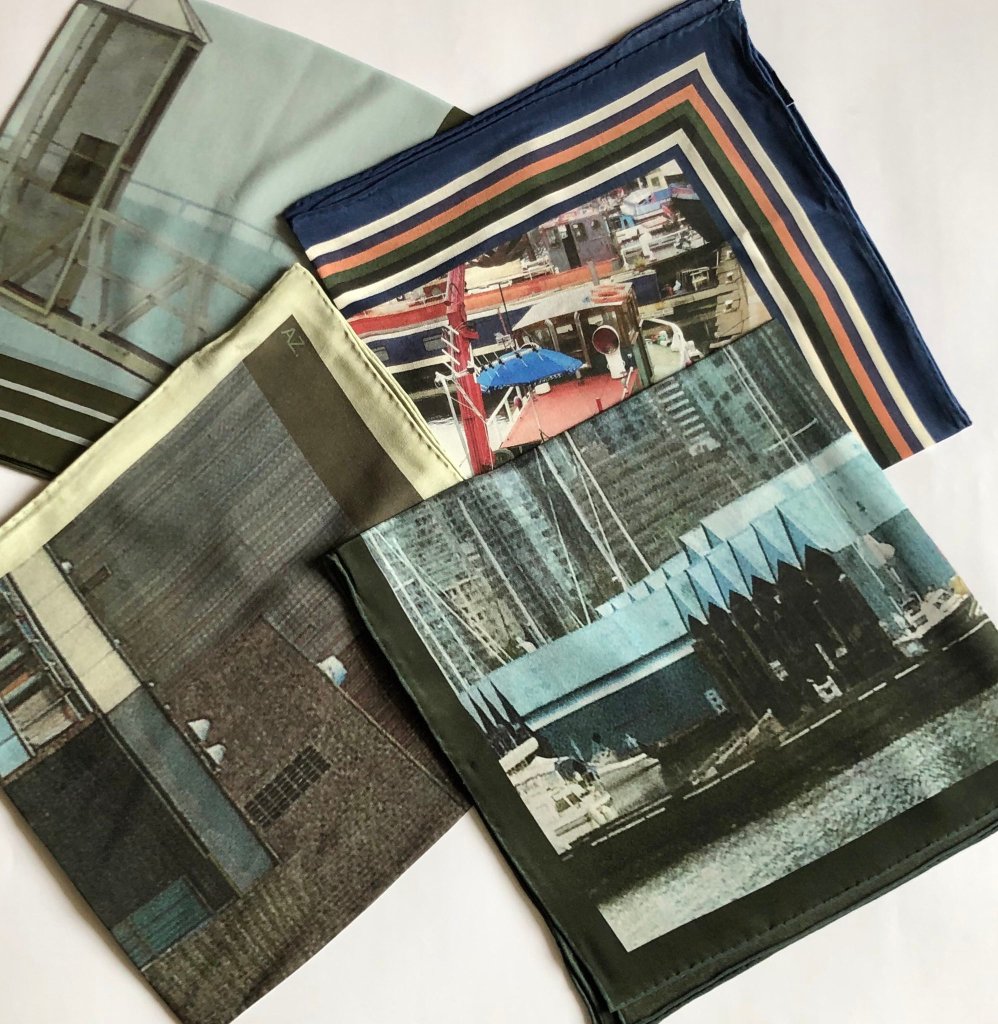
My poem Wearable Narratives (from the collection Nothing serious, nothing dangerous) is in two parts. Here is part i. It was inspired by a pure silk scarf, made by Andrea Zapp, that was on display in the shop of Manchester Art Gallery. At that time, I didn’t have a smartphone. So, here is a picture of other scarves, made by Andrea Zapp. See the note below for more information about her amazing work.
Scarf
A turquoise ribbon runs under khaki stepping stones. Tomatoes are the red carpet. Slanting shadows pull the empty staircase under water. Its fine metal tracery anchors a washing line with checked tea towel.
Cold marble columns, bleached shutters closed. Almost out of sight wooden farming implements, a clock stopped at ten to eleven, a car hubcap.
Everything here is at an angle now. What survives are the chalk drawings: a cheerful elephant, the ibis and another bird, its round black eye like a spinning top.
Note:
Andrea Zapp, born in Germany, living in Manchester, pioneered in coalescing her digital media art background with the fashion industry. Andrea has created the luxury fashion brand AZ.andreazapp. This sells high quality silk dresses and scarves printed with her own photography of urban views, rural panoramas, miniature scenarios and objects of culture and curiosity, creating a collection of stunning authentic hand-made garments.
International Anthony Burgess Foundation, 3 March 2020
Friday 16 September is an exciting day: the catalogue of David Duggleby, Valuers & Auctioneers, includes 24 works by the artist Graham Kingsley Brown. He was the father of my friend Sophie Brown. She is my webmaster, designed the original website for my psychotherapy practice and, in 2016, this website.
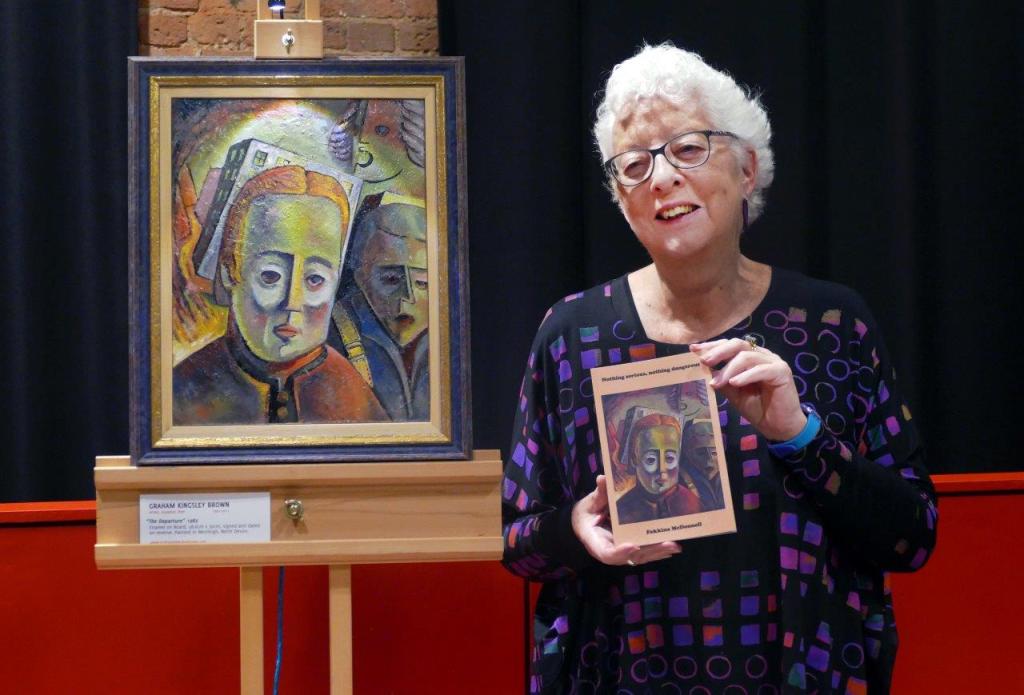
Sophie is herself a Fine Arts graduate and practising artist. That is how I got talking to her about a suitable design for the cover of my second collection Nothing serious, nothing dangerous. It was wonderful to have the actual painting at the launch. Strange to think that a fortnight later I had my own departure – fled just before the UK lockdown to my bolthole in Holland.
The Departure is Lot 203, the estimate £400 – £600, and the approx. sale time is 13:54 – 14:14 UK time. The auction is at the venue in in Scarborough and live online, so – if you are drawn to any of the works, register and make a bid!
Details of all the works can be found here in the catalogue:
On her blog Sophie has previously written about her interpretation of The Departure – it may be inspired, partly, by his childhood experience of being evacuated during WW2.







 Acacia Publications