Tag Archives: poems

wetting the ink…

It’s a great pleasure to introduce this month’s guest poet Julie Mellor.

Julie holds a PhD in creative writing from Sheffield Hallam University and has published two poetry chapbooks with Smith/Doorstop: Breathing Through Our Bones (2012) and Out of the Weather (2017). In 2019 she became interested in haiku, and since then her haiku and haibun have appeared in Blithe Spirit, Frogpond, Modern Haiku, Presence, The Heron’s Nest and Tinywords, as well as two Red Moon anthologies. She recently retired from a career in education, and enjoys walking her dog, attending art classes and playing the banjo.

Here are recent haiku and a haibun with their publication details. You can find more of Julie’s writing on her site here.

Modern Haiku 54.3 (Autumn 2023)

toe-hold weeds
things that were said
years ago

Blithe Spirit 35:2 (May 2025)

long night joining the dots between stars

The Heron’s Nest Summer 2025

wetting the ink
a ghost orchid blooms
from its painted stem

Presence issue 82 (Summer 2025)

morning moon
beside the fretless banjo
pistachio shells

BHS Hope anthology 2025 (ed Neil Sommerville)

butterfly summer
I write a letter
to my future self

Presence 73 – Summer 2022 – and included in Contemporary Haibun 18 (Red Moon Press, 2023)

The Coffin Path

Grass, waist high this morning, and wet with last night’s rain. Brushing past it, my jeans wick the droplets from seeding cock’s-foot and brome. No one else walks this way. Behind the hawthorn hedge is the cemetery. People tend to use the other path, the one that the council mows. Or else they drive – ‘to save their legs’ my mother says. Some days she says she wants to be buried. Other days, she thinks she’d prefer to be cremated and have her ashes scattered next to a memorial bench. No rush to decide, I tell her, trying to make light of things.

elderflowers
pressed in her prayer book
a recipe for wine

Day Breaks as a Petrol Station

photo credit: Andrew Taylor

It’s a great pleasure to introduce this month’s guest poet Cliff Yates. I met him on an excellent online workshop he ran for the Poetry Business. They published his New & Selected Poems, which brings together poems from five earlier publications – over thirty years of ‘inimitable’ work. Poignancy, economy, humour, a touch of the surreal…

You can find Cliff’s biography and the link to his website below the poems.

Day Breaks as a Petrol Station

Day breaks deliberate as a petrol station
newspapers and expensive flowers
but you’re tired of vacuum-packed sandwiches
and sordid headlines.

On the 15.07 out of Deansgate
she’s reading The Holy Sinner.
The dog opposite smiles
through its muzzle.
Coffee, or maybe something’s on fire
we do appear to be speeding
unless we’re stationary and the landscape’s
rattling past. ‘It’s been a good day,’
she says, ‘it makes up for yesterday.’
‘Why, what happened yesterday?’

Days without rain and suddenly it rains.
Another country, your body’s not your own.
You want to go for a walk. In this?

He threw a stick for the dog in Habberley Valley
the tattoo flew from his arms
landed in the bracken like leaves.

Dog

So many places closed: the off-licence,
the butcher, the corner shop, even
the telephone box screwed shut.
Dog had come a long way, and now what?

The cherry blossom, he noted,
looking up for once from the pavement,
was particularly stunning this year,
maybe it was the same every year

but noticing it, his heart was lifted
and he decided not to be disappointed.
The journey had been arduous, the future
was uncertain, but there is more to life,

he reflected, cocking his leg against the letter box,
than a bowl of fruit on a table.

The Lesson

The nun points out the ones to watch:
the boy in the corner, the girl at the back.
In this class it’s the boy in the middle
who thinks he’s a cat.

Outside, workmen are felling trees.
A bird’s nest tumbles in through the window,
lands on a desk. Inside the nest, a baby bird.
It’s okay it’s okay, the children say,
Brian will know what to do.

The boy who thinks he’s a cat
gathers the bird and, holding it
at arm’s length in the cup of his hands,
heads for the door, the nun behind him
between the silent rows of children
and the bird, as if on cue, lifts up its beak and sings.

Lighthouse

The lighthouse flickers at the end of the pier.
We watch it in our red pyjamas.
Actually, neither of us are wearing red pyjamas.
You’re wearing my blue shirt.

The lighthouse flickers at the end of the pier.
It’s the only thing we can be sure of.
Everything’s uncertain
since you set alight my record collection.

I’m trying to work out an appropriate reaction,
rearranging things in my head to eliminate
all memory of the record collection.
The lighthouse flickers on and off.

Actually it doesn’t, you point out, it just appears to.
You look amazing in my blue shirt.
I haven’t words to describe how good you look
in the light from the lighthouse. Now you’re here

now you’re not. Maybe I should burn
something of yours, you suggest.
Your voice leaves me in the dark.
It doesn’t sound like you when I can’t see you.

Cliff Yates was born in Birmingham and has been publishing poetry since the 1980s. His New & Selected Poems (Smith/Doorstop, 2023) brings together work from various collections including Henry’s Clock  (Fenton Aldeburgh First Collection Prize; Poetry Business Book & Pamphlet Competition), Frank Freeman’s Dancing School (Arts Council England Writers Award) and Jam (ACE Grant for the Arts). He taught English at Maharishi School in Skelmersdale and wrote Jumpstart Poetry in the Secondary School during his time as Poetry Society poet-in-residence, following the success of his students in poetry competitions. He has led courses for, among others, the Arvon Foundation and the British Council.

Cliff’s site: https://cliffyates.wordpress.com/

Books – Unread & Banned

Last year I wrote about the ‘Ongelezen Boeken Club’ (Unread Books Club), a new venture where libraries promoted books on the ‘null list’ – books that have never been taken out.

This year, the ‘Nationale Ongelezen Boekendag’ (National Day of Unread Books) coincides with another new initiative: De Week van het Verboden Boek (The Week of Forbidden Books). Bookshops and libraries throughout the country are showcasing books that have been or are still censored.

On Wikipedia, you can find an article on book censorship, a list of banned books and the main list of books banned by governments. This starts with the Bible and Albania and ends with Yugoslavia.

If I counted correctly: 66 countries. ‘Almost every country places some restrictions on what may be published, although the emphasis and the degree of control differ from country to country and at different periods.’

Wikipedia lists 66 books that have been or are currently banned in India. A small number, relatively speaking. The earliest is a Gujarati translation of Mahatma Gandhi’s book Hind Swaraj. This was banned by the British Authorities in 1909. In August 2025, the Indian Home Department banned 25 books for ‘propagating false narrative and secessionism in Jammu and Kashmir.’

Here in The Netherlands, there is only one book officially banned: Adolf Hitler’s Mein Kampf (1924). In 2014, a bookshop owner in Amsterdam was found to stock and sell the book. There was no prosecution.

However, training for new staff in bookshops routinely includes how to deal with aggressive customers. Library staff find returned books with pages torn out. A Dutch survey last year found that (1 in 7) authors had to deal with aggression, threats, intimidation – much of it online.

Here is the cover of Lale Gul’s debut published in 2021, when she was 23. It’s an autobiographical account of growing up in a strict Islamic family. It became a bestseller and was translated, but Lale has since been in hiding.

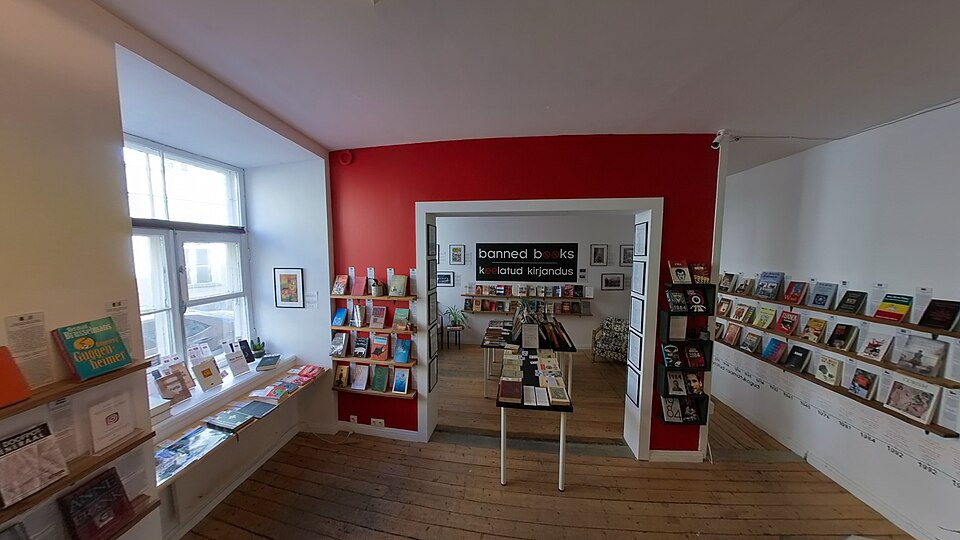
If Tallinn is on your bucket list, you can visit the Banned Books Museum while you’re there!

Photo credit: Fuzheado

The Last Corinthians

I’m delighted to share three poems by Matthew Paul from his new collection with Crooked Spire Press. The poems demonstrate Matthew’s ‘unflinching clarity’, and his ‘fierce attention to detail’. His biography follows the poems and there you can also find a link to his own website.

Spent Matches

Mum lets only Granddad light up in our house.
The second Thursday of every other month,
she fetches Grandma and him over from Sutton.
The chalkhill-blue elegance of the Wedgwood
ashtray rhymes with unfiltered smoke rings
pixilating like Ceefax in the living-room air.

Teatime doesn’t wait for Dad: Hovis, Primula,
Shippam’s fish paste, allotment tomatoes, cress;
mini rolls, Penguins, cremated fruitcake; pots
of Brooke Bond PG Tips; Beryl Ware replaced
by Royal Worcester, on Hay Wain place mats.
Chit-chat wilts like Dad’s California poppies.

Mum fills space with monologues. My brothers’
progress; mine. WRVS activities. Her botched
hysterectomy. We watch Grandma’s must-see,
Crossroads, then ours: ‘Top of the Flops, I call it,’
says Granddad. The outfits, songs, presenters
and Legs & Co. baffle him into silence; except

when Julio Iglesias butchers ‘Begin the Beguine’.
‘Artie Shaw!’ he cries; and his and Grandma’s
memories spool back to bulletins on the wireless,
to Chamberlain’s jubilant declaration of peace.
Barely through the door, Dad re-buttons his coat
to take them home. Granddad beams, ‘Abyssinia!’

Photo credit: Liam Wilkinson

A Common Hand

I don’t have to prove whether I did it or not; if they can’t see it, what kind of damned experts are they? [. . .] I’m not a crook; I’m just doing what people have always done in the history of the world: ever since art was invented, people have made imitations of it.
Eric Hebborn, ‘Portrait of a Master Forger’, Omnibus, BBC TV, 1991

Eric pestles oak gall, gum Arabic, pinches of iron
Sulphate and rain into ink with ‘a gorgeous patina’,
To pen his line on slyly foxed paper, in the styles
Of Pisanello, Poussin and sundry other old masters,
Reshaping preparatory sketches to make pentimenti,
Faking collectors’ monograms as cherries on top.

At junior school, Eric, aged eight, discovered that
Burnt Swan and Vesta matchsticks’ charcoal tips
Burnished imagination’s marks, incurring, firstly,
Welts from a leathering for possessing matches,
Then a three-year stretch in an Essex reformatory
For wilfully setting cloakrooms on fire. A flair for
Painting sees him into art schools, lastly the RA,
Where, though he wins every prize, contemporaries
Remember Eric only as ‘a silent creature’; ‘a joke’.

They would say that, since he’s brought their craft
Into disrepute. ‘Dealers are not interested in art, but
Money,’ he says. ‘The real criminal, if there is one,
Is he who makes the false description; guiltier by far
Than had he manipulated the nib himself. Ignore
The fusspots. Enjoy art, without worrying whether
Attributions are correct.’ Museums have everything
To lose from uncovering Eric’s handiwork; queasily,
They check their acquisitions back to the Sixties
And issue, de haut en bas, highly selective denials.

‘No one is studying art with honesty,’ claims Eric,
Upon the publication of The Art Forger’s Handbook
In Italian. Out in Trastevere three icy nights later,
He stumbles, soaked in Chianti Classico Riserva,
Down a cobbled passage, to his blunt force demise.

In Which I Spend a Fortnight of my West Berlin Summer in 1987 Doing a Few Hours’ Cleaning Per Day in Some Multinational’s HQ

My Iraqi supervisor Zaynab and I enjoy,
for our lingua franca, helpless
amusement. Every day, precisely
at knocking-off time,
we point at the clock, chorus ‘Sechs!’,
then cackle like siblings.

Dieter, fellow cleaner, never gets our jokes.
Just like me, he’s twenty and nearing
the end of a gap year; mandatory,
before enrolment at Humboldt.
Mine’s elective, for my mental health.
He and I view the city’s halves from the roof:
the Wall zigzags like the Western Front.

Afterwards, we take the U-Bahn
—he buys a ticket; I don’t—
to the agency’s office, at Nollendorfplatz.
He translates the clerk: I won’t get paid
until next week. ‘Scheisse,’ I say.
Dieter deadpans: ‘She said,
“Ah, so the English boy
can speak German after all”’

Biography

Matthew Paul hails from South London and lives in South Yorkshire. His second collection, The Last Corinthians, was published by Crooked Spire Press in June 2025. He is also the author of two haiku collections – The Regulars (2006) and The Lammas Lands (2015) – and co-writer/editor (with John Barlow) of Wing Beats: British Birds in Haiku (2008), all published by Snapshot Press. His reviews regularly appear in The Friday Poem and elsewhere. He blogs here.

Mine

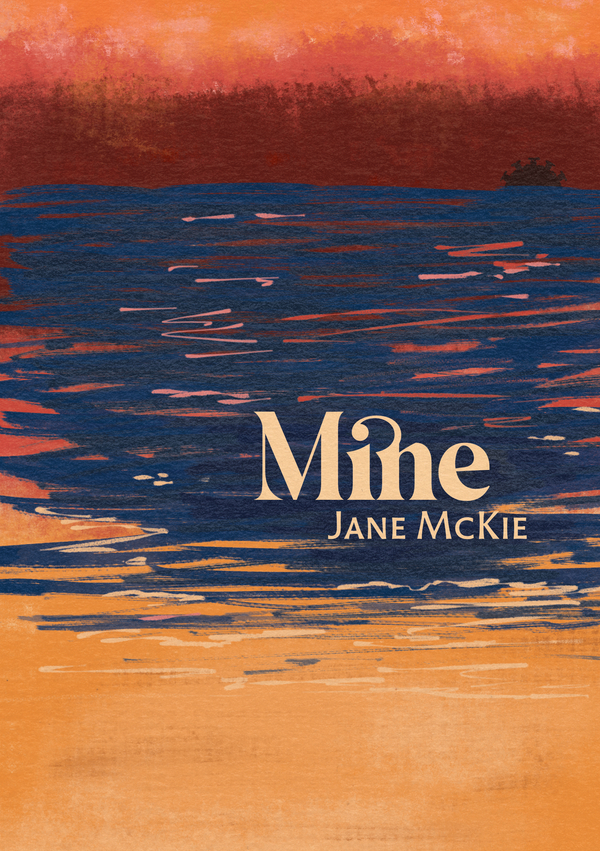
It’s my pleasure to introduce our May guest poet Jane McKie. We met many years ago on a writing workshop and are still part of an email group. You can find her biography at the end of this post. Cinnamon Press recently published her new poems and I’ve chosen some poems from Mine: vivid, clear embodied images with marvellous economy.

Mine

On nights when the wind drops, I hear it crooning softly,
not like a real bomb. A toothless, barnacled silhouette, wittering
to itself when the tide is low. My friends and I sometimes get close,
daring each other to nudge its rust. But what happens when
the music cuts out? Tonight, the mine’s a mute companion:
whiff of brine, cryptic fist. As my eyelids close, that’s when it—

Kevlar


I am the tattoo of a spider’s web
on a sixteen-year-old girl’s calf.
Traced from a drawing of a photo,
in time, I will thread up her thigh,
over her whole torso, in a riot of
silk that is stronger than Kevlar.

She will wear me like armour:
my vest of ink, her toughest skin.
Who wouldn’t fear a woman
fluent in the language of spiders?
Those twitches in cobwebs
that throb like old wounds.

Dreaming in an age of austerity


Not a single one finished: all mark time
until a rich developer completes the job.
Here, stone knuckles. There, exposed metal rods
stab at the sky like a mech-monster’s fingers.

Not vital or hungry, these resort Titans.
But not quite dead either. Gulls like to roost
in the pockets of them. Gulls dabble bills in
puddles that form from the absence of roofs.

Even small children play in the undead bodies
of imagined buildings, sneaking past tape
to be mummies and daddies in beautiful houses
that shelter insatiable, suckling doll-babies.

Polished malachite


on my desk, riven
with almost-blue, a pool
or algal cistern.

I touch it when I’m sad
and its green eye blinks, rippling
with souterrain light.

Biography


Jane McKie is a Senior Lecturer in Creative Writing at the University of Edinburgh. She has written several poetry collections, including Morocco Rococo (2007), Kitsune (2015), and Quiet Woman, Stay (2020) with Cinnamon. Her most recent full collection is Carnation Lily Lily Rose (Blue Diode, 2023). She lives in Scotland, but was originally from the Sussex coast, which inspired several poems in Mine.

Filling the well, stocking the pond…

It’s been a long time since I’ve been out to fill that well. I’ve had health issues and sat at home with the black dog. The exhibition of Joan Miró’s sculptures at Beelden aan Zee is almost closing. On a cold and sunny Tuesday, I got two trams to Scheveningen.

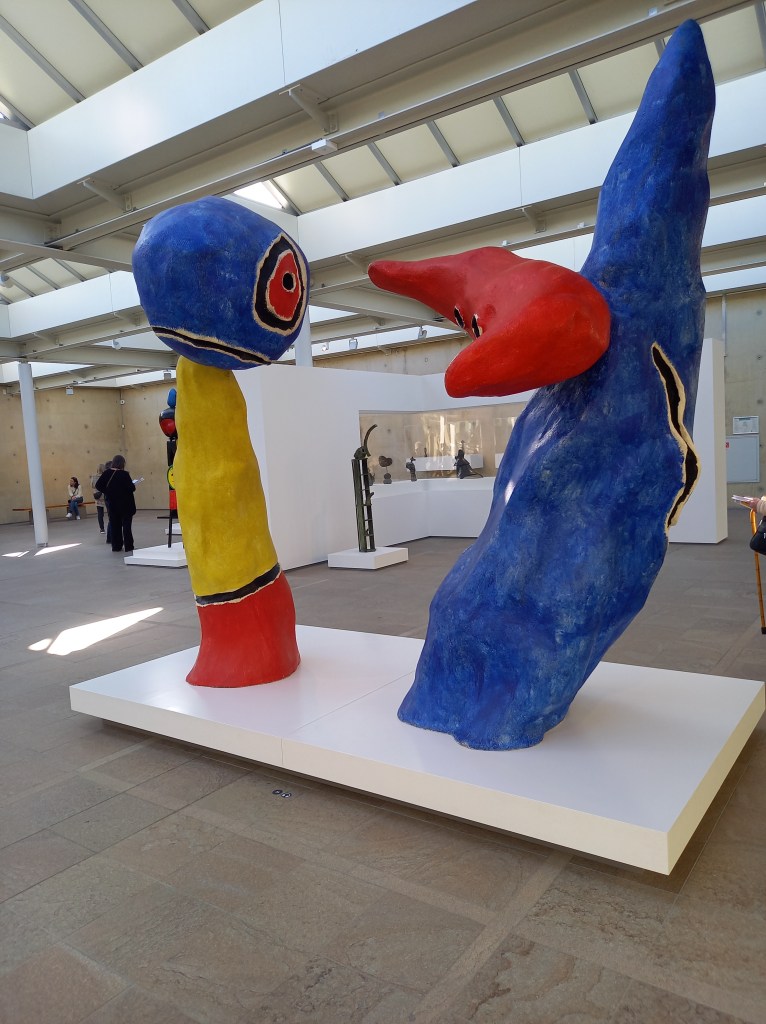
Pair of lovers playing with almond blossom

Beelden aan Zee is the only Dutch museum specialising in sculpture and it’s in a great setting. The authorities in The Hague insisted that the building should not be visible, so it’s hidden inside a dune, and it is mostly underground. From the terrace you can only see the sea, not the busy boulevard. All the materials have a sandy colour. Through plenty of glass in the roof there is a lot of light.

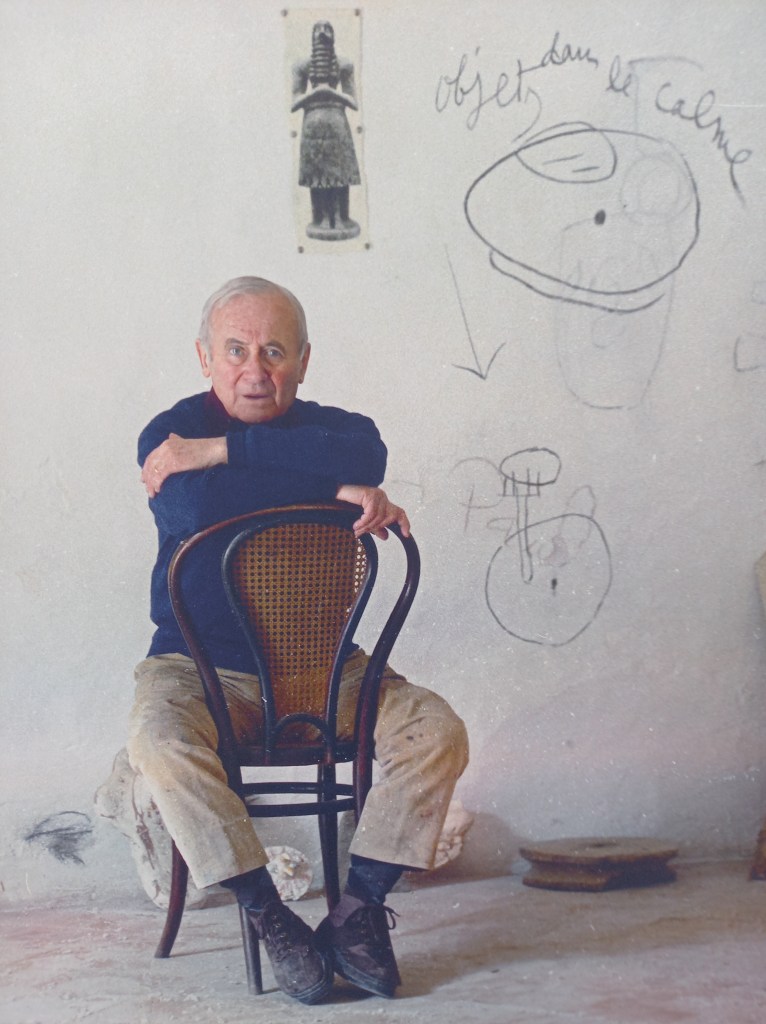
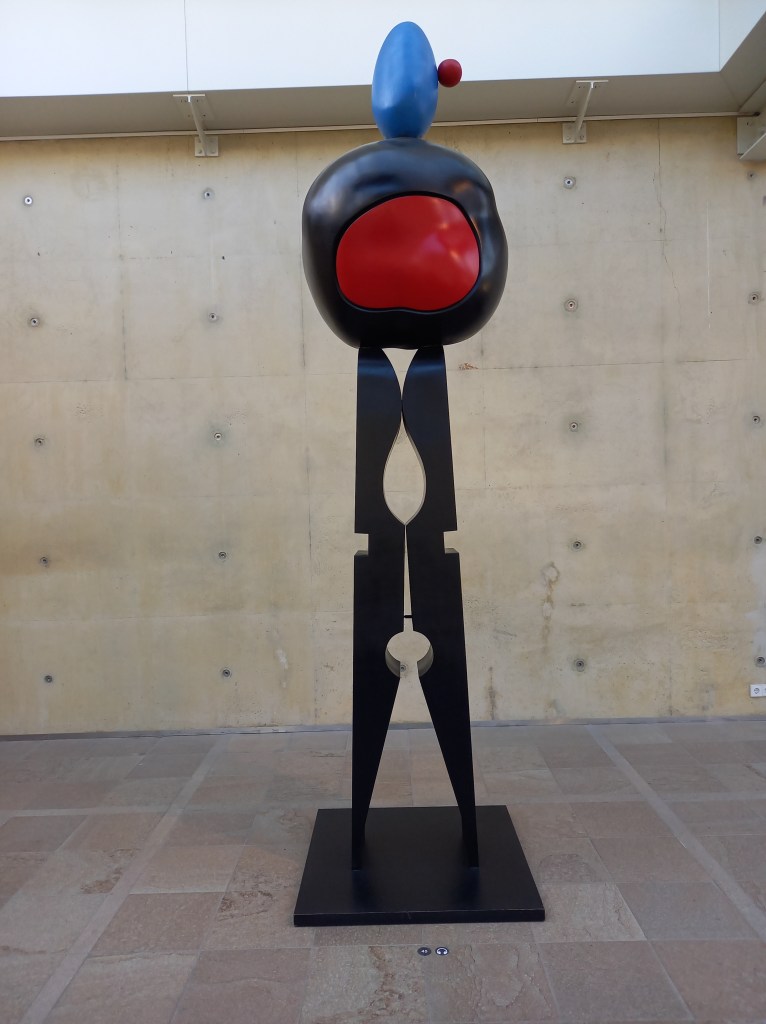
In his studios by the sea in Mont-roig del Camp and on Mallorca, Miró’s love for sculpture was given a huge boost. The (natural) objects he found on his walks were incorporated into sculptures and assemblages, along with everyday objects. The giant clothes peg (painted synthetic resin) was a design for a prestigious project in Central Park, New York. It would have been at least 14 metres high, though it was never realised.

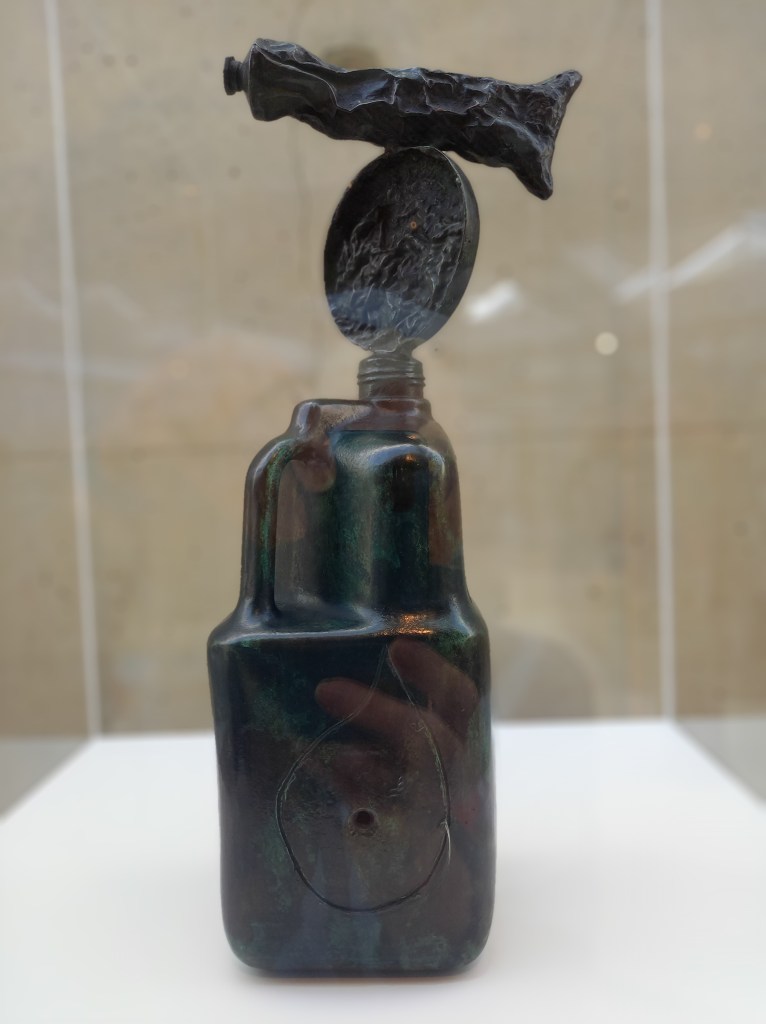
You can see the objects in this bronze sculpture: a paint tube, plastic bottle, spoon. Miró’s bronze sculptures were created using plastic models that he continued to shape until he found them good enough to cast.

The sculpture Monsieur et madame (Sir and Madam) is made of painted bronze. Two different objects form a couple. A square, red-painted stool stands for the man. On top of it is a rectangular white box with a face on it. The round, black stool represents the woman. It has a yellow egg on it. A playful, archetypical representation of masculinity and femininity.

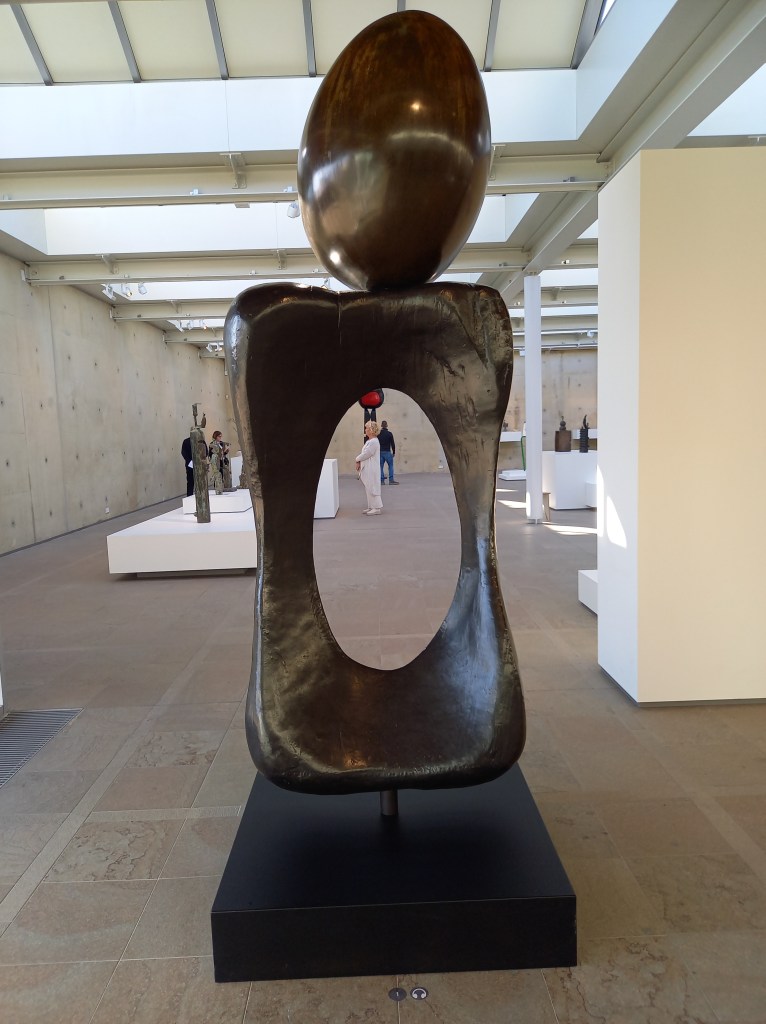
The Monument is the first sculpture as you enter the main hall. You can see some of the light coming through the roof.

It was hugely inspiring to see how Miró continued to innovate and be curious well into his 70s and 80s.

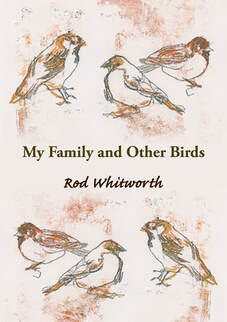
My family and other birds

It’s a great pleasure introducing this month’s guest poet: Rod Whitworth. We first met, probably, a good decade or so ago. His poems have been widely published and successful in competitions. One of these, the poignant Demobbed was featured here on 30 May, 2021. Rod recently launched his first full collection My family and other birds. I’ve chosen a selection of poems on the themes of family and birds and, of course, jazz.

Tandem in Holland

On that day, your smile
hung like a sunrise
over the polders.

And on that day, your voice
greeted me like blackbirds
singing to claim and to yield.

And on that day, your touch
thrilled like a breeze
from the pine trees.

And that day brought the knowledge
of itself and knew
that it was this day.

Portrait of my grandfather, accompanied

The daft smile, wide as a spiv, tells us
Sunday afternoon, after a slow left-arm morning
and Chester’s Best in the Cotton Tree.
You’re sitting in the sun on the donkey-stoned
front step of Number 51
in undone waistcoat, collarless shirt, felt slippers,
a Capstan Full Strength drooped from a trailing hand.
This is happiness: transported
from your brother Llewelyn who never left the Somme,
from crying all the way home after delivering jam and marmalade
to shops in Coventry the day after it was blitzed.

On your right knee: me, plump
as a queen’s cushion, wide-eyed,
in Auntie-Louie-knitted rompers,
not knowing any of this.

Names you know, names

It was Rod, the other one,
the one who listened to American radio
on his Communist dad’s short wave,
who, one bright April morning
between the 53 bus stop and school, said
You’ve got to listen to this bloke,
a pianist, Thelonious Monk.
He’s something else. Another world.
I told him no-one could be called
Thelonious Monk. It took me
two years to find out he was right,
on both counts. What he didn’t know though
was that Monk’s middle name was Sphere.
By the time I knew that,
the car Rod was travelling in
had crashed into the lamp post.

One for…

He was walking away
when I noticed the wings.

Furled they were, but still
visible against the dark blue

hoodie. I don’t believe in angels
but it does make you think.

I called him back, asked him to intercede.
You’re asking a lot from a magpie

he croaked, then flew off.
Made me feel sorrowful.

I wished he’d had a friend.

Biography

Rod Whitworth was born in Ashton-under-Lyne in 1943, and has done a number of jobs, including teaching maths (for 33 years) and working in traffic censuses (the job that kept him on the streets). He currently works as a medical rôle-player. Rod has been writing poetry for a few years and has had work published in a number of journals and anthologies. His first collection, My family and other birds, was published by Vole Books in 2024. He now lives in Oldham and is still tyrannised by commas.

Britain, once more …

Nuri Rosegg had seen publicity about my online reading for Writers in the Bath, Sheffield. This led them to my website. Nuri loves the UK and, pre-Brexit, used to visit often. Nuri’s website can be found below her poem. There are also three poems on the Visual Verse website.

Below is Nuri’s poem, inspired by my poem Britain, from the Anthology Welcome to Britain.

BRITAIN  
 
Britain is a fedora hat, opera- 
And theatre-tried. In this modern era 
Dramas turn into comedies. 
 
This country is a glass of ginger wine: 
Tangy wetness without a spine. 
Alas, the love for self-harm is mega-big. 
 
Britain is a decaying cherry tree 
Turning its back on the sea. 
The City, such a cold-hearted cherry pit. 

http://aroundthewritingworld.weebly.com/about-me.htm

https://visualverse.org/writers/nuri-rosegg/


Too Much Mirch

It’s an enormous pleasure to introduce our guest poet. Safia and I met on a Poetry Business workshop a few years ago.

Safia Khan is a newly qualified doctor and poet. Her debut pamphlet (Too Much Mirch, Smith | Doorstop) won the 2021 New Poet’s Prize. Safia’s full biography can be found below her stunning poems.

Dave

Let’s discharge him today.
We’re wasting a bed keeping him here,
I know a lost cause when I see one.

No need to biopsy, it’s clearly end-stage.
Sadly, not much we can do at this point,
best to discharge him today.

He’s asked, but don’t bother with a referral
to Addiction Services – he won’t engage.
Trust me, I know a lost cause when I see one.

Before you book his cab, tell him he needs
to break the cycle. Record it, otherwise
we can’t discharge him today.

His notes say no fixed abode. He mentioned
a daughter. I doubt she’ll take him in this state,
that’s a lost cause if I’ve ever seen one.

Social services have called twice now.
The daughter asked why she wasn’t contacted.
I said they told me to discharge him,
they knew a lost cause when they saw one.

On Placement

I donned mask, visor, and apron,
washed my hands the right way,

correctly identified an osteophyte
at the acromioclavicular joint,

imagined the right diagnosis,
asserted the wrong ones,

was humbled like pines after avalanche,
inspected behind the curtain,

tried not to register relief
when hers looked like mine,

translated incorrectly, blamed my parents
for speaking English in the house.

I donned mask, visor, and apron,
washed my hands the right way,


noted an antibiotic prescription
for a young wife’s sudden death,

and a son’s hanging decades later,
ate fish and chips during a discussion


on seven-year old M, presenting with
pain down there (by his cousin),

taken into care after being removed
for witnessing Mum’s self-immolation.

After, I wiped
the mushy peas from my mouth.

I donned mask, visor, and apron,
washed my hands the right way,

vaccinated death in a red dressing gown,
touched its eggshell, auscultated its yolk.

I have heard ghosts blooming like spring mist
through my stethoscope.

River
(After Selima Hill
)

Other people’s mothers
shout at them in public,
I cry in the car on the way
back from dinner.
Other people’s mothers
don’t cremate their
daughters with a look.
My mother opens
like the seed of a tree.

I am sorry, she says.
You are right. But
other people’s mothers
had the chance
to be daughters.
Other people’s mothers
were softened by rivers.
I had to be bedrock
all my life.

I am sorry
you can feel silt
in my love,
but know you are
water to me.
Wherever you run
I’ll run under you,
holding the current
like no one else can.

But where are you really from?

Clay. A shapeshifting clot of blood. A kernel inside the first shell-
breath of God. Primordial soup, reduced to its atoms after being
brought to boil. The same place as the stars and birds, where
everything that ever existed was wrapped in tin foil and microwaved
into being. An iron ballerina, pirouetting round the Sun and sweating
out the Oceans. Mountains formed in an ice tray mould. A patch of
grass that drifted from elsewhere. A patch of grass still drifting. Like a
refugee with amnesia, I cannot recall home, though once in a while, I
catch its fragrance on the wind.

Biography:

Safia Khan is a newly qualified doctor and poet. Her debut pamphlet (Too Much Mirch, Smith | Doorstop) won the 2021 New Poet’s Prize. Her work has been published in various journals and anthologies including The North, BATH MAGG, Poetry Wales, Introduction X: The Poetry Business Book of New Poets (New Poets List), We’re All in It Together: Poems for a disUnited Kingdom (Grist), Dear Life (Hive), Surfing the Twilight (Hive).

She has been commissioned to write poetry for the University of Huddersfield and The British Library. Safia has performed her work widely, including as a headliner for Off The Shelf Festival. She has delivered poetry workshops for The Poetry Business, and seminars for the University of Oxford on the role of poetry as patient advocacy. Safia has been invited to deliver a creative writing teaching series with Nottingham Trent University’s WRAP Program, as their featured writer for 2023. 


refugee with amnesia, I cannot recall home, though once in a while, I
catch its fragrance on the wind.

Review: Contrapasso by Alexandra Foessinger

Credit: Kev via Pixabay


Contrapasso is the title of the debut collection of Alexandra Fössinger. She is of Italian origin and currently lives in Northern Germany. She writes mostly in English. Many of the poems included have been previously published in the UK and elsewhere, in magazines such as Tears in the Fence, The High Window, The Journal. The cover design – a black bird against a stark white background – is by Daniel Lambert, Art Director of Cephalopress, established in 2018, providing ‘a voice for the marginalised and the voiceless’.


I do not know the author, though I attended her online reading with Q&A. There she explained the background to the poems: her attempt at survival ‘after the imprisonment in the UK of someone dear to me’. This sudden loss may, in part, have coincided with the pandemic and its lockdowns: creating an incarceration for the poet too.


In Dante’s Divine Comedy, contrapasso is the punishment of souls by a process either resembling or contrasting with the sin itself. The collection is in two parts, both preceded by a quotation from Dante’s Inferno. Part 1 covers the period of imprisonment, while poems in Part 2 were written after the person’s release.


Birds for someone who cannot hear is the title of the opening poem and birds appear throughout the collection, as messengers, omens, and symbols: the blackbird frozen in shock, the thrushes in hiding, along with magpies, sparrows, sky larks, great tit, kingfishers, herons, seabirds. The second poem is titled Cell, giving us just the bare numbers:
1,
5,
3,
4,
7,
1,
and ending:
bad luck has brought
and kept you here,
and whether
you’ll walk out

or
be carried in a coffin

is also entirely
a matter of chance
.

The poems are the author’s response to the sudden loss, despair, darkness, pain. We have no life apart from life apart (Sentence); How can I find dreams of oarweed and eelgrass, / bring currents to glide on, as I must, when half / of my body is entangled / on the wrong side of the sea, / how will I know when time says to dive? (Velut luna).

Fössinger has said that she ‘is mostly interested in the spaces between things, the tiny shifts in time, the overlooked, the unsaid.’ Throughout the collection, we find astute observations and statements: la vita assurda: the middle-aged couple / pushing their dog in a pram. (July); that emptiness is best hidden / by a display of tame beauty. (Ambulant).

The strongest poems are those which describe a specific situation, or which have objects as ‘animate scaffold’. The poem Ambulant is in two parts:
I
The house with the Christmas decoration,
and the magnolia tree in bloom,
and the blackbird frozen in shock,
and an ambulance parked in the front garden,

all stand completely still.
People walk by, averting their gaze,
a stoop hammered into their skin –
How many lives will they have lost before,
without ever noticing.

The orange light is beating on the windows
like rain.

Here is Fössinger’s close attention to the overlooked, effective personification, interesting use of language. Not all the poems are so securely grounded, sometimes abstraction obscures their meaning. Other poems would have benefited from being tighter, shorter. The book is a short collection of 31 poems with quite a few blank pages. Some readers might want ‘more poems’ for their ‘pounds’.

While the poems reflect the poet’s emotional and psychological response to loss and separation, she manages to maintain a careful balance: hope is not abandoned. The recurrent bird theme also provides a framework, an underlying structure. This theme returns in the short closing poem, The robin redbreast. The loved one appears in a dream, as tiny as a bird, and:

Then you grew a beak
with which to pick and sing
and transport worms and roses.

Contrapasso is a confident and authentic debut by a perceptive, astute poet. Her personal tale finds echoes in the reader’s universal story. However long and painful the journey, there can be closure and transformation.