With my birthday coming up, I am posting a poem that celebrates key experiences in my life. These include visiting Lalibela in Ethiopia in 2007, travelling with the friend who set up the Lalibela Educational Trust, to meet the boy I sponsored and his widowed mother. My parents – a church organist father and semi-professional singing mother – did pass on the creative gene, for sure.
Thank you for liking these posts and for following my blog!
St Mark’s Venice – Hermann via Pixabay
Taking other routes
My parents never taught me to swim; didn’t take me skating on those Christmas-card frozen canals. I have never been famous, but I have sung in Burgos and Florence, Vespers in St Mark’s. My singing has made grown men cry.
I have not travelled on ferries, floating from one Greek island to another, forgetting the name of the day. I have never stroked a giraffe, nor given birth to a baby boy. But I have picked redcurrants from the back garden, sharing rich crops for over twenty years with small black birds.
In Ethiopia I have a son and I sat with him in his Physics class. And for a few years I was a sailor, snatching a few hours in Sydney, shopping in Hong Kong. I danced in a grass skirt and flew across Alaskan glaciers with the man I loved.
As today is Father’s Day, I’m posting this poem by Kathleen Kummer. Here she combines the personal and the public, with her reference to the miners’ strikes and the General Strike of 1929.
My father’s hands
For a short time they handled a pencil, maybe a squeaky one on a slate. Abruptly, they, they found themselves grasping a pick in the dark. When the strikes came, obedient, they downed their tools and, at street corners, were clasped and breathed into for warmth, patted the greyhound of a mate waiting for the pubs to open. They withdrew their labour from the mine owner once and for all in the General Strike of 1929. In the next phase, though, still handling the black stuff, they weighed it, bagged it, loaded it onto the back of a lorry. Then it was clay pipes instead of coal, contorted monsters, drab, glazed brown, easily chipped.
This is the time from which I remember those hands, their dull sheen, as if sanded down, the skin agonisingly tight, with cracks, near the nails, manicured with a penknife, not made for tenderness and caresses, but good safe hands to be held in.
Last night, as I warmed my hands at the fire, I winced at the memory of his, held so close to the flames and hot coals, they almost touched so cold, they could never again be warm.
I am pleased to introduce this month’s guest poet: Judi Sutherland. We met as poets on Facebook a few years ago and I attended a recent online event where she read her poems.
Judi Sutherland has lived and worked all over England and is now based in North County Dublin, Ireland. She writes about the natural world, about home, place and belonging, and things she reads on the internet. She obtained an MA in Creative Writing from Royal Holloway, University of London, in 2012 and was awarded the Margaret Hewson Prize.
Her first pamphlet The Ship Owner’s House was published in 2018 by Vane Women Press (available here: The Ship Owner’s House by Judi Sutherland – The Poetry Book Society) and focuses on north south contrasts, specifically Oxfordshire and County Durham. Vane Women Press is a writing, performing and publishing collective based in the North East of England. It was formed in 1991.
A recent booklet Animals in Lockdown was published as a hand-made edition by Kazvina (Karen Little). Copies can be obtained from kazvina@yahoo.es, and proceeds go to Happy Tails Halfway Home animal rescue.
Here is my selection: the booklet’s title poem and three poems from The Ship Owner’s House.
The Animals in Lockdown
The mountain goats have noticed something’s wrong. Their anxious hooves trot into town tap-tapping on our tarmac. They’ve come to browse verges and hedges, keeping down
the wildness, which they know distresses us. In clearwater harbours, dolphins nose the prows of empty boats drifting at anchor. Songbirds note the silence in the air.
A fox sniffs for contagion, scenting only spring, he knows we’ve gone to earth. He has mixed feelings about this. The dogs who shepherd us on our permitted walks
leave smell-messages for each other, asking ‘Lads, what’s going on?’ And here at home, my cat tucks me into bed each night, checking that I’m safe. All through the night, she listens for my breathing.
Looking for Kites
I went over to Kinninvie because I had heard you were there. I took the straight, whitelined road that wagtails across the fells. There were sheep, carpet-backed, in a row ripping grass, and mottled cattle, cream and brown like chocolate truffles tilting their long horns at the sky. A hawk held steady over a whin bush and I thought I saw you eddy into the wind over a broad, shouldering field. When I turned homewards, the valley was bright with gorse and rapeseed flowers and sunshine flooded the far slopes with summer.
And what scented his fear was this: the fleet chill of clear air rushing, the flap of canvas, the propeller’s halting stutter. Hanging suspended between sky and Crete, and the silver-drab of olive trees reaching up to meet him. I still dream that flight and plunge, the terror and the black; feel the dull indentation of the skull, the buzz of metal plates beneath my scalp. I’m always writing Icarus; afraid to fall, finding life vertiginous. He very nearly died. I very nearly remember.
Relocation
So, the place I thought was home turned out to be somewhere we were passing through, and we have traded all the grey, red, cream of flint, brick, render, for this buttered stone; beechwoods for bare hills, accents clipped like lawns for vowels as broad as fells. The green-spined lane became a hard grey road, the kites are hawks, and the placid boating river is a rocky fall past a castle keep. Life pitches our tent in a different portion of the desert. We make it ours. I can no longer tell you where my heart is.
My friend and poet Kathleen Kummer will have her birthday soon. We have visited the Dartington Estate in Devon several times: to hear the then Poet Laureate Sir Andrew Motion read, to listen to music during the Music Summer School & Festival which was established in 1947. Alwyn Marriage of Oversteps Books invited me to read during the Ways with Words Literary Festival. It was wonderful seeing people out on the lawn, resting in deckchairs, or queuing up to get their book signed by famous authors.
Dartington Hall is a spectacular Grade I listed building. The gardens are grade II listed: a sculpture by Henry Moore, a yew tree that is 1500 years old and a row of sweet chestnut trees believed to be about 400 years old. The gardens are a delight in every season. Here is Kathleen’s poem about the gardens.
The Tiltyard, Dartington Hall Gardens
That summer day
That summer day at Dartington, everything familiar, beautiful: the corrugation of the bark of ancient trees, the sun behind the scarlet maple leaves, the swathes of wildflowers in the glades, warm to the touch the might buttocks of Henry Moore’s reclining figure, the bench, its oak smooth, silver, following the stone wall’s curve, on which we sat. Unexpected, the robin landing next to us, a fledgling, plump, who stayed ten, fifteen minutes until his mother called him. And, in the little wave of sadness which washed over us, because he looked so young, indivisible as water is, this swell of happiness.
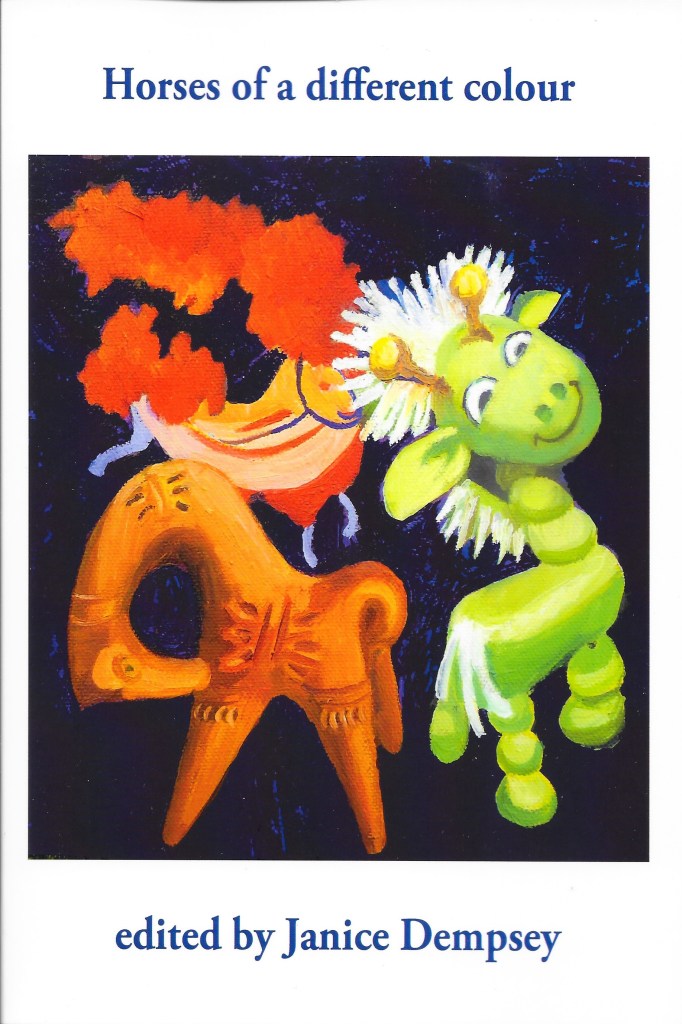
It was a lovely surprise to get this anthology ahead of schedule, so I could read it before leaving for the Netherlands. Dempsey & Windle organise an annual competition, with options to enter single poems as well as a batch of 10 to win publication of a pamphlet. The anthology has poems by the winners of both categories, as well as the highly commended and longlisted poems. I was glad to have my tribute to a poet friend included. On Thursday 10 June in the evening there will be a reading on Zoom with a number of poets reading. Contact Dempsey & Windle for the link.
This poem by fellow poet Rod Whitworth has it first publication in the same anthology. Rod and I met several years ago on writing workshops. I admire its economy and delicacy. It’s not surprising it gained a 2nd prize.
Demobbed
Go on. Hold his hand. You’ll be all right. I looked at the man in the new suit they’d told me was my dad and I walked at his side, hands in my pockets.
We stepped into the street, his right hand steering Megan’s pram with ease and command past Cropper’s with the pigeons, and I walked at his side, hands in my pockets.
Down Platting Brew, round the curve over the culverted brook and a hard shove to the road to Daisy Nook, me walking at his side, hands in my pockets.
Past the milk farm – Whitehead’s – and the field with the pond and reeds, the greying April snow. I walked, my right hand warm in his left hand.
The day we switched off the machine, I told him they’d arrested Pinochet, though he was past cheering, and he lay, his right hand cold in my left hand.
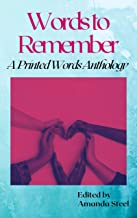
Last year Amanda Steel of Printed Words produced her first charity anthology Words to Remember. It includes fiction, non-fiction and poetry, some of it related to cancer. I was glad to have these two poems accepted for the anthology.
Printed Words has its own Facebook page. Even with the lockdown last year, the anthology has done well, and Amanda was able to make donations to two cancer charities: Marie Curie and Cancer Research UK. Amanda Steel is on https://amandasteelwriter.wordpress.com
Bitterne Park, Southampton
The blackout curtains don’t let the sun through. I wake to the small sounds that come with morning: squirrels jump around the oak tree at the heart of our cul-de-sac. A bus strains up the hill.
At the Triangle, the bank opens and the smiley greengrocer limps his vegetable crates outside. On the river Itchen John strokes his beard, thinks about brewing tea.
It is meant to be an ordinary day. But this month is a long-distance runner, this month is a marathon.
On the other side of the narrow bridge, a woman is taking two large black bags into a charity shop. Suits and shirts, all washed, dry-cleaned, ironed. She had forgotten the silk ties. Now they’re rolled up, placed in a see-through Biza bag that once held duty-free cologne.
May
Living one day at a time will be like walking through a tunnel, away from being held by memories. The smell of petrol, choking. Cars driving close and fast. The red rear lights in pairs, an illusion of safety and warmth.
Do not turn round now, back towards that day when you viewed daffodils through a thin black veil from a car at walking speed. Decide to live this day. Summer will slowly creep in, its light, colour, the company of bold blue, orange, pink, the grass that will keep growing.
This week I am featuring another one of Kathleen Kummer’s poem. It’s short and the neutral title belies the heart-breaking content. The poem is addressed to her adult son.
Item
You left behind: your silver spoon – there are days when I stir my coffee with it; the drawing of yourself with the Mona Lisa eyes; I sometimes wonder how you got the chestnut avenue from that angle, and I’m suddenly happy, as though you’d just sauntered in from school and were upstairs moving your table, shouting down you were hungry; all the photographs of you – if I flicked the pages fast enough, would those in the top right-hand corner, at least, spring jerkily into life?
Item: a bank account – didn’t you need the money? Your sisters; me. People hope I don’t mind them asking about you. As if in a language I’m learning, I say, no, I don’t mind.
Prompt: What item do you still need to write about, even if a part of you doesn’t want to? To whom are you writing?
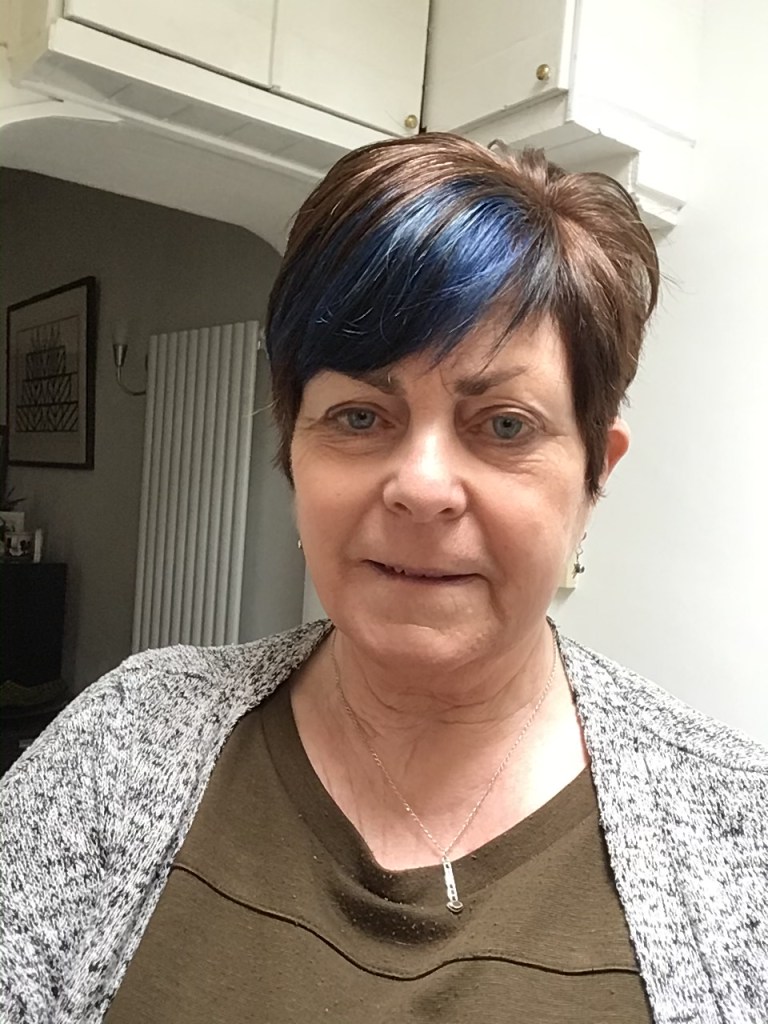
It’s a great pleasure introducing this month’s poet Pat Edwards. We met on Facebook and then discovered we both have a book with Indigo Dreams Publishing.
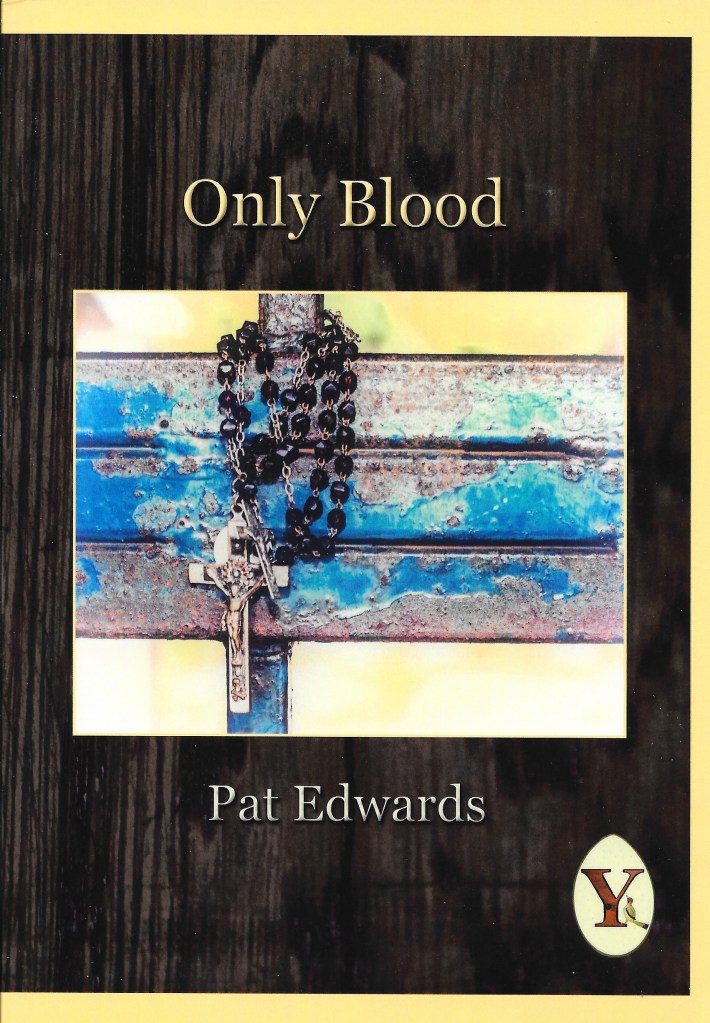
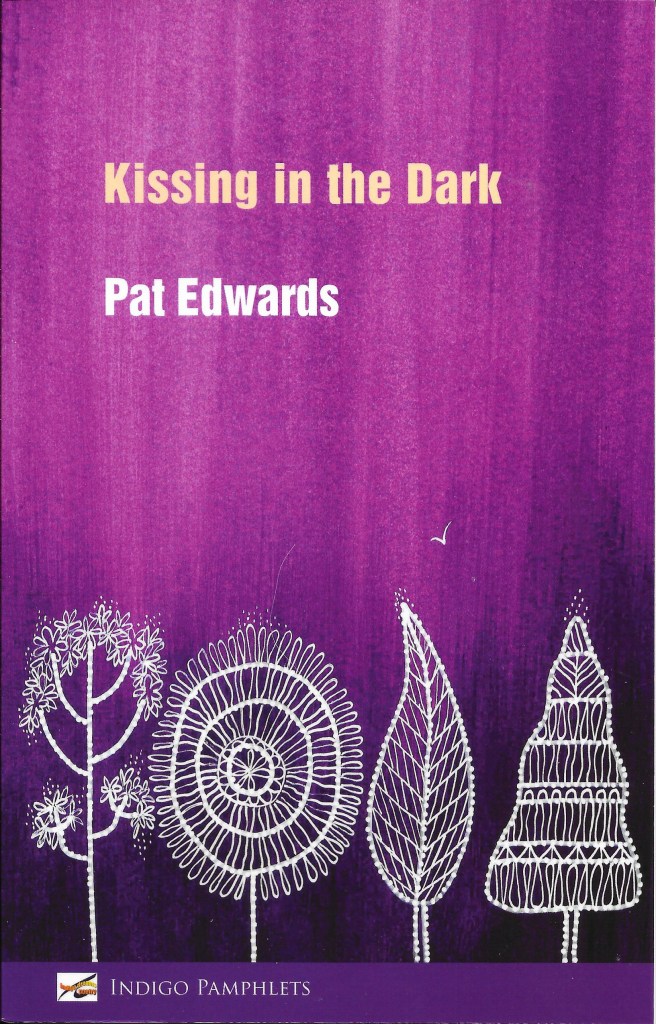
Pat is a writer, reviewer and workshop leader from mid Wales. She also offers a poetry feedback service on her site Gold Dust. Her work has appeared in Magma, Prole, Atrium,IS&T and many others. Pat hosts Verbatim open mic nights during more ‘normal’ times and curates Welshpool Poetry Festival. She has two pamphlets: Only Blood (Yaffle, 2019); Kissing in the Dark (Indigo Dreams Publishing, 2020).
Today is Mother’s Day in many countries. Pat’s dedication for Only Blood reads ‘For Mum and Dad if only we could all try again.’ Here are three poems from Only Blood, followed by Journey, from Kissing in the Dark, in Pat’s honest and compassionate voice.
The year Mum died
She is cutting tiny pieces of foam rubber to comfort-cushion her feet in pinch-painful shoes.
There’s that look in her eyes, the one I don’t yet understand, that gives away the cell-division in her breast.
She has a box of keepsakes I’m allowed to sift through: the silver clasp for keeping sixpences together; the golden compact that clicks open to reveal a mirror; the trace of bronze powder that smells like ladies.
Here in 1963 amongst the fullness of her skirt, I am barely five and only know I love her.
Gems
I want to find my mother’s jewellery, to lift the lid on a tin box of paste and pearls;
to find drop earrings that glint, necklaces that lie on collar bones, a charm or two for luck.
I want her wedding band, brooches that once fastened scarves, all the souvenirs and sentiment.
But I bet the first went to pay the gas, the second to buy the weekly shop, the third towards a gambling debt.
Gee-gees
Teenage me always knew when he’d put on a bet. The channel would get changed, there would be an urgent tension, tight as a fist.
We’d sit saying not a word, for fear speaking would fracture us. Then, in the closing furlongs, I’d know for sure.
Dad would bounce on the edge of his seat, building from a hushed Come on my beauty! to blatant demand of it.
We would both urge the horse across the finishing line, jockey standing in his stirrups, cracking the whip.
Then the relief. Let’s get your hair done. I can buy you a new coat. As if I was my mother.
Journey
I draw a blue-black line under my eyes, trace it across the tattoo on my left arm. I watch it slide down the veins of my leg, to settle in a grey graffiti pool by my feet. That’s quite some journey I say out loud, so the man on the train looks up from his screen and glares at me like a priest. My thin mouth flashes a penance smile back at him and he absolves me I think. That’s quite some journey I say silently so the man in my dream looks up from his book and smiles at me like a friend. My full mouth offers him a lover’s kiss which surely changes something I think. I draw a blue-black line under everything.
In the Netherlands, on the evening of 4 May, the war dead will be remembered. Here is my friend Kathleen Kummer’s poem about an event that happened in Holland during the Second World War. Kathleen’s mother-in-law was a published poet.
They came at night
Then there was the night they came for the horses. There would have been no warning before the clang of jackboots on the cobbles in the yard of the outlying farm and the hammering on the door.
By the time they reached the edge of the village, the farmers were up and had slipped their bare feet into clogs. Behind the door, they were waiting for the clattering of the hooves on the road to cease.
Not that there would have been silence as this farmer moved, if need be at gunpoint, to the stable: the shifting of hooves, the neighing, the whinnying, he would know, without finding the words, meant betrayal,
his, as far as the horses knew, which may be why he came to my mother-in-law’s. I want that poem you wrote, he said, that’s being passed round, about the horses.
And now I write mine, seventy years since then, for when I can’t sleep, I often listen as the clatter of hooves on those roads in Holland swells in the peace of a night in Devon.
This month I am featuring poems by Martin Zarrop. We met some years ago through the Poetry School workshops and are also members of one of the Poetry Society’s Stanzas. I start by congratulating Martin: the 2021 Cinnamon Press Pamphlet competition got 450 submissions. The results came out a few days ago – Martin’s manuscript was in the top five!
Martin is a retired mathematician who wanted certainty but found life more interesting and fulfilling by not getting it. He started writing poetry in 2006 and has been published in various magazines and anthologies. He completed a MA in Creative Writing at Manchester University in 2011.
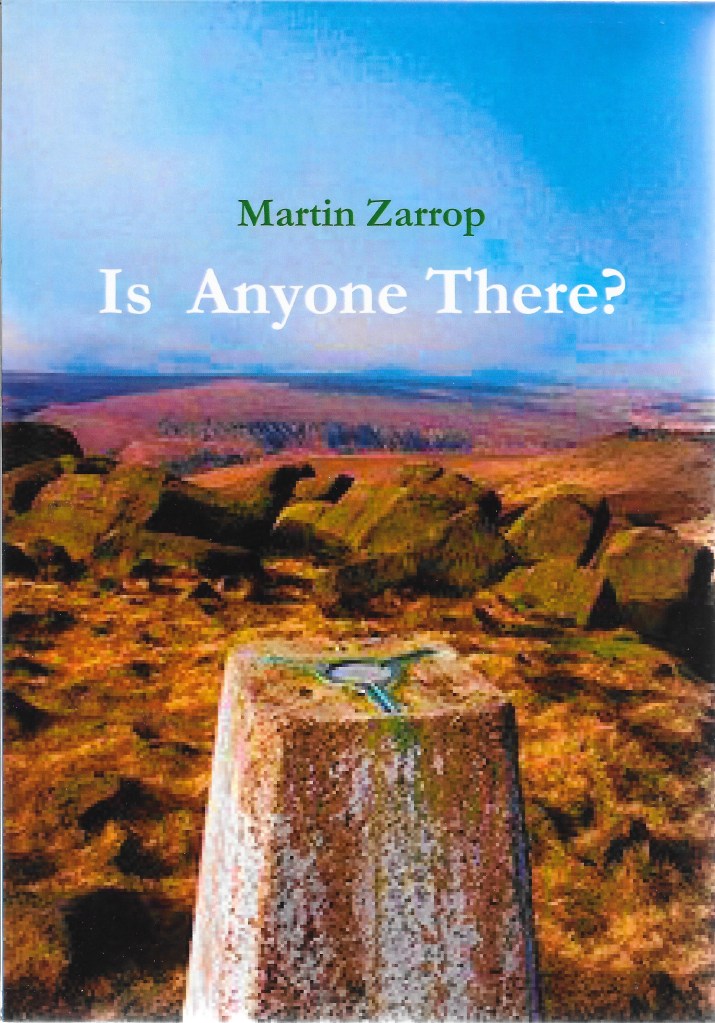
His pamphlet No Theory of Everything (2015) was one of the winners of the 2014 Cinnamon Press pamphlet competition and his first full collection Moving Pictures was published by Cinnamon in 2016. His pamphlet Making Waves on the life and science of Albert Einstein was published by V. Press in 2019. His second collection Is AnyoneThere? was published by High Window Press in March 2020.
The five poems are all from Is Anyone there? Where Martin’s poems refer to science, they do so in an accessible way, often poignant, often with humour. Like Martin, I first came to Manchester in the early 1980s – a place where now around 200 world languages are spoken. I hope you enjoy this selection.
Sci Fi
The aliens are coming. I can see them flicker in the flames as I stare into the coal fire and my mother asks me if I’m happy. Has she been taken over by Martians? I must take care not to fall asleep.
And here I am covered in mud. The invisible predator can’t see me as I try to leave the exam room. Failure isn’t an option but the exit signs are hidden under ectoplasmic goo. The ice cream man ignores my screams.
It is bursting out of my chest cavity, this other me I don’t want to know. Why is my name missing from the credits? Perhaps I didn’t wait long enough for the Z’s. Out in the foyer, zombies are waiting for the next show.
First Impressions Manchester 1980
People talk to you here but not in English and the rain is cold on the grim streets that run for their lives past empty Victoriana, lost empires.
At night, the city strips to its bones, lies unwashed in the glow of fag ends, crushed and dying among claggy debris, northern mouths.
published by The High Window
Missing
She must be in here somewhere. He turns another page and stares at shapes, the outline of a face and almost smiles. The hair’s not right, he says.
Under his thumb, images move, some not even close to human. This one looks like a centaur, this a lion. He knows how much he wants her but he struggles to join the dots.
Across the table, the astronomer, sympathetic despite the late hour, is accustomed to darker matters. Try this one, he grunts, and opens another star catalogue.
Hands
UK’s first double hand transplant awoke from a 12-hour operation with two new sets of fingers (Guardian 23.07.16)
It’s not like wearing leather gloves. This is for real, the weld of tissue, bone to severed stumps; white flesh imbibes the ruddiness of life, then shudders at an alien command –
a finger twitches. It displays no loyalty to donor meat, no tear or thought, no dumb relief not to be ash, no memory of goodbye waves, past loves held close.
The patient chews his nails, flexes each knuckle as if born to it, admires blotches, childhood scars from scraps he never fought, holds out his hands.
To My Nineties
You’d better get your skates on or at least your boots and get out there, old dribbler, before it’s too late.
I may not meet you in the hills struggling through Kinder peat. Thirteen miles, fifteen? No problem!
Or so I thought as hair thinned and Christmas followed Easter as if in a time machine that ate old friends for breakfast.
You stand patient near the finish line as I pull myself up for the final sprint. Nothing lasts forever, not hips, not brain cells. I need a project.





 Acacia Publications