Tag Archives: music

Spoilt for choice…

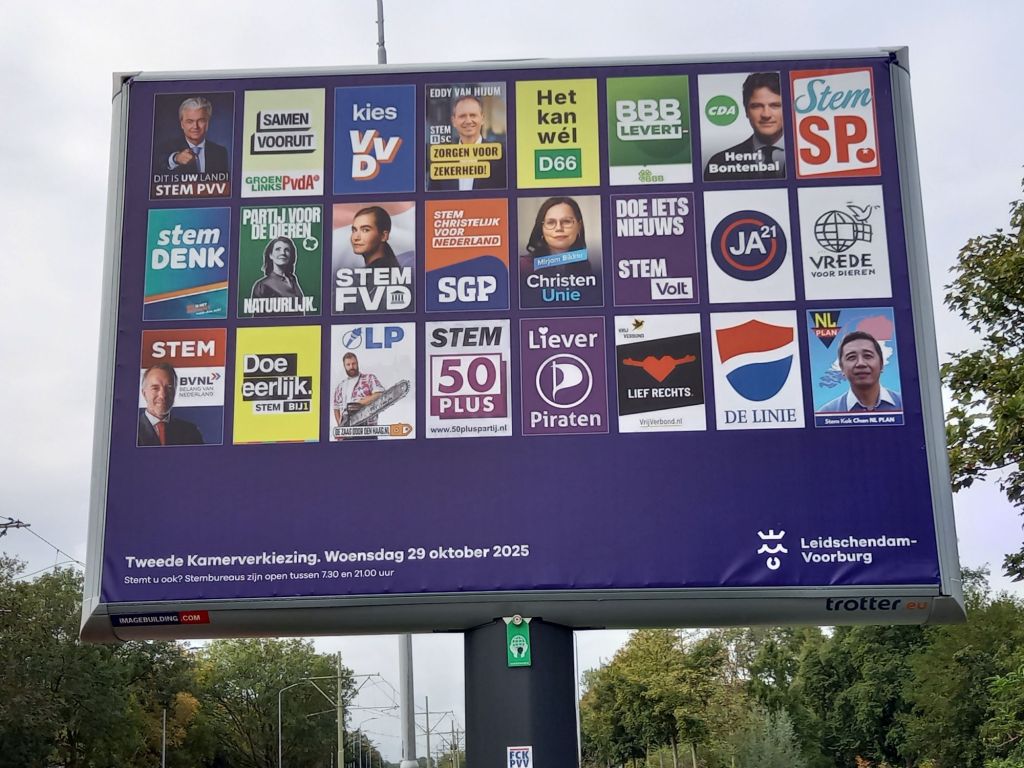
This coming Wednesday are the elections for the ‘Tweede Kamer van de Staten Generaal’ – the lower house of parliament.

All over the country, boards have appeared with the 24 political parties. In large cities and towns each party has its own board. In small towns, like mine, the one shown.

On Friday, a pale grey sheet of A1-sized paper arrived by post: names of candidates for the 25 parties. So much detail: it’s essential to orient yourself beforehand. Otherwise, you’d spend too much time in your cubicle on the day, and there will be queues. When I voted in the last elections (November 2023), I couldn’t fold the paper back into its original roadmap shape…

The Dutch are famed for their tolerance. I find that puzzling, but then I spent most of my life outside The Netherlands.

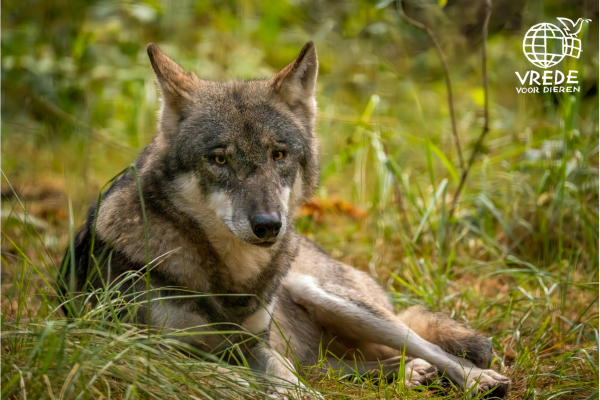
A few months ago, a new political party ‘Vrede voor Dieren’ (Peace for Animals) was established. They split from the original ‘Partij van de Dieren’ (Party of the Animals) because the leader of the PvdD (initially pacifist) changed their views and now supports re-armament. The new VvD rejects re-armament in principle.

You don’t need to have read Animal Farm to think that an animal’s view of pacifism is probably Will I be eaten or not? (paraphrasing a Dutch novelist).

Confidence in politics and politicans

Confidence in politics is at an all-time low. In the August 2025 polls it ranged from 4% – 9%. Some 25% of those polled were floating voters. There are several reasons for that.

Photo credit: MabelAmber via Pixabay

Time lost in the polder…

  1. The ‘polder’ model is the pragmatic recognition of pluriformity. Time is needed to achieve consensus: people will need to polder. However, this verb has a negative connotation in relation to politics. An election will be followed by months of sitting and talking, walking and talking. A ‘formateur’ will facilitate the process. Meanwhile, the previous coalition is just ‘care taking’ and keeps things ticking over.

It also takes several months to organise an election, typically four to five.

The coalition Rutte II was the first cabinet that completed its full four-year term since 1998. Its starting date was 5 November 2021. Since then, just over two years were spent on forming the next three coalitions.

Not lasting the course

Rutte III – the full cabinet resigned over the child benefit scandal. A parliamentary enquiry had found that officials had knowingly and systematically deprived people who were legitimate claimants. Thousands of people have still not been compensated.

Rutte IV – resigned over fundamental disagreements regarding immigration measures.

Schoof – An unstable coalition from the start: two parties (the Boer Burger Beweging or BBB) and the NSC (Nieuw Sociaal Contract) both new to government and both struggling to get enough credible candidates for their seats. With Wilders of the PVV (Partij voor de Vrijheid) who’d walked out of an earlier coalition government. Seen as a ‘bunch of amateurs bickering amongst themselves.’

Not tackling the crucial issues

The Hague is a long way from the northern province of Groningen where thousands of people have been waiting for over a decade for compensation. (The subsidence caused to properties caused by fracking. Another parliamentary enquiry.) Just an example.

This time I’m a floating voter. So, I’ll go and have another coffee, inspect that grey form a little closer!

Slow Movement

It is an immense pleasure to present this month’s guest poet Sarah Mnatzaganian. Poems from her award-winning pamphlet Lemonade in the Armenian Quarter were featured here before. Today’s poems were chosen from the dozen that were included in Slow Movement, an exquisite small journal designed, created and stitched by poet Maria Isakova Bennett. The photo of the cover doesn’t quite do it justice.

The sequence was one of four winners in the 2022/2023 Coast to Coast to Coast poetry prize. Maria wrote ‘Slow Movement is a sensuous sequence of love poems expressed through the colours, sounds, materials, and obsessions of cello making and sailing.’ The sequence is dedicated to Robin, the cello maker; poems were previously published (Poetry Wales, Magma, Poetry Salzburg).

Bogle

Two wedges of maple are ready for the vice.
The cello maker scans the silken surfaces for flaws
but the wood looks clean as buttermilk.

He leans and pushes translucent ribbons,
tissue paper thin, through the plane’s grey mouth.
Stops. A failed twig-hole, a dark finger of incipient rot

points from the joint accusingly. He groans,
grabs a back-arch template, offers it to the knot.
Smiles. He’ll outwit the bogle this time.

He heats hide-glue in the pot and rubs the joint
until it gels and bites, the halves aligned and left to dry.
Next week, he’ll flip the plate like a stranded tortoise

and hunt the blemish with his keenest gouge
until he holds a hollow brindled shell,
bogle-ridden wood chips snapping at his feet.

Laying up

Salt-bitten snap shackles slump down the forestay
and surrender to the pull of his thumbs.
He drags an impossibility of canvas over the guard rail
while I hug the rest free of the wire.

The sail crumples like a giant wedding dress,
crocodile-toothed with zigzag thread. It’s time
to climb down to the queasy buoyancy of the old
polystyrene pontoon, to stand fifteen feet from him

and guess where in this pale tangle of cloth to grip
with my left hand; how far to reach with my right.
We’ll tighten the white distances between us
and fold each crease over into a taut edge

until we make a concertina of the sail. He’ll nod
and fold his end towards me, two foot at a time.
I’ll do the same for him until our halves meet
and lie without stretch or slack,

my luff to his leech, head to his foot,
clew to his tack, throat to his peak.

Bridge

He’s in the kitchen, leaning over the hob,
dropping a bridge blank into the frying pan.

I start to speak but know he can’t reply.
He’s counting down the seconds till it’s time to flip

the steaming bridge, to press and count again.
Twenty, twenty, ten, ten, five, five. Done.

He stands the bridge to cool. Takes the next.
I’ll kiss him then, to pass annealing time.

Twenty to please my tongue and lips. Twenty
more to tighten breasts and scalp. Ten, ten

to spice my skin. His free fingers stroke a slow
five, five around my willing ear.

When Sunday is not a day of rest

Photo Anton van Daal

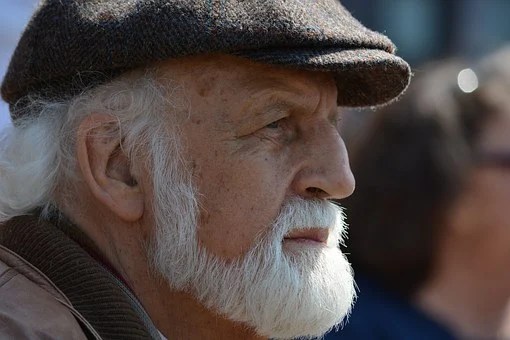
A poem that has two fathers in it, with a photo of the actual building.

When Sunday is not a day of rest

Two narrow wooden benches form the arena.
Both gladiators enter through the main left door.
The one with the brown perm has an entourage:
three boys (one with red hair), a girl with braces,
and the eldest son with glasses, the creepy smile
inherited from his father, a businessman with butter
in his mouth who happens to be our uncle.
As church elder, he’ll collect in the interval,
holds out a long wooden pole with black velvet bag.
Both gladiators buy at Stoutebeek,
the town’s upmarket department store.

Our gladiator has better legs, better posture,
a striking hat, which makes up for just three of us.
She is a semi-professional singer.
Our gladiator chose to marry the controller
of church proceedings – the organist.
Outside, afterwards, the light ammunition
of smiles, air kisses and compliments.

Miniature French Suite – writing prompt

Credit: fsHH on Pixabay

It’s a rainy weekend here in Holland. So, I’m writing the blog piece for this month’s guest poet: Steve Waling. That reminds me of this poem which I wrote on a short workshop with Steve. And it was in January 2011 that I heard the countertenor Andreas Scholl sing in the Bridgewater Hall in Manchester, UK. It’s such an experience seeing and hearing your heroes live!

Writing prompt: Combining a place and the music you (might) have heard there. Or, you could use write a miniature suite, like I did. Or, the end of the poem could come back full-circle to the beginning.

Miniature French Suite

Allemande

Do you mind if I borrow your man?
The old one with the beard that has
sparrows nesting in it. It’s only
for the Open Gardens weekend.
He needs to wear something
beige-brown, corduroy and I’ll
provide food. Tell him to wear
a cap or a southwester – something
to keep the fledglings dry.
He can hum to them. It might rain,
it could snow, warm boots.
Rameau or Telemann, I don’t mind.

Sarabande

Rameau or Telemann, I don’t mind.
A countertenor can’t be that choosy.
A voice like that is a rare find
but keeping it alive and strong taxes
me and my agent, bless her.
She tells me to let go of worries
and fears. It’s her domain to get
me engagements, book flights,
the new portrait and such.
She says a voice like mine is a horse,
that needs to be whispered to,
not broken in.

ErikTanghe on Pixabay

Gigue

I’m warming up in an empty church,
on a grey Sunday afternoon.
It’s winter, the radiators gurgle,
the conductor is late.
I let my eyes wander in order
to keep my thoughts at rest
but now they take flight,
filling the gallery, the arches
and the painting of the old one
with the beard that has
sparrows nesting in it.

(published in Another life, Oversteps Books, 2016)

A poem about my father …

Building prev. Middelaarkerk, Beverwijk, NL

My father was born on the 2nd of September. Here is a short prose poem about him. That so-called High Street was the Breestraat in the small Dutch town of Beverwijk, a few miles from the coast. In 1996 the building was last used as a church. When looking for a photo I came across a website offering accommodation. There is an apartment with a stained-glass window…

Hat

That Saturday afternoon my father had been drinking with the sales reps who had driven in to collect their bonus and, of course, being pleased with their bonus, they would have bought my father a drink. My father, being generous and liking his drink, anyway, would have bought them a drink. How the subject turned to hats, I don’t know, but around three, or three-thirty, my father came back home and picked up my mother’s hat, the one she would wear to church the following day: a large peach-shaped, red-wine-coloured, black-velvet-edged-bonbon-of-a-thing. I watched my father put on this hat and leave the house. I went out and followed him. The three sales reps stood outside the café at the end of our road. With the disdain of a Spanish matador, my father strode past them, heading for the High Street.

(published in Another LIfe, Oversteps Books, 2016)

That summer day – a poem

Dartington Hall, Devon

My friend and poet Kathleen Kummer will have her birthday soon. We have visited the Dartington Estate in Devon several times: to hear the then Poet Laureate Sir Andrew Motion read, to listen to music during the Music Summer School & Festival which was established in 1947. Alwyn Marriage of Oversteps Books invited me to read during the Ways with Words Literary Festival. It was wonderful seeing people out on the lawn, resting in deckchairs, or queuing up to get their book signed by famous authors.

Dartington Hall is a spectacular Grade I listed building. The gardens are grade II listed: a sculpture by Henry Moore, a yew tree that is 1500 years old and a row of sweet chestnut trees believed to be about 400 years old. The gardens are a delight in every season. Here is Kathleen’s poem about the gardens.

The Tiltyard, Dartington Hall Gardens

That summer day

That summer day at Dartington,
everything familiar, beautiful:
the corrugation of the bark
of ancient trees, the sun behind
the scarlet maple leaves, the swathes
of wildflowers in the glades, warm
to the touch the might buttocks
of Henry Moore’s reclining figure,
the bench, its oak smooth, silver,
following the stone wall’s curve,
on which we sat. Unexpected,
the robin landing next to us,
a fledgling, plump, who stayed ten, fifteen
minutes until his mother called him.
And, in the little wave of sadness
which washed over us, because
he looked so young, indivisible
as water is, this swell of happiness.

Music – poem

Schimmel sideways


Looking in the Cloud for a picture of a frog I came across a photo of my piano: a white horse (Schimmel). My friend Marianne who left me the old caravan had a digital piano here. I took that across to the UK and started having lessons with John who came to the house.

The next year (2009) I even took the Grade 1 examination. Turned up at the venue to find bemused children staring at me. I passed, just short of a Distinction. As a reward, I got  a proper acoustic piano. Found this lovely Schimmel with a warm European sound.

Horror! One day I lifted the lid to see a moth appear from between two white keys. Yes, a proper infestation. Fortunately, the wonderfully eccentric tuner, also called John, managed to take the piano apart and deal with that. I continued with lessons. But I was too anxious to go for the Grade 2 or Grade 3. When I moved into the flat, so did the piano. On its side, still a mellow sound. I sold it a couple of years ago. It went to a good home …

The poem Music is from my second collection Nothing serious, nothing dangerous, published by Indigo Dreams Publishing (2019).

 
Music

There was always music going on in our house,
live music, piano and song. The organ was
down the road, past the Catholics’ houses.
We were Protestant then, some of us, anyway.

There was always music in our house.
Bach on a black piano and Brahms
Mein Mädel hat einen Rosenmund.
My mother, the diva, practising before
her weekly lesson with the best alto
in Holland, who kept a pet monkey.
My father, with his piano hands,
shaking his vigorous black hair.

In our house there was always music.
More often than not it would be
minor chords, discordance, long
silence above the empty bar lines.

The small Japanese corner


Scan0023


How strange to see the notification of someone’s birthday on Facebook
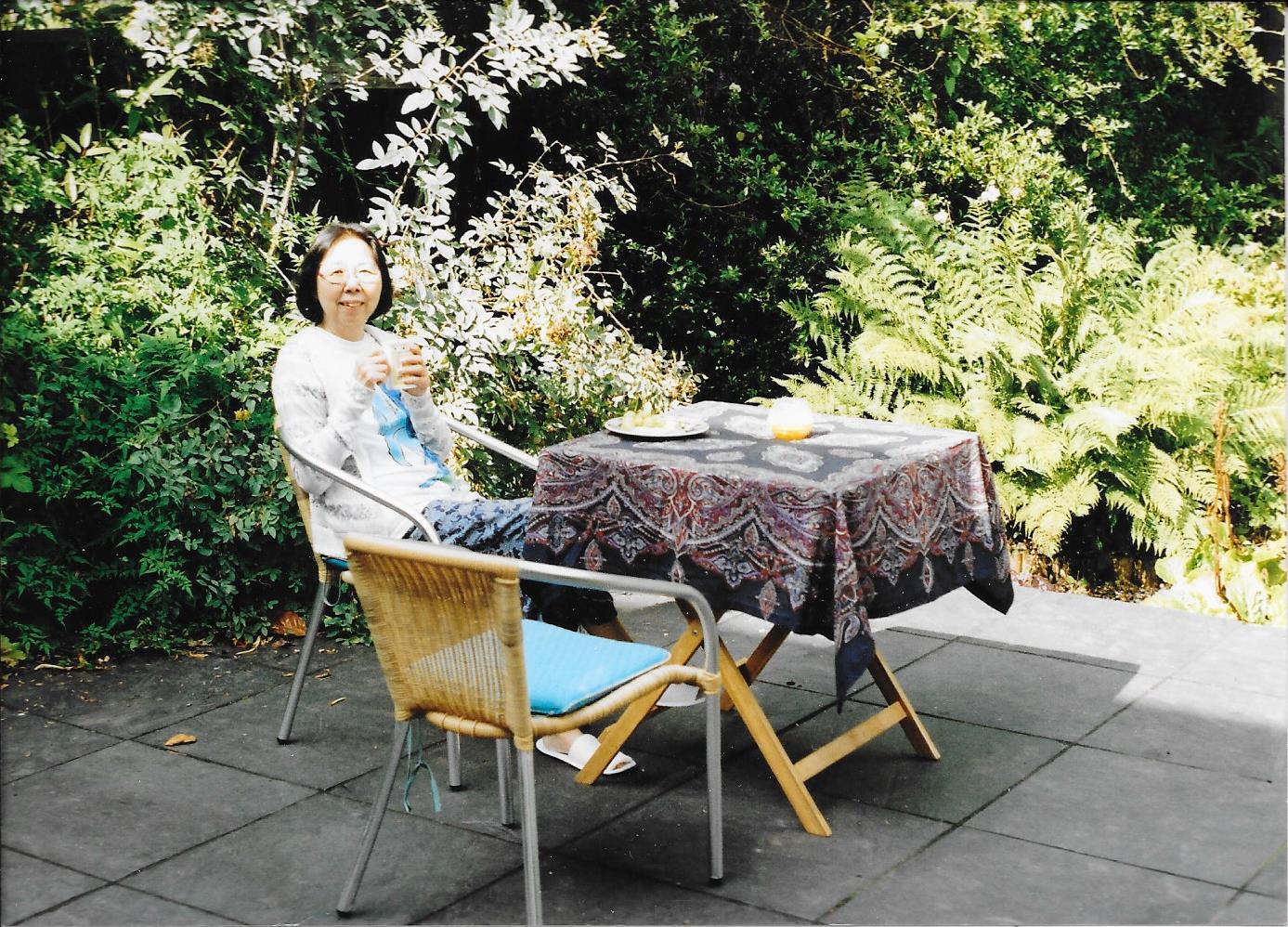
when they are no longer there to receive your greeting … Sumiko Morimoto
and I met in 2014.


The small Japanese corner

Howell was all packed, to return to live in Japan,
and as keen as always to win the karaoke contest.
He’d been brushing up, but Sumiko too knew
how to soft sing sakura, sakura

Now and then I see her mother’s old blue fan
on the shelf in my Japanese corner, beside the blue
mug Howell gave me, with the names of fishes,
Sumiko’s delicate New Year card with pigs and piglets.

She’d been well looked after at Rydal Hall, when she
went up to the Lakes, wanting at last to see the small
cottage of Wordsworth, her hero, whom she’d studied.
Here is the photo of her smiling over breakfast in my garden.

Worried about Sumiko, Howell’s email two months ago,
the illness she is fighting. Here’s another email …
If I finally decide to fly to Osaka, it’ll just be Howell
and me, eating his favourite okonomiyaki pancake.

Father’s Day

Vader


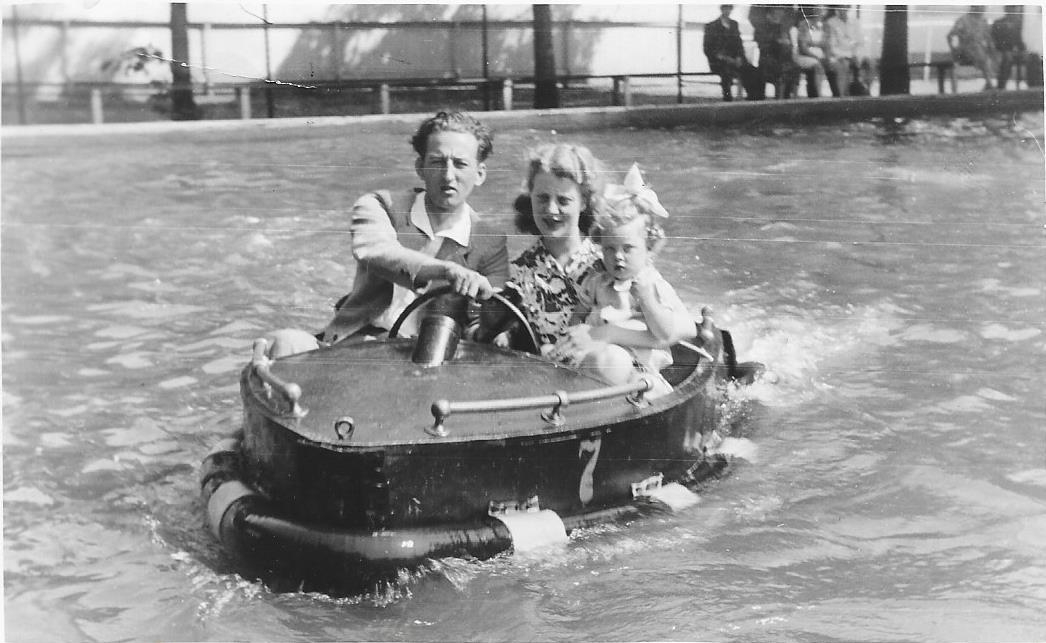
My father died a few weeks after his 75th birthday in October, 1990.  He had a talent for music: singing in and conducting choirs, and playing the church organ for many years. Here is a picture of him as a young man: a somewhat anxious look, wanting to do a good job of transporting my mother and me safely.

The poem Prelude and Fugue was published in the anthology, Poems from the Readaround, Tarantula Press, 1995.
Prelude and Fugue

I enter and dare a glance at your effects –
straight rows of books in alphabetical order
the white board emptied
pens and pencils (four of each)
manuscript paper and a rubber
on the Yamaha
You were filling in the bass line

Music for a while shall all your cares beguile

You kept some organ pipes in the loft.
You were going to build one.
What happened to those when you moved
into the flat?

Sometimes I turned the pages for you
feet darting across the pedals
When I was twelve I left the choir
and gave up singing

Your black shoes scuffed at the side

The Catholics paid best you said
a bonus for weddings and funerals

Brahms’ Alto Rhapsody

Rotterdam 015

Marianne Carolan, Rotterdam, 2008.

This week my friend Marianne would have celebrated her birthday.  One of my best memories is the trip I made with Marianne and other sponsors to Lalibela, Ethiopia in January 2007, during the Timket celebrations. Marianne had set up the Lalibela Educational Trust in 2006, to ensure there would be enough funding for sponsored children when they moved into secondary and tertiary education – university, nursing college.

With her 2007 Christmas card she sent a change of address: she’d bought a flat in Rotterdam, to be close to her new partner.  She was going to join an accordion orchestra and find a violin teacher.  I booked my flights in November 2007, the month Marianne’s GP mis-diagnosed, telling her symptoms were just Irritable Bowel Syndrome (IBS).  After the photo was taken Spring 2008, Marianne donated her accordion to the woman director of the orchestra.


Brahms’ Alto Rhapsody

The March visit had been planned
as a celebration of your retirement.
We walked on Calshot beach
summing up our lives, loves,
gifts and regrets.

Later, in your study upstairs,
we listened, connected
to your white MP3.
I couldn’t stop myself
from humming along.

Your ex-colleague (younger,
glasses, a little overweight)
started to speak in the silence –
when the men have stopped singing.
At your cremation they let
that alto voice fade away