Tag Archives: loss

Wind phone

The original wind phone, photo credit Matthew Komatsu


It’s a year ago today that my brother died. If grief is love with nowhere to go, the wind phone can be a place for those feelings to land, even momentarily.


The initiative was started in Japan by garden designer Itaru Sasaki in Otsuchi Prefecture in 2010. Sasaki said: ‘Because my thoughts couldn’t be relayed over a regular phone line, I wanted them to be carried on the wind.’ Hence the name Kaze no denwa’ – phone of the wind. The disconnected old-style rotary telephone allowed him to deal with grief after his cousin’s death of cancer.


Sasaki: ‘When your heart is filled with grief or some kind of burden, you aren’t in tune with your senses. You’re closed off like curtains have been pulled around you. After you empty your heart a little bit, you might be able to hear some birds singing again.’


The following year close to 20,000 people were killed by the earthquake and tsunami. In Tokohu 10% of the population died. Sasaki allowed local people to use the wind phone. Over 30,000 people have made the journey to this telephone since, and wind phones have been set up in other countries. The wind phone also provided inspiration for films and novels.


Amy Dawson (USA) lost her daughter Emily to terminal illness in 2020. She learned about wind phones and now devotes much of her time to maintaining a listing of wind phones worldwide, providing advice and resources. The current total is just over 400. Not all calls are to a deceased. People make calls about other losses. Go to her website for more information. There is also an article on Colossal


The first wind phone in The Netherlands was placed in 2019. There are now eight, with a further eight being planned. The locations include Haarlem – the town where my brother and sister-in-law lived before moving to the nearby village of Spaarndam.


I imagine a wind phone, the black cord snipped, in the dunes of Wijk aan Zee – where I’ll celebrate my special birthday this weekend, and where my brother and I spent much time as children during the summer vacation.

empty sky
sand piling up
rustle of marram grass

Exit Strategy

It’s my pleasure to introduce this month’s guest poet Patrick Wright. Patrick and I met years ago at Manchester Poets. Earlier this month his poem Archive, inspired by Anselm Kiefer, featured on the blog. You’ll find Patrick’s biography at the end of the post.

Today I’m sharing more poems from his substantial collection Exit Strategy, a ‘vivid exploration of grief and loss’. Tamar Yoseloff said of the collection: ‘Patrick Wright is one of those rare poets who can translate the complex images of visual artists into precise and pitch-perfect language.’

Patrick has been inspired by artists past and present (Rousseau, Klee, Rachel Whitehead, J M W Turner), to mention some well-known names.

The collection uses a wide range of forms (couplets, tercets, stanza, sonnet, ghazal, prose poem) and makes excellent use of white space through columns and indents. WordPress can’t do justice to formatting. Therefore, I’ve chosen poems with a more traditional lay-out.

COLD DARK MATTER

After Cornelia Parker

Thanks to you I am learning to see again
through a sparseness of particles—

like how I learned to listen to an eyelid
twitch once yes and twice no through a coma.

Darkness I’ve come to realise is a privilege—
known at 4am & sleepless

the sun rising like a scalpel
& turning the room purple.

Somehow, we go on & somehow it never ends
& we go on like a double pendulum.

Perhaps love is like this fixed explosion.
Perhaps you’re nearer now than the word belief.

SHADOW OF A GIRL PLAYING WITH A HULA HOOP
After Giorgio de Chirico

It used to scare me, what this girl is doing,
or those around her, off in the blind field.
Seemingly a girl playing with a hula hoop,
or just a shadow, no source, just a shadow
next to a wagon, its backdrop here a dusty
plaza. Somewhere, I feel, from an upstairs
room, an eye looks at me. Somewhere, off
screen, a murder is taking place, this shade
a clue. Even so, things are too belated now,
this girl clearly a phantom and not a muse,
like she’s in a toy shop or inside its puzzle,
no girl playing so nonchalant with a hoop.
The sun, at these times, is no longer a sun,
more likely a lamp. My fingers are syllables.
And this pine table where the postcard sits
is full of knots, staring like gods from above.

ROBERT RAUSCHENBERG’S UNTITLED

& already I see alpines
prise their way through the brutalist grey
of Chernobyl floors. Through the sarcophagus
they reach for sunlight. Maybe we only learn
what the burn of graphite means once blind.
I know you better after knowing disaster.

I’ve studied the colour theories
of Goethe and Albers where the wheel
& the wheel of life are a way to feel closer.
I am the stalk through the fallout, one that insists
on pushing its way & one that’s been patient.
On the surface we share the mark of detonation.

They say a town like this is void
though one pulse of a deer’s heart
makes it a plenum. A full spectrum will reveal
itself only when you’ve pledged to cease
hurting. Through this I see what you saw
when the sun set & made shades on a radiator.
We are both on the side of art.

WINTER LANDSCAPE WITH SKATERS AND BIRD TRAP
After Pieter Bruegel the Elder


I find no pleasure in the ice.
Everything about me lies still—save for murmurations.

Peasants weave between trees: each crystalline
like coral on a seabed.

I give you a winter landscape in place of a mirror.
The bird trap is my heart.

Soon it will be still, a skull in a crypt, lit by candles.
My hills are a wishbone. They undulate under great tension.

The skaters are insouciant, crows peck their shadows.
My face startles—a chance alignment of stars.

Skaters are on slippery ground
and if they should slip, they have nothing to cling onto.

Biography


Patrick Wright’s poems have appeared in Poetry Ireland, Poetry Wales, The North, Gutter, and The London Magazine. His debut collection, Full Sight of Her, was published in 2020 by Eyewear and nominated for the John Pollard Prize. His pamphlet, Nullaby (2017), was also published by Eyewear. His second collection, Exit Strategy (2025), was published by Broken Sleep Books. He teaches English and Creative Writing at the Open University.

Chalking the Pavement

It is a great pleasure to introduce this month’ guest poet Kate Noakes. Kate and I met during the first lockdown on Zoom (a group set up by a fellow poet). Kate Noakes’ most recent collection is Goldhawk Road (Two Rivers Press, 2023). Her website is www.boomslangpoetry.blogspot.com. She lives in Bristol.

Earlier this month Kate’s poem The Sick Spring appeared on the blog. It is from her pamphlet, Chalking the Pavement, published by Broken Sleep Books in 2024. At the heart of the book is Field Notes 2020. Field Notes has 65 entries: observations of life during the first lockdown in the form of prose poems.

I’ve chosen five, from the beginning and end of the sequence. All of them show Kate’s acute attention to detail as she ‘captures the soon-forgotten details of the changes to our lives’.

Field Notes 2020

Children are rediscovering, or discovering, the pleasures of chalking the pavement with hearts and messages of love for the NHS. Hopscotch has the thrill of the new, but neither the girl nor her mother knows how to play it. I look around for a handy stone. None are at arm’s length.

*

The slates pathing my garden are sleek with wet. Dust is dampened. This morning after weeks of early summer-in-spring is a change and a good one. I’ll rest indoors trying not to dwell on my friend’s friend: just two years older than us and dead. All day the blackbirds have busied about the garden in search of nesting materials. Such industry, even in the constant day-drip of rain.

*

My neighbour tells me he’s been scaled back to three days a week with attendant pay cut, yet considers himself lucky; most staff in his firm having been let go, along with eight percent of those in hospitality.

*

A windy day for children to learn or relearn the small pleasure of flying a kite. Prescriptions need at least a week’s notice and the pharmacist tells me there is some drug rationing. We have learned that a life is worth sixty thousand pounds; in case you’re ever wondered. And again there is no surprise in discovering that some people believe rules only apply to others.

*

I want my day to always start with a fishing heron and a cormorant drying its wings on the foreshore near the bridge, the tide running out, and the sun brilliant on the water. White stripes on the river path every two metres are a constant presence that it is hard to ignore.

After the Rites and Sandwiches

It is a privilege and a great pleasure to share three poems by Kathy Pimlott from her third pamphlet with The Emma Press, published this month. It is ‘an honest, lyrical and nuanced journey through the complexity of bereavement’. The poem What I do with you now you’re dead was longlisted for the National Poetry Competition 2023. Further down you’ll find Kathy’s biography and links to her website.

Death Admin I

Your demise constitutes a third off council tax;
the removal of a vote you seldom cast and then
only to be contrary; write-off of a modest overdraft;
the bill for an overpaid pension. Tell Us Once promises
it will be a doddle. It is not. I repeat time and again
in spoken and in written words to the indifferent
or distracted, He has died. What do I need to do?

What I do with you now you’re dead

The Queen is dead too and on her way to a proper tomb.
Everything’s shut and there’s nothing on tv, but the sun
comes out so I go to the mimosa tree where, months ago,
I dumped, in a laughing panic, dumped, about a quarter
of your ashes and ran away, the illicit thrill exactly what
you would have wanted. Today, with a flask, shortbread,

I’ve come because, while I don’t love the Queen, it seems
like a fitting thing to do. This royal park is empty, quiet,
allowing me to cry all through its splendid long borders
with their harmonious purple and blue planting until,
on a near-enough bench, I sit. By my feet, Lamb’s Ears
offer silky comfort, as does the pile of pistachio shells,

little coracles, showing someone sat here eating a bagful.
You kept your shells in the pockets of your gardening coat
which I emptied out before taking it to the charity shop
with your best shoes. The mimosa’s not out of course
but its ferny leaves show promise of the glory to come.
A robin perches closer than he should, inspects me,

then accepts a crumb or two. Your ashes have disappeared,
no longer so alarmingly burnt-bone visible, so very there.
They say the old Queen’s coffin is oak, lined with lead.
Three-quarters of you is still in the back of the wardrobe.
A crow chases off my robin. So much peril. It’s enough
to be sitting thumbing Lamb’s Ears, thinking about you.

The Passing Visit

A friend came by from Brussels and we talked of our dead
or rather about what they leave behind, the stuff in storage,

the binding strands. I told him more than I’d told most,
of how (and I said, then rejected, the word tumultuous),

how textured our long, long marriage had been and by textured
I meant bumpy, dropped stitches, amateur darning. I told him

how often you fell in and out of love and how I left and returned
more than once. Perhaps because I didn’t care enough, I said.

And perhaps I didn’t. There was something he wasn’t telling me
but the sun was out and we walked the courtyards and backways

of the neighbourhood, crossed the bridge, watching the sky whiten
and the coloured lamps in the trees come on. We spoke of cities,

their pleasures. The comfort I find in the river. How Brussels’ Senne
is covered over, subterranean. Of moving along and clearing out.

Biography

Kathy Pimlott has two previous pamphlets with The Emma Press: Goose Fair Night (2016) and Elastic Glue (2019). Her debut full collection, the small manoeuvres, was published by Verve Poetry Press (2022). Her work is widely published in magazines and anthologies, and she has been longlisted, placed and has won several poetry prizes.

Kathy’s website

The Friday Poem

A tribute

This post is a tribute to my brother Theo who died early on Tuesday morning in hospital. On the evening of Friday 28 June, he went out with his wife Ancilla to celebrate their 52nd wedding anniversary. After a lovely meal he had a fall in which he sustained serious brain damage. I spent time with him on the Saturday. Ancilla and my nephew were with him when he died.


It was only last autumn, when a MRI scan was taken for other purposes, that my brother learned that he had the rare condition of multiple cavernomas. This explains the paralysis and subsequent sudden hearing loss. The poem 1962 was published in my debut collection Another life.


My brother had a rich and full life. The photo was taken in 2019 when he and Ancilla both received honours (Member of the Order of Oranje-Nassau) in recognition of decades of charity and community service.

1962

Alexander Eduard (coppersmith
in the bible and van Beinum,
the famous conductor).
Our Irish setter had been given
the names of an unborn child.

A ward of six, our parent’s daily
drive, almost an hour each way.
Neurologist, paralysis,
lumbar puncture, nausea
.

Grandfather owned an electrical shop
(double-fronted on the main street),
gave my brother a beige-brown radio.

The specialist allowed our red
Irish setter to visit my brother,
celebrating his fourteenth birthday
in the academic hospital in Leiden.

Three months later he arrived home,
just in time for Sint Nikolaas.
My brother still limped and his crown
was marked by two scars at right angles,
the space between dipped and dented.
A few days later grandfather came
to take his radio back.

Wendsday

It’s a great pleasure to introduce this month’s guest poet Matthew Stewart, with three poems from his collection Whatever you do, just don’t. It was published by HappenStance Press to their usual high standards in 2023. The background of the jacket is an old map of Extremadura, Spain. The poem Gostrey Meadow was published in Stand. See below the poems for Matthew’s biography. I admire the attention to detail, precision, and economy of his poems: so much between the lines…

Banana

Come to think of it, she didn’t tell us
who’d got hold of the banana, or how,
and we forgot to ask, stunned by the news
that at ten years old she’d never seen one.

She was still proud her class had raffled it
for the war effort, still slightly mournful
at it turning black on her teacher’s desk
long before they drew the winning ticket.

She wouldn’t talk about gas masks, the Blitz,
the doodlebugs (how they changed to V2s) —
but she always recalled her fury
at the waste of bloody good food.

Wendsday

Halfway through the word and the week,
my pen used to pause and stumble,
tripped up by my eight-year-old tongue

and even now I still delight
in having learned at last to swap
the n and d and add the e.

I stumbled, too, after coming
to Spain. Shook off routines and rules.
Let a new language soak through me.

Two more hassle-packed, tensed-up days
till vino tinto y queso
instead of cod and chips.

Gostrey Meadow

Showing my son round, I notice
a father taking a picture
of his wife and son who’s melted
half an ice cream on his fingers
and the other half on his face.

It’s a copy of a photo
in our album. Same river.
Same heat-laden sky. Same roles.
Same spot on the bank. Same pose.
Our trees were ten feet shorter.

Biography

Matthew Stewart lives between Extremadura in Spain and West Sussex in the South of England. He works in the Spanish wine trade as a blender and exporter. His blog site ‘Rogue Strands’ is a respected source for poetry lovers, and he reviews widely for a range of publications. His first full collection was The Knives of Villalejo (Eyewear, 2017). Before that, there were two pamphlets from HappenStance:
Tasting Notes (2012) and Inventing Truth (2011).

Austere beauty

I was deeply saddened to learn of the death of Louise Glück. She is, perhaps, best known for her poetry collection The Wild Iris, which was published in 1992 and for which she received the Pulitzer Prize. The title poem opens the book: At the end of my suffering / there was a door.

Her 2014 collection Faithful and Virtuous Night, also from Carcanet, gave me both comfort and confidence as I was struggling to complete the manuscript of Remembering / Disease. ‘You enter the world of this spellbinding book through one of its many dreamlike portals, and each time you enter it’s the same place but it has been arranged differently.’ Each time I entered this world, I felt closer to home.

Glück was awarded the Nobel Prize in 2020 for her ‘unmistakable poetic voice that with austere beauty makes individual existence universal’.

The title poem Faithful and Virtuous Night is a long poem, over 10 pages, consisting of short stanzas. It ends:

I think here I will leave you. It has come to seem
there is no perfect ending.
Indeed, there are infinite endings.
Or, perhaps, once one begins,
there are only endings.

Olympic Cyclists – a poem

Photo credit: Grace Sail

This month’s poet is Lawrence Sail. We met 20 years ago when he tutored a week-long course at Madingley Hall, part of Cambridge University. We have kept in touch and I was delighted with his endorsement of my second collection Nothing serious nothing dangerous.

Lawrence Sail has written thirteen books of poems; Waking Dreams: New & Selected Poems (Bloodaxe Books, 2010) was a Poetry Book Society Special Commendation. His publications include the anthology First and Always: Poems for Great Ormond Street Children’s Hospital (Faber, 1988), and two books of essays, Cross-Currents (Enitharmon, 2005) and The Key to Clover (Shoestring Press, 2013). He has written two memoirs, both published by Impress Books: Sift (2010) and Accidentals, the latter illustrated by his daughter, Erica Sail, and published in December 2020.

He was chairman of the Arvon Foundation from 1991 to 1994, has directed the Cheltenham Festival of Literature and was on the management committee of the Society of Authors from 2007 to 2011. He was awarded a Hawthornden Fellowship in 1992, and an Arts Council Writer’s Bursary the following year. In 2004 he received a Cholmondeley Award for his poetry. He is a Fellow of the Royal Society of Literature.

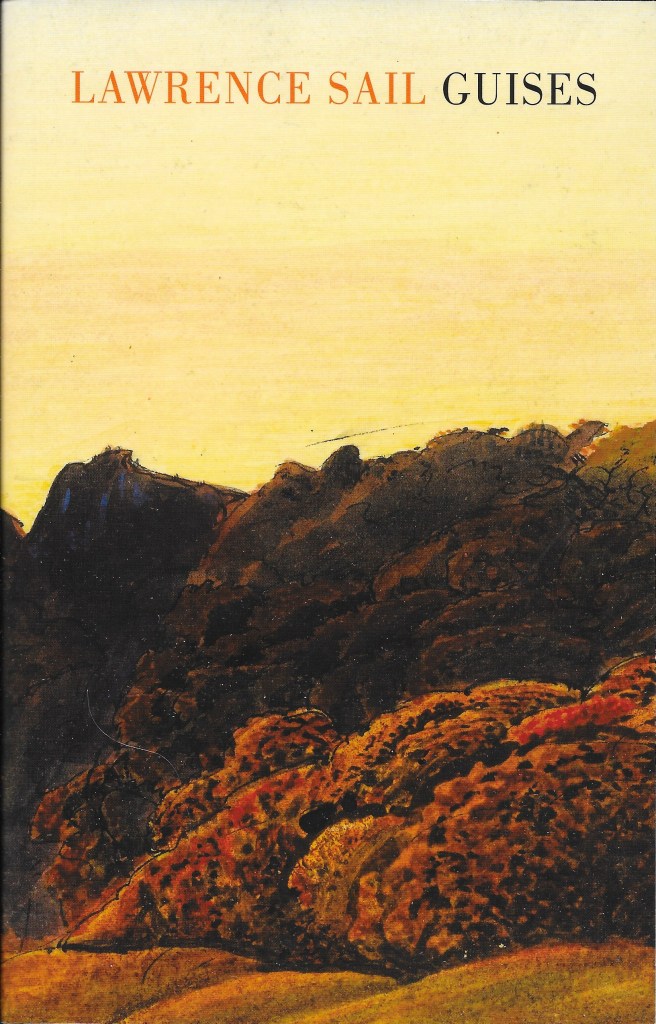
I’ve selected four poems from Guises, Lawrence’s most recent collection, published by Bloodaxe Books in early 2020. They show his close observation skills, precision of imagery, interest in art and in life – what is and what was lost. Understatement is used to great effect in Journey.

Cover painting: detail of Yellow Twilight
by Samuel Palmer

Radishes
‘What do I know of man’s destiny? I could tell you more about radishes.’ Samuel Beckett

Bunched tightly –
no sign of
the flowers with
their four petals

At one end, weak
and tatty leaves
that soon wilt,
ill with yellow

At the other
a wisp of root,
vestigial tail
thinly curling

Their cylinders, white
and carmine, harbour
a residue
of soil’s sourness

Their gifts? Crispness and
surprise – from
their pure white core
they bite back: like destiny

Olympic Cyclists

Start at the nape
with the helmet that tapers so finely
and looks designed
for a new occipital shape –
it must come straight out of
a dream played
on an oval board, under lights

Everything comes second
to aero-dynamics, kinetics –
it is not always easy
to tell where the cycle ends
and the rider begins. They become
one curve among
many, parts of one thought

– which bends their spines,
stares from the rounds of the goggles,
pumps the pedals,
blurs the black wheels’ outlines;
which has them swoop flightily
down the banked track
sudden as a hawk stooping

Such oneness, wholly
integrated – as in
the fado singer’s
tremble of husky melancholy,
or the grounded delight of lovers
before they reel
out of the charmed circle

Giacometti’s Cat

Its head to body to tail
is one long, mean
horizontal hoisted
on the spindly twin trestles
of its best feet forward

A nerve-bundle fused in bronze
it lives apart, locked
in a trance of stealth
as it probes the air ahead
taking nothing for granted

Journey

I am travelling to meet you again –
through morning air burnt
to a clarity you would admire

And of course my mind has stored
a certain amount of baggage
accrued in the course of time

It includes a small rucksack
you once wore, and the sweep
of your arm, stressing a point

As well as the passion with which
you embark on serious discussion
with, sometimes, an emphatic blink

Yet almost as vivid is the thought
of the platform as it will look
after the train has gone

The shine of the rails snaking
away, a soft breeze, the atmosphere
intent but free of intention

On the far side of you waits
an absence charged and changed
that I do not want to re-settle

Item – poem and writing prompt

Photo credit Stux via Pixabay

This week I am featuring another one of Kathleen Kummer’s poem. It’s short and the neutral title belies the heart-breaking content. The poem is addressed to her adult son.

Item

You left behind: your silver spoon –
there are days when I stir my coffee with it;
the drawing of yourself with the Mona Lisa eyes;
I sometimes wonder how you got the chestnut avenue
from that angle, and I’m suddenly happy, as though
you’d just sauntered in from school and were upstairs
moving your table, shouting down you were hungry;
all the photographs of you – if I flicked the pages
fast enough, would those in the top right-hand corner,
at least, spring jerkily into life?

Item: a bank account – didn’t you need
the money? Your sisters; me. People hope
I don’t mind them asking about you. As if
in a language I’m learning, I say, no, I don’t mind.

Prompt: What item do you still need to write about, even if a part of you doesn’t want to? To whom are you writing?

Turkish Delight – poem

It is a great pleasure introducing this month’s poet. Paul Stephenson and I met eight years ago through the Poetry Business’ Writing School, an eighteen-month programme.

Paul was born and grew up in Cambridge. He studied modern languages and linguistics then European Studies. He spent several years living between London and France, Spain, and the Netherlands. He currently lives between Cambridge and Brussels.

Paul was selected for the Arvon/Jerwood mentoring scheme and the Aldeburgh Eight. He has been co-curator of the Poetry in Aldeburgh poetry festival since 2018.

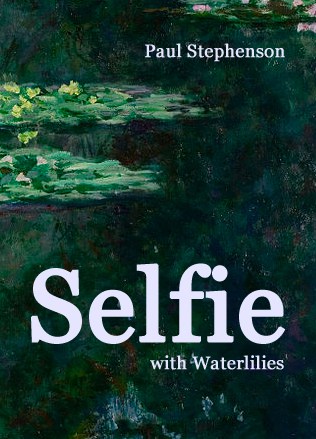
His first pamphlet Those People (Smith/Doorstop, 2015) was a winner in the Poetry Business Book and Pamphlet Competition, judged by Billy Collins. His second pamphlet The Days that Followed Paris (HappenStance, 2016) was written in the wake of the November 2015 terrorist attacks. His book Selfie with Waterlilies was published by Paper Swans Press after winning their 2017 Poetry Pamphlet Prize. Read more at: http://www.paulstep.com

I have selected two poems from Those People. The poems Turkish Delight and The Rub open the pamphlet Selfie with Waterlilies. Here is Paul’s keen eye for the details that matter, his playful language adding an extra dimension to the subject of loss.

Capacity

Seventy litres: in theory more than plenty
for three t-shirts, two shorts, the pair of jeans
you’re wearing. Then the question of the tent,

saucepan, small canister of gas, map and bible
of Thomas Cook timetables – every single train
possibility from here to Ankara. One crisp fifty

thousand lira note, a handful of Swiss francs
and wad of American Express traveller’s cheques.
Foreign currency kept flat, zipped inside a canvas

wallet with Velcro strap, wrapped tight around
the waist. Typical Monday. Your father at work.
Your mother out somewhere. Your lift here soon.

Passwords

I avoid the house I grew up in,
keep away from my mother

and father’s birthdays: calendar
opposites, June and January.

I steer clear of my brother’s
crash, rule out the hot summer

I left school, graduated, went off.
I adopt different characters,

mix upper and lower case.
I do my utmost to never

choose when I was born.
Mine take years to crack.

Paper Swans Press

Turkish Delight

What you do when you get the call is take it,
hear words at dawn before they’re mouthed:
You should probably come now.

What you do is shower and dress, skip yoghurt
and honey, the baklava breakfast, and walk briskly
to the ticket office, hand over your sob story.

Once given a seat today (not tomorrow because
tomorrow is too late), what you do is pack, sit
on a shell-shocked suitcase poring over a tourist map

mentally-cataloguing Byzantine cathedrals
then mosques, till a twelve-seater van for one pulls up
to taxi you with stop-starts across the Bosphorous

into Asia. What you do to kill an afternoon
on a new continent at the international airport hub
is browse briefs and socks, visit the James Joyce Irish pub,

mill about getting sprayed with testers of musk, citrus,
bergamot, think nothing of spending sixty three euros
and seventy four cents on different nut varieties of

Turkish Delight (which is heavy and must be carried),
remember nobody likes Turkish Delight – except him.
What you do till they display your gate is stare out

as dusk descends, count the seconds between
runway ascents, promise you’ll return one day
to be consumed by the vastness of the Hagia Sophia.

The Rub

Menthol my father,
menthol his room,
menthol his bed.

My out of sight father,
my fast relief father,
my warming father.

My dual action father,
my targeted father,
my daily father.

My caution father,
my blood flow father,
my enclosed father,

Menthol my father,
menthol his back,
menthol his beard.

My turpentine father,
my paraffin father,
my eucalyptus father.

My muscular father,
my thin layer father,
my recommended father.

My wool fat father,
my liquid father,
my expiry father.