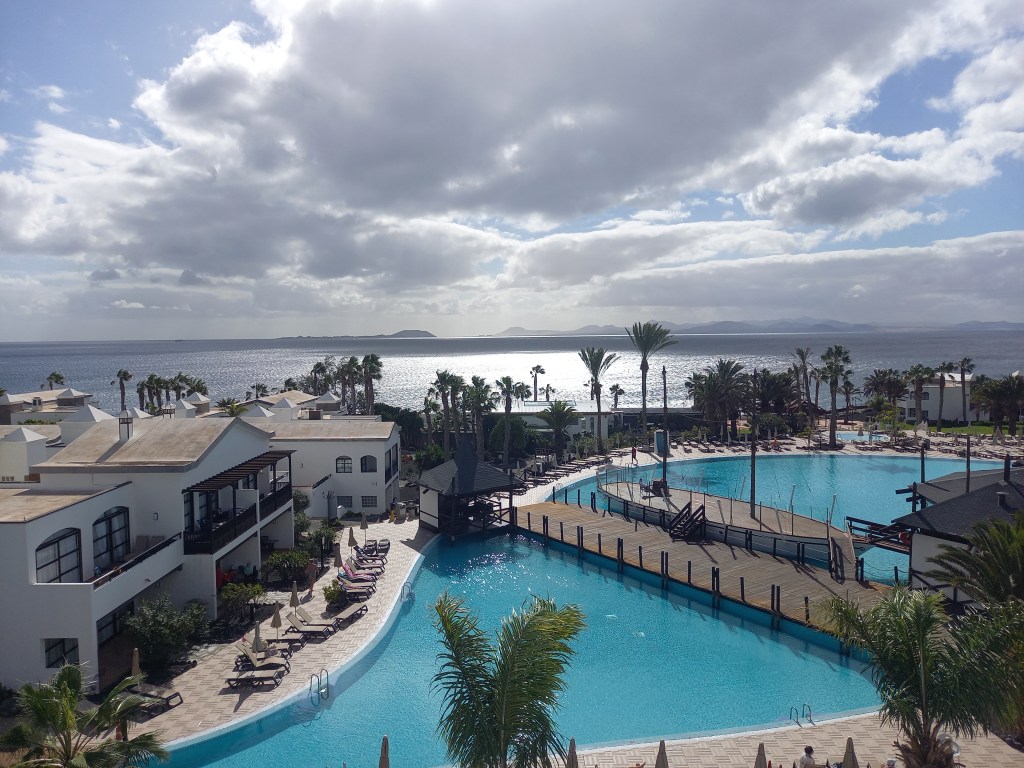
Most of January I was on Lanzarote. I was unwell, so I spent much of my time reading in the Piano Bar of the hotel. Here is a view from the balcony. In the distance is Fuerteventura.
I also forgot about posting the answers to Vasko Popa’s riddles which I posted in December. The riddles are from his collection The Golden Apple, 2010. It’s a round of stories, songs, spells, proverbs & riddles that Popa himself selected from various anthologies of Serbo-Croatian folk literature. Here are the riddles and their answers, followed by another riddle.
Riddles
In one room both bone and flesh grow.
I stretched a gold thread through the wide world and wound it up into a walnut shell.
I shake a tree here, but the fruit falls half an hour away
Answers
1 Egg 2 Eyesight 3 The sound of a bell
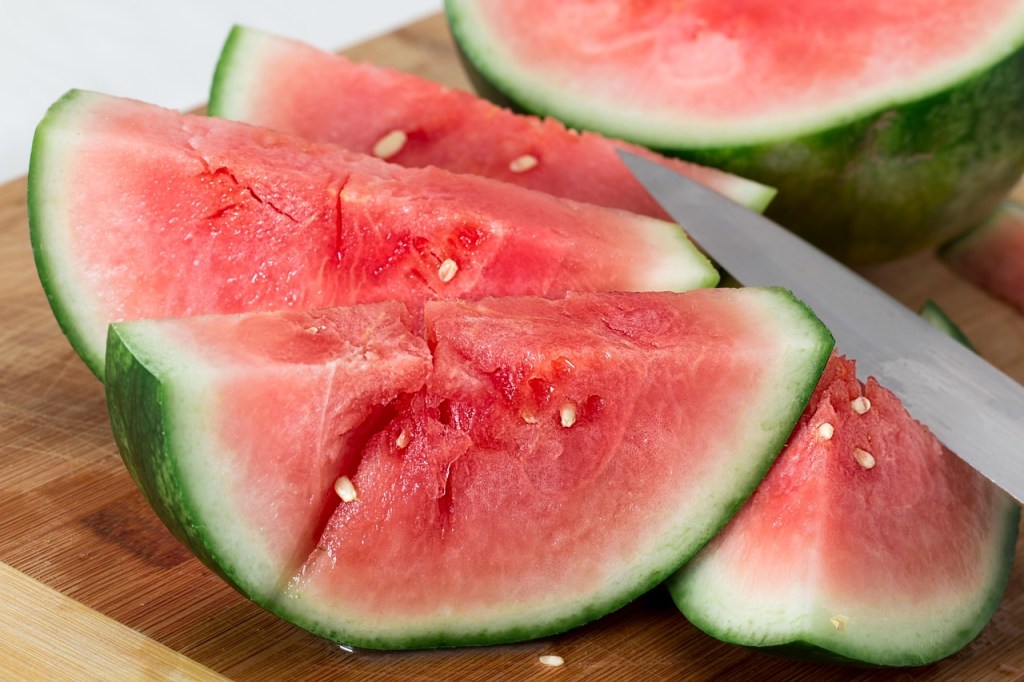
Photo
Photo credit: stevepb via Pixabay
Riddle
With an iron key I open a green fortress And drive out the black cattle
Here in The Netherlands Kookboekenweek (Cookery Books Week) has just ended. A recent annual event, it’s designed to promote cookery books. Bookshops and libraries organise workshops, lectures, and tasting events. Of course, it’s all to encourage people to buy books as presents for December: St Nicolaas and Kerstmis.
Professionals shortlisted six books (Vietnamese, Japanese, Indian, Italian (2), and baking skills). They’ve chosen Bloem Suiker Boter, by Nicola Lamb, translated into Dutch. I’m going with Breakfast, a poem celebrating poetry and friendship.
Breakfast
Bridie would be in the kitchen, barking with Finn and Tara in a metal cage under the table. I’m in your backroom, sheepskin on the seat of the wooden chair, just gone 9 o’clock this Tuesday.
You’ve made the scrambled eggs exactly as I like them, with enough mustard and fresh chives. Now you’re coming in with yours, followed by your small dogs who settle on the settee, by the fire.
We catch up over this monthly meal. Soon we’ll sit silently behind our laptops, typing up poems from old notebooks. Now eating toast with ginger preserve, I look out of the window; the smiling Buddha is lit up by the sun.
This is my 300th blog post. Many thanks to all the blog’s followers, also for your likes and lovely comments. They are much appreciated. I’m taking a break from weekly blogging: I need to ‘fill the well’ – take myself out to find poems and art on the streets of The Hague, get inspired and fired up again. I’m celebrating the 300th post in the company of Cecile Bol – our August guest poet.
Cecile is also the organiser of the Poetry Society’s Groningen Stanza. When I moved back to The Netherlands , I was fortunate that their meetings were on Zoom due to the lockdown. It was great to meet Cecile and other members of the Stanza in person earlier this year. The hotel where I stayed is just a few houses down from the literary café De Graanrepubliek where they meet.
I have chosen three poems from Cecile’s chapbook Fold me a Fishtail. Read more about Cecile and the book below her poems.
yet you speak of resilience
there are things that make me sink back into the grave (red on black, stardust freckles, knee socks, foxy wrists) inside Plato’s cave, where moving shadows are safe
I saw a flowered brown tie turn into a snake woke up crying, your shoulder blade stuck to my lip there are things that make me sink back into the grave
same table, same cheap wine, same talk, another day you pull me close as if you’re not pushing me in, inside Plato’s cave, where moving shadows are safe
like the cute demon I asked how I should behave – he said ‘always choose slyly between loud and still’ – there are things that make me sink back into the grave
they nibble at my feet, ask if this time I’ll stay (petrol candy, flawed magic, and plenty to kiss) inside Plato’s cave, where moving shadows are safe
I seep through layers of earth, call out all their names yet you speak of resilience as if we can win there are things that make me sink back into the grave inside Plato’s cave, where moving shadows are safe
paper crown
a cut-out crown is still a crown for a girl on a stolen horse I would have swapped our sanities to see her hair become lost in rose horizons, saddlebags filled with boxes of chocolate sprinkles
I’d been chasing robber children long before we met – and I will stick with this selfish travelling until or well beyond my death but she – she bore whole galaxies sprinkled into maps on her skin
in my inside pocket you’ll find scissors, tape and golden paper the day I borrowed her reindeer I thought in time she’d ride my horse instead I stop at roadside shrines and eat chocolate sprinkles daily
robber child: arguably the most interesting character in H.C. Andersen’s story The Snow Queen is the unnamed little robber girl
Krasokouloura
I should have made them milk and bread, while they were still in bed – instead, I impulsively fired up the electric oven – as always, procrastinating – to bake twenty ring-shaped Greek cookies with things lying around the cupboard.
Flour, sugar, baking powder, cinnamon, salt, ground cloves, some olive oil and another glass of white wine.
I should have written them a note, but I’m that cat; as always, capitulating to curiosity – I had to taste one, still warm, curled up on the windowsill – new sun, please, tell me what skills it would take to achieve immaculate roundness.
Biography: Cecile Bol is a Dutch writer with a small family and a big edible garden in the north of the Netherlands. She doesn’t have an MA in Creative Writing, because things like that don’t exist in her country. She does, however, earn her money as a self-employed copywriter. The somewhat well-known poet Helen Ivory describes Cecile’s work as ‘like finding snakes in your strawberry patch’. Cecile enjoys incorporating fairy tales and popular culture in her poetry, and her poems often have a slight erotic edge. Cooking (mostly Greek) food is her means of meditation. Cecile owns 57 different kinds of herbs and spices of which cumin and dill are her favourites.
Cecile’s debut chapbook Fold me a Fishtail was published by UK-based Selcouth Station Press in 2022 (Sadly, Selcouth Station Press ceased to be in 2023). So what’s Fold me a Fishtail about? Cecile: “I sometimes wonder whether Disney’s Ariel misses her mermaid tail, now that she’s the legged wife of prince Eric. Isn’t she way too curious and free-spirited for a conventional family life? Or is that just me? That feeling chained to a husband, toddler and suburban lifestyle was enough to drive me dangerously crazy? Fold me a Fishtail is a collection of mostly confessional poetry about a long journey into, through and out of (?) the dark.”
The day before my birthday storm Poly (Beaufort 11) raged at speeds of 140 kms an hour: overhead lines and trees came down. The day after my birthday the Dutch government fell.
On my birthday I treated family to lunch. It was a joyous occasion. My uncle (born 17 years after my mother) turned 85 in June. He has only recently given up playing volleyball: too much for his shoulders. He’s taken up Jeu de Boules instead.
Here are two verses from an extended sequence titled Briefly a small brown eye.
Primary school demolished, protestant church a community centre. Our old house extended. Forty years on no reason to visit this town other than the old uncle.
Lunchtime, my aunt brings out the special table cloth. She has embroidered signatures, some in Arabic, some in Cyrillic. I’m looking for mine.
This coming week it’s my birthday. I’m taking family out to lunch near where I was born: a lovely bistro near the water. Here is a poem that I wrote on an excellent workshop with the poet Kei Miller.
My name
Even in the Netherlands my name is rare. It comes from the Northern provinces, a bleak windy place near the sea, near Germany.
People of the North grow tall to stand up to gales that whistle, across bare fields, into your face. A name so rare it’s not in the book of names.
I inherited this name from a grandmother who was often ill to spite her husband. I heard him shout behind the shop in a town
named after the beaver. Beavers on the façade of the vegetable canning factory, the foundry roof. My name means strong like the teeth of a beaver.
No, it doesn’t. I wish it did. Most children born just after the war had bad teeth because of the hunger winter: eating tulip bulbs to survive.
I wish I was named after the beaver, or the giraffe, an animal strong enough to shatter a lion’s skull with a single blow of its hooves.
In Dutch my name means people, folk or even battle folk. My grandmother died at 55. I’m beyond that age. I am an animal after all.
It’s a great pleasure to introduce this month’s guest poet Judy Kendall. We met many years ago through our membership of the Yorkshire/Lancashire Haiku group. Judy lived and worked in Japan for nearly seven years. Cinnamon Press published four collections – containing haiku and ‘mainstream’ poems. You can read Judy’s full biography further down. I’ll post a second selection of Judy’s writing next month.
Haiku published in Presence
shades of blue distance in the fells
afternoon off red grouse in flight almost grazing the heather
moorland air just after a curlew’s call liquid fresh—
travelling light I will my neighbor to turn the page
(published in Presence and selected for Red Moon Best English Language anthology)
Short poems or ‘vegetable’ haiku published in insatiable carrot (Cinnamon Press, 2015)
[Many of these have featured on Incredible Edible Todmorden’s Edible Poetry site and on or around the town]
tall green mild and meek not quite the full onion the gentle leek
hairy bitter cress going wild among the cabbages
snug by the wall the one the pennine wind forgot Todmorden’s first apricot
taken apart, the cabbage becomes all heart and leaves
chunky, nobbly-eyed the potato says ‘hi, will you be my friend?’
Haiku and poems from Joy Change (Cinnamon Press, 2010) Haiku:
wooden geta the water quivers with carp a horizon of lilies
sickle moon, yellow and black, on my way back to the heart
(still international haiku competition)
watching the breath come and go, who am I but a broken bit of star?
(still international haiku competition)
drifting mountains shoulder the sky blotches of pine
(Asahi Shimbun)
Biography
Judy Kendall worked as an English lecturer at Kanazawa University in Japan for nearly seven years. When she first went to Japan she was a practicing playwright but she soon began to focus on poetry and haiku, kickstarted by an invitation to to participate in a collaborative translation of Miyaiki Eiko’s haiku. This became the bilingual publication Suiko /The Water Jar. Since then she has been writing haiku and haibun along with other poetic and prose forms. The haiku mode has informed her four Cinnamon Press poetry collections, particularly Joy Change – composed while she was in Japan. She has won several poetry awards, recently receiving a 2019 Genjuan International Haibun An Cottage prize, and is the essays and bilingual translations editor for Presence haiku journal.
She is Reader in English and Creative Writing at Salford University, and aside from haiku and haibun, works as a poet, poetry translator and visual text exponent. She has published several articles and books on the translation and creative process, including ‘Jo Ha Kyu? and Fu Bi Xing; Reading|Viewing Haiku’ in Juxtapositions, 1 (2). She is currently putting the finishing touches to a monograph for Edinburgh University Press on Where Language Thickens (focusing on the threshold between articulation and inarticulation in language – a threshold in which haiku itself is surely situated).
I’m not keen on them, so I’m not buying now they’re 4 Euro each. Dutch growers have kept their glasshouses empty because of the cost of gas and electricity. I was lucky, though, to be accepted as a patient by a GP practice in the town I moved to. Lucky also that my journey to the implantologist involves two trams: there were strikes again on regional buses last week.
This poem, from a recent workshop, is a snapshot of life in The Netherlands.
Word jij onze nieuwe collega?
Outside every restaurant and café two blackboards: one with a menu, the other asking for a sous-chef, a washer-upper, or bar staff. Freek van Os, the expensive plumbing business is even renting lit-up space by the side of a bus shelter. They need a planner, and also have two technical vacancies. Manda, my hairdresser, had found a 42-year-old Afghan woman, single parent, career-changer. When I came in a month later, she’d changed her mind. Legal cases are abandoned, judges are dead or retiring. As are many GP’s. They’re not signing the new contracts, anyway. Not much the government or the insurers can do. People want to work fewer hours, it’s said, not more.
A Christmas Day poem with my best wishes for the day and with my thanks to Matthew Stewart. In his pamphlet Tasting Notes (Happenstance Press) he pairs poems with notes about the Zaleo wines from Extremadura, a region with several UNESCO heritage sites.
Food Match
It glistens on the wooden stand, a black trotter pointed upwards as if offering a hoofprint. Now cut a slice so thin that steel is visible below the meat.
Place it across your tongue and wait for the marbled fat to melt. Sip un vino tinto. The tannin grips, hugging the ham — both of them start, suddenly, to magnify.
Credit: GerardBarcelona, on Pixabay
Biography:
Matthew Stewart works in the Spanish wine trade and lives between Extremadura and West Sussex. His second full collection is due from HappenStance Press in November 2023.
There are a few copies left of Tasting Notes. Contact Matthew direct via social media.
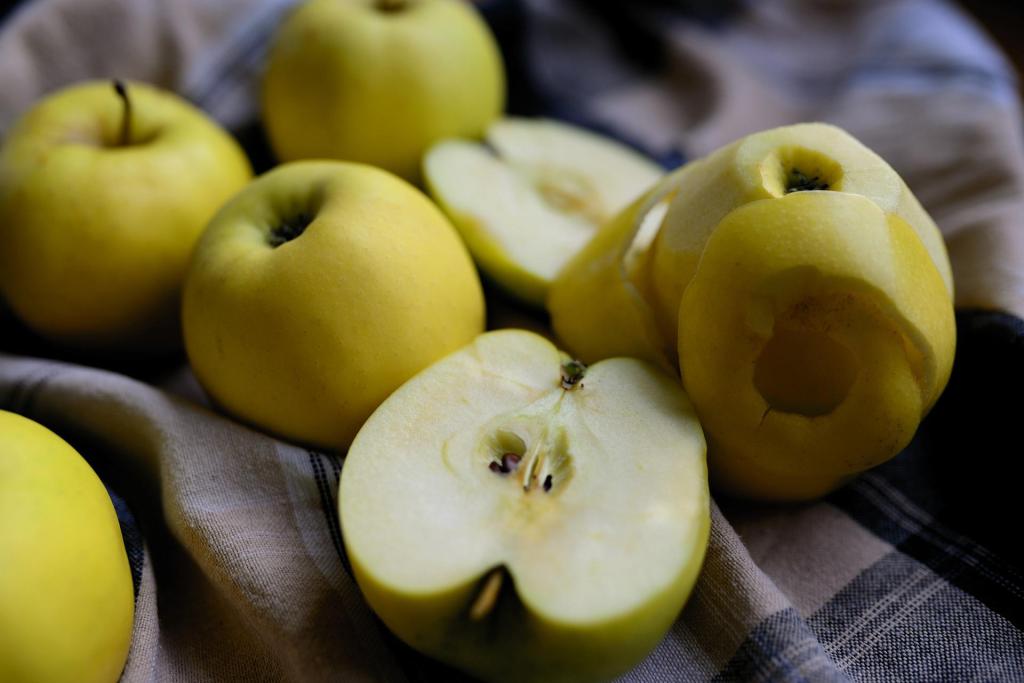
National Apple Day falls on the 21st of October. It was created in the UK by the charity Common Ground in Covent Garden, London on 21 October 1990 to raise awareness about the importance of diversity in different communities. Apparently, there are about 7,500 varieties of apple grown globally. In my local Hoogvliet supermarket I can find six: Kanzi, Pink Lady, Golden Delicious, Granny Smith, Royal Gala and Jazz.
Celebrations take place in the UK throughout October, so go to a fair, take part in an apple peeling contest, bake or eat an apple pie. Here in the Netherlands, traditional Appeltaart always has a good dose of warm spices – cinnamon, ginger, nutmeg. They are baked in a spring form and have a lattice crust. I will have mine with a good dollop of sweet whipped cream, thank you.
My poem is somewhat melancholy. It has the feel of a tanka – the first three lines giving a description, with emotion and reflection in the last two lines.
carefully quartering soft red apples into a compostable bag – I still wait for the letter that will never come
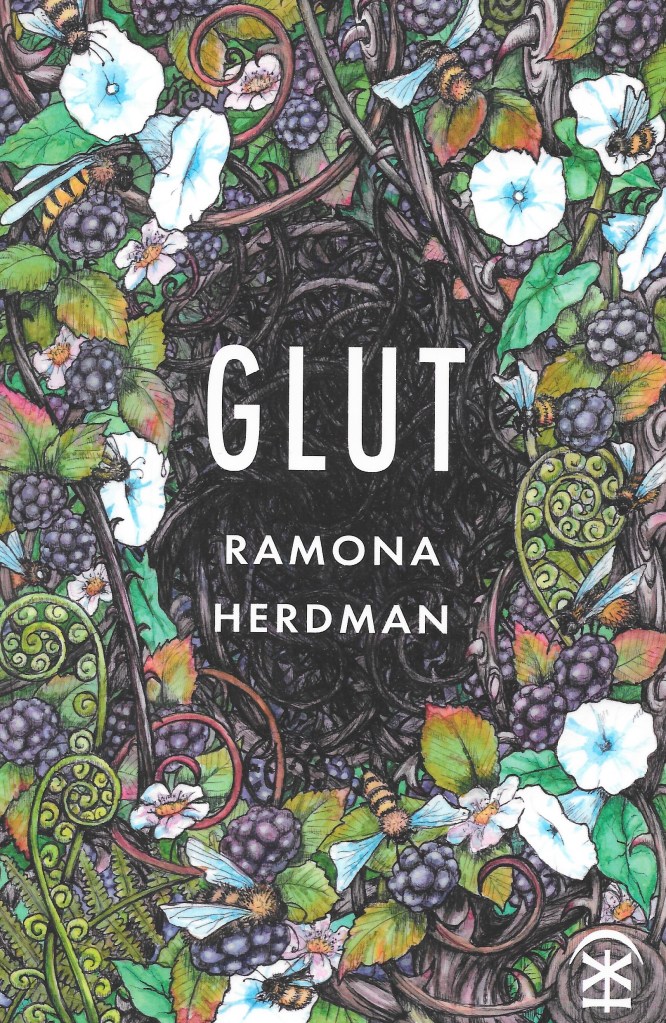
It’s an immense pleasure introducing this month’s guest poet Ramona Herdman. We met a few years ago on a residential workshop and are members of a group that meets weekly online.
Ramona Herdman’s recent publications are Glut (Nine Arches Press), A warm and snouting thing (The Emma Press) and Bottle (HappenStance Press). Ramona lives in Norwich and is a committee member for Café Writers. She tweets @ramonaherdman
I have selected four poems from Glut, beautifully produced by Nine Arches Press, to give you a flavour of these darkly funny, bittersweet poems. I hope my choices also show their ‘quiet ferocity’ (Philip Gross). Below the poems you’ll find links to a blog about the cover (by Jacky Howson) and to a video with Ramona reading Blackberrying and Congratulations. Glorious is the word!
Blackberrying
Blooded young, we waded into the hooked shallows of hedges, caught up and cut in our toddler blundering, dirty with gritty juice and dotted-line scratches.
We without-ritual British, we atheists. Hippies’ children, grown up in the world they believe they changed – we have blackberrying as our sacrament.
At school, neater children wouldn’t eat the berries, said their mothers said no, said they had worms in that would eat our insides and poke out of our bumholes.
Now we go every year, like it’s Midnight Mass. We avoid the dog zone at the bottom of the bushes. Tell each other that by Michaelmas the Devil will have pissed them bitter.
We take offal-heavy carrier bags of berries to our parents, too old now for all that bother. We pick the children out of the tangled footings. We cook pies and crumbles in our own kitchens, competently. We placate the gods.
Cover design by Jacky Howson
Cuckoo and egg
It’s hard to soft-boil an egg in another woman’s kitchen – even the water is different.
It’s our first ‘family’ holiday together. She makes me a soft-boiled egg with a lot of fanfare and the whole breakfast-table gets involved in the hoo-hah.
And there’s a performance of trust in cracking it – the risk of a wet white, the opposite risk of a solid yolk. We’re on the edge
of an ovation when it turns out perfect. I eat it hot, like a heart.
It’s not me taking the minutes
It’s not me anymore escorting visitors from the front desk. I don’t fill the water jugs and make sure the glasses aren’t too dirty. I sometimes buy the biscuits, now there’s no budget. It’s not me too scared to ask a question or supply a fact, wondering if I’m allowed a view or am just a transcription machine.
A man once told me working with women had taught him not to interrupt. It’s a terrible world. I told him working with men had taught me to keep on talking, slightly louder. Try interrupting and you’ll get to see the flying-galleon belly of my argument as I lift off cathedral-high over you.
Don’t dare to talk over my people, including the young woman taking minutes, who is well on her way to wherever she wants, who could take your eye out with her wit. The meetings are my meetings now.
Two death in the afternoons, please
Dad, now you’re dead you scare me. Every time I think about stepping into traffic I think of you building your glass castle, cornershop-whisky-bottle by cornershop-whisky-bottle.
I had to do one of those questionnaires recently: How many times in the last month has your drinking stopped you doing things you needed or wanted to do? I put zero, Dad, proud nothing. They never ask
about the times the drink makes living possible. I think of your kitchen-drinking nights, how you told me you didn’t get hangovers anymore and I was too young to reply.
When I’m scared, Dad, I know a gluey-gold inch of brandy or one gin and tonic’s scouring effervescence will lift me to arm’s-length from caring, will calm me in a bubble of slight incapacity.
The old dread, Dad – I think now you carried it like a wolf in your stomach. The drink quiets it, but it doesn’t drown. I recently learned another cocktail by Hemingway –
‘Death in the afternoon’, champagne and absinthe. You’d find the name as funny as I do. He recommended three or five in slow succession. When I make them, I toast him. He’s family.
Dad, you’re nothing now. It’s only the thought of your life that scares me. But if there were an afterlife I’d meet you there, happy hour. It’d be dimlit and we’d sit low in a booth and they’d keep
bringing the drinks in fine heavy glasses and no one would interrupt to say this wasn’t actually heaven, this delicious blunting of feeling, this merciful cessation, and that there was something outside that was better –
like walking out on the seafront together, wind and water-roar and saying something risky and being understood.







 Acacia Publications