Tag Archives: death

Hard Drive – guest poet


It is a great privilege to share Paul Stephenson’s poems here. His debut collection was published by Carcanet in June this year. See the end of this post for Paul’s biography and details of his three poetry pamphlets.


When his partner suddenly died, life changed utterly for Paul Stephenson. In Hard Drive a prologue and epilogue hold six parts of almost equal length. These poems take the reader through the journey of grief: Signature, Officialdom, Clearing Shelves, Covered Reservoir, Intentions, Attachment.


‘A noted formalist, with a flair for experiment, pattern and the use of constraints’, Paul also has a talent for intriguing titles: Other people who died at 38; Better Verbs for Scattering; We weren’t married. He was my civil partner.


There is a great variety of form: erasure poems, use of indents and columns, haibun, prose poems, alongside the narrative poems which range in length from three lines to the five-page poem Your Brain. Unfortunately, WordPress can’t do justice to the poems which need formatting.


I have chosen four poems from four parts: What Jean saw, Battleships, On mailing a lock of his hair to America, belatedly, and Putting It Out There. Battleships is a particular favourite – precise and poignant.

What Jean Saw


Through the letterbox
the little bald patch of you
asleep on the floor

Battleships

I must sort his room, a room as full
of ships as any room could be, clear up
the battle waging on open seas.

I imagine them, christened one summer afternoon,
careering down their slipway
ironclad onto polished parquet.

Red and blue ships strewn – mile-long,
laden with guided missiles,
locked onto my feet, closing in on my knees.

Picking up a ship, I cup it, poor target,
slide a knife in the cracks
between floorboards to extricate others.

No mayday for these navies in trouble,
these heavily manned fleets,
their broadsides struck, hulls torn and listing.

For the scuttled and sunk, damaged
and wrecked, the ships reported missing,
I bag them up and think charity.

No more games here.
No more torpedoes in crossfire – hit!
His room a tidy horizon, the radar blank.

On mailing a lock of his hair to America, belatedly

Would his hair be worth it?
Would his hair provide comfort?
Would his hair cause upset?
Would his hair be an act of violence?
Would his hair destroy their day?

Would his hair survive the journey?
Would his hair have to declare itself?
Would his hair be seized?
Would his hair still shine?
Would his hair be hair after all this time?

Putting It Out There

So here I am worrying myself to death
about commodifying your death,
arranging and sequencing your death,
curating the left and right pages of your death,
deciding which parts of your death to leave out.

Here I am again, giving a title to your death,
choosing an attractive cover for your death,
(will your death have French flaps?)
writing intelligent-sounding blurb for your death,
thinking how we might best promote your death,
who might best be willing to endorse it.

Still me, waiting to be sent a proof of your death.
I’ll need an eye for detail to check your death for typos.
I’ve got to get it right – the finger-feel,
the texture of the paper of the pages of your death,
ensure a sharp jet black for your death’s ink.
(I’m wondering about the numbers in your death’s ISBN).

Before I sign off on your death – your death done,
and wait for a box with hard copies of your death
and organize things to launch your death – finally,
then wait, for reviews of your death (hopefully considered),
to be told how well your death has sold.

Biography

Paul Stephenson studied modern languages and linguistics, then European studies. He has published three pamphlets: Those People (Smith/Doorstop, 2015), which won the Poetry Business pamphlet competition; The Days that Followed Paris (HappenStance, 2016), written after the November 2015 terrorist attacks; and Selfie with Waterlilies (Paper Swans Press, 2017). He is a University teacher and researcher living between Cambridge and Brussels.

website: paulstep.com / Twitter: @stephenson_pj / Instagram: paulstep456

Turn Up the Ocean – poems

It’s four years this month since the poet Tony Hoagland died. Turn Up the Ocean was published posthumously this year.

The blurb on the back says ‘Over the course of his celebrated career, Tony Hoagland ventured fearlessly into the unlit alleys of emotion and experience. The poems [ … ] examine with mordant wit the reality of living and dying in a time and culture that conspire to erase our inner lives.’


The mordant wit can be found in some of the titles:

  • Four Beginnings for an Apocalyptic Novel of Manners
  • Why I Like the Hospital
  • On Why I Must Decline To Receive The Prayers You Say You Are Constantly Sending


The last few lines of this poem are:


And could you stop burning so many candles, please?


My god, think how many hours and hours and hours –
think of how hard those bees worked
to make all that wax!

Hoagland’s poems often go just over the page and here are the last few lines of Gorgon:

Your job is to stay calm.
Your job is to watch and take notes,
to go on looking.

Your job is to not be turned into stone.

Cuckoo and egg – guest poet

It’s an immense pleasure introducing this month’s guest poet Ramona Herdman. We met a few years ago on a residential workshop and are members of a group that meets weekly online.

Ramona Herdman’s recent publications are Glut (Nine Arches Press), A warm and snouting thing (The Emma Press) and Bottle (HappenStance Press). Ramona lives in Norwich and is a committee member for Café Writers. She tweets @ramonaherdman

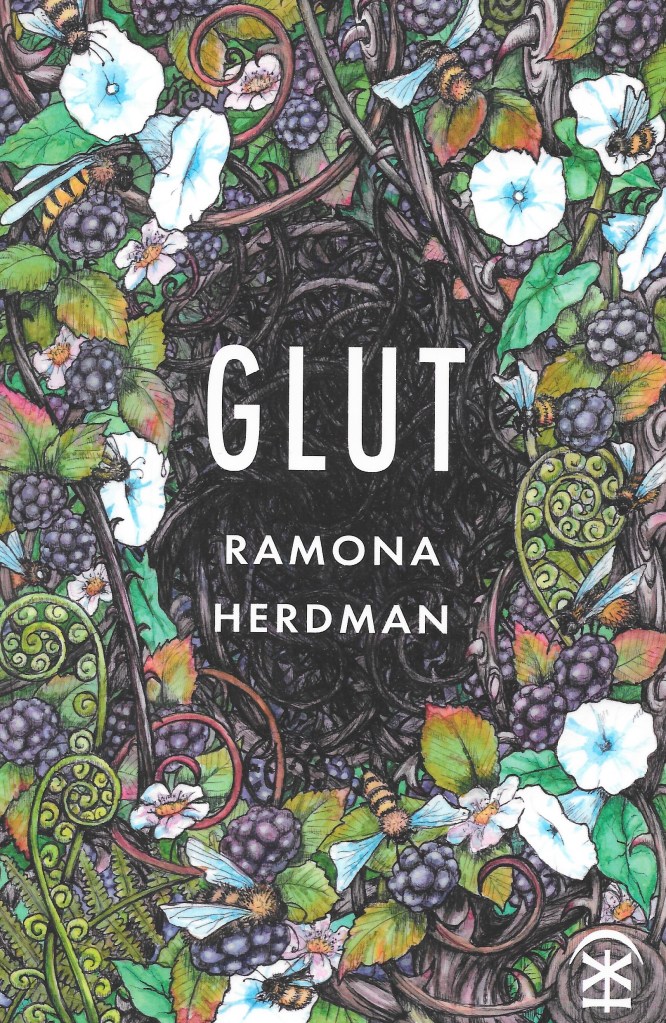
I have selected four poems from Glut, beautifully produced by Nine Arches Press, to give you a flavour of these darkly funny, bittersweet poems. I hope my choices also show their ‘quiet ferocity’ (Philip Gross). Below the poems you’ll find links to a blog about the cover (by Jacky Howson) and to a video with Ramona reading Blackberrying and Congratulations. Glorious is the word!

Blackberrying

Blooded young, we waded
into the hooked shallows of hedges,
caught up and cut in our toddler blundering, dirty
with gritty juice and dotted-line scratches.

We without-ritual British, we atheists.
Hippies’ children, grown up
in the world they believe they changed –
we have blackberrying as our sacrament.

At school, neater children wouldn’t eat the berries,
said their mothers said no, said
they had worms in that would eat our insides
and poke out of our bumholes.

Now we go every year, like it’s Midnight Mass.
We avoid the dog zone at the bottom of the bushes.
Tell each other that by Michaelmas
the Devil will have pissed them bitter.

We take offal-heavy carrier bags of berries
to our parents, too old now for all that bother.
We pick the children out of the tangled footings.
We cook pies and crumbles in our own kitchens,
competently. We placate the gods.

Cover design by Jacky Howson

Cuckoo and egg

It’s hard to soft-boil an egg in another woman’s kitchen –
even the water is different.

It’s our first ‘family’ holiday together.
She makes me a soft-boiled egg with a lot of fanfare
and the whole breakfast-table gets involved in the hoo-hah.

And there’s a performance of trust in cracking it –
the risk of a wet white, the opposite risk
of a solid yolk. We’re on the edge

of an ovation when it turns out perfect.
I eat it hot, like a heart.

It’s not me taking the minutes

It’s not me anymore escorting visitors
from the front desk. I don’t fill the water jugs
and make sure the glasses aren’t too dirty.
I sometimes buy the biscuits, now there’s no budget.
It’s not me too scared to ask a question
or supply a fact, wondering if I’m allowed
a view or am just a transcription machine.

A man once told me working with women
had taught him not to interrupt. It’s a terrible world.
I told him working with men had taught me
to keep on talking, slightly louder. Try
interrupting and you’ll get to see
the flying-galleon belly of my argument
as I lift off cathedral-high over you.

Don’t dare to talk over my people,
including the young woman taking minutes,
who is well on her way to wherever she wants,
who could take your eye out with her wit.
The meetings are my meetings now.

Two death in the afternoons, please

Dad, now you’re dead you scare me.
Every time I think about stepping into traffic
I think of you building your glass castle,
cornershop-whisky-bottle by cornershop-whisky-bottle.

I had to do one of those questionnaires recently:
How many times in the last month has your drinking
stopped you doing things you needed or wanted to do?
I put zero, Dad, proud nothing. They never ask

about the times the drink makes living possible.
I think of your kitchen-drinking nights, how you told me
you didn’t get hangovers anymore
and I was too young to reply.

When I’m scared, Dad, I know a gluey-gold inch
of brandy or one gin and tonic’s scouring effervescence
will lift me to arm’s-length from caring, will calm me
in a bubble of slight incapacity.

The old dread, Dad – I think now you carried it
like a wolf in your stomach.
The drink quiets it, but it doesn’t drown.
I recently learned another cocktail by Hemingway –

‘Death in the afternoon’, champagne and absinthe.
You’d find the name as funny as I do.
He recommended three or five in slow succession.
When I make them, I toast him. He’s family.

Dad, you’re nothing now.
It’s only the thought of your life that scares me.
But if there were an afterlife I’d meet you there, happy hour.
It’d be dimlit and we’d sit low in a booth and they’d keep

bringing the drinks in fine heavy glasses
and no one would interrupt to say this wasn’t actually heaven,
this delicious blunting of feeling, this merciful cessation,
and that there was something outside that was better –

like walking out on the seafront together, wind and water-roar
and saying something risky and being understood.

Links:
To buy the book
An interesting blog piece about the design of the cover
Ramona reads Congratulations
Ramona reading Blackberrying