Friendship is the theme of this year’s Poetry Week, celebrated in The Netherlands and the Flemish-speaking part of Belgium through 400+ events. It starts on Thursday 26 January. Miriam Van Hee (B) and Hester Knibbe (NL), two poets who have been friends for almost 40 years were commissioned to write five poems each for a book. In a recent interview they said that trust and curiosity are key elements for a friendship to endure and last.
Anyone who spends over 12,50 Euro on poetry books during Poetry Week will be given a copy. It’s not hard to spend that sort of money, as poetry books are expensive in The Netherlands!
Here is my poem on the theme of friendship: memories of a long weekend in Vienna in 1994.
Vienna
I would gladly return, walk with Wendy through the rain to the museum, see the Hunters on the Hill – tired, wet dogs, in the Little Ice Age when frozen birds fell from the sky.
I would gladly go back there, view grey buildings slide past, hear the clanging bell. Schwedenplatz, umsteigen. A trolley bus securely attached to the two lines above.
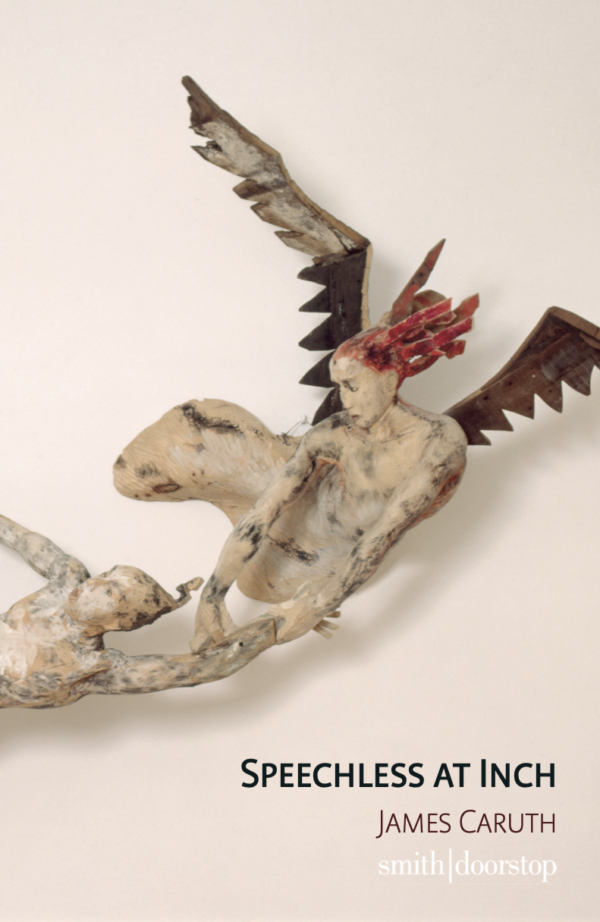
The poems of James (Jim) Caruth have featured on the blog before. Here is the link. Last year his new collection, Speechless at Inch, was published by smith/doorstop. It was shortlisted for The Derek Walcott Poetry Prize 2023.
The striking cover image is of Janet Mullarney’s The Straight and Narrow. Made in 1991 of painted wood, it measures 228 x 320 x 137 cm. It’s in the collection of the Irish Museum of Modern Art.
Here is a seasonal poem from Speechless at Inch:
Above Redmires
It was mid-December, a back road through the low hills that nurse the city’s northern edge, when I came upon
a flock of black-faced ewes crowded in a corner of a field, a squeeze of tattered wool and clouded breath.
I stopped the car to look around, searching for a dog slipped the leash or a fox tasting the air along the hedgerows
but as far as I could see there was no other living thing between those frightened sheep and me.
Biography
James Caruth was born in Belfast but has lived in Sheffield for over thirty years. He has had several pamphlets and a collection published: A Stone’s Throw (Staple Press, 2007), Marking the Lambs (Smith/Doorstop, 2012), The Death of Narrative (Smith/Doorstop, 2014) and Narrow Water (Poetry Salzburg, 2017).
I am delighted to feature the poem Winter Sun Speaks by Maggie Reed. We first met on a residential workshop several years ago. The picture of winter sun is also by Maggie.
Winter Sun Speaks
I birth my cry through cloud layers push my weight low over the southern horizon, strident, desperate, slanting over the hills forking through trees, splintering ice. I blind drivers on the school run.
How I ache for summer skies, to leap and arch over the earth, spread light, energy and love.
But for now my shriek, my low level beam, insists my right for the few hours I’m allowed to crisp up these dark winter days.
Biography:
Maggie Reed lives in the Malvern Hills, Worcestershire, having spent much of her life in Cumbria. Her current collection Let Small Wings Fly was self-published in 2021 to accompany the Arts Council funded travelling art exhibition ‘Mappa Marches’ that visited libraries and art centres across Herefordshire throughout 2022.
She has been published in several journals, including The North, Orbis, PoetryBirmingham, Pennine Platform, Three Drops from a Cauldron and Poetry Village, and has been included in anthologies such as This Place I Know (Handstand Press, 2018), Places of Poetry (One World, 2019), When All This is Over (Calder Valley Poetry, 2020), Poetry of Worcestershire (Offas Press, 2019) and In the Sticks (Offas Press, 2021). She won the Poem and a Pint competition (judge, Carrie Etter) in 2019.
Each Sunday in December there will be seasonal poems on the blog. For a few years I lived in the Withington area of Manchester, so I recognised the shop mentioned in Annie Muir’s poem. It’s from her pamphlet New Year’s Eve, published by Broken Sleep Books in 2021.
Crab Snowglobe
Thrown in with shoelaces and paracetamol, a souvenir from Copson Street pound shop –
this rusty orange crab on a rock with specks of glitter resting
in every nook and cranny. Around the base there are footprints in sand
and another, smaller crab, exactly alike except I can touch it.
Inside your hard, glass globe you seem to be in some other dimension
like the reflection in a mirror, or memory.
Either dormant or ecstatic – when I shake you up
it is for a moment New Year’s Eve, your pincers grasping to catch the confetti
that floats around your head in kaleidoscope slow motion.
Then, when each piece has fallen, you wait for something else to happen.
Biography
Annie Muir lives in Glasgow. Her debut pamphlet New Year’s Eve was published by Broken Sleep Books. Pre-pandemic she handed out poems on the street outside local libraries, and she has a podcast – Time for one Poem – aimed at complete beginners to poetry. @time41poem
Another quote from Claes Oldenburg’s famous Ode to Possibilities ‘I’m for …’ from 1961. It reads like a long list poem. Oldenburg said it was a statement, not a manifesto.
Risham Syed, The Tent of Darius
My poem Wearable Narratives, from my second collection, Nothing serious, nothing dangerous, published by Indigo Dreams in 2019, is in two parts. The poem was inspired by art in the Manchester Art Gallery. Last week I posted part i (Scarf).
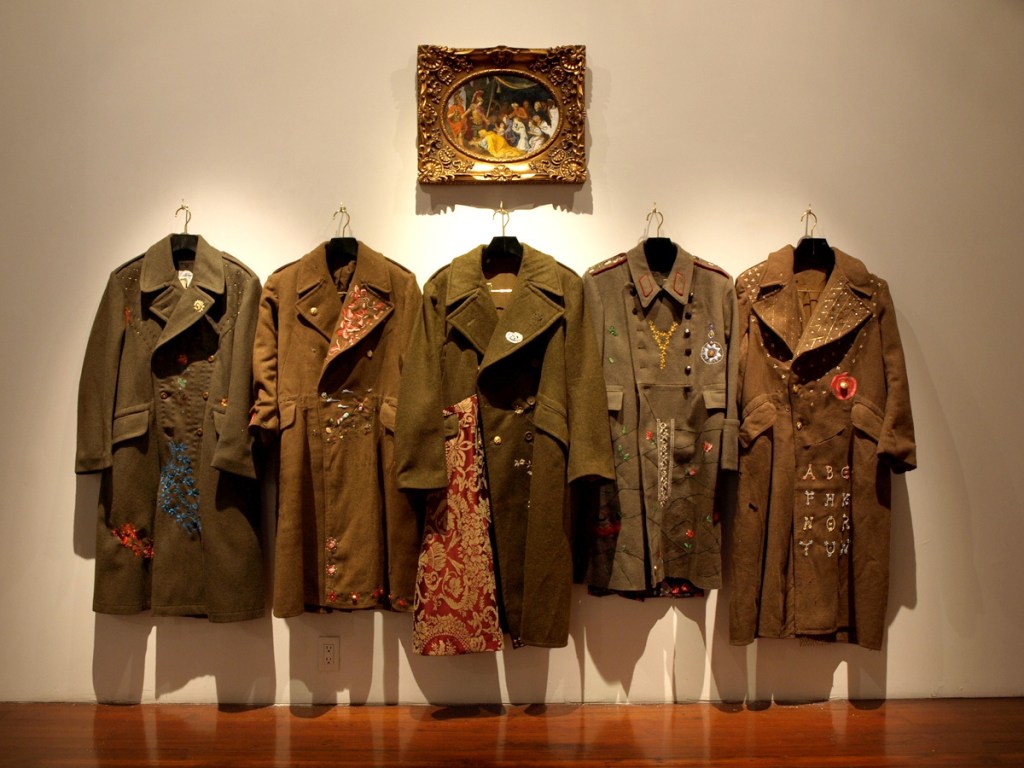
The Tent of Darius, an installation from 2009, is a complex work by the Lahore-based Risham Syed. It consists of five embroidered vintage European Army Coats with a small painting. This is a copy, painted by her, of the Charles Le Brun work of the same name. Syed describes her inspiration for it:
“I imagined these five coats to have travelled all over the world, with women having contributed to them by adding a piece of embroidery. They are like these tired, old worn-out soldiers who have dreamt of coming back home. On the one hand, they symbolize the imperial power, but on the other hand, there is another aspect to this work; how soldiers from the colonies were made to fight for the Imperial powers. It’s true for any army including the Pakistan army, where most soldiers are from Jehlum, Potowar region, from poor, lower middle-class families and end up with the army because of their physique/tradition, in the hope of making a romantic/glamorous career. This work, compares the romance/glamor to the actual reality of war, the aim of it and the beneficiaries of it. I juxtapose the embroidered coats with an ‘Oriental’ painting called The Tent of Darius, a seventeenth-century painting by Charles Le Brun that provides the title for the installation. In it, the Queen of Persia bows to Alexander the Great who has conquered the land. It serves as a metaphor for the West making incisions in the East.”
I was very moved by the sight of these five coats and the details of the embroideries which inspired the last stanza.
The tent of Darius
The ornate faux-Chinese frame holds a cropped copy on acrylic: The Queen of Persia draped at the feet of Alexander.
Below, an array of five overcoats, donated by European soldiers, appliquéd and embroidered by women’s hands.
Under the lapel, a stilled windmill, peach-coloured vanes. A green tree above a button hole. Death comes like blue geese.
So said Claes Oldenburg and he said a lot more like it, such as ‘I’m for art that flaps like a flag, or helps blow noses like a handkerchief’. Oldenburg said that his famous 1961 Ode to Possibilities, ‘I am for …’ was a statement, not a manifesto. It’s a fantastic read, a long list poem that works well as a writing prompt. Here is the link.
Swedish-born Oldenburg, one of the founding fathers of Pop Art died July this year at the age of 93. He was famous for his monumental sculptures where mundane objects (matches, clothes peg, apple core) suddenly became larger than life.
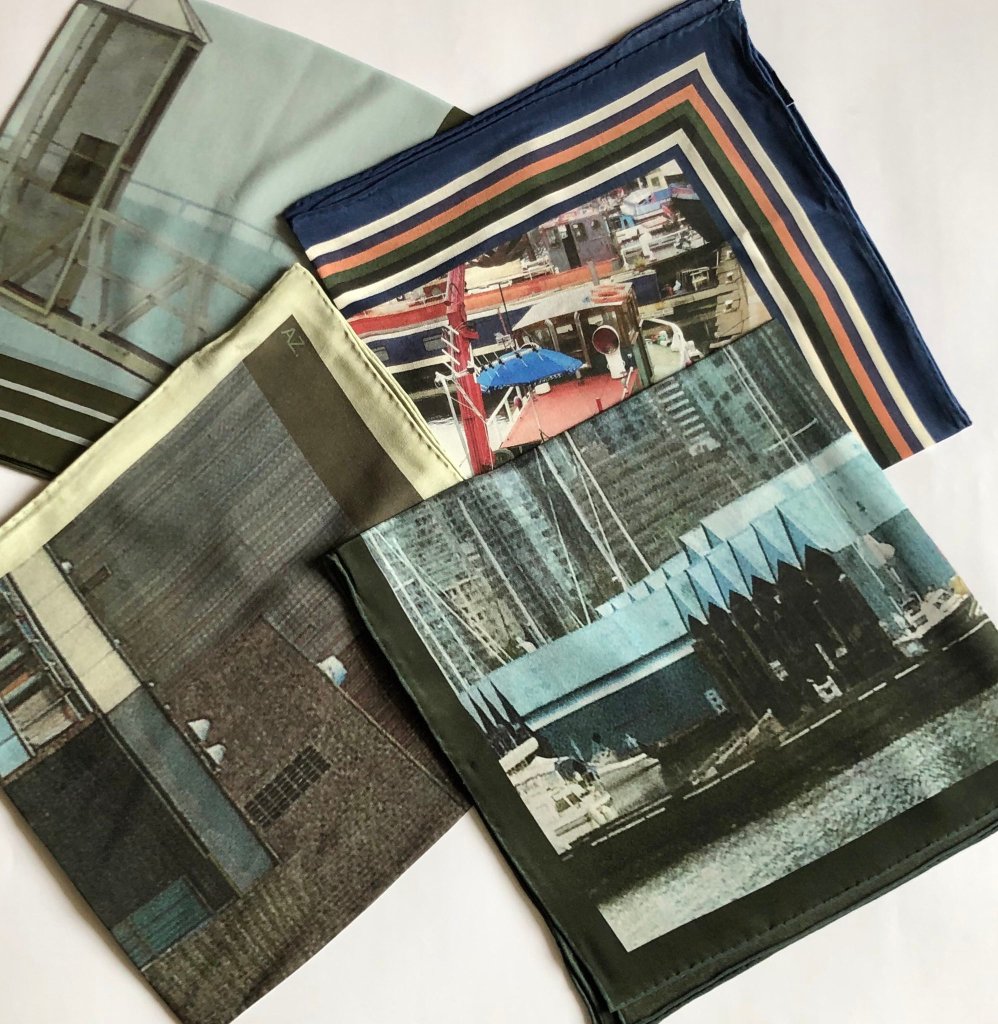
My poem Wearable Narratives (from the collection Nothing serious, nothing dangerous) is in two parts. Here is part i. It was inspired by a pure silk scarf, made by Andrea Zapp, that was on display in the shop of Manchester Art Gallery. At that time, I didn’t have a smartphone. So, here is a picture of other scarves, made by Andrea Zapp. See the note below for more information about her amazing work.
Scarf
A turquoise ribbon runs under khaki stepping stones. Tomatoes are the red carpet. Slanting shadows pull the empty staircase under water. Its fine metal tracery anchors a washing line with checked tea towel.
Cold marble columns, bleached shutters closed. Almost out of sight wooden farming implements, a clock stopped at ten to eleven, a car hubcap.
Everything here is at an angle now. What survives are the chalk drawings: a cheerful elephant, the ibis and another bird, its round black eye like a spinning top.
Note:
Andrea Zapp, born in Germany, living in Manchester, pioneered in coalescing her digital media art background with the fashion industry. Andrea has created the luxury fashion brand AZ.andreazapp. This sells high quality silk dresses and scarves printed with her own photography of urban views, rural panoramas, miniature scenarios and objects of culture and curiosity, creating a collection of stunning authentic hand-made garments.
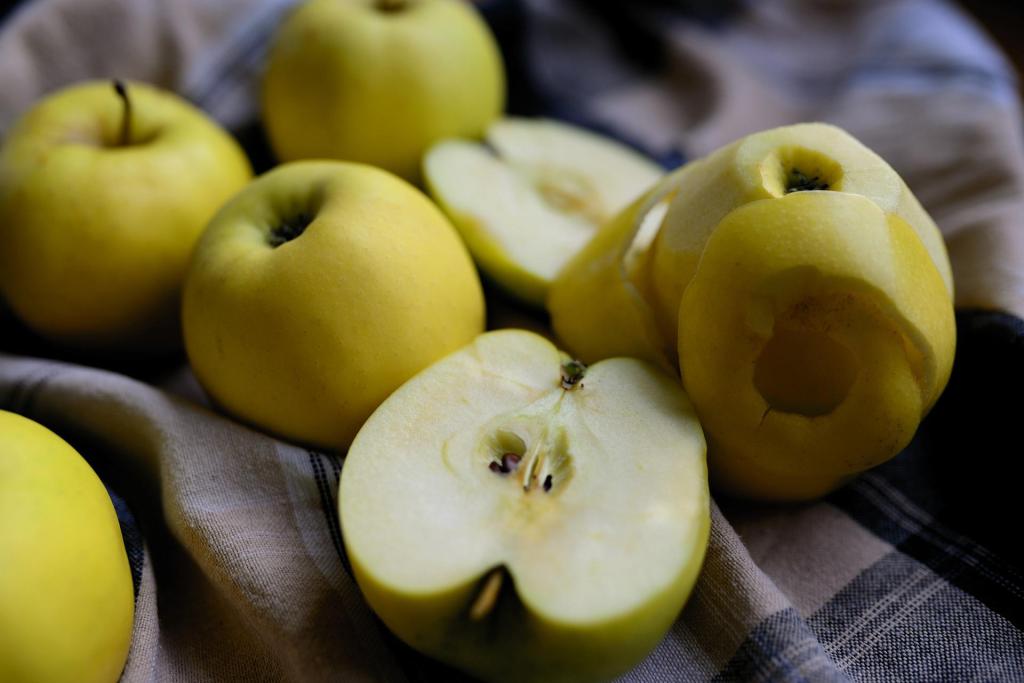
National Apple Day falls on the 21st of October. It was created in the UK by the charity Common Ground in Covent Garden, London on 21 October 1990 to raise awareness about the importance of diversity in different communities. Apparently, there are about 7,500 varieties of apple grown globally. In my local Hoogvliet supermarket I can find six: Kanzi, Pink Lady, Golden Delicious, Granny Smith, Royal Gala and Jazz.
Celebrations take place in the UK throughout October, so go to a fair, take part in an apple peeling contest, bake or eat an apple pie. Here in the Netherlands, traditional Appeltaart always has a good dose of warm spices – cinnamon, ginger, nutmeg. They are baked in a spring form and have a lattice crust. I will have mine with a good dollop of sweet whipped cream, thank you.
My poem is somewhat melancholy. It has the feel of a tanka – the first three lines giving a description, with emotion and reflection in the last two lines.
carefully quartering soft red apples into a compostable bag – I still wait for the letter that will never come
I enjoy most of the archive poems from the Paris Review which arrive in the inbox. I save many of them in my folder ‘Inspiration’.
The poem Imaginary Paintings, by Lisel Mueller (Fall 1992, # 124) is in seven numbered sections. Seven is always a good number. The length of sections varies, from one line (Love) to 10 (Big Lie).
Lisel Mueller, 1924 – 2020
1 How I would Paint the Future
A strip of horizon and figure, seen from the back, forever approaching.
2 How I would Paint Happiness 3 How I would Paint Death 4 How I would Paint Love 5 How I would Paint the Leap of Faith 6 How I would Paint the Big Lie 7 How I would Paint Nostalgia
I liked the start of the Big Lie painting:
Smooth, and deceptively small so that it can be swallowed like something we take for a cold.
Here is my attempt at How I would Paint Patience:
A small mat, wool, handwoven. Mostly pale grey, with the odd black nubbly bits at the corners.
Credit: Prawny via Pixabay
Writing prompt: If you’re looking for a subject for your imaginary paintings, you could always take one of the seven cardinal sins (pride, greed, lust, envy, gluttony, wrath, sloth) or one of the capital virtues that overcome them (humility, generosity, chastity, brotherly love, temperance, meekness, diligence). There is also prudence, fortitude, justice. Or take anything abstract, such as stubbornness, peace.
It’s four years this month since the poet Tony Hoagland died. Turn Up the Ocean was published posthumously this year.
The blurb on the back says ‘Over the course of his celebrated career, Tony Hoagland ventured fearlessly into the unlit alleys of emotion and experience. The poems [ … ] examine with mordant wit the reality of living and dying in a time and culture that conspire to erase our inner lives.’
The mordant wit can be found in some of the titles:
Four Beginnings for an Apocalyptic Novel of Manners
Why I Like the Hospital
On Why I Must Decline To Receive The Prayers You Say You Are Constantly Sending
The last few lines of this poem are:
And could you stop burning so many candles, please?
My god, think how many hours and hours and hours – think of how hard those bees worked to make all that wax!
Hoagland’s poems often go just over the page and here are the last few lines of Gorgon:
Your job is to stay calm. Your job is to watch and take notes, to go on looking.
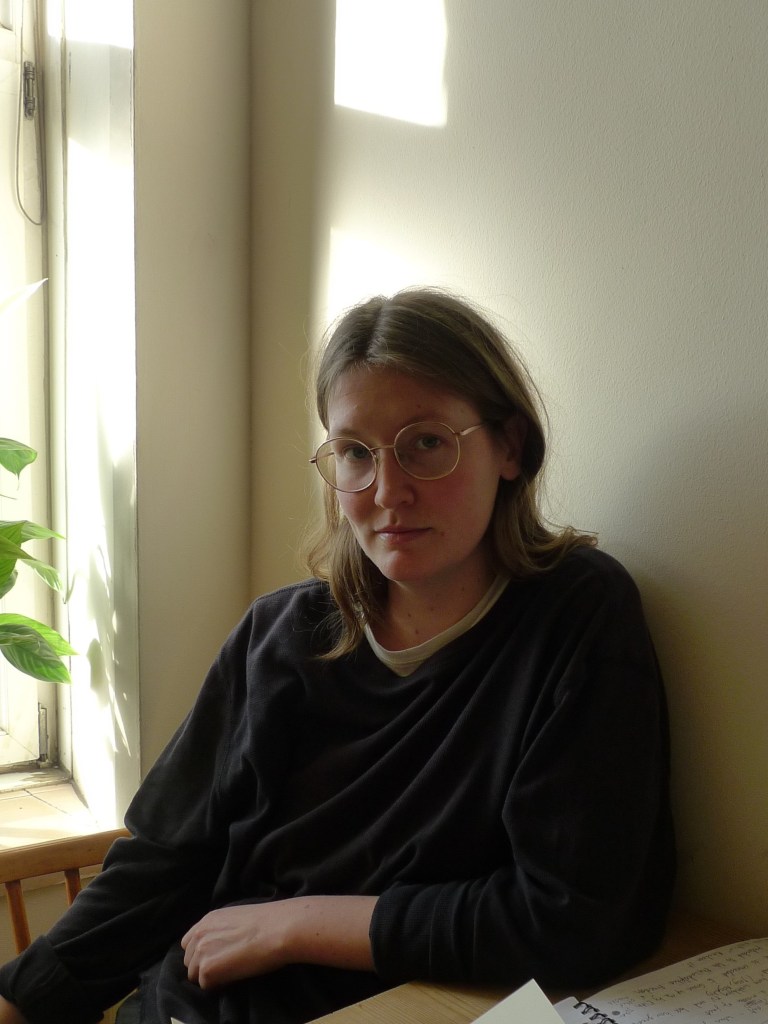
It’s an immense pleasure introducing this month’s guest poet Ramona Herdman. We met a few years ago on a residential workshop and are members of a group that meets weekly online.
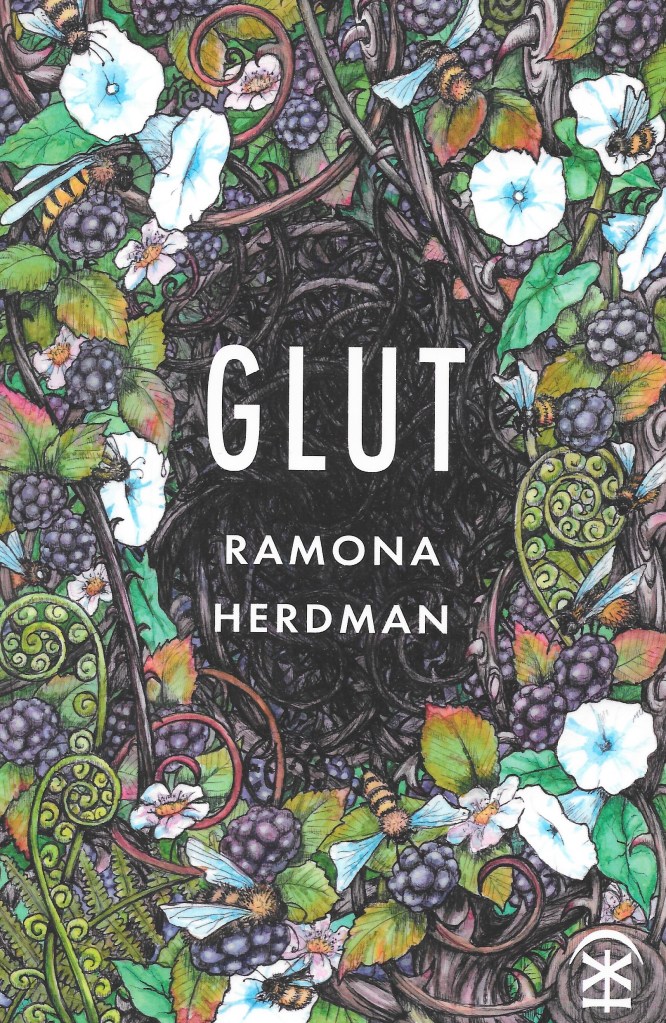
Ramona Herdman’s recent publications are Glut (Nine Arches Press), A warm and snouting thing (The Emma Press) and Bottle (HappenStance Press). Ramona lives in Norwich and is a committee member for Café Writers. She tweets @ramonaherdman
I have selected four poems from Glut, beautifully produced by Nine Arches Press, to give you a flavour of these darkly funny, bittersweet poems. I hope my choices also show their ‘quiet ferocity’ (Philip Gross). Below the poems you’ll find links to a blog about the cover (by Jacky Howson) and to a video with Ramona reading Blackberrying and Congratulations. Glorious is the word!
Blackberrying
Blooded young, we waded into the hooked shallows of hedges, caught up and cut in our toddler blundering, dirty with gritty juice and dotted-line scratches.
We without-ritual British, we atheists. Hippies’ children, grown up in the world they believe they changed – we have blackberrying as our sacrament.
At school, neater children wouldn’t eat the berries, said their mothers said no, said they had worms in that would eat our insides and poke out of our bumholes.
Now we go every year, like it’s Midnight Mass. We avoid the dog zone at the bottom of the bushes. Tell each other that by Michaelmas the Devil will have pissed them bitter.
We take offal-heavy carrier bags of berries to our parents, too old now for all that bother. We pick the children out of the tangled footings. We cook pies and crumbles in our own kitchens, competently. We placate the gods.
Cover design by Jacky Howson
Cuckoo and egg
It’s hard to soft-boil an egg in another woman’s kitchen – even the water is different.
It’s our first ‘family’ holiday together. She makes me a soft-boiled egg with a lot of fanfare and the whole breakfast-table gets involved in the hoo-hah.
And there’s a performance of trust in cracking it – the risk of a wet white, the opposite risk of a solid yolk. We’re on the edge
of an ovation when it turns out perfect. I eat it hot, like a heart.
It’s not me taking the minutes
It’s not me anymore escorting visitors from the front desk. I don’t fill the water jugs and make sure the glasses aren’t too dirty. I sometimes buy the biscuits, now there’s no budget. It’s not me too scared to ask a question or supply a fact, wondering if I’m allowed a view or am just a transcription machine.
A man once told me working with women had taught him not to interrupt. It’s a terrible world. I told him working with men had taught me to keep on talking, slightly louder. Try interrupting and you’ll get to see the flying-galleon belly of my argument as I lift off cathedral-high over you.
Don’t dare to talk over my people, including the young woman taking minutes, who is well on her way to wherever she wants, who could take your eye out with her wit. The meetings are my meetings now.
Two death in the afternoons, please
Dad, now you’re dead you scare me. Every time I think about stepping into traffic I think of you building your glass castle, cornershop-whisky-bottle by cornershop-whisky-bottle.
I had to do one of those questionnaires recently: How many times in the last month has your drinking stopped you doing things you needed or wanted to do? I put zero, Dad, proud nothing. They never ask
about the times the drink makes living possible. I think of your kitchen-drinking nights, how you told me you didn’t get hangovers anymore and I was too young to reply.
When I’m scared, Dad, I know a gluey-gold inch of brandy or one gin and tonic’s scouring effervescence will lift me to arm’s-length from caring, will calm me in a bubble of slight incapacity.
The old dread, Dad – I think now you carried it like a wolf in your stomach. The drink quiets it, but it doesn’t drown. I recently learned another cocktail by Hemingway –
‘Death in the afternoon’, champagne and absinthe. You’d find the name as funny as I do. He recommended three or five in slow succession. When I make them, I toast him. He’s family.
Dad, you’re nothing now. It’s only the thought of your life that scares me. But if there were an afterlife I’d meet you there, happy hour. It’d be dimlit and we’d sit low in a booth and they’d keep
bringing the drinks in fine heavy glasses and no one would interrupt to say this wasn’t actually heaven, this delicious blunting of feeling, this merciful cessation, and that there was something outside that was better –
like walking out on the seafront together, wind and water-roar and saying something risky and being understood.









 Acacia Publications