Aus Herzen und Hirnen spriessen die Halme der Nacht, 2019-2020. Oil, acrylic, emulsion, shellac, straw, gold leaf, wood and metal on canvas. Dims: 471 x 841,5 x 36 cm. Collection Voorlinden.
Our guest poet this month is Patrick Wright. As I was reading his collection Exit Strategy (Broken Sleep Books, 2024) I came upon the poem Archive and discovered that Patrick and I are both very interested in Kiefer’s work.
For me one of the highlights last year was visiting Bilderstreit, a major exhibition of Kiefer’s work at Voorlinden Museum, The Netherlands. A few weeks earlier I had watched the documentary that Wim Wenders made about Anselm Kiefer. I was blown away too by the film: it’s in black-and-white and one can watch it through 3D glasses.
Kiefer was born during the bombing raids in the final months of WWII. For him, everything exists somewhere in the cycle of death and rebirth. Whenever he creates a new work, he knows that one day he will destroy it: attacking it with a flamethrower, axe, bolt cutter, or red-hot liquid lead.
ARCHIVE After Anselm Kiefer
Before his landscapes scorched by war and history, paintings of straw and glue, your golden hair, Margarethe, before ‘Death Fugue’, I was back at school, deep winter. In the yard blew a few stray crisp packets; seagulls pecked at crumbs. The annex and fence had the look of an abandoned camp, in Polish hinterlands. Through a cloakroom window I peered, looking for a ghost of myself, then at a ghost of myself, as the sun poked out from a cloud and the contours of bulimia gazed back, in sepia tones. I saw the bullies too, with razored eyebrows, piercings, fists in my gut, spit on my shoulder, the stench of Lynx, using queer as an insult. With my SLR, I clicked more in hope than expectation. I fumbled with fixative, the stop bath, the gelatin swell. My negatives solarised. I kept re-visiting as a witness. Those days, I bit the inside of my lip, stubbed cigarettes out on my arm. When the dysmorphic class photos were framed, still as that winter, your golden hair, said the Kiefer print, your golden hair, Margarethe.
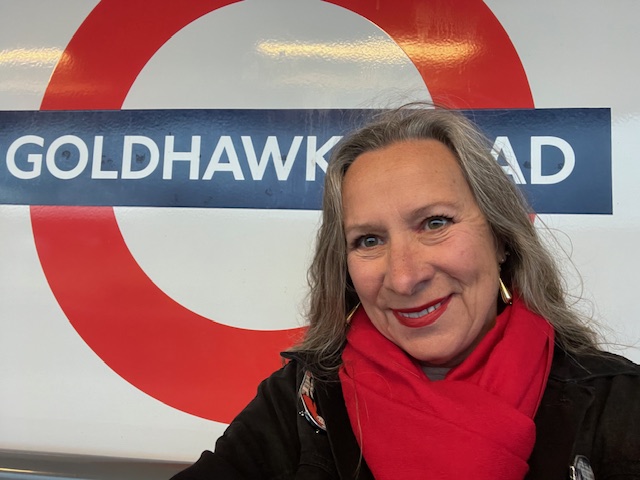
It is a great pleasure to introduce this month’ guest poet Kate Noakes. Kate and I met during the first lockdown on Zoom (a group set up by a fellow poet). Kate Noakes’ most recent collection is Goldhawk Road (Two Rivers Press, 2023). Her website is www.boomslangpoetry.blogspot.com. She lives in Bristol.
Earlier this month Kate’s poem The Sick Spring appeared on the blog. It is from her pamphlet, Chalking the Pavement, published by Broken Sleep Books in 2024. At the heart of the book is Field Notes 2020. Field Notes has 65 entries: observations of life during the first lockdown in the form of prose poems.
I’ve chosen five, from the beginning and end of the sequence. All of them show Kate’s acute attention to detail as she ‘captures the soon-forgotten details of the changes to our lives’.
Field Notes 2020
Children are rediscovering, or discovering, the pleasures of chalking the pavement with hearts and messages of love for the NHS. Hopscotch has the thrill of the new, but neither the girl nor her mother knows how to play it. I look around for a handy stone. None are at arm’s length.
*
The slates pathing my garden are sleek with wet. Dust is dampened. This morning after weeks of early summer-in-spring is a change and a good one. I’ll rest indoors trying not to dwell on my friend’s friend: just two years older than us and dead. All day the blackbirds have busied about the garden in search of nesting materials. Such industry, even in the constant day-drip of rain.
*
My neighbour tells me he’s been scaled back to three days a week with attendant pay cut, yet considers himself lucky; most staff in his firm having been let go, along with eight percent of those in hospitality.
*
A windy day for children to learn or relearn the small pleasure of flying a kite. Prescriptions need at least a week’s notice and the pharmacist tells me there is some drug rationing. We have learned that a life is worth sixty thousand pounds; in case you’re ever wondered. And again there is no surprise in discovering that some people believe rules only apply to others.
*
I want my day to always start with a fishing heron and a cormorant drying its wings on the foreshore near the bridge, the tide running out, and the sun brilliant on the water. White stripes on the river path every two metres are a constant presence that it is hard to ignore.
I had booked return flights Manchester – Exeter to visit my poet friend Kathleen. My trip was going to be in the third week of March 2020. On the 5th of March Flybe filed for administration and ceased all operations immediately. I lost £65, but I was very relieved: If I had flown to Exeter, I might well have been stuck in Devon as that first lockdown started…
On Sunday 15 March I learned the British government was considering a compulsory quarantine. The next day I emailed the owner of the campsite asking if I could arrive early. He replied immediately. I booked a flight, transferred money, packed, agonised over which poetry books to take to my ‘desert island’ near The Hague. I flew to Schiphol on the Wednesday. The local buses already had the area near the driver closed off with white-red plastic.
Here are two poems about that first lockdown:
The departure
Half a century condensed into Brexit, pandemic. At the threat of a four-month’ compulsory quarantine I fled to my bolthole in Holland.
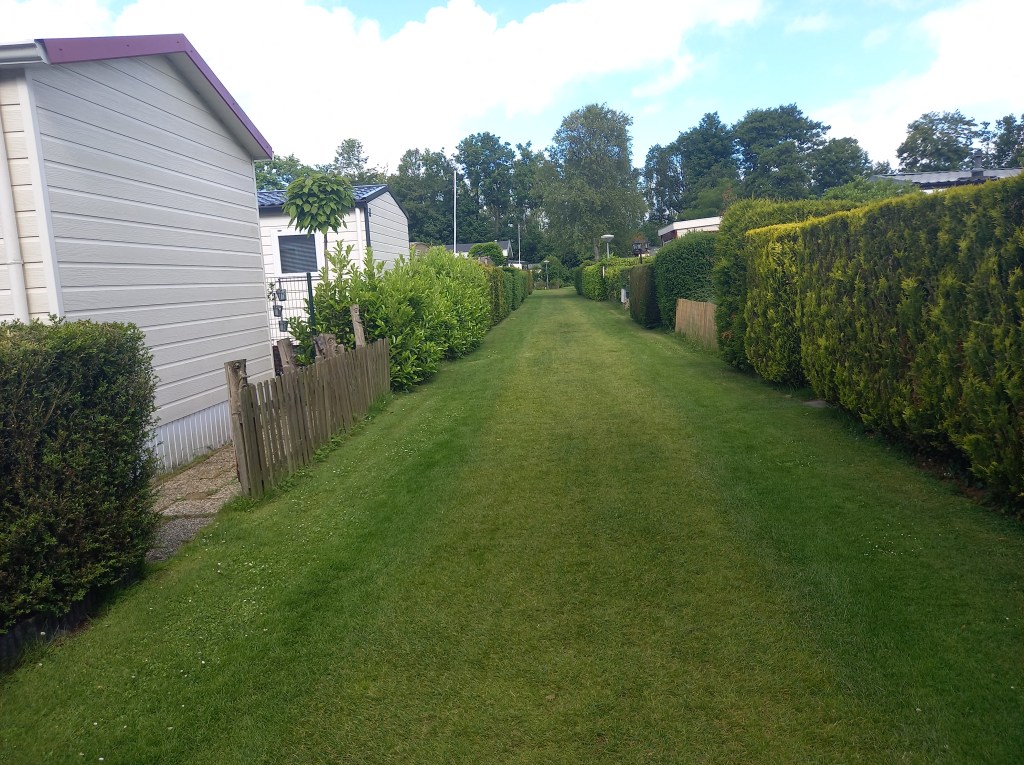
Six months of safety in a static caravan, waking to birdsong each morning, shielded from the sun by the golden elm. I walked my daily rounds on the grass lanes.
Forsythia, tulips, narcissi, rhododendron, pyracantha, salvia, rock rose, asters: the seasons’ steady markers. From a distance I waved to neighbours finally arriving.
In the cupboard of the spare room lay the letter confirming my ‘settled status’ on the other side of the North Sea.
The undertakers
A double spread in the paper features a large photo.
This man, in his thirties, a narrow horizontal moustache, soft smile.
He sits in a wooden boat, his right hand resting on a plain white coffin.
People are asked to email text and selfies. Made into cards, these are placed on the coffin.
He is based in Amsterdam, will transport you safely through the canals.
That undertaker has just opened a crematorium. He also owns a chain of hotels.
The pandemic has cut the numbers allowed to be in the room. There is livestreaming.
People, he says, are glad of it. The intimacy makes it easier to speak.
At the end of September 2020, the campsite closed. I got a Covid test somewhere in the centre of The Hague and flew back to Manchester.
Late lockdown poem
I wake up and know, of course, that I am not a morning person. The sound of rain, of course, and fewer sirens as people are supposed to be at home. My lifelines are the same, of course: motto, comfort break, medication. Of course, I think about exercise, settle for Composer of the Week, dead, of course.
Marie-Louise Park, Didsbury, Manchester, UK
A postage stamp, Joshua calls it
He’s right and there’s traffic noise from the main road and people with dogs on long leads, but not all the benches are dedicated to the dead, Marie-Louise is a pretty name for a park and the 43 Airport bus is a hybrid and no-one much was going to the airport that autumn: I often had the bus to myself, both ways.
As I was updating the website recently, I was reminded of the lovely interview that Andy N Poet did that very Friday. He came to the flat in Manchester where I then lived. On the 3rd of March I had launched a pamphlet and my second collection at the International Anthony Burgess Foundation. The launch was one of the reasons for the interview. Andy has now done several hundred interviews. You can find them all on Spokenlabel.bandcam.com Here is the link to my interview: SpokenLabel
When I listened to the interview this week, it felt spooky at times. Early February 2020 I had received confirmation of my ‘settled status’. I told Andy that I hoped to spend ‘most of the summer’ in my caravan in The Netherlands, that I couldn’t immediately tell him who my ‘desert island’ poets would be. At one point Andy mentioned the ‘virus’.
Here is a poem about that Friday from Kate Noakes who is our guest poet this month. The poem is from her 2024 Chalking the Pavement published by Broken Sleep Books.
The sick spring
Thirteenth March, a Friday with which comes a most lauded play, Stoppard’s last contract: Vienna, and a family succumbs, fortunes and losses in Leopoldstadt.
I am treated to the stalls by a friend of a friend, a nice man I do not know. His cancelled cultural holiday ends with a short email critique of the show.
I give him scenes, chronology, pictures, timings avoiding history’s clichés; how I stepped into busy Leicester Square with foreboding that hurried me away,
and how I scurried home to a semi-death: headache, sore throat, cough and struggle for breath.
It is a pleasure to introduce our February guest poet Rob Miles. I do not know Rob personally: we have been Facebook friends for some time. I bought a copy of his recent collection Dimmet which was published by Broken Sleep Books. See below the poems for Rob’s biography.
The glorious cover image of a murmuration was designed by Aaron Kent. Dimmet is a West Country word for dusk, twilight. Katherine Towers notes of the collection: ‘These are poems of great precision and delicacy’. I’ve chosen four poems which demonstrate these qualities.
Dimmet
His hands still bronzed, still baling-raw. His voice no longer snared, whisper-low as decades ago, in this same field, he guided me
to not disturb that horse; circling quietly, its half-scattered straw an ingot melting, and my thin flames no match for such a sunset anyway.
*
On this, another near-to-night, it’s clear that he has no more kept his mind from wayward sparks than I have closed my eyes
before any fading fire, ever since recalled a slow white shadow steady on its dial in the always almost dark.
Café Poem
Just when I think there is nothing so boring
as someone else’s childhood a toddler
in dungarees is guided around our table
by his puppeteer parent, arms up, in a vertical sky-dive, or
like a drunk, when walking is more about not falling
every step forward rewarded with a double high five.
I whispered to the dog
that she’d been a winner a Crufts champion
at least twice. Once she saw off a Dobermann, burglars, a werewolf
even the odd Sasquatch. I reminded her
as her old eyes darkened that she had saved lives.
Making Way
A keeper, you said of the house, but I’d sensed everything trying to make its way: those errant velvet fingers from your orchid pots; the oak putting on its chain mail of ivy and moss and losing; the birds we fed still pinned to their shadows; crisp wasps electrocuted by views through grubby double glazing, and you just weeks before, showing your wrists as if uncuffed, asking for my thoughts on a fragrance.
Biography
Rob Miles is from South Devon, and he lives in Leeds where he is Fellow in Film Studies in the Centre for World Cinemas and Digital Cultures at The University of Leeds. His poetry has appeared widely in magazines and anthologies, recently in Stand, New Welsh Review, The Scores, Spelt, 14 Magazine, Ink Sweat and Tears, One Hand Clapping, Poetry Wales, and four Candlestick Press pamphlets. He has won various awards including the Philip Larkin Prize, judged by Don Paterson, the Resurgence International Ecopoetry Prize, judged by Jo Shapcott and Imtiaz Dharker, and the Poets & Players Prize, judged by Sinéad Morrissey.
Lucy Newlyn describes Dimmet as ‘the best collection of contemporary poetry I have read in a long while’, and John Glenday writes: ‘When it’s done as well as this, there’s nowhere on earth poetry can’t go.’
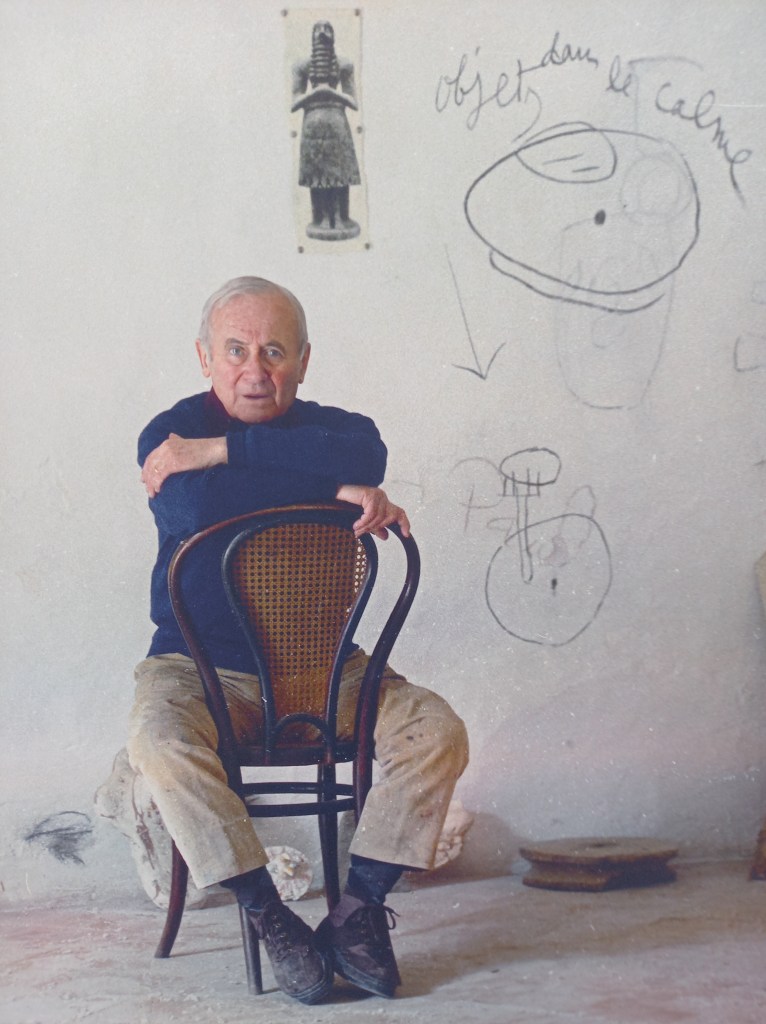
It’s been a long time since I’ve been out to fill that well. I’ve had health issues and sat at home with the black dog. The exhibition of Joan Miró’s sculptures at Beelden aan Zee is almost closing. On a cold and sunny Tuesday, I got two trams to Scheveningen.
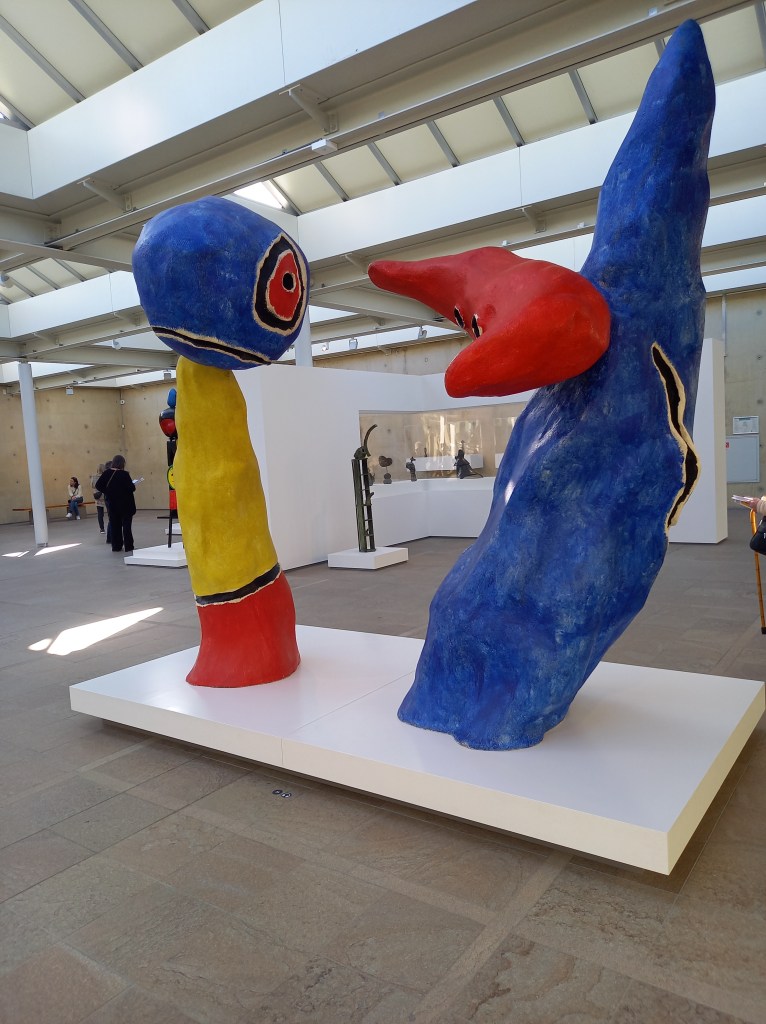
Pair of lovers playing with almond blossom
Beelden aan Zee is the only Dutch museum specialising in sculpture and it’s in a great setting. The authorities in The Hague insisted that the building should not be visible, so it’s hidden inside a dune, and it is mostly underground. From the terrace you can only see the sea, not the busy boulevard. All the materials have a sandy colour. Through plenty of glass in the roof there is a lot of light.
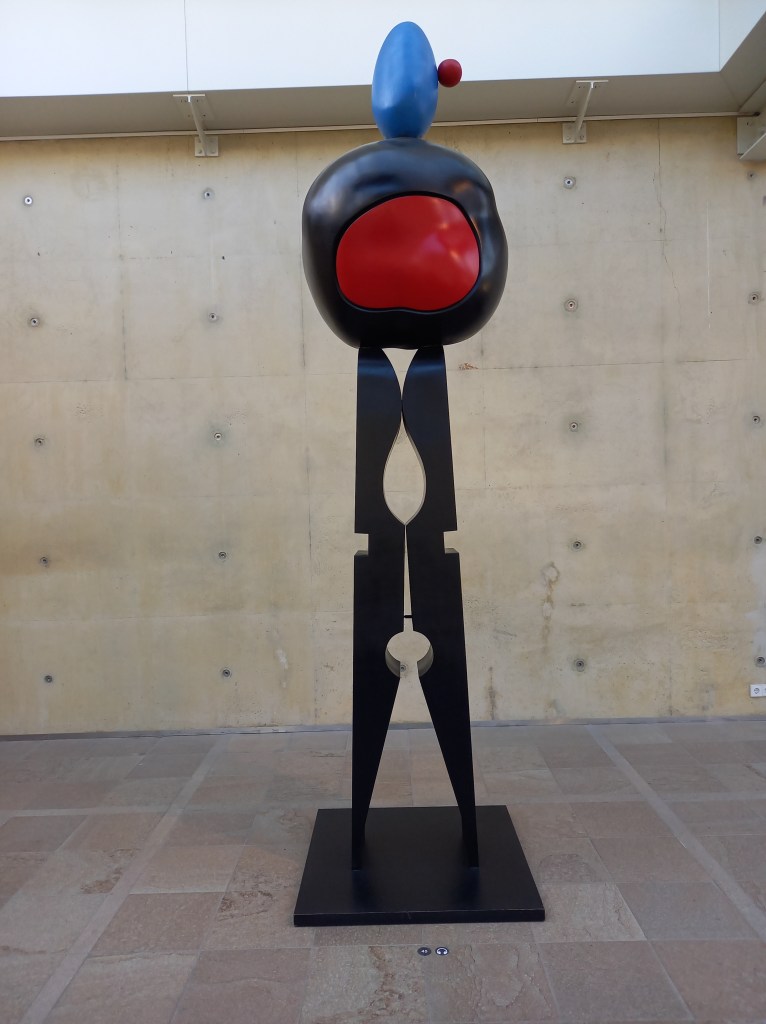
In his studios by the sea in Mont-roig del Camp and on Mallorca, Miró’s love for sculpture was given a huge boost. The (natural) objects he found on his walks were incorporated into sculptures and assemblages, along with everyday objects. The giant clothes peg (painted synthetic resin) was a design for a prestigious project in Central Park, New York. It would have been at least 14 metres high, though it was never realised.
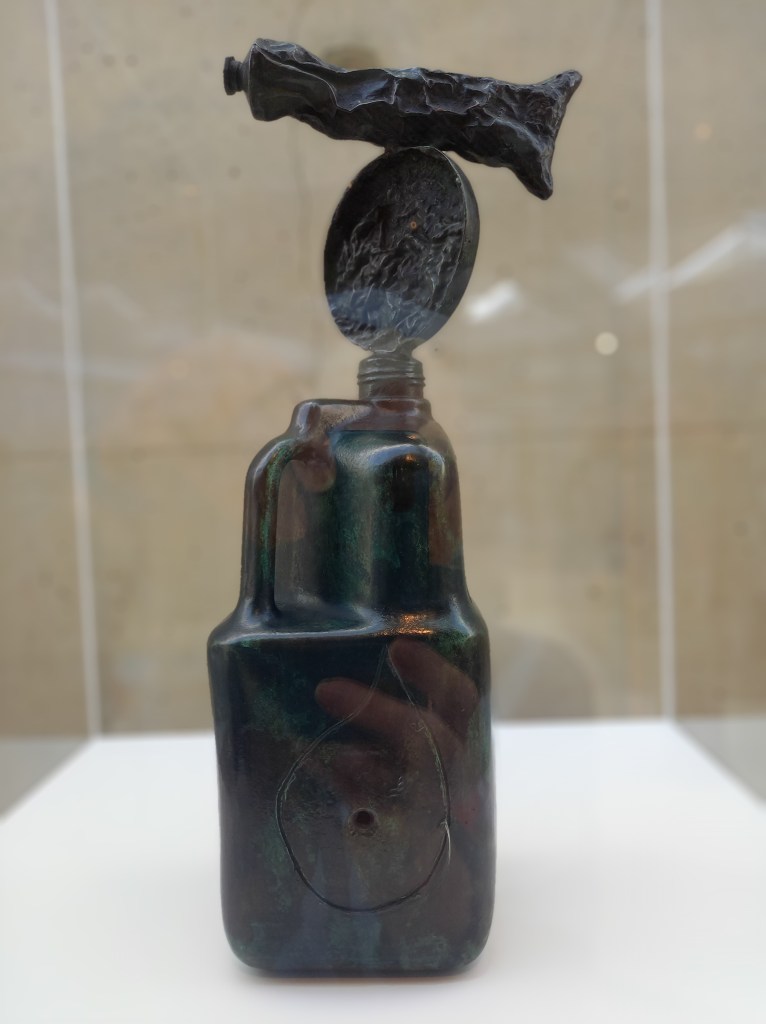
You can see the objects in this bronze sculpture: a paint tube, plastic bottle, spoon. Miró’s bronze sculptures were created using plastic models that he continued to shape until he found them good enough to cast.
The sculpture Monsieur et madame (Sir and Madam) is made of painted bronze. Two different objects form a couple. A square, red-painted stool stands for the man. On top of it is a rectangular white box with a face on it. The round, black stool represents the woman. It has a yellow egg on it. A playful, archetypical representation of masculinity and femininity.
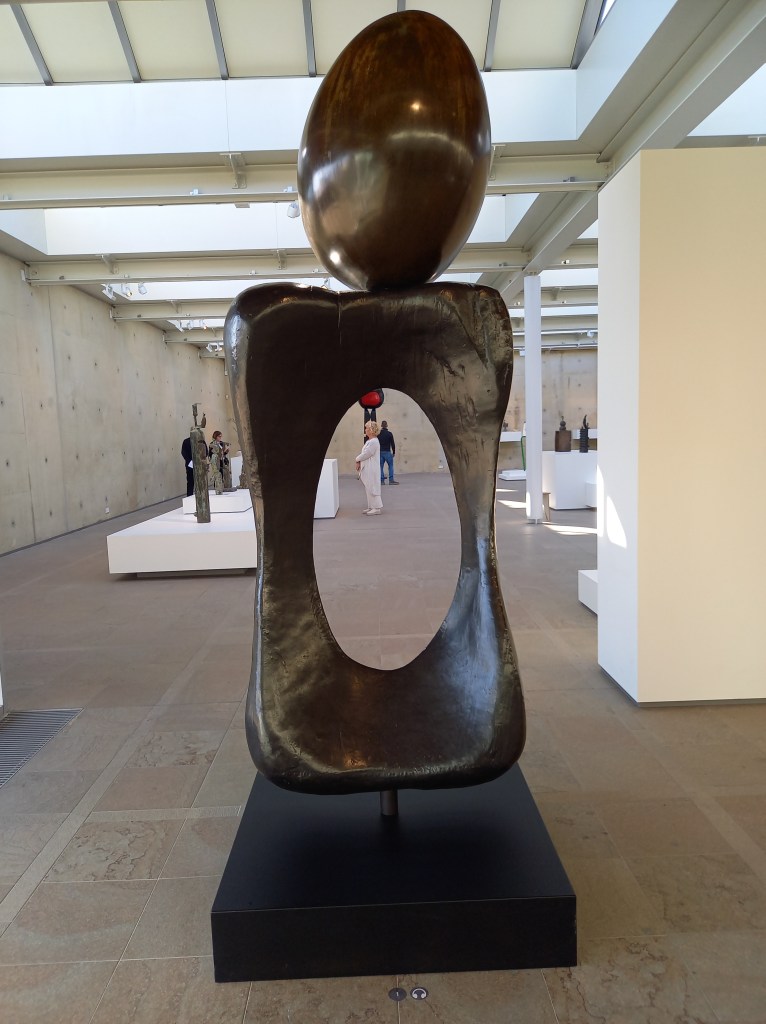
The Monument is the first sculpture as you enter the main hall. You can see some of the light coming through the roof.
It was hugely inspiring to see how Miró continued to innovate and be curious well into his 70s and 80s.
Rachel Davies and Hilary Robinson have been friends for over 20 years. Friends call them the ‘poetry twins’. They are both accomplished poets and you can find their biography below.
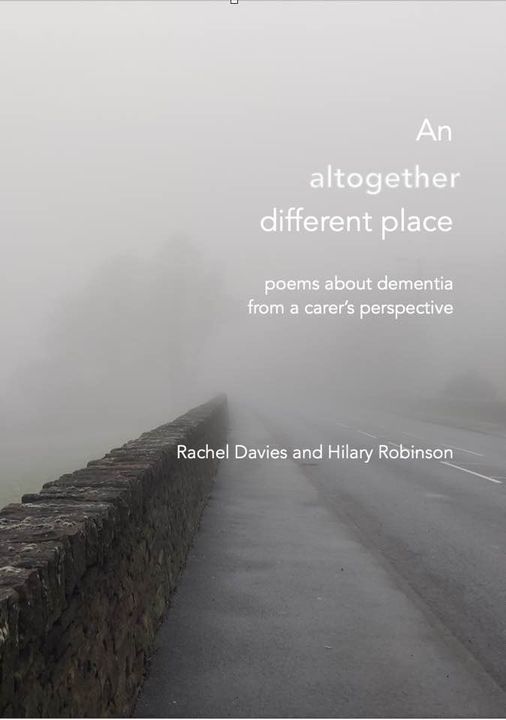
An altogether different place, published by Beautiful Dragons Squared, is a joint project. In 2022 Hilary’s husband was diagnosed with vascular dementia; in 2023 Rachel’s partner with dementia and Lewy bodies. In the introduction they write ‘dementia is a catalogue of cruel diseases’. Living with and caring for someone with dementia ‘you come to know grief by slow degrees’. Through poetry Hilary and Rachel ‘found a joint space to laugh, cry, find context and write out their experiences’.
The collection is sold to raise essential research funds for dementia charities in the UK. It is a privilege to share a selection of the poems here: Brainworm and Seven ways oflooking at a husband are by Hilary. Rachel wrote Degrees of Challenge and This is not apoem about dementia which was awarded 2nd place in the Hippocrates Prize 2024.
Brainworm
There are many crap poems online for those who care for loved ones with dementia. Dementia has a symbolic flower – the unimaginative forget-me-not. I’ll have none of that shit. I want the gristle of it, the offal, brain-spatter, white matter of it. Show me the MRI with extensive vascular changes, let me count the dead parts of the brain so I can explain, daily, what ails my love. I watch Dirty Great Machines, find Big Bertha in Seattle, tunnelling machine on steroids moving at thirty five feet a day. Something has wormed its way into the tiny vessels inside his head over years and now whole sections of his once-sharp brain have died. It’s our Golden Wedding Anniversary this year. I don’t know who I’ll be celebrating with.
Seven ways of looking at a husband
1 Straight on. Taking in his 2-day grey beard, his nostril hair and ear fuzz. His smile.
2 Side profile. Noticing his cute nose, the same shape as our daughter’s.
3 From the bedroom door. Noting the cocoon he’s made of the duvet.
4 Across the kitchen. See, he’s forgotten how to toast his fruit tea cake, make coffee.
5 From the driver’s seat. Clocking his wince as you pull out safely onto the busy main road.
6 Across the care home corridor. Seeing his smile grow, then his arm around you, his whiskery kiss.
7 On the care home terrace. Look, he can’t turn his head to where you point. Misses the squirrel.
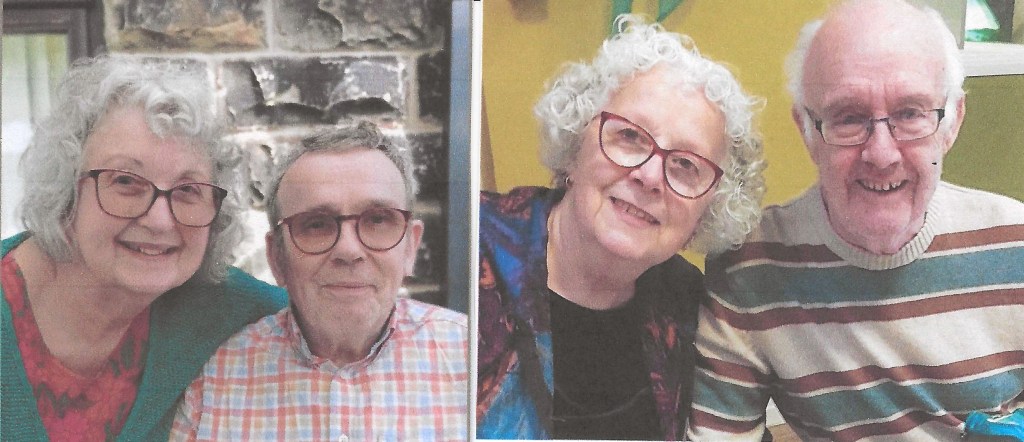
(L) Hilary with David (R) Rachel with Bill
Degrees of Challenge
I’m watching you struggle to break the seal on an ice cream wrapper and I think of the time you redesigned the roof of Piccadilly Station, worked in millimetres to ensure each pane of glass
fitted exactly into the space you’d drawn for it. I remember the night you clipped on a safety harness, climbed onto the roof to inspect each perfect joint, came home buzzing but satisfied at day break.
Tomorrow you’ll shuffle out to the Age UK minibus, the driver watching you don’t slip on the wet steps; but tonight you’re making a major task
of breaking into a Mini Magnum. I know better than to offer help; eventually you’ll pass it to me, say I’m sorry, I can’t seem to
This is not a poem about dementia
I am opening the windows and doors letting in fresh air to blow dementia down the lane like giant tumble weed
I am clearing out drawers and wardrobes filling black bags with hallucinations donating them all to the Age UK shop
I am having the Lewy bodies serviced unblocking its pipes flushing confusion down the drain with the incontinent waste
I am partying like there’s no dementia raising a cake with bicarb of dementia licking up the fluffy dementia crumbs
I am sleeping peacefully in the quiet night dreaming a poem that has absolutely nothing to do with dementia
Biographies
Rachel Davies is a mother, grandmother and great-grandmother and a retired primary school headteacher. Her poetry is widely published in journals and anthologies and has been a prize-winner in several poetry competitions, most recently, the Hippocrates Prize 2024. A selection of her work was published in Some Mothers Do… (Dragon Spawn Press 2018). Her debut pamphlet, Every Day I Promise Myself, was published by 4Word Press in December 2020. Since retiring she has achieved an MA in Creative Writing and a PhD in contemporary poetry, both from Manchester Metropolitan University.
Hilary Robinson has lived in Saddleworth for most of her life. She met her husband, David, at secondary school. She gained a BA (Distinction) and a PGCE and became a primary school teacher. After a successful career, Hilary retired and started a Creative Writing (Poetry) MA at Manchester Metropolitan University and gained a distinction. Her poetry is published in print and online journals, and in several anthologies. Her poetry has also been set to music by RNCM students of composition. In 2018 some of her problems were published by Dragons Spawn as Some Mothers Do… and this was followed in June 2021 by her first solo pamphlet, Revelation, published by 4Word Press.
It is a privilege and a great pleasure to share three poems by Kathy Pimlott from her third pamphlet with The Emma Press, published this month. It is ‘an honest, lyrical and nuanced journey through the complexity of bereavement’. The poem What I do with you now you’re dead was longlisted for the National Poetry Competition 2023. Further down you’ll find Kathy’s biography and links to her website.
Death Admin I
Your demise constitutes a third off council tax; the removal of a vote you seldom cast and then only to be contrary; write-off of a modest overdraft; the bill for an overpaid pension. Tell Us Once promises it will be a doddle. It is not. I repeat time and again in spoken and in written words to the indifferent or distracted, He has died. What do I need to do?
What I do with you now you’re dead
The Queen is dead too and on her way to a proper tomb. Everything’s shut and there’s nothing on tv, but the sun comes out so I go to the mimosa tree where, months ago, I dumped, in a laughing panic, dumped, about a quarter of your ashes and ran away, the illicit thrill exactly what you would have wanted. Today, with a flask, shortbread,
I’ve come because, while I don’t love the Queen, it seems like a fitting thing to do. This royal park is empty, quiet, allowing me to cry all through its splendid long borders with their harmonious purple and blue planting until, on a near-enough bench, I sit. By my feet, Lamb’s Ears offer silky comfort, as does the pile of pistachio shells,
little coracles, showing someone sat here eating a bagful. You kept your shells in the pockets of your gardening coat which I emptied out before taking it to the charity shop with your best shoes. The mimosa’s not out of course but its ferny leaves show promise of the glory to come. A robin perches closer than he should, inspects me,
then accepts a crumb or two. Your ashes have disappeared, no longer so alarmingly burnt-bone visible, so very there. They say the old Queen’s coffin is oak, lined with lead. Three-quarters of you is still in the back of the wardrobe. A crow chases off my robin. So much peril. It’s enough to be sitting thumbing Lamb’s Ears, thinking about you.
The Passing Visit
A friend came by from Brussels and we talked of our dead or rather about what they leave behind, the stuff in storage,
the binding strands. I told him more than I’d told most, of how (and I said, then rejected, the word tumultuous),
how textured our long, long marriage had been and by textured I meant bumpy, dropped stitches, amateur darning. I told him
how often you fell in and out of love and how I left and returned more than once. Perhaps because I didn’t care enough, I said.
And perhaps I didn’t. There was something he wasn’t telling me but the sun was out and we walked the courtyards and backways
of the neighbourhood, crossed the bridge, watching the sky whiten and the coloured lamps in the trees come on. We spoke of cities,
their pleasures. The comfort I find in the river. How Brussels’ Senne is covered over, subterranean. Of moving along and clearing out.
Biography
Kathy Pimlott has two previous pamphlets with The Emma Press: Goose Fair Night (2016) and Elastic Glue (2019). Her debut full collection, the small manoeuvres, was published by Verve Poetry Press (2022). Her work is widely published in magazines and anthologies, and she has been longlisted, placed and has won several poetry prizes.
Here in The Netherlands Kookboekenweek (Cookery Books Week) has just ended. A recent annual event, it’s designed to promote cookery books. Bookshops and libraries organise workshops, lectures, and tasting events. Of course, it’s all to encourage people to buy books as presents for December: St Nicolaas and Kerstmis.
Professionals shortlisted six books (Vietnamese, Japanese, Indian, Italian (2), and baking skills). They’ve chosen Bloem Suiker Boter, by Nicola Lamb, translated into Dutch. I’m going with Breakfast, a poem celebrating poetry and friendship.
Breakfast
Bridie would be in the kitchen, barking with Finn and Tara in a metal cage under the table. I’m in your backroom, sheepskin on the seat of the wooden chair, just gone 9 o’clock this Tuesday.
You’ve made the scrambled eggs exactly as I like them, with enough mustard and fresh chives. Now you’re coming in with yours, followed by your small dogs who settle on the settee, by the fire.
We catch up over this monthly meal. Soon we’ll sit silently behind our laptops, typing up poems from old notebooks. Now eating toast with ginger preserve, I look out of the window; the smiling Buddha is lit up by the sun.
Earlier this year, a group of artists in The Netherlands set up the Ongelezen Boeken Club (Unread Books Club). It is a sad fact that many library books are never borrowed. Currently, there is an exhibition in a public library in Amsterdam featuring some of their unread books.
Upstairs, around 200.000 books are on loan. If a book is not taken out during a period of two to three years, it moves onto the ‘null list’ and disappears downstairs. Here a good 400.000 books are stored along 24 km of shelving. At the exhibition, there is an old-fashioned telephone on which visitors can ring and reserve one of the unread books on the ‘nul lijst’.
The artists have declared Thursday 19 September as the first Nationale Ongelezen Boekendag (National Unread Books Day).
There is the concept of the anti-library: a collection of unread books as a research tool, as an ode to everything one wants to explore. Related to that is Tsundoku, acquiring reading materials and letting them pile up. Many poets I know feel somewhat guilty about new poetry books piling up.
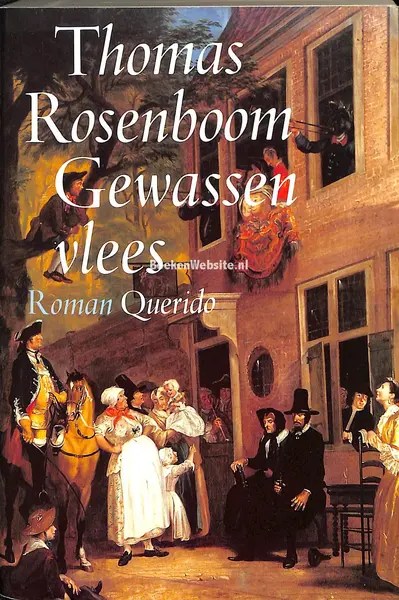
This is the cover of a historical novel, Gewassen Vlees, by Thomas Rosenboom. It won the dutch Libris prize (worth 50,000 Euros) in 1995. It’s over 700 pages long. I am never going to read it. A friend gave it to me. He died in 2000 and that’s the reason it’s still taking up shelf space.









 Acacia Publications