Category Archives: Art

Music – poem

Schimmel sideways


Looking in the Cloud for a picture of a frog I came across a photo of my piano: a white horse (Schimmel). My friend Marianne who left me the old caravan had a digital piano here. I took that across to the UK and started having lessons with John who came to the house.

The next year (2009) I even took the Grade 1 examination. Turned up at the venue to find bemused children staring at me. I passed, just short of a Distinction. As a reward, I got  a proper acoustic piano. Found this lovely Schimmel with a warm European sound.

Horror! One day I lifted the lid to see a moth appear from between two white keys. Yes, a proper infestation. Fortunately, the wonderfully eccentric tuner, also called John, managed to take the piano apart and deal with that. I continued with lessons. But I was too anxious to go for the Grade 2 or Grade 3. When I moved into the flat, so did the piano. On its side, still a mellow sound. I sold it a couple of years ago. It went to a good home …

The poem Music is from my second collection Nothing serious, nothing dangerous, published by Indigo Dreams Publishing (2019).

 
Music

There was always music going on in our house,
live music, piano and song. The organ was
down the road, past the Catholics’ houses.
We were Protestant then, some of us, anyway.

There was always music in our house.
Bach on a black piano and Brahms
Mein Mädel hat einen Rosenmund.
My mother, the diva, practising before
her weekly lesson with the best alto
in Holland, who kept a pet monkey.
My father, with his piano hands,
shaking his vigorous black hair.

In our house there was always music.
More often than not it would be
minor chords, discordance, long
silence above the empty bar lines.

Moment – poem


Clingendael 2

Photo credit: Ted Koehler

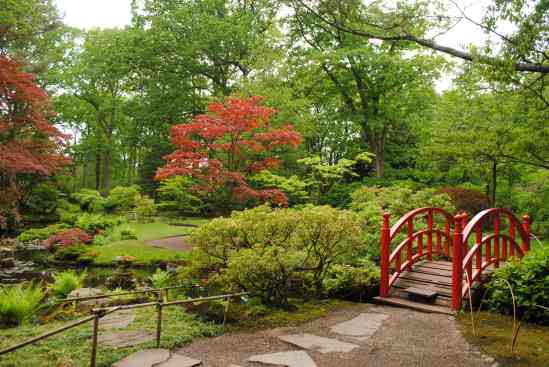
The warm, sunny weather this week has helped me to stay more in the present. I’ve been for walks in the nearby estate of Clingendael.

Clingendael estate has a 17th Century manor house which is home to the Dutch Institute for International Relations. Since the 16th Century the gardens have been remodelled, from the original French design, to the popular English landscape style. Now you can find a rose garden, splendid azaleas and rhododendrons, and a walled fruit garden. There are some marked walks, cycling paths, and canoeists and rowers can travel through by water.

However, Clingendael is most famous for its Japanese garden. It is the only Japanese garden from around 1910 and is, therefore, of great historical importance and a state monument. Marguerite M, Baroness van Brienen made several trips to Japan by ship to purchase the lanterns, statues, bridges and the wooden pavilion. Because of its fragility, the Japanese garden is only open eight weeks of the year, from mid-May to early July. Because of the Corona-crisis, it is closed. Here you can view a short video clip that The Hague city council put on their website.

Clingendael 3

Photo credit: Ted Koehler


My poem Moment from my second collection Nothing serious, nothing dangerous was inspired by a poem with the title This Moment by the Irish poet Eavan Boland who died recently, aged 75, after a stroke. Her poem, with its short, choppy lines starts A neighbourhood/At dusk and is an excellent example of how a short poem can give us a snapshot of time, the night and temporality. You can read the original poem here. It is deceptively simple, but Boland uses several poetic techniques to achieve the effect, such as alliteration and repetition.

 
Moment

A suburb at dawn

People are turning back
from dreams
into their own lives

Frost and spiders,
shrubs cradle themselves.

One side of the road is black.
One row of houses a yellow pink.

A cat wakes up
to the footsteps above,
secure in his oval basket.

Frost fades,
spiders stretch,
ferns unfold in the sun.

The light streams in – poem


Keukenhof 18

Yesterday afternoon I watched a TV programme about the Keukenhof, a major Dutch tourist attraction. Annually visitors come from over 100 different countries. A team of 40 gardeners has worked for three months last autumn planting around seven million bulbs – tulips, hyacinths, narcissi. Easter w/end is usually one of the busiest times; this year the Keukenhof will not open to visitors.

The photos are from 2018 when I went with my sister and brother-in-law. Now you cannot visit the Keukenhof, the Keukenhof will come to you. On the website they will be posting more videos. Go to de Keukenhof


purle tu;los


The poem is by Thomas Tranströmer, from his collection The Sad Gondola, 1996. May you and those dear to you be safe and sound this Easter.

 
The Light Streams In

Outside the window, the long beast of spring
the transparent dragon of sunlight
rushes past like an endless
suburban train – we never got a glimpse of its head.

The shoreline villas shuffle sideways
they are proud as crabs.
The sun makes the statues blink.

The raging sea of fire out in space
is transformed to a caress.
The countdown has begun.

Vanished – poem


broom-2884860_1280

Photo credit Milliways42 on Pixabay

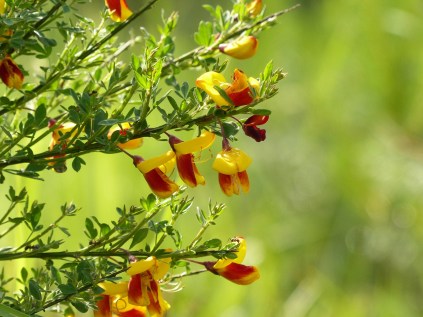
The storm last weekend changed my To Do list: on Sunday morning I opened the door to see the terracotta-coloured broom had been cut down – two parts lay entangled on the lawn.

 
I had planted that broom with its coconut scent, the yellow forsythia and white spiraea as a new hedge in spring 2012 after the new caravan was towed into place November 2011. Nico, the trusted on-site DIY man had removed the gate, shrubs and old hedge, and had taken apart the old wooden caravan my friend Marianne had left me a few years earlier. When she bought that old caravan her partner, a sculptor, had trimmed the tall conifers and shaped them into four guards. I had wanted to keep these, so Nico dug them up and they’ve been attached to the new fence. You can see they’re beginning to look grey and grumpy…

the for men
Good things happened this week too – an extended Skype lunch with a good friend in Manchester. The onsite shop and snack bar has opened, so I can treat myself to the occasional saté and French fries.

I hope that you and those dear to you are keeping well and safe.

The poem is from my second collection Nothing serious, nothing dangerous, with Indigo Dreams Publishing, 2019.

 
Vanished

Vanished the coconut scent of the bronze gorse,
forsythia, the thin red stalks of fuchsia.

Lavenders are dotted around the borders,
a white one with the old red rose that Marianne planted.

The shadows must rest in the memories of grass blades.
Does grass carry its memory from year to year?

Early evening already, the new conifer hedge catches
the sun. The single siren of an ambulance going to Bronovo.

A blackbird hides among the orange berries,
sky is greying. Vanished into the earth
my friends, enemies. Finches swing on the fat ball.

Ferry crossing – poem

Fokkina_McDonnell_Poetry_Launch_3March2020_with_GKB_Painting (002)

The Departure, book and me (Photo: copyright Sophie J Brown)

 
Here I am with my second collection Nothing serious, nothing dangerous at the launch, held at the International Anthony Burgess Foundation, Manchester on the 3rd of March. It was a wonderful occasion, made very special by Graham Kingsley Brown’s painting The Departure being there too.

His daughter Sophie Brown (herself a talented artist) designed this website. Visit www.grahamkingsleybrown.com and click on the Curator’s Diary for her account of the launch and to read what the meaning of the painting may be (entry 28 November 2019).

Below is the first poem of the book. This may well be the ferry from Harwich, UK to Hook of Holland, the Netherlands. A ferry crossing is a departure of a kind …


Ferry crossing

Two people sit at a table by an oblong picture window.
Sun lights up their hands which are curled round coffee cups.

The window is made of safety glass. There have been announcements:
location of lifebelts, life rafts, long and short blast of a horn.

While words are hidden at the obscure side of imagination,
other people are queuing for lunch or buying alcohol in the shop.

The folded hands are the back of playing cards, The Queen of Spades,                                    operas, novellas, the shortest of short stories.

It is not strange to see these cards turn into sea gulls.
A white ferry is a city where nothing is permanent.

A man with a frown – poem and writing prompt

rain-3518956_640

Photo credit: Pixabay

It is March, so here is an example of personification. It comes from a workshop: we were asked to choose a month and write about it, as though it was a person.  Do you see March as a man too? Does his emotional state reflect typical March weather?


March

He is a man with a frown,
walking in a military
manner. He is the eldest
son of a Rossendale baker, who
married young and placed his hopes
on other people’s shoulders.

He studied accountancy at a redbrick
in the Midlands, ironed shirts himself,
lost his accent, met a nurse
in town one night, got drunk,
a lower second degree, a baby,
a small semi in the suburbs.

Last year he didn’t get a rise,
didn’t get promotion either.
He thinks about renewing insurance,
calculates the cost of divorce,
puts his hands in his pockets and
strides over the zebra crossing.

He often feels like going crazy, going
off with a woman half his age, living
in the south of France, but he walks
back to the empty house, hiding
under a large black umbrella,
cursing under his breath.

Celebrating …

Dublin photo

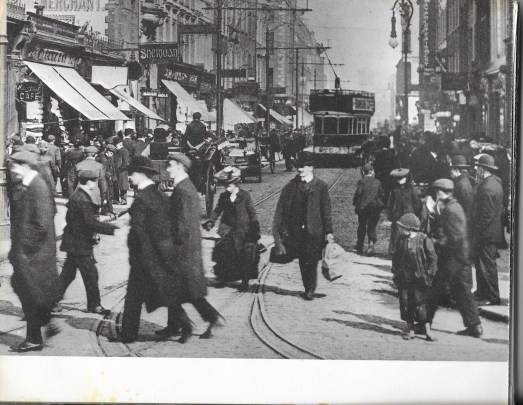
North Earl Street, Dublin, 1904

I am celebrating! Just two working days after I applied, the Home Office emailed me confirmation of my “settled status” in the UK. Hence a post with a food poem …

This stew combines two foods known since the earliest Irish literature. Bacon (tinne or senshaille) is mentioned many times in the medieval Vision of MacConglinne, as are sausages, particularly called Maróc, and another called Indrechtán. Leeks and oatmeal were no doubt used in the earliest form of Coddle, but since the eighteenth century, potatoes and onion have supplanted them.

The recipe for Dublin Coddle is in my copy of A Taste of Ireland in Food and in Pictures by Theodora Fitzgibbon. The magnificent black-and-white pictures (some of them well over a hundred years old) had been found “heaven knows where – by Miss Fitzgibbon’s husband, George Morrison, creator of the Gael-Linn films on 1916 and the civil war”. The book was published in 1968 and, having married a Dublin man, and believing that saying about the “way to a man’s heart” I bought it shortly after we married in 1973.

The poem was included in Sweet Tongues: Crocus book of food poems, published by Commonword in 2013.

 
Dublin Coddle

Saturday supper is a savoury stew.
Sausages, and slices of bacon.
Potatoes and onion supplanted
the oatmeal and leek. Enough stock

to barely cover, season to taste,
simmer slowly, let the liquid reduce.
Tears run down the steamy window.
Chopping parsley holds the pain.

One of us poured a steady Guinness;
the other already lost in the black
and salty taste of waiting.
Between us the open cookery book:

a small black and white picture,
North Earl Street, Dublin, 1904.
Blurred images of men in coats
and caps, horse-drawn cart, a sunny day.

A couple crosses the tramlines.
He carries bags in both hands.
She, to the right of him,
looks down to safely place her feet.


The Outsider


unnamed

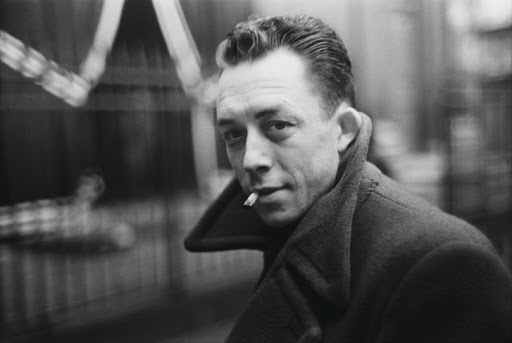
Albert Camus


It seemed fitting to spend 31 January (Brexit Day) with a good old friend. She has the modern smart phone needed to scan my Dutch passport. It was good to have moral support: I had a crying fit during the identity check part of the application. Luckily, I only started crying after she’d taken my photo which the Home Office staff/system will check against the photo in the passport!  And the automatic check on my National Insurance (NI) number confirmed that I was eligible to apply for “settled” status.

I’ve been resident in the UK since 1973 and I have close friends here and my writing, but it has felt less and less like home after the 2016 referendum.

At secondary school (Gymnasium) we learned English, German and French and we crawled at a snail’s pace through l’Étranger, the 1942 novel by Albert Camus which is a classic in world literature.  Camus developed the philosophical concept of Absurdism and the way he died in a car accident, aged 46, could be considered absurd.

The poem is from my debut collection Another life, published by Oversteps Books Ltd in 2016.

On reaching his 102nd Birthday

He always liked his drink,
so it’s no surprise that Albert went North,
that unused train ticket in his pocket.

He is said to have died in a car crash,
but police do know people who
walk away and without a scratch.

After walking for weeks, he reached Norway
where the days are short
and the nights are made for alcohol.

Camus lived in a modest house
with a butcher’s block in the kitchen
where he cut reindeer and smoked.

A flock of swans flew through his dreams,
so he married the next woman to walk past,
taught her two sons to play football.

She taught him to sleep soundly at last.
A pied-noir at rest under the Herring Lights,
on the cold edge of man’s world.

Yellowish green and faint red glowing,
these arcs and rays and curtains of gas,
the fight against dawn and the sun.

Snow still in sight


Scan0012

 
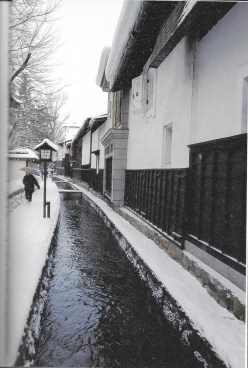
snow still in sight
the water becomes less cold
in this castle town

yuki nokori tsutsu mizu nurumu jokamachi

(haiku by Kiyo)

This castle town may be located somewhere deep in the mountains in the northern part of Japan. Snow still remains on the surrounding steep mountains, but the snowmelt water flows peacefully in the river running through the town. We can imagine the lives of the lord who owned this castle and its dwellers, which may not have been so peaceful all the time.

One of my bookshelves is filled with books and magazines on haiku, tanka, renga and renku. One of them is very special to me: Haiku. The poetic key to Japan by Mutsuo Takahashi, Hakudo Inoue and Kazuya Takaoka, published in 2003. It suddenly arrived several months after a Japanese postgraduate student who had shared my house had returned home.

Each haiku is accompanied by a wonderful colour picture, a brief explanation, the original Japanese text and the version in Romaji. Is late January too early for a spring haiku? I hope not!

Haiku calendars

haiku-calendar-2020.jpg


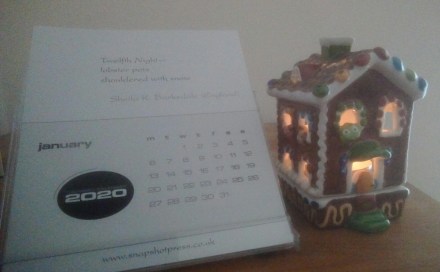
I bought extra copies of the 2020 Haiku Calendar to give as presents. This small desk calendar shows one haiku each month, with three or four more on the back.

Twelfth Night –
lobster pots
shouldered with snow
(Sheila K. Barksdale – England)

The haiku presented in the calendar are the winners and runners-up of the annual competition. The competition for the 2021 calendar is open until the 31st of January. Guidelines are on http://www.snapshotpress.co.uk

Twelfth Night was last Sunday when I was taking down Christmas decorations and carefully removing Christmas cards from the display on the kitchen door. And I was also thinking about the other haiku calendar – a present from a friend who lives in Japan. One of these calendars I’m going to take with me to my caravan in the Netherlands. No need to decide yet: my first trip there is early April!

snow scene


The images in the large calendar are all from the Art Gallery of Greater Victoria. Miyajima in the Snow is by Tsuchiya Koitsu (1937), wood cut on paper.

oyuki ya
yuki o mi ni yuku
tokoro nashi

 
So much snow – but
a place for snow viewing?
There is nowhere to go!

(Anonymous, 18th century)