Tag Archives: writing

Dimmet


It is a pleasure to introduce our February guest poet Rob Miles. I do not know Rob personally: we have been Facebook friends for some time. I bought a copy of his recent collection Dimmet which was published by Broken Sleep Books. See below the poems for Rob’s biography.

The glorious cover image of a murmuration was designed by Aaron Kent. Dimmet is a West Country word for dusk, twilight. Katherine Towers notes of the collection: ‘These are poems of great precision and delicacy’. I’ve chosen four poems which demonstrate these qualities.

Dimmet

His hands still bronzed, still
baling-raw. His voice
no longer snared, whisper-low
as decades ago, in this same field, he guided me

to not disturb that horse; circling
quietly, its half-scattered straw
an ingot melting, and my thin flames no match
for such a sunset anyway.

*

On this, another near-to-night, it’s clear
that he has no more kept his mind
from wayward sparks than I
have closed my eyes

before any fading fire, ever since recalled
a slow white shadow
steady on its dial
in the always almost dark.

Café Poem

Just when I think there is nothing
so boring

as someone else’s childhood
a toddler

in dungarees is guided
around our table

by his puppeteer parent, arms
up, in a vertical sky-dive, or

like a drunk, when walking
is more about not falling

every step forward
rewarded with a double high five.

I whispered to the dog

that she’d been a winner
a Crufts champion
 
at least twice. Once
she saw off a Dobermann, burglars, a werewolf
 
even the odd Sasquatch.
I reminded her

as her old eyes darkened     
that she had saved lives.

Making Way

A keeper, you said of the house, but I’d sensed everything
trying to make its way: those errant velvet fingers
from your orchid pots; the oak
putting on its chain mail of ivy and moss
and losing; the birds we fed still pinned
to their shadows; crisp wasps
electrocuted by views
through grubby double glazing, and you
just weeks before, showing your wrists
as if uncuffed, asking for my thoughts on a fragrance.

Biography

Rob Miles is from South Devon, and he lives in Leeds where he is Fellow in Film Studies in the Centre for World Cinemas and Digital Cultures at The University of Leeds. His poetry has appeared widely in magazines and anthologies, recently in Stand, New Welsh Review, The Scores, Spelt, 14 Magazine, Ink Sweat and Tears, One Hand Clapping, Poetry Wales, and four Candlestick Press pamphlets. He has won various awards including the Philip Larkin Prize, judged by Don Paterson, the Resurgence International Ecopoetry Prize, judged by Jo Shapcott and Imtiaz Dharker, and the Poets & Players Prize, judged by Sinéad Morrissey.

Lucy Newlyn describes Dimmet as ‘the best collection of contemporary poetry I have read in a long while’, and John Glenday writes: ‘When it’s done as well as this, there’s nowhere on earth poetry can’t go.’

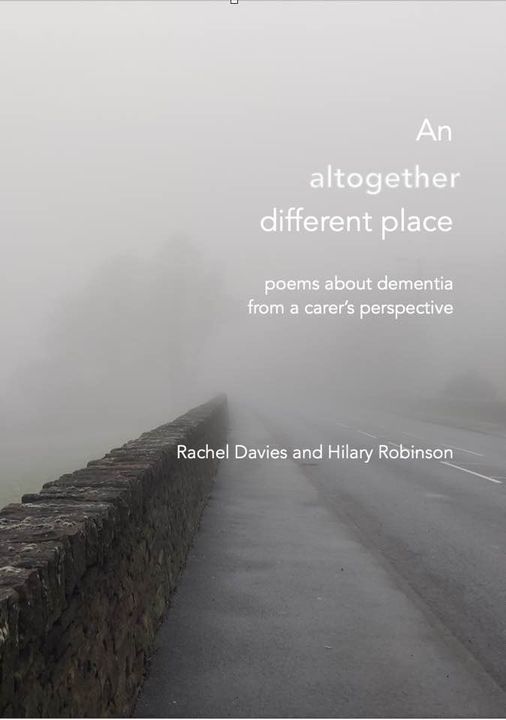
An altogether different place

Cover photo by Ben Robinson


Rachel Davies and Hilary Robinson have been friends for over 20 years. Friends call them the ‘poetry twins’. They are both accomplished poets and you can find their biography below.


An altogether different place
, published by Beautiful Dragons Squared, is a joint project. In 2022 Hilary’s husband was diagnosed with vascular dementia; in 2023 Rachel’s partner with dementia and Lewy bodies. In the introduction they write ‘dementia is a catalogue of cruel diseases’. Living with and caring for someone with dementia ‘you come to know grief by slow degrees’. Through poetry Hilary and Rachel ‘found a joint space to laugh, cry, find context and write out their experiences’.


The collection is sold to raise essential research funds for dementia charities in the UK. It is a privilege to share a selection of the poems here: Brainworm and Seven ways of looking at a husband are by Hilary. Rachel wrote Degrees of Challenge and This is not a poem about dementia which was awarded 2nd place in the Hippocrates Prize 2024.

Brainworm


There are many crap poems online for those who care for loved ones with dementia. Dementia has a symbolic flower – the unimaginative forget-me-not. I’ll have none of that shit. I want the gristle of it, the offal, brain-spatter, white matter of it. Show me the MRI with extensive vascular changes, let me count the dead parts of the brain so I can explain, daily, what ails my love. I watch Dirty Great Machines, find Big Bertha in Seattle, tunnelling machine on steroids moving at thirty five feet a day. Something has wormed its way into the tiny vessels inside his head over years and now whole sections of his once-sharp brain have died. It’s our Golden Wedding Anniversary this year. I don’t know who I’ll be celebrating with.

Seven ways of looking at a husband

1
Straight on. Taking in his 2-day grey beard,
his nostril hair and ear fuzz. His smile.

2
Side profile. Noticing his cute nose,
the same shape as our daughter’s.

3
From the bedroom door. Noting
the cocoon he’s made of the duvet.

4
Across the kitchen. See, he’s forgotten
how to toast his fruit tea cake, make coffee.

5
From the driver’s seat. Clocking his wince
as you pull out safely onto the busy main road.

6
Across the care home corridor. Seeing his smile grow,
then his arm around you, his whiskery kiss.

7
On the care home terrace. Look, he can’t turn
his head to where you point. Misses the squirrel.

(L) Hilary with David (R) Rachel with Bill

Degrees of Challenge

I’m watching you struggle to break the seal
on an ice cream wrapper and I think of the time
you redesigned the roof of Piccadilly Station,
worked in millimetres to ensure each pane of glass

fitted exactly into the space you’d drawn for it.
I remember the night you clipped on a safety harness,
climbed onto the roof to inspect each perfect joint,
came home buzzing but satisfied at day break.

Tomorrow you’ll shuffle out to the Age UK minibus,
the driver watching you don’t slip on the wet steps;
but tonight you’re making a major task

of breaking into a Mini Magnum. I know better
than to offer help; eventually you’ll pass it to me,
say I’m sorry, I can’t seem to

This is not a poem about dementia

I am opening the windows and doors
letting in fresh air to blow dementia
down the lane like giant tumble weed

I am clearing out drawers and wardrobes
filling black bags with hallucinations
donating them all to the Age UK shop

I am having the Lewy bodies serviced
unblocking its pipes flushing confusion
down the drain with the incontinent waste

I am partying like there’s no dementia
raising a cake with bicarb of dementia
licking up the fluffy dementia crumbs

I am sleeping peacefully in the quiet night
dreaming a poem that has absolutely
nothing to do with dementia

Biographies


Rachel Davies is a mother, grandmother and great-grandmother and a retired primary school headteacher. Her poetry is widely published in journals and anthologies and has been a prize-winner in several poetry competitions, most recently, the Hippocrates Prize 2024. A selection of her work was published in Some Mothers Do… (Dragon Spawn Press 2018). Her debut pamphlet, Every Day I Promise Myself, was published by 4Word Press in December 2020. Since retiring she has achieved an MA in Creative Writing and a PhD in contemporary poetry, both from Manchester Metropolitan University.


Hilary Robinson has lived in Saddleworth for most of her life. She met her husband, David, at secondary school. She gained a BA (Distinction) and a PGCE and became a primary school teacher. After a successful career, Hilary retired and started a Creative Writing (Poetry) MA at Manchester Metropolitan University and gained a distinction. Her poetry is published in print and online journals, and in several anthologies. Her poetry has also been set to music by RNCM students of composition. In 2018 some of her problems were published by Dragons Spawn as Some Mothers Do… and this was followed in June 2021 by her first solo pamphlet, Revelation, published by 4Word Press.

Breakfast

Here in The Netherlands Kookboekenweek (Cookery Books Week) has just ended. A recent annual event, it’s designed to promote cookery books. Bookshops and libraries organise workshops, lectures, and tasting events. Of course, it’s all to encourage people to buy books as presents for December: St Nicolaas and Kerstmis.


Professionals shortlisted six books (Vietnamese, Japanese, Indian, Italian (2), and baking skills). They’ve chosen Bloem Suiker Boter, by Nicola Lamb, translated into Dutch. I’m going with Breakfast, a poem celebrating poetry and friendship.

Breakfast

Bridie would be in the kitchen,
barking with Finn and Tara
in a metal cage under the table.
I’m in your backroom, sheepskin
on the seat of the wooden chair,
just gone 9 o’clock this Tuesday.

You’ve made the scrambled eggs
exactly as I like them, with enough
mustard and fresh chives.
Now you’re coming in with yours,
followed by your small dogs
who settle on the settee, by the fire.

We catch up over this monthly meal.
Soon we’ll sit silently behind our laptops,
typing up poems from old notebooks.
Now eating toast with ginger preserve,
I look out of the window; the smiling
Buddha is lit up by the sun.

The unread book

Earlier this year, a group of artists in The Netherlands set up the Ongelezen Boeken Club (Unread Books Club). It is a sad fact that many library books are never borrowed. Currently, there is an exhibition in a public library in Amsterdam featuring some of their unread books.

Upstairs, around 200.000 books are on loan. If a book is not taken out during a period of two to three years, it moves onto the ‘null list’ and disappears downstairs. Here a good 400.000 books are stored along 24 km of shelving. At the exhibition, there is an old-fashioned telephone on which visitors can ring and reserve one of the unread books on the ‘nul lijst’.

The artists have declared Thursday 19 September as the first Nationale Ongelezen Boekendag (National Unread Books Day).

There is the concept of the anti-library: a collection of unread books as a research tool, as an ode to everything one wants to explore. Related to that is Tsundoku, acquiring reading materials and letting them pile up. Many poets I know feel somewhat guilty about new poetry books piling up.

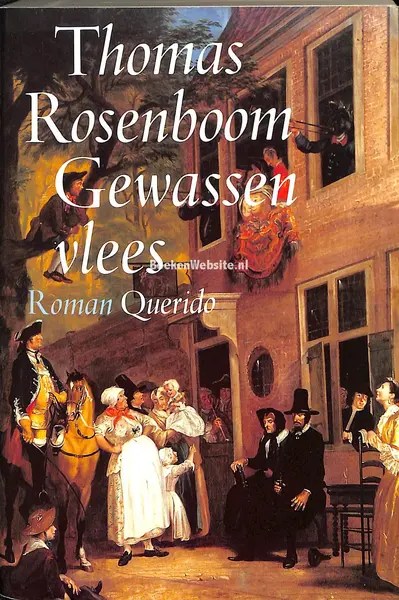
This is the cover of a historical novel, Gewassen Vlees, by Thomas Rosenboom. It won the dutch Libris prize (worth 50,000 Euros) in 1995. It’s over 700 pages long. I am never going to read it. A friend gave it to me. He died in 2000 and that’s the reason it’s still taking up shelf space.

Carnation Lily Lily Rose

It’s a great pleasure to feature four poems from our guest poet Jane McKie. Her collection Carnation Lily Lily Rose was published by Blue Diode earlier this year. The title and title poem are after John Singer Sargent’s painting of the same name. Each word is also the heading of the four sections of the book.

The collection includes a range of poetic forms and shapes: prose poems, a concrete poem, long and thin poems. We meet couplets and triplets, striking titles: Cairn to a Dead Biker, X-Ray of a Deer’s Skull. The poems crackle with energy and vitality. The book is ‘a hymn to all the different kinds of connective tissue that lightly, but firmly, weave us into the fabric of our own and others’ lives’. (David Kinloch).

Lord, Make Me an Instrument

Here the clouds outrun land: greyer, fleeter,
casting their shadows on the estuary and making
mud move at their speed, blown rather than
fixed, flexing with light / dark / light / dark,
sea-blite at the edges to catch the odd discarded
fag butt. Sea pea, clover, yellow vetch.

Further out, the flattened eelgrass – a trammelled
thatch without the tide; with it, upstanding,
like proud speech. Into this landscape creeps
a man following redshank, black-tailed godwits;
watch him huddle – glimmer of a struck match.
Winged souls call to the crackle of his breath.

Sand

Tonight, I’m in an arbour designed
by an artist who moonlights as a gardener.

Our host’s aesthetic sixth sense is spot on:
look how the roses jostle the frame,
how the lattice pins them like pretty moths.
A drink in one’s hand is compulsory.

And we guests are laughing, playing up
a hunger that may be on the wane,
but holds us, tonight, as snug as palms
around glasses. It is brilliant, this garden,
and familiar, as if it is not a garden at all
but a gateway, and we are not guests
at a middle-aged party but school-leavers
on a promised, delicious brink.

Tonight, if you sliced me open,
you would find a swirl of glitter:
all the shades of the sand
at Alum bay squeezed
into one miniature glass lighthouse.

Antigravity

They hover along pavements, barelegged,
on Mini Micro scooters, a flock of them –

the best of us. Hovering in shirtsleeves, hearts
and mouths open before guile sets in.

Don’t they feel the cold? Hovering to class
like motes in light.

On this unbearable, ordinary day, we mothers
can’t stop them lifting off the ground,

their small hands to their mouths
as they giggle, spitting out milk teeth,

growing too quickly. Catch onto
their waistbands and don’t let go.

Harness

I think of the invisible harness that hitches us, one to the other,
how it signifies both baggage and provision;

how, in the past, I have slipped the harness
and tested freedom, finding it overrated;

how mood is a harness, like gravity, pitching our orbits
a little off-kilter;

how sometimes the harness pinches and we are inclined
to worry it, fidgeting, even to tear at it;

how we trust the harness to repair itself like skin.

Biography

Jane McKie works as a Senior Lecturer in Creative Writing at the University of Edinburgh. Her first collection, Morocco Rococo (Cinnamon Press) was awarded the 2008 Sundial/Scottish Arts Council prize for best first book of 2007. Recent collections include Quiet Woman Stay (Cinnamon Press, 2020) and Jawbreaker (2021) which won the Wigtown Poetry Festival’s Alastair Reid’s Pamphlet Prize 2021.

Jane, as a member of the Edinburgh-based Shore Poets, facilitates poetry readings and music. She is interested in collaboration across forms, writes with 12, a collective of women writers, and with Edinburgh’s genre spoken word group Writers’ Bloc.

The price of cauliflowers

Credit: Pixaline via Pixabay

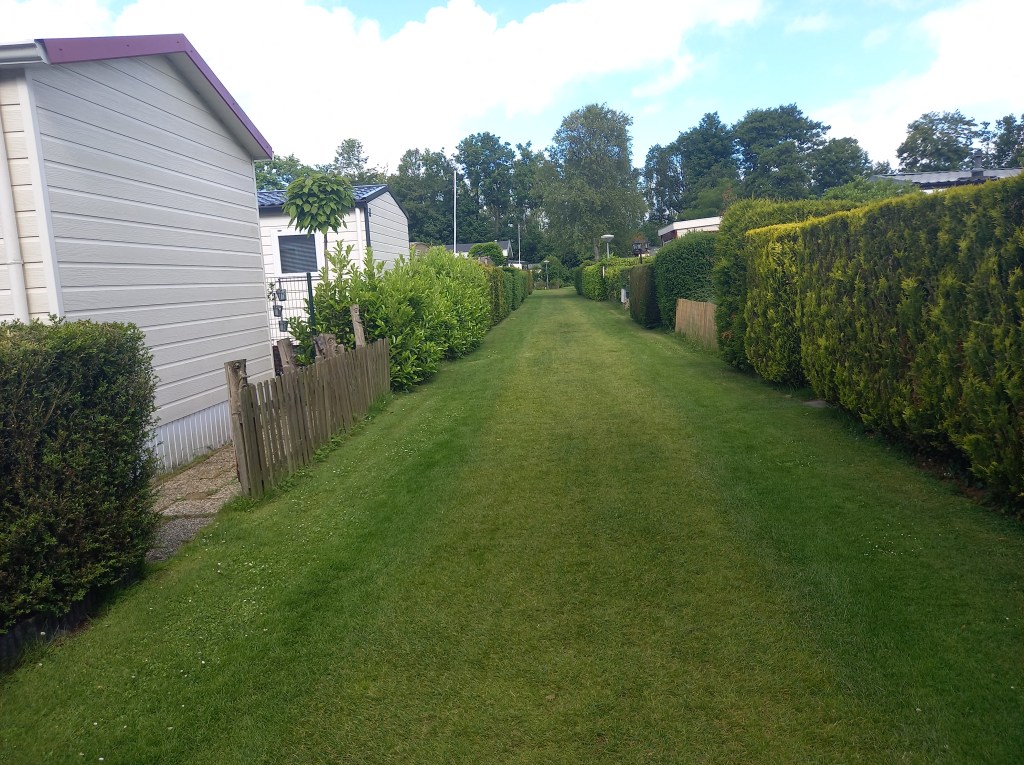
I’m not keen on them, so I’m not buying now they’re 4 Euro each. Dutch growers have kept their glasshouses empty because of the cost of gas and electricity. I was lucky, though, to be accepted as a patient by a GP practice in the town I moved to. Lucky also that my journey to the implantologist involves two trams: there were strikes again on regional buses last week.


This poem, from a recent workshop, is a snapshot of life in The Netherlands.

Word jij onze nieuwe collega?

Outside every restaurant and café two blackboards:
one with a menu, the other asking for a sous-chef,
a washer-upper, or bar staff.
Freek van Os, the expensive plumbing business
is even renting lit-up space by the side
of a bus shelter. They need a planner,
and also have two technical vacancies.
Manda, my hairdresser, had found
a 42-year-old Afghan woman, single parent,
career-changer. When I came in a month later,
she’d changed her mind. Legal cases are abandoned,
judges are dead or retiring. As are many GP’s.
They’re not signing the new contracts, anyway.
Not much the government or the insurers can do.
People want to work fewer hours, it’s said, not more.

February

A seasonal poem and sampler by Rebecca Cullen who is our March guest poet. It’s from her collection A Reader’s Guide To Time. I very much enjoyed Rebecca’s take on February and hope you do too.

Speak Easy (2)


Speak Easy was formed at Stretford’s Sip Club by Dave Hartley in August 2015 as a spoken word open mic before the team of Andy N, Amanda Nicholson and Steve Smythe joined forces to take it over at the end of 2017. The night moved to Chorlton Cum Hardy’s Dulcimer Bar in August 2020 and has carried on being a welcoming, supportive, friendly and encouraging night since welcome to both experienced and newcomers with all acts given equal opportunity to perform with everybody who reads being headliners.

(See the end of the post for details and links to social media for Speak Easy, Andy N, Amanda Nicholson.)

Andy N

Andy N is the author of 8 full length poetry collections including ‘Return to Kemptown’ and ‘The End of Summer’ and co-runs Chorlton Cum Hardy’s always welcoming Spoken Word Open mic night ‘Speak Easy’. He runs / co-runs Podcasts such as Spoken Label, Cloaked in the Shadows and Storytime with Andy & Amanda and does ambient music under the name of Ocean in a Bottle.

Three x Winter Haiku

Walking in darkness
your front door briefly lights up
in the heavy rain. 
*
Ripping out the trees
lighting hit the forest hard
flooding the river
*
Sleeping in winter
the trees hibernate alone
awaiting for Spring. 

*

Amanda Nicholson


Amanda Nicholson is an author, poet, podcast co-host and copywriter. She has written several books as Amanda Steel, including Ghost of Me. Amanda’s poetry has been broadcast on BBC Radio Manchester. She Has a Creative Writing MA, and has had articles published by Jericho Writers, Reader’s Digest UK, Ask.com, and Authors Publish.

Do All These Labels Make Me Look Fat?
 
Like blank sticky labels pressed to my skin
I write on some myself
While people scribble their own words
Over time, the ink fades on some
and others fall off
The one labelled daughter is half peeled off now
Older labels remain stuck fast
But buried by new labels
So people rarely see
Unless they get close enough
And there is always room for more
Some are like tattoos
Only more painful
And others wash away easily

Links
Speak Easy:
Facebook: https://www.facebook.com/speakeasymanchester
Twitter: https://twitter.com/speakspokenword
Instagram: https://www.instagram.com/speakeasypoetryspokenword/
Recordings of Night: https://andyn.bandcamp.com/

Andy N Poet:
His blog: http://onewriterandhispc.blogspot.com/
His books can be found on Amazon etc.
Ocean in a Bottle is at: oceaninabottle.bandcamp.com
Facebook: https://www.facebook.com/andynstorytellerpoet
Twitter: https://twitter.com/aen1mpo
Instagram: https://www.instagram.com/andynpoet/
Tiktok: https://www.tiktok.com/@andynwriter

Amanda Nicholson

Her blog is: https://amandasteelwriter.wordpress.com/
Facebook: https://www.facebook.com/AmandaSteelWriter
Twitter: https://twitter.com/Amanda_S_Writer
Instagram: https://www.instagram.com/amandasteel37/

Friendship

Friendship is the theme of this year’s Poetry Week, celebrated in The Netherlands and the Flemish-speaking part of Belgium through 400+ events. It starts on Thursday 26 January. Miriam Van Hee (B) and Hester Knibbe (NL), two poets who have been friends for almost 40 years were commissioned to write five poems each for a book. In a recent interview they said that trust and curiosity are key elements for a friendship to endure and last.

Anyone who spends over 12,50 Euro on poetry books during Poetry Week will be given a copy. It’s not hard to spend that sort of money, as poetry books are expensive in The Netherlands!

Here is my poem on the theme of friendship: memories of a long weekend in Vienna in 1994.

Vienna

I would gladly return,
walk with Wendy through
the rain to the museum,
see the Hunters on the Hill –
tired, wet dogs, in the Little Ice Age
when frozen birds fell from the sky.

I would gladly go back there,
view grey buildings slide past,
hear the clanging bell.
Schwedenplatz, umsteigen.
A trolley bus securely attached
to the two lines above.

Speak Easy (Stephen Smythe)

It’s a pleasure to introduce Stephen Smythe. He has been involved with Speak Easy since it started (at the SIP Club in Stretford) and that’s where we met. The SIP Club closed during the lockdown and Speak Easy then moved online. I was able to take part from my caravan in The Netherlands, along with poets and writers from London and the US and elsewhere.


Stephen Smythe is a Manchester writer who achieved an MA in Creative Writing from Salford University, in 2018. He was shortlisted in the Bridport Prize, Flash Fiction category, in 2017, and was also longlisted for the Bath Flash Fiction Award, in 2018. He won The Bangor Literary Journal FORTY WORDS Competition, in 2022, and was placed third in the Strands International Flash Fiction Competition, in 2021, for his 1000-word story.


His book of forty x forty word stories published by Red Ceilings Press is due out later this year.


Here are two prize winners to give you a taste…

KLEPTO


Bridget took stuff from her work colleagues after they’d gone home. Pens, post-it pads, sweets, even family photos. People suspected her, but couldn’t prove anything. When the company introduced hot desking, Bridget became confused and sometimes stole from herself.

(Winner of the Bangor Literary Journal FORTY WORDS Competition, 2022)

COLD CALL


‘Wait!’ Dad yelled down the phone.
He put his specs on. ‘That’s better, I can hear you now.’
He listened intently, frowned deeply, then hung up.
‘A conservatory?’ He snorted. ‘Your mother would kill me– if she were alive.’

(Second place in the Bangor Literary Journal FORTY WORDS Competition, 2019)

Links to 1000-word stories


Love Your Neighbour


The Fourth P (weebly.com)


Al Pacino of the Welsh Valleys (weebly.com)

Granny (weebly.com)

Poetry
Sommelier 2020 – Janus Literary