Tag Archives: family

Food Match

Credit: Life-Of-Pix, Pixabay

A Christmas Day poem with my best wishes for the day and with my thanks to Matthew Stewart. In his pamphlet Tasting Notes (Happenstance Press) he pairs poems with notes about the Zaleo wines from Extremadura, a region with several UNESCO heritage sites.

Food Match

It glistens on the wooden stand,
a black trotter pointed upwards
as if offering a hoofprint.
Now cut a slice so thin that steel
is visible below the meat.

Place it across your tongue and wait
for the marbled fat to melt. Sip
un vino tinto. The tannin
grips, hugging the ham — both of them
start, suddenly, to magnify.

Credit: GerardBarcelona, on Pixabay

Biography:

Matthew Stewart works in the Spanish wine trade and lives between Extremadura and West Sussex. His second full collection is due from HappenStance Press in November 2023.

There are a few copies left of Tasting Notes. Contact Matthew direct via social media.

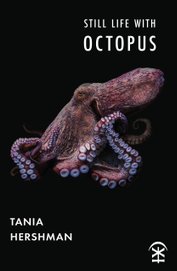
Still Life with Octopus

Photo credit: Grace Gelder

It is a great pleasure to introduce this month’s guest poet Tania Hershman. I met Tania a few years ago when I attended a series of workshops she gave on flash fiction. She is a generous, inspiring tutor. I have chosen four different poems from her new collection.

Tania Hershman’s second poetry collection, Still Life with Octopus, was published by Nine Arches Press in July 2022, and her debut novel, Go On, a hybrid “fictional-memoir-in-collage” will be published by Broken Sleep Books on 17 November 2022. Her poetry pamphlet, How High Did She Fly, was joint winner of Live Canon’s 2019 Poetry Pamphlet Competition and her hybrid particle-physics-inspired book ‘and what if we were all allowed to disappear’ was published by Guillemot Press in March 2020.

Tania is also the author of a poetry collection, a poetry chapbook and three short story collections, and co-author of Writing Short Stories: A Writers’ & Artists’ Companion (Bloomsbury, 2014). She is co-creator of the @OnThisDayShe Twitter account, co-author of the On This Day She book (John Blake, 2021), and has a PhD in creative writing inspired by particle physics. As writer-in-residence for Arvon for Autumn 22-Winter 23, Tania has curated a programme of readings, workshops and talks, both online and in person. Find out more at http://www.taniahershman.com

Still Life With Octopus (II)

I only asked her once to climb inside a jar for me. (Before we met, I’d watched all the videos of those experiments.) She sighed but did it, said I could screw the lid, released herself easily. You could become any shape you want, I said. She said nothing. One arm sent itself out to switch the kettle on. While she made us tea, I put the jar back in the cupboard, feeling that slight ache from too much sitting in my hip bones, my lower back, where fixed part meets fixed part of me.

Standardized Patient*

Today I am your
lower back pain. Listen,
I have all the details, will
not veer

from the script. Tomorrow
I will be your cancer
of the kidneys. Next week,

I may be your
one-legged skier (I know,
I know). Whose pain
is this?

*Standardized patient simulation lets medical students practice on people trained to play patients.

And then God

sends someone else’s
Jewish grandmother
to stop me

with a question about birds
I can’t answer. She says – as if
this is her river – I’ve never

seen you here before,
then presses for my
exact address. Instead

of the usual, Such a nice
girl, no husband?, she asks,
No dog? I don’t know why

I tell her then
that I’m a poet, but
the gleam in her eyes

warns me this
is the point
to leave, the unasked

dancing on the path
between us: Will you
make a poem out of me?

Middle of the Night

Night asks me
to wake up. What?
I say. Night whispers
darkly, something
about cats coming in
and out, a baby five
doors down. You
want company? I ask.
Night nods. I get up

and we make tea. Too
early, the cat mutters
as we pass. Night
and I get back
into bed. I’m fine
now, Night says.

Cover design: Ben Rothery

Note: Peter Godfrey-Smith, Other Minds: The Octopus and the Evolution of Intelligent Life (William Collins, 2017).

Cuckoo and egg – guest poet

It’s an immense pleasure introducing this month’s guest poet Ramona Herdman. We met a few years ago on a residential workshop and are members of a group that meets weekly online.

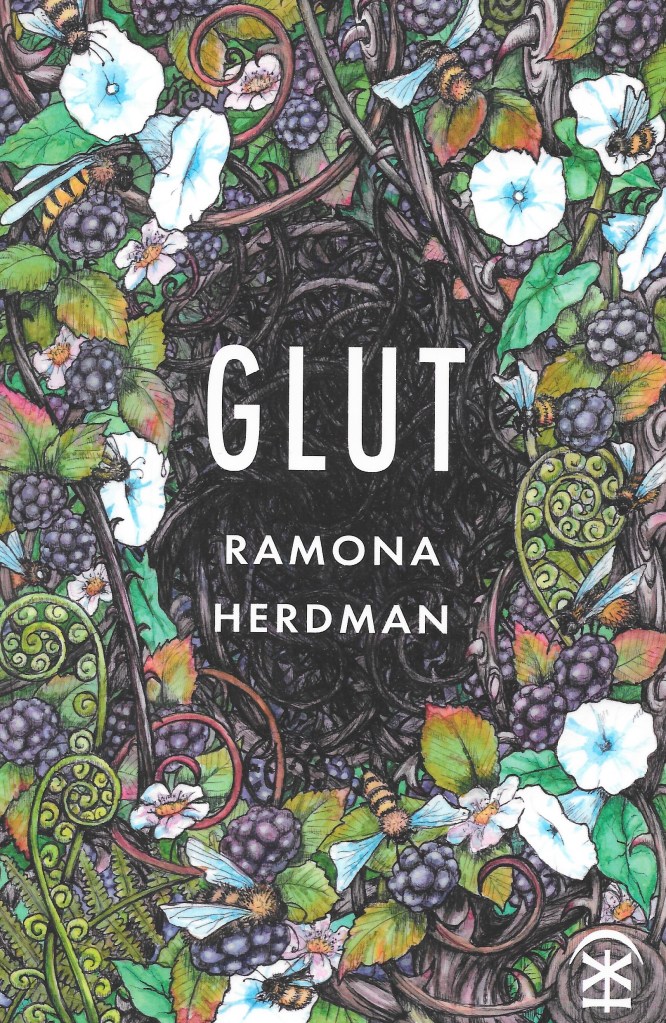
Ramona Herdman’s recent publications are Glut (Nine Arches Press), A warm and snouting thing (The Emma Press) and Bottle (HappenStance Press). Ramona lives in Norwich and is a committee member for Café Writers. She tweets @ramonaherdman

I have selected four poems from Glut, beautifully produced by Nine Arches Press, to give you a flavour of these darkly funny, bittersweet poems. I hope my choices also show their ‘quiet ferocity’ (Philip Gross). Below the poems you’ll find links to a blog about the cover (by Jacky Howson) and to a video with Ramona reading Blackberrying and Congratulations. Glorious is the word!

Blackberrying

Blooded young, we waded
into the hooked shallows of hedges,
caught up and cut in our toddler blundering, dirty
with gritty juice and dotted-line scratches.

We without-ritual British, we atheists.
Hippies’ children, grown up
in the world they believe they changed –
we have blackberrying as our sacrament.

At school, neater children wouldn’t eat the berries,
said their mothers said no, said
they had worms in that would eat our insides
and poke out of our bumholes.

Now we go every year, like it’s Midnight Mass.
We avoid the dog zone at the bottom of the bushes.
Tell each other that by Michaelmas
the Devil will have pissed them bitter.

We take offal-heavy carrier bags of berries
to our parents, too old now for all that bother.
We pick the children out of the tangled footings.
We cook pies and crumbles in our own kitchens,
competently. We placate the gods.

Cover design by Jacky Howson

Cuckoo and egg

It’s hard to soft-boil an egg in another woman’s kitchen –
even the water is different.

It’s our first ‘family’ holiday together.
She makes me a soft-boiled egg with a lot of fanfare
and the whole breakfast-table gets involved in the hoo-hah.

And there’s a performance of trust in cracking it –
the risk of a wet white, the opposite risk
of a solid yolk. We’re on the edge

of an ovation when it turns out perfect.
I eat it hot, like a heart.

It’s not me taking the minutes

It’s not me anymore escorting visitors
from the front desk. I don’t fill the water jugs
and make sure the glasses aren’t too dirty.
I sometimes buy the biscuits, now there’s no budget.
It’s not me too scared to ask a question
or supply a fact, wondering if I’m allowed
a view or am just a transcription machine.

A man once told me working with women
had taught him not to interrupt. It’s a terrible world.
I told him working with men had taught me
to keep on talking, slightly louder. Try
interrupting and you’ll get to see
the flying-galleon belly of my argument
as I lift off cathedral-high over you.

Don’t dare to talk over my people,
including the young woman taking minutes,
who is well on her way to wherever she wants,
who could take your eye out with her wit.
The meetings are my meetings now.

Two death in the afternoons, please

Dad, now you’re dead you scare me.
Every time I think about stepping into traffic
I think of you building your glass castle,
cornershop-whisky-bottle by cornershop-whisky-bottle.

I had to do one of those questionnaires recently:
How many times in the last month has your drinking
stopped you doing things you needed or wanted to do?
I put zero, Dad, proud nothing. They never ask

about the times the drink makes living possible.
I think of your kitchen-drinking nights, how you told me
you didn’t get hangovers anymore
and I was too young to reply.

When I’m scared, Dad, I know a gluey-gold inch
of brandy or one gin and tonic’s scouring effervescence
will lift me to arm’s-length from caring, will calm me
in a bubble of slight incapacity.

The old dread, Dad – I think now you carried it
like a wolf in your stomach.
The drink quiets it, but it doesn’t drown.
I recently learned another cocktail by Hemingway –

‘Death in the afternoon’, champagne and absinthe.
You’d find the name as funny as I do.
He recommended three or five in slow succession.
When I make them, I toast him. He’s family.

Dad, you’re nothing now.
It’s only the thought of your life that scares me.
But if there were an afterlife I’d meet you there, happy hour.
It’d be dimlit and we’d sit low in a booth and they’d keep

bringing the drinks in fine heavy glasses
and no one would interrupt to say this wasn’t actually heaven,
this delicious blunting of feeling, this merciful cessation,
and that there was something outside that was better –

like walking out on the seafront together, wind and water-roar
and saying something risky and being understood.

Links:
To buy the book
An interesting blog piece about the design of the cover
Ramona reads Congratulations
Ramona reading Blackberrying


My brother – poem

Today I am with my brother and sister-on-law. It’s his birthday today, so I arrived yesterday to have the chance to catch up with them before friends and family arrive.

I’m the eldest, three years between us. I’ve been protective of him from the start.

For many years now, my brother has worn a metal brace on his leg. A few years ago he managed to get a second-hand ‘loopfiets’ – a walking bicycle. I’d never seen one before, but it’s small enough to go through a standard door so one can go into shops, and it’s light enough to put in a car.

Example of ‘walking’ bike

It was my father’s birthday on Sunday 2 September that year and my parents’ friends commented on how my brother limped, encouraged my mother to get it checked out. GP on Monday, neurologist on Tuesday. I can still see my parents’ car disappear round the corner on the Wednesday morning.

1962

Alexander Eduard (coppersmith
in the bible and van Beinum,
the famous conductor).
Our Irish setter had been given
the names of an unborn child.

A ward of six, our parents’ daily
drive, forty minutes each way.
Neurologist, paralysis,
lumbar puncture, nausea.

Grandfather owned an electrical shop
(double-fronted on the main street);
gave my brother a beige-brown radio.

The specialist allowed our red
Irish setter to visit my brother,
celebrating his fourteenth birthday
in the academic hospital in Leiden.

Three months later he arrived home,
just in time for St. Nicolaas.
My brother still limped and his crown
was marked by two scars at right angles,
the space between dipped and dented.
A few days later grandfather came
to take his radio back.

Published in Another life, Oversteps Books, 2016.

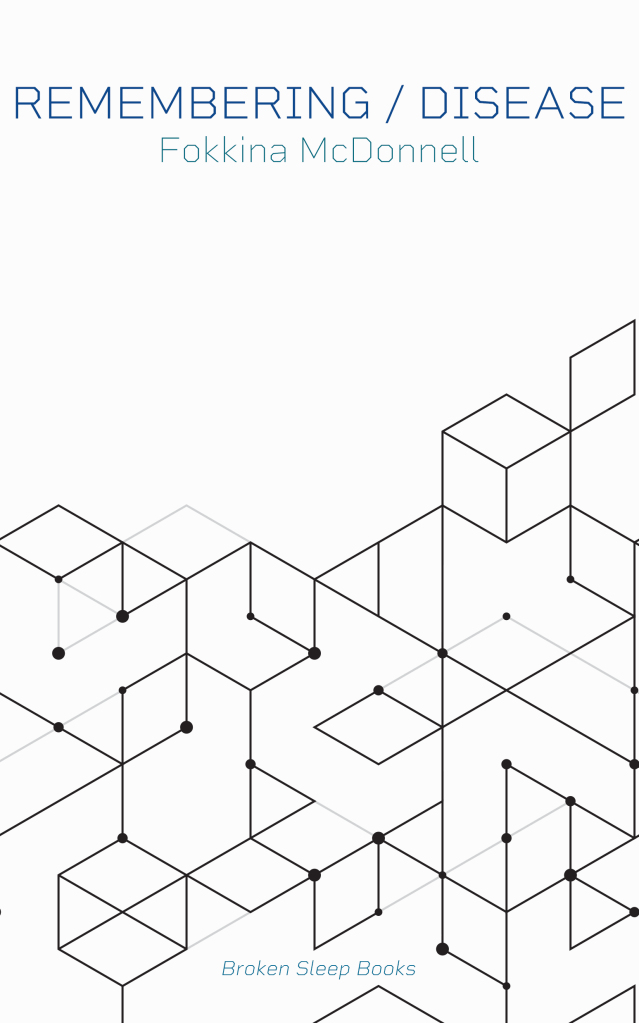
Remembering / Disease

Design, Aaron Kent

My third collection, the award-winning Remembering / Disease, is now available for pre-order with Broken Sleep Books

The poetry entries for the Northern Writers’ Award were judged by the poet Vahni Capildeo. They selected my manuscript, along four others, and praised the ‘beautiful minimalism’ and ‘intriguing poise’.

Here is the poem Secrets which is a prologue:

Secrets

This secret is always circling.
Certain seasons and times of day are its allies.
That much I am allowed to reveal.

This secret can seep through concrete.
A dark liquid is left that even the sun cannot dry.
The spot cleaning burns your hands.

This secret has its own language.
Each secret needs an interpreter.
Few are willing.

This secret is always looking,
the one in the secret always
on the lookout.

These secrets yearn to Rest in Peace.
Bring them flowers, bring ferns,
bring them feathers so they can fly away.

the small manoeuvres – poems

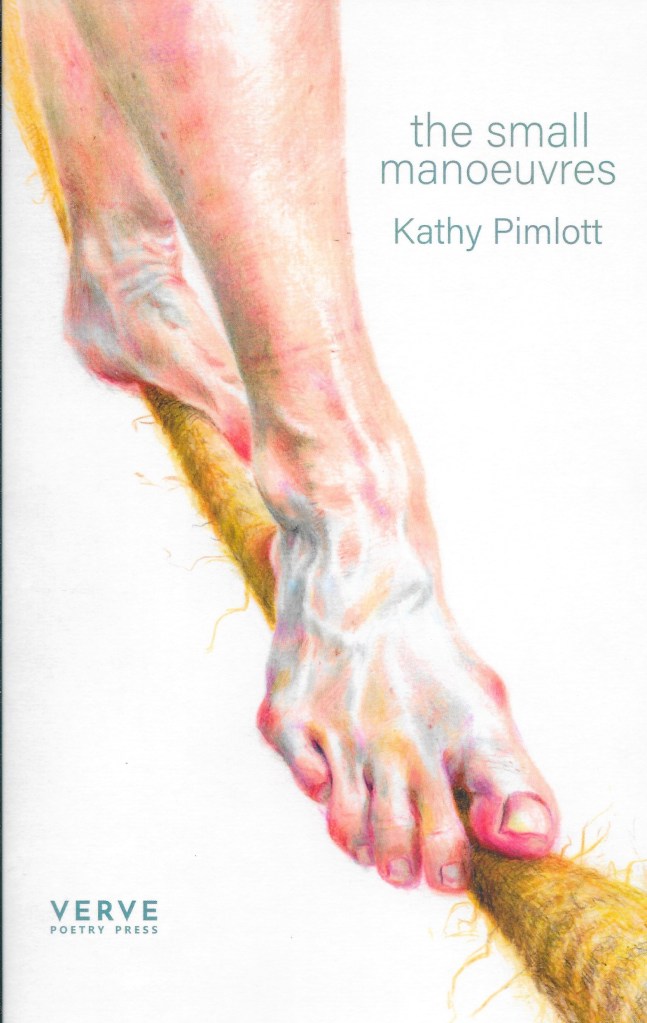
I’m delighted to introduce this month’s guest poet Kathy Pimlott. We met a couple of years ago on a residential workshop and are both members of a small group that meets regularly online.

Kathy Pimlott’s debut full collection, the small manoeuvres, (Verve Poetry Press) was published in April 2022. She has two pamphlets with the Emma Press, Goose Fair Night and Elastic Glue and is widely published in magazines and anthologies. She lives in Seven Dials, Covent Garden, London.

The splendid cover is by Sharon Smart, a London-based artist (www.sharonsmart.com)
Many of the poems have intriguing titles. Here are a few examples:

  • the Baby in the Wardrobe
  • Three Men in a pub, probably, they made it happen
  • Some Context in Mitigation
  • Apple Day: An Apology

I have chosen four poems which demonstrate Kathy’s ‘immaculate eye for the juicy, telling detail’, her tender-dry wit’ (Claire Pollard). You can find more of Kathy’s work on her website here.

The Grand Union Canal Adventure

We three old girls, fractured
by the usual losses, aren’t mended
Japanese-style with precious seams
that make each fissure sing,
but rivetted: serviceable, not art.

To prove our mettle, we choose
to chug along the old Grand Union,
moor by fields of roosting geese
to sway in darkness on the water’s
shallow, dreamless shift.

Forty feet above the Ouse, I’m left.
The others go below to show me
I can, despite my doubts, skipper us
along the strait way of the aqueduct,
not falter, step back into empty air

down into the river’s wilder waters.
On a narrow boat there’s no choice
but to make the small manoeuvres
that trundle us over the drop and on,
now and again to know the satisfaction

of a perfect approach to a bend.
Shins bruised, knuckles scraped raw,
we tie up, step ashore to climb the hill
up to the Peace Pagoda, so golden,
so unlikely, outside Milton Keynes.

Small Hours

In one of the many ways I’m guilty,
I cursed my baby to a life of broken sleep,
laying my hand on her back, lovingly
rousing her to check she was still alive.

Now when I creep in in the dark to feel
her breathing on the back of my hand,
my mother stirs from her merciful sleep,
asks what time it is. For when I’m not here,

which is mostly, I bought a special clock:
press once to hear the time and once again
for day and date. But tonight I am, carry
her hearing aids to their cradle to charge.

One buzzes on my palm and I think I hear
a faraway voice, an urgent message
just out of earshot. Now that she can see
nothing by looking, all the looking things

are done with, leaving only the voices
of talking books, their complicated family
crochet work, sagas of poor girls’ privations
bravely overcome and a clock saying 3.45am.

Going to the Algerian Coffee Store: 500g Esotico

After the bin lorry has exhausted its beautifully modulated warnings,
after the glass lorry has shifted shingle, I step out into West Street

and the dog-end of last night, where a sweeper leans on his cart
and chats with his own country and a man with his trousers down

round his knees hobbles past, trailing a sleeping bag over his arm
like a negligent debutante with her stole. The pavements are tacky,

no loitering snappers, no witless number plates outside The Ivy yet,
just yellow drums of spent oil and bags of yesterday’s fancy breads

awaiting their special collections under the heritage lamppost.
In what passes for peace, helicopters and gulls are still roosting

as I skirt the grim lieutenants outside Le Beaujolais, their hybrid engine
purring as they wait for lowly envoys on stolen bikes. My age exactly,

The Mousetrap sleeps the sleep of the utterly justified. Or, I leave
by the front onto Earlham Street, its hat stall, cinnamon and falafel fug,

risk an erratic rickshaw bike’s right turn, cross the Circus, passing
the latest sensation at The Palace, into Soho’s loud and narrow scuzz

of £12 haircuts, tattooists, Aladdin, leather masks, the endless churn
of fit outs. And all the boys, the visitors, the louche remains of glory days

drink coffee on Old Compton Street, study each other side-eyed across
the blue recycling bags and natty dogs. The choice of pastries is infinite.

Weathers in the City

Our lead-laced down draughts gust
between high-rises, blow sex cards
from phone kiosks, shake plane trees
to sneezes. Not true winds as such.

Very rarely, a small dry frost or snow
will sit on rubbish sacks, out-of-town
van roofs or a still-flowering geranium,
to deliver one day of lovely hysteria

before slumping to grey inconvenience.
Or the old sun asserts itself, sets fires
in the fancy-angled glass of the City,
melting wing mirrors until, cooling,

it slinks off, faintly ridiculous. Without
oceans, rippling cornfields, crags,
we must find the sublime where we can.
Once, from the Lyric Hammersmith bar,

disappointed with the play, I looked out
and saw a triple rainbow, so clear it made
anything possible. And sometimes grubby air
rests on our cheeks as if we are loveable.

Travels with my daughter – poem

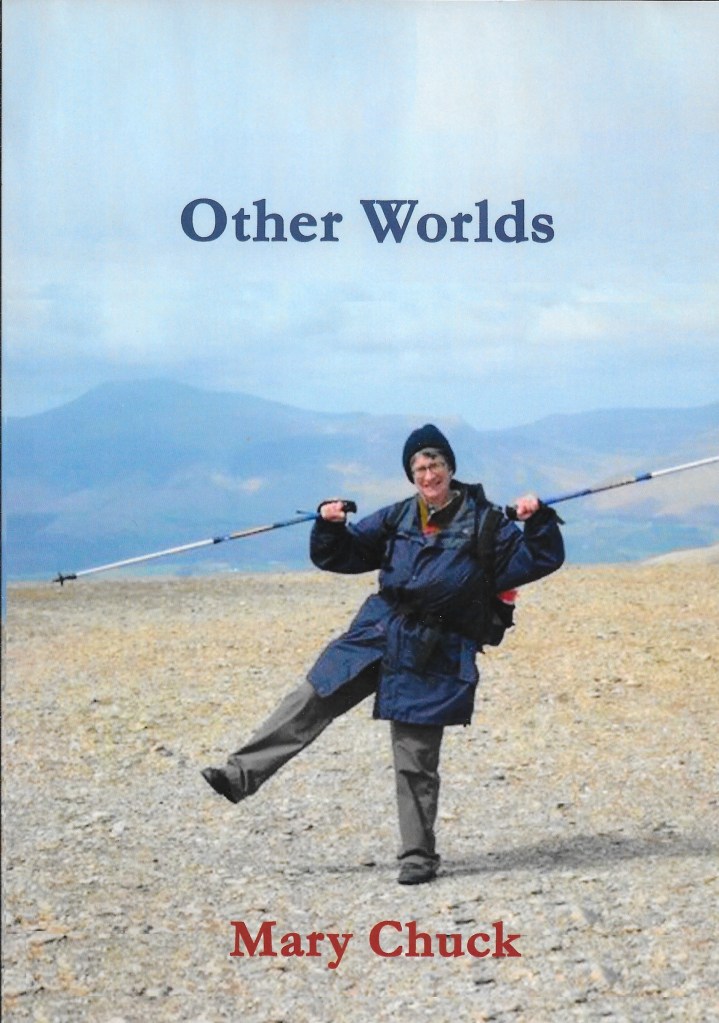
It’s a great pleasure to introduce this month’s guest poet Mary Chuck. Mary and I first met on a poetry workshop in Manchester and we have met on such workshops many times since, including a splendid one at the Almassera Vella, Spain.

Mary Chuck started writing poetry when she retired after 30 years working in Secondary Schools, starting by teaching chemistry.  While she was working her need to escape and let some-one else do the organising took her on many walking holidays in different parts of the world. She is still an active governor at a local primary school and has just completed twelve years as a Trustee of the Wordsworth Trust. She has been writing poetry with several groups, attending workshops and going on residentials with a variety of poets, but most often with Peter and Ann Sansom at the Poetry Business.

I’ve chosen four poems from Mary’s debut collection Other Worlds (Dempsey & Windle, 2021). Mary will have a belated Zoom launch with two poet friends on Tuesday 23 August. Contact Dempsey & Windle for a link.

Migration

His people came from Russia and Lithuania,
their passports always changing, not because they moved
but because their countries became other countries.

His people were Jews, Ashkenazy Jews.
They came from the East,
driven south and west over centuries
until finally they fled from the Pale.

Long after my grandfather settled in England,
and long before he was naturalised,
he was able, once again, to be Lithuanian.
His mother’s people were White Russians
or maybe they had ten white horses?

My father married out.
Her people were not Jews.

They came from Shropshire,
farmers, and one was a stationmaster.
They were not the chosen people.
Her people were not so interesting.

Jammu-Kashmir

He tells me that his father was Kashmiri
but now he can’t go back and I describe
to him what Srinagar was like
before unrest made it unsafe to go;

I tell him how we only went because
the flight to Leh was cancelled due to clouds,
and how luxurious it was,
staying on house boats on Dal Lake;

how we were shown around the lake and lay
with curtains to protect us from the sun,
on cushions on a wooden boat, a shikara,
and saw the floating gardens there;

tell him how pink the lotus flowers were
and how the Mughal gardens, full of scents
I didn’t recognise, were
different from the spice stalls in the street;

how the couple in one garden, keen to speak
in English, asked me about my life,
how they were sad my family
had not arranged a marriage – then I stopped.

I knew I’d gone on far too long. His eyes
glazed over as he looked beyond me, said
I never knew my dad
I never really wanted to.

Travels with my Daughter

I’m not really sure
when the balance altered,
when I knew for certain
our relationship had changed.

Perhaps somewhere north of Peshawar
after we drove up the Khyber Pass
with an escort carrying a Kalashnikov,
arrogant, in the front seat of the car

and after we bought an alcohol licence
in the hotel, and she flirted
in the swimming pool, with a young man
who claimed he was the brother of Imran Khan

but maybe before the landslide
which closed the road, when she carried
a tiny baby across the rubble, impossible
for its mother wearing a burkha.

We crossed a bridge over a ravine at night,
before the house of the drunken engineer.
She had been talking easily in Urdu to the driver;
we turned and reversed, then advanced

more slowly, about nothing she said
as we jolted across – then on the other side –
He had heard that the bridge was rotten,
but I told him it would be fine.

A well-worn track on Kerridge Ridge

Another glorious Saturday morning
needing to be out, needing to be walking
to be moving rhythmically across the hillside
up to White Nancy, through the kissing gate,
ignoring the brambles, skirting the quarry,
following the well-worn track on the back of Kerridge Ridge
head down muttering to myself long before anyone
might have thought I was phoning
going over and over conversations I have had
or might have had
over and over thinking if only

until, hearing the hint of a cough
I feel warm breath on my face
and lift my head to find myself looking
at a moist, brown, eye
above a large, brass, ring
in the nose of an enormous bull.

I breathe, slowly.
I look around.
It is a glorious Saturday morning.

27 June, the day after her birthday

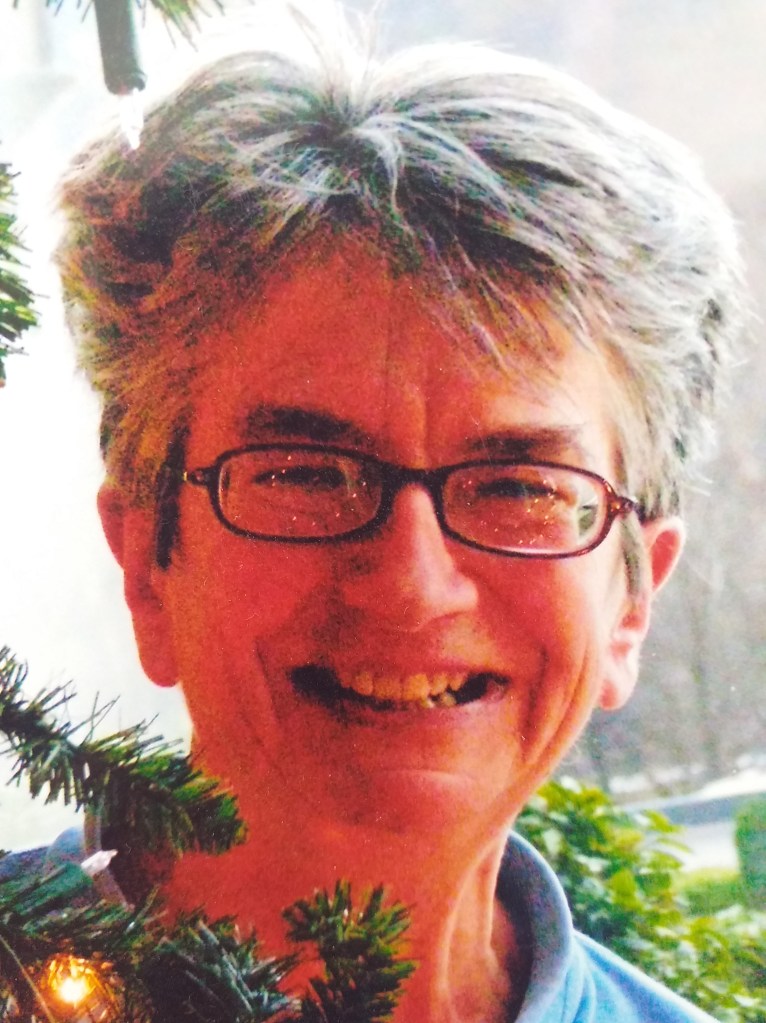
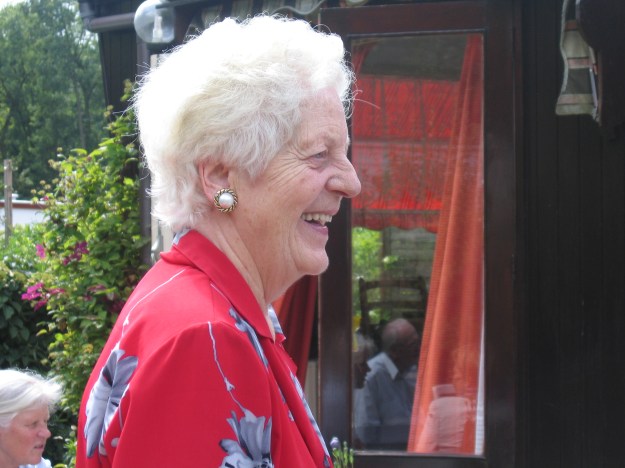
Today would have been my mother’s birthday. The photo was taken at my 60th birthday party which I celebrated in the garden of my friend’s caravan – the one I was to inherit just three years later.

The poem describes a time when my mother was still living independently. As I lived in England, the opportunities to help were limited. I happened to be over in the Netherlands.

27 June, the day after her birthday

I’d left a note on her bedside table
Don’t eat, don’t drink when you wake up.
We walk arm in arm, it’s warm already.
The doctor lives two houses down.
A blue Scandinavian cotton dress,
chunky necklace and earrings to match.
My mother does not look eighty-one.

That blood test done, we sit and face him.
Slightly raised, but no need to worry.
How are you keeping he asks my mother
who smiles, puts on her usual pose, I’m fine,
while I shake my head silently.

She’s leafing through her diary.
It says, Doctor, 8 o’clock.
We’ve been, now it’s time for coffee.
I want to go upstairs to pack.
Before you go, just one question
The matt-green door frame cuts the scene.
I wave, but she frowns at her diary.

Lemonade in the Armenian Quarter

This month’s guest poet is Sarah Mnatzaganian. We first met on a Poetry Business residential workshop a few years ago. Sarah is an Anglo Armenian poet based in Ely, UK. She grew up in rural Wiltshire and in her late teens spent each summer with her father’s family in the Armenian Quarter of Jerusalem.

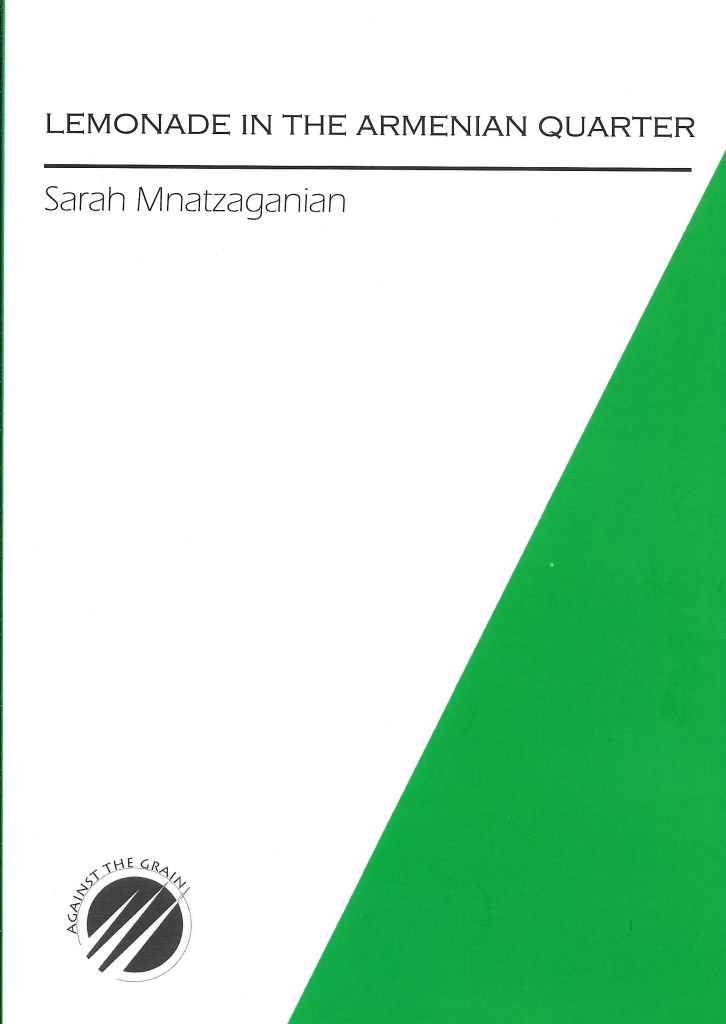
Her debut pamphlet, Lemonade in the Armenian Quarter, is published by Against the Grain Press. Sarah’s work has appeared in The North, The Rialto, Poetry News, Poetry Wales, Poetry Salzburg Review, Magma, Pennine Platform, London Grip, Atrium, and many anthologies. She was a winner in the Poetry Society’s winter 2020 members’ competition on the theme of ‘Youth’ and won the inaugural Spelt nature poetry competition in 2021.

In the 2022 Saboteur Awards Sarah’s debut with its ‘wonderfully moving poems’ gained the award for Best Poetry Pamphlet.

Lemonade in the Armenian Quarter

Uncle Hagop planted lemon trees outside his house
where small passionate tortoises collide each spring
with the hollow pock of a distant tennis match.

At night his ripest lemons dropped into a crackle
of leaves. He grunted through the cardamom-coffee kitchen
into the courtyard to fill his hands with fruit.

Auntie soothed the juice with syrup and iced water.
Uncle drank, clacked his tongue and sang, My Heart
Will Go On, his head thrown back like a songbird.

The lemons lay thick last February. My sister filled a bag
for Uncle. She put a smooth yellow oval into his hand
and helped him lift it to his face to smell the zest.

Dad asked the nurse for sugar and a knife. He cut,
squeezed, stirred. See, Hagop, I’m making lemonade
from your trees. Watched his brother smile, sip, sleep.

Egg Time

To my mother, Madeleine

Give me an egg, round as childhood.
I’ll tap its innocent shell; push sideways
through its Humpty Dumpty head to find
a core of molten gold or the dry pollen
of a hardened heart. May this teaspoon
teach my tongue the taste of lunch hour
on a school day when I’m six, hugging
the bump under mum’s dungarees.
How did the morning go? Watching her
butter home-made bread. Reading aloud
while the baby kicks. Back down the lane
for the lonely end of playtime, her love
like albumen around my ears and in
my eyes. Voices water-slow. Whistle
blown from the other side of the world.

Juice

To my father, Apraham

Every time I set spade against turf,
you’re there, cutting grass-topped cliffs
into our borders, neat as the Normandy coast.

You snatch sweat from your face
and ask for Lemon, half a lemon,
squeezed, with water please, darling,
it quenches the thirst.

I silently sing each syllable to myself
in your voice, like no other voice,
licking the ‘l’ in half almost as long as in lemon,
expressing the juice of each word with your verve,
crushing the fruit’s face into ridged glass
and clouding cold water with the sharpness you crave.
Each sucked finger stings.

Now I want to watch your dark throat dance
while you drink.

At the end of my suffering / there was a door

Have you ever hated anyone enough
to ask an iris leaf to turn into a sword
sharp as the new moon, cold as a snowdrop,
irresistible as spring grass growing disorderly,
before it’s mown to match the wishes of one
demanding pair of eyes? Don’t lose focus.

Take one, narrow, curved iris leaf and hold it up.
If the heart you want to penetrate is hard enough
to steal a country and the lives from its people;
if that heart won’t learn the wisdom of the iris,
the snowdrop and the moon – that life is mutable –
then that heart will feel the leaf turn to steel
and, to grant your wish, will stop beating.

The iris will flower blue and yellow, as it should,
for the people returning to their country,
as they should, and there will be no blood
on your hands.

The title is a quotation from The Wild Iris by Louise Glück.

Adopt a Christmas tree – writing prompt

Adopteer een Kerstboom


This week I saw a feature on tv about various adoption schemes here in The Netherlands. One of those, Adopteer een Kerstboom, now has 3,000 people who have adopted a Christmas tree. There is a waiting list: it takes five years for a tree to be tall and big enough for adoption. Each tree carries a metal tag with a number, so that the adopters know it’s their tree. Many people have given their tree a name. They pay a small deposit on collection in November from one of 13 locations, and trees are returned in January when they are planted back in their slot. The fee goes up a little each year the taller the trees get.


I think it’s a great scheme! Season’s Greetings to you all. Thank you for following my blog and for your comments. A short seasonal poem:

I’ve never been to that desert island
though the removal firm sends me
a bill each month for the books I left there.
I’ve never been to Iceland for that green light,
nor Lapland for those dogs and sledges,
but I have kissed Father Christmas.

Writing Prompt 1: a six-line poem that includes, in different lines, an animal, a country, a place in nature, a concrete object (like my book).

Writing Prompt 2: What name would you give your adopted Christmas tree? Write a short ode to Julian or Emily, or ….