Category Archives: Travel

Is it a competition?


11

Virtues of Unity, by Halima Cassell

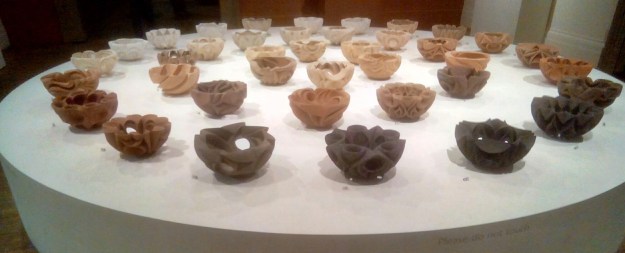
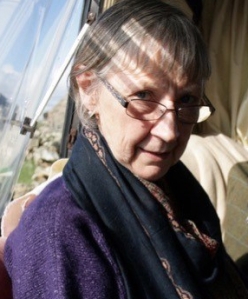
Is it a competition? the woman with dark hair and glasses asked. I stood writing in a small notebook.  On the contrary, I said. I told her this installation is a major and ongoing project. The artist Halima Cassell was born in Kashmir, then raised in the UK. In England she is called a “foreigner” or “second generation migrant”, so she has always been aware of issues of identity. However, when she visited Pakistan as an adult in 2009, she was called “British Asian” or more frequently “a foreigner from England”.

This sense of double dislocation was the trigger for Virtues of Unity. Different countries produce different colours and textures of clay. Each sculpture has its own design. Superficially, we seem dissimilar, but we share DNA. We all come from the clay of the earth and will return to that same elemental clay. The shape of the sculpture resembles the earth, the holes remind us of the womb and the birth canal. Halima was pregnant with her first child when she conceived the project.

So far, Halima has made 39 vessels. Her aim is to make 195, one for each of the countries in the world today. It will be a life-long journey. Each of the sculptures has been made from the clay of that country. The designs of each vessel and the titles represents a positive quality of that country, eg the Netherlands is called Harmony.

I was on a writing workshop at Manchester Art Gallery and we were to imagine a public superhero with a piece of art in the Gallery. I have been pleased to read that the under 35’s are streaming the composer J S Bach. He has been one of my superheroes for many years.

2 (2)


Virtues of Unity

He seemed invisible to visitors,
though he was dressed in a costume
of the period, and his wig resembled
curved waves of a waterfall.

In truth, I thought he was part
of the installation: thirty-nine spheres,
each one representing a country and
made from the clay of this country.

He moved slowly anticlockwise,
stopped at the small ceramic vessel,
a creamy white called Faith.
The positive quality of Germany.

A slow smile grew on his face
when he saw there were no openings,
that the vessel seemed restful,
flowering into a solid cathedral.

Russet, tan, black, brown, beige, taupe,
grey, creamy-white, white. Eyes fixed
on his native country, he started humming
Jesu, joy of man’s desiring, and I was glad.


Glad not to be the corpse – guest poet

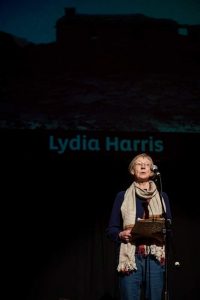
NWA_ScottishBookTrust_HIGHRES_January_18_2018_KatGollock_-73_Lydia_Harris-200x300
A knock-out title for a poetry book, I should say. Lydia Harris and I met on the Poetry Business Writing School in 2012, the year Smiths Knoll published her pamphlet.
The others are glad not to be the corpse is the first line of a poem with the title
We make a video  on All Saints, North Street for English Heritage.

Many of Lydia’s poems have this filmic quality. They’re typically condensed narratives, with arresting first lines, and slivers of telling monologue or dialogue. They are also a masterclass in choosing titles. Could you resist I couldn’t ask if he was glad he’d married me; Widow to step-son; Lice-infested sea trout; Oxygen mask? The next poem is a delicious example:

The rolls arrive at the Inchnadamph Hotel

She doesn’t say ‘I never should have married you’,
instead tries I’ve cleaned our tennis shoes.
He spots the van through his binoculars,
the rattle on the cattle grid alerts the lad who helps.

The rolls brim with themselves,
two each, in baskets on the tables,
they smell of steam and Morag’s overall,
the early morning shuffle in the bakery.

A twist of butter opens out, floats on cloud.
Perhaps I’ll find a horseshoe charm, a wind-up bird.
She reaches for the marmalade.

I’d like a Harvey’s Bristol Cream, he says.
Tonight, she laughs, at five.

The day’s a swing-boat,
red plush seats, a fringe of gold.
He’s helped her in,
pulled the rope to make it rise.

 
Shortly after we met, Lydia moved to Scotland. She has made her home on one of the northern Orkney islands, a small but vibrant community. Recently, her pamphlet of Westray poems An unbolted door was published. I’m very pleased I can share a few poems from the book here. Lydia’s website is homeabout.co.uk


Lydia


How to Approach the Pier

With a bowline tied to your monkey-fist,
with your heaving-rope coiled sun-wise,
bow to Faray, engine in reverse.

With your stern door lined up to the ramp,
to starboard, the quarry, slumped
where the stones for the pier were hacked free.

With outlines of Wideford and Keelylang
papered on the skyline. The tide running high
and the wind southerly.

With trails of foam in your wake,
Geldibust to port. With the stanchions easy,
hung with tyres.

With a route pressed to your palm,
in your pouch, the honed spoon
and that knapped flint from Howar.


Jeemo Services My Van in January

He keeps spare bulbs in a fridge,
cattle in the byre next door,

spreads shafts and flanges
round the anvil
like the gaming pieces
and spindle whorls from Scar,

the woman who bore them
so long dead
she’s in the sky
over Ouseness at night,
unravelling her skins.

 
From the Box Bed

Our sheets are sails on the sweet hay sack
and we sail to the moon with an ebb and a flow.

Your hands smooth my throat in the starlit room,
there’s nothing to say but the brush of flesh.

My lips drink your breath and the tide is in,
the clock on the wall makes the only sound

but for the air as it leaves your lungs,
sweeter than scallops from the pan,

for where has it been,
inside your skin and I take you in.

Brahms’ Alto Rhapsody

Rotterdam 015

Marianne Carolan, Rotterdam, 2008.

This week my friend Marianne would have celebrated her birthday.  One of my best memories is the trip I made with Marianne and other sponsors to Lalibela, Ethiopia in January 2007, during the Timket celebrations. Marianne had set up the Lalibela Educational Trust in 2006, to ensure there would be enough funding for sponsored children when they moved into secondary and tertiary education – university, nursing college.

With her 2007 Christmas card she sent a change of address: she’d bought a flat in Rotterdam, to be close to her new partner.  She was going to join an accordion orchestra and find a violin teacher.  I booked my flights in November 2007, the month Marianne’s GP mis-diagnosed, telling her symptoms were just Irritable Bowel Syndrome (IBS).  After the photo was taken Spring 2008, Marianne donated her accordion to the woman director of the orchestra.


Brahms’ Alto Rhapsody

The March visit had been planned
as a celebration of your retirement.
We walked on Calshot beach
summing up our lives, loves,
gifts and regrets.

Later, in your study upstairs,
we listened, connected
to your white MP3.
I couldn’t stop myself
from humming along.

Your ex-colleague (younger,
glasses, a little overweight)
started to speak in the silence –
when the men have stopped singing.
At your cremation they let
that alto voice fade away

Rain, rain, rain …


rain


This poem by Lemm Sissay is a great example of “concrete” poetry: the physical shape of the poem fits with the subject matter. Rain is on a wall on Oxford Road, Manchester, between the Whitworth and Manchester University. It’s the partner of Hardy’s Well, the poem by Lemm Sissay that is on the wall of a pub. I blogged about that in July last year. The title of the piece is What a Waste!

The last few days it has been raining here in Manchester, though the sun comes out now and then. It made me think of the famous poem Rain by Don Paterson. You can find it on http://www.poetry.org the site of the Academy of American Poets. It’s mostly in four-line stanzas and has end-rhymes, and starts:

I love all films that start with rain:
rain, braiding a windowpane
or darkening a hung-out dress
or streaming down her upturned face;

The poem ends with a one-line stanza which is a very striking “turn”. Many poems have turns, most famously, of course, the sonnet form with its volta. Paterson has:

and none of this, none of this matters.

 
My rain poem is in my collection Another life. There are several turns in the poem, including in the final stanza.

The Lido, Clifton

It is dry this Monday morning.
I wonder what it’s like swimming here
when it rains. Just then the drizzle starts,
a gently pulsating rhythm.

Bristol had the oldest open-air lido
in the country. Refurbished Grade II
it sits between the backs of offices.

The water is warm, kept at this
steady temperature. Floating on my back
I see the movement of clouds.

The following year my friend
would abandon me once I became ill,
but here we are drawing small ripples
in the water, each of us in our own lane.

Please Hear What I’m Not Saying

cover MIND


With 200 poems, this is a substantial anthology of mental health issues. It was compiled and edited by Isabelle Kenyon of Fly on the Wall Press. Profits from the publication go to MIND, the UK mental health charity and a small charity based in Scotland. So far almost £600 has been raised.

Isabelle organised a micro-competition to celebrate the first anniversary of the anthology’s publication. I just received my copy of the anthology, as she declared Voice the winner.

 
Voice

I’m scared of the voice that tells me to let go of the wheel.
It’s an old man’s, harsh, gritty, cold, pushing me.
That time: Monday, sunny, A487, heading for Portmadog …

throat, sweaty fingers, heat


Black figures carry bags home. Whatever home might mean.
Silence, only sirens calling. The dog-end of the year.


Falling is kind of doing something.
You can fall sideways, head first, backwards.
I have worked all these years to stay upright.
Running like a rabbit on a metal track.

American Dream – guest poet

Jim Caruth
This month’s poet is James (Jim)  Caruth. We met in 2012 on the Poetry Business Writing School. He has had several pamphlets and a collection published: A Stone’s Throw (Staple Press, 2007), Marking the Lambs (Smith/Doorstop, 2012), The Death of Narrative (Smith/Doorstop, 2014) and Narrow Water (Poetry Salzburg, 2017).

Jim says: I was born in Belfast, have lived in South Africa and, for the last thirty years, in South Yorkshire. Like all itinerants, that has left me with a need to question what I mean by home.

Many of James’ poems are a search for a definition, a means to find some way to articulate the past (whether real or imagined) and put names and faces to the ghosts.

I admire his ability to say so much in few words with accurate and delicate detail. I’m delighted to share Jim’s work here.

 
American Dream

Each time I tell it differently.
It was Autumn, a skirr of leaves
in Washington Square, old men playing chess,
two women on a bench drinking Zinfandel
from crystal flutes while the Cuban boys danced salsa.

Summer maybe, a man stretched on his bed,
the wail of sirens from the streets
as cockroaches scratch in the walls
and the woman in the next apartment
makes love in Spanish.

And on a sidewalk in the East Village,
a man with a sign – Gulf War Vet,
one trouser-leg flapping from the knee,
till a fat cop in his stayprest blues kicks
the one good leg, fingers his polished holster
and raises a night-stick to point the way home.

Or was it late Spring when we saw them
on Charles Street, heard the young one yell –
keep your freekin hands off me
as the other raised two pale palms
and turned away as her face fell apart.

No, it was Winter, a trace of snow
on the streets when I took a photograph of you
by an office window – Divorce$300,
as you lifted your hand to your heart
and sang – God Bless America.


Traces

He preferred horses to people.
Recognised that look of madness
in their eyes. Loved to run
a calloused hand along their sheen,
feel the taut length of a sinew
with knowing fingers.

Two months before he died,
we found ourselves stranded
across a table in a pub,
empty conversation rattling
the space between us
like a spoon in a pot.

As he looked at the walls
decorated with the past,
a bridle, collar and traces,
his eyes washed clear of me.
But I swear I heard him say,
Walk on. Walk on boy.


41+David+Goad

By David Goad

A First Glimpse of Snow

Strikes and demonstrations,
burning necklaces in the townships,
the rhetoric of bull-whips in Adderley Street.
It must have been winter, eighty-five,
when the Cape had a first fall of snow
and I drove you and Alice to Franschoek.
Up through vineyards, past dams of green water,
till we reached that point where the dirt road
was washed away and we got out to watch
a flock of guinea fowl root amongst the rooikrans.
We stood, sipping the clear air in slow breaths
as she laughed at their kek-kek, kek-kek
and you lifted her in your arms, so a child
might have a first glimpse of snow.

 
What’s the Point?

My father would say
he could never see the point
in climbing a hill
though they rose like a wall
at the top of each street.

Never looked down
on the city at night,
jewels on black velvet,
never once felt peace
rise up like a breath.

He never stood on Cave Hill
to watch the ferries
slip down the Lough,
never thought that grey stretch
as a road to anywhere.

He never climbed the slopes
of Divis on a spring afternoon,
never lay amongst the heather
to watch a kestrel hover
as if it was pinned to the sky.

I am taking my father’s ashes
up Carnmoney Hill.
In the hearse’s slow climb
I hear a voice in my head:
What’s the point in this?

John and Mary meet …


2 romance

A romantic display at the 2018 Keukenhof, the Netherlands

A poem for Valentine’s Day:


John and Mary meet

John and Mary meet.
John and Mary greet.

The Film and Reels.
The Cog and Wheels.

John falls first.
Therefore, he kneels.

Mary thinks she knows
what John feels.

So, Mary falls as well,
as far as John can tell.

The sorcerer, a spell.
The Bell and Peals.

John and Mary greet.
John and Mary eat,

more sour than sweet.
Their eyes no longer meet.

Year of the Golden Pig

4

Shop Window in Siena, Italy

Wishing you a happy, healthy and prosperous Year of the Golden Pig, with a haiku sequence.

I wrote this after a visit to Little Gidding in August 2001, while on a writing week with the poet Lawrence Sail. Little Gidding is, of course, well-known as the fourth and final of T S Eliot’s Four Quartets. He wrote it after his own visit to Little Gidding.

My haiku sequence was published in Presence #18, in September 2002. The illustration below of the wild boar is by Ian Turner. It’s a photograph of Wild Boar Clearing Sculpture by Sally Matthews, 1987. It was made of mud, cement and brash and situated in Grizedale Forest, Cumbria, UK. Grise dal is Norwegian for Valley of the boars.


Little Gidding

following her
across the field
a white butterfly

almost hidden by grass
three wooden crosses

the church bell
covered
in pigeon droppings

pink geranium petals
a droning plane

on the terrace
calling us old, advanced –
the toothless guide

finding the pigsties –
number one boarded up

as we leave
sunlight
on the font


Golden Boar

A Golden Shovel poem about Brexit…

40.jpg

The Campo, Siena, Italy.

The Golden Shovel form was invented by Terrance Hayes. His poem Golden Shovel is a tribute to the poem We Real Cool by another US poet Gwendolyn Brooks. It is a poem about a group of young black men playing pool in the Golden Shovel. Terrance Hayes’ poem stays close to the subject of the original poem. You can find it on the Poetry Foundation site.

A Golden Shovel poem takes a line from another poem and places the words at the end of the lines of the new poem. So, Terrance Hayes’ poem starts:

When I am so small Da’s sock covers my arm, we
cruise at twilight until we find the place the real

men lean, bloodshot and translucent with cool.
The UK is inching closer and closer to the 29 March deadline for leaving Europe. I’ve had chronic “Brexit Anxiety Disorder” for over two years now, so was glad to escape for three weeks to Lanzarote – warmth, sun, walks by the sea, good books, company of family and friends.

Here is my first attempt at a Golden Shovel poem. It is inspired by a line from Nine Allegories of Power, by John Siddique: The accumulation of seconds in which empires are born, gather their height and become broken statues and friezes in museums far away.

In Blighty

So much here in Blighty has been lost, replaced or deleted: in the
grey city centre European Christmas markets confront an accumulation
of dirty duvets in doorways of offices and hotels. I hear the faint ticking of
clocks, hold memories of closed libraries, swimming pools. No seconds
are offered in foodbanks. Minutes after my friend put tinned rice in
a cardboard box in Sainsbury’s, she tripped on the cracked pavement which
has an outline in white paint. The people, many of them, dream of empires
returning. The past was always another country and pipe dreams are
made of clay. One man’s dream is another woman’s nightmare. I was born
in a land below the sea, the North Sea, a country where politicians gather
around tables, walk the corridors in The Hague to arrive, eventually, at their
destination: consensus, compromise, through polderen. I cry at the height
of hypocrisy when Britannia rules the waves, Jerusalem, and
other iconic symbols are stolen by those moneyed men who have now become
European citizens simply through buying in. The UK, my home for 45 years, is broken
but the chimneys of empty factories will outlive the stately statues
of proud admirals on horseback. They are already covered in pigeon shit and
some wear a fluorescent yellow jacket. High up in the Gallery are Victorian friezes
and dusty glass cases display the relics of civilisation, while upstairs in
the Elgin Room a silent queue shuffles, some people are crying. These museums,
(yes, every town or city has its Museum of Lost Marbles), have at the far
end the emergency exit, a green man running, running, running away.

Exploring the Orinoco – guest poet

It’s a pleasure and a privilege to introduce Alan Payne, the poet featured this month. We met during the 2012-13 Poetry Business Writing School.

Alan Payne

Alan was born in Trinidad and lives in Sheffield. His pamphlet Exploring the Orinoco was a winner in the 2009 – 10 Poetry Business competition. He has had poems published in Smiths Knoll, the North and Scintilla, and in various anthologies including The Sheffield Anthology: Poems from the City Imagined, and Cast: The Poetry Business Book of New Contemporary Poets. He worked for many years as a teacher of young children.

His poems visit themes of loss, grief and migration. Alan writes with great economy, sometimes even sparseness. Poignancy is created by his selection of accurate and telling details. Alan always writes with empathy for the people in his poems. His poems taught me that it is fine to revisit the themes that continue to haunt us.

The poems Colombie and Exploring the Orinoco are from the 2009 pamphlet. Menu and Silence are published in The North, issue 60, August 2018.

Colombie

Sudden stars pulled us through
the Dragon’s Mouth.
Port of Spain extinguished.
Home and homeliness
already a legend.

Next day, briefly ashore
in Guadeloupe –
the patois a distorted version
of a beloved tongue,
its lilt curled in my ear.

Crossing the Atlantic –
a band’s orchestrated goodbyes
lost in the wind,
the thundery embrace
of the Northern Range
an echo in the swell,
my stuffed alligator
a talisman.

Fabled Plymouth.
And the journey north, by train,
to Apperley Bridge.
There, in that no-man’s-land,
I tasted pickled onions.
Assumed a stranger’s skin.
A worsted suit.

 
Exploring the Orinoco

With the Thames in their hearts,
and childhood fevers in common,
my father and his dead brother
explored the Orinoco.

The boat of my father’s faith
carried them upstream
to the port of Encaramada,
past the granite domes
of Punta Curiquima.

There, on a deserted island,
they camped for the night,
sitting on the scattered husks
of turtle shells,
reading in the moonlight,
and dining. A faint stink
of rotting crocodiles
corroded the air

During the night, a jaguar
added discord to the howling
of their dogs,
and cataracts answered
the rumbles overhead.

Once, a small black monkey,
like a widow in mourning,
returned the sweet, sceptical smile
of my father’s brother
as he glanced up
from his beloved Darwin.
With a pencil, he underlined
a few words; then disappeared
into the forest
of my father’s mind,
where their mother’s grief
(one boy saved, one boy lost)
left him bereft.

 
Menu

Stereotypical, I know, this woman
carrying an urn on her head, smiling,
as if it’s nothing to have walked
to the market in Tunapuna,
and this man who, good-naturedly,
holds out his cup, and this donkey,
waiting patiently by the man’s side,
still, with well-behaved ears.

My father framed it, hung it on the wall,
a reminder of S.S. Colombie,
au revoir, the French waiter
with one blue eye, one green eye,
Trinidad, Martinique, Guadeloupe,
and then the chilly Atlantic.


Silence

There was always silence in our house,
the silence before grace,
the silence following the Lord’s Prayer,
the silence of my father’s work
that seeped out from behind
his polished study door,
the silence of my mother’s brother
who, we were told, died in the war,
but as I later discovered
blew his brains out
in a car-park in Hammersmith
on receiving his call-up papers.