Category Archives: Art

Living below sea level – guest poet

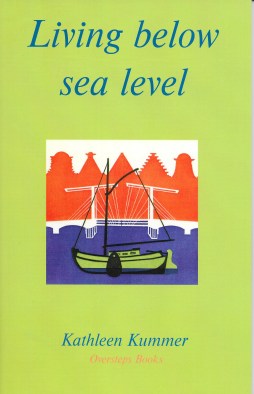
Living below sea level is the title of Kathleen Kummer’s debut poetry collection (Oversteps Books Ltd, 2012), as well as the title of a short sequence in the book. Kathleen and I met at the beginning of the century on a week’s writing workshop with the poet Lawrence Sail. She had been married to a Dutchman and lived and worked for 14 years in the Netherlands, teaching French and German.

We kept in touch as poets and then became friends. When Kathleen moved to Devon to be nearer her two daughters, I suggested she submit her work to Devon publishers. Kathleen only started writing poetry seriously in her late sixties and had immediate success in competitions and acceptances in quality UK magazines.

I’m featuring Kathleen as this month’s poet, with three poems from the collection. That day is the second poem in the sequence. The cover picture is by Shirley Smith, Society of Wood Engravers.

News item

Let it be hard to write this poem.
Let it be hard to listen to.
Its words should lie flat and grey on the page,
ugly, as befits the vocabulary of war.

He had no alternative, said the surgeon,
but to amputate the festering hand
of the baby, nine months old.
Did you, like me, hear the news over dinner

in a comfortable chair, in a comfortable room,
and wonder how you could go on eating,
go on living? But did, having no
alternative. Let that child, I asked –

without knowing whom I asked it of –
still have a mother and family to rock
and cradle it. For how many lullabies will it need
to sleep, how many bedtime stories?


ii That day

A kind of delousing: hours later,
I’m still finding rice and confetti in your hair,
but no trace of the cobalt-blue, vermillion
and burnt umber which dappled your face
and your dark hired suit, as the sun streamed on us
through the stained-glass windows. And that cascade of notes
‘Handel’, you whispered. I was proud of you
for knowing and didn’t let on I knew.

Image (6)

Boat on my windowsill

Forgive me for not using the pine cones you gave me
to light the fire. They look good on the hearth
in a wooden bowl. Among them, I found
a piece of bark, two-sided, V-shaped.
On my windowsill, upside down, it becomes
whatever boat I want it to be:
The Oseberg ship, chattels, carved wagon
on board, moored in its burial ground;
a Viking longboat, cutting through
the Baltic and Skagerrak as though they were butter;
a rowing boat, sturdy enough to take me
out to the ships which stand so still
on the firm line of the horizon; in the coracle,
I’d be snug and safe as a walnut in its shell
for the short crossing to the other side.


The Old Olive Press

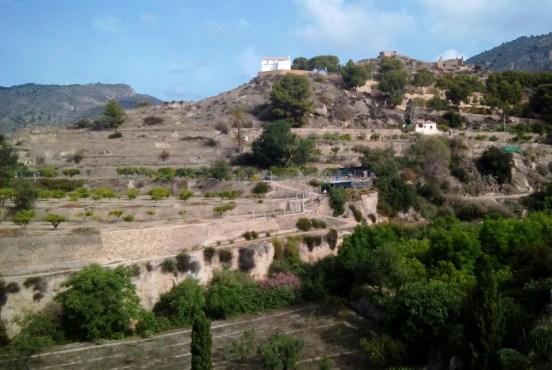
Below is a picture of that olive press. Christopher and Marisa North opened The Old Olive Press, which is their house, as well as a cultural centre, in 2002. The press is located on the ground floor which has a sitting area and a large table seating a dozen. The first floor is at street level and houses the library of close to 4,000 books. Writing retreats are available and the Almàssera Vella is also listed in Alisdair Sawdays’s Spain (Special Places to Stay).

The blue house is at the edge of Relleu, a village in the mountainous area of Alicante province, known as ‘Marina Baixa’. It is the perfect location for a writing retreat, just one hour from Alicante Airport, half an hour from Villajoyosa on the coast; the village is large enough to have a bank, pharmacy, several bars and local shops. The Romans established the village on its existing site at the end of the 1st century B.C.

olive presspool JL

bancal

The olive press, the pool, the terraces (bancals) with olive trees.

I’ve just come back from my seventh visit. I’ve attended workshops with poets Mimi Khalvati, Matthew Sweeney and, in recent years, with the incomparable Ann Sansom. A week there is a winning combination of writing in the morning, a buffet lunch, and plenty of free time to write, read, relax, swim in the pool, or walk. Below is a poem from last year.

Relleu, 2017

The church bells do not have twins.
Bells ring twice, so the men working
in the campo can count the second time.

We’re at Pepe’s on the village square,
seated in two long rows at a narrow table.
Down the cobbled street is the blue house
where a white dog barks into the valley.

Maggie is moving along the table reading
aloud lines from a poem written by all
of us on the edge of the paper cloths.

A little Navarra rosé is left in my glass.
The twins of that paper poem are ahead of us.

Refusal of a visit visa (3)

suleman 3

What Dreams May Come (2015) placed between After All It’s Always Somebody Else Who Dies (2017).

Adeela Suleman writes: My work is profoundly shaped by the way in which violence is performed, experienced and remembered. The more heinous the violence, the more beautiful its memorial.  In contemporary Pakistan death surrounds us, nameless, faceless and countless. In Karachi up to 12 people a day die in gangland and politically motivated murders.

The birds are dead. They make a pattern, a simple pattern that silently repeats itself. Silence haunts you, silence is disturbing. The delicate sparrow is a symbol and their shadow on the wall a reminder of the fragility of life.

After all it’s always somebody else who dies

The headless warrior still stands strong, holds his shield,
grips the tall lance, two narrow ribbons flutter.
Reeds, flowers and grasses part for his feet.
A memorial captured in carved wood stained green,
the colour that pleases the prophet.

Hand beaten and hand beaten from behind, through
chasing and repoussé, the stainless steel sparrows
that tumbled to their death. On the left 420 sparrows,
their beaks and feet touching, all held together.
On the right the same number of sparrows,
a shiny, shiny stillness.

My poem was a response to Suleman’s sculptures. It appeared in Building Bridges, an international anthology edited by Bob Beagrie and Andy Willoughby, published by Ek Zuban in 2017.


Refusal of a visit visa (2)

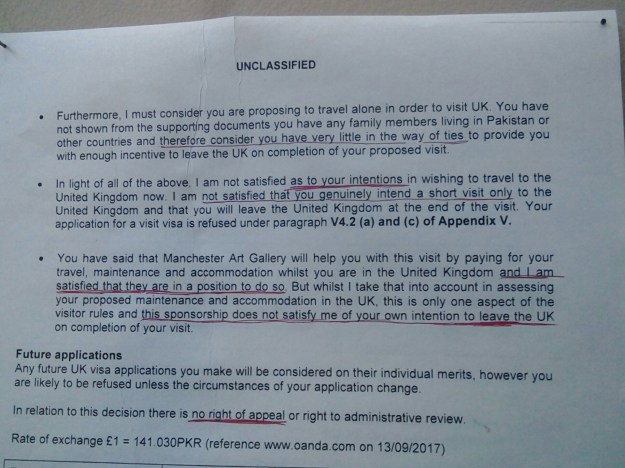
Recent Poetry School workshops have been held in the Manchester Art Gallery. So, we have been inspired by sample poems as well as the works on display. On the second floor there have been several interesting exhibitions of modern art. Dashing back downstairs I missed the display on the foyer wall – an enlarged copy of Home Office form OV51 Visit (NRA). On the first page the staff have given another reason for the refusal. They doubt that the artist has control over her bank account (the application was accompanied by bank statements, as required).

visa 2

Some personal details have been blacked out prior to posting, but the applicant is born in Pakistan and the work in the gallery is by Adeela Suleman, a sculptor and artist and Associate Professor and Head of the Fine Art Department of the Indus Valley School of Art and Architecture in Karachi.

My short “found” poem:

Refusal of a visit visa

Date of refusal decision: 13 September 2017

Furthermore, you have stated that you are single
with no dependents.

I am not satisfied that you have demonstrated ties
to Pakistan that would give you reason to return
there.

a simple pattern that silently repeats itself
               silence haunts you
                                       silence is disturbing


Text in italics by Adeela Suleman.


Refusal of a visit visa (1)

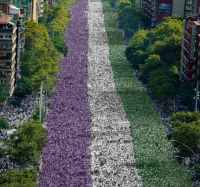
I’m flying out on Saturday, so can’t take part in one of the women’s processions that are being held in the four political capitals: London, Cardiff, Belfast and Edinburgh on Sunday. Those taking part will be given a sash in one of the suffragette’s colours – white (purity), green (hope) and violet/purple (loyalty and dignity). Manchester is the birthplace of the suffragette movement. The Pankhurst Centre is just a few miles from where I live.

processions-2018_-courtesy-of-artichoke

Suffragette Procession, courtesy of Artichoke

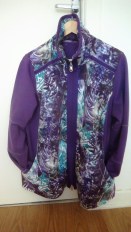
Yesterday I realised that this top, bought in Holland, is in the suffragette colours! Okay, the green is turquoise.

Pankhurst jacket

The Pankhurst Centre published a booklet – essays, memories – to celebrate its tenth anniversary in 1997. The one poem included was mine: a sonnet of sorts.

A line to Mrs Pankhurst

Leaving space for dreams between
the cooking and the dressing of the tree
Purple White and Green

Counting wrinkles on baubles I flee
to caress the turkey and knock
about the choice: dead or free.

Skimming fat off steaming stock
to start afresh, to say seems equal folly
Purple White and Green I fill my sock.

With another drink I might feel jolly.
Outside fairy lights among a flurry of snow.
I shudder when he pulls me under the holly

and Purple White and Green I know
that maybe next year I will go.


Beneath the Earth

I’ve just finished reading Beneath the Earth by the Irish writer John Boyne. It’s his first collection of short stories. Boyne is better known as a novelist: he has published nine novels and five novels for younger readers. One of these The Boy in the Striped Pyjamas sounded familiar: in 2008 a film was made in the UK based on the book.

I’d taken the book with me when I went to Italy recently. I can’t settle into a novel when I travel – plane, train, hanging around at airports. The blurb calls them “dark, unerring and surprising” and you can tell from the opening sentences below that they are dark. Boy, 19 opens the collection and Beneath the Earth is the last of the dozen.

* I started charging for sex a few days after my nineteenth birthday (Boy, 19)
* The brick crashed through the front window shortly after midnight and Émile woke with a start, his heart pounding, his eyes raw from interrupted sleep. (The Country You Called Home)
* I never had a chance to observe Arthur in his public role until a few days before my mother’s funeral (The Schleinermetzenmann)
* Hawke, a grey wolf in human form, emerged from the forest on his hands and knees, pulling pine needles from his palms. (Rest Day)
* It was no easy task to dig the child’s grave. (Beneath the Earth).

In my folder “Working Poems” sits a poem Reading Disgrace at the Mezza Luna. I started it on a workshop where the sample poem was Reading Rumi in the Bear Inn (I think that’s the name of the pub – I’ve mislaid the poem). The novel starts: For a man of his age, fifty-two, divorced, he has, to his mind, solved the problem of sex rather well.

We know, immediately, that the protagonist (David Lurie who teaches Romantic poetry) will fail and fall. The novel is a masterpiece for which J M Coetzee was awarded the 1999 Booker Prize.

Is this opening line too strong, though, to include in a poem that weaves together quotes from a book with observations about a place and people in it? Is that why the poem doesn’t work (yet)?

14 Ways to Write an Ekphrastic Poem

You will find this interesting and useful article on the website of the poet Martyn Crucefix.  He gives examples of poems under each of the 14 headings.  I came across the article just the other week, timely as I’m doing a Poetry School course held at the Manchester Art Gallery.

Martyn has divided these 14 ways into five subgroups:- Through Description, Through Ventriloquism, Through Interrogation, Through Giving an Account and, finally, Come At a Tangent.  He suggests people try to write one a day for the next fortnight.

I doubt I’ll manage one a day, but I’ve taken heart from the article: I have lots of abandoned ekphrastic poems, because one tutor was adamant that such poems have no merit if they merely describe!