In the Netherlands, on the evening of 4 May, the war dead will be remembered. Here is my friend Kathleen Kummer’s poem about an event that happened in Holland during the Second World War. Kathleen’s mother-in-law was a published poet.
They came at night
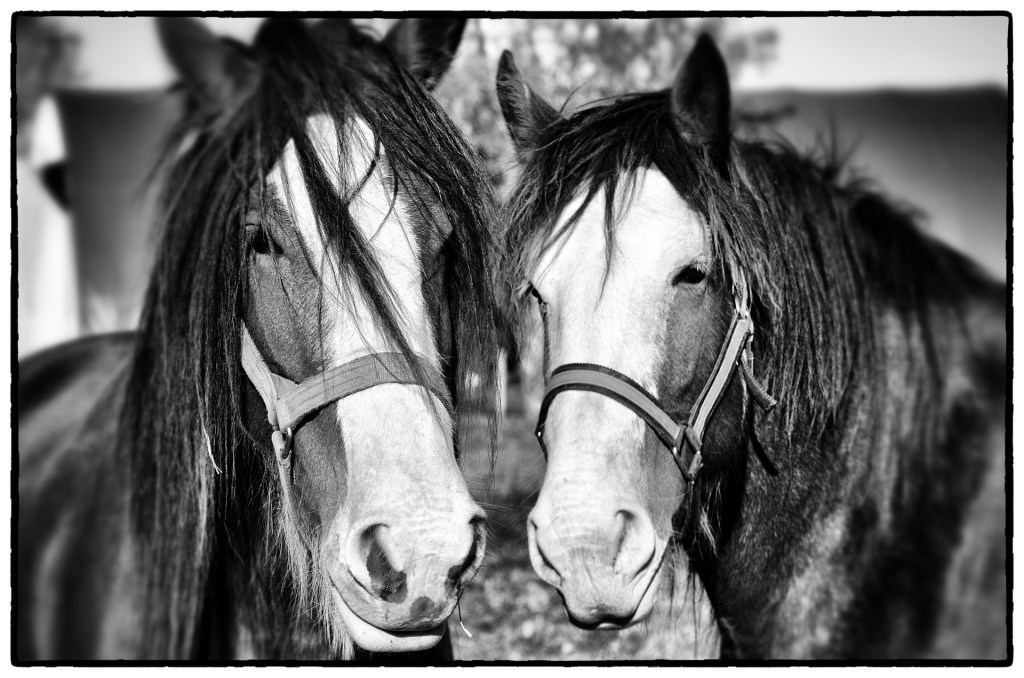
Then there was the night they came for the horses. There would have been no warning before the clang of jackboots on the cobbles in the yard of the outlying farm and the hammering on the door.
By the time they reached the edge of the village, the farmers were up and had slipped their bare feet into clogs. Behind the door, they were waiting for the clattering of the hooves on the road to cease.
Not that there would have been silence as this farmer moved, if need be at gunpoint, to the stable: the shifting of hooves, the neighing, the whinnying, he would know, without finding the words, meant betrayal,
his, as far as the horses knew, which may be why he came to my mother-in-law’s. I want that poem you wrote, he said, that’s being passed round, about the horses.
And now I write mine, seventy years since then, for when I can’t sleep, I often listen as the clatter of hooves on those roads in Holland swells in the peace of a night in Devon.
This month I am featuring poems by Martin Zarrop. We met some years ago through the Poetry School workshops and are also members of one of the Poetry Society’s Stanzas. I start by congratulating Martin: the 2021 Cinnamon Press Pamphlet competition got 450 submissions. The results came out a few days ago – Martin’s manuscript was in the top five!
Martin is a retired mathematician who wanted certainty but found life more interesting and fulfilling by not getting it. He started writing poetry in 2006 and has been published in various magazines and anthologies. He completed a MA in Creative Writing at Manchester University in 2011.
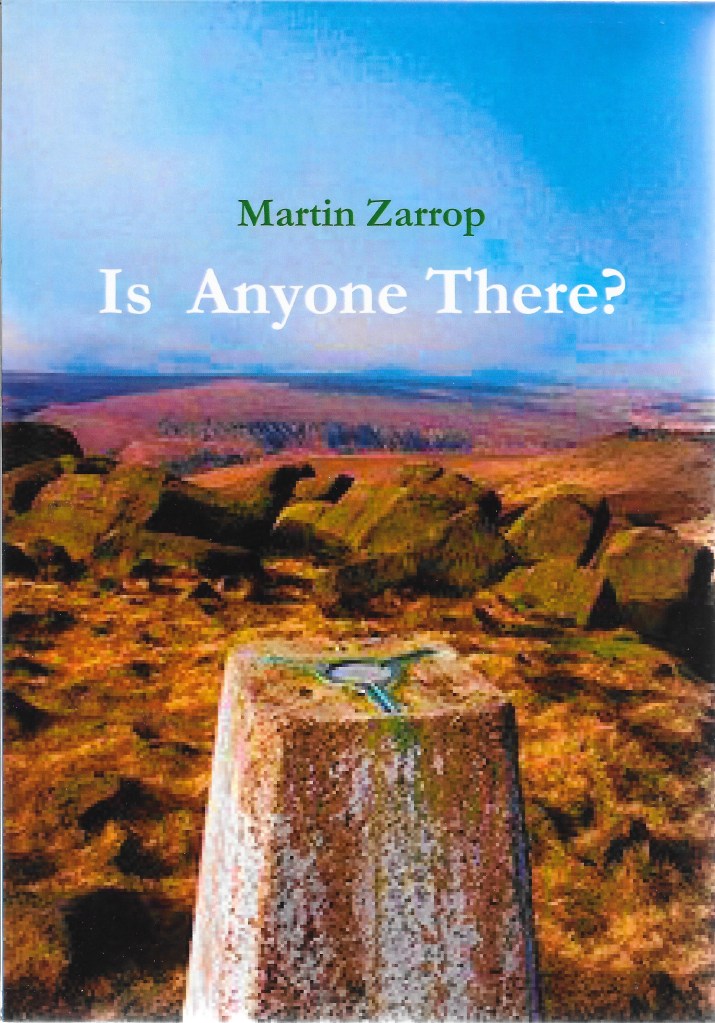
His pamphlet No Theory of Everything (2015) was one of the winners of the 2014 Cinnamon Press pamphlet competition and his first full collection Moving Pictures was published by Cinnamon in 2016. His pamphlet Making Waves on the life and science of Albert Einstein was published by V. Press in 2019. His second collection Is AnyoneThere? was published by High Window Press in March 2020.
The five poems are all from Is Anyone there? Where Martin’s poems refer to science, they do so in an accessible way, often poignant, often with humour. Like Martin, I first came to Manchester in the early 1980s – a place where now around 200 world languages are spoken. I hope you enjoy this selection.
Sci Fi
The aliens are coming. I can see them flicker in the flames as I stare into the coal fire and my mother asks me if I’m happy. Has she been taken over by Martians? I must take care not to fall asleep.
And here I am covered in mud. The invisible predator can’t see me as I try to leave the exam room. Failure isn’t an option but the exit signs are hidden under ectoplasmic goo. The ice cream man ignores my screams.
It is bursting out of my chest cavity, this other me I don’t want to know. Why is my name missing from the credits? Perhaps I didn’t wait long enough for the Z’s. Out in the foyer, zombies are waiting for the next show.
First Impressions Manchester 1980
People talk to you here but not in English and the rain is cold on the grim streets that run for their lives past empty Victoriana, lost empires.
At night, the city strips to its bones, lies unwashed in the glow of fag ends, crushed and dying among claggy debris, northern mouths.
published by The High Window
Missing
She must be in here somewhere. He turns another page and stares at shapes, the outline of a face and almost smiles. The hair’s not right, he says.
Under his thumb, images move, some not even close to human. This one looks like a centaur, this a lion. He knows how much he wants her but he struggles to join the dots.
Across the table, the astronomer, sympathetic despite the late hour, is accustomed to darker matters. Try this one, he grunts, and opens another star catalogue.
Hands
UK’s first double hand transplant awoke from a 12-hour operation with two new sets of fingers (Guardian 23.07.16)
It’s not like wearing leather gloves. This is for real, the weld of tissue, bone to severed stumps; white flesh imbibes the ruddiness of life, then shudders at an alien command –
a finger twitches. It displays no loyalty to donor meat, no tear or thought, no dumb relief not to be ash, no memory of goodbye waves, past loves held close.
The patient chews his nails, flexes each knuckle as if born to it, admires blotches, childhood scars from scraps he never fought, holds out his hands.
To My Nineties
You’d better get your skates on or at least your boots and get out there, old dribbler, before it’s too late.
I may not meet you in the hills struggling through Kinder peat. Thirteen miles, fifteen? No problem!
Or so I thought as hair thinned and Christmas followed Easter as if in a time machine that ate old friends for breakfast.
You stand patient near the finish line as I pull myself up for the final sprint. Nothing lasts forever, not hips, not brain cells. I need a project.
Today’s poem is another childhood memory, related by a fellow teacher to my friend, poet Kathleen Kummer. I find much to admire and like here: the first line which places it so precisely, the questions in the first stanza, that use of the word ‘goosestep’ in the second stanza, the sensory details – sounds, images, smells. The end rhyme is often subtle, and I particularly like the ending. How our view of a person can suddenly shift through something we learn about them.
Piecework
At the age of two or three in wartime London, under the table she played alone to the hum of the sewing machine. Did she ignore the coil, pastel-coloured, which lengthened with the shadows to fall over the edge, soon reaching the floor? Or was it her job to alert her mother when the pink or blue fabric touched down and risked getting dirty? That this was a lifeline, she understood: with carrier bags, they arrived and departed, the strangers who counted out with care the sixpences, pennies, halfpennies, so much a pair. Until the table was needed, she built, then demolished, towers of silver and nasty-smelling copper.
Her mother worked late. She would hear from her bed the goosestep of scissors through felt or satin, the thread as it snapped at the end of the long line of shoes, soft shoes for babies, for feet in mint condition, unused. Had it seemed like magic the first time the puckered cord which dangled over the table’s edge was transformed and became tiny shoes, some with pearl buttons, some with rosebuds, perfectly paired? That the strangers would come and take them away, was what she remembered, and her mother dividing the money, putting some of it in tins for another rainier day – which is more or less what she told me, the colleague I hadn’t warmed to previously.
On Friday I had my second vaccination (Pfizer). I have felt ok, a bit tired and feverish. By way of a treat, a good childhood memory.
The “selling fur coats” took place in Amsterdam, in Maison de Bonneterie: a small chain of high-end fashion stores. The building in Amsterdam was designed by a well-known Dutch architect with an interior in the style of Louis XVI (the Sun King of France), an imposing staircase and a glass roof.
It closed in 2014, after 125 years of uninterrupted service to the elegant public. The Amsterdam store is a national listed building and now used as a location for events.
Saturday mornings
We’ve been waiting in silence. It’s just the three of us. Mother’s away in a city, selling fur coats. The radio crackles, but here comes father with blue beakers, hot chocolate, curled cream on top, and the bread he has baked on his day off.
Tomorrow he’ll be on the balcony playing the organ; we’ll be below. Today he is the son of a master baker. We’ll have the bread with butter and jam, red strawberries, shiny against the golden crust.
For Easter Sunday I have chosen this poem by my friend Kathleen Kummer. The title is intriguing, the details are precise: we sense they are based on the poet’s own experience. Then there is the reference to that well-known Stanley Spencer painting of the Resurrection. You can see it here. Does it work for you as a prompt?
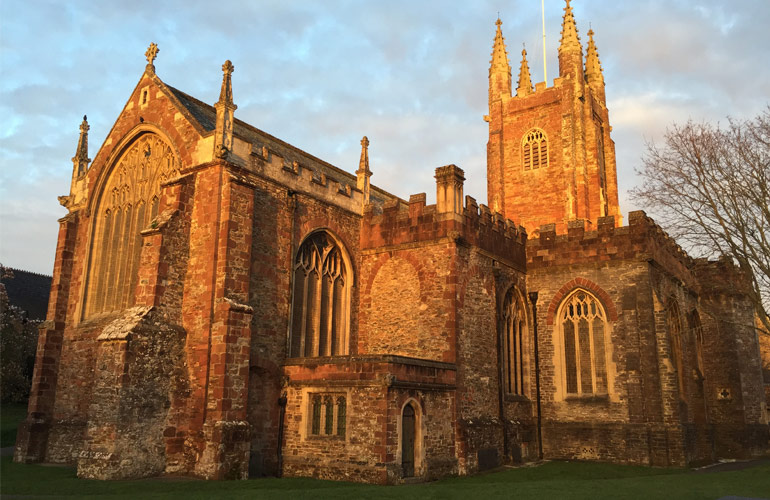
I asked Kathleen about the graveyard. It’s part of St. Mary’s Church, a Grade I listed building in the centre of Totnes, Devon. Perhaps, I could have worked it out for myself: the poem mentions the iconic ‘steep hill’ in Totnes. Kathleen and I have walked up and down it many times, and hope we can do so again soon. Easter Greetings to you all!
Eating a Croissant in a Graveyard
I’m eating a croissant in a graveyard, grassed over. People come here to rest, eat a sandwich. (I wish I’d bought something less flighty, like a scone or an Eccles cake.) The graves are few and not recent. There’s a table-top tomb, ideal for a picnic, but respect is shown: low voices, no chirrup from a mobile phone; people sit on the wall or the grass. I’m expecting that Labrador to cock his leg, but he doesn’t.
Across the street, the bustle of the market just reaches us, and I think of the dead around me, of how this town was theirs, that they walked up the steep hill, stopping to speak to their friends about their simple, complicated lives. When I close my eyes, I see them clambering out of their graves, as in that Resurrection painting by Stanley Spencer, looking dazed, but as if their discomfiture won’t last long, with the green hills they knew around them, the sky blue and summery. And surely the warm-hearted townsfolk will welcome the dead.
It’s as if I’ve banished them by opening my eyes. The place is empty, but for two men in wheelchairs, parked with their backs to the view.
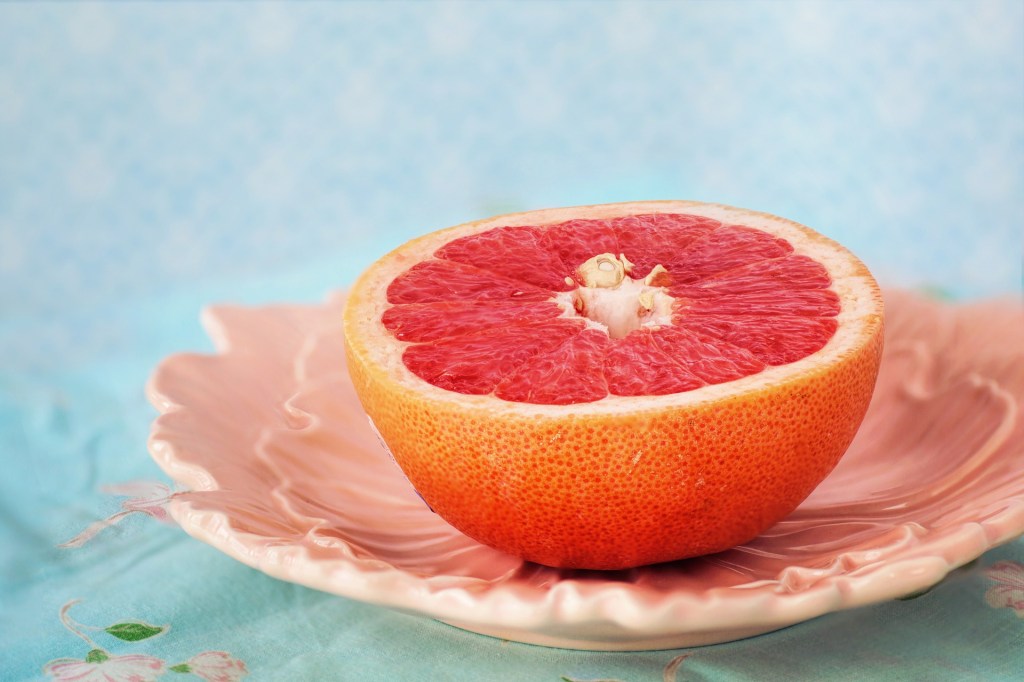
Such a strange fruit: many children don’t like it. I didn’t. Many years later I acquired a curved knife and I found it a tricky and time-consuming job to properly prepare the fruit. Here is Kathleen Kummer’s poem. It doesn’t specify who the people are, but I imagine it’s a mother, watched by children, that “he” is the husband. It’s an understated poem, but those details are precise and poignant.
Preparing grapefruit
Did she peel it – I don’t remember – as though it were an orange? Or cut it in half and make the usual precise incisions, holding back the pith like flaps of skin to extract the pulp?
Our eyes were on her hands as she worked to unravel the strands from each segment of flesh before it tumbled into the bowl. Some fell apart, translucent droplets shaped like tears. How many spoonfuls
would the sick body take of this butterfly food? Would he sleep? I remember the light from the fire, its warmth on our faces, in the drawing room where now the double bed rode at anchor, before the voyage out.
Credit Skitterphoto on Pixabay – Scheveningen Pier
Greetings on World Poetry Day! At the 30th General Conference of UNESCO in Paris, 1999, it was decided to mark 21 March as an annual celebration. Poetry has “the unique ability to capture the creative spirit of the human mind”.
I’ve chosen a poem with international connections, a lot of people, fruit – a festive gathering on a Dutch beach. It’s from my collection Nothing serious, nothing dangerous.
On the beach after My boat by Raymond Carver
Bill’s last words were always Have fun, so I will. He was a very good father, Bill, though he wasn’t my father. Liz will be there too. And Mary and Brian, the Como couple. Seville will be there, all the places I ever fell in love with. We’ll be on a beach, a wide sandy beach with small white shells, large white gulls and far off, in the distance, the red container ships, nothing dangerous, nothing serious.
At the flood line broken razor clams crackle under our feet. There is Dick, almost 80, and Miep, their cycles parked up against the metal wire by the marram grass dotted on the dunes. Esther, Peter, Theo, Ancilla on their e-bikes, they love this beach. Skewered fruit, Water Melon Men and the three Irish men I loved, and the others, the artist with one eye has come back from Hungary. Boats will be there, beached. We’re all beached. My UK friends have come by ship, a ship with starched officers, a ship from Southwold that I specially chartered.
I invited J S Bach, Schubert and anyone else whose names I am forgetting. I have been given dispensation – hey, that sounds medical, nothing dangerous, nothing serious, the friends who are no longer friends, what’s rejection, abandonment among true friends. Apples, oranges, enough grapes to count in the new year, fresh figs, plums, peaches, kiwi fruit for sleep, passion fruit. With all that fruit we are fit to count our blessings, our nine lives. Have fun. The tide’s out, and it is a long time before it’s coming back in.
It’ll be St. Patrick’s Day next Wednesday, so I found you a poem with an Irish theme.
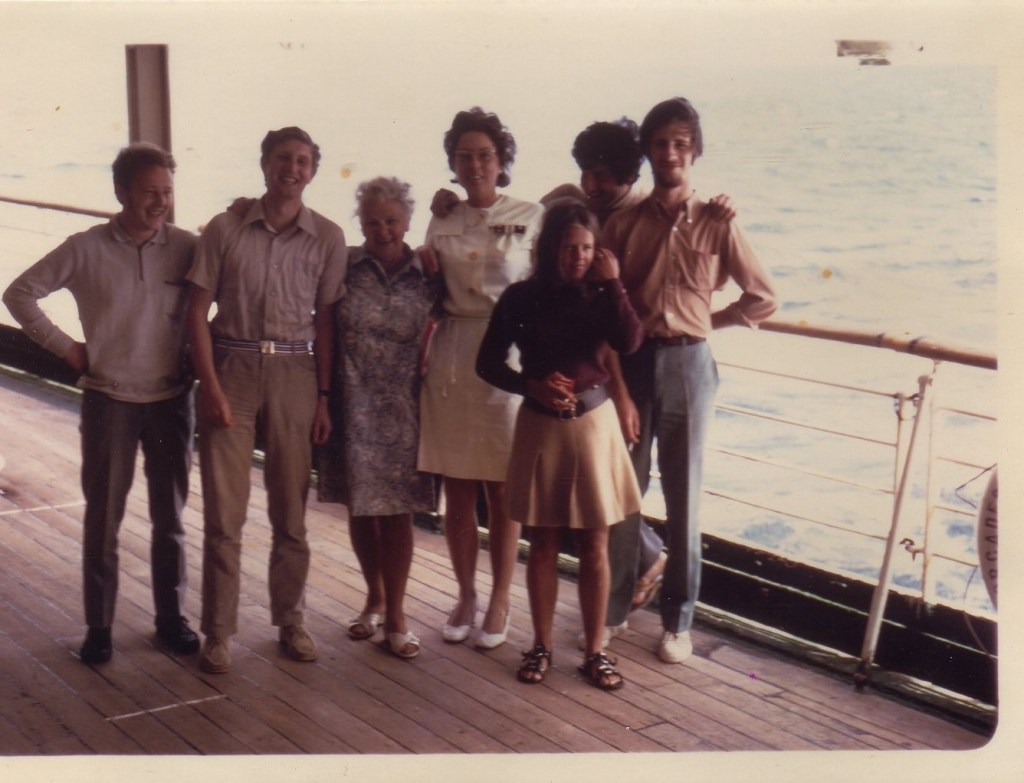
Thousands of Europeans were emigrating to Australia and New Zealand under the ‘Assisted Passage’ scheme. I took my Dutch, English, French and German across the Channel and joined P & O Lines Ltd as a WAP (Woman Assistant Purser) in 1969.
The following year I joined SS Orcades. The ship was due to arrive in Australia in time for older passengers to celebrate Christmas and New Year with family who’d moved there. Because of the large number of Dutch passengers, I held a daily coffee meeting – giving information about ports en route, as well as translating and interpreting.
Each morning, I also met with a small group of German-speaking passengers. On the photo, you can just about see my language badges, attached to my uniform with Velcro!
The poem SS Arcadia, from my second collection Nothing serious, nothing dangerous is about meeting my late husband for the first time. May you be blessed with the luck of the Irish!
Photo Credit: by Taken via PIxabay
SS Arcadia
I was still in my whites, had just rolled down the shutters on shore excursions, orders for birthday cakes, contact lenses lost in the swimming pool.
I was headed down aft, the Tourist Nursery, rehearsals for Hawaiian Night. Oh, I’m going to a hukilau.
It was a moment of whites and early evening sunlight. That Irishman, feet planted wide on shiny boards, who controlled the English bar staff, Goanese stewards.
I already knew that Junior Officers were not supposed to fraternise with Leading Hands.
Can’t you sleep either? After a dark year, many old friends gone, I thought I heard you sing outside the window inches from my ear. Who are you singing for this time of night? Did I dream you?
This is the first stanza of Ruth Padel’s poem Night Singing in a Time of Plague. You can read the full poem on the Poetry Society’s site here. It is a response to John Keats’ poem Ode to a Nightingale. The poem was commissioned as part of the Keats200 bicentenary – a celebration of Keats’ life, works and legacy.
We are close to the first anniversary of the pandemic. The borders of the Netherlands remain closed to visitors from the UK. I have been sleeping less well for weeks now. Here is Kathleen Kummer’s poem, also about the difficulty of finding sleep.
Lying in bed with my life
I am lying in bed with my life. It is one of those sleepless night when I chafe at its bulk alongside me. It will fill the hours with my clan of northerners and sundry others. I shall speak for them all, the living and the dead.
I know the words, which I’m good at repressing when they were my own and unkind. I shout Cut if the scene is unbearable, switch on the lamp to get rid of it, a shame, as I might still have seen my mother’s harebell-blue eyes and the family wearing each other’s hats at a picnic.
The curtain at last turns grey and grainy, and my life rolls up fast with a click inside me. I’m reminded of that when my daughter says I don’t suppose you’ve got a decent tape-measure?
We end the month with a February poem by Kathleen Kummer. I love all the flowers that are included, how the poem touches on that moment of turning. The last two lines carry an extra weight this year.
Another spring
There had been no hint that it was in the air, no question of even imagining a haze of green round the trees. What flowers there were pointed to winter: hellebores, snowdrops, a few crocuses trembling in the grass, and the camellias in bloom, ice-maidens, translucent, quite at home in the cold. It was February. Coming home in the dark, I paused on the step to the garden, held back by the smell of the soil someone had turned in my absence, moist, as if a god were breathing on it to warm the earth. Then I knew for certain that spring was coming, that, deo volente, I’d be there.









 Acacia Publications