Each Sunday in December there will be seasonal poems on the blog. For a few years I lived in the Withington area of Manchester, so I recognised the shop mentioned in Annie Muir’s poem. It’s from her pamphlet New Year’s Eve, published by Broken Sleep Books in 2021.
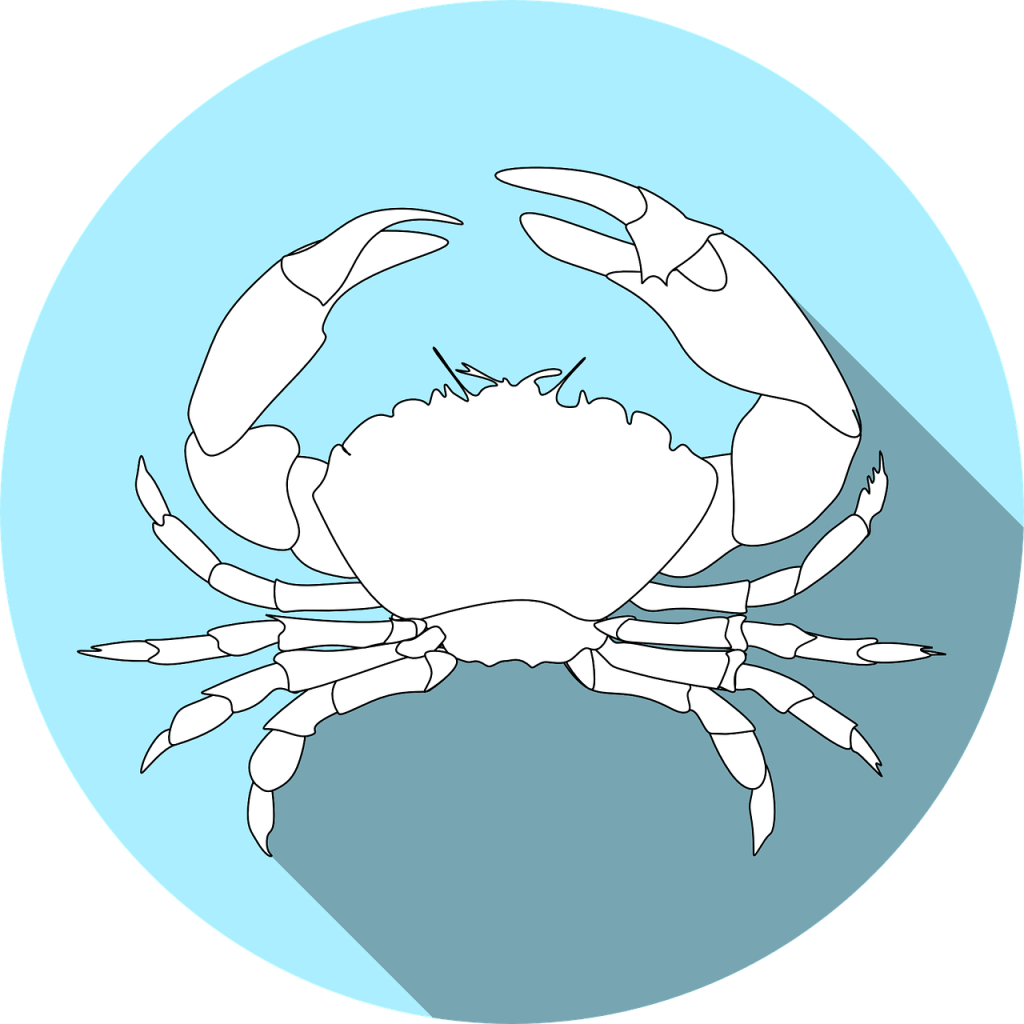
Crab Snowglobe
Thrown in with shoelaces and paracetamol, a souvenir from Copson Street pound shop –
this rusty orange crab on a rock with specks of glitter resting
in every nook and cranny. Around the base there are footprints in sand
and another, smaller crab, exactly alike except I can touch it.
Inside your hard, glass globe you seem to be in some other dimension
like the reflection in a mirror, or memory.
Either dormant or ecstatic – when I shake you up
it is for a moment New Year’s Eve, your pincers grasping to catch the confetti
that floats around your head in kaleidoscope slow motion.
Then, when each piece has fallen, you wait for something else to happen.
Biography
Annie Muir lives in Glasgow. Her debut pamphlet New Year’s Eve was published by Broken Sleep Books. Pre-pandemic she handed out poems on the street outside local libraries, and she has a podcast – Time for one Poem – aimed at complete beginners to poetry. @time41poem
Another quote from Claes Oldenburg’s famous Ode to Possibilities ‘I’m for …’ from 1961. It reads like a long list poem. Oldenburg said it was a statement, not a manifesto.
Risham Syed, The Tent of Darius
My poem Wearable Narratives, from my second collection, Nothing serious, nothing dangerous, published by Indigo Dreams in 2019, is in two parts. The poem was inspired by art in the Manchester Art Gallery. Last week I posted part i (Scarf).
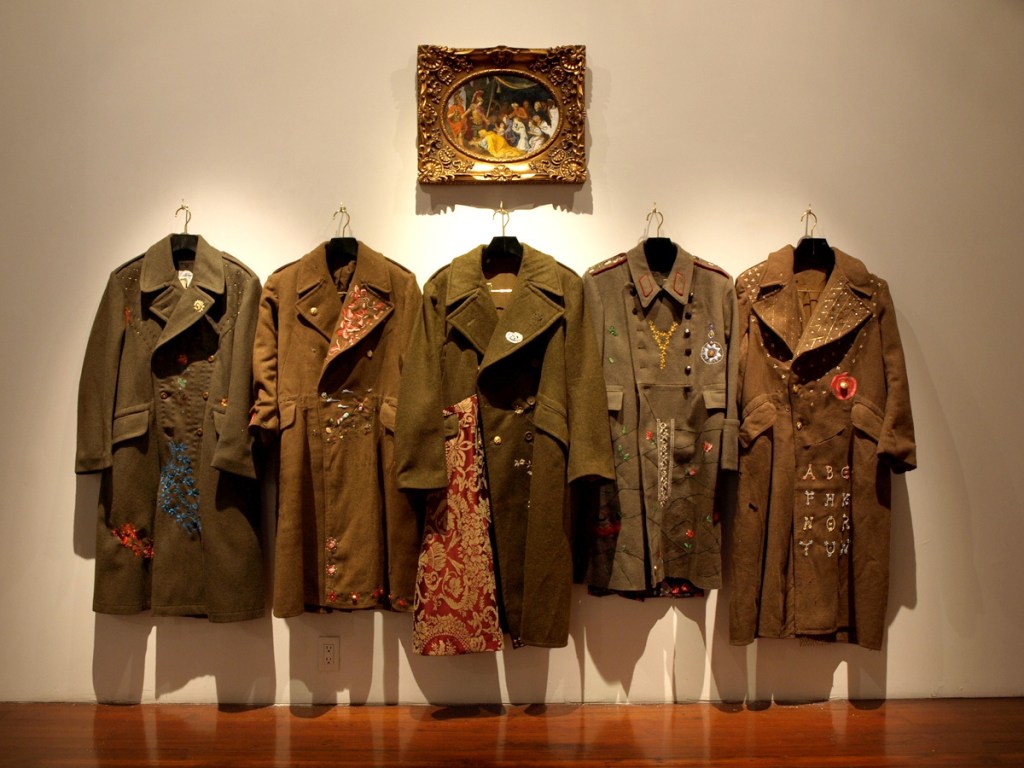
The Tent of Darius, an installation from 2009, is a complex work by the Lahore-based Risham Syed. It consists of five embroidered vintage European Army Coats with a small painting. This is a copy, painted by her, of the Charles Le Brun work of the same name. Syed describes her inspiration for it:
“I imagined these five coats to have travelled all over the world, with women having contributed to them by adding a piece of embroidery. They are like these tired, old worn-out soldiers who have dreamt of coming back home. On the one hand, they symbolize the imperial power, but on the other hand, there is another aspect to this work; how soldiers from the colonies were made to fight for the Imperial powers. It’s true for any army including the Pakistan army, where most soldiers are from Jehlum, Potowar region, from poor, lower middle-class families and end up with the army because of their physique/tradition, in the hope of making a romantic/glamorous career. This work, compares the romance/glamor to the actual reality of war, the aim of it and the beneficiaries of it. I juxtapose the embroidered coats with an ‘Oriental’ painting called The Tent of Darius, a seventeenth-century painting by Charles Le Brun that provides the title for the installation. In it, the Queen of Persia bows to Alexander the Great who has conquered the land. It serves as a metaphor for the West making incisions in the East.”
I was very moved by the sight of these five coats and the details of the embroideries which inspired the last stanza.
The tent of Darius
The ornate faux-Chinese frame holds a cropped copy on acrylic: The Queen of Persia draped at the feet of Alexander.
Below, an array of five overcoats, donated by European soldiers, appliquéd and embroidered by women’s hands.
Under the lapel, a stilled windmill, peach-coloured vanes. A green tree above a button hole. Death comes like blue geese.
So said Claes Oldenburg and he said a lot more like it, such as ‘I’m for art that flaps like a flag, or helps blow noses like a handkerchief’. Oldenburg said that his famous 1961 Ode to Possibilities, ‘I am for …’ was a statement, not a manifesto. It’s a fantastic read, a long list poem that works well as a writing prompt. Here is the link.
Swedish-born Oldenburg, one of the founding fathers of Pop Art died July this year at the age of 93. He was famous for his monumental sculptures where mundane objects (matches, clothes peg, apple core) suddenly became larger than life.
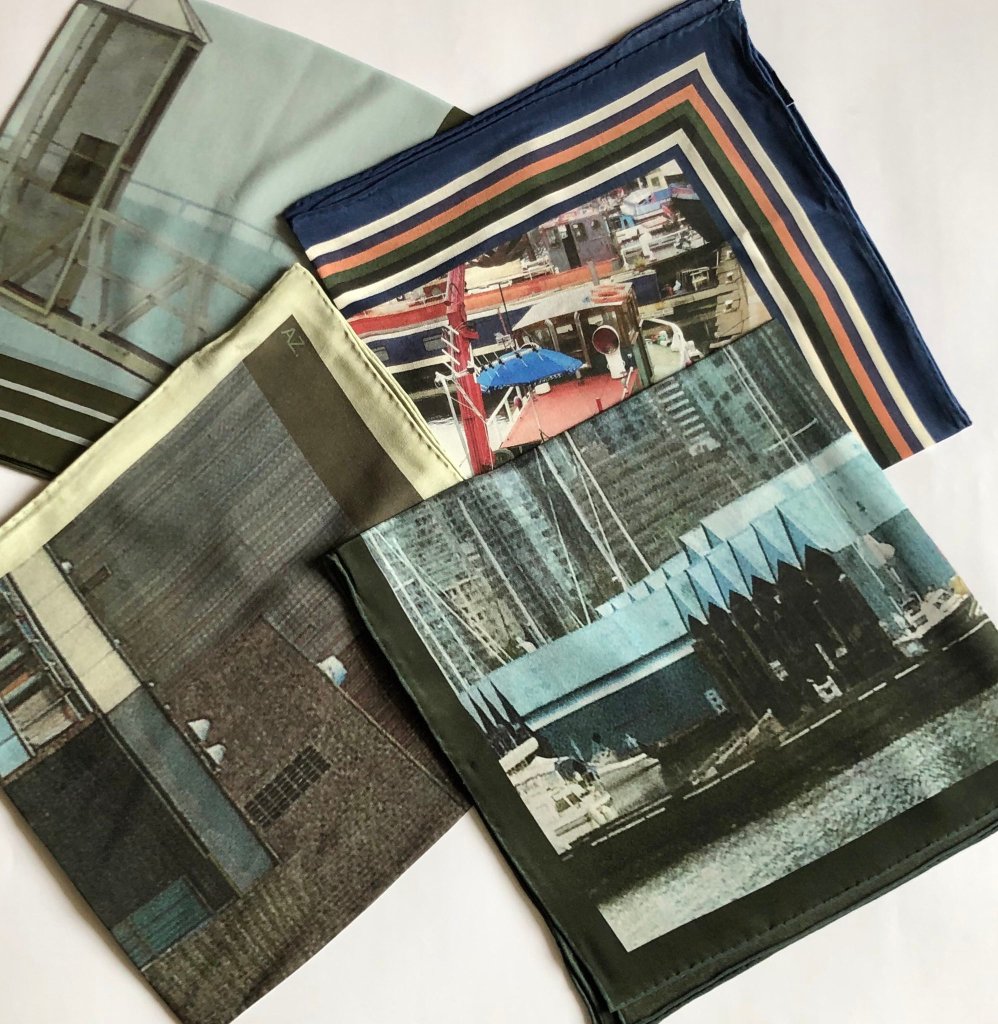
My poem Wearable Narratives (from the collection Nothing serious, nothing dangerous) is in two parts. Here is part i. It was inspired by a pure silk scarf, made by Andrea Zapp, that was on display in the shop of Manchester Art Gallery. At that time, I didn’t have a smartphone. So, here is a picture of other scarves, made by Andrea Zapp. See the note below for more information about her amazing work.
Scarf
A turquoise ribbon runs under khaki stepping stones. Tomatoes are the red carpet. Slanting shadows pull the empty staircase under water. Its fine metal tracery anchors a washing line with checked tea towel.
Cold marble columns, bleached shutters closed. Almost out of sight wooden farming implements, a clock stopped at ten to eleven, a car hubcap.
Everything here is at an angle now. What survives are the chalk drawings: a cheerful elephant, the ibis and another bird, its round black eye like a spinning top.
Note:
Andrea Zapp, born in Germany, living in Manchester, pioneered in coalescing her digital media art background with the fashion industry. Andrea has created the luxury fashion brand AZ.andreazapp. This sells high quality silk dresses and scarves printed with her own photography of urban views, rural panoramas, miniature scenarios and objects of culture and curiosity, creating a collection of stunning authentic hand-made garments.
On Monday, my journey to the other side of the North Sea involved five different modes of transport: taxi from Aldeburgh to Ipswich, National Express coach to Standsted Airport, Easyjet flight to Schiphol, Intercity to Den Haag Centraal, tram to the flat. All clockwork, no delays. It was dark when I got back home.
Taking part in the ‘live’ Poetry in Aldeburgh Festival has been a joyous experience. The highlight was the reading Our Whole Selves with poet friends. Poet Kathy Pimlott and I wrote several blog pieces about the readings, workshops, performances, open mic. These will soon be on the official website. A big thank you to the small organising team which managed to arrange a wonderful programme.
The poems I read were from my new collection Remembering / Disease, published by Broken Sleep Books last month. I opened my set with Nautical Miles (from my collection Nothing serious, nothing dangerous). When I looked at an old photo, I saw that only Hoek van Holland is ‘less than a hundred’ nautical miles. Good reminder that poetic truth matters more than the accurate facts…
Nautical miles
Outside the Sailors’ Reading Room, the sign:
thin wooden planks, painted white: Den Helder, IJmuiden, Hoek van Holland.
Across the horizon, they are less than a hundred nautical miles from Southwold in Suffolk
where the narrow beach of pebbles – grey, brown, black mostly –
is held together by couplets of groynes, slimy green.
Both our languages have the word strand.
Note: The Sailors’ Reading Room, Southwold is a Grade II listed building from 1864 and still a refuge for sailors and fishermen.
I am very glad to introduce this month’s guest poet Sheila Butterworth. We met many years ago, in that Yorks/Lancs Branch of the BHS. I let Sheila introduce herself and her haiku.
“Winning the Leeds Waterstones Haiku Competition in 2000, organised by the Yorks/Lancs Branch of the British Haiku Society, introduced me to the world of haiku poets, workshops, journals and a network of local poets with whom to chew the haiku fat. I have since had poems published in Blithe Spirit, Presence, The Snapshot Press Haiku Calendar, Wales Haiku Journal and The Red Moon Anthology.
Most of my haiku come out of the everyday experiences of life within a mile of my edge of village doorstep where I have lived for 40 years. This is where I notice those things that have most meaning to make haiku. The familiar environment highlights the nuances of change in place, in time and in me and this is when haiku happen.”
coming light the bubble and trill of robin and wren
high street dawn the smell of sweet dough folds into the fog
morning mizzle molehills spatter the spring pasture
planting potatoes startled sparrows scatter in the quickthorn
summer rain the shining bole of a sapling ash
evening sun the shadow of the wood fills the field
Yesterday’s journey: comfortable Eurostar from Rotterdam Centraal, a sit-down at Soho & Co, Liverpool Street Station for food. The unexpected ‘red signal’ at Colchester turned out to be ‘waiting for British Transport Police’. They escorted a couple off the train. Missed connection at Ipswich gives an unexpected hour to mull and ponder. The friendly taxi driver from A2B and warm welcome at The White Lion where the bar is still open.
Today is the publication day of my third collection. This evening, starting at 19:30 UK time, there will be a Zoom launch, organised by the publisher, Broken Sleep Books. There is a link on their website to Eventbrite.
Four other poets will also be reading, to launch their pamphlet or collection: Caleb Parkin, Chrissy Williams, Taylor Strickland, and Chris Laoutaris.
The manuscript was awarded a Northern Writers’ Award from New Writing North in June 2020. That raised my spirits during the lockdown. It was a unanimous decision by the Board of Broken Sleep Books to accept the collection for publication. The delicate cover design by Aaron Kent is a great match for the minimalist content.
My poems and I have found at Broken Sleep Books, and I am looking forward very much to the reading this evening.
It is a great pleasure to introduce this month’s guest poet Tania Hershman. I met Tania a few years ago when I attended a series of workshops she gave on flash fiction. She is a generous, inspiring tutor. I have chosen four different poems from her new collection.
Tania Hershman’s second poetry collection, Still Life with Octopus, was published by Nine Arches Press in July 2022, and her debut novel, Go On, a hybrid “fictional-memoir-in-collage” will be published by Broken Sleep Books on 17 November 2022. Her poetry pamphlet,How High Did She Fly, was joint winner of Live Canon’s 2019 Poetry Pamphlet Competition and her hybrid particle-physics-inspired book ‘and what if we were all allowed to disappear’ was published by Guillemot Press in March 2020.
Tania is also the author of a poetry collection, a poetry chapbook and three short story collections, and co-author of Writing Short Stories: A Writers’ & Artists’ Companion (Bloomsbury, 2014). She is co-creator of the @OnThisDayShe Twitter account, co-author of the On This Day She book (John Blake, 2021), and has a PhD in creative writing inspired by particle physics. As writer-in-residence for Arvon for Autumn 22-Winter 23, Tania has curated a programme of readings, workshops and talks, both online and in person. Find out more at http://www.taniahershman.com
Still Life With Octopus (II)
I only asked her once to climb inside a jar for me. (Before we met, I’d watched all the videos of those experiments.) She sighed but did it, said I could screw the lid, released herself easily. You could become any shape you want, I said. She said nothing. One arm sent itself out to switch the kettle on. While she made us tea, I put the jar back in the cupboard, feeling that slight ache from too much sitting in my hip bones, my lower back, where fixed part meets fixed part of me.
Standardized Patient*
Today I am your lower back pain. Listen, I have all the details, will not veer
from the script. Tomorrow I will be your cancer of the kidneys. Next week,
I may be your one-legged skier (I know, I know). Whose pain is this?
*Standardized patient simulation lets medical students practice on people trained to play patients.
And then God
sends someone else’s Jewish grandmother to stop me
with a question about birds I can’t answer. She says – as if this is her river – I’ve never
seen you here before, then presses for my exact address. Instead
of the usual, Such a nice girl, no husband?, she asks, No dog? I don’t know why
I tell her then that I’m a poet, but the gleam in her eyes
warns me this is the point to leave, the unasked
dancing on the path between us: Will you make a poem out of me?
Middle of the Night
Night asks me to wake up. What? I say. Night whispers darkly, something about cats coming in and out, a baby five doors down. You want company? I ask. Night nods. I get up
and we make tea. Too early, the cat mutters as we pass. Night and I get back into bed. I’m fine now, Night says.
Cover design: Ben Rothery
Note: Peter Godfrey-Smith, Other Minds: The Octopus and the Evolution of Intelligent Life (William Collins, 2017).
National Apple Day falls on the 21st of October. It was created in the UK by the charity Common Ground in Covent Garden, London on 21 October 1990 to raise awareness about the importance of diversity in different communities. Apparently, there are about 7,500 varieties of apple grown globally. In my local Hoogvliet supermarket I can find six: Kanzi, Pink Lady, Golden Delicious, Granny Smith, Royal Gala and Jazz.
Celebrations take place in the UK throughout October, so go to a fair, take part in an apple peeling contest, bake or eat an apple pie. Here in the Netherlands, traditional Appeltaart always has a good dose of warm spices – cinnamon, ginger, nutmeg. They are baked in a spring form and have a lattice crust. I will have mine with a good dollop of sweet whipped cream, thank you.
My poem is somewhat melancholy. It has the feel of a tanka – the first three lines giving a description, with emotion and reflection in the last two lines.
carefully quartering soft red apples into a compostable bag – I still wait for the letter that will never come
I enjoy most of the archive poems from the Paris Review which arrive in the inbox. I save many of them in my folder ‘Inspiration’.
The poem Imaginary Paintings, by Lisel Mueller (Fall 1992, # 124) is in seven numbered sections. Seven is always a good number. The length of sections varies, from one line (Love) to 10 (Big Lie).
Lisel Mueller, 1924 – 2020
1 How I would Paint the Future
A strip of horizon and figure, seen from the back, forever approaching.
2 How I would Paint Happiness 3 How I would Paint Death 4 How I would Paint Love 5 How I would Paint the Leap of Faith 6 How I would Paint the Big Lie 7 How I would Paint Nostalgia
I liked the start of the Big Lie painting:
Smooth, and deceptively small so that it can be swallowed like something we take for a cold.
Here is my attempt at How I would Paint Patience:
A small mat, wool, handwoven. Mostly pale grey, with the odd black nubbly bits at the corners.
Credit: Prawny via Pixabay
Writing prompt: If you’re looking for a subject for your imaginary paintings, you could always take one of the seven cardinal sins (pride, greed, lust, envy, gluttony, wrath, sloth) or one of the capital virtues that overcome them (humility, generosity, chastity, brotherly love, temperance, meekness, diligence). There is also prudence, fortitude, justice. Or take anything abstract, such as stubbornness, peace.