Table 64 – writing prompt

Credit: Pexels on Pixabay

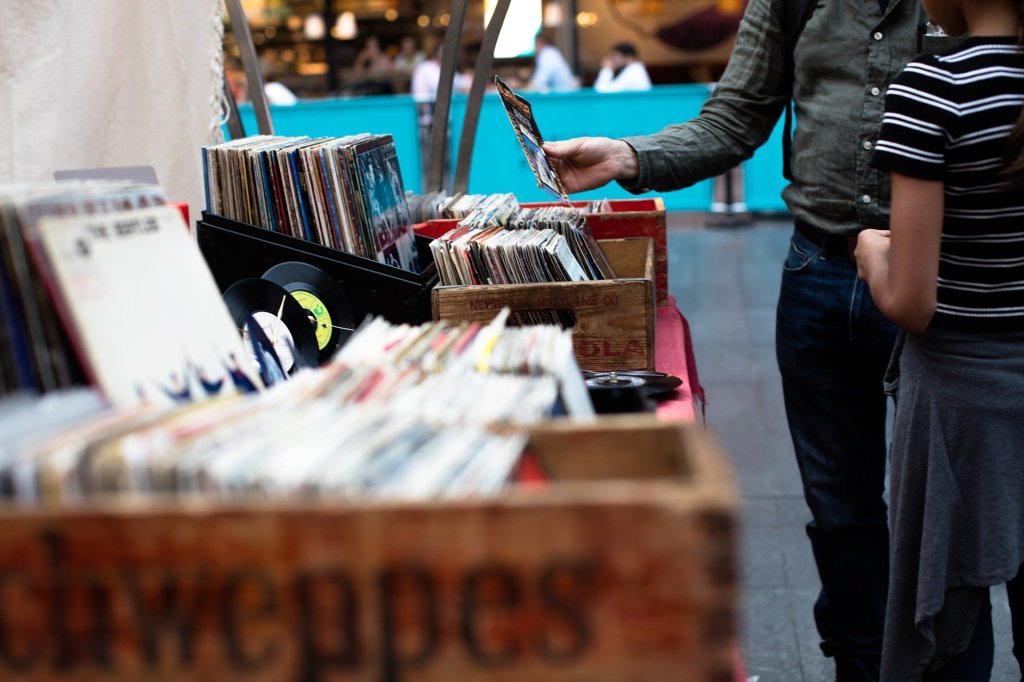
This week my friend Valerie celebrated her birthday. We met 30 years ago on a residential week in Spain. To celebrate our friendship, here is a short poem in which we’re together. Bowler’s is a very large indoor and outdoor carboot sale location in Manchester.


That Generation Game is a tv game show in which teams of two family members, but from a different generation compete. The winners see a conveyor belt with goodies wobble past. No worries: if they can’t remember them all, the studio audience will shout to help …

Table 64

We carried the plastic crates and cardboard
boxes into Bowlers at bloody six o’clock.
The locusts, proper traders, picked items
from the piles we carried, threw us
pound coins and a few fivers.

The early flurry was good and then it was
like the Generation Game in reverse:
suitcases went, a pile of books, glasses,
a wok, costume jewellery, some cuddly toys.
We sat back in our folding chairs like regulars,
holding off sleep.

Writing Prompt: Did you do a car boot sale with a friend? Were you a market trader (for real or in your dreams)? Did you go to an auction of lost property? What is the object that you lost or found?

Changing the clocks

Credit: Brigitte via PIxabay

We moved into wintertime last night. A good time for a poem that mentions clocks. For over 12 years three friends and I met monthly at each other’s houses to write, taking turns to host and find sample poems. This came from one of those sessions. It’s published in the pamphlet A Stolen Hour, Grey Hen Press, 2020. The poem was also Highly Commended in the 2016 Manchester Cathedral poetry competition. It was a privilege to read it during the prize-giving at the cathedral.

A la Hafiz

For just one minute of the day
open all the windows.
Let your mind run alone,
like a foal that has never
known fields without fences.

For just one minute of the day
let your body rest in a place
where other people run past,
so that they have the permission
they need to go and play.

For just one minute of the day
go and sit within sight of a large clock.
Remember how the three hands
are always trying to catch up with each other.
Feel your compassion grow. Be still.

With all the rest of your time
make bread, make beds, make love.
Do what is needed and then close
the windows. You are already
looking upon yourself more as God does.

A Mirroring – poems

Ken Evans

It is my pleasure to introduce this month’s poet: Ken Evans. Ken and I met some years ago at writing workshops in Manchester. I hope you enjoy these new poems.

Ken longlisted in the National Poetry Competition this year, and in 2015, while doing a Poetry Master’s in Manchester. In 2018, Ken won the Kent & Sussex competition. His poems feature in Magma, 14, Under the Radar, Envoi, The Lighthouse Literary Journal, The High Window, Obsessed with Pipework, and The Interpreter’s House.
 
In 2016, Ken won the Battered Moons Competition and was runner-up in Poets & Players. A first pamphlet, ‘The Opposite of Defeat’ appeared in 2016. Ken’s first collection, ‘True Forensics’ in 2018. He’s thinking he may be close to finishing a second collection…

A Mirroring

A tiny hop on one leg when you see me,
a straightening to rise and bob,
then a small correction, mid-

air, as you pivot yourself to steady,
like a dust-devil swaying over
tarmac after days of brown desert.

Your black leather jacket and red blouse,
a grey plait across one shoulder, all
thought through before, but for a moment,

I glimpse the girl in a classroom drawing,
a pink tongue seeming to swing your attentive,
cross-hatching pencil-hand from side

to side: the fleshy dark mirror of your jacket.
Supple and barely touching, we hug and pull back
with comradely smiles, but you catch

my thought as it forms, like a cloud
in a cleaned window, before
looking up, to see the thing itself.

Forever, the Light from Sirius
Sirius, the brightest star in the sky,
whose light takes 9 years to reach Earth

Earth, I left a voicemail, my umpty-eighth.
Must I really draw a picture, me that loves
you, as the flip-side of your silver coin?
I am not who set out, nine years ago. I am
not the me I left behind, and you are not
the you I came to talk to then, but you can
see my same light now, crystalline, falling.

Tracks

A tendency to see the deceased’s room as empty
is a control mechanism, when it’s no more void than

a December garden at four-twenty, the light
running out of the day’s green bottle faster than

drips down a window, though in fact, calls thread
the blackening sky and hedges: an owl more than

clearing its throat for the nightshift, or the longer
than usual high call of a wren, louder even than

the distant, reverse warning alarm on a lorry
at the steel factory, red lights more piercing than

crows commenting from the chimney pots.
The room itself is bare, a white-out, rather than

featureless. A glass door throws what light there
is on the carpet, naked and pinker where divots

from what was chair legs puncture the fibres,
the hollows suggesting how she faced one way

so many unfurling days, the pile threadbare
where her slippers marked the apex of a star

in front of her, tracks now damped by towels
and steamed with an iron to raise back the flush,

though not all obey. Lines left by a Welsh dresser
still bear her weight, the not-yet-gone of her,

the thoroughfare of a ruined city where
I am an unguided tourist greeted ceremonially

at the eastern gate by a roaring lion with a nose lost
to weathering, running due west in a straight line

to the red sunset, only the weeds in the mortar
noting the location, the sub-divisions of the hours.

The Final Invoice from the Co-Op
A part-found poem

for bringing the deceased into our care in working hours;
for private use of the Chapel of Rest;
for care and preparation of the deceased before the funeral;
for provision of a hearse and three personnel for the service;
for choice of a Simple coffin; a Minister’s and a Doctor’s fee;
for a non-witnessed scattering of the ashes in the Garden

of Remembrance. Note: none of the above subject to VAT.

It’s false then that, ‘nothing can be said to be certain, except 
death and taxes,’ Benjamin Franklin or Daniel Defoe,
whoever it was wrote that.
What we remember of our lost may yet be false:
a conservator before
it was a cause or fashion, she dunked
tea bags twice,
marked the coffee on a jar with the stub
of an HB pencil,
and saved her hearing-aid batteries
for birdsong.
She’d dance with one hand on her stick, for such a deal –
‘Look, no VAT on dying, a saving of 20% – Bingo!’

Satsumas – a poem

credit: Kie-ker via Pixabay

In the Netherlands it was National Vegetable- and Fruit Day on Thursday 14 October. The front cover of the weekly free paper was a large colour photo of three local shop owners encouraging us to ‘go for colour’ – have some fruit or veg to deal with the afternoon ‘dip’.


The Dutch love their tomatoes: it’s the most popular vegetable, making up of 10% of vegetables bought. The Dutch are eating a little more fruit and veg this year, compared to last year. The most popular fruit was the banana. Probably because fewer apples were harvested.

Credit: Lumix2004 via Pixabay


The poem Satsumas was published in my debut collection Another life, by Oversteps Books in 2016. I wrote it on a workshop where the tutor suggested that ‘half a sestina might be called a satsuma’. I’m always grateful for prompts!

Satsumas


The mandarin is also a clementine, or a seedless tangerine.
They must not be confused with the satsuma, first
exported from the province Satsuma in Japan.

The men and women of the Fruit-and-Veg Marketing Board
are introducing their successes: the Orkney, a type
of button mushroom, but a clear ice-white and stoic.
There is the Argyle, an improved form of celery with
lower water content, therefore less stringy and greener.
The Devon is already being exported to Japan:
a small, tasty apple, dark red, square and stackable.

No-one mentions the Wicklow with a taste like ratatouille
after a fortnight in the fridge, or the Sark, a long, sour,
brown hairy thing lying at the back in wooden crates.

2pm Appointment – a poem


The Safe Place or Special Place exercise is an essential part of the preparation phase of EMDR, before the client or patient starts the processing of the traumatic memory.

Today is World Mental Health Day. Below is my sonnet about EMDR (Eye Movement Desensitisation and Reprocessing). EMDR is a a proven trauma treatment which has been NICE-recommended in the UK since 2005. In 2013 it was also listed as a recommended trauma treatment on the website of the World Health Organisation (WHO).

The poem is included in my pamphlet A Stolen Hour, published by Grey Hen Press, 2020.

2 pm Appointment

Holding a fingertip to his right ear;
this is the worst part of the memory:
all bright, vivid. He is still forced to see
and feel the machete: cold steel, cold fear

Now he dreams, cannot sleep, was driven here
by his wife. Four or five men, he tells me,
balaclavas, jumped from a van. Now he
lies with a blanket of guilt, but it’s clear
to me that he wants to become the man
that he was. That he did the best he could.

As you’ve come through pain and grief in the past,
you can do that again. Sounds and sights can
go. We’ll create your Safe Place now. I’ll put
you in for next week. This stuff will go, fast.

Stonemason – writing prompt

Credit: Ray Miller via PIxabay

Here in Scheveningen, the seaside district of The Hague, it’s a wet Sunday. Tomorrow it’ll be World Animal Day. Here is a short poem with wet animals, inspired by seeing the peregrine falcons at Norwich Cathedral. It’s from my pamphlet A Stolen Hour, published by Grey Hen Press.

Prompt: What animal(s) did inspire you? Where did you first see it? What day was it?

Stonemason

I am the last stonemason.
Green water spouts from
the gargoyle to my left.
I am hidden up here
with the two peregrines,
sodden on their cathedral nest.

My apprentice didn’t come today.
Black sky, lightning and
the distant rumbling of armies
advancing, retreating.
I count hours on my arthritic fingers.

Uniforms – poem

As you can see from the picture, I’m back in the Netherlands. The camp site closes 12 noon this Thursday, so I’m making the most of the good weather to work in the garden and plant bulbs.

On the last Sunday in September I’m posting this poem which is included in my second collection Nothing serious, nothing dangerous (with Indigo Dreams Publishing, 2019).


Uniforms

I saw the van turn and park
by the old oak tree
at the heart of our cul-de-sac.

It was early September and sunny.
It must have been afternoon,
because I worked part-time.

Our white cat was asleep upstairs.

Two men carried it, though
it wasn’t heavy. A metal
trunk, shiny in the sun.

The ship safely back in Southampton.

That sheen on the dark brown coffin
as it was helped from the limousine.
We had buried you in May,
a cemetery next to the Ford factory.

White and black uniforms.
Shirts, trousers, shorts.
Black shoes, white shoes,

cracked by too much cleaning,
and yellowing socks
in different stages of decay.

That stale ship’s smell still clings.

In the fields near Arnhem – poem

During this year I’ve been posting poems by my friend Kathleen Kummer. This is the last one. Kathleen lived and worked in the Netherlands after she married a Dutchman and taught German and French at an international school.

The battle of Arnhem took place during 17 – 26 September 1944. Operation Market Garden failed when the allied forces could not take the bridge over the Rhine.

In the fields near Arnhem

It falls like a petal from the last rose of summer:
a bus ticket, Arnhem Municipal Transport, flutters
from the faded pages of L’Art D’Etre Aimée.

Learning how to love and be loved, which was harder,
was what I had no idea I was doing that summer
of trains, boats and buses, all bound for Cythera.

It sounded so playful in French: Ecoutez-le,
(listen to him), passionnément. Ils adorent les cheveux,
so, wear your hair loose. But this was no game, we were serious.

Not so much so that we thought how, six years earlier,
they had floated down from the sky, white flowers
in their thousands in the fields near Arnhem.

Earth Days Numbered – new anthology

I am very pleased to have a poem in this pamphlet which, along with its companion Counting Down the Days, has just been published by Grey Hen Press. Joy Howard, the editor, has done a great job of producing these two anthologies: allowing older women poets to show their support for the younger generation.

All proceeds from the sales of the two books will go to supporting the work of the UK Youth Climate Coalition. Below is my poem to give you a taster.

Paternoster

Some survivors live on the edge in cars,
dented, rusted ridges, blown tyres,
a towel drying on the steering wheel.
Much of life now is waiting and standing in line,
but Paternoster tells us it was often so in the Old Life.

Strong men searched among the rubble,
found saucepans, leather boots, shoulder bags.
Once a black wooden box called Schimmel
which Paternoster says means white horse.
Papaver grows inside that piano now.

Horses stand by the narrow river, kick sand.
One brown mare is with foal.
Our Friesian cows give us white gold most days.
We are waiting for rain, for a sign.
Men play a game of stone, paper, scissors.

I stroke the flute I made from bone.
I must be careful not to dream.
We trained the rats to smell landmines.
Paternoster remembers grapefruit,
a bitter yellow ball, the colour of sun.

Seven liners, seven lines …


Cruise liners were parked at sea last year. I could see them from the beach at Scheveningen. And a travel company did send me an offer I could refuse…

It was a different story on 3rd of July 2012, when P&O celebrated its 175-year anniversary: for the first time ever its seven passenger ships were in port together. An ex-P&O friend of mine was there taking pictures. Here is the flotilla leaving Southampton.

The offer of a £150 reduction comes on heavy white paper


SS Zeus floats downstream on the Danube.
Elderly passengers, each with their own balcony.
A decade on, scale models the colour of gold
are on display in suburban charity shops
where other old hands fumble,
hand over coins with the monarch’s head.