Solstice: a clear day here in the Netherlands with the sun breaking through as I type this.
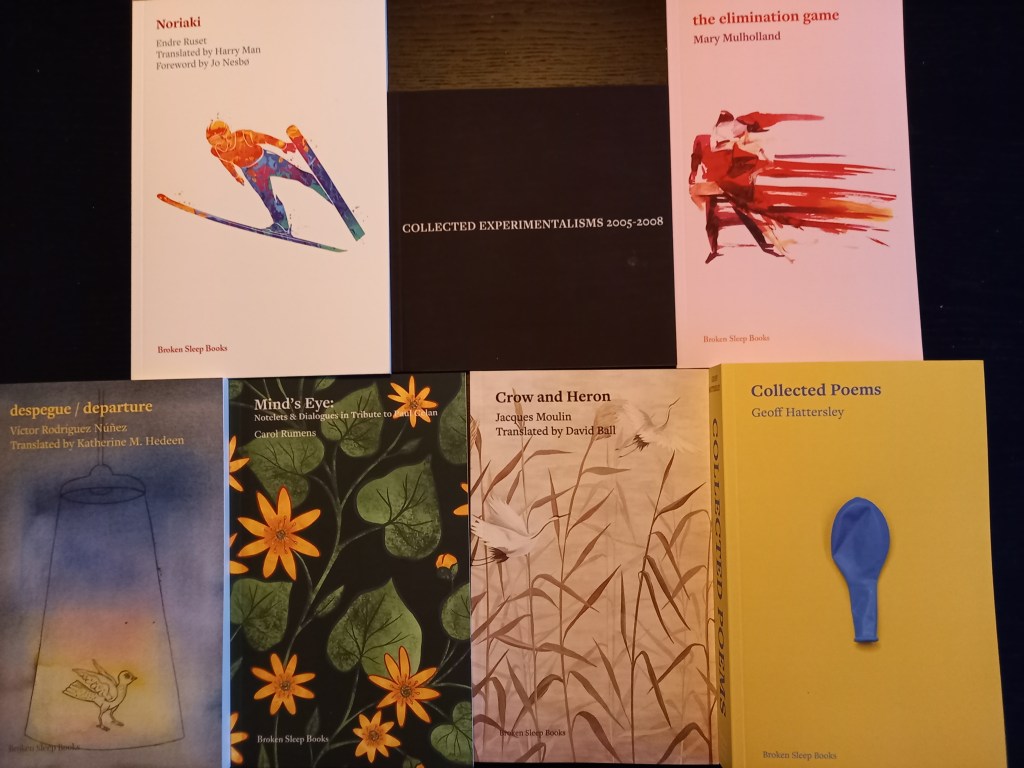
My holiday reading is sorted. The seven books include translations from French, Spanish and Norwegian. The latter an interesting set of haiku and haiku-like poems about the Japanese ski-jumper Noriaki Kasai.
Broken Sleep Books use the world’s largest on-demand publishers. The parcel came from France: no import duties, no VAT, no waiting while parcels linger in the customs depot. A bonus!
This is my last post for 2025. Season’s Greetings and many thanks to you all.
Here is the link to James Schuyler’s poem Linen. A poem about gratitude, starting with a question, and almost a sestude.
I’m delighted to share poems by Matthew Paul from his new collection with Crooked Spire Press. The poems demonstrate Matthew’s ‘unflinching clarity’, and his ‘fierce attention to detail’. His biography follows the poems and there you can also find a link to his own website.
Spent Matches
Mum lets only Granddad light up in our house. The second Thursday of every other month, she fetches Grandma and him over from Sutton. The chalkhill-blue elegance of the Wedgwood ashtray rhymes with unfiltered smoke rings pixilating like Ceefax in the living-room air.
Teatime doesn’t wait for Dad: Hovis, Primula, Shippam’s fish paste, allotment tomatoes, cress; mini rolls, Penguins, cremated fruitcake; pots of Brooke Bond PG Tips; Beryl Ware replaced by Royal Worcester, on Hay Wain place mats. Chit-chat wilts like Dad’s California poppies.
Mum fills space with monologues. My brothers’ progress; mine. WRVS activities. Her botched hysterectomy. We watch Grandma’s must-see, Crossroads, then ours: ‘Top of the Flops, I call it,’ says Granddad. The outfits, songs, presenters and Legs & Co. baffle him into silence; except
when Julio Iglesias butchers ‘Begin the Beguine’. ‘Artie Shaw!’ he cries; and his and Grandma’s memories spool back to bulletins on the wireless, to Chamberlain’s jubilant declaration of peace. Barely through the door, Dad re-buttons his coat to take them home. Granddad beams, ‘Abyssinia!’
Photo credit: Liam Wilkinson
A Common Hand
I don’t have to prove whether I did it or not; if they can’t see it, what kind of damned experts are they? [. . .] I’m not a crook; I’m just doing what people have always done in the history of the world: ever since art was invented, people have made imitations of it. Eric Hebborn, ‘Portrait of a Master Forger’, Omnibus, BBC TV, 1991
Eric pestles oak gall, gum Arabic, pinches of iron Sulphate and rain into ink with ‘a gorgeous patina’, To pen his line on slyly foxed paper, in the styles Of Pisanello, Poussin and sundry other old masters, Reshaping preparatory sketches to make pentimenti, Faking collectors’ monograms as cherries on top.
At junior school, Eric, aged eight, discovered that Burnt Swan and Vesta matchsticks’ charcoal tips Burnished imagination’s marks, incurring, firstly, Welts from a leathering for possessing matches, Then a three-year stretch in an Essex reformatory For wilfully setting cloakrooms on fire. A flair for Painting sees him into art schools, lastly the RA, Where, though he wins every prize, contemporaries Remember Eric only as ‘a silent creature’; ‘a joke’.
They would say that, since he’s brought their craft Into disrepute. ‘Dealers are not interested in art, but Money,’ he says. ‘The real criminal, if there is one, Is he who makes the false description; guiltier by far Than had he manipulated the nib himself. Ignore The fusspots. Enjoy art, without worrying whether Attributions are correct.’ Museums have everything To lose from uncovering Eric’s handiwork; queasily, They check their acquisitions back to the Sixties And issue, de haut en bas, highly selective denials.
‘No one is studying art with honesty,’ claims Eric, Upon the publication of The Art Forger’s Handbook In Italian. Out in Trastevere three icy nights later, He stumbles, soaked in Chianti Classico Riserva, Down a cobbled passage, to his blunt force demise.
In Which I Spend a Fortnight of my West Berlin Summer in 1987 Doing a Few Hours’ Cleaning Per Day in Some Multinational’s HQ
My Iraqi supervisor Zaynab and I enjoy, for our lingua franca, helpless amusement. Every day, precisely at knocking-off time, we point at the clock, chorus ‘Sechs!’, then cackle like siblings.
Dieter, fellow cleaner, never gets our jokes. Just like me, he’s twenty and nearing the end of a gap year; mandatory, before enrolment at Humboldt. Mine’s elective, for my mental health. He and I view the city’s halves from the roof: the Wall zigzags like the Western Front.
Afterwards, we take the U-Bahn —he buys a ticket; I don’t— to the agency’s office, at Nollendorfplatz. He translates the clerk: I won’t get paid until next week. ‘Scheisse,’ I say. Dieter deadpans: ‘She said, “Ah, so the English boy can speak German after all”’
Biography
Matthew Paul hails from South London and lives in South Yorkshire. His second collection, The Last Corinthians, was published by Crooked Spire Press in June 2025. He is also the author of two haiku collections – The Regulars (2006) and The Lammas Lands (2015) – and co-writer/editor (with John Barlow) of Wing Beats: British Birds in Haiku (2008), all published by Snapshot Press. His reviews regularly appear in The Friday Poem and elsewhere. He blogs here.
On a rainy Bank Holiday Sunday it’s good to be reminded of old poems and successes. Poems that are accepted for publication disappear into the folder ‘Published’ and into books and magazines that sit together on a shelf. Out of sight, out of mind…
For many years through the 90’s I kept this green A4 certificate with the impressive signatures in a clip frame at the bottom of the staircase. It was a daily reminder that I could write through what was a dark period in my life.
Credit: Public Domain via Pixabay
Games
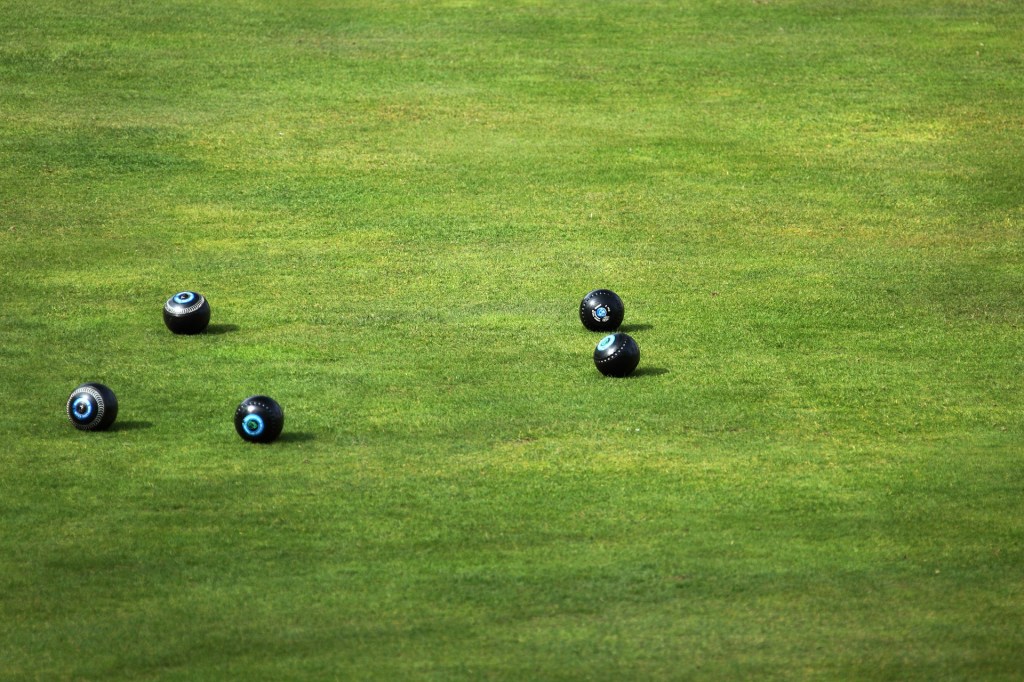
I watched the old men in the park today playing bowls, much the same as yesterday. Smiles all around and gentle teasing by the winners.
I wondered whether at their age you would have needed stick or hearing aid. If your hair would turn to yellow-white or grey.
You never tried your hands at bowls, did you? An old man’s game you called it. Surely, much more fun than kicking up the daisies?
It’s a huge pleasure introducing this month’s guest poet Carl Tomlinson. Carl and I met on a w/end poetry workshop some years ago. He was born in Lancashire – where his father’s family had farmed for 150 years. He now lives in Oxfordshire and is a coach and part-time finance director. His poems have been published in magazines, anthologies and online.
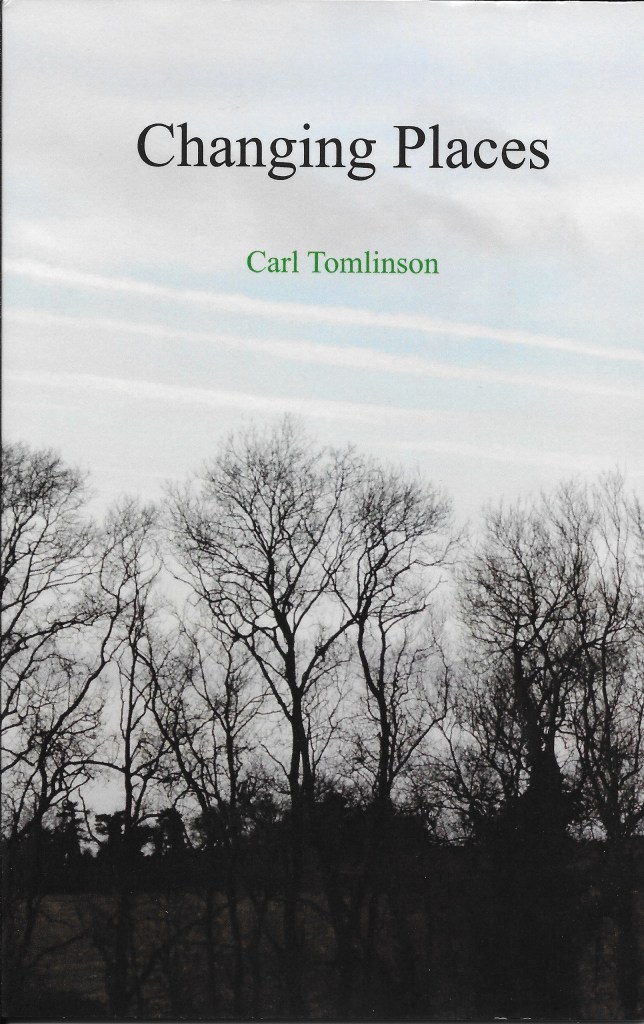
From his debut Changing Places I have chosen one poem that has a personal meaning to me: I was living in Southampton in 1976 and my late husband supported our local team. The other four poems are a moving tribute to Carl’s personal land and heritage. The cover picture was taken by him.
Picking sides
FA Cup Final. 1 May 1976. Southampton 1 – 0 Manchester United
Bobby Stokes made me a Red one Spring day at Wembley. He broke my heart in a moment scuffing that shot past Stepney.
Although I wasn’t football mad you still had to pick a side and a playground full of Saints fans said Man United were mine.
Four years after moving South my accent was still abused. Flattened vowels lurked in my mouth and echoed round the school.
All that week I learned their names eager to share the glory, but sometimes, as the pundits say, the Cup’s a fairy story.
Nil-nil at eighty-three minutes, the telly rings with cheers. Stokes shoots. He scores. Saints win it. This was what I’d feared.
Bobby Stokes made me blush deep red at hymn-time in assembly, For all the saints, the teacher said. Every face was turned on me.
Baling
I’d just got my A-levels out of the way and was spending a week with my Aunt in the house her grandfather’d built in the garden behind the farm, in a place that had seemed like forever, aged eight. She said “Derek Fitton wants a hand with his hay.” As kids we had loved helping Grandad, chasing the baler round Tandle Hill’s haunch riding the trailer back to the barn echoing Tarzan calls under the bridge. We lived with the itching and the seeds in our hair because that was the way we were made. It was ten years since the pain of the sale and I wanted to feel like a farmer again. Derek was glad of my help that day. It was fun enough, in a blokeish way. He gave me a fiver. Later, I drank it away. The twine cut my fingers, my back complained the welts sprang up on my arms again. You wouldn’t know, I guess you’ve never baled but it’s a different kind of ache when it’s not your hay.
Coming to grief
We were most of the way to Middleton when I discovered that grief doesn’t always dress in death. One of my parents said that Three Gates Farm – where six generations had tilled the last of Lancashire’s silty soil – was being sold that week.
In the winter of sixty-three my Grandad made the front page phoning for a snowplough because the lane was six foot deep. Now we were in ‘th’Observer’ again in the back of the classifieds along with all the other lots due ‘Under the Marshall hammer.’
Reading the paper emptied my eyes. I realised whatever childish plans I’d made for those fifty acres of gentle land nudged between mill towns and millstone grit were to be knocked down (for twenty-six grand in the end) in Ye Olde Boar’s Head by an auctioneer I never met.
And by my father’s teenage need to leave that land and make his life his own. And by my uncle’s trying to stay where I was sure we all belonged. And by Grandad’s explaining that even the hencotes would go. So the scheme to keep one to use as a den, that went south as well.
The parlour’s long since seen a cow, there’s nothing like a farm there now but the breath of beasts on a winter day and the sweetness of cowshit and hay surprise that grief back into me.
Inventory
Accounts and correspondence, attached with failing staples, complete the detail of a sale of Live and Dead Farming Stock.
Dead just means inanimate, not deceased.
Then, in the Particulars, I find the line that honours my line, and all they left here ‘The land will be seen to be in a high state of fertility.’
Harvest
“Oh bugger!”, the words thud. I’ve just put the fork through a spud.
I’m showing our son and daughter something I learnt from my father which my Grandad had taught him before.
“You start a bit off, away from the green, keep the fork away from the tubers, you want to lift ‘em, not pierce ‘em, and they’ll not store if you fork ‘em, they’ll be no good if you fork ‘em’.”
Again the fork sinks, again the soil shifts and this time a big‘un gets stuck on a tine. “Oh bugger!” I thud before I’m stood up and quick as an echo the lad pipes up with “That’s what our Grandad said when he put his fork through a spud.”




 Acacia Publications