Tag Archives: poems

Why are we in Vietnam?

9781912876228
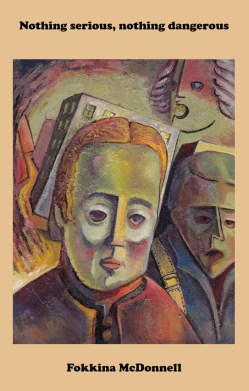
Tomorrow is the publication date of my second collection Nothing serious, nothing dangerous. The book is already on Amazon and has been available for pre-publication orders from Indigo Dreams Publishing.

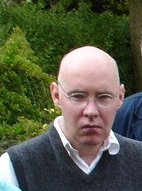
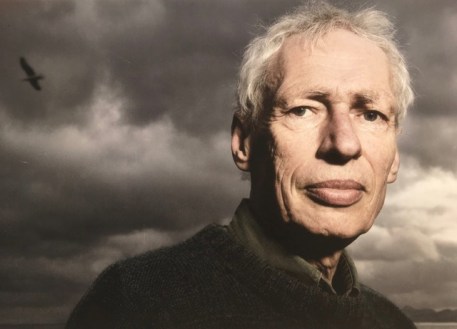
The publishers have selected six accessible poems for the author page, and the author photo is by my nephew Ted Köhler who lives in the Netherlands and is beginning to build up a photography portfolio. The end of November is too close to the festive season for an official launch. That will be here in Manchester, at the International Anthony Burgess Foundation on Tuesday 3 March.

The title was inspired by a Raymond Carver poem called My Boat. Raymond Carver is one of my all-time favourite poets. Someone I return to when I feel stale and in a negative frame of mind.

The poem Why are we in Vietnam? was written on a workshop at the wonderful Almassera Vella, Spain. We were to find any book in the library, open it at random and use a few lines as a starting point for a poem. Then we were to imagine finding a postcard inside the book. Where was the postcard from? What was written on the back? Who had sent it? I picked the paperback because of its intriguing title. It’s by Norman Mailer. I was surprised to find the lines and I imagined there would be an art card inside, a card I’d bought and forgotten about. It’s a reminder how working with “found” materials can easily trigger our creativity. The poem was commended in the 2016 Havant Open Poetry Competition.


Why are we in Vietnam?

It has held up the broken leg
of a single bed in the attic.
Everything is dusty now.
Who brought this Panther
paperback into my life?
Then the trail of the blood
took a bend, beat through dwarf alder.
The postcard isn’t of Cezanne’s gardener
seated upright in his chair,
or Venetian gondoliers.
Didn’t want to die in those woods,
wounded caribou…
Green lines, black dots,
small yellow triangles,
Miro’s insects and birds.
Neat black lines for the address,
the black box for a stamp.
To the left white space,
the white space of that Alaska.


Never Totally Lucid

Hilary


This is my 100th blog piece, and I am delighted I can celebrate this century by introducing you to the work of Hiliary Elfick. We first met many years ago at the wonderful Almassera Vella in Relleu, Spain and have exchanged poems there several times since.

Hilary is an experienced broadcaster and the author of a novel and over a dozen poetry collections and pamphlets. She has performed her work in cathedrals, theatres, bookshops, libraries, schools and literary festivals in many countries, including Africa. Two of her poetry books have been translated into Romanian.

Hilary lives in East Anglia and also in New Zealand (where she is a bush bird guide), and is a frequent visitor to Australia where she recently launched two poetry sequences in collaboration with an international prize-winning Australian photographer, with a third appearing in early 2020. She has a lifelong love of being out in boats on the water.

Three poems are from Hilary’s THIS IS WHAT HAPPENS, published by Grey Hen Press (2019), while The Wedding Ring is from her earlier book THE OUTSHIFT PLACES, also with Grey Hen Press.


The Wedding Ring

But the morning before the wedding his father died. Two events
he’d long anticipated and with equal fervour. He would have
ignored the former, but Gilly persuaded him that even a minor
gesture to the event at their own reception might be at least seemly
and, more, something that much later he might be glad that he had
done. ‘I won’t pretend’ he said. ‘I won’t do platitudes.’

His mother came as planned. Under her wide hat her face
impossible to read, as it had been for many years. His sister
hugged him, saying nothing. Only when Gilly’s ring slid on his
finger did something jolt inside him. A ring finger. A ring. His
father ‘d always worn his. Even after everything.


Scan0020


When you know exactly where you were at the time
i.m. Professor Donald Nicholl

Six foot six he was but never towered.

Your first week. A small lecture theatre,
a wisp of Sobranie from the row in front.

He comes in, begins to speak

then nothing but his voice
and what he says and how he says it.
Sixty years ago. You’re at his feet:

whatever subject this man teaches
whatever he’ll demand
you’ll do it. You’ll be there.

Your first tutorial he asks how Christ came into Britain.
Someone tells him what happened, names, dates, places.
He turns to you and waits. You wait too. Then you tell him:

One man told another.
They put down their nets and followed.

Days later his wife has their fifth, last baby;
he names her after you.

Forty years on when he’s dying you remind him
Socrates said there’s no greater love
than between a teacher and his natural pupil.

Wonderful he whispers.

 
Four Quarters
A Grandmaster sees four moves ahead.

As child, I anticipate the trigger
for a new rage in my mother.

As mother I wake startled
by a cry or too-deep silence,
deep water, roaring roads.

As wife I place your glasses, shoes,
just where your eye might fall,
forgiving the questions I answered
today, yesterday,

tomorrow.

 
Never Totally Lucid

‘The reality of nature …obeys laws…never totally lucid to
our understanding.’ Anni Albers

When is he coming?
Five o’clock.
Is that what you wanted?
No. You gave me that yesterday.
I can’t have.
You did. Look. Here in my bag.

Did he come yesterday?
No. He’s coming today.
I’m not ready.
You have till five. You have time.
Why is he coming? Is it cold in here?
Your skin smells different.

I can’t find it.
You put it in your pocket
I only have this in my pocket.
That’s the one we’re talking about.
Who wrote this?
I did. You asked me to.
Why do I need it now?
You don’t. It’s for tomorrow.
Did I agree to this?
You did.

You make me so angry, you don’t listen to me, you just go ahead.

It was your idea.

What was my idea? When was it my idea?
Yesterday. That’s why he’s coming today.
Who?
James.
I don’t know a James.
Look. Here’s his name. Your handwriting.
Did he come?
No. He’s coming today at five.

Cheerio and Goodbye: going bananas

1024px-Wijk_aan_zee_044

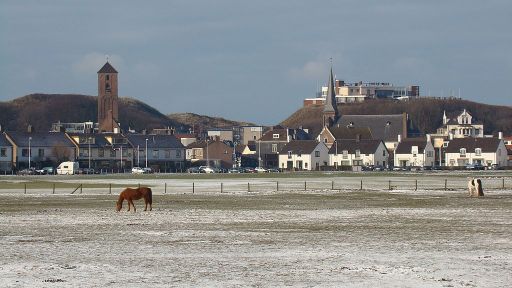
To date, over 13,000 people have booked to attend a party on the beach at Wijk aan Zee in the Netherlands on the 31st of October. It all started as a joke on Facebook in August but quickly grew. People paid Euro 19.73 (the year the UK joined the EU) and they were going to wave goodbye to us here in the UK, listening to live music and being served Belgian beer, French wine and Dutch chips and cheese.

I know Wijk an Zee very well: it’s just two miles from the small town where I was born. I spent a lot of time there as a child and adolescent. From the beach you can see the chimneys of the steelworks by the port of Ijmuiden.

Brexit has been delayed and so has the party! The organiser, Ron Toekook, admits that it has not been possible to get the finance sorted for a party this size in such a short time. Money will be refunded, and they will try again early next year.

According to a recent survey, one third of the UK population reports mental health issues as a result of Brexit.  That’s close to 22 million people and I am only one of them.

This seems a good time to share with you my Brexit poem Going bananas. One of the lies told by politicians here in the UK was that the EU wouldn’t allow bananas to be bent! The poem is in the form of an abecedarian. This is an ancient form with each line starting with a letter of the alphabet. Apparently, the first examples were in Semitic and religious Hebrew poems.

Going bananas

Aliens’ Office: the first destination on my 1969 arrival, a somewhat
bewildering encounter with Blighty’s bureaucracy in London.
Colombey-les-Deux-Églises it ain’t and I’m in Manchester now, five
decades down the time-line, feeling like a sick parrot, a dead one
even. I was an economic migrant, attracted by English eccentricity.
Four candles? Fork handles? Wit and humour have been turned into the
Groundhog Day of Brexit negotiations. Jack took a fortnight’s leave –
halcyon days in September – and through marriage I acquired an
Irish surname while my husband held two passports, even then.
Je ne regrette rien screech those who voted non in the referendum.
Kafka would have been enchanted by a hard border in the Irish sea.
Languages were my passport, small flags sewn on the uniforms;
my Seaman’s Record Book rests in a box file with birthday cards.
NHS nurses and pediatricians are returning to Europe, even poets I know.
Oui, some of the three million are voting with their feet.
P&O gave the world the word posh: port out, starboard home. The
question of lorries queuing on the M20 still has no answer, as do the
refugee tales of children held in indefinite detention or stuck in Calais.
Schadenfreude is not what they feel in Europe, they’re just bewildered.
Tourist shoppers avail themselves of the sinking pound sterling and the
ugly UKIP man with Union Jack footwear, beery bonhomie, claimed
victory then scarpered sharply right. What kind of victory is it
when I now no longer want to become a British citizen? My neighbours are
xenophobes who, Macron says, will soon need visit visa to enter France.
Yes, the yahoos are among us yanking us closer and closer to the edge,
zealots who prefer the zilch-no-deal, while I cry and pluck my zither.

The Herring Eater


Herring Eater

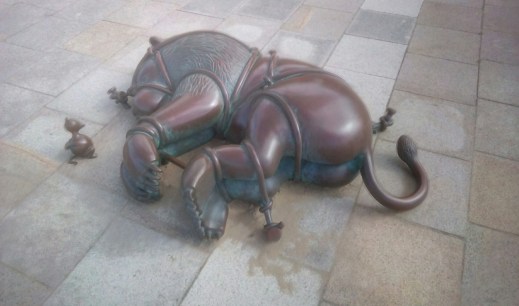
The Herring Eater is the centrepiece of a series of 23 inter-related sculptures by the American sculptor Tom Otterness. The tubes and round shapes are typical of his work: cartoon-like and humorous. However, these sculptures called Fairytales by the Sea are not from the children’s playground, but they remind us how these stories have a serious, even bleak, message. Here are Gulliver and creatures held down, tied down, or captive in cages. There is the hangman’s noose.


Fairy tale


Scheveningen was one of the major ports for the Dutch herring fleet. To this day, most Dutch people love their raw herring with chopped onion served in a white bread roll. There is always a queue at the stall next door to my local supermarket. I am about to close the caravan for the winter. The poem was written earlier in the season.

 
When in Holland

When in Holland do as the Dutch do:
eat raw herring in a white roll with
optional small bits of onion.
Or, like the giant bronze statue
The Herring Eater, already weathered
out on the promenade, head backwards,
holding the fatty fish by its tail.

Next you need to hunt out smoked eel
in the supermarkets. They’re delicious
with a sauce of crème fraiche and jenever.
Flight KL1079 to Manchester arrived on time
and I let the fish go.

A cylinder full of the rushing sea …


Mesdag 4

Panorama Mesdag is a cylindrical painting, more than 14 metres high and 120 metres in circumference. It’s a view of the sea, the dunes and Scheveningen village as it was in 1881. It’s the oldest 19th century panorama in the world in its original site.

Ever since getting my caravan in Holland, I’ve been visiting several times a year. When I am standing on the circular viewing platform in the centre, I know I’m just 14 metres away from the canvas. I know it’s all an illusion, but I can hear sea gulls, I get the salty tang, I see clouds pass by and the sun break through.

Mesdag 3

Painting the enormous canvas was a team effort: Hendrik Willem Mesdag with his wife Sientje and various able painters from the Hague. Other panoramas portray violent scenes (the battle at Waterloo, the Crucifixion of Christ). Here it’s visible silence, still as the hourglass (Dante Gabriel Rossetti), the tranquility of everyday life. A few fishermen are messing about with their nets, the boats are beached, the cavalry are walking their horses on the sand, women are chatting in a doorway, a dog lies down quietly.

Before the camping closes and I lock up my caravan, I will go and stand on that viewing platform again and say my goodbyes to Panorama Mesdag. The poem is by my friend Keith Lander.


Mesdag trieneke

The Mesdag Panorama
after a panoramic painting by Mesdag in The Hague

I’m on a school trip to The Hague
transfixed by the Mesdag Panorama,
especially the seascape stretching away
from the viewpoint on the man-made sandhill,
with fishing boats moored on the vast beach,
a troop of cavalry men in training,
and, joy of joys, a donkey ride.

When no one is looking I climb
over the railings onto the sandhill
and, without looking back, skip away
laughing and tumbling down the slope
towards the beach, the north sea breeze
in my hair, to run behind the military
and have endless rides on the donkeys.

Forty years later, a bored business man
with time to spare before an appointment,
I visit the Panorama and remember
I’ve been there before as a schoolboy.
As I stare at the seascape again I see
the boats on the beach, the military men
and a lost boy waving from the donkey ride.

A glint of wolf

DSC00273

I am very pleased to introduce our September poet: Stuart Quine. We met almost 30 years ago. I hope you love his haiku as much as I do.

In 1998, after a few years of writing haiku in a three-line form, Stuart Quine started to feel that his haiku were becoming a little formulaic and so began to explore the opportunities of a one-line format without breaks or punctuation.. In addition to their aesthetic appeal, one-line haiku echo Japanese haiku which usually, of course, are written in a single, albeit vertical, line. While many one-line haiku contain an implicit caesura given by their syntax, at their best they can be broken in a number of places thereby enabling a multitude of readings. Haiku is a collaborative poetry with writers and readers working together to bring it to completion. Therefore the success of a haiku is not a matter of how well it conveys the writer’s intention to the reader but rather whether readers can enter and occupy it on their own terms.

Many of Stuart’s haiku have been included in anthologies and journals and he is a former associated editor of the journal Presence. He has also had two collections of haiku published by Alba Publishing (available from albapublishing.com ). Sour Pickle (2018) contains 100 one-line haiku and Wild Rhubarb (2019) contains another 80.

A practitioner of Soto Zen Buddhism for over thirty years he regards his haiku writing as a dao and is a member of the Red Thread Haiku Sangha..


hidden and unseen the burgeoning life in buds and bellies

through driving rain the ambulances’ dopplering sirens

round midnight moonlight playing on the piano hammers

a short night shrunk to a dog bark and the clanking of the trams

through the haze the headlights of a hearse

lassitude and languor these days without rain

snagged in machair a gull feather unzipped by the wind

distant thunder the old mouser raises an ear

-not yet, not yet” says the tumbling beck

pagan moon in the shadow of her cleavage a tiny silver cross

winter solstice darkness gathers in the unrung bells

birthcry deep in the night a freight train’s lonesome whistle

like the honed edge of a blade keen is the cold

winter moon a glint of wolf in the mongrel’s eyes

under mistletoe on her lips a tang of tamarind

new year’s day only the rain comes to my gate


Fishbones Dreaming

IMG_0679
Tomorrow it’s a year since the Irish poet Matthew Sweeney died. He was just 65 and died of motor neurone disease.

I took the photo in 2006 when I attended a week-long course with Matthew at the wonderful Almassera Vella in Spain. He was like a dog with a bone about adjectives, but otherwise warm and funny. I learned a great deal that week.

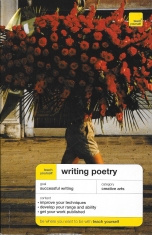
The poem Fishbones Dreaming features in Writing Poetry, a publication in the Teach Yourself series. It’s packed with ideas and good exercises. Matthew wrote it with the poet John Hartley Williams. They both lived in Berlin for a period and were friends. The friendship clearly shows in the bits of dialogue where they introduce the exercises.

Scan0014

Fishbones Dreaming starts: Fishbones lay in the smelly bin. / He was a head, a backbone and a tail. / Soon the cats would be in for him.

The refrain is: He didn’t like to be this way. / He shuts his eyes and dreamed back.

The poem uses a gradual flashback technique, with the refrain dividing the stanzas: a stanza about being on plate, next to the green beans, a stanza about being in the freezer with lamb cutlets, about squirming in a net, and so on. Till he is darting through the sea, past crabs and jellyfish.

My poem below was written in response. It was published in my debut collection Another life.


Friday evening

He leaves work early,
walks past the pub,
unchaining habits,
dropping an old raincoat
into the Ribble.
Preston is still Preston,
magnificent failure.

If he can walk backwards
to the railway station,
he will catch himself
in the windows.
There is his 40th birthday,
never celebrated.
Here are the empty Sundays.
Swans, a football, his parents, baby sister.


The secret of flying

hMtWA9O4R+e9JsZYGPtAaw_thumb_a91 (002)


I am delighted to introduce this month’s poet.  David Underdown and I met a few years ago on a residential writing workshop.

David Underdown (www.davidunderdown.co.uk) has recently come to live in Hebden Bridge. Though a Mancunian by birth most of his life has been spent in the West of Scotland, latterly on the Isle of Arran where he is an organiser of the McLellan Poetry Competition. His two collections, both from Cinnamon, are Time Lines (2011) and, in 2019, A Sense of North. David Constantine describes his poems as ‘watchful’: ‘he gives us a view from (in his own words) ‘a window / we did not know was there’, he makes ‘a halo round the ordinary’’.


The secret of flying


The breakthrough is to stop thinking
about aerodynamics. Concentrate
on the immeasurable pleasures
of floating above roofs
and the open mouths of chimney pots

stems of road budding
houses, the rumple of fields
and, beyond, the dark spot of a copse
or how the river feels
up into its tree-lined tributaries.

And later, after that first step
into space
the art of soaring on thermals
of passing over boundaries
a sense of north.


Against the tide

Down here the river has widened,
already flooding salt for half the day,
mud-bound for the rest.
The tides wipe clean
the mazy prints of wading birds.
Below the bridge there’s broken masonry,
the pier where the cobbles stop,
and then it’s willow herb and buddleia
all the way to the sea’s flat-line.

Easy to see why you linger
to watch the gulls circle,
catching the hum from the bypass.
If you could, you would turn
and find your way upstream again
past viaducts and fat meadows,
solid farmsteads set round by trees,
and feel, as the land draws in,
the younger waters quicken.

There, where the uplands open out
you would track each beck
up to its marshy watershed
to understand how it started,
the long journey to the sea
and what alternatives there nearly were.
But the tide is turning,
colder wind roughening the water,
staining it dark, draining it out.


Shrine

The narrow path is steep
with scents of pine and juniper that lead you on
to where a lintel at the cavern’s mouth
will make you stoop so low
as to leave the outer world behind.
Enter, and all falls away,
though you, a frail and used-up thing,
and hunched, are still in hope,
for once inside the roof is lofty, almost limitless.
From waves of ancient seas, stone lolls in tongues.
And there, within, no god, but a reminder
of what a god might be: a simple table,
faded cloth, gifts that some might misjudge poor,
small money, keepsakes, herbs as grateful prayers.

To be there for an hour, and still,
is more than some can stand, but do
and you’ll leave naked in yourself
as if unclothed of need, and shuffle out
to blink in new-found light
with sun upon your head.


Notes for a solitary walk

For M.W. 1951 – 2014

This morning you are walking for her,
a small thing you can do, on a day
of deep green shadows and granite glitter,
that, if she were here, she would love.

Today, as she is not here,
you will not go the usual way
across the burns through stands of birch
where the dog would flex at the scent of deer,

but further, up the glen where even in her lifetime
the last men were still mining the hill.
You will shin up that shoulder of Cioch na’ Oighe
to see the whole Clyde laid out,

just how, if she had ever had the chance,
she would have chosen to arrange it –
the named near hills and the unnamed hills of the horizons
and the spaces of water between.

You will walk south along your home’s spine
for her to count its line of rocky vertebrae
and marvel at the openness
of all these lands of the West.

You will talk to her of travelled roads
and also of oceans you might have crossed
if there had been time, until,
reaching the lip of Coire Lan,

you will leave the broad path and drop down
below Am Binnein to the White Water
that leads (with no time now to stop)
past home to the indifferent sea.

Father’s Day

Vader


My father died a few weeks after his 75th birthday in October, 1990.  He had a talent for music: singing in and conducting choirs, and playing the church organ for many years. Here is a picture of him as a young man: a somewhat anxious look, wanting to do a good job of transporting my mother and me safely.

The poem Prelude and Fugue was published in the anthology, Poems from the Readaround, Tarantula Press, 1995.
Prelude and Fugue

I enter and dare a glance at your effects –
straight rows of books in alphabetical order
the white board emptied
pens and pencils (four of each)
manuscript paper and a rubber
on the Yamaha
You were filling in the bass line

Music for a while shall all your cares beguile

You kept some organ pipes in the loft.
You were going to build one.
What happened to those when you moved
into the flat?

Sometimes I turned the pages for you
feet darting across the pedals
When I was twelve I left the choir
and gave up singing

Your black shoes scuffed at the side

The Catholics paid best you said
a bonus for weddings and funerals

Glad not to be the corpse

NWA_ScottishBookTrust_HIGHRES_January_18_2018_KatGollock_-73_Lydia_Harris-200x300
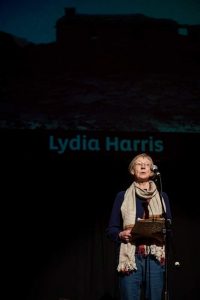
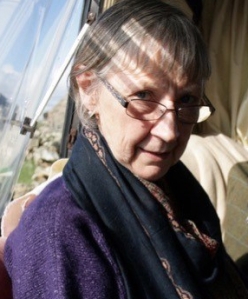
A knock-out title for a poetry book, I should say. Lydia Harris and I met on the Poetry Business Writing School in 2012, the year Smiths Knoll published her pamphlet.
The others are glad not to be the corpse is the first line of a poem with the title
We make a video  on All Saints, North Street for English Heritage.

Many of Lydia’s poems have this filmic quality. They’re typically condensed narratives, with arresting first lines, and slivers of telling monologue or dialogue. They are also a masterclass in choosing titles. Could you resist I couldn’t ask if he was glad he’d married me; Widow to step-son; Lice-infested sea trout; Oxygen mask? The next poem is a delicious example:

The rolls arrive at the Inchnadamph Hotel

She doesn’t say ‘I never should have married you’,
instead tries I’ve cleaned our tennis shoes.
He spots the van through his binoculars,
the rattle on the cattle grid alerts the lad who helps.

The rolls brim with themselves,
two each, in baskets on the tables,
they smell of steam and Morag’s overall,
the early morning shuffle in the bakery.

A twist of butter opens out, floats on cloud.
Perhaps I’ll find a horseshoe charm, a wind-up bird.
She reaches for the marmalade.

I’d like a Harvey’s Bristol Cream, he says.
Tonight, she laughs, at five.

The day’s a swing-boat,
red plush seats, a fringe of gold.
He’s helped her in,
pulled the rope to make it rise.

 
Shortly after we met, Lydia moved to Scotland. She has made her home on one of the northern Orkney islands, a small but vibrant community. Recently, her pamphlet of Westray poems An unbolted door was published. I’m very pleased I can share a few poems from the book here. Lydia’s website is homeabout.co.uk


Lydia


How to Approach the Pier

With a bowline tied to your monkey-fist,
with your heaving-rope coiled sun-wise,
bow to Faray, engine in reverse.

With your stern door lined up to the ramp,
to starboard, the quarry, slumped
where the stones for the pier were hacked free.

With outlines of Wideford and Keelylang
papered on the skyline. The tide running high
and the wind southerly.

With trails of foam in your wake,
Geldibust to port. With the stanchions easy,
hung with tyres.

With a route pressed to your palm,
in your pouch, the honed spoon
and that knapped flint from Howar.


Jeemo Services My Van in January

He keeps spare bulbs in a fridge,
cattle in the byre next door,

spreads shafts and flanges
round the anvil
like the gaming pieces
and spindle whorls from Scar,

the woman who bore them
so long dead
she’s in the sky
over Ouseness at night,
unravelling her skins.

 
From the Box Bed

Our sheets are sails on the sweet hay sack
and we sail to the moon with an ebb and a flow.

Your hands smooth my throat in the starlit room,
there’s nothing to say but the brush of flesh.

My lips drink your breath and the tide is in,
the clock on the wall makes the only sound

but for the air as it leaves your lungs,
sweeter than scallops from the pan,

for where has it been,
inside your skin and I take you in.