Health issues have kept me housebound, but I was determined to go and see this artwork at Museum Beelden aan Zee, Scheveningen before it goes back to Marseille. A sunny, breezy autumn day, a salty tang, quiet beach.
Khaled Dawwa (Maysaf, 1985) worked on it during 2018 – 2022. He was invited to show it at Beelden aan Zee in 2025 – when here in The Netherlands we celebrate 80 years of freedom.
Voici mon coeur!
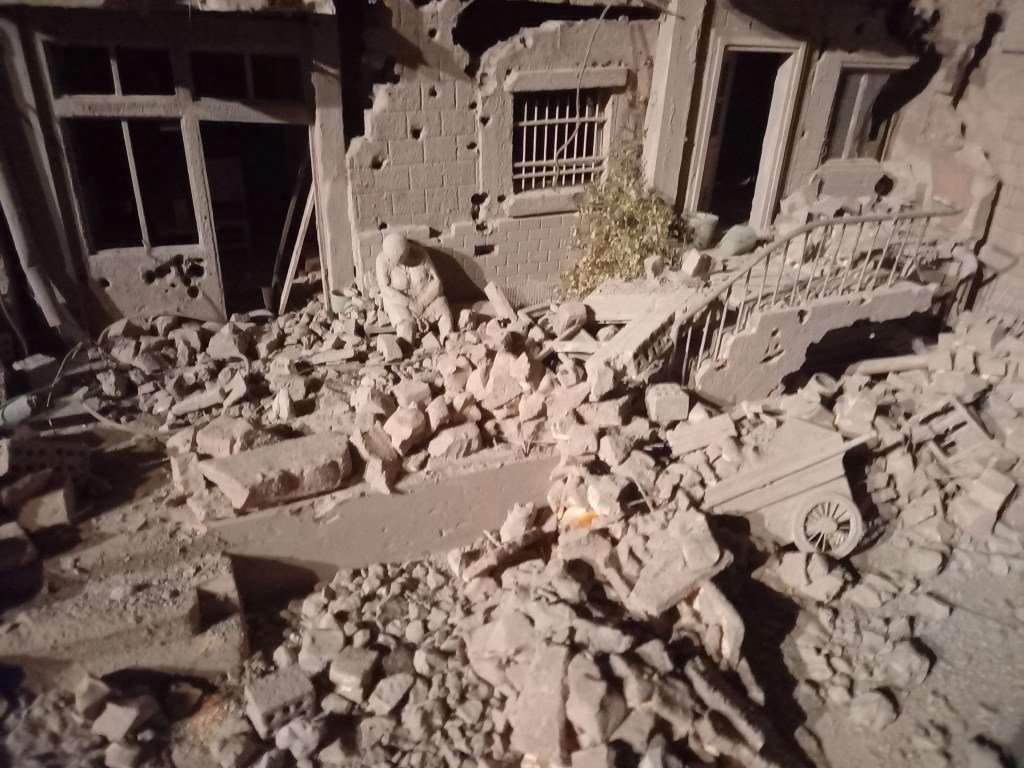
The work (tr. Here is my heart!) is a 6 m long model. It’s made of vulnerable, unbaked clay. It represents a fictional street in Damascus. Outside, there are the remains of a car, benches, a swing seat. We see material damage. The setting is nighttime.
It was a disorienting experience walking into the small side gallery as it was almost dark. A volunteer gives visitors a small torch, so we can walk around and shine into the rooms: beds, tables, chairs, a poster on the wall, a book left on the table.
Dawwa and his family fled Syria shortly after the start of the civil war. After a year in Lebanon, they travelled to France where they now live in exile. Khaled now works in a studio just outside Paris.
Before leaving he took photos of the works he had made, then destroyed them – for security reasons, or because they were too large to travel.
Voici mon coeur!, a contemporary war memorial, is a personal and emotional representation, in contrast with the collective memory expressed by traditional war memorials. A powerful and timely reminder. I found it deeply moving.
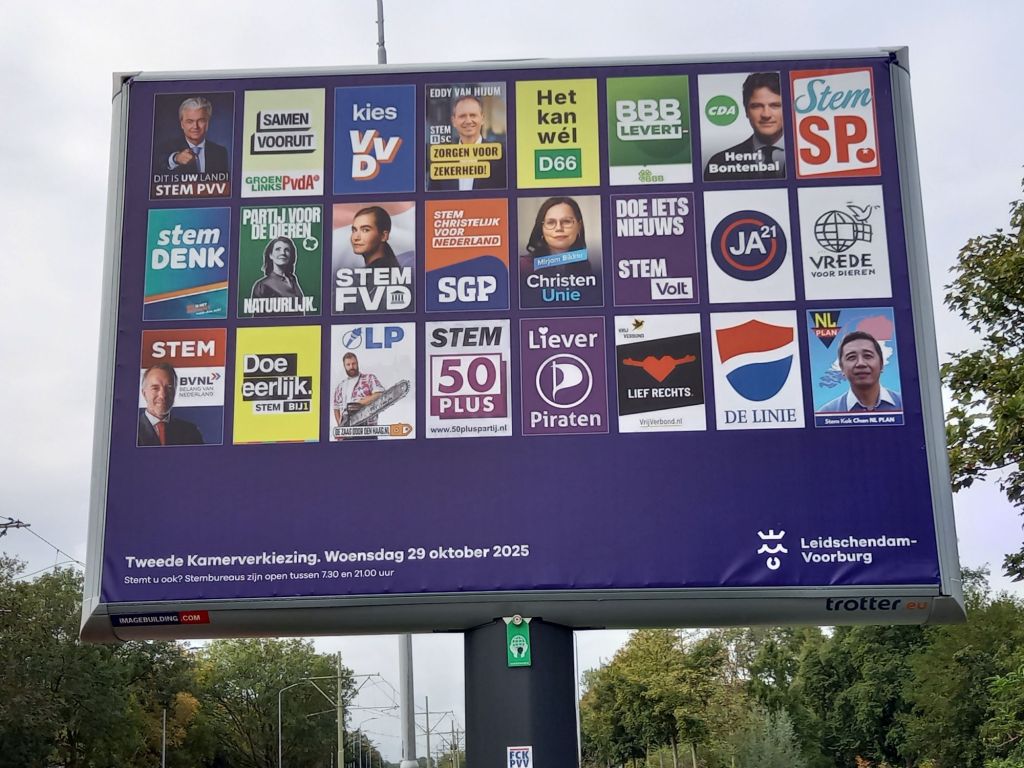
This coming Wednesday are the elections for the ‘Tweede Kamer van de Staten Generaal’ – the lower house of parliament.
All over the country, boards have appeared with the 24 political parties. In large cities and towns each party has its own board. In small towns, like mine, the one shown.
On Friday, a pale grey sheet of A1-sized paper arrived by post: names of candidates for the 25 parties. So much detail: it’s essential to orient yourself beforehand. Otherwise, you’d spend too much time in your cubicle on the day, and there will be queues. When I voted in the last elections (November 2023), I couldn’t fold the paper back into its original roadmap shape…
The Dutch are famed for their tolerance. I find that puzzling, but then I spent most of my life outside The Netherlands.
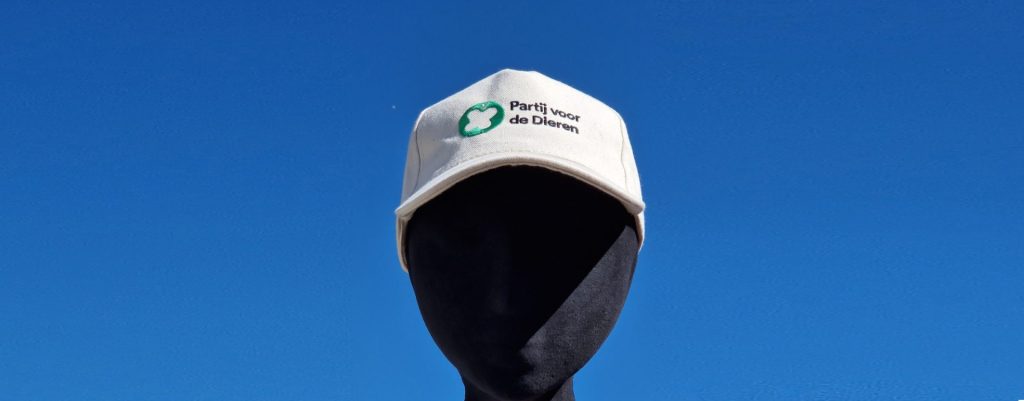
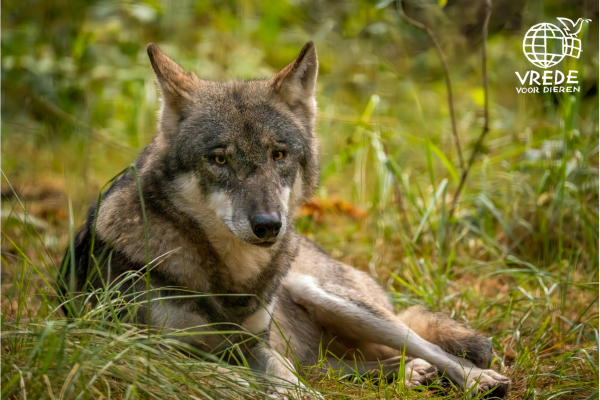
A few months ago, a new political party ‘Vrede voor Dieren’ (Peace for Animals) was established. They split from the original ‘Partij van de Dieren’ (Party of the Animals) because the leader of the PvdD (initially pacifist) changed their views and now supports re-armament. The new VvD rejects re-armament in principle.
You don’t need to have read Animal Farm to think that an animal’s view of pacifism is probably Will I be eaten or not? (paraphrasing a Dutch novelist).
Confidence in politics and politicans
Confidence in politics is at an all-time low. In the August 2025 polls it ranged from 4% – 9%. Some 25% of those polled were floating voters. There are several reasons for that.
Photo credit: MabelAmber via Pixabay
Time lost in the polder…
The ‘polder’ model is the pragmatic recognition of pluriformity. Time is needed to achieve consensus: people will need to polder. However, this verb has a negative connotation in relation to politics. An election will be followed by months of sitting and talking, walking and talking. A ‘formateur’ will facilitate the process. Meanwhile, the previous coalition is just ‘care taking’ and keeps things ticking over.
It also takes several months to organise an election, typically four to five.
The coalition Rutte II was the first cabinet that completed its full four-year term since 1998. Its starting date was 5 November 2021. Since then, just over two years were spent on forming the next three coalitions.
Not lasting the course…
Rutte III – the full cabinet resigned over the child benefit scandal. A parliamentary enquiry had found that officials had knowingly and systematically deprived people who were legitimate claimants. Thousands of people have still not been compensated.
Rutte IV – resigned over fundamental disagreements regarding immigration measures.
Schoof – An unstable coalition from the start: two parties (the Boer Burger Beweging or BBB) and the NSC (Nieuw Sociaal Contract) both new to government and both struggling to get enough credible candidates for their seats. With Wilders of the PVV (Partij voor de Vrijheid) who’d walked out of an earlier coalition government. Seen as a ‘bunch of amateurs bickering amongst themselves.’
Not tackling the crucial issues
The Hague is a long way from the northern province of Groningen where thousands of people have been waiting for over a decade for compensation. (The subsidence caused to properties caused by fracking. Another parliamentary enquiry.) Just an example.
This time I’m a floating voter. So, I’ll go and have another coffee, inspect that grey form a little closer!
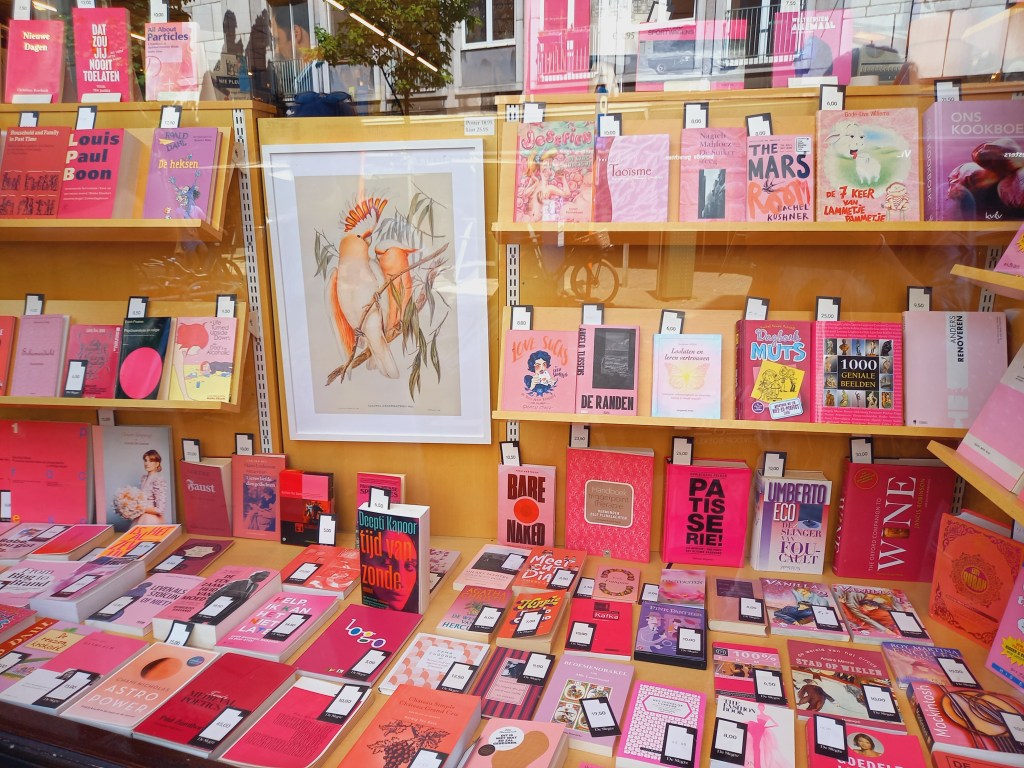
Recently, I had a short reunion with the friend I met 35 years ago during a holiday to China. Our reunion last year was in Ghent, Belgium. I was very pleased to discover a branch of De Slegte, second-hand bookshop, in the same street as our hotel. I’d come by train with a rucksack: spending was modest.
I lent Eleven Kinds of Loneliness by Richard Yates to my friend, so she had reading material for her journey back to the UK. I am a keen reader of short stories, glad to have the paperback returned to me. I enjoyed these: the mundane sadness of domestic life.
As the blurb says: ‘a haunting mosaic of the 1950s, the era when the American dream was finally coming true – and just beginning to ring a little hollow.’ Yes, it’s bleak, like Raymond Carver without the humour. Yates had a difficult childhood and suffered from TB which must have coloured his view of life.
Yates is probably best known for his first novel Revolutionary Road. It was published in 1961 and an instant success. The 2008 film with Kate Winslet and Leonardo DiCaprio was true to the book.
Bookshop De Slegte, Ghent, Belgium
Mary Ruefle’s My Private Property (2016) includes 11 short pieces about Sadness which are spread throughout the book. Here is an extract from Granta’s website: ‘Red sadness never appears sad . . . it appears in flashes of passion, anger, fear, inspiration and courage, in dark unsellable visions; it is an upside-down penny concealed beneath a tea cosy.’
Writing prompt
Go with loneliness or sadness if it appeals. Or choose another emotion/feeling you would like or not like to write about. Choose a few colours which you like and a few you don’t. What comes out of the melting pot? In her prose poems, Ruefle mixes the descriptions of concrete objects with some abstraction, and off-beat imagery: Grey sadness is the sadness of paper clips and rubber bands, of rain and squirrels and chewing gum,….
Yellow sadness is the surprise sadness. It {….} is the confusing sadness of the never-ending and the evanescent…
The original wind phone, photo credit Matthew Komatsu
It’s a year ago today that my brother died. If grief is love with nowhere to go, the wind phone can be a place for those feelings to land, even momentarily.
The initiative was started in Japan by garden designer Itaru Sasaki in Otsuchi Prefecture in 2010. Sasaki said: ‘Because my thoughts couldn’t be relayed over a regular phone line, I wanted them to be carried on the wind.’ Hence the name Kaze no denwa’ – phone of the wind. The disconnected old-style rotary telephone allowed him to deal with grief after his cousin’s death of cancer.
Sasaki: ‘When your heart is filled with grief or some kind of burden, you aren’t in tune with your senses. You’re closed off like curtains have been pulled around you. After you empty your heart a little bit, you might be able to hear some birds singing again.’
The following year close to 20,000 people were killed by the earthquake and tsunami. In Tokohu 10% of the population died. Sasaki allowed local people to use the wind phone. Over 30,000 people have made the journey to this telephone since, and wind phones have been set up in other countries. The wind phone also provided inspiration for films and novels.
Amy Dawson (USA) lost her daughter Emily to terminal illness in 2020. She learned about wind phones and now devotes much of her time to maintaining a listing of wind phones worldwide, providing advice and resources. The current total is just over 400. Not all calls are to a deceased. People make calls about other losses. Go to her website for more information. There is also an article on Colossal
The first wind phone in The Netherlands was placed in 2019. There are now eight, with a further eight being planned. The locations include Haarlem – the town where my brother and sister-in-law lived before moving to the nearby village of Spaarndam.
I imagine a wind phone, the black cord snipped, in the dunes of Wijk aan Zee – where I’ll celebrate my special birthday this weekend, and where my brother and I spent much time as children during the summer vacation.
I had booked return flights Manchester – Exeter to visit my poet friend Kathleen. My trip was going to be in the third week of March 2020. On the 5th of March Flybe filed for administration and ceased all operations immediately. I lost £65, but I was very relieved: If I had flown to Exeter, I might well have been stuck in Devon as that first lockdown started…
On Sunday 15 March I learned the British government was considering a compulsory quarantine. The next day I emailed the owner of the campsite asking if I could arrive early. He replied immediately. I booked a flight, transferred money, packed, agonised over which poetry books to take to my ‘desert island’ near The Hague. I flew to Schiphol on the Wednesday. The local buses already had the area near the driver closed off with white-red plastic.
Here are two poems about that first lockdown:
The departure
Half a century condensed into Brexit, pandemic. At the threat of a four-month’ compulsory quarantine I fled to my bolthole in Holland.
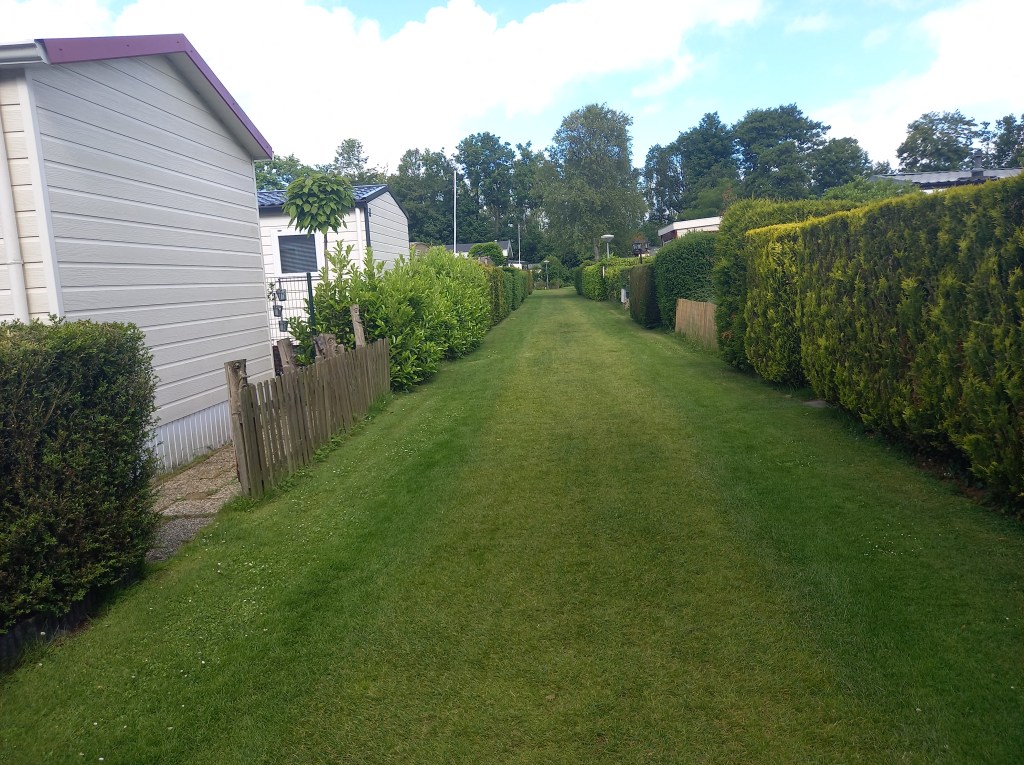
Six months of safety in a static caravan, waking to birdsong each morning, shielded from the sun by the golden elm. I walked my daily rounds on the grass lanes.
Forsythia, tulips, narcissi, rhododendron, pyracantha, salvia, rock rose, asters: the seasons’ steady markers. From a distance I waved to neighbours finally arriving.
In the cupboard of the spare room lay the letter confirming my ‘settled status’ on the other side of the North Sea.
The undertakers
A double spread in the paper features a large photo.
This man, in his thirties, a narrow horizontal moustache, soft smile.
He sits in a wooden boat, his right hand resting on a plain white coffin.
People are asked to email text and selfies. Made into cards, these are placed on the coffin.
He is based in Amsterdam, will transport you safely through the canals.
That undertaker has just opened a crematorium. He also owns a chain of hotels.
The pandemic has cut the numbers allowed to be in the room. There is livestreaming.
People, he says, are glad of it. The intimacy makes it easier to speak.
At the end of September 2020, the campsite closed. I got a Covid test somewhere in the centre of The Hague and flew back to Manchester.
Late lockdown poem
I wake up and know, of course, that I am not a morning person. The sound of rain, of course, and fewer sirens as people are supposed to be at home. My lifelines are the same, of course: motto, comfort break, medication. Of course, I think about exercise, settle for Composer of the Week, dead, of course.
Marie-Louise Park, Didsbury, Manchester, UK
A postage stamp, Joshua calls it
He’s right and there’s traffic noise from the main road and people with dogs on long leads, but not all the benches are dedicated to the dead, Marie-Louise is a pretty name for a park and the 43 Airport bus is a hybrid and no-one much was going to the airport that autumn: I often had the bus to myself, both ways.
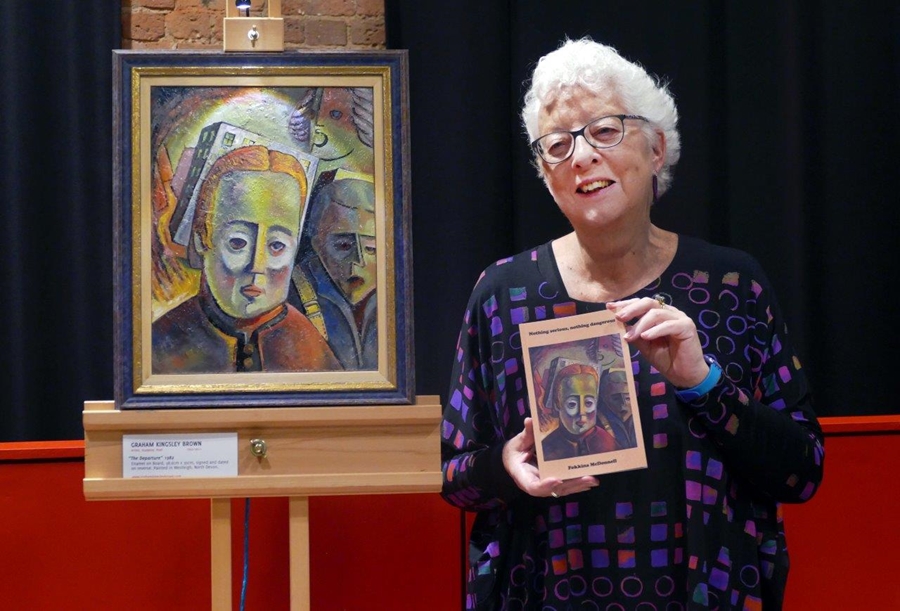
As I was updating the website recently, I was reminded of the lovely interview that Andy N Poet did that very Friday. He came to the flat in Manchester where I then lived. On the 3rd of March I had launched a pamphlet and my second collection at the International Anthony Burgess Foundation. The launch was one of the reasons for the interview. Andy has now done several hundred interviews. You can find them all on Spokenlabel.bandcam.com Here is the link to my interview: SpokenLabel
When I listened to the interview this week, it felt spooky at times. Early February 2020 I had received confirmation of my ‘settled status’. I told Andy that I hoped to spend ‘most of the summer’ in my caravan in The Netherlands, that I couldn’t immediately tell him who my ‘desert island’ poets would be. At one point Andy mentioned the ‘virus’.
Here is a poem about that Friday from Kate Noakes who is our guest poet this month. The poem is from her 2024 Chalking the Pavement published by Broken Sleep Books.
The sick spring
Thirteenth March, a Friday with which comes a most lauded play, Stoppard’s last contract: Vienna, and a family succumbs, fortunes and losses in Leopoldstadt.
I am treated to the stalls by a friend of a friend, a nice man I do not know. His cancelled cultural holiday ends with a short email critique of the show.
I give him scenes, chronology, pictures, timings avoiding history’s clichés; how I stepped into busy Leicester Square with foreboding that hurried me away,
and how I scurried home to a semi-death: headache, sore throat, cough and struggle for breath.
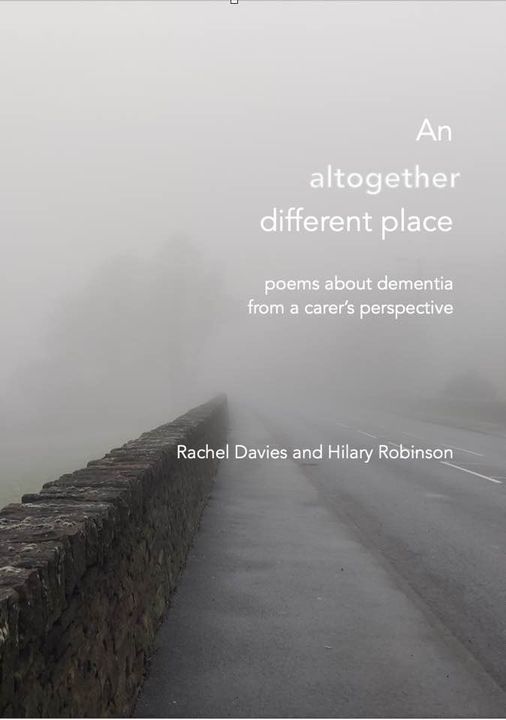
Rachel Davies and Hilary Robinson have been friends for over 20 years. Friends call them the ‘poetry twins’. They are both accomplished poets and you can find their biography below.
An altogether different place, published by Beautiful Dragons Squared, is a joint project. In 2022 Hilary’s husband was diagnosed with vascular dementia; in 2023 Rachel’s partner with dementia and Lewy bodies. In the introduction they write ‘dementia is a catalogue of cruel diseases’. Living with and caring for someone with dementia ‘you come to know grief by slow degrees’. Through poetry Hilary and Rachel ‘found a joint space to laugh, cry, find context and write out their experiences’.
The collection is sold to raise essential research funds for dementia charities in the UK. It is a privilege to share a selection of the poems here: Brainworm and Seven ways oflooking at a husband are by Hilary. Rachel wrote Degrees of Challenge and This is not apoem about dementia which was awarded 2nd place in the Hippocrates Prize 2024.
Brainworm
There are many crap poems online for those who care for loved ones with dementia. Dementia has a symbolic flower – the unimaginative forget-me-not. I’ll have none of that shit. I want the gristle of it, the offal, brain-spatter, white matter of it. Show me the MRI with extensive vascular changes, let me count the dead parts of the brain so I can explain, daily, what ails my love. I watch Dirty Great Machines, find Big Bertha in Seattle, tunnelling machine on steroids moving at thirty five feet a day. Something has wormed its way into the tiny vessels inside his head over years and now whole sections of his once-sharp brain have died. It’s our Golden Wedding Anniversary this year. I don’t know who I’ll be celebrating with.
Seven ways of looking at a husband
1 Straight on. Taking in his 2-day grey beard, his nostril hair and ear fuzz. His smile.
2 Side profile. Noticing his cute nose, the same shape as our daughter’s.
3 From the bedroom door. Noting the cocoon he’s made of the duvet.
4 Across the kitchen. See, he’s forgotten how to toast his fruit tea cake, make coffee.
5 From the driver’s seat. Clocking his wince as you pull out safely onto the busy main road.
6 Across the care home corridor. Seeing his smile grow, then his arm around you, his whiskery kiss.
7 On the care home terrace. Look, he can’t turn his head to where you point. Misses the squirrel.
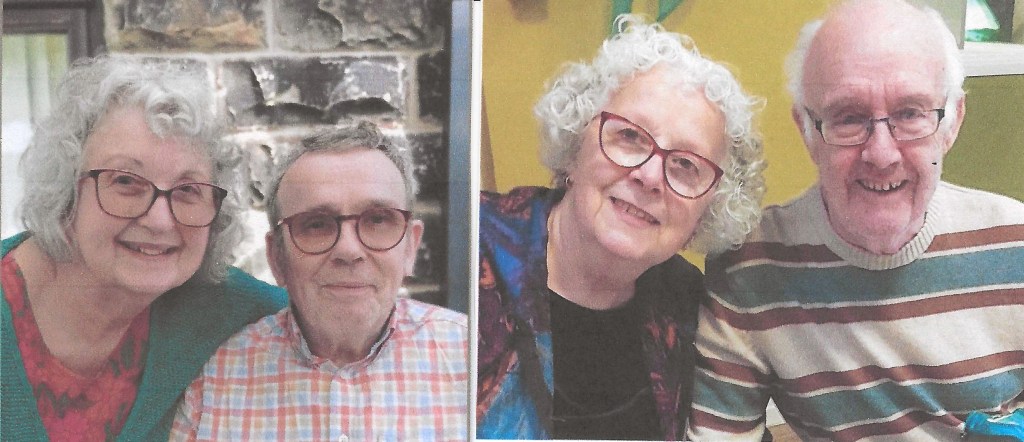
(L) Hilary with David (R) Rachel with Bill
Degrees of Challenge
I’m watching you struggle to break the seal on an ice cream wrapper and I think of the time you redesigned the roof of Piccadilly Station, worked in millimetres to ensure each pane of glass
fitted exactly into the space you’d drawn for it. I remember the night you clipped on a safety harness, climbed onto the roof to inspect each perfect joint, came home buzzing but satisfied at day break.
Tomorrow you’ll shuffle out to the Age UK minibus, the driver watching you don’t slip on the wet steps; but tonight you’re making a major task
of breaking into a Mini Magnum. I know better than to offer help; eventually you’ll pass it to me, say I’m sorry, I can’t seem to
This is not a poem about dementia
I am opening the windows and doors letting in fresh air to blow dementia down the lane like giant tumble weed
I am clearing out drawers and wardrobes filling black bags with hallucinations donating them all to the Age UK shop
I am having the Lewy bodies serviced unblocking its pipes flushing confusion down the drain with the incontinent waste
I am partying like there’s no dementia raising a cake with bicarb of dementia licking up the fluffy dementia crumbs
I am sleeping peacefully in the quiet night dreaming a poem that has absolutely nothing to do with dementia
Biographies
Rachel Davies is a mother, grandmother and great-grandmother and a retired primary school headteacher. Her poetry is widely published in journals and anthologies and has been a prize-winner in several poetry competitions, most recently, the Hippocrates Prize 2024. A selection of her work was published in Some Mothers Do… (Dragon Spawn Press 2018). Her debut pamphlet, Every Day I Promise Myself, was published by 4Word Press in December 2020. Since retiring she has achieved an MA in Creative Writing and a PhD in contemporary poetry, both from Manchester Metropolitan University.
Hilary Robinson has lived in Saddleworth for most of her life. She met her husband, David, at secondary school. She gained a BA (Distinction) and a PGCE and became a primary school teacher. After a successful career, Hilary retired and started a Creative Writing (Poetry) MA at Manchester Metropolitan University and gained a distinction. Her poetry is published in print and online journals, and in several anthologies. Her poetry has also been set to music by RNCM students of composition. In 2018 some of her problems were published by Dragons Spawn as Some Mothers Do… and this was followed in June 2021 by her first solo pamphlet, Revelation, published by 4Word Press.
This is my 300th blog post. Many thanks to all the blog’s followers, also for your likes and lovely comments. They are much appreciated. I’m taking a break from weekly blogging: I need to ‘fill the well’ – take myself out to find poems and art on the streets of The Hague, get inspired and fired up again. I’m celebrating the 300th post in the company of Cecile Bol – our August guest poet.
Cecile is also the organiser of the Poetry Society’s Groningen Stanza. When I moved back to The Netherlands , I was fortunate that their meetings were on Zoom due to the lockdown. It was great to meet Cecile and other members of the Stanza in person earlier this year. The hotel where I stayed is just a few houses down from the literary café De Graanrepubliek where they meet.
I have chosen three poems from Cecile’s chapbook Fold me a Fishtail. Read more about Cecile and the book below her poems.
yet you speak of resilience
there are things that make me sink back into the grave (red on black, stardust freckles, knee socks, foxy wrists) inside Plato’s cave, where moving shadows are safe
I saw a flowered brown tie turn into a snake woke up crying, your shoulder blade stuck to my lip there are things that make me sink back into the grave
same table, same cheap wine, same talk, another day you pull me close as if you’re not pushing me in, inside Plato’s cave, where moving shadows are safe
like the cute demon I asked how I should behave – he said ‘always choose slyly between loud and still’ – there are things that make me sink back into the grave
they nibble at my feet, ask if this time I’ll stay (petrol candy, flawed magic, and plenty to kiss) inside Plato’s cave, where moving shadows are safe
I seep through layers of earth, call out all their names yet you speak of resilience as if we can win there are things that make me sink back into the grave inside Plato’s cave, where moving shadows are safe
paper crown
a cut-out crown is still a crown for a girl on a stolen horse I would have swapped our sanities to see her hair become lost in rose horizons, saddlebags filled with boxes of chocolate sprinkles
I’d been chasing robber children long before we met – and I will stick with this selfish travelling until or well beyond my death but she – she bore whole galaxies sprinkled into maps on her skin
in my inside pocket you’ll find scissors, tape and golden paper the day I borrowed her reindeer I thought in time she’d ride my horse instead I stop at roadside shrines and eat chocolate sprinkles daily
robber child: arguably the most interesting character in H.C. Andersen’s story The Snow Queen is the unnamed little robber girl
Krasokouloura
I should have made them milk and bread, while they were still in bed – instead, I impulsively fired up the electric oven – as always, procrastinating – to bake twenty ring-shaped Greek cookies with things lying around the cupboard.
Flour, sugar, baking powder, cinnamon, salt, ground cloves, some olive oil and another glass of white wine.
I should have written them a note, but I’m that cat; as always, capitulating to curiosity – I had to taste one, still warm, curled up on the windowsill – new sun, please, tell me what skills it would take to achieve immaculate roundness.
Biography: Cecile Bol is a Dutch writer with a small family and a big edible garden in the north of the Netherlands. She doesn’t have an MA in Creative Writing, because things like that don’t exist in her country. She does, however, earn her money as a self-employed copywriter. The somewhat well-known poet Helen Ivory describes Cecile’s work as ‘like finding snakes in your strawberry patch’. Cecile enjoys incorporating fairy tales and popular culture in her poetry, and her poems often have a slight erotic edge. Cooking (mostly Greek) food is her means of meditation. Cecile owns 57 different kinds of herbs and spices of which cumin and dill are her favourites.
Cecile’s debut chapbook Fold me a Fishtail was published by UK-based Selcouth Station Press in 2022 (Sadly, Selcouth Station Press ceased to be in 2023). So what’s Fold me a Fishtail about? Cecile: “I sometimes wonder whether Disney’s Ariel misses her mermaid tail, now that she’s the legged wife of prince Eric. Isn’t she way too curious and free-spirited for a conventional family life? Or is that just me? That feeling chained to a husband, toddler and suburban lifestyle was enough to drive me dangerously crazy? Fold me a Fishtail is a collection of mostly confessional poetry about a long journey into, through and out of (?) the dark.”
It’s a great pleasure to introduce my guest poet Judith Wilkinson. Judith and I are both members of the Groningen Stanza. It had been meeting through Zoom for over a year, and in March I went up to meet her and the other members in person.
Judith Wilkinson is a British poet and award-winning translator, living in Groningen, the Netherlands. She has published three collections of her own poetry with Shoestring Press: Tightrope Dancer (2010), Canyon Journey (2016) and In Desert (2021). Some of the poems in Tightrope Dancer have been performed by the London dance-theatre company The Kosh.
Wilkinson is also a translator of Dutch and Flemish poetry, including Toon Tellegen’s Raptors (Carcanet Press 2011), which was awarded the Popescu Prize for European poetry in translation. Other awards include the Brockway Prize and the David Reid Translation Prize.
The poems in this selection are from In Desert, which explores various desert experiences, solitary journeys in which people are thrown back on their own resources. ‘The Risks You Take’ and ‘The Tuareg’s Journey’ form part of a longer sequence inspired by a Dutch expedition through the Sahara.
IMAGINING GEORGIA O’KEEFFE AT HER GHOST RANCH
‘My pleasant disposition likes the world with nobody in it.’ (Georgia O’Keeffe)
I will never tire of the desert, its severe hillsides, punctuated with mesquite, its unsentimental trees, shrouded in dust.
Now that he has left me for another, a few owls and a mourning dove are all that splinter the silence spreading before me like a horizon.
I don’t need more mourning, I want to walk across the bristly desert floor that the ocean turned into, arrange some black stones in my yard into a cordate shape I’ll call My Heart.
I was shipwrecked here a few times in my life and found restoration under a pitiless sky. Having let all the waters pour away, the desert unwrapped me, and my flint faith, bound to the Badlands rolling from my door.
I set my easel in plains of cinnabar and flax so I can explore the palette of solitude, capture mandarin-dusted mountains, staggered against sky, cliffs isolated in space, rising from the plateaux in banana and persimmon and cream, undulating mounds striated with celadon and a lavender mist coating the distance.
Every day I scour the ground for fossil seashells, little definite ghost-houses, air-havens I could live in.
I’m free to gather the bleached bones of the desert: deer horn, horse’s pelvis, ram’s skull, splaying them open like butterflies, dipping them in bouquets of wildflowers, suspending them above the ever-looming Pedernal.
This morning I trekked far into the Black Place because I could, because it was difficult, because fear and pain were expecting me.
When I got back I grabbed the ladder by the shed and leaned it against the evening sky. It needed nothing.
THE RISKS YOU TAKE
‘The true contemplative is he who has risked his mind in the desert.’ (Thomas Merton, Letter to Dom Francis Decroix)
Can I extract myself from you? Someone called you a few degrees short of bipolar, always urgent, pouncing on life, difficult not to love.
When depression settles on you, you travel beyond reach, going far out to some rocky, arid place, peopled by spectres and you stay there, stubbornly studying them, letting them haunt you, before coming back to tell the tale that restores you to your life.
There is so much of you, that you crowd out my patch of wilderness, that space where I too risk my mind for the sake of the inexplicable.
After months of turbulence I’m regaining some composure, breathing in what the desert offers – although I’m not sure I want all my prayers to go to the gods of serenity.
Absorbing this swathe of wilderness, I wonder if this is what I want for myself, the wide, wild courage to leave you, your tempests, your risks
THE TUAREG’S JOURNEY
Lost, not lost, in the ténéré, desert of loneliness, where the Kel Essuf spook us till we’re adrift on the empty side of home, as time sifts, dunes lapse.
Without GPS, without coordinates, we measure grass blades, we focus without a compass. With an infinite politeness to the desert we can tell a reliable groove in the sand from a wind-distorted one, extract logic from a shrub, tell the lie of the land by a bloom’s impermanence, take our direction from sun and moon and all the stars constellated in our heads.
We will never find Gewas, the Lost Oasis, we will always find Gewas in the middle of the trackless ténéré.
Lost and not lost, so lost that we’re at home
Note: Kel Essuf: anthropomorphic spirits; Ténéré: Tuareg word for desert, wilderness; Gewas: the Lost Oasis that figures in many Tuareg legends.
Credit: Ondrej Sponiar via Pixabay
THE WHOLE MOSAIC – A DAY IN THE ATACAMA DESERT
‘Why are there archaeologists and astronomers in one place? Because in the Atacama the past is more accessible than elsewhere.’ Patricio Guzmán, Nostalgia for the Light (film documentary)
At the observatory an astronomer scans the sky for treasure: clusters of stars, nebulas, planets, comets like those that watered the earth, or the death throes of a supernova, hatching our atoms. Here the Chilean sky is so translucent he can almost finger the stars, pull them down to eye-height, unravel the energy prizing them apart, as if the story, from start to finish, was his birthright.
In this salt-steeped land an archaeologist studies strata of sand and rock underpinned by meteorites distorting the direction of his compass. Tenacity got him this far, leading him to rock face carved by pre-Columbian shepherds, whose mummified remains he gathers up, tracing each part to its origin. He finds a petrified lake, fish frozen in time, and an ancient trade route from the high plains to the sea, where caravans of llamas once found their way.
Near the ruins of a concentration camp, women sift through the desert, decade after decade, in search of loved ones. Stumbling on Pinochet’s mass graves, they piece together splinters worlds apart, bleached by the calcinating sun. ‘I found a piece of my brother there and spent a morning with his foot, stroking it, though it smelled of decay, hoping to find the whole mosaic that was my brother.’
It’s an enormous pleasure to introduce our guest poet. Safia and I met on a Poetry Business workshop a few years ago.
Safia Khan is a newly qualified doctor and poet. Her debut pamphlet (Too Much Mirch, Smith | Doorstop) won the 2021 New Poet’s Prize. Safia’s full biography can be found below her stunning poems.
Dave
Let’s discharge him today. We’re wasting a bed keeping him here, I know a lost cause when I see one.
No need to biopsy, it’s clearly end-stage. Sadly, not much we can do at this point, best to discharge him today.
He’s asked, but don’t bother with a referral to Addiction Services – he won’t engage. Trust me, I know a lost cause when I see one.
Before you book his cab, tell him he needs to break the cycle. Record it, otherwise we can’t discharge him today.
His notes say no fixed abode. He mentioned a daughter. I doubt she’ll take him in this state, that’s a lost cause if I’ve ever seen one.
Social services have called twice now. The daughter asked why she wasn’t contacted. I said they told me to discharge him, they knew a lost cause when they saw one.
On Placement
I donned mask, visor, and apron, washed my hands the right way,
correctly identified an osteophyte at the acromioclavicular joint,
imagined the right diagnosis, asserted the wrong ones,
was humbled like pines after avalanche, inspected behind the curtain,
tried not to register relief when hers looked like mine,
translated incorrectly, blamed my parents for speaking English in the house.
I donned mask, visor, and apron, washed my hands the right way,
noted an antibiotic prescription for a young wife’s sudden death,
and a son’s hanging decades later, ate fish and chips during a discussion
on seven-year old M, presenting with pain down there (by his cousin),
taken into care after being removed for witnessing Mum’s self-immolation.
After, I wiped the mushy peas from my mouth.
I donned mask, visor, and apron, washed my hands the right way,
vaccinated death in a red dressing gown, touched its eggshell, auscultated its yolk.
I have heard ghosts blooming like spring mist through my stethoscope.
River (After Selima Hill)
Other people’s mothers shout at them in public, I cry in the car on the way back from dinner. Other people’s mothers don’t cremate their daughters with a look. My mother opens like the seed of a tree.
I am sorry, she says. You are right. But other people’s mothers had the chance to be daughters. Other people’s mothers were softened by rivers. I had to be bedrock all my life.
I am sorry you can feel silt in my love, but know you are water to me. Wherever you run I’ll run under you, holding the current like no one else can.
But where are you really from?
Clay. A shapeshifting clot of blood. A kernel inside the first shell- breath of God. Primordial soup, reduced to its atoms after being brought to boil. The same place as the stars and birds, where everything that ever existed was wrapped in tin foil and microwaved into being. An iron ballerina, pirouetting round the Sun and sweating out the Oceans. Mountains formed in an ice tray mould. A patch of grass that drifted from elsewhere. A patch of grass still drifting. Like a refugee with amnesia, I cannot recall home, though once in a while, I catch its fragrance on the wind.
Biography:
Safia Khan is a newly qualified doctor and poet. Her debut pamphlet (Too Much Mirch, Smith | Doorstop) won the 2021 New Poet’s Prize. Her work has been published in various journals and anthologies including The North, BATH MAGG, Poetry Wales, Introduction X: The Poetry Business Book of New Poets (New Poets List), We’re All in It Together: Poems for a disUnited Kingdom (Grist), Dear Life (Hive), Surfing the Twilight (Hive).
She has been commissioned to write poetry for the University of Huddersfield and The British Library. Safia has performed her work widely, including as a headliner for Off The Shelf Festival. She has delivered poetry workshops for The Poetry Business, and seminars for the University of Oxford on the role of poetry as patient advocacy. Safia has been invited to deliver a creative writing teaching series with Nottingham Trent University’s WRAP Program, as their featured writer for 2023.
refugee with amnesia, I cannot recall home, though once in a while, I catch its fragrance on the wind.