Tag Archives: Manchester Art Gallery

I’m for the art of last war’s raincoats


Another quote from Claes Oldenburg’s famous Ode to Possibilities ‘I’m for …’ from 1961. It reads like a long list poem. Oldenburg said it was a statement, not a manifesto.
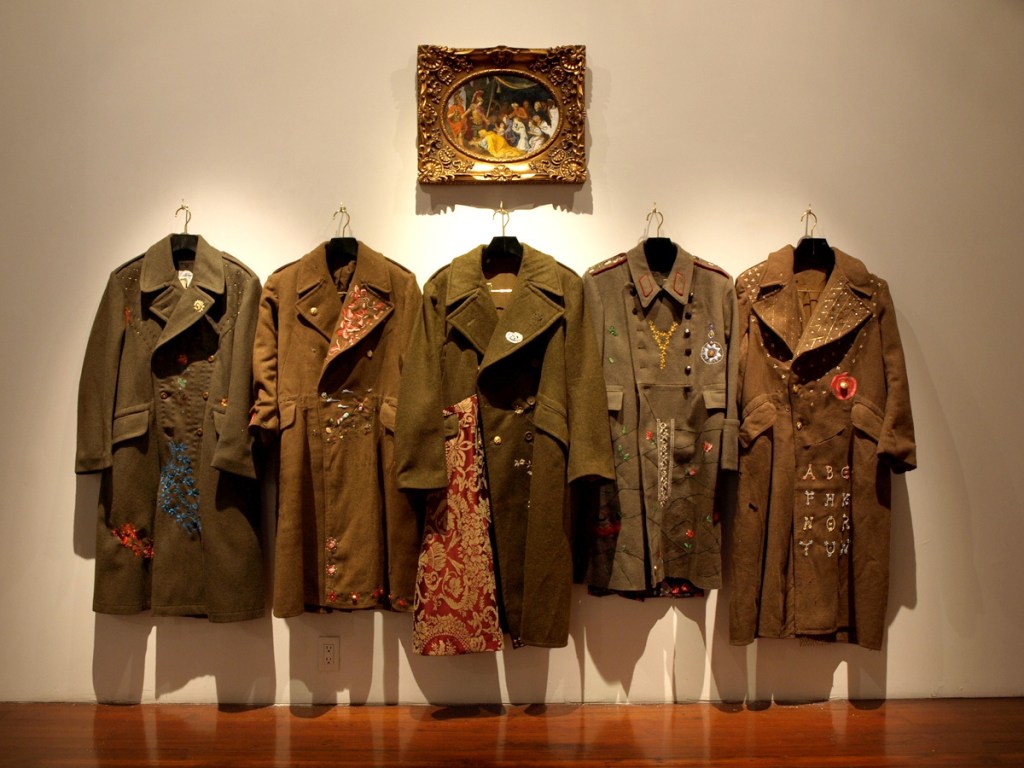
Risham Syed, The Tent of Darius

My poem Wearable Narratives, from my second collection, Nothing serious, nothing dangerous, published by Indigo Dreams in 2019, is in two parts. The poem was inspired by art in the Manchester Art Gallery. Last week I posted part i (Scarf).


The Tent of Darius, an installation from 2009, is a complex work by the Lahore-based Risham Syed. It consists of five embroidered vintage European Army Coats with a small painting. This is a copy, painted by her, of the Charles Le Brun work of the same name.
Syed describes her inspiration for it:


“I imagined these five coats to have travelled all over the world, with women having contributed to them by adding a piece of embroidery. They are like these tired, old worn-out soldiers who have dreamt of coming back home. On the one hand, they symbolize the imperial power, but on the other hand, there is another aspect to this work; how soldiers from the colonies were made to fight for the Imperial powers. It’s true for any army including the Pakistan army, where most soldiers are from Jehlum, Potowar region, from poor, lower middle-class families and end up with the army because of their physique/tradition, in the hope of making a romantic/glamorous career. This work, compares the romance/glamor to the actual reality of war, the aim of it and the beneficiaries of it. I juxtapose the embroidered coats with an ‘Oriental’ painting called The Tent of Darius, a seventeenth-century painting by Charles Le Brun that provides the title for the installation. In it, the Queen of Persia bows to Alexander the Great who has conquered the land. It serves as a metaphor for the West making incisions in the East.”

I was very moved by the sight of these five coats and the details of the embroideries which inspired the last stanza.

The tent of Darius

The ornate faux-Chinese frame holds
a cropped copy on acrylic:
The Queen of Persia
draped at the feet of Alexander.

Below, an array of five overcoats,
donated by European soldiers,
appliquéd and embroidered
by women’s hands.

Under the lapel, a stilled windmill,
peach-coloured vanes.
A green tree above a button hole.
Death comes like blue geese.

I am for an art that helps old ladies across the street

Oldenburg in 1970 with Giant Toothpaste (1964)

So said Claes Oldenburg and he said a lot more like it, such as ‘I’m for art that flaps like a flag, or helps blow noses like a handkerchief’. Oldenburg said that his famous 1961 Ode to Possibilities, ‘I am for …’ was a statement, not a manifesto. It’s a fantastic read, a long list poem that works well as a writing prompt. Here is the link.


Swedish-born Oldenburg, one of the founding fathers of Pop Art died July this year at the age of 93. He was famous for his monumental sculptures where mundane objects (matches, clothes peg, apple core) suddenly became larger than life.

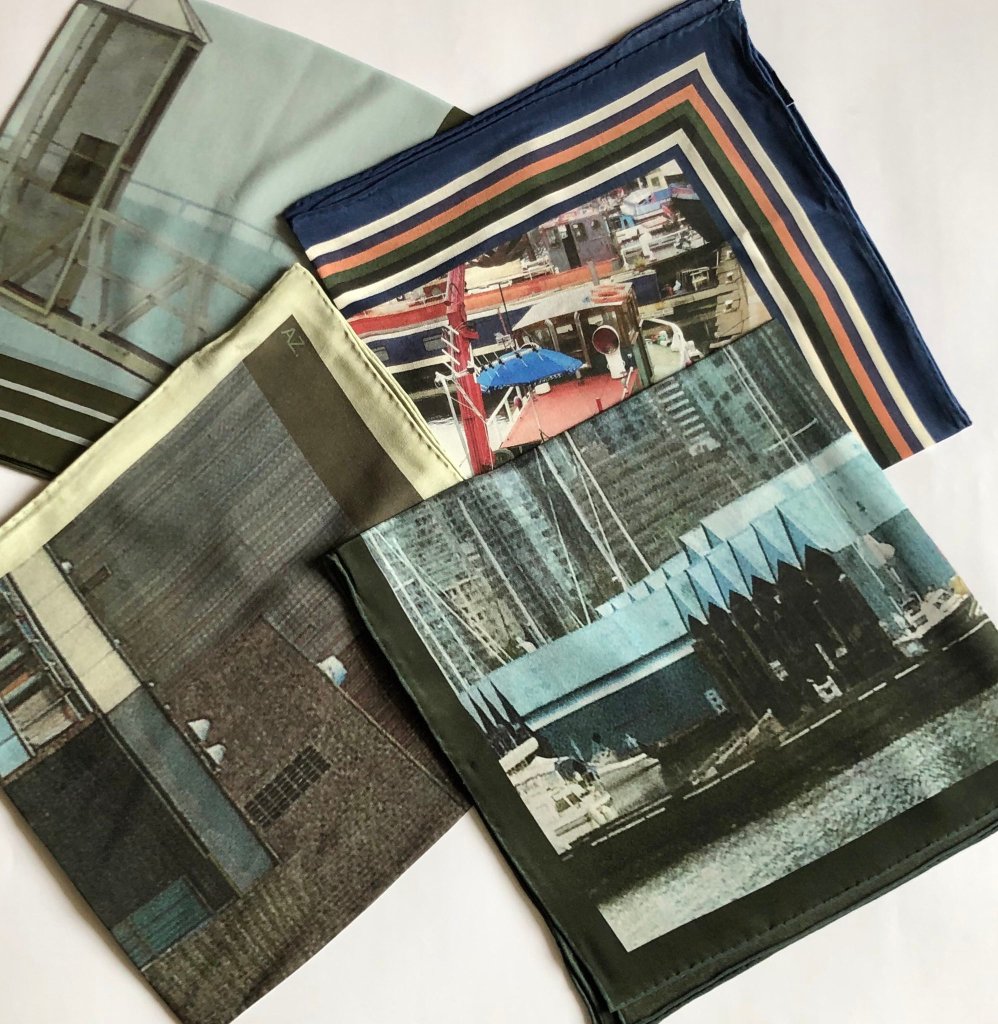
My poem Wearable Narratives (from the collection Nothing serious, nothing dangerous) is in two parts. Here is part i. It was inspired by a pure silk scarf, made by Andrea Zapp, that was on display in the shop of Manchester Art Gallery. At that time, I didn’t have a smartphone. So, here is a picture of other scarves, made by Andrea Zapp. See the note below for more information about her amazing work.

Scarf

A turquoise ribbon runs under khaki stepping stones.
Tomatoes are the red carpet. Slanting shadows
pull the empty staircase under water. Its fine metal
tracery anchors a washing line with checked tea towel.

Cold marble columns, bleached shutters closed.
Almost out of sight wooden farming implements,
a clock stopped at ten to eleven, a car hubcap.

Everything here is at an angle now.
What survives are the chalk drawings:
a cheerful elephant, the ibis and another bird,
its round black eye like a spinning top.

Note:

Andrea Zapp, born in Germany, living in Manchester, pioneered in coalescing her digital media art background with the fashion industry. Andrea has created the luxury fashion brand AZ.andreazapp. This sells high quality silk dresses and scarves printed with her own photography of urban views, rural panoramas, miniature scenarios and objects of culture and curiosity, creating a collection of stunning authentic hand-made garments.

This is not Dante – writing prompt

Dante, by Botticelli

One of the poems in this week’s inbox came courtesy of The Paris Review: Identity Check by Hans Magnus Enzensberger. The title is intriguing enough, the first line is a bold claim and a denial:


This is not Dante


This immediately sets up tension and hooks the reader’s curiosity. If not Dante, who is it? We get an answer we know can’t be true: This is a photograph of Dante. Then: This is a film showing an actor who pretends to be Dante.


The poem continues like this. It reminded me of a poem of mine published in orbis magazine which uses similar techniques. If I feel really ‘stale’, then using two prompts of a different kind is guaranteed to work.


In 2017 I went to Tate Modern for the exhibition of Robert Rauschenberg – very stimulating. It included his telegram This is a painting of Iris Clert if I say so. A visit with a poet friend to Manchester Art Gallery then started the poem. The painting described is Portrait of Lucian Freud by Francis Bacon. Here is the link.

Franz Kafka

This is a portrait if I say so


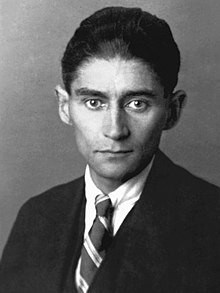
A portrait of Kafka, in a long coat; dark grey, almost black. No, it’s not. It’s just paint on canvas. This is a portrait of the man who was a friend of the man who put the paint on the canvas. Paint is history. Painting is looking for something, then losing it again. This is a portrait of a man, based on a photo of Kafka. My friend Kathleen asked Was Kafka’s face that long? The man in the long coat in the portrait is striding out. No, he’s not. The note to the right of the portrait says the man who is not Kafka is leaning against the pillar, but the pillar isn’t straight. This is a portrait of a man who isn’t famous, based on a photo of Kafka, and Kafka became famous, and the man who put the paint on the canvas became famous. Kafka is dead. The painter is dead, but this portrait is living, dead paint is living. This is the living portrait of a man who had friends. The man in a coat the colour of death. All colours become history. A coat; a face; a pillar. A portrait is, he says so.

Birds on Paper (2)


sparrow-4334964_1920 (2)

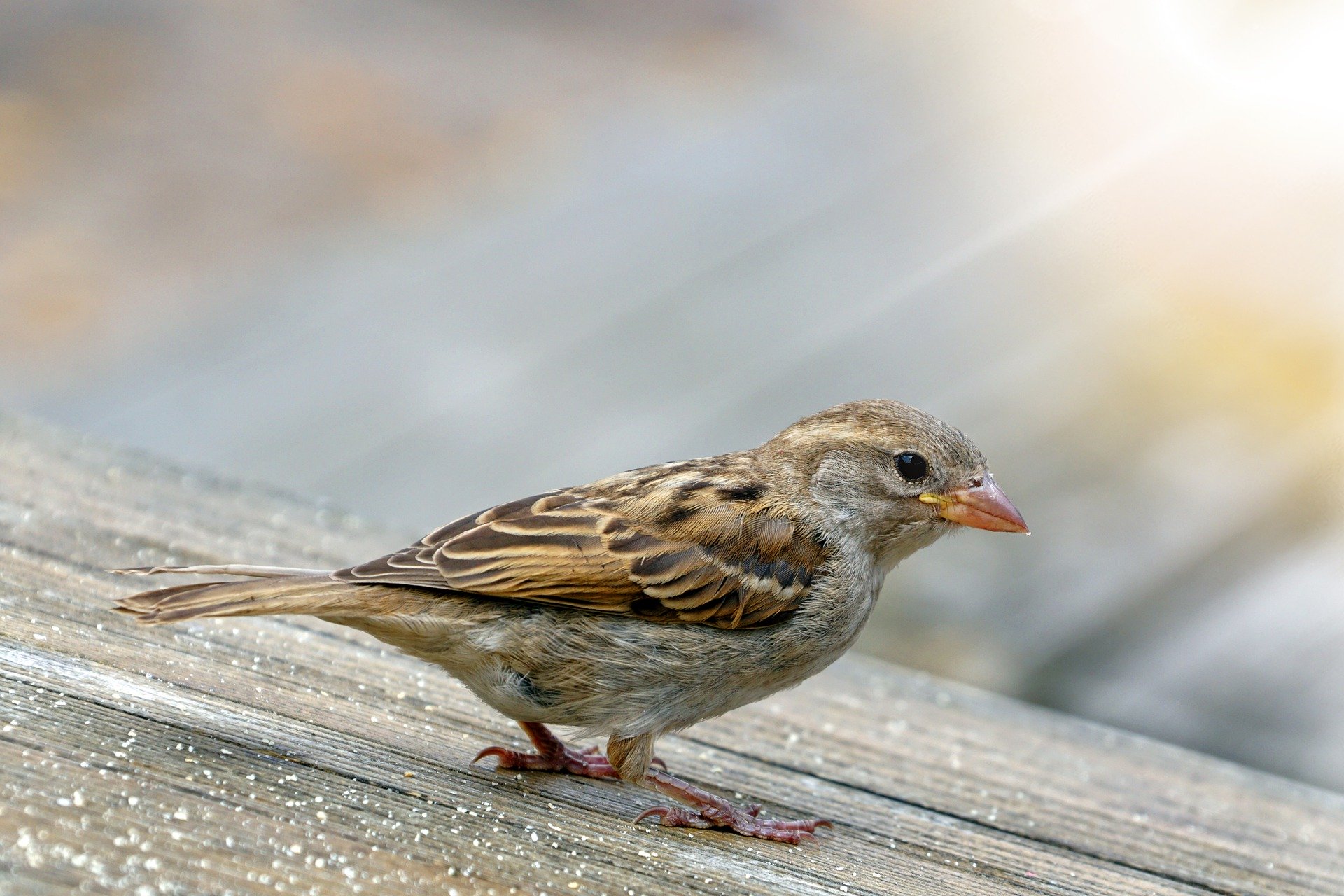
Photo credit: Susanne Jutzeler, Suju Foto on Pixabay

More birds: here is the second half of the sequence Almost complete poems: encounters with twelve birds. The inspiration for these short poems came from different sources:

* The title comes from the Wallace Stevens poem Thirteen Ways of Looking at a Blackbird. I decided I needed at least one blackbird poem, but there are two.
* i – Almost complete poems is the title of a poetry collection by Stanley Moss. It is published by Carcanet who (used to) send postcards with pictures of their books with your order. The cover image of the book is Still Life of Grapes with a Grey Shrike, Antonio da Cavalcore. I keep dozens of art postcards in a box, in case there is no inspiration.
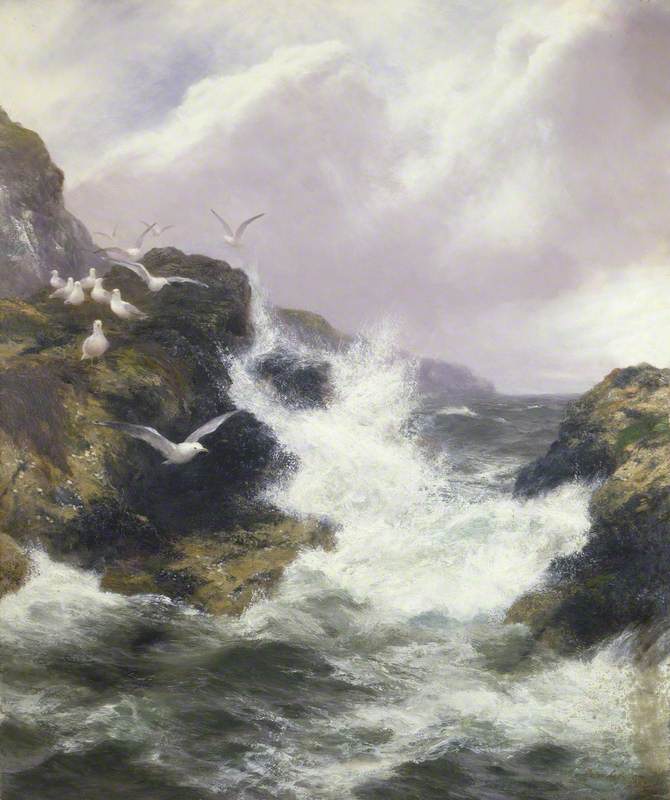
* ii – Painting The Sea-Birds’ Domain by Peter Graham in Manchester Art Gallery. The reproduction doesn’t show it clearly, but my dialogue is with the bird on the rock that is nearest to the viewer.


Graham, Peter, 1836-1921; The Seabirds' Domain

Graham, Peter; The Seabirds’ Domain; Manchester Art Gallery; http://www.artuk.org/artworks/the-seabirds-domain-205095

* v – inspired by reading Jaan Kaplinski, Estonian poet.
* vi – observation from my attic window.
* viii, x and xii – a short writing exercise from workshops with Ann Sansom, the Poetry Business. She often does these just before a break. Mostly six or seven lines with restrictions, for example line 1 must have a day of the week, line 2 a building, line 3 no rules. Written against the clock, some small jewels may appear.
* ix – observation from sun lounge window.
* xi – inspired by that phone call. The tanka was published in Blithe Spirit, the magazine of the British Haiku Society, some years ago.


peregrine-falcon-371610_1920

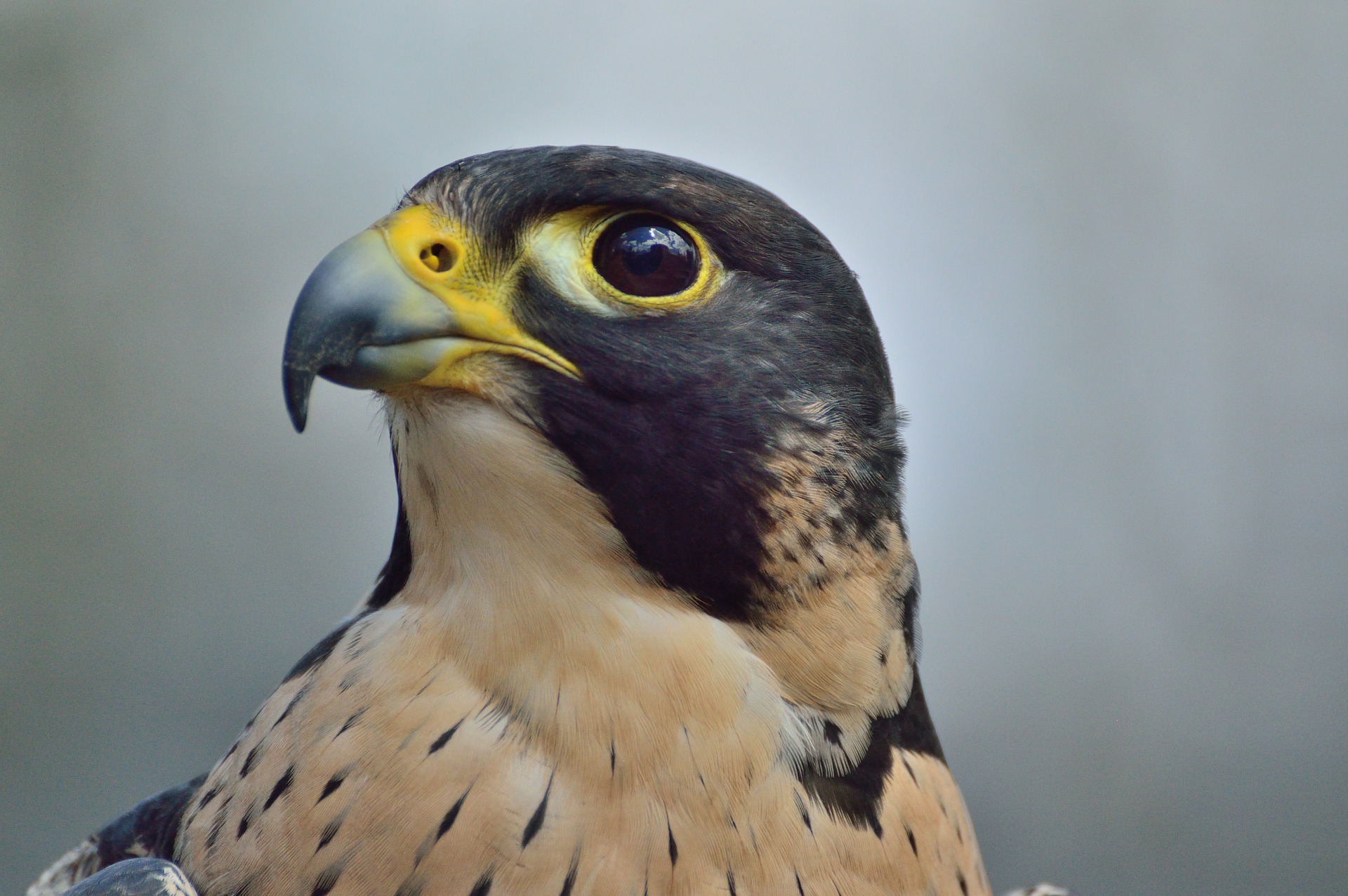
Peregrine falcon, Photo credit: Ray Miller on Pixabay

vii
Pocked and pitted stone
visible only to the peregrines
that nest on this cathedral –
a grimace carved by the stonemason
who used to beat his apprentice.

viii
Sundays summer and winter
we went to church at least once –
If I was that tiny sparrow
I would slip out, circle the white
spray, marram grass, the endless shore.

ix
Blackbirds nest in the ivy hedge,
as one comes in with food
the other exits at the side –
I remember those empty rituals
well-meaning suitors spurned

x
All around fields are planted with dill,
among the fronds an anklebone.
Just one pale bone.
Scrawny canaries fly across
the aria Verdi never composed.

xi
My friend calls:
an orphan
at sixty, suddenly
I hear blackbirds sing
thin, feathery clouds.
xii
A lost parakeet, friendly face
against turquoise wings
paper notice on the mat –
small birds are a comfort stone
to be carried around in a sombrero.

Missing Manchester …

Manchester_Art_Gallery_-_geograph.org.uk_-_1748756

I am settled in my caravan in Holland, enjoying the warm weather and making the most of the peaceful environment before the camp site opens 1 July when it will be the high season.

 
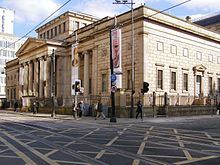
But I am missing Manchester and, in particular, the monthly writing workshops with Peter Sansom of the Poetry Business These have been held at Manchester Art Gallery. It consists of three connected buildings, two of which were designed by Sir Charles Barry. The main building is Grade 1 listed, while the Atheneum is Grade II. A modern extension was added in the beginning of this century.

 
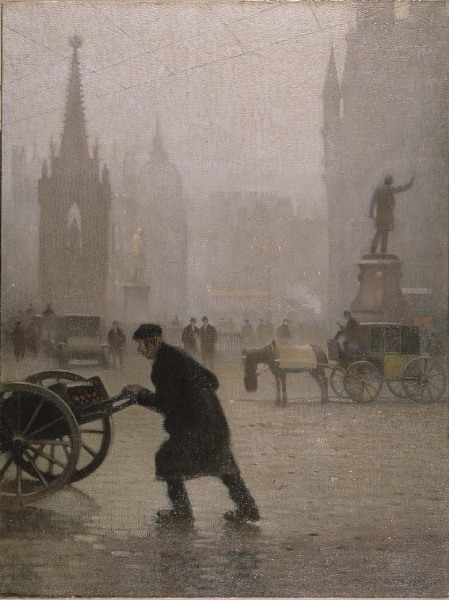
During the writing workshops we have the opportunity to be inspired by the permanent collection – works of international significance and Victorian art. The painting Albert Square (1910) by the French impressionist painter Adolphe Valette hangs in a central foyer. Valette lived in Manchester for a period and really caught the damp and wet conditions. My poem is included in the pamphlet A Stolen Hour (Grey Hen Press, 2020,


Albert_Square_Manchester_1910,_Valette


Albert Square

I am not that cellar man pushing 

his barrow loaded with crates of wine.
I am not the horse with its head
stuck into a nose bag, nor
the coach driver resting his
right knee on the plate,
nor the men with bowler hats
conversing by the railings.

Up there is the Town Hall
covered in a velvet coat of soot.
I am the greyness of the oil paint,
the rippled rain reflecting
the cellar man’s rounded boots.
I am the smog and the smoke,
half shielding these statues:
politician, mayor, consort.

Is it a competition?


11

Virtues of Unity, by Halima Cassell

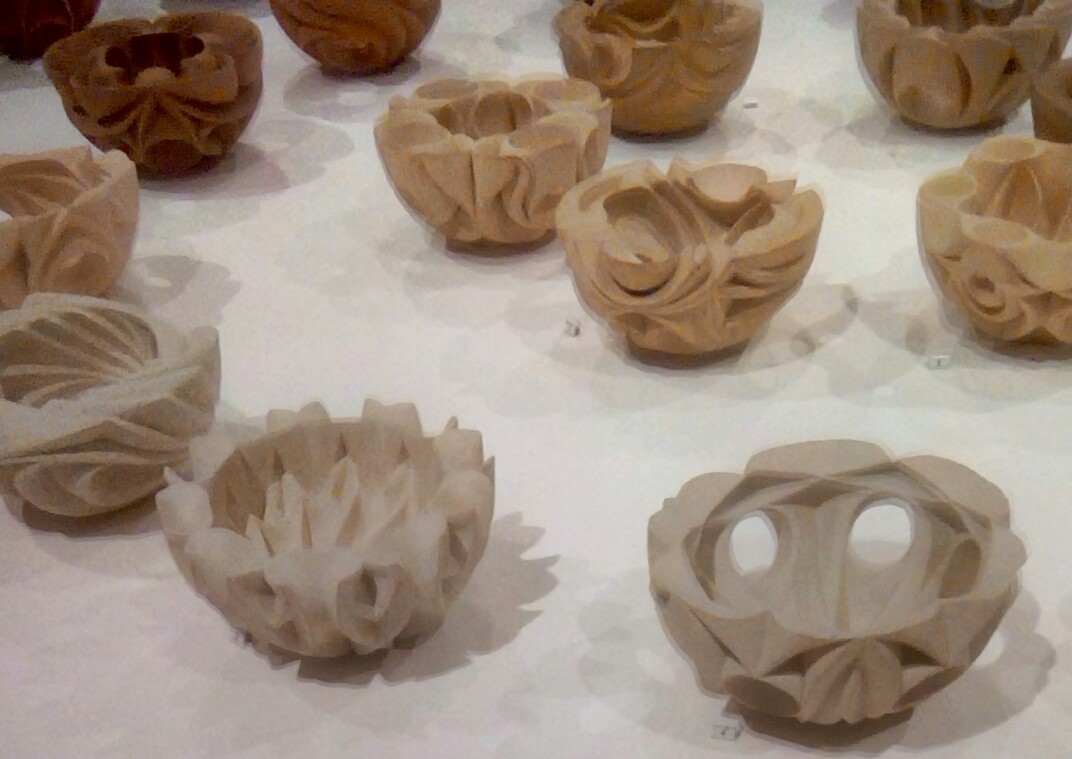
Is it a competition? the woman with dark hair and glasses asked. I stood writing in a small notebook.  On the contrary, I said. I told her this installation is a major and ongoing project. The artist Halima Cassell was born in Kashmir, then raised in the UK. In England she is called a “foreigner” or “second generation migrant”, so she has always been aware of issues of identity. However, when she visited Pakistan as an adult in 2009, she was called “British Asian” or more frequently “a foreigner from England”.

This sense of double dislocation was the trigger for Virtues of Unity. Different countries produce different colours and textures of clay. Each sculpture has its own design. Superficially, we seem dissimilar, but we share DNA. We all come from the clay of the earth and will return to that same elemental clay. The shape of the sculpture resembles the earth, the holes remind us of the womb and the birth canal. Halima was pregnant with her first child when she conceived the project.

So far, Halima has made 39 vessels. Her aim is to make 195, one for each of the countries in the world today. It will be a life-long journey. Each of the sculptures has been made from the clay of that country. The designs of each vessel and the titles represents a positive quality of that country, eg the Netherlands is called Harmony.

I was on a writing workshop at Manchester Art Gallery and we were to imagine a public superhero with a piece of art in the Gallery. I have been pleased to read that the under 35’s are streaming the composer J S Bach. He has been one of my superheroes for many years.

2 (2)


Virtues of Unity

He seemed invisible to visitors,
though he was dressed in a costume
of the period, and his wig resembled
curved waves of a waterfall.

In truth, I thought he was part
of the installation: thirty-nine spheres,
each one representing a country and
made from the clay of this country.

He moved slowly anticlockwise,
stopped at the small ceramic vessel,
a creamy white called Faith.
The positive quality of Germany.

A slow smile grew on his face
when he saw there were no openings,
that the vessel seemed restful,
flowering into a solid cathedral.

Russet, tan, black, brown, beige, taupe,
grey, creamy-white, white. Eyes fixed
on his native country, he started humming
Jesu, joy of man’s desiring, and I was glad.


Refusal of a visit visa (3)

suleman 3

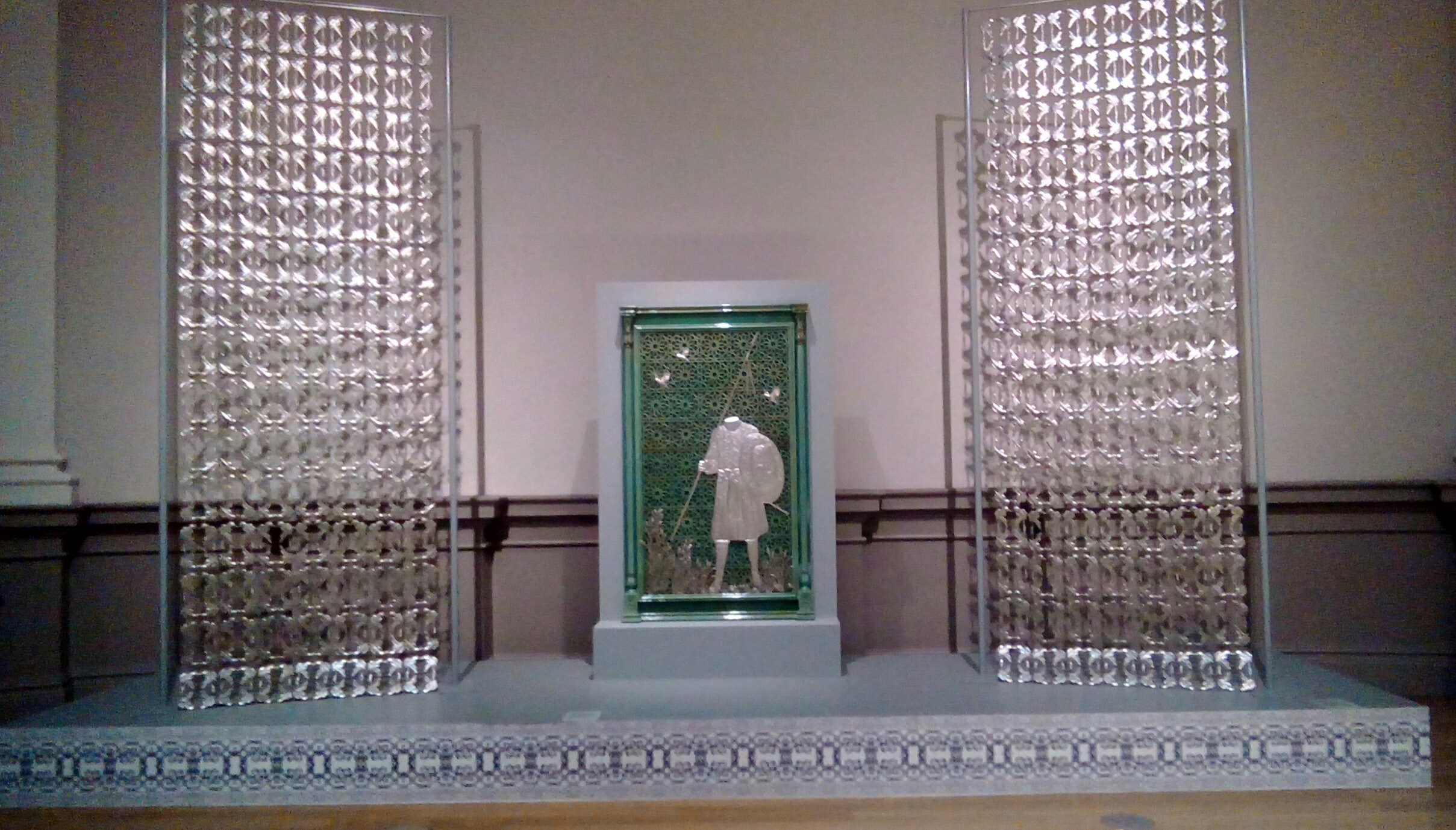
What Dreams May Come (2015) placed between After All It’s Always Somebody Else Who Dies (2017).

Adeela Suleman writes: My work is profoundly shaped by the way in which violence is performed, experienced and remembered. The more heinous the violence, the more beautiful its memorial.  In contemporary Pakistan death surrounds us, nameless, faceless and countless. In Karachi up to 12 people a day die in gangland and politically motivated murders.

The birds are dead. They make a pattern, a simple pattern that silently repeats itself. Silence haunts you, silence is disturbing. The delicate sparrow is a symbol and their shadow on the wall a reminder of the fragility of life.

After all it’s always somebody else who dies

The headless warrior still stands strong, holds his shield,
grips the tall lance, two narrow ribbons flutter.
Reeds, flowers and grasses part for his feet.
A memorial captured in carved wood stained green,
the colour that pleases the prophet.

Hand beaten and hand beaten from behind, through
chasing and repoussé, the stainless steel sparrows
that tumbled to their death. On the left 420 sparrows,
their beaks and feet touching, all held together.
On the right the same number of sparrows,
a shiny, shiny stillness.

My poem was a response to Suleman’s sculptures. It appeared in Building Bridges, an international anthology edited by Bob Beagrie and Andy Willoughby, published by Ek Zuban in 2017.


Refusal of a visit visa (2)

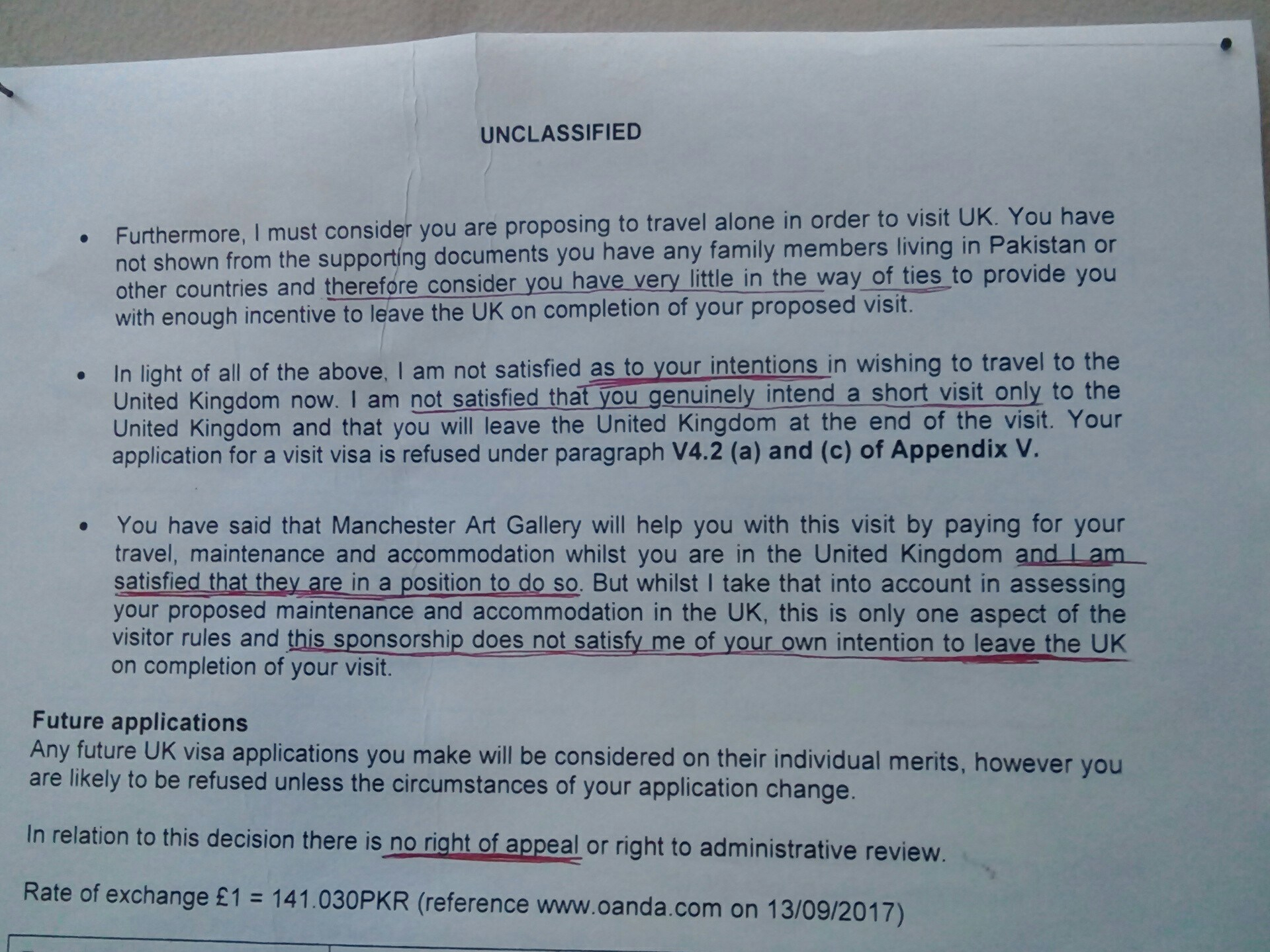
Recent Poetry School workshops have been held in the Manchester Art Gallery. So, we have been inspired by sample poems as well as the works on display. On the second floor there have been several interesting exhibitions of modern art. Dashing back downstairs I missed the display on the foyer wall – an enlarged copy of Home Office form OV51 Visit (NRA). On the first page the staff have given another reason for the refusal. They doubt that the artist has control over her bank account (the application was accompanied by bank statements, as required).

visa 2

Some personal details have been blacked out prior to posting, but the applicant is born in Pakistan and the work in the gallery is by Adeela Suleman, a sculptor and artist and Associate Professor and Head of the Fine Art Department of the Indus Valley School of Art and Architecture in Karachi.

My short “found” poem:

Refusal of a visit visa

Date of refusal decision: 13 September 2017

Furthermore, you have stated that you are single
with no dependents.

I am not satisfied that you have demonstrated ties
to Pakistan that would give you reason to return
there.

a simple pattern that silently repeats itself
               silence haunts you
                                       silence is disturbing


Text in italics by Adeela Suleman.


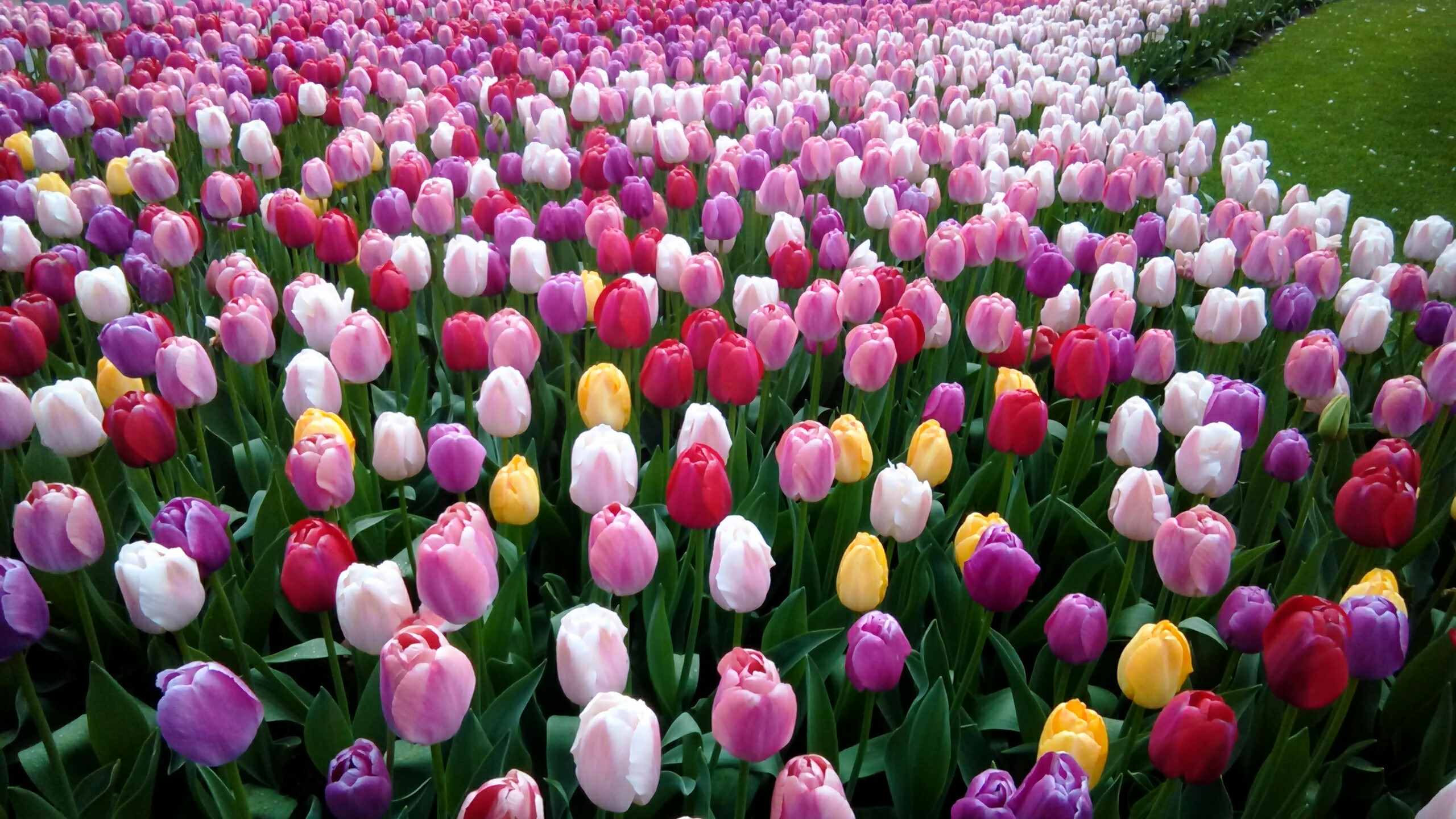
Tulips

During my recent trip to the Netherlands I joined my sister and brother-in-law for a visit to the Keukenhof. It was a clear dry day, with a slight breeze and a some sun in the afternoon.

The Keukenhof is one of the world’s largest flower gardens incorporating different gardens and styles on a 79-acre site. It’s situated on 15th century hunting grounds and there are beech trees which are centuries old. The original park was designed in the 1830s and the Keukenhof (Kitchen garden) first opened in 1949. Each year some seven million bulbs are planted up.

17 purple tulips

I vaguely recalled the Sylvia Plath poem about tulips, so I looked it up. It was written in 1961 and consists of nine 7-line stanzas. It starts: The tulips are too excitable, it is winter here. The poem is based on Plath’s experience of recovering in hospital from an operation: I am learning peacefulness, I am lying by myself quietly/ In the following stanzas the tulips are not experienced as benign: The tulips are too red in the first place, they hurt me. The vivid tulips eat my oxygen. The tulips should be behind bars like dangerous animals;

I have one poem about tulips (in the Building Bridges anthology published by Ek Zuban last year). It has a very different feel from the fabulous Keukenhof tulips and is more at the Sylvia Plath end of the continuum. The title of the poem is the title of a watercolour painting donated by the (anonymous) artist to Manchester Art Gallery.

Extraordinary Popular Delusions and the Madness of Crowds

They’ve not yet reached one of the tulips,
the central one of this display.
You can imagine a window, if you like.
Five parrot tulips lean towards the light.
Degrees of purpling. The ants appear
half-way up the bulb-shaped vase.
I’ve left the thin pencil lines
indicating a flat surface.
Look closely and you’ll see this vase
should tumble, fall or slip.
Three fingers’ width, water level
in the glass. Greying water extracted.
The tulips were a present.
You can count the ants, if you like.