Over half a century ago I shared a room in an Earls Court hostel with three other Dutch women. P&O Lines Ltd had just taken us on as WAPs (Woman Assistant Pursers) and we were to be employed in various offices while waiting for a ship to become available. I did secretarial work for a Scottish marine engineer, struggling to capture the technical terms – about bulkheads of a vessel that was being built at the famous Cammell Laird yard in Birkenhead.
We have kept in touch all those years, and celebrated in the Eye, Amsterdam with lunch in 2019. The film museum is an iconic building just the other side of the railway station. A short ferry journey is a good way to get there. Our plan for an annual reunion had not taken a pandemic into account and now one of us has health issues. Fingers crossed for September!
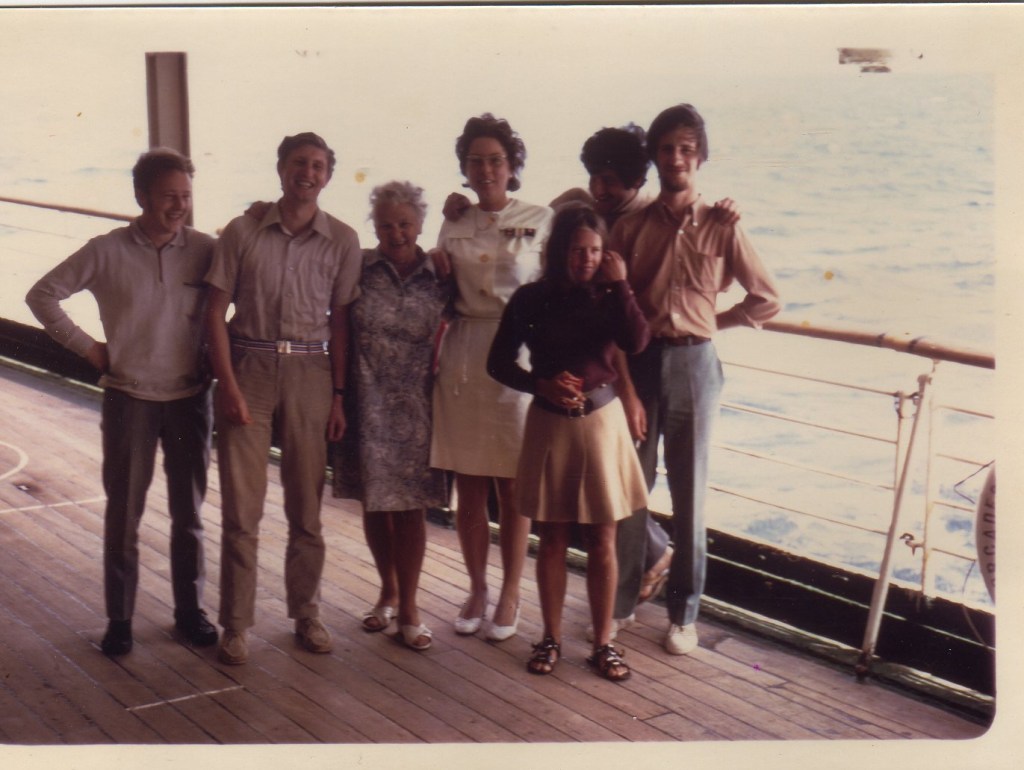
Our language skills had got us the job: Dutch, English, French and German. The photo is from S.S. ORCADES where I was Supernumerary, translating the news, and holding daily meetings. Here I am with the small group from Germany and Switzerland.
Assisted passage
You’re on F deck aft, an alleyway away from your spouse, also sharing with five strangers.
Time to fold over your memories, freshly laundered. You don’t need memories where you’re heading.
You saw the Fire Dance in Dakar. Days of sea, sun, and sky. Cape Town with Table Mountain.
Nine grey days of swell. Freemantle, Adelaide, Melbourne, Sydney.
Shake a leg, show a leg. You’ll soon be down under. Your new upside-down lives.
Fruit & veg, toms, salad, mayo, salmon, ½ loaf … I’ve not yet managed to write a shopping list in Dutch even when the words are shorter (sla) or similar abbreviations (gr & fruit). It’s too much hard work late on a Thursday evening when I’m sitting with a glass of wine (wijn) and contemplating the moving project: flooring, top-down & bottom-up blinds, two chairs – ordered; research on fridge/freezers needed, also a new GP practice and pharmacist.
Here in the Netherlands the distance is important: the GP must be able to get to your home within 10 minutes. That doesn’t mean it’s easy to register. In Scheveningen (where I spent the winter) three practices did not take on new patients or had a four-month’ waiting list. A tomato a day may keep the doctor away …
Tomatoes
I am stepping away from my life, my life as short as a haiku. I have turned biographer, am writing vignettes, pale green, the length of celery.
My vignettes may concern elderly mules with dental decay, the struggle to remember maternal aunts. I am numbering my vignettes 1A, 1B, 1C, 1D – narrow seats in the small airplane Aer Lingus would use on the late Saturday flight.
I could write a vignette about the plastic dummies they use in ambulance training. Today I’m going to focus on pretend tomatoes. My invisible friend has started her new diet.
On Tuesday evening my local Stanza poetry group held it first ‘live’ meeting since the start of the pandemic. It was a hybrid session which worked very well: some poets in the station bar of Stalybridge station, some of us at home in the UK and abroad. I was pleased that I could take part. I have also joined the Groningen Stanza here in The Netherlands which alternates live and Zoom meetings.
I saw fresh rhubarb at the supermarket yesterday which reminded me of another group I used to belong to in Manchester. My third poetry book is dedicated to Elaine, Hannah and Jackie; here is a poem written in a back garden in Chorlton-cum-Hardy, Manchester.
Laughter
The laughter swaying across the lettuce, strong knotted rope in the old Bramley tree. A grandmother sits quietly in a wooden chair; she counts knitting patterns in her head.
The dappled shade is a cool alleyway between her life and her daughter’s world. Laughter slides away from them, low down across the grass; it hides between the rhubarb and redcurrant bushes, waiting until night time for the moles to come up and breathe into it. Yesterday’s laughter a small pile of earth.
(published in Another life, Oversteps Books, 2016).
It’s a huge pleasure introducing this month’s guest poet Carl Tomlinson. Carl and I met on a w/end poetry workshop some years ago. He was born in Lancashire – where his father’s family had farmed for 150 years. He now lives in Oxfordshire and is a coach and part-time finance director. His poems have been published in magazines, anthologies and online.
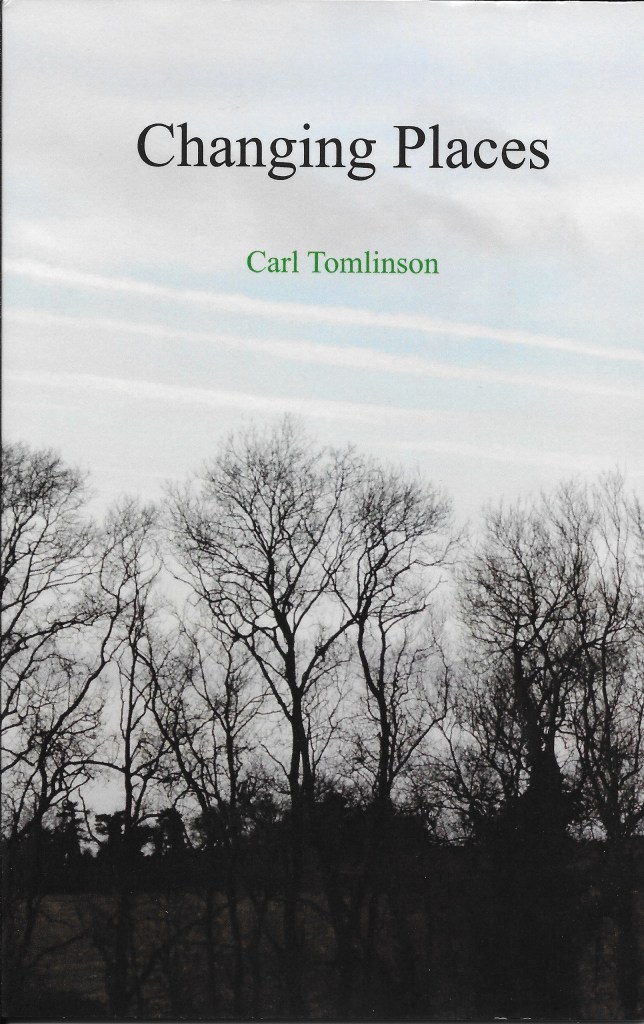
From his debut Changing Places I have chosen one poem that has a personal meaning to me: I was living in Southampton in 1976 and my late husband supported our local team. The other four poems are a moving tribute to Carl’s personal land and heritage. The cover picture was taken by him.
Picking sides
FA Cup Final. 1 May 1976. Southampton 1 – 0 Manchester United
Bobby Stokes made me a Red one Spring day at Wembley. He broke my heart in a moment scuffing that shot past Stepney.
Although I wasn’t football mad you still had to pick a side and a playground full of Saints fans said Man United were mine.
Four years after moving South my accent was still abused. Flattened vowels lurked in my mouth and echoed round the school.
All that week I learned their names eager to share the glory, but sometimes, as the pundits say, the Cup’s a fairy story.
Nil-nil at eighty-three minutes, the telly rings with cheers. Stokes shoots. He scores. Saints win it. This was what I’d feared.
Bobby Stokes made me blush deep red at hymn-time in assembly, For all the saints, the teacher said. Every face was turned on me.
Baling
I’d just got my A-levels out of the way and was spending a week with my Aunt in the house her grandfather’d built in the garden behind the farm, in a place that had seemed like forever, aged eight. She said “Derek Fitton wants a hand with his hay.” As kids we had loved helping Grandad, chasing the baler round Tandle Hill’s haunch riding the trailer back to the barn echoing Tarzan calls under the bridge. We lived with the itching and the seeds in our hair because that was the way we were made. It was ten years since the pain of the sale and I wanted to feel like a farmer again. Derek was glad of my help that day. It was fun enough, in a blokeish way. He gave me a fiver. Later, I drank it away. The twine cut my fingers, my back complained the welts sprang up on my arms again. You wouldn’t know, I guess you’ve never baled but it’s a different kind of ache when it’s not your hay.
Coming to grief
We were most of the way to Middleton when I discovered that grief doesn’t always dress in death. One of my parents said that Three Gates Farm – where six generations had tilled the last of Lancashire’s silty soil – was being sold that week.
In the winter of sixty-three my Grandad made the front page phoning for a snowplough because the lane was six foot deep. Now we were in ‘th’Observer’ again in the back of the classifieds along with all the other lots due ‘Under the Marshall hammer.’
Reading the paper emptied my eyes. I realised whatever childish plans I’d made for those fifty acres of gentle land nudged between mill towns and millstone grit were to be knocked down (for twenty-six grand in the end) in Ye Olde Boar’s Head by an auctioneer I never met.
And by my father’s teenage need to leave that land and make his life his own. And by my uncle’s trying to stay where I was sure we all belonged. And by Grandad’s explaining that even the hencotes would go. So the scheme to keep one to use as a den, that went south as well.
The parlour’s long since seen a cow, there’s nothing like a farm there now but the breath of beasts on a winter day and the sweetness of cowshit and hay surprise that grief back into me.
Inventory
Accounts and correspondence, attached with failing staples, complete the detail of a sale of Live and Dead Farming Stock.
Dead just means inanimate, not deceased.
Then, in the Particulars, I find the line that honours my line, and all they left here ‘The land will be seen to be in a high state of fertility.’
Harvest
“Oh bugger!”, the words thud. I’ve just put the fork through a spud.
I’m showing our son and daughter something I learnt from my father which my Grandad had taught him before.
“You start a bit off, away from the green, keep the fork away from the tubers, you want to lift ‘em, not pierce ‘em, and they’ll not store if you fork ‘em, they’ll be no good if you fork ‘em’.”
Again the fork sinks, again the soil shifts and this time a big‘un gets stuck on a tine. “Oh bugger!” I thud before I’m stood up and quick as an echo the lad pipes up with “That’s what our Grandad said when he put his fork through a spud.”
1 I discovered Pome only a couple of months ago and am enjoying the poems very much: an interesting range and they are short, even very short. As I understand it, Matthew (Matt) Ogle originally posted the poems some years ago and the project has restarted via Tiny Letter.
Here is an Issa haiku, translated by Robert Hass. Since I am a paid-up member of the Society for the Prevention of Cruelty to House Dust, it speaks to me …
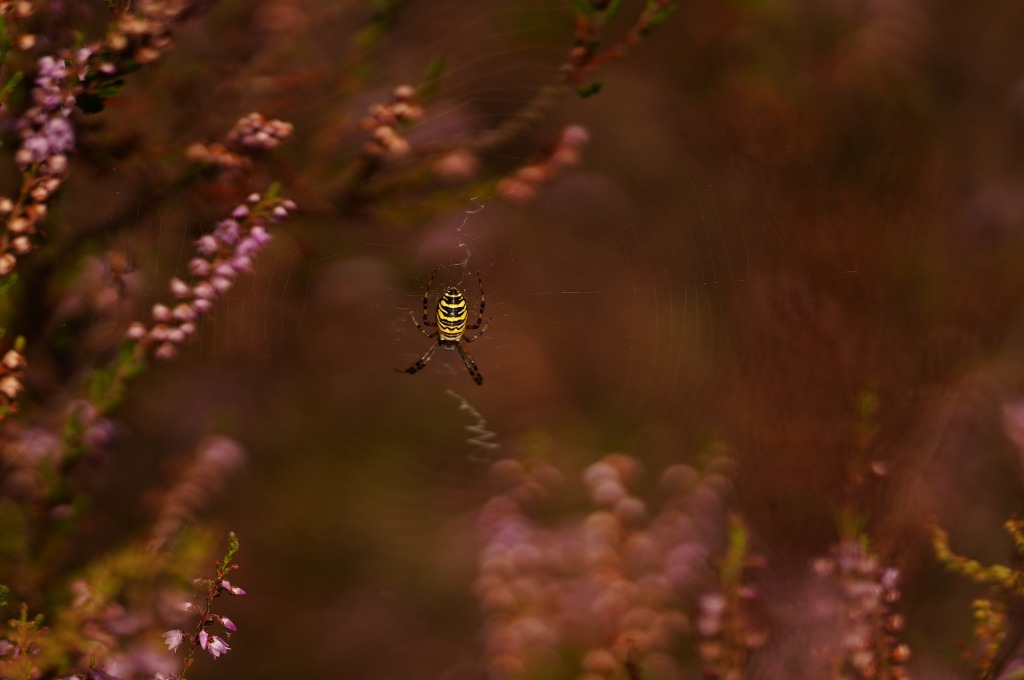
Don’t worry, spiders, I keep house casually
2 Monostich – a poem or epigram of one single line. The title is important and may be long, longer even than the poem. My recent example from a course I’m doing:
While it rained, we went out and put the poster on trees and lamp posts in theneighbourhood
It needs heart and courage (lebh in Hebrew) to wear a pochet with conviction.
3 Here is a short poem by Carl Tomlinson from his Changing Places. It has a haiku-like quality. Carl is the May guest poet. I look forward to sharing more of his poems with you then.
August
All along the bridleway some kind of rain is trying to shake off the wind. The land feels thinned.
A great many thanks to my fellow poets who responded splendidly on Facebook to the George Perec ‘e’ challenge. It’s a feast. I hope you enjoy the selection. I send them and you warm Easter greetings.
Steve Smythe: Send me every gem she ever kept. Steve Smythe: Beef, beer, weed: perfect. Helen Kay: Helen expects eleven eggs every week. Sarah L Dixon: Every beret fells seven men even when they tend seeds, mend fences, then recede. End. Steve Smythe: Best strengthen the steel sheep pen Hannah Mackay: Chew seven spelt seeds. Renew every few weeks. Steve Smythe: Feel the breeze; expect red cheeks. Hilary Robinson: Send me the new bed, fresh sheet-bedecked. Janet Sutherland: She expects her energy ends here. Barry Fentiman-Hall: When Ben went there Jen went red. Sarah J Bryson: He knew every beech tree grew free, the breeze renewed, endlessly. Katy Evans-Bush: She’d never pre-empt these seven, then exempt. Angi Holden: Envy the clever shepherd – the twelve speckled sheep he secretly keeps chew where the endless greenery stretches between cherry tree edged beech crescents. Sue Kindon: The Beer Fest swells the seventh tent; breezy revellers emerge, three sheets teetered. Oz Hardwick: The elect erected dressy needles, yet clerks scythe empty chests. Pam Thompson: We’re held, spent – thresh sleep/speech event, feel stress. Rachel Davies: When we’re elderly trekkers the knees need rest Sarah Mnatzaganian: Eyes drench every element when they weep. Stephen Payne: He prefers terser sentences. Vanessa Lampert: Yes the egg never left me, yes the elf then wept, even better, he grew mettle greener, severed the tree then tweeted the red hedge news. Sally Evans: she emerges even when she expects endless reverses.
Credit: Peggy Marco via Pixabay
By way of bonus, here is poet Rod Whitworth’s contribution – using only ‘i’ and ‘y’.
I
I mind (with liking) this child imbibing milk. Lit with infinity, it insists it is big. Bit by bit — spiting my might, my right — it fights my will.
I find sticks in bins igniting nightly, kindling my illicit still. Timing it by twilight I skip by drinking whisky, singing in high winds, rhyming, rhythmic. By limp light I’m writing mythic signs my child might find inspiring. I sigh.
It is an enormous pleasure to introduce this month’s guest poet Hilary Robinson. We met many years ago on writing workshops in Manchester.
Hilary Robinson
Hilary Robinson has lived in Saddleworth for over 40 years. Publications include The Interpreter’s House, Obsessed with Pipework, Strix, The Morning Star, Riggwelter, Atrium and Poetry Birmingham and several anthologies including Please Hear What I’m Not Saying (Fly on the Wall Poetry 2018), A New Manchester Alphabet (Manchester Writing School 2015), Noble Dissent (Beautiful Dragons Press 2017), Bloody Amazing! (Yaffle/Beautiful Dragons Press 2020) and The Cotton Grass Appreciation Society. In 2018 twelve of her poems were published in the first joint DragonSpawn book, Some Mothers Do . . . alongside Dr Rachel Davies and the late Tonia Bevins. Her poem, ‘Second Childhood’ was shortlisted in the 2016 Yorkmix Poetry Competition.
Hilary has collaborated with composition students from the Royal Northern College of Music as part of the Rosamond Prize and was involved in the 2016 Leeds Lieder Festival. She is currently collaborating with composer, Joseph Shaw, on an opera to be performed at the Royal Northern College of Music.
In June 2021, Hilary’s debut pamphlet, Revelation, was published by 4Word Press. Hilary has an MA in Creative Writing from Manchester Metropolitan University. The central section of Revelation is a series of poems which explore the aftermath of betrayal in a marriage. From this section I have selected four poems. Nikolai Duffy says that these poems ‘sing with a lyrical precision that is as authentic as it is unflinching.’
Revelation
And I beheld the last seven years open up before me and they gave up their secrets.
And I beheld my beloved’s face concealed by a fine beard and his feet that were turned to sand.
And I beheld seven office chairs, unoccupied except for two, on which sat my beloved and his shame.
And surrounding my beloved and his shame were all the places they had been while I had slept on in our bed.
And all the places they had been were also all the places he had taken me. And I wept that this was true.
And I beheld his eyes turn to streams as his remorse descended from him. And lo — his arms reached out for mine.
And I tightened my golden belt around my waist, knelt down by his side and said that I forgave him.
That September
Every time he went to the window he saw them. Gangs hired to find us, gangs armed with torches burning even though it was early September and still light. Gangs getting closer.
He’d let everyone down, his partners, clients, staff, his family. Most of all he’d let me down in ways I’d never imagined. Now they were at the end of our drive. Now he’d found a way to stop the fire he’d caused.
It took four of us to prize his fingers from the Swiss Army Knife’s twin blades. I never knew what happened to that knife. I wiped blood from his hand, found the doctor’s home number.
The rest is a history of ashes, scorched earth of a marriage that somehow bore new life after hospital, after ECT, after many hours of therapy. This house still stands.
Brittle
In the kingdom of glass everything is transparent, and there is no place to hide a dark heart. Vera Nazarian, The Perpetual Calendar of Inspiration
To become glass, learn to make yourself fluid as egg-timer sand.
Hone yourself to brittleness with just a little give to accommodate rough winds.
Research your ancestry — try to enter the mindset of silica.
Practise the occasional sharp look, the cutting remark — hide in the shadows.
To become glass, give in — become transparent; melt into the view from this bedroom.
Trying to Take my Husband to the Antica Carbonera
There is no chance I’ll find the Calle Bembo with its kinks, its turns, its lamps hanging above shops of antique Murano beads, its shiny cobbles and those buskers trotting out Vivaldi through the season. No chance I’ll find what translates
where Cath and I ate wild mushrooms cooked four ways and spent so much they brought us Limoncello on the house.
Yet here we are. This is the first Venetian street our feet touch on the way to the Al Codega. The food is perfectly seasoned. Tonight we’re on the roof. I have another angle on this street.
I discovered a book programme on Dutch TV. It’s called Brommeropzee (mopedonsea) after a Dutch short story. There are two presenters. Based on my brief observation, I would say: she is E for Empathy, he is E for Ego.
One item was an interview with Guido van de Wiel. He has previously translated Perec’s 1969 novel La Disparation (A Void) into Dutch – see the cover. Like the original, the text does not include a single vowel ‘e’.
In 1972 Perec published a companion piece Les Revenentes (The Exeter Text). In the interview Guido showed long lists of words containing only the vowel ‘e’. He has worked on this translation on-and-off for 12 years. The translation follows the original in form (lipogram) and content.
Brommeropzee issued a challenge to viewers: compose a coherent sentence of at least 10 and at most 30 words, using any consonant, but only the vowel ‘e’. Here is my sentence: De beleefde kreeft heeft even geleden en elders negeert de kwelder de heen-en-weer regen.
Translated: The polite lobster has suffered briefly and elsewhere the salt marsh ignores the to-and-fro rain. There are no rhyming sounds as in my Dutch original, but you get the flavour.
If you like a challenge, compose a (decent) sentence of words using only the vowel ‘e’ and send them to me via the Contact page. I’ll publish a selection in a few weeks.
It is a huge pleasure to introduce this month’s guest poet: Hamish Wilson whom I met four years ago when I attended a workshop at Garsdale.
Having taught in schools for 31 years, Hamish moved to Cumbria in 2016 to set up and run The Garsdale Retreat, http://www.thegarsdaleretreat.co.uk, a residential creative writing centre. This has allowed him the time and space to develop his own writing career.
The Garsdale Retreat
He has had poetry published in two anthologies: This Place I Know – A New Anthology ofCumbrian Poetry (Ed. Darbishire, Moore, Nuttall/Handstand Press, 2018) and Play (Ed. Taylor, Williams/PaperDart Press, 2018) and was shortlisted for the following competitions: WoLF poetry competition in 2017 and 2018 and Write Out Loud’s Beyond the Storm (Poems From the Covid Era) in 2020. He has also had poems in Culture Matters and The Morning Star.
In 2019 he performed Parallel Lives, (a sonnet sequence with live music, film and photography, exploring the creative lives of John Lennon and Dylan Thomas) at The Brewery Arts Centre, Kendal.
Written in 2020, Lockdown Journal is a sonnet sequence which explores his experience of the pandemic between 28 March and 21 April, reflecting on daily life in Garsdale as well as the wider world.
I asked Hamish to select three sonnets from Lockdown Journal as a way of marking the second anniversary of the pandemic.
Saturday, 28 March, 2020
The road is quiet. The weekend bikers who came back with the curlews, have not returned. This first weekend of Covid lockdown’s like a languid bank holiday without the burn
of off-comers. Spring greens on regardless, daffs trumpet; lambs skip, suckle; horned Highland cattle shadow on the fell; lapwings test their stuntman wings, plummet to earth (as planned).
At home, virtual visitors ease the time with supportive texts, puzzles, You Tube vids; parodies of songs, coronavirus rhymes, zoom-conferencing and Happy Hour bids.
The News At Six brings contact nationwide, a thousand UK people now have died.
Friday, 10 April, 2020
Days which bleed to other days still make their mark, Good Friday’s on regardless and they fear we’ll enjoy it with dangerous outdoor larks. We’re shown deserted beaches, seaside piers
which forecast what they hope the weekend brings; ‘Your front door’s safer than a protective mask…..’ cut to bench taped like a crime scene, chained up swings: stay-at-home’s fine-enforced now not an ask.
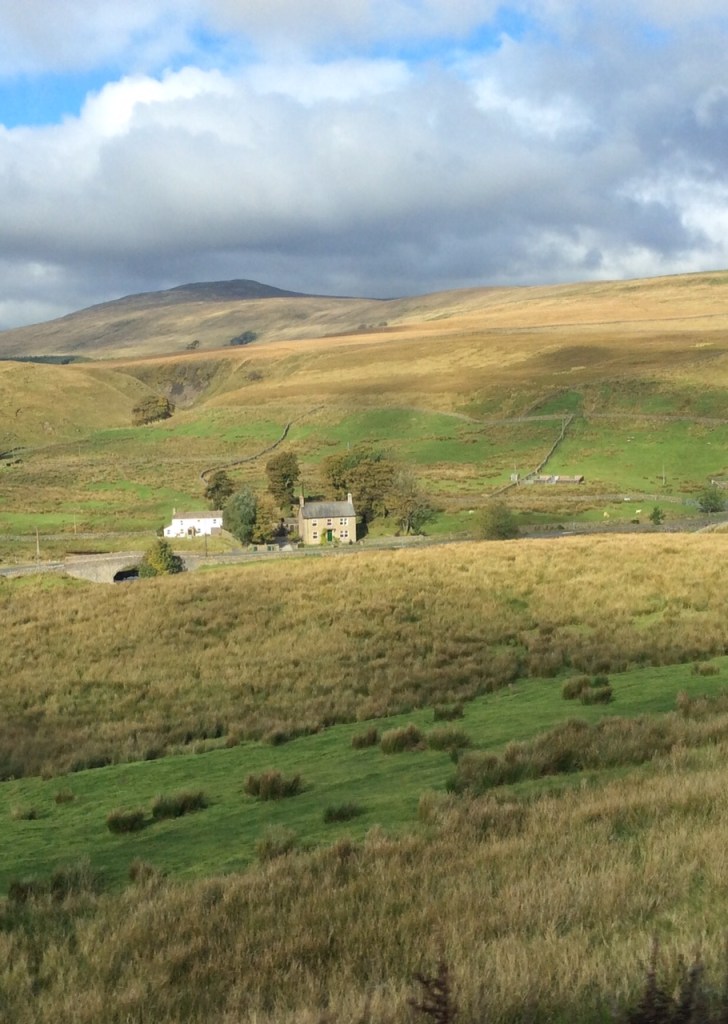
Up here, where social distancing’s the norm, our walk on Blea Moor fell is not policed – the only drone, a distant train, informs we’re not alone and breaks the blanket peace.
A sky lark ascends, arpeggios on high, coal-black speck of dust in the empty sky.
Tuesday, 21 April, 2020
Larks, invisibly high, white noise the sky, we climb the tussocked sea towards the cairn, the railway shrinks to Hornby, lapwings cry like broken squeaky toys. Spring warmth returns.
In shirt-sleeves, we zig-zag slow to summit, pause to watch a matchbox car surprise the Coal Road, before we reach the sunlit limestone and meet a ram skull’s hollow eyes.
The news is billed as good as we’re prepared with twenty thousand beds to match the needs of future patients in intensive care. The experts tell us now we can succeed
to break the rise in deaths, to turn the tide. Up here, we see our house, our tiny, tiny lives.
Yesterday I talked with friends about Cambridge. That brought back memories of a one-week workshop at Madingley Hall with the poet Lawrence Sail. Madingley Hall is a 16th Century building just a few miles from Cambridge. It is set in seven acres of splendid gardens and grounds, designed by the famous Capability Brown in the 18th Century.The weather was good the week I was there and we would all find a quiet corner outside and get writing.
Credit: Pasja1000 via Pixabay
Writing prompt
One of the exercises was about personification. We mentally went through the alphabet and stopped at a letter that resonated with us. What kind of life does that letter have? What do they want and what is difficult for them?
The poem Trying was published in my debut Another life (Oversteps Books Ltd, 2016).
Trying
Trying not to be like one who has gone before. Allocated a slot at the back of the queue: a circle dancer with a club foot.
Striving to become the symbol of perfection. Dragging a tail, leaving tiny furrows on the rough terrain.
Trying then to hide in foreign places. Archaic words spoken with a twang: Qua, quorum, quota, quasi.











 Acacia Publications