This coming week it’s my birthday. I’m taking family out to lunch near where I was born: a lovely bistro near the water. Here is a poem that I wrote on an excellent workshop with the poet Kei Miller.
My name
Even in the Netherlands my name is rare. It comes from the Northern provinces, a bleak windy place near the sea, near Germany.
People of the North grow tall to stand up to gales that whistle, across bare fields, into your face. A name so rare it’s not in the book of names.
I inherited this name from a grandmother who was often ill to spite her husband. I heard him shout behind the shop in a town
named after the beaver. Beavers on the façade of the vegetable canning factory, the foundry roof. My name means strong like the teeth of a beaver.
No, it doesn’t. I wish it did. Most children born just after the war had bad teeth because of the hunger winter: eating tulip bulbs to survive.
I wish I was named after the beaver, or the giraffe, an animal strong enough to shatter a lion’s skull with a single blow of its hooves.
In Dutch my name means people, folk or even battle folk. My grandmother died at 55. I’m beyond that age. I am an animal after all.
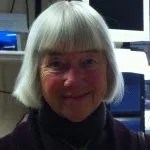
A year ago this month, Gina Wilson died. The two of us met just over a decade ago on the Writing School run by Ann and Peter Sansom of The Poetry Business. We were both psychotherapists, working in private practice.
Gina was published first as a children’s writer – novels (Faber), poetry (Cape), picture books (Walker Books). Her adult poems are ‘complex, though deceptively simple’ and ‘tough and compelling, no verbiage, no sentimentality’ (Kate Clanchy).
Gina’s poems ‘lure you into thinking you’re on safe, possibly domestic territory. Then they catch you unawares, taking off at an unexpected, often surreal tangent.’
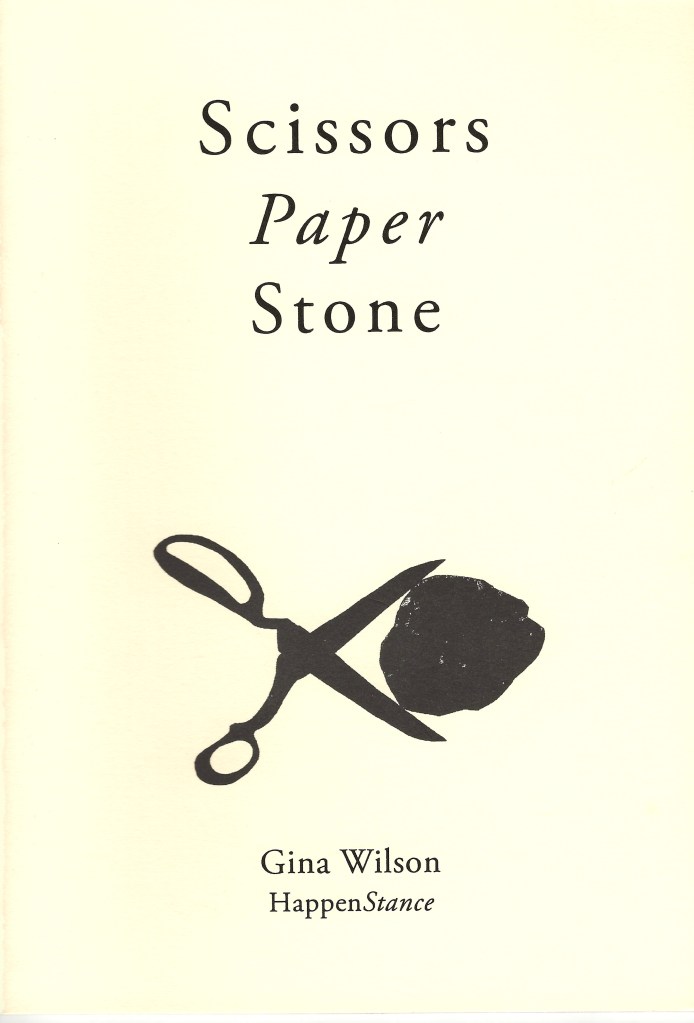
I am grateful to her family for permission to share three poems from Gina’s poetry pamphlets (Scissors Paper Stone, HappenStance, 2010; It Was And It Wasn’t, Mariscat Press, 2017.
First Shoes
I must label, swaddle, cradle them at just the right temperature. Their linings are cracking already.
The step of childhood ought to be weightless, all skipping and dancing but they look haggard, misshapen
as if old age has worn them. Polish can’t cover their knocks.
I showed them once at a meeting. Bring something you’ve kept we were told, a sign, maybe something you’ve made.
I took the shoes. Nobody spoke. Because of the way you looked someone said. As if you were bringing a grief, not a pride.
Photograph with a Very Small Moon
It was still day, the end of a summer one that people had been happy in; I wanted its tiny white moon, not quite spherical or certain to stay.
I wanted to catch it, lacy, fine, almost dissolving in almond-blossom clouds, so I tilted the camera upward. Otherwise I might have filmed
little barefoot girls setting up their lantern with the glass door and tealight, friends round the warped table, wine;
not the moon, but moths, and slugs oiling the flagstones. I might have caught a wind getting up, or the edge in low voices that moment when darkness plummets.
Still Horses
He said he heard her one night, about a week after she died, her Scots ‘r’ and no-nonsense tone that carried without being a shout.
He got out of bed, found his balance in the dark and took his time, checking upstairs first (once a hayloft), then down stone steps to where it seemed there were still horses and a night-time smell of straw and soft new dung.
She wasn’t there. Just a shawl left draped because it was winter. He opened the door to stars and mild small moon in a blur of frost. Cold held him fast.
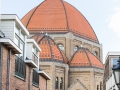
A poem that has two fathers in it, with a photo of the actual building.
When Sunday is not a day of rest
Two narrow wooden benches form the arena. Both gladiators enter through the main left door. The one with the brown perm has an entourage: three boys (one with red hair), a girl with braces, and the eldest son with glasses, the creepy smile inherited from his father, a businessman with butter in his mouth who happens to be our uncle. As church elder, he’ll collect in the interval, holds out a long wooden pole with black velvet bag. Both gladiators buy at Stoutebeek, the town’s upmarket department store.
Our gladiator has better legs, better posture, a striking hat, which makes up for just three of us. She is a semi-professional singer. Our gladiator chose to marry the controller of church proceedings – the organist. Outside, afterwards, the light ammunition of smiles, air kisses and compliments.
It’s a great pleasure to introduce this month’s guest poet Judy Kendall. We met many years ago through our membership of the Yorkshire/Lancashire Haiku group. Judy lived and worked in Japan for nearly seven years. Cinnamon Press published four collections – containing haiku and ‘mainstream’ poems. You can read Judy’s full biography further down. I’ll post a second selection of Judy’s writing next month.
Haiku published in Presence
shades of blue distance in the fells
afternoon off red grouse in flight almost grazing the heather
moorland air just after a curlew’s call liquid fresh—
travelling light I will my neighbor to turn the page
(published in Presence and selected for Red Moon Best English Language anthology)
Short poems or ‘vegetable’ haiku published in insatiable carrot (Cinnamon Press, 2015)
[Many of these have featured on Incredible Edible Todmorden’s Edible Poetry site and on or around the town]
tall green mild and meek not quite the full onion the gentle leek
hairy bitter cress going wild among the cabbages
snug by the wall the one the pennine wind forgot Todmorden’s first apricot
taken apart, the cabbage becomes all heart and leaves
chunky, nobbly-eyed the potato says ‘hi, will you be my friend?’
Haiku and poems from Joy Change (Cinnamon Press, 2010) Haiku:
wooden geta the water quivers with carp a horizon of lilies
sickle moon, yellow and black, on my way back to the heart
(still international haiku competition)
watching the breath come and go, who am I but a broken bit of star?
(still international haiku competition)
drifting mountains shoulder the sky blotches of pine
(Asahi Shimbun)
Biography
Judy Kendall worked as an English lecturer at Kanazawa University in Japan for nearly seven years. When she first went to Japan she was a practicing playwright but she soon began to focus on poetry and haiku, kickstarted by an invitation to to participate in a collaborative translation of Miyaiki Eiko’s haiku. This became the bilingual publication Suiko /The Water Jar. Since then she has been writing haiku and haibun along with other poetic and prose forms. The haiku mode has informed her four Cinnamon Press poetry collections, particularly Joy Change – composed while she was in Japan. She has won several poetry awards, recently receiving a 2019 Genjuan International Haibun An Cottage prize, and is the essays and bilingual translations editor for Presence haiku journal.
She is Reader in English and Creative Writing at Salford University, and aside from haiku and haibun, works as a poet, poetry translator and visual text exponent. She has published several articles and books on the translation and creative process, including ‘Jo Ha Kyu? and Fu Bi Xing; Reading|Viewing Haiku’ in Juxtapositions, 1 (2). She is currently putting the finishing touches to a monograph for Edinburgh University Press on Where Language Thickens (focusing on the threshold between articulation and inarticulation in language – a threshold in which haiku itself is surely situated).
To celebrate my friend Kathleen Kummer’s 94th birthday, here is a poem from her debut collection Living below sea level. Poems from the book have featured on the blog before. The cover image is by Shirley Smith, Society of Wood Engravers.
Kathleen’s father was a coal miner. She went to Cambridge to study Modern Languages. She met and married a Dutchman. For several years Kathleen taught French and German at an International School in The Netherlands.
Happy Birthday, Kathleen: Van harte gefeliciteerd met je verjaardag.
The best years of our lives
Passing under the neo-Gothic redbrick arch, the original bluestockings? Not quite, but close enough to be given the run of the Fellows’ drawing room to sip our pre-prandial sherry, held in hands we remembered curled for warmth round mugs of cocoa. The cold tiles loud with echoes, we followed the murky passage to Hall, the swimming-pool’s proximity still worrying, potent with the imagined smell of bleach. The dinner was, as expected, reassuringly bad; the rooms were bleak, the unfamiliar duvets thin, cot-sized; resilience was needed for the nocturnal trek to the bathroom. But none of this detracted one jot from the utter, heartfelt certainty that those had been the best years of our lives.
I’ve just renewed my annual Museum pass. With a typical entry fee of 15 Euros, it’s well worth it: over 400 Dutch museums take part. There is usually a top-up fee for major exhibitions. I wrote the prose poem on a recent workshop.
Exhibitions
You can’t just wake up and decide to visit an exhibition. Not a major show. You must book a ticket online beforehand and choose a time slot. I managed to get one, Saturday lunchtime, for the Manhattan Masters. Rembrandt, aged 52, poster boy.
I was way too early (I’d gone with Astrid to collect her prize from the Xmas competition and have our photo taken) so I ended up buying books in all three bookshops near the Mauritshuis. Manhattan Masters, ten paintings over from New York while the Frick is being refurbished. The Fricks went to Europe to buy, do the grand tour. They were booked to travel back on the Titanic. She sprained her ankle and they postponed.
I won’t even tell you about the Vermeer at the Rijksmuseum, the coloured lines on the floor, everyone taking photos, the horse-tooth woman who needed to be in the photo with the painting. I gave up after 30 minutes. I think it’s well-known that the exhibitions of prehistoric art take place in replica caves with fake bones and spotlights on those red hand prints and bison on the walls. I’ll give it a miss. I’ll order the catalogue and a pack of six postcards from the museum shop online.
It’s a great pleasure to introduce my guest poet Judith Wilkinson. Judith and I are both members of the Groningen Stanza. It had been meeting through Zoom for over a year, and in March I went up to meet her and the other members in person.
Judith Wilkinson is a British poet and award-winning translator, living in Groningen, the Netherlands. She has published three collections of her own poetry with Shoestring Press: Tightrope Dancer (2010), Canyon Journey (2016) and In Desert (2021). Some of the poems in Tightrope Dancer have been performed by the London dance-theatre company The Kosh.
Wilkinson is also a translator of Dutch and Flemish poetry, including Toon Tellegen’s Raptors (Carcanet Press 2011), which was awarded the Popescu Prize for European poetry in translation. Other awards include the Brockway Prize and the David Reid Translation Prize.
The poems in this selection are from In Desert, which explores various desert experiences, solitary journeys in which people are thrown back on their own resources. ‘The Risks You Take’ and ‘The Tuareg’s Journey’ form part of a longer sequence inspired by a Dutch expedition through the Sahara.
IMAGINING GEORGIA O’KEEFFE AT HER GHOST RANCH
‘My pleasant disposition likes the world with nobody in it.’ (Georgia O’Keeffe)
I will never tire of the desert, its severe hillsides, punctuated with mesquite, its unsentimental trees, shrouded in dust.
Now that he has left me for another, a few owls and a mourning dove are all that splinter the silence spreading before me like a horizon.
I don’t need more mourning, I want to walk across the bristly desert floor that the ocean turned into, arrange some black stones in my yard into a cordate shape I’ll call My Heart.
I was shipwrecked here a few times in my life and found restoration under a pitiless sky. Having let all the waters pour away, the desert unwrapped me, and my flint faith, bound to the Badlands rolling from my door.
I set my easel in plains of cinnabar and flax so I can explore the palette of solitude, capture mandarin-dusted mountains, staggered against sky, cliffs isolated in space, rising from the plateaux in banana and persimmon and cream, undulating mounds striated with celadon and a lavender mist coating the distance.
Every day I scour the ground for fossil seashells, little definite ghost-houses, air-havens I could live in.
I’m free to gather the bleached bones of the desert: deer horn, horse’s pelvis, ram’s skull, splaying them open like butterflies, dipping them in bouquets of wildflowers, suspending them above the ever-looming Pedernal.
This morning I trekked far into the Black Place because I could, because it was difficult, because fear and pain were expecting me.
When I got back I grabbed the ladder by the shed and leaned it against the evening sky. It needed nothing.
THE RISKS YOU TAKE
‘The true contemplative is he who has risked his mind in the desert.’ (Thomas Merton, Letter to Dom Francis Decroix)
Can I extract myself from you? Someone called you a few degrees short of bipolar, always urgent, pouncing on life, difficult not to love.
When depression settles on you, you travel beyond reach, going far out to some rocky, arid place, peopled by spectres and you stay there, stubbornly studying them, letting them haunt you, before coming back to tell the tale that restores you to your life.
There is so much of you, that you crowd out my patch of wilderness, that space where I too risk my mind for the sake of the inexplicable.
After months of turbulence I’m regaining some composure, breathing in what the desert offers – although I’m not sure I want all my prayers to go to the gods of serenity.
Absorbing this swathe of wilderness, I wonder if this is what I want for myself, the wide, wild courage to leave you, your tempests, your risks
THE TUAREG’S JOURNEY
Lost, not lost, in the ténéré, desert of loneliness, where the Kel Essuf spook us till we’re adrift on the empty side of home, as time sifts, dunes lapse.
Without GPS, without coordinates, we measure grass blades, we focus without a compass. With an infinite politeness to the desert we can tell a reliable groove in the sand from a wind-distorted one, extract logic from a shrub, tell the lie of the land by a bloom’s impermanence, take our direction from sun and moon and all the stars constellated in our heads.
We will never find Gewas, the Lost Oasis, we will always find Gewas in the middle of the trackless ténéré.
Lost and not lost, so lost that we’re at home
Note: Kel Essuf: anthropomorphic spirits; Ténéré: Tuareg word for desert, wilderness; Gewas: the Lost Oasis that figures in many Tuareg legends.
Credit: Ondrej Sponiar via Pixabay
THE WHOLE MOSAIC – A DAY IN THE ATACAMA DESERT
‘Why are there archaeologists and astronomers in one place? Because in the Atacama the past is more accessible than elsewhere.’ Patricio Guzmán, Nostalgia for the Light (film documentary)
At the observatory an astronomer scans the sky for treasure: clusters of stars, nebulas, planets, comets like those that watered the earth, or the death throes of a supernova, hatching our atoms. Here the Chilean sky is so translucent he can almost finger the stars, pull them down to eye-height, unravel the energy prizing them apart, as if the story, from start to finish, was his birthright.
In this salt-steeped land an archaeologist studies strata of sand and rock underpinned by meteorites distorting the direction of his compass. Tenacity got him this far, leading him to rock face carved by pre-Columbian shepherds, whose mummified remains he gathers up, tracing each part to its origin. He finds a petrified lake, fish frozen in time, and an ancient trade route from the high plains to the sea, where caravans of llamas once found their way.
Near the ruins of a concentration camp, women sift through the desert, decade after decade, in search of loved ones. Stumbling on Pinochet’s mass graves, they piece together splinters worlds apart, bleached by the calcinating sun. ‘I found a piece of my brother there and spent a morning with his foot, stroking it, though it smelled of decay, hoping to find the whole mosaic that was my brother.’
Nuri Rosegg had seen publicity about my online reading for Writers in the Bath, Sheffield. This led them to my website. Nuri loves the UK and, pre-Brexit, used to visit often. Nuri’s website can be found below her poem. There are also three poems on the Visual Verse website.
Below is Nuri’s poem, inspired by my poem Britain, from the Anthology Welcome to Britain.
BRITAIN
Britain is a fedora hat, opera- And theatre-tried. In this modern era Dramas turn into comedies.
This country is a glass of ginger wine: Tangy wetness without a spine. Alas, the love for self-harm is mega-big.
Britain is a decaying cherry tree Turning its back on the sea. The City, such a cold-hearted cherry pit.
That Zelenski’s whistle-stop tour of The Netherlands fell on Thursday, 4th of May, cannot have been a coincidence. He spoke at the International Criminal Court, suggesting a future Nuremberg-style trial of Putin.
I needed to go to Scheveningen to collect post that had been sent to my old address. The sky was a clear blue with thin whisps of cloud. A dark blue helicopter travelled North and then turned. The ICC is just a couple of miles from the beach. It was warm and sunny, and quite busy because of the May Holidays. Parents with children queued at Sea Life. Having walked to the southern end, I had the choice of Bandu (new owners), Escubelle, Buena Vista, and The Fat Mermaid. Even though I’ve retired from my practice over five years ago, it still feels a luxury having lunch on the beach on a weekday.
Here in The Netherlands, the 4th of May is the day of Dodenherdenking followed by Bevrijdingsdag on the 5th of May. Liberation is celebrated each year, with a speech, festivals, communal meals, and an evening concert. There is a major celebration (when workers are entitled to a day off) every five years.
Those who died in WWII, and in wars and peace missions since, are remembered every 4th of May. The King and Queen place a wreath at the cenotaph, a National Monument, on the Dam, Amsterdam. There is a two-minute silence at 20:00. Then more wreaths are placed. Similar ceremonies take place in other towns and cities and locations such as camp Westerbork.
Untitled
First warm day of the year. Inside the ICC with its living walls of green, Zelenski speaks of a Nuremberg trial.
The Farmers’ Defence League still have the red-white-blue upside down today.
I choose The Fat Mermaid for a brioche kroket (so unhealthy!) with a dollop of mustard, Pinot Grigio.
Not only that, it’s Sunday: my least favourite day of the week. I’ve been rescued by being on an online writing weekend with fellow poets most of whom I know. So here is a short warm-up for you. You can use it as a prompt. What mode of transport were you afraid of? What presents have you given that were returned in some way?
My father died in 1990, my mother in 2008. That penny farthing now stands on top of a bookcase here in my flat.
Before 11am I am not human
I’m blue like old potato sky. I was afraid of penny-farthings and of men with tall cylinder hats. My own hands are on a photo, making a gift of a miniature penny-farthing to my parents, an anniversary party.