Monthly Archives: October 2025

Veteran trees

Poplar tree, 110-year-old.

Today I am voting twice: first for a political party, then for a tree.

In a busy city, there is little room for trees to become old. On average, a city tree lives for 50 years.

The Hague doesn’t have many old trees: during WWII a lot were cut down, their wood used for cooking and heating. Of the 120,000 city trees, only around 1300 have the ‘monumental’ tree status.

Such trees are over 50 years old and meet at least one of these criteria: it is irreplaceable, of rare type, shape, or size. It may have historical value, or provide a home for rare plants or animals.
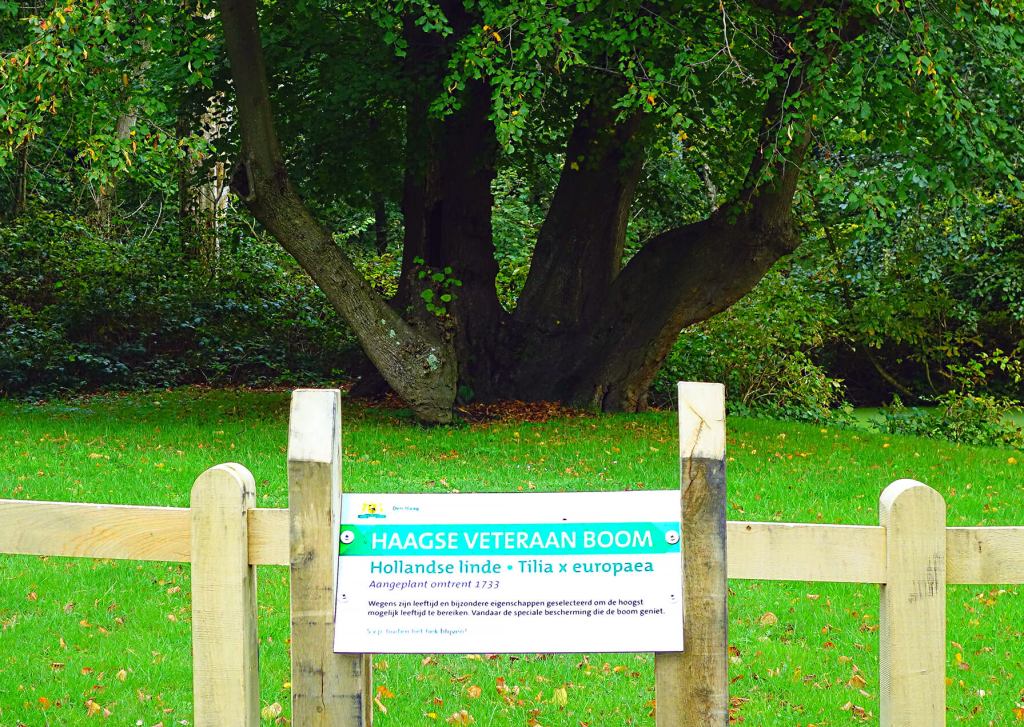
Photo credit: Joost Gieskes

The veteran tree initiative comes from the UK. The first official veteran tree of The Hague – even of The Netherlands – is a lime or linden tree (Tilia x europea) on the Clingendael Estate. This was planted around 1733.

I came across it on my walks during the first 2020 lockdown: Clingendael is close to the camping where I had my caravan. I was intrigued to find a tree in a corner of a field with a fence round it.

A veteran tree is protected and allowed to remain in place forever. A ‘monumental’ tree may be cut down when it becomes dangerous or diseased.
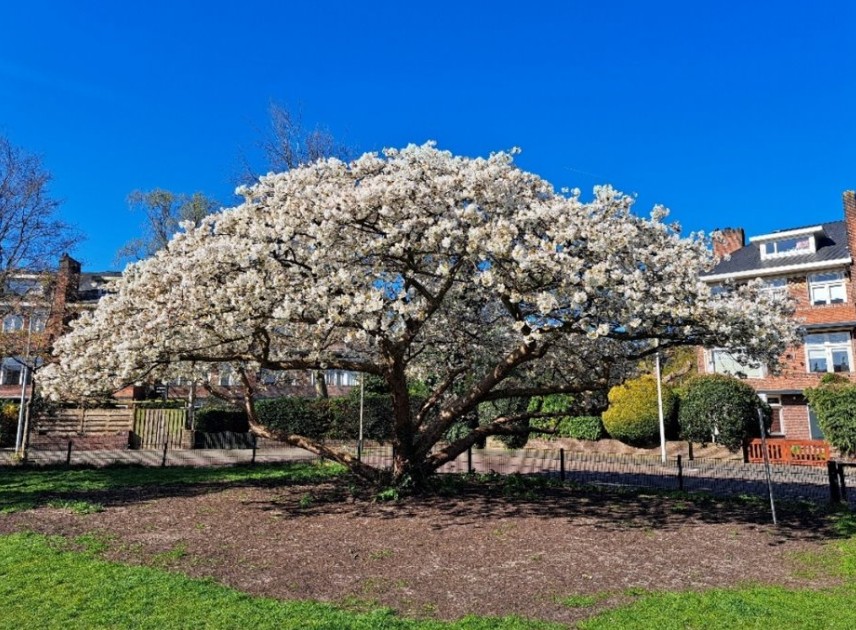
Japanese flowering cherry, tree. 92, 13 m wide.

The Hague local authority has nominated 10 trees and invites people to vote for five of these to become a veteran tree. The five trees that don’t get veteran status will become monumental trees. All the nominated trees are between 70 and 220 years old.

This is much harder than choosing a political party!

Will I choose that Japanese cherry, or the ’12 Broers’, tree no. 73, a 220-year-old oak that had a tough life (cut down often) and now has 12 trunks (the brothers), or choose the 145-year-old Mourning beech that houses falcons. I will let you know.
Spoilt for choice…

This coming Wednesday are the elections for the ‘Tweede Kamer van de Staten Generaal’ – the lower house of parliament.

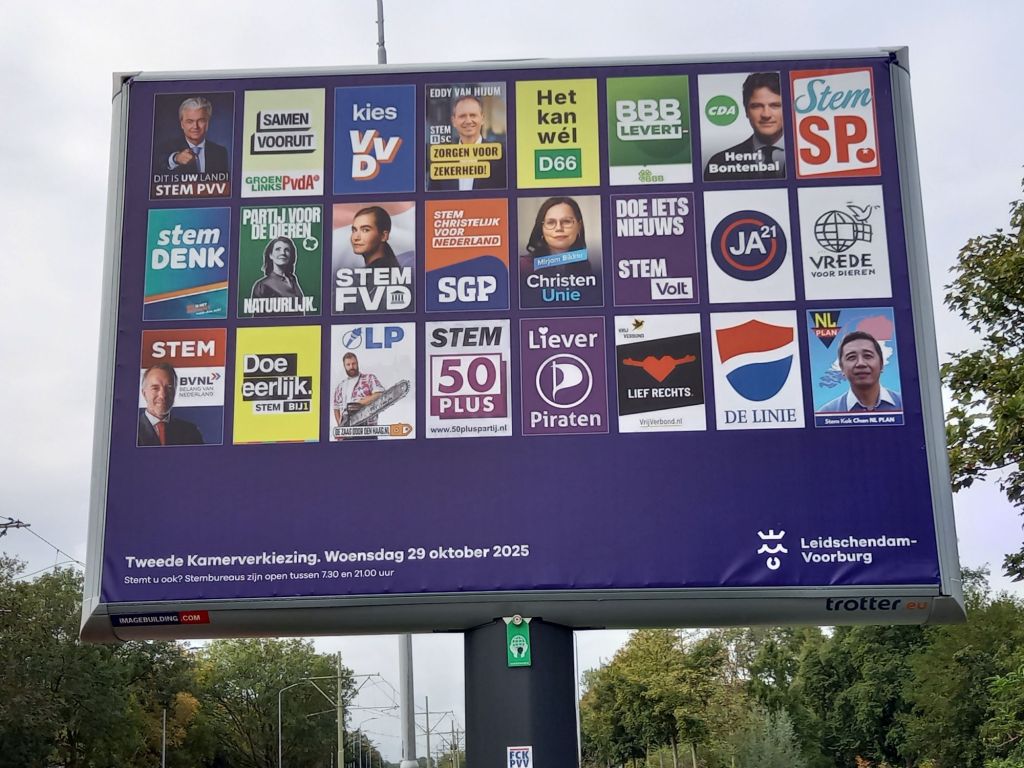
All over the country, boards have appeared with the 24 political parties. In large cities and towns each party has its own board. In small towns, like mine, the one shown.

On Friday, a pale grey sheet of A1-sized paper arrived by post: names of candidates for the 25 parties. So much detail: it’s essential to orient yourself beforehand. Otherwise, you’d spend too much time in your cubicle on the day, and there will be queues. When I voted in the last elections (November 2023), I couldn’t fold the paper back into its original roadmap shape…

The Dutch are famed for their tolerance. I find that puzzling, but then I spent most of my life outside The Netherlands.

A few months ago, a new political party ‘Vrede voor Dieren’ (Peace for Animals) was established. They split from the original ‘Partij van de Dieren’ (Party of the Animals) because the leader of the PvdD (initially pacifist) changed their views and now supports re-armament. The new VvD rejects re-armament in principle.

You don’t need to have read Animal Farm to think that an animal’s view of pacifism is probably Will I be eaten or not? (paraphrasing a Dutch novelist).

Confidence in politics and politicans

Confidence in politics is at an all-time low. In the August 2025 polls it ranged from 4% – 9%. Some 25% of those polled were floating voters. There are several reasons for that.

Photo credit: MabelAmber via Pixabay

Time lost in the polder…

  1. The ‘polder’ model is the pragmatic recognition of pluriformity. Time is needed to achieve consensus: people will need to polder. However, this verb has a negative connotation in relation to politics. An election will be followed by months of sitting and talking, walking and talking. A ‘formateur’ will facilitate the process. Meanwhile, the previous coalition is just ‘care taking’ and keeps things ticking over.

It also takes several months to organise an election, typically four to five.

The coalition Rutte II was the first cabinet that completed its full four-year term since 1998. Its starting date was 5 November 2021. Since then, just over two years were spent on forming the next three coalitions.

Not lasting the course

Rutte III – the full cabinet resigned over the child benefit scandal. A parliamentary enquiry had found that officials had knowingly and systematically deprived people who were legitimate claimants. Thousands of people have still not been compensated.

Rutte IV – resigned over fundamental disagreements regarding immigration measures.

Schoof – An unstable coalition from the start: two parties (the Boer Burger Beweging or BBB) and the NSC (Nieuw Sociaal Contract) both new to government and both struggling to get enough credible candidates for their seats. With Wilders of the PVV (Partij voor de Vrijheid) who’d walked out of an earlier coalition government. Seen as a ‘bunch of amateurs bickering amongst themselves.’

Not tackling the crucial issues

The Hague is a long way from the northern province of Groningen where thousands of people have been waiting for over a decade for compensation. (The subsidence caused to properties caused by fracking. Another parliamentary enquiry.) Just an example.

This time I’m a floating voter. So, I’ll go and have another coffee, inspect that grey form a little closer!

Having Her Cake


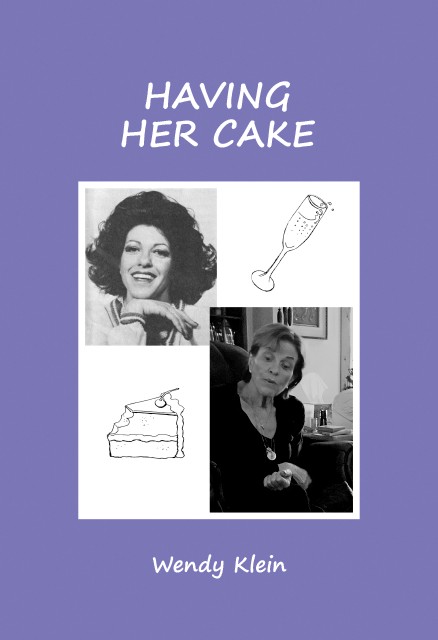
It is a pleasure and a privilege to share three poems from Wendy Klein’s new pamphlet Having Her Cake, published by Grey Hen Press. The pamphlet is dedicated to Barbara Cox (1943 – 2019). Several poems give us vivid details about their lifelong friendship. However, the focus is Barbara’s ‘physician assisted’ death. The opening poem starts: Barbara never knows what time it is in Britain. California calling ends: the kindly California law / on assisted dying / I tell her I’m coming.

Having her Cake

The chocolate cake, left over
from her annual pre-Christmas do
sits on a large white china plate,
dwindling in size day by day,
an unwashed fork lying next to it,
a temptation to any passers-by,
though no one ever sees
anyone else eating it
and it would have been sacrilege
to open the cutlery drawer,
select a clean fork,
place the used one in the sink
or the dishwasher, but someone
on the third day I’m there removes
the plate, crumb-covered and sticky,
replaces it with a tidy paper version
tucking the now over-large piece
of cling-film around the edges
clumsily, carelessly, as if
it no longer mattered, as if
at any moment it could be binned
plate and all.

What you can’t wake

The dead. No, not even the dogs,
grumbling at being shut
in their crates, beside her bed
peering through the grate, eyes
full of reproach.

No, you can’t wake the dead,
but the not-quite-dead
are too awake, their eyes
peeled until the last,
their flesh jumpy,
their muscles braced.

Beneficiary

Released from the need to worry
for herself, she frets
about the falling stock market
on behalf of her beneficiary,
a willowy young hairdresser,
the daughter she never had,
who will inherit everything:
the rambling shambolic bungalow
with its million and one flaws:
the water pressure that shuts down
the whole system when the shower is on,
necessitating bouts of shouting,
water, water if someone so much as
turns on a tap to rinse a cup,
brushes teeth, flushes the toilet
in any other part of the house —
a second-hand Honda Jazz,
a rusting dishwasher, a dog run
which looks like a concentration camp
for canines, meant to be protection
from ‘critters out there,’
and the stock market falling,
falling, falling.

Biography


Widely published and the winner of many prizes, Wendy Klein is a retired psychotherapist, born in New York and brought up in California. Since leaving the U.S. in 1964, she has lived in Sweden, France, Germany, and England. Her writing has been influenced by early family upheaval resulting from her mother’s death when she was nine months old, her nomadic years as a young single mother and subsequent travel. She has published three collections: Cuba in the Blood (2009) and Anything in Turquoise (2013) from Cinnamon Press, and Mood Indigo (2016), from Oversteps Books., plus a new and selected, Out of the Blue (2019) from The High Window Press. Her first pamphlet Let Battle Commence (2020) from Dempsey & Windle, was based on her great grandfather’s letters home while serving as a Confederate Officer in the US Civil War. She shares her work on https://www.cronepoet.com.