Tag Archives: The Netherlands

The Herring Eater


Herring Eater

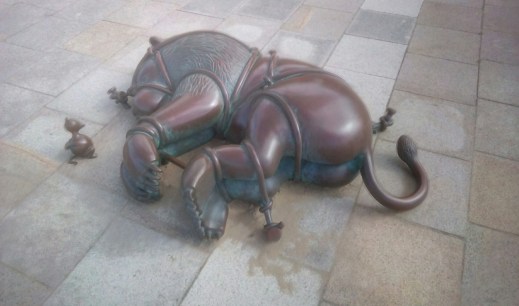
The Herring Eater is the centrepiece of a series of 23 inter-related sculptures by the American sculptor Tom Otterness. The tubes and round shapes are typical of his work: cartoon-like and humorous. However, these sculptures called Fairytales by the Sea are not from the children’s playground, but they remind us how these stories have a serious, even bleak, message. Here are Gulliver and creatures held down, tied down, or captive in cages. There is the hangman’s noose.


Fairy tale


Scheveningen was one of the major ports for the Dutch herring fleet. To this day, most Dutch people love their raw herring with chopped onion served in a white bread roll. There is always a queue at the stall next door to my local supermarket. I am about to close the caravan for the winter. The poem was written earlier in the season.

 
When in Holland

When in Holland do as the Dutch do:
eat raw herring in a white roll with
optional small bits of onion.
Or, like the giant bronze statue
The Herring Eater, already weathered
out on the promenade, head backwards,
holding the fatty fish by its tail.

Next you need to hunt out smoked eel
in the supermarkets. They’re delicious
with a sauce of crème fraiche and jenever.
Flight KL1079 to Manchester arrived on time
and I let the fish go.

Living below sea level – guest poet

Living below sea level is the title of Kathleen Kummer’s debut poetry collection (Oversteps Books Ltd, 2012), as well as the title of a short sequence in the book. Kathleen and I met at the beginning of the century on a week’s writing workshop with the poet Lawrence Sail. She had been married to a Dutchman and lived and worked for 14 years in the Netherlands, teaching French and German.

We kept in touch as poets and then became friends. When Kathleen moved to Devon to be nearer her two daughters, I suggested she submit her work to Devon publishers. Kathleen only started writing poetry seriously in her late sixties and had immediate success in competitions and acceptances in quality UK magazines.

I’m featuring Kathleen as this month’s poet, with three poems from the collection. That day is the second poem in the sequence. The cover picture is by Shirley Smith, Society of Wood Engravers.

News item

Let it be hard to write this poem.
Let it be hard to listen to.
Its words should lie flat and grey on the page,
ugly, as befits the vocabulary of war.

He had no alternative, said the surgeon,
but to amputate the festering hand
of the baby, nine months old.
Did you, like me, hear the news over dinner

in a comfortable chair, in a comfortable room,
and wonder how you could go on eating,
go on living? But did, having no
alternative. Let that child, I asked –

without knowing whom I asked it of –
still have a mother and family to rock
and cradle it. For how many lullabies will it need
to sleep, how many bedtime stories?


ii That day

A kind of delousing: hours later,
I’m still finding rice and confetti in your hair,
but no trace of the cobalt-blue, vermillion
and burnt umber which dappled your face
and your dark hired suit, as the sun streamed on us
through the stained-glass windows. And that cascade of notes
‘Handel’, you whispered. I was proud of you
for knowing and didn’t let on I knew.
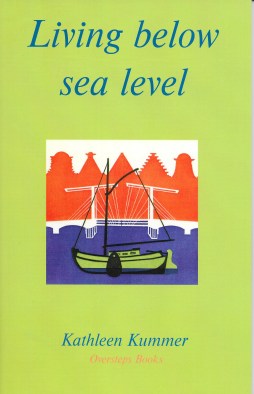
Image (6)

Boat on my windowsill

Forgive me for not using the pine cones you gave me
to light the fire. They look good on the hearth
in a wooden bowl. Among them, I found
a piece of bark, two-sided, V-shaped.
On my windowsill, upside down, it becomes
whatever boat I want it to be:
The Oseberg ship, chattels, carved wagon
on board, moored in its burial ground;
a Viking longboat, cutting through
the Baltic and Skagerrak as though they were butter;
a rowing boat, sturdy enough to take me
out to the ships which stand so still
on the firm line of the horizon; in the coracle,
I’d be snug and safe as a walnut in its shell
for the short crossing to the other side.


Tulips

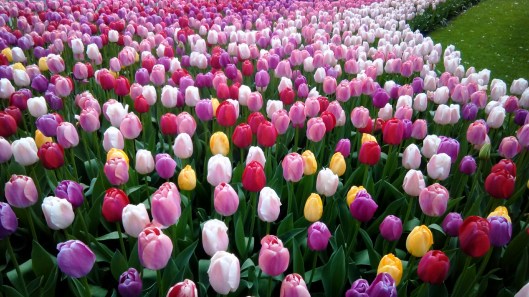
During my recent trip to the Netherlands I joined my sister and brother-in-law for a visit to the Keukenhof. It was a clear dry day, with a slight breeze and a some sun in the afternoon.

The Keukenhof is one of the world’s largest flower gardens incorporating different gardens and styles on a 79-acre site. It’s situated on 15th century hunting grounds and there are beech trees which are centuries old. The original park was designed in the 1830s and the Keukenhof (Kitchen garden) first opened in 1949. Each year some seven million bulbs are planted up.

17 purple tulips

I vaguely recalled the Sylvia Plath poem about tulips, so I looked it up. It was written in 1961 and consists of nine 7-line stanzas. It starts: The tulips are too excitable, it is winter here. The poem is based on Plath’s experience of recovering in hospital from an operation: I am learning peacefulness, I am lying by myself quietly/ In the following stanzas the tulips are not experienced as benign: The tulips are too red in the first place, they hurt me. The vivid tulips eat my oxygen. The tulips should be behind bars like dangerous animals;

I have one poem about tulips (in the Building Bridges anthology published by Ek Zuban last year). It has a very different feel from the fabulous Keukenhof tulips and is more at the Sylvia Plath end of the continuum. The title of the poem is the title of a watercolour painting donated by the (anonymous) artist to Manchester Art Gallery.

Extraordinary Popular Delusions and the Madness of Crowds

They’ve not yet reached one of the tulips,
the central one of this display.
You can imagine a window, if you like.
Five parrot tulips lean towards the light.
Degrees of purpling. The ants appear
half-way up the bulb-shaped vase.
I’ve left the thin pencil lines
indicating a flat surface.
Look closely and you’ll see this vase
should tumble, fall or slip.
Three fingers’ width, water level
in the glass. Greying water extracted.
The tulips were a present.
You can count the ants, if you like.