Tag Archives: Poetry

Haiku calendars

haiku-calendar-2020.jpg


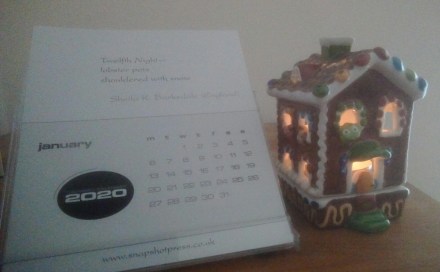
I bought extra copies of the 2020 Haiku Calendar to give as presents. This small desk calendar shows one haiku each month, with three or four more on the back.

Twelfth Night –
lobster pots
shouldered with snow
(Sheila K. Barksdale – England)

The haiku presented in the calendar are the winners and runners-up of the annual competition. The competition for the 2021 calendar is open until the 31st of January. Guidelines are on http://www.snapshotpress.co.uk

Twelfth Night was last Sunday when I was taking down Christmas decorations and carefully removing Christmas cards from the display on the kitchen door. And I was also thinking about the other haiku calendar – a present from a friend who lives in Japan. One of these calendars I’m going to take with me to my caravan in the Netherlands. No need to decide yet: my first trip there is early April!

snow scene


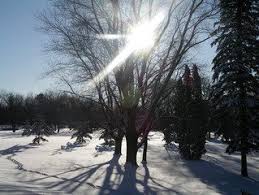
The images in the large calendar are all from the Art Gallery of Greater Victoria. Miyajima in the Snow is by Tsuchiya Koitsu (1937), wood cut on paper.

oyuki ya
yuki o mi ni yuku
tokoro nashi

 
So much snow – but
a place for snow viewing?
There is nowhere to go!

(Anonymous, 18th century)

Your heart is a frozen orange

Hernandez


Your heart is a frozen orange

Your heart is a frozen orange.
No light gets in; it is resinous, porous,
golden: the skin promises
good things to the eye.

My heart is a feverish pomegranate
of clustered crimson, its wax opened,
which could offer you its tender pendants
lovingly, persistently.

But how crushing it is to go
to your heart and find it frosted
with sheer, terrifying snow!

On the fringes of my grief
a thirsty handkerchief
hovers, hoping to drink down my tears.

 
The poet Don Share translated this early poem and the other poems by Miguel Hernández in I have lots of heart, Selected Poems. This bilingual Spanish-English edition was published by Bloodaxe in 1997. I came across this poet by chance: visiting his birthplace Orihuela in Spain. Hernández was a self-educated goatherd and is now one of the most revered poets in the Spanish-speaking world.

After fighting on the Republican side in the Spanish Civil War, he was imprisoned in several of Franco’s jails, where he continued to write until his death from untreated tuberculosis. He was only 31. Below is the original poem in Spanish with its wonderful rhymes. This poem inspired my poem Flight of swallows, murmuration of starlings which was first published in the anthology Drifting down the lane (2013), along with the painting by Malgorzata Lazarek.


Tu corazón, una naranja helada

Tu corazón, una naranja helada
con en dentro sin luz de dulce miera
y una porosa vista de oro: un fuera
venturas prometiendo a la mirada.

Mi corazón, una febril granada
de agrupado rubor y abierta cera,
que sus tiernos collares te ofreciera
con una obstinación enamorada.

Ay, qué acometimiento de quebranto
ir a tu corazón y hallar un hielo
de irreductible y pavorosa nieve!

Por los alrededores de mi llanto
un panuelo sediento va de vuelo
con la esperanza de que en él lo abreve.


Cip Cip

 
Flight of swallows, murmuration of starlings

 
A long line of scarecrows was no defence.
Each day at dusk more words arrived.
Small words with soft downy feathers, large
words that made strange gurgling sounds
Litany, Lamentation. They roosted
on telegraph wires, fences round his fields.

His wife had been a word collector. She kept
thousands in small paper boxes called books.
These boxes were lined up in coloured rows
in cases, on wooden shelves and tables.
She had taken the books with her when she left
calling him spineless and an empty well.

His neighbour Charlie, the old lion tamer came
with his black boots, his long whips. The birds
hissed and pecked at Charlie’s hat. Feral words.
He remembered his mother telling him stories
about loaves and fishes, storms of locusts.
The local preacher came in his long black coat.
His booming sermon scared away the clouds.
The words spread their feathers, glinting
in the sun; closed their small fierce eyes.

That night a small red hen walked into his dream.
She had made hundreds of prints in the fresh snow.
The hen stood on a book with his wife’s name on it.
The next morning, he drove into town, bought the only
poetry book in the remainder shop. A poet who had taught
himself, a goat herd from Orihuela, Miguel Hernandez.

Poems of love, loss, war; poems of prison.
Miguel died in prison not yet 32.
The telegraph wires pinged. The words watched.
Your heart is a frozen orange. A bird on the wing
like a thirsty handkerchief hovers, hoping to drink tears.
The old farmer, for the first time in his life, crying.

Late in the year …

woman

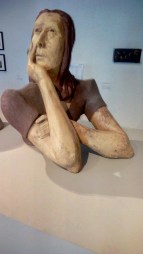
Woman, Leeds Museum

I am very glad to leave this year behind me. Those of you who’ve been following the blog for some time know that the chronic Brexit stress had badly affected my health. I was in and out of hospital for a series of investigations, blood tests and scans. The National Health System (NHS) is extremely short on resources and staff, but every individual I met treated me well and as an individual. Brexit will now happen, so I must apply for settled status soon.

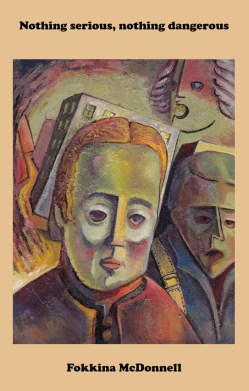
I got the all-clear late August and my second collection Nothing serious, nothing dangerous came out last month. The poetry world is extremely competitive, so I was delighted to be asked for a manuscript! My third book, a pamphlet called A Stolen Hour, will be published Spring 2020 by Grey Hen Press.

The small paperback Creative Visualisation by Shakti Gawain is my Desert island favourite. I’ve had a copy for decades. First published in 1978, it’s been a bestseller since. On or around New Year’s Eve I always take stock. A regular item on my seasonal To Do list is the gratitude list. On a personal level there is a great deal to be grateful for.


Creative Visualisation


Thank you for following my blog. I leave you with a poem about 2019 and a blessing for 2020 – a new year and another decade.

 
Late in the year

It was late in the year, too late
for the year to end in an orderly manner.
This year had no manners; it stopped
suddenly in July and now it was travelling
at speed, but in the wrong direction.

Four horses pulling the carriage
splash through puddles on the rutted road.
Through an archway into the yard – a square
dark patch – a small whimpering dog
left behind now the owners have moved.

This year is like that farm, empty
and cold, a broken window, dead
birds in the chimney, overgrown grass.

The lanterns on the carriage are getting
smaller still and the road is a dead-end
stony track ending high up on the moors.
It was that kind of year, we were lost
and not all of us would survive it.


Blessing

May inspiration come to you
whether you’re awake or asleep.
May the poems you find be yours to keep.

May you create easily to give you a lift
while your inner critic works a different shift.

Almost Solstice


solstice


As a Dutch national living in the UK I was unable to vote in the elections on Thursday. Never has Friday the 13th felt worse: those results and interminable rain, rain.

A couple of friends have just lost a parent, or friend, another friend is about to have the last Christmas with her father. Hospice care has already been arranged for him. I count my blessings and I count the days until Solstice on my fingers.

 
Waiting

The water meadows
are waiting
for the storks to return

 
always invisible
the other side
of her face

 
in this book
there is snow
on every page

 
even an old potato
can be turned
into a Christmas stamp

 
the naming of colours
is not a science.
I vote for bird’s nest grey

Mid-December

garden_fox_in_snow


At our Manchester Poets Christmas meeting on Friday someone read Stopping by Woods on a Snowy Evening. This poem, along with The Road not Taken, is one of Robert Frost’s most famous poems. Many people who are not poets have come across them.

Here is Questioning Faces, a short winter poem by Frost. It has marvellous precision and economy. It inspired my poem Mid-December. It is based on a real observation: seeing the fox in my rear garden under the light cast by the helicopter. Getting the end-rhyme across the two stanzas was an interesting task.

 
Questioning Faces

The winter owl just banked in time to pass
And save herself from breaking window glass.
And her wings straining suddenly aspread
Caught color from the last of evening red
In a display of underdown and quill
To glassed-in children at the windowsill.

 
Mid-December

Some people might pray for the day
to end, so they can cover glass
panels with ceiling-to-floor lined drapes,
or plain blinds that click into place.
Sitting by the radiator
I count the nights before Solstice,

think of the fox who’s come to stay.
She, padding across stiff white grass,
makes no such distinctions, escapes
gardens, water meadows; her face
now up to the police helicopter
beaming light on the world that is.

St. Nicolaas, 5 December 1957


_Groeten_van_St._Nicolaas!__St._Nicholas_and_a_helper,_St._Nick_is_in_a_white_robe,_orange_cap,..._(NBY_1458)


Traditionally, both St. Nicolaas and Zwarte Piet (Black Peter) arrive in ports in the Netherlands on a steam ship towards the end of November. A white horse awaits the holy man who rides through the streets. In the week or so before St. Nicolaas’ evening, children would leave a carrot for the horse in their shoe (few of us wore clogs!) by the fireplace. The evidence that St. Nicolaas and Zwarte Piet had come down the chimney to visit was there the next morning: some sweets, chocolates or a small piece of marzipan in those shoes.

Black Peter is a helper, distributing sweets to the children who’ve been good. However, he also carries a large bag. Any child that has been misbehaving during late November-early December risks being noticed and being carried off to Spain in that bag.

The competition from Father Christmas has become stronger over the last decades. In recent years, there has also been a controversy in the Netherlands about Zwarte Piet and a small UN Human Rights deputation even came to investigate the accusations of racism and colonialism. Some councils and schools now have a white helper (not blacked up) and elsewhere St. Nicolaas visits on his own. The controversy is ongoing with demonstrations, petitions and activism.

On the 5th of December I will be in the UK, on a writing week. I still love marzipan, but I am cutting down on sweets and I have asked St. Nicolaas for a large batch of good, new poems! The poem is from my debut collection Another life (Oversteps Books Ltd).

 
St. Nicolaas, 5 December 1957

We’re crowded in our dining room.
Grandmother has closed her face.
There’s me in pyjamas, smiling.
I’m next to my father’s father.
His heart will give out soon.
I’ve just been given a book;
animal stories with illustrations.

My brother too smiles, because
our mother isn’t there.
She may be in the kitchen
or upstairs, ill, thinking
about walking out on us.
My father has taken this photo.
He too will have closed his face.

Why are we in Vietnam?

9781912876228
Tomorrow is the publication date of my second collection Nothing serious, nothing dangerous. The book is already on Amazon and has been available for pre-publication orders from Indigo Dreams Publishing.

The publishers have selected six accessible poems for the author page, and the author photo is by my nephew Ted Köhler who lives in the Netherlands and is beginning to build up a photography portfolio. The end of November is too close to the festive season for an official launch. That will be here in Manchester, at the International Anthony Burgess Foundation on Tuesday 3 March.

The title was inspired by a Raymond Carver poem called My Boat. Raymond Carver is one of my all-time favourite poets. Someone I return to when I feel stale and in a negative frame of mind.

The poem Why are we in Vietnam? was written on a workshop at the wonderful Almassera Vella, Spain. We were to find any book in the library, open it at random and use a few lines as a starting point for a poem. Then we were to imagine finding a postcard inside the book. Where was the postcard from? What was written on the back? Who had sent it? I picked the paperback because of its intriguing title. It’s by Norman Mailer. I was surprised to find the lines and I imagined there would be an art card inside, a card I’d bought and forgotten about. It’s a reminder how working with “found” materials can easily trigger our creativity. The poem was commended in the 2016 Havant Open Poetry Competition.


Why are we in Vietnam?

It has held up the broken leg
of a single bed in the attic.
Everything is dusty now.
Who brought this Panther
paperback into my life?
Then the trail of the blood
took a bend, beat through dwarf alder.
The postcard isn’t of Cezanne’s gardener
seated upright in his chair,
or Venetian gondoliers.
Didn’t want to die in those woods,
wounded caribou…
Green lines, black dots,
small yellow triangles,
Miro’s insects and birds.
Neat black lines for the address,
the black box for a stamp.
To the left white space,
the white space of that Alaska.


And roared for hours at the moon …

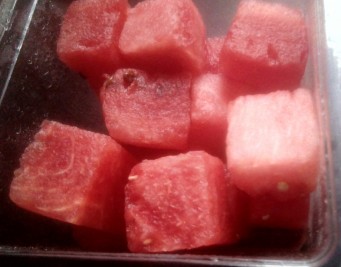
water melon


As you know, when I’m struggling to get new poems out and there are no workshops booked, I return to the books with their exercises. Exercise 7 in the book Writing Poetry by Matthew Sweeney and John Hartley Williams is called Backwards. Here are the examples from that exercise:

* ‘Eating red carnations by the dozen’
* ‘Singing, she pedalled over the moonlit bridge’
* ‘Back to his underwater home’
* ‘And roared for hours at the moon’
* ‘To stand, staring at the water’
* ‘Then parachuted, roaring, into a bonfire’

The late Matthew Sweeney contributed this exercise: “I woke up one morning with a poem fully formed in my head, but was too lazy to get out of bed and write it down. Then the poem started to evaporate, line by line, but I jumped out of bed and caught it by the toe – I had the last line, The smell and colour of petroleum, and spent the rest of the week working backwards to recover the poem, although it was undoubtedly inferior to the one I had had in my head.”

Well, I always have a notebook on my bedside table, but I rarely wake up with a poem fully formed!

I picked one of the lines and wrote a poem. It ended up being a comment about tourism, which I wasn’t expecting, and it certainly worked as a “warm up” exercise.


Wednesday

The old man shuffles up and down the beach
holding up the quartered fruit with one hand,
imploring in guttural sounds Water melon, melon,
a large plastic bag in his other hand.
He turns where the beach meets the shack
renting out parasols. Small white waves
tickle his feet, but he doesn’t smile.

Today the small strip of pebbly brown sand
is almost empty. The tourists have been placed
in shiny white coaches with air-co in the toilet.
This week’s excursion to the castle on the other
side of the bay: gardens, statues, fountains, lakes.
Shuffling through long corridors and state rooms,
the visitors huddle round their guide, see tired faces
staring back at them in monumental mirrors.

The tourists are back in their air-conditioned hotel,
five floors, five stars. There will be entertainment.
The old man has gone away. I’m told he made
a large mountain, a green mountain with red pulp.
I’m told he sat on that mountain all night
and roared for hours at the pale and distant moon.

Never Totally Lucid – guest poet

Hilary


This is my 100th blog piece, and I am delighted I can celebrate this century by introducing you to the work of Hiliary Elfick. We first met many years ago at the wonderful Almassera Vella in Relleu, Spain and have exchanged poems there several times since.

Hilary is an experienced broadcaster and the author of a novel and over a dozen poetry collections and pamphlets. She has performed her work in cathedrals, theatres, bookshops, libraries, schools and literary festivals in many countries, including Africa. Two of her poetry books have been translated into Romanian.

Hilary lives in East Anglia and also in New Zealand (where she is a bush bird guide), and is a frequent visitor to Australia where she recently launched two poetry sequences in collaboration with an international prize-winning Australian photographer, with a third appearing in early 2020. She has a lifelong love of being out in boats on the water.

Three poems are from Hilary’s THIS IS WHAT HAPPENS, published by Grey Hen Press (2019), while The Wedding Ring is from her earlier book THE OUTSHIFT PLACES, also with Grey Hen Press.


The Wedding Ring

But the morning before the wedding his father died. Two events
he’d long anticipated and with equal fervour. He would have
ignored the former, but Gilly persuaded him that even a minor
gesture to the event at their own reception might be at least seemly
and, more, something that much later he might be glad that he had
done. ‘I won’t pretend’ he said. ‘I won’t do platitudes.’

His mother came as planned. Under her wide hat her face
impossible to read, as it had been for many years. His sister
hugged him, saying nothing. Only when Gilly’s ring slid on his
finger did something jolt inside him. A ring finger. A ring. His
father ‘d always worn his. Even after everything.


Scan0020


When you know exactly where you were at the time
i.m. Professor Donald Nicholl

Six foot six he was but never towered.

Your first week. A small lecture theatre,
a wisp of Sobranie from the row in front.

He comes in, begins to speak

then nothing but his voice
and what he says and how he says it.
Sixty years ago. You’re at his feet:

whatever subject this man teaches
whatever he’ll demand
you’ll do it. You’ll be there.

Your first tutorial he asks how Christ came into Britain.
Someone tells him what happened, names, dates, places.
He turns to you and waits. You wait too. Then you tell him:

One man told another.
They put down their nets and followed.

Days later his wife has their fifth, last baby;
he names her after you.

Forty years on when he’s dying you remind him
Socrates said there’s no greater love
than between a teacher and his natural pupil.

Wonderful he whispers.

 
Four Quarters
A Grandmaster sees four moves ahead.

As child, I anticipate the trigger
for a new rage in my mother.

As mother I wake startled
by a cry or too-deep silence,
deep water, roaring roads.

As wife I place your glasses, shoes,
just where your eye might fall,
forgiving the questions I answered
today, yesterday,

tomorrow.

 
Never Totally Lucid

‘The reality of nature …obeys laws…never totally lucid to
our understanding.’ Anni Albers

When is he coming?
Five o’clock.
Is that what you wanted?
No. You gave me that yesterday.
I can’t have.
You did. Look. Here in my bag.

Did he come yesterday?
No. He’s coming today.
I’m not ready.
You have till five. You have time.
Why is he coming? Is it cold in here?
Your skin smells different.

I can’t find it.
You put it in your pocket
I only have this in my pocket.
That’s the one we’re talking about.
Who wrote this?
I did. You asked me to.
Why do I need it now?
You don’t. It’s for tomorrow.
Did I agree to this?
You did.

You make me so angry, you don’t listen to me, you just go ahead.

It was your idea.

What was my idea? When was it my idea?
Yesterday. That’s why he’s coming today.
Who?
James.
I don’t know a James.
Look. Here’s his name. Your handwriting.
Did he come?
No. He’s coming today at five.