Tag Archives: Orkney

Fieldfare, blown off course, early spring

A lively and intriguing title for a poem sequence by our guest poet Lydia Harris. Her work has featured here before (March 2019). This sequence is from her new collection Objects for Private Devotion, beautifully produced by Pindrop Press, published last year. Lydia lives in the Orkney island of Westray. Many of the poem sequences in her new book focus on local culture, people, nature, objects – such as the prayer nut which provides the cover image.

The sequence about the fieldfare is inspired by the great Serbian poet Vasco Popa. The Blackbird’s Field is also a sequence, from Popa’s Collected Poems, close on 400 pages – drawing on folk tale, surrealist fable, personal anecdote, and tribal myth.

Fieldfare, blown off course, early spring

After Vasco Popa 

My Fieldfare

He’s made of bone pins.
He’s a book inside a box
with a beak-shaped lid.
A snapped-shut lock.

He Makes Landfall

at Hagock where the Scollays
ploughed in patches,
wore tracks with their boots,
gulped spring water,
built their house.

Body

His muscles hurtle
from rump to neb.

First Song

The sky is my eye,
earth my egg.
From Noup to the Ness
in the turn of my head.

How I know him

His underwing flashes,
he wheels before settling
on plough or pasture.

His Manners

When the tide is asleep
he swallows it.
His wings are granite
with a hundred eyes.

Second Song

Bone grinds skin,
stone splits grain.

His Passion

Flames again.
He thinks he is clay.
The sea wrought him
like a mace head,
speckled, banded,
half-way done.
Bird before he was bird.

Third Song

Snapped flint,
water-worn
sea pebble.

His Dress Code

He squints through an eye mask,
lifts his mottled back through west winds,
across north winds.

A Flagstone in the Wall Speaks to Him

Grapple with my grain.
My night surfaces.
Tap the lichen from my face.
Draw silver from my base.

Lament

I’ve lost my folk,
my night ships,
my dear blood,
thick then thin,
night bird, stray bird.

Tongue

A whip of liver-coloured flesh
sheathed in the coffin of his beak.

His Heart

Its flicker forms ice,
his own padlocked air.
His map of the wind
stiff with frost
in the skirts of an old storm.

He Takes His Leave

Fooled by the moon.
He’s lost his bearings,
like the night boat.
We need to talk
on the edge of sight.

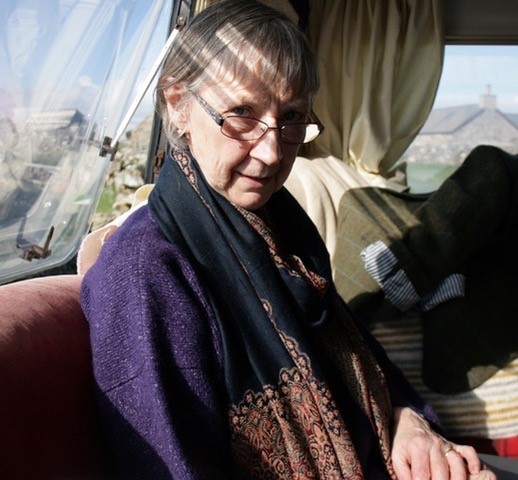
Biography: Lydia Harris lives in the Orkney island of Westray. Her first pamphlet Glad not to be the corpse was published by Smiths Knoll in 2012. In 2017 she held a Scottish Book Trust New Writers’ Award. Her pamphlet A Small Space was placed first in the Paper Swans competition 2020.

Glad not to be the corpse

NWA_ScottishBookTrust_HIGHRES_January_18_2018_KatGollock_-73_Lydia_Harris-200x300
A knock-out title for a poetry book, I should say. Lydia Harris and I met on the Poetry Business Writing School in 2012, the year Smiths Knoll published her pamphlet.
The others are glad not to be the corpse is the first line of a poem with the title
We make a video  on All Saints, North Street for English Heritage.

Many of Lydia’s poems have this filmic quality. They’re typically condensed narratives, with arresting first lines, and slivers of telling monologue or dialogue. They are also a masterclass in choosing titles. Could you resist I couldn’t ask if he was glad he’d married me; Widow to step-son; Lice-infested sea trout; Oxygen mask? The next poem is a delicious example:

The rolls arrive at the Inchnadamph Hotel

She doesn’t say ‘I never should have married you’,
instead tries I’ve cleaned our tennis shoes.
He spots the van through his binoculars,
the rattle on the cattle grid alerts the lad who helps.

The rolls brim with themselves,
two each, in baskets on the tables,
they smell of steam and Morag’s overall,
the early morning shuffle in the bakery.

A twist of butter opens out, floats on cloud.
Perhaps I’ll find a horseshoe charm, a wind-up bird.
She reaches for the marmalade.

I’d like a Harvey’s Bristol Cream, he says.
Tonight, she laughs, at five.

The day’s a swing-boat,
red plush seats, a fringe of gold.
He’s helped her in,
pulled the rope to make it rise.

 
Shortly after we met, Lydia moved to Scotland. She has made her home on one of the northern Orkney islands, a small but vibrant community. Recently, her pamphlet of Westray poems An unbolted door was published. I’m very pleased I can share a few poems from the book here. Lydia’s website is homeabout.co.uk


Lydia


How to Approach the Pier

With a bowline tied to your monkey-fist,
with your heaving-rope coiled sun-wise,
bow to Faray, engine in reverse.

With your stern door lined up to the ramp,
to starboard, the quarry, slumped
where the stones for the pier were hacked free.

With outlines of Wideford and Keelylang
papered on the skyline. The tide running high
and the wind southerly.

With trails of foam in your wake,
Geldibust to port. With the stanchions easy,
hung with tyres.

With a route pressed to your palm,
in your pouch, the honed spoon
and that knapped flint from Howar.


Jeemo Services My Van in January

He keeps spare bulbs in a fridge,
cattle in the byre next door,

spreads shafts and flanges
round the anvil
like the gaming pieces
and spindle whorls from Scar,

the woman who bore them
so long dead
she’s in the sky
over Ouseness at night,
unravelling her skins.

 
From the Box Bed

Our sheets are sails on the sweet hay sack
and we sail to the moon with an ebb and a flow.

Your hands smooth my throat in the starlit room,
there’s nothing to say but the brush of flesh.

My lips drink your breath and the tide is in,
the clock on the wall makes the only sound

but for the air as it leaves your lungs,
sweeter than scallops from the pan,

for where has it been,
inside your skin and I take you in.