

Today I am voting twice: first for a political party, then for a tree.
In a busy city, there is little room for trees to become old. On average, a city tree lives for 50 years.
The Hague doesn’t have many old trees: during WWII a lot were cut down, their wood used for cooking and heating. Of the 120,000 city trees, only around 1300 have the ‘monumental’ tree status.
Such trees are over 50 years old and meet at least one of these criteria: it is irreplaceable, of rare type, shape, or size. It may have historical value, or provide a home for rare plants or animals.
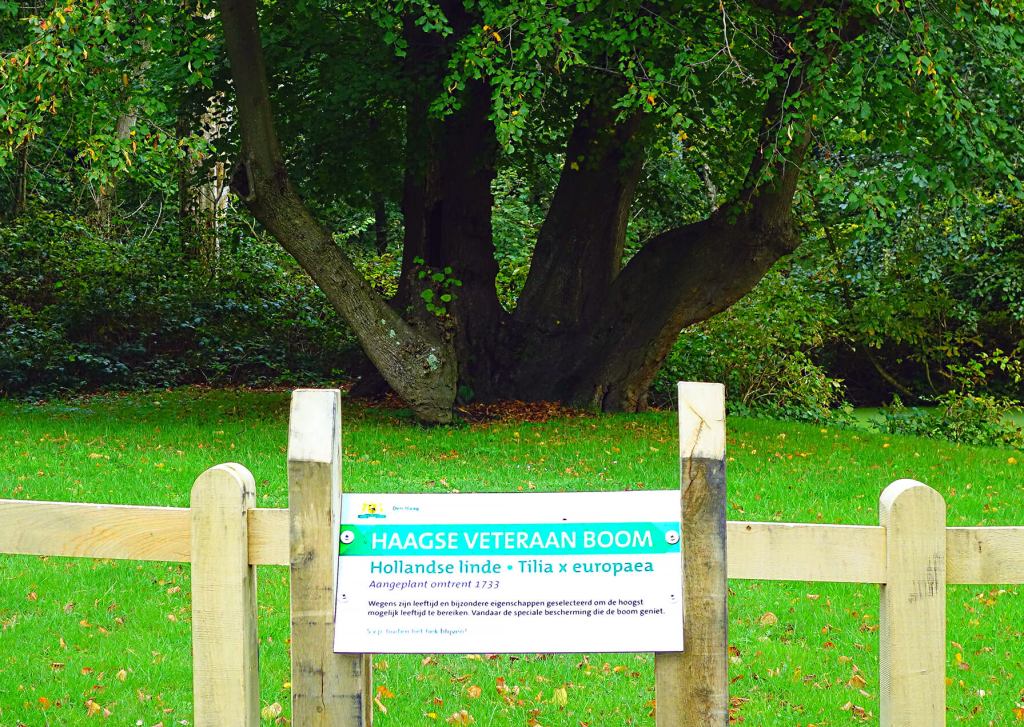
The veteran tree initiative comes from the UK. The first official veteran tree of The Hague – even of The Netherlands – is a lime or linden tree (Tilia x europea) on the Clingendael Estate. This was planted around 1733.
I came across it on my walks during the first 2020 lockdown: Clingendael is close to the camping where I had my caravan. I was intrigued to find a tree in a corner of a field with a fence round it.
A veteran tree is protected and allowed to remain in place forever. A ‘monumental’ tree may be cut down when it becomes dangerous or diseased.
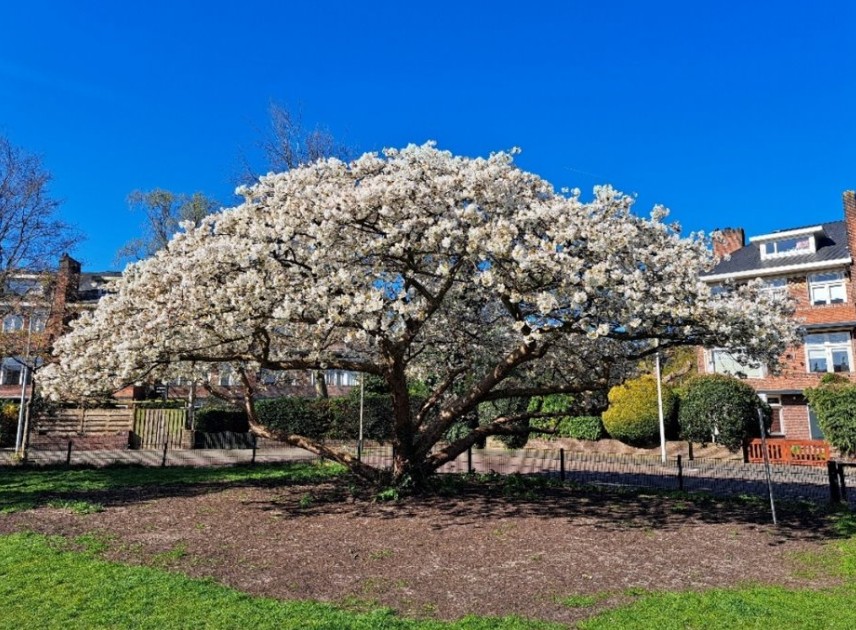
The Hague local authority has nominated 10 trees and invites people to vote for five of these to become a veteran tree. The five trees that don’t get veteran status will become monumental trees. All the nominated trees are between 70 and 220 years old.
This is much harder than choosing a political party!
Will I choose that Japanese cherry, or the ’12 Broers’, tree no. 73, a 220-year-old oak that had a tough life (cut down often) and now has 12 trunks (the brothers), or choose the 145-year-old Mourning beech that houses falcons. I will let you know.
 Acacia Publications