Category Archives: Travel

Bee Journal

9 (2)

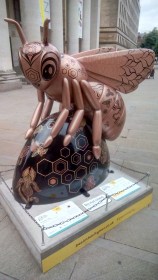
The Love Bee with Distiller-Bee on the right
6


In the 1800s the Manchester textile mills were called ‘hives of activity’ and the workers compared with bees. The Borough of Manchester was granted city status in 1842; on the city crest seven bees are flying over a globe, signifying Manchester’s industry being exported. Images of bees can be found on buildings and bins. After the Arena bombing last year many Mancunians got themselves bee tattoos.

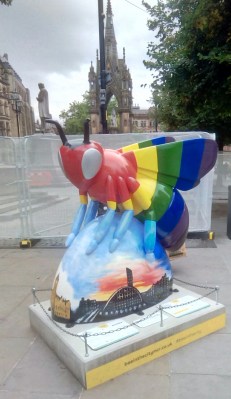
So, there is a lot of interest and excitement about bees currently dotted around town, in parks and public spaces. Over 100 large bees have been decorated by artists, while 130 little bees are part of the City Learning Programme. It’s how creative producers Wild in Art are celebrating their 10th anniversary, and there are some fabulous creatures to be found. The bee below shows some Manchester landmarks: the Town Hall, a Grade I listed building, the Manchester Central  Convention Complex (the original Central railway station) and the Beetham Tower with 47 floors, until recently, the tallest building in the UK outside London.
4 (2)

This is Manchester, C Elliott

On a recent trip to Leeds University to visit the Special Collection I was delighted to see a copy of the 1634 revised edition of the first English-language book devoted to beekeeping The Feminine Monarchie, the histori of bee’s. Charles Butler was also called The Father of Beekeeping. He was a priest and kept bees at his parsonage. Butler writes about bee gardens, hive making, enemies of bees, feeding, pollination and swarm catching. The book also includes a musical score: a four-part madrigal that mimics the sound of swarming bees!

Butler cover

One of the most original poetry collections I read in the last few years is Bee Journal by Sean Borodale. It was shortlisted for the 2012 Costa Poetry Prize. Borodale had previously published books based on walking and writing on location and Bee Journal was supposedly written at the hive, with the poet wearing a veil and gloves! The 90 pages chronicle the life of the hive, from the collection of a small nucleus on 24 May – extract below –

He just wears a veil, this farmer, no gloves
and lifts open a dribbly wax-clogged
blackwood box.
We in our whites mute with held breath.
Hello bees.
Drops four frames into our silence.

to the capture of a swarm two years later, with all the learning, joy and anxiety in between  The poem titles are all dates, some with additional notes, as below:

14th August: Bee Inspector
Today a DEFRA bee inspector clipped the wings of our queen.

Some days the poems are only a few lines, or a single word. 7th January starts:

Four inches of snow. The hive a hut
of silence and darkness.

A year later, there is the entry for 13th January: False Spring Week’s long hoax of mild weather/and bees wander like fools.  On the 15th January Sean makes herb tea for his bees, adding grains of salt and their own honey (10%) to boiling water.  Opposite is the devastating empty page, titled 24/25th January: Bees Die.

In between, there are many poems full of joy and marvel. Here’s a stanza from 2nd May:

A bee, a tine being struck was out:/sound like a rooting of thin flash/in liquid form poured from a bucket the size of an adult/tooth./Magnet of listening, I to hear it/turned the pole of my head.

Because of the regular small interventions the beekeeper has to make, his observations and devotion turn to a deep intimacy, with unusual imagery and dense, “clotted” language.  Reading it was an amazing experience.


Above a thousand feet of space – guest poet


D Wilson action


In the Balance

You pause beneath a boss of ice
above a thousand feet of space.
The picks of your axes barely bite:
it’s bullet hard, black with rock dust.
You’ve run out forty feet of rope,
placed only an ice-screw and screamer.
You’ve dreamed of this route for half your life.
Your calves ache. You can’t wait long.

Decision time. Weigh the following:-
an abseil retreat to blankets, pasta, beer;
the taste in your mouth if you bottle out;
November at work without a fix;
glimpses of where the pitch might ease;
a face at a window, Dad come home,
and you not knowing where you’ve been
or how to get back from it.

 
David Wilson turned to writing poetry a few years ago after being inspired by reading Derek Walcott’s poem ‘Midsummer, Tobago’ on the wall of a hospital waiting room in Leeds. He then discovered the Writing Days run by the Poetry Business in Sheffield and started writing poems of his own. His pamphlet Slope was published by Smith/Doorstop in 2016 and he has a collection coming out with them in 2019.

David was born and brought up in North London and studied at the London School of Economics, followed by a Master’s degree at Leeds University, which at the time had the only indoor climbing wall in the country and was close to excellent outcrop climbing. He has climbed extensively in the UK, Alps and further afield, at a standard best described as erratic.  In mid-life he got hooked on windsurfing, but writing about climbing has led him back into it.

After living in Leeds, David settled with his family in Harrogate. He has worked freelance for many years as an organisation development consultant. He now works part-time, exclusively in the area of academic leadership, helping people like Heads of Department to tackle the many challenges they face. He mainly works 1:1 with people and the diversity of their subject areas is a delight: from Medieval Welsh Poetry to Theoretical Physics to Cancer Research to Arabic, and that’s just in the past few weeks!  Favourite poets include Jane Kenyon, Les Murray, Jane McKie, Norman McCaig and Seamus Heaney.

Slope cover

David and I met on the 2012/13 Writing School and I’m delighted to share his work. Below are more poems from the pamphlet Slope. Everest was awarded 1st prize in the 2015 Poets & Players poetry competition, judged by Paul Muldoon. For a few technical terms: a cam is a device fitted into cracks to protect a lead climber. It has spring-loaded metal cams which grip the rock. A Micro-traxion gadget is a pulley that locks the rope, capturing what’s gained as a climber is hauled from a crevasse. A screamer is a sling which has stitches designed to rip and thereby absorb the energy of a fall. Typically used with doubtful ice-screws.

Stanage Edge

Summer’s returned for one day only,
blue sky, no wind, mist in the valleys,
bracken bronzing every hill,
the Edge’s gritstone silver in the sun.
Rock warm to touch. But holds won’t sweat.

I check my harness, knots and rack,
lay away, step high and up again to poise
off-balance, wriggle a cam into place,
then smear a slab, heels low, until
a crack grips my outstretched hand.

We linger on the edge. Smoke rises
straight up from the chimney at Hope.
It’s not a day to hurl ourselves against
but for dancing with, to feel alive
on Black Slab, Inverted V, Goliath’s Groove.

And it will light the long edge in our minds,
where name after name spells a life,
Flying Buttress and Left Unconquerable,
holds we could trust to be always there,
winds which threw every word away.


Everest

Once it was Chomolungma,
Mother Goddess of the Earth,
a face whose veil rarely lifted,
its whiteness the White Whale’s.

Now it’s like Elvis near the end,
a giant in a soiled jumpsuit,
blank, useful for percentages,
a sheet from which the music’s fled.


Alpine Partner

I was thinking of glaciers as metaphors,
you knew the car park’s exit code.
And you’d practised techniques
for rescue from a crevasse.

to dig a T slot, bury your ice-axe,
attach our micro-traxion gadget,
then fix the rope as a Z-haul
across the sweating surface, so that inch

by inch you heaved me up when I fell,
up from that cold place – its white walls
and longing, fins of green ice, pale blue caves,
darker blue depth beyond saying.

Yorkshire Day

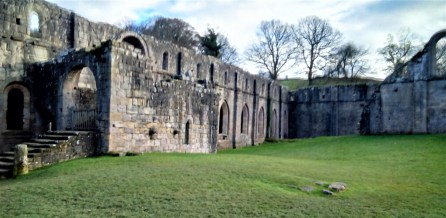
A suitable day for checking up on the Northern Poetry Library project: a series of poems in the new 821 form. I posted about the competition a few weeks ago. The picture is of Fountains Abbey, near Ripon, North Yorkshire.

img_20171126_1349339_rewind-003.jpg

The first canto of poems is up: poems about Liverpool, drystone walling, the journey North, a poem titled Notes made on Hadrian’s Wall by Catherine Ayes, and Ghost Crossing by Harry Man which has been Commended in the competition, and starts:

Making an enemy of the wind, a crow
backtracks on its own trajectory against

Two poems have just been added to the second canto and you can follow the growing sequence on https://poemsofthenorth.co.uk

Writing retreat with yoga

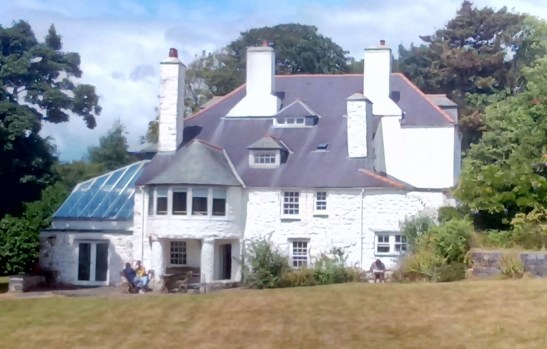
The writing retreat with yoga at Ty Newydd last week was very productive. I drove through torrential rain to North Wales, but it cleared as soon as I arrived, and we had three gorgeous days – warm and sunny.

TN house

Ty Newydd, North Wales

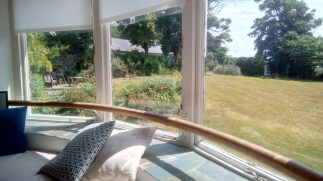
Ty Newydd, the National Writing Centre of Wales is a Grade II listed building. Part of it goes back to the 15th century. It was extended into a more upmarket three-storey Georgian residence in the mid-1700’s. A full renovation with new additions (such as that curved library window) was undertaken in the early 1940’s. The client was David Lloyd George, the politician and PM, who died in the house only a few years after moving in.
I didn’t know this, but the architect was Clough William-Ellis, better known as the creator of the nearby Italianate fantasy village Portmeirion. His motto was Cherish the past, adorn the present, construct for the future.

garden through librarygarden and sea 2


I had been apprehensive about the yoga, but Laura Karadog, our tutor, was reassuring. I managed three of the four morning sessions, 7am start, lasting for a full 75 minutes: grounding/breathing book-ending an active sequence of movement. Laura was excellent and very generous with her time, offering an afternoon and evening close-down, and individual slots. After the sessions I was grounded, focused and hungry!

My goal for the retreat was to go through all my poems and select enough to form the basis of a submission. After yoga I parked myself on that blue settee and spread my white papers around, then read or relaxed in the garden in the afternoon. Meal times were an opportunity to chat with the others. A nice and interesting group, writing diverse material: short stories, flash fiction, performance poetry, non-fiction, plays. And then there was the young woman composer from Colorado, US who had come to work on the libretto for an opera!

library

Drying her prayers – guest poet

Kasane

DRYING HER PRAYERS

As the rains of spring
Fall, day after day, so I
Fare on through time
While by the fence the grasses grow
And green spreads everywhere.

                           Izumi Shikibu (late 10th C)

Mother, you are hanging out prayers on the willow
but the ink hasn’t dried;
little flies scenting sweet gum embellish
your latest calligraphy.

I breathe on my hands, it is March,
My fingers are white as bamboo.
On the bridge, I hear the sisterly
slop of our sandals, still wait

for the god, hiding behind our gate,
to give chase, tap me on the shoulder,
offer a pale green scroll
with your name written there, words

golden, scattered like pollen.


This is a poem from Parting the Ghosts of Salt, a sequence of 15 poems. They are a series of letters exchanged between a mother, Tamiko, and daughter, Kasane, both of whom are married to sumo wrestlers. Each poem starts with a striking quote, from medieval and modern Japanese poetry. All the poems are entirely imagined, but they ring true. And it’s an interesting form.

Pam Thompson

Pam Thompson, this month’s featured poet, has published several pamphlets and her second collection Strange Fashion was published by Pindrop Press last year. Pam and I met on the Poetry Business Writing School in 2012. Pam has recently completed her PhD in Creative Writing. She is a free-lance writer, lecturer, writing tutor and reviewer. Her poems travel widely. There may be humour, but this is always combined with a clear eye for the telling detail and with compassion. Pam blogs at https://pamthompsonpoetry.com

Near Heaven – a journalist encountering Virginia Woolf is at once surreal, humorous and poignant. In the Abecedarian for Liam Pam uses the form – which can be tricky – in a natural way to tell a family story rich with detail.

 
Near Heaven

The lift doors open
on the wrong floor but she’s perfectly cheery.
Ms Woolf, I begin,
and she gives me that haughty, beady-eyed stare
like an intelligent red setter,
What is it you’re reading?
She pats a huge leather holdall,
her voice trails, … Of course … in my day we …
and sunsets … Eliot, with his green-powdered face
smiled like a girl
She’s drifted off my point.

To bring her back I say
that what the reader wants is
your favourite pen, coffee or red wine.
Your top ten diary writing tips,
what to do when the novel gets stuck.

At this rate we’ll never make the launch
The Wings? Waving at the Lighthouse?
These days I never even read the press release,
just take along fizz, their favourite fags
or something stronger; usually they’ll give
me all I want, sometimes a little extra.

So, Ms Woolf, the most dangerous place you’ve ever …?

I’m thinking she’s not heard the question
when our lift bell dings –
This must be your party, dear, she says, in the voice of my mother
and there they are, uncles, aunts, my father, all my cats,
two hamsters,
and I’m about to greet them, waving fizz, posh ciggies.

A hiss of words …a Schaeffercoffee … then fainter,
write before breakfast, garden, then write again,
take a little float down the river

the river

then she presses the button, the doors close, she ascends.

 
Abecedarian for Liam

All those years you had blonde hair –
back in Hong Kong they considered it lucky.
Cake in a posh hotel, you were six, born in the Year of the
Dragon, old people touched your hair, no inhibitions,
even when we were at your side, you were golden, a charm
for locals. Remember how you wondered if the Sikh doorman was
God? The photo shows him laughing, me
helping you blow out your candles,
I hope I made you wish, then you and the other kids
jumped all over the beds and the settee in our room,
Kowloon was a day or so away, and getting
lost, both of you so little – Derry only three – to be
meandering along the wrong road, away from the lights, with
Nanna too, Derry tired and crying, I was crying inside but kept
on pretending, and I’ve blanked it, but Henry
probably got us out of it, then the day we
queued for the tram to Victoria Peak and I’ve just
remembered Stanley, the shanty town we all mentally
stepped over, physically routed ourselves around,
the tee-shirts painted with your name in kanji,
up late eating Pringles, on a speedboat with Derry, Rosie and Lisa,
visiting a Shinto temple, posing outside with Nanna,
with Tom and Fauna, your favourite smoked salmon, scrambled eggs,
Xmas breakfast with champagne, and I could lie to
you when I’m telling you twenty-one years later, that the
zoo trip was on Boxing Day when I think that was the speedboat.

Dublin: Day One

At airports my Dutch passport occasionally causes confusion, as it is in my maiden name Köhler, followed by w/v – widow of McDonnell.  On Tuesday the machine at Schiphol Airport struggled to match the name on the ticket with the passport.

Back in the late 90’s I self-published a pamphlet Boxing with the Lobster. The poem is based on my first visit, Christmas 1972, in a house with heating on the blink.  I believe that the area, Rathmines, has since gone up in the world.

Dublin: Day One

A hundred thousand welcomes
my arse.
I wasn’t a Catholic
I wasn’t a colleen
and when our hearts united
the money orders to your Mummy
ceased.
They put us in separate bedrooms
which I called hypocrisy.

Eamon de Valera
The Post Office
O’Connell Street
The Easter Rising.
My temples throbbed
and lunch was Guinness thick as stew.

You promised me a claddagh ring
but ended the day drinking
with Liam and Tommy and Joe.
I waited with them,
talked about cooking colcannon
while they kept the plates warm.

When you all came back
we sat in the parlour swaying
to the Rose of Tralee.
Asked for a Dutch song
I could only muster
a shepherd and his sweet girl.

Next your man Aidan sang
and his eyes glistened:
When they came down the stairs
they shot them in pairs
when they came through the doors
they shot them in fours.


What a waste!

hardys-well-2-e1529961469867.jpeg

Hardy’s Well is a pub at the end of Manchester’s famous Curry Mile. The building is 200 years old. As a bet with the landlord in 1994 Lemm Sissay wrote the poem that is on the side wall: a rebellious shout. The pub closed in 2016 and is at risk of being demolished. A planning application has been submitted for a block of 26 flats with shops. The wall with the poem will be retained inside the new building. Below is my reply to Lemm Sissay.

What a waste!

What a waste of wise, witty words, wholly wild, worldwide; wicked, wanton, willful, witless wickedness.
When the watering hole Hardy’s Well is without water, wine, whiskey, whisky,
without Wienerwurst, Wi-Fi, whitebait, wontons, wedges, waffles;
without waiters, white witches, widows, widowers in wellingtons,
women, wheeler dealers, wastrels, wino’s, woodworkers in winklepickers,
white wicket keepers, weightlifter with whippets whining at the window;
Welsh welders in woollen woven wetsuits.

Wretched, wretched, wretched! Wrong, wrong, wrong!

We who wave at weddings, whisper at wakes, we wish to wave wands,
write wry words as ways to wound those wealthy windbags with their weasel words.
When we wander away towards Withington, walk against whipping wind
we weep, watching weeds, wear and tear on wooden wheelbarrows
in a wasteland, we who wage war against wrongs, let’s have a whip round.

Poet Lemm Sissay is philosophical about the development: Things change, and new poems emerge. It’s all part of the march of time. (Manchester Evening News).


Annoying Utterances

Christopher North has said: To me the ten most annoying utterances from the lectern at a poetry reading are:
1. Have I got time to squeeze in a short one?
2. Now let me see if I can find it…
3. Now if I can just get this thing to work…
4. This is one I wrote on the way here…
5. We were asked to write a villanelle…
6. I know it’s here somewhere…yes. Oh no erm let me see…
7. How long have I got?
8. It’s a load of rubbish but I read it anyway.
9. So all you need to know is that a ‘squawk bogger’ is a New Zealand newt, and that ‘ramping in the dolditts’ is an expression used by Romany folk from the Upper Silesia referring to their annual bean throwing festival, and that Durnstadt-terminum is a Village in Bavaria where they make clay pipes – well you’ll see what I mean when I…
10. (Already 15 minutes over allotted time) – ‘…and here’s one that I have to read. It came about after my son’s first session in Rehab – he’s out now and all seems Ok, Hooray! Hooray! And it’s an important poem for me because it was like a coming to terms emotionally with …blah blah blah.
(in an interview with William Oxley in Summer 2014, published in Acumen, September 2014)

I can tick all of these of on my list of readings that I have attended!

CN

Christopher, who owns the Old Olive Press (Almàssera Vella) in Relleu, Spain is a published and prize-winning poet. His first pamphlet A Mesh of Wires (Smith/Doorstop) was shortlisted for the 1999 Forward Prize. Oversteps Books Ltd published two collections Explaining the Circumstances (2010), The Night Surveyor (2014) as well as a joint bilingual collection with Terry Gifford: Al Otro Lado del Aguilar (2011). His pamphlet Wolves Recently Sighted was published by Templar in 2014.

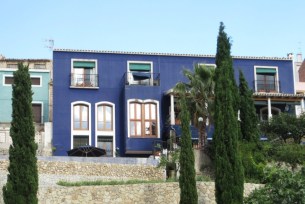
blue house back view

The Old Olive Press (Almassera Vella)

It does add a special quality to being on a writing week at the Old Olive Press when your host is himself a poet. We were delighted to learn that Christopher is one of the four winners of the annual Poetry Business pamphlet competition. His collection The Topiary of Passchendaele will be launched at the Wordsworth Trust on 22 September this year. The title poem has just been awarded the 3rd prize in the 2018 Poetry on the Lake competition. With Christopher’s permission I’m publishing three poems of the new book below:

Last Word

In 1997 it was calculated that that there are fifty languages on the planet with only one speaker still alive. By 2015 there were just eight.

Lost in distant steppes
of somewhere to the East

there is a bank of evening primrose
beside a mud road with

a centre strip of mayweed,
hardheads smelling of pineapple.

The man at the window
has no word for pineapples.

He has a word for the ‘Via Lactea’,
that nightly glows above his roof.

It is similar to his word
for the blur caused by a stone or rain

hitting a puddle of clear water.
He had a word for evening primrose

but has forgotten it;
now they are nothing more

than his word for ‘flowers’.
The flowers have no words.

They only know their mechanisms:
their stretching upwards

their brief flare
and then a falling back to earth.

Sometimes a jet roars across the sky
leaving a tracer line that fades slowly.

He has never had a word for that.


From an Armchair

Beyond the range of the King’s photographer
the forest of the meteorite
and its star of blasted pines;

beyond the islands of the Gulag
and the road of bones through endless forest
where winter is norm, lives pass unrecorded,

epics unfold their progress in silence,
towns work through unknown narratives —
all outside the great conversation;

beneath sky-scapes lashed with stars
and the unfolding green of borealis;
through Sakha, Yakutsk and ice crushed bridges

lies Omyakon between frozen mountains,
where they say in winter words freeze
as they leave your mouth to fall forgotten in the snow.

They make a tundra littered with gossip,
cries of love, argument and greeting,
speeches and shouts petrified in depths of ice

until one midday when larch are greening
and golden root makes a brief smile at the low sun,
words fall into air as if from a door flung open

to fill the town like birdsong and running water


(From an idea of John Catanach – originally a story from Colin Thubron)


Trestles

Wise is knowing how much
you don’t know, have no conception of.

Unravel ignorance. Cover a trestle
with all those things not known.

The trestle groans, add another,
then more, fill a hall, then an annexe,

spread into the street,
become a neighbourhood,

grow to a city, a region,
a country with unmarked frontiers.

Maintain in a corner, dimly lit,
a timid altar of things you think you know.


The Old Olive Press

Below is a picture of that olive press. Christopher and Marisa North opened The Old Olive Press, which is their house, as well as a cultural centre, in 2002. The press is located on the ground floor which has a sitting area and a large table seating a dozen. The first floor is at street level and houses the library of close to 4,000 books. Writing retreats are available and the Almàssera Vella is also listed in Alisdair Sawdays’s Spain (Special Places to Stay).

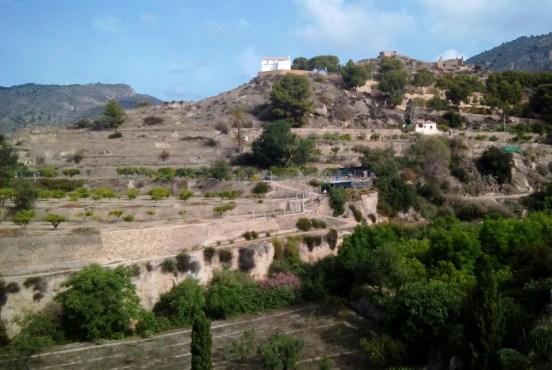
The blue house is at the edge of Relleu, a village in the mountainous area of Alicante province, known as ‘Marina Baixa’. It is the perfect location for a writing retreat, just one hour from Alicante Airport, half an hour from Villajoyosa on the coast; the village is large enough to have a bank, pharmacy, several bars and local shops. The Romans established the village on its existing site at the end of the 1st century B.C.

olive presspool JL

bancal

The olive press, the pool, the terraces (bancals) with olive trees.

I’ve just come back from my seventh visit. I’ve attended workshops with poets Mimi Khalvati, Matthew Sweeney and, in recent years, with the incomparable Ann Sansom. A week there is a winning combination of writing in the morning, a buffet lunch, and plenty of free time to write, read, relax, swim in the pool, or walk. Below is a poem from last year.

Relleu, 2017

The church bells do not have twins.
Bells ring twice, so the men working
in the campo can count the second time.

We’re at Pepe’s on the village square,
seated in two long rows at a narrow table.
Down the cobbled street is the blue house
where a white dog barks into the valley.

Maggie is moving along the table reading
aloud lines from a poem written by all
of us on the edge of the paper cloths.

A little Navarra rosé is left in my glass.
The twins of that paper poem are ahead of us.

Refusal of a visit visa (3)

suleman 3

What Dreams May Come (2015) placed between After All It’s Always Somebody Else Who Dies (2017).

Adeela Suleman writes: My work is profoundly shaped by the way in which violence is performed, experienced and remembered. The more heinous the violence, the more beautiful its memorial.  In contemporary Pakistan death surrounds us, nameless, faceless and countless. In Karachi up to 12 people a day die in gangland and politically motivated murders.

The birds are dead. They make a pattern, a simple pattern that silently repeats itself. Silence haunts you, silence is disturbing. The delicate sparrow is a symbol and their shadow on the wall a reminder of the fragility of life.

After all it’s always somebody else who dies

The headless warrior still stands strong, holds his shield,
grips the tall lance, two narrow ribbons flutter.
Reeds, flowers and grasses part for his feet.
A memorial captured in carved wood stained green,
the colour that pleases the prophet.

Hand beaten and hand beaten from behind, through
chasing and repoussé, the stainless steel sparrows
that tumbled to their death. On the left 420 sparrows,
their beaks and feet touching, all held together.
On the right the same number of sparrows,
a shiny, shiny stillness.

My poem was a response to Suleman’s sculptures. It appeared in Building Bridges, an international anthology edited by Bob Beagrie and Andy Willoughby, published by Ek Zuban in 2017.