Category Archives: Travel

The Outsider


unnamed

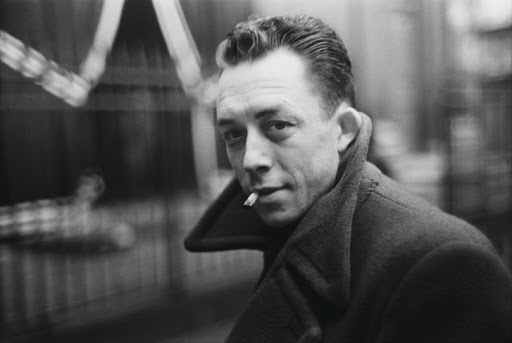
Albert Camus


It seemed fitting to spend 31 January (Brexit Day) with a good old friend. She has the modern smart phone needed to scan my Dutch passport. It was good to have moral support: I had a crying fit during the identity check part of the application. Luckily, I only started crying after she’d taken my photo which the Home Office staff/system will check against the photo in the passport!  And the automatic check on my National Insurance (NI) number confirmed that I was eligible to apply for “settled” status.

I’ve been resident in the UK since 1973 and I have close friends here and my writing, but it has felt less and less like home after the 2016 referendum.

At secondary school (Gymnasium) we learned English, German and French and we crawled at a snail’s pace through l’Étranger, the 1942 novel by Albert Camus which is a classic in world literature.  Camus developed the philosophical concept of Absurdism and the way he died in a car accident, aged 46, could be considered absurd.

The poem is from my debut collection Another life, published by Oversteps Books Ltd in 2016.

On reaching his 102nd Birthday

He always liked his drink,
so it’s no surprise that Albert went North,
that unused train ticket in his pocket.

He is said to have died in a car crash,
but police do know people who
walk away and without a scratch.

After walking for weeks, he reached Norway
where the days are short
and the nights are made for alcohol.

Camus lived in a modest house
with a butcher’s block in the kitchen
where he cut reindeer and smoked.

A flock of swans flew through his dreams,
so he married the next woman to walk past,
taught her two sons to play football.

She taught him to sleep soundly at last.
A pied-noir at rest under the Herring Lights,
on the cold edge of man’s world.

Yellowish green and faint red glowing,
these arcs and rays and curtains of gas,
the fight against dawn and the sun.
Snow still in sight


Scan0012

 
snow still in sight
the water becomes less cold
in this castle town

yuki nokori tsutsu mizu nurumu jokamachi

(haiku by Kiyo)

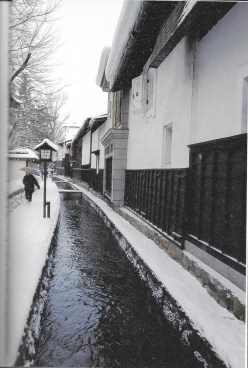
This castle town may be located somewhere deep in the mountains in the northern part of Japan. Snow still remains on the surrounding steep mountains, but the snowmelt water flows peacefully in the river running through the town. We can imagine the lives of the lord who owned this castle and its dwellers, which may not have been so peaceful all the time.

One of my bookshelves is filled with books and magazines on haiku, tanka, renga and renku. One of them is very special to me: Haiku. The poetic key to Japan by Mutsuo Takahashi, Hakudo Inoue and Kazuya Takaoka, published in 2003. It suddenly arrived several months after a Japanese postgraduate student who had shared my house had returned home.

Each haiku is accompanied by a wonderful colour picture, a brief explanation, the original Japanese text and the version in Romaji. Is late January too early for a spring haiku? I hope not!

Ambulance Ride – guest poet


Carole B

 
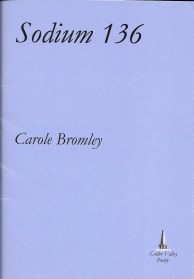
Many of the poems in the pamphlet Sodium 136 were written in Hull Royal Infirmary where Carole Bromley had pituitary surgery in 2018. I first met Carole on a writing week in 2004. It is a privilege to feature four of the poems. The pamphlet was produced and published by Calder Valley Press in 2019 and a donation from every copy sold will be made to The Pituitary Foundation. Many of the poems had already been published in magazines, and several have been commended or placed in competitions.

The testimonial by the poet Clare Shaw: “If poetry’s work is to speak to the universal through the particular, then Sodium 136 is a triumph. With the profound insight of personal experience, Carole Bromley captures the complex experience of serious illness, affording equal worth to the mundane and terrible with a beautiful and uncompromising directness. This is not just a record of physical suffering – it is a powerful and profoundly intelligent exploration of grief, gratitude, fear, love, and joy. Poetry at its best.”

 
Ambulance Ride

My Poetry Society bag is on my lap,
Take if you must this little bag of dreams;
the drip hung from a hook. A jolt
as the gurney hits the hoist, that blast of air.
We’ll soon get you warmed up. They ask me
which route I would take. The driver says
he thinks he’ll put the flasher on but not the siren.
After three minutes the siren goes on too.
I can’t be doing with traffic jams!
I watch as we go through every red light.
The ambulance man gives me a sick bowl,
apologises for the bumpiness of the ride,
holds the gurney steady with his foot,
fills in a pink form, gives me a pain killer,
tells me about his earlier calls, the RTA,
the one-year-old he drew a face on a glove for,
says he and his wife wanted kids but it never happened.
When we arrive on the ward I feel lost.
A man walks up and down like a zombie,
his spine and head held up in a cage.
In my bay two women with bandaged scalps
vomit in cardboard bowls. I tell the nurse
I feel like bolting. She says I know it’s not
as nice as York. The ambulance man points
That’s why I could never be a patient.
How do you sleep with one pillow?


Consent Form

The registrar reminds me of the dangers,
scaring me all over again.
Blindness, stroke, death is the gist.
He’s not anxious to proceed
on his own decision-making;
he needs to patient to do the hard part.

With the consultant it’s different.
He’s so young his baby’s only two weeks old
and so handsome he cuts a dash on the ward round.
He weighs up the pros and cons when the posse
of students have moved on with their clip boards,
their crack-of-dawn observation of the sick.

I’m not good at decisions at the best of times
and this is not the best of times
so I say What would you advise me
if I was your wife? He says
You could lose your sight. I’d go ahead.
I say Give me the pen.


Sodium 136
Visiting Time

In here everyone talks to the dead.
Some speak aloud, Barry calls to his son;
Enid, who, after having her hip done
broke the other one getting out of bed,
talks to her late husband, telling him
This is the worst pain and I’m not joking
and I, inside my head, talk to my mum
which is ironic as we barely spoke.

I’m sorry I didn’t buy you the dressed
crab that awful lunchtime. You guessed,
as I did not, that it would be your last,
afterwards you’d eat little and then less
then not even sips out of a beaker,
just me wielding the sponge on a stick.


Sodium 136

A new form of torture
to raise my sodium level
which is dangerously low.
They measure out five glasses
of water into my jug
to last me till midnight,
write 1 litre fluid restriction
on the board over my bed
so the tea trolley passes me by,
the milk-shake woman doesn’t come,
the pourer of custard shakes her head.
Slowly the level creeps up.
After five days I’m fantasising
about gulping cartons of juice.
I have a tug of war with a nurse,
will not let go of the jug
which she wants to remove,
tell her if I wanted to cheat
I could put my head under the tap
and drink. I win, the jug stays.
The tea lady leaves me half a cup
and whispers I won’t tell them, love.
I do not touch it. 117, 118,
123, 124 and then, overnight,
SODIUM 136. I weep with joy.
They rub out the notice.
I gulp down glass after ice-cold glass.

Haiku calendars

haiku-calendar-2020.jpg


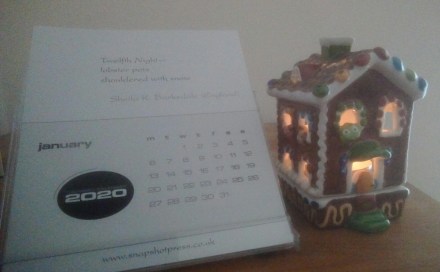
I bought extra copies of the 2020 Haiku Calendar to give as presents. This small desk calendar shows one haiku each month, with three or four more on the back.

Twelfth Night –
lobster pots
shouldered with snow
(Sheila K. Barksdale – England)

The haiku presented in the calendar are the winners and runners-up of the annual competition. The competition for the 2021 calendar is open until the 31st of January. Guidelines are on http://www.snapshotpress.co.uk

Twelfth Night was last Sunday when I was taking down Christmas decorations and carefully removing Christmas cards from the display on the kitchen door. And I was also thinking about the other haiku calendar – a present from a friend who lives in Japan. One of these calendars I’m going to take with me to my caravan in the Netherlands. No need to decide yet: my first trip there is early April!

snow scene


The images in the large calendar are all from the Art Gallery of Greater Victoria. Miyajima in the Snow is by Tsuchiya Koitsu (1937), wood cut on paper.

oyuki ya
yuki o mi ni yuku
tokoro nashi

 
So much snow – but
a place for snow viewing?
There is nowhere to go!

(Anonymous, 18th century)

Your heart is a frozen orange

Hernandez


Your heart is a frozen orange

Your heart is a frozen orange.
No light gets in; it is resinous, porous,
golden: the skin promises
good things to the eye.

My heart is a feverish pomegranate
of clustered crimson, its wax opened,
which could offer you its tender pendants
lovingly, persistently.

But how crushing it is to go
to your heart and find it frosted
with sheer, terrifying snow!

On the fringes of my grief
a thirsty handkerchief
hovers, hoping to drink down my tears.

 
The poet Don Share translated this early poem and the other poems by Miguel Hernández in I have lots of heart, Selected Poems. This bilingual Spanish-English edition was published by Bloodaxe in 1997. I came across this poet by chance: visiting his birthplace Orihuela in Spain. Hernández was a self-educated goatherd and is now one of the most revered poets in the Spanish-speaking world.

After fighting on the Republican side in the Spanish Civil War, he was imprisoned in several of Franco’s jails, where he continued to write until his death from untreated tuberculosis. He was only 31. Below is the original poem in Spanish with its wonderful rhymes. This poem inspired my poem Flight of swallows, murmuration of starlings which was first published in the anthology Drifting down the lane (2013), along with the painting by Malgorzata Lazarek.


Tu corazón, una naranja helada

Tu corazón, una naranja helada
con en dentro sin luz de dulce miera
y una porosa vista de oro: un fuera
venturas prometiendo a la mirada.

Mi corazón, una febril granada
de agrupado rubor y abierta cera,
que sus tiernos collares te ofreciera
con una obstinación enamorada.

Ay, qué acometimiento de quebranto
ir a tu corazón y hallar un hielo
de irreductible y pavorosa nieve!

Por los alrededores de mi llanto
un panuelo sediento va de vuelo
con la esperanza de que en él lo abreve.


Cip Cip

 
Flight of swallows, murmuration of starlings

 
A long line of scarecrows was no defence.
Each day at dusk more words arrived.
Small words with soft downy feathers, large
words that made strange gurgling sounds
Litany, Lamentation. They roosted
on telegraph wires, fences round his fields.

His wife had been a word collector. She kept
thousands in small paper boxes called books.
These boxes were lined up in coloured rows
in cases, on wooden shelves and tables.
She had taken the books with her when she left
calling him spineless and an empty well.

His neighbour Charlie, the old lion tamer came
with his black boots, his long whips. The birds
hissed and pecked at Charlie’s hat. Feral words.
He remembered his mother telling him stories
about loaves and fishes, storms of locusts.
The local preacher came in his long black coat.
His booming sermon scared away the clouds.
The words spread their feathers, glinting
in the sun; closed their small fierce eyes.

That night a small red hen walked into his dream.
She had made hundreds of prints in the fresh snow.
The hen stood on a book with his wife’s name on it.
The next morning, he drove into town, bought the only
poetry book in the remainder shop. A poet who had taught
himself, a goat herd from Orihuela, Miguel Hernandez.

Poems of love, loss, war; poems of prison.
Miguel died in prison not yet 32.
The telegraph wires pinged. The words watched.
Your heart is a frozen orange. A bird on the wing
like a thirsty handkerchief hovers, hoping to drink tears.
The old farmer, for the first time in his life, crying.

Late in the year …

woman

Woman, Leeds Museum

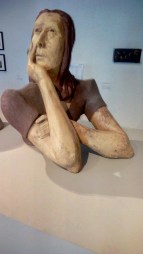
I am very glad to leave this year behind me. Those of you who’ve been following the blog for some time know that the chronic Brexit stress had badly affected my health. I was in and out of hospital for a series of investigations, blood tests and scans. The National Health System (NHS) is extremely short on resources and staff, but every individual I met treated me well and as an individual. Brexit will now happen, so I must apply for settled status soon.

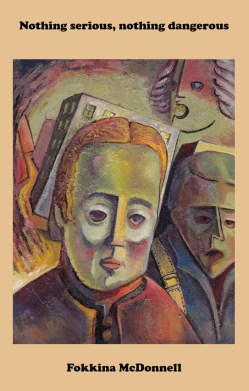
I got the all-clear late August and my second collection Nothing serious, nothing dangerous came out last month. The poetry world is extremely competitive, so I was delighted to be asked for a manuscript! My third book, a pamphlet called A Stolen Hour, will be published Spring 2020 by Grey Hen Press.

The small paperback Creative Visualisation by Shakti Gawain is my Desert island favourite. I’ve had a copy for decades. First published in 1978, it’s been a bestseller since. On or around New Year’s Eve I always take stock. A regular item on my seasonal To Do list is the gratitude list. On a personal level there is a great deal to be grateful for.


Creative Visualisation


Thank you for following my blog. I leave you with a poem about 2019 and a blessing for 2020 – a new year and another decade.

 
Late in the year

It was late in the year, too late
for the year to end in an orderly manner.
This year had no manners; it stopped
suddenly in July and now it was travelling
at speed, but in the wrong direction.

Four horses pulling the carriage
splash through puddles on the rutted road.
Through an archway into the yard – a square
dark patch – a small whimpering dog
left behind now the owners have moved.

This year is like that farm, empty
and cold, a broken window, dead
birds in the chimney, overgrown grass.

The lanterns on the carriage are getting
smaller still and the road is a dead-end
stony track ending high up on the moors.
It was that kind of year, we were lost
and not all of us would survive it.


Blessing

May inspiration come to you
whether you’re awake or asleep.
May the poems you find be yours to keep.

May you create easily to give you a lift
while your inner critic works a different shift.

Almost Solstice


solstice


As a Dutch national living in the UK I was unable to vote in the elections on Thursday. Never has Friday the 13th felt worse: those results and interminable rain, rain.

A couple of friends have just lost a parent, or friend, another friend is about to have the last Christmas with her father. Hospice care has already been arranged for him. I count my blessings and I count the days until Solstice on my fingers.

 
Waiting

The water meadows
are waiting
for the storks to return

 
always invisible
the other side
of her face

 
in this book
there is snow
on every page

 
even an old potato
can be turned
into a Christmas stamp

 
the naming of colours
is not a science.
I vote for bird’s nest grey

Mid-December

garden_fox_in_snow


At our Manchester Poets Christmas meeting on Friday someone read Stopping by Woods on a Snowy Evening. This poem, along with The Road not Taken, is one of Robert Frost’s most famous poems. Many people who are not poets have come across them.

Here is Questioning Faces, a short winter poem by Frost. It has marvellous precision and economy. It inspired my poem Mid-December. It is based on a real observation: seeing the fox in my rear garden under the light cast by the helicopter. Getting the end-rhyme across the two stanzas was an interesting task.

 
Questioning Faces

The winter owl just banked in time to pass
And save herself from breaking window glass.
And her wings straining suddenly aspread
Caught color from the last of evening red
In a display of underdown and quill
To glassed-in children at the windowsill.

 
Mid-December

Some people might pray for the day
to end, so they can cover glass
panels with ceiling-to-floor lined drapes,
or plain blinds that click into place.
Sitting by the radiator
I count the nights before Solstice,

think of the fox who’s come to stay.
She, padding across stiff white grass,
makes no such distinctions, escapes
gardens, water meadows; her face
now up to the police helicopter
beaming light on the world that is.

St. Nicolaas, 5 December 1957


_Groeten_van_St._Nicolaas!__St._Nicholas_and_a_helper,_St._Nick_is_in_a_white_robe,_orange_cap,..._(NBY_1458)


Traditionally, both St. Nicolaas and Zwarte Piet (Black Peter) arrive in ports in the Netherlands on a steam ship towards the end of November. A white horse awaits the holy man who rides through the streets. In the week or so before St. Nicolaas’ evening, children would leave a carrot for the horse in their shoe (few of us wore clogs!) by the fireplace. The evidence that St. Nicolaas and Zwarte Piet had come down the chimney to visit was there the next morning: some sweets, chocolates or a small piece of marzipan in those shoes.

Black Peter is a helper, distributing sweets to the children who’ve been good. However, he also carries a large bag. Any child that has been misbehaving during late November-early December risks being noticed and being carried off to Spain in that bag.

The competition from Father Christmas has become stronger over the last decades. In recent years, there has also been a controversy in the Netherlands about Zwarte Piet and a small UN Human Rights deputation even came to investigate the accusations of racism and colonialism. Some councils and schools now have a white helper (not blacked up) and elsewhere St. Nicolaas visits on his own. The controversy is ongoing with demonstrations, petitions and activism.

On the 5th of December I will be in the UK, on a writing week. I still love marzipan, but I am cutting down on sweets and I have asked St. Nicolaas for a large batch of good, new poems! The poem is from my debut collection Another life (Oversteps Books Ltd).

 
St. Nicolaas, 5 December 1957

We’re crowded in our dining room.
Grandmother has closed her face.
There’s me in pyjamas, smiling.
I’m next to my father’s father.
His heart will give out soon.
I’ve just been given a book;
animal stories with illustrations.

My brother too smiles, because
our mother isn’t there.
She may be in the kitchen
or upstairs, ill, thinking
about walking out on us.
My father has taken this photo.
He too will have closed his face.

Why are we in Vietnam?

9781912876228
Tomorrow is the publication date of my second collection Nothing serious, nothing dangerous. The book is already on Amazon and has been available for pre-publication orders from Indigo Dreams Publishing.

The publishers have selected six accessible poems for the author page, and the author photo is by my nephew Ted Köhler who lives in the Netherlands and is beginning to build up a photography portfolio. The end of November is too close to the festive season for an official launch. That will be here in Manchester, at the International Anthony Burgess Foundation on Tuesday 3 March.

The title was inspired by a Raymond Carver poem called My Boat. Raymond Carver is one of my all-time favourite poets. Someone I return to when I feel stale and in a negative frame of mind.

The poem Why are we in Vietnam? was written on a workshop at the wonderful Almassera Vella, Spain. We were to find any book in the library, open it at random and use a few lines as a starting point for a poem. Then we were to imagine finding a postcard inside the book. Where was the postcard from? What was written on the back? Who had sent it? I picked the paperback because of its intriguing title. It’s by Norman Mailer. I was surprised to find the lines and I imagined there would be an art card inside, a card I’d bought and forgotten about. It’s a reminder how working with “found” materials can easily trigger our creativity. The poem was commended in the 2016 Havant Open Poetry Competition.


Why are we in Vietnam?

It has held up the broken leg
of a single bed in the attic.
Everything is dusty now.
Who brought this Panther
paperback into my life?
Then the trail of the blood
took a bend, beat through dwarf alder.
The postcard isn’t of Cezanne’s gardener
seated upright in his chair,
or Venetian gondoliers.
Didn’t want to die in those woods,
wounded caribou…
Green lines, black dots,
small yellow triangles,
Miro’s insects and birds.
Neat black lines for the address,
the black box for a stamp.
To the left white space,
the white space of that Alaska.